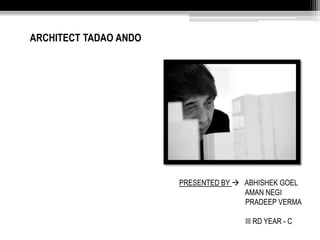
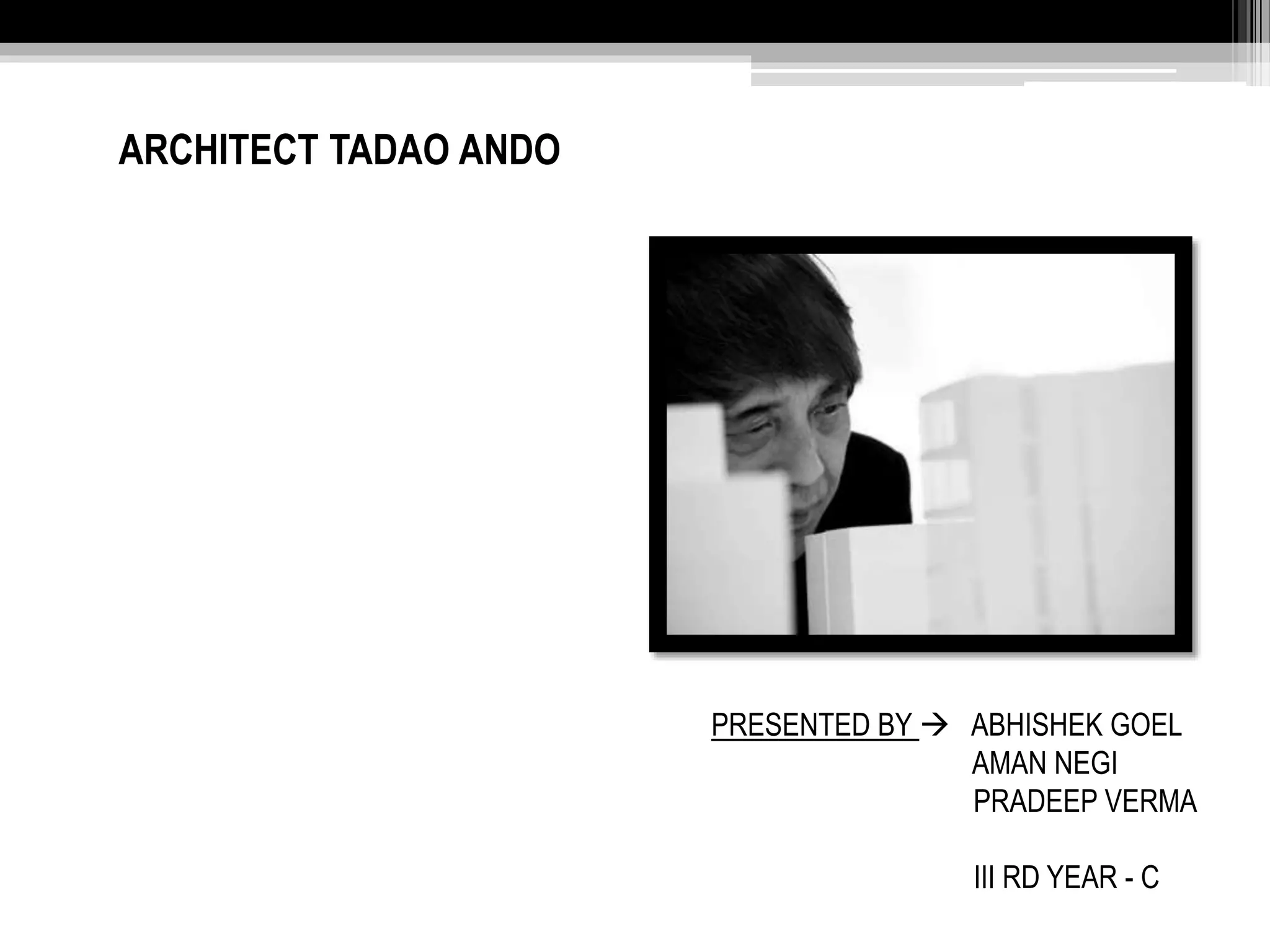
ARCHITECT TADAO ANDO 
PRESENTED BY  ABHISHEK GOEL 
AMAN NEGI 
PRADEEP VERMA 
III RD YEAR - C
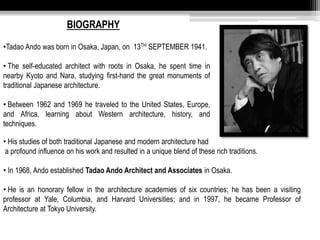
BIOGRAPHY 
•Tadao Ando was born in Osaka, Japan, on 13TH SEPTEMBER 1941. 
• The self-educated architect with roots in Osaka, he spent time in 
nearby Kyoto and Nara, studying first-hand the great monuments of 
traditional Japanese architecture. 
• Between 1962 and 1969 he traveled to the United States, Europe, 
and Africa, learning about Western architecture, history, and 
techniques. 
• His studies of both traditional Japanese and modern architecture had 
a profound influence on his work and resulted in a unique blend of these rich traditions. 
• In 1968, Ando established Tadao Ando Architect and Associates in Osaka. 
• He is an honorary fellow in the architecture academies of six countries; he has been a visiting 
professor at Yale, Columbia, and Harvard Universities; and in 1997, he became Professor of 
Architecture at Tokyo University.
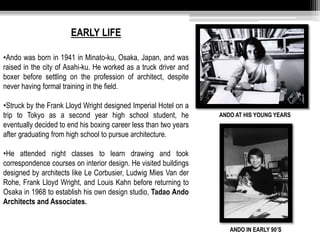
EARLY LIFE 
•Ando was born in 1941 in Minato-ku, Osaka, Japan, and was 
raised in the city of Asahi-ku. He worked as a truck driver and 
boxer before settling on the profession of architect, despite 
never having formal training in the field. 
•Struck by the Frank Lloyd Wright designed Imperial Hotel on a 
trip to Tokyo as a second year high school student, he 
eventually decided to end his boxing career less than two years 
after graduating from high school to pursue architecture. 
•He attended night classes to learn drawing and took 
correspondence courses on interior design. He visited buildings 
designed by architects like Le Corbusier, Ludwig Mies Van der 
Rohe, Frank Lloyd Wright, and Louis Kahn before returning to 
Osaka in 1968 to establish his own design studio, Tadao Ando 
Architects and Associates. 
ANDO AT HIS YOUNG YEARS 
ANDO IN EARLY 90’S
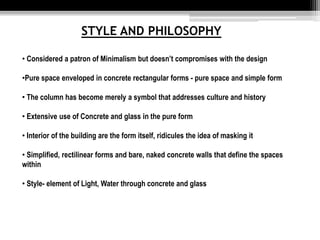
STYLE AND PHILOSOPHY 
• Considered a patron of Minimalism but doesn’t compromises with the design 
•Pure space enveloped in concrete rectangular forms - pure space and simple form 
• The column has become merely a symbol that addresses culture and history 
• Extensive use of Concrete and glass in the pure form 
• Interior of the building are the form itself, ridicules the idea of masking it 
• Simplified, rectilinear forms and bare, naked concrete walls that define the spaces 
within 
• Style- element of Light, Water through concrete and glass
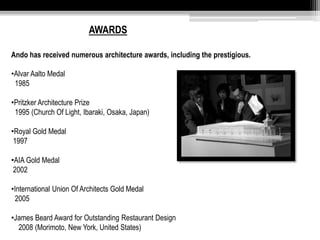
AWARDS 
Ando has received numerous architecture awards, including the prestigious. 
•Alvar Aalto Medal 
1985 
•Pritzker Architecture Prize 
1995 (Church Of Light, Ibaraki, Osaka, Japan) 
•Royal Gold Medal 
1997 
•AIA Gold Medal 
2002 
•International Union Of Architects Gold Medal 
2005 
•James Beard Award for Outstanding Restaurant Design 
2008 (Morimoto, New York, United States)
CHURCH OF 
LIGHT
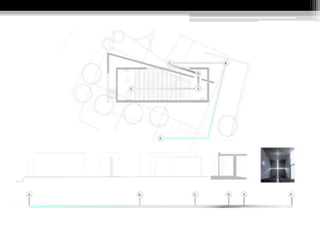
TYPICAL 
PLAN 
OF 
CHURC 
H OF 
LIGHT
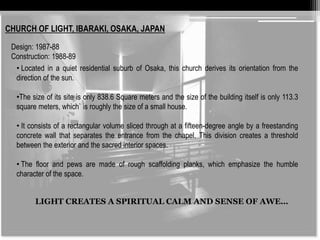
CHURCH OF LIGHT, IBARAKI, OSAKA, JAPAN 
Design: 1987-88 
Construction: 1988-89 
• Located in a quiet residential suburb of Osaka, this church derives its orientation from the 
direction of the sun. 
•The size of its site is only 838.6 Square meters and the size of the building itself is only 113.3 
square meters, which` is roughly the size of a small house. 
• It consists of a rectangular volume sliced through at a fifteen-degree angle by a freestanding 
concrete wall that separates the entrance from the chapel. This division creates a threshold 
between the exterior and the sacred interior spaces. 
• The floor and pews are made of rough scaffolding planks, which emphasize the humble 
character of the space. 
LIGHT CREATES A SPIRITUAL CALM AND SENSE OF AWE…
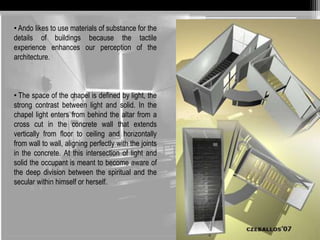
• Ando likes to use materials of substance for the 
details of buildings because the tactile 
experience enhances our perception of the 
architecture. 
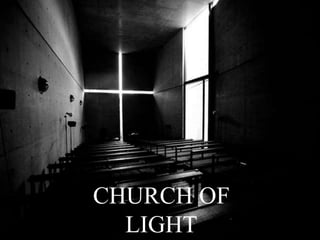
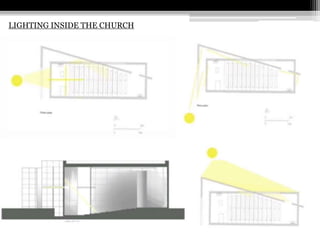
• The space of the chapel is defined by light, the 
strong contrast between light and solid. In the 
chapel light enters from behind the altar from a 
cross cut in the concrete wall that extends 
vertically from floor to ceiling and horizontally 
from wall to wall, aligning perfectly with the joints 
in the concrete. At this intersection of light and 
solid the occupant is meant to become aware of 
the deep division between the spiritual and the 
secular within himself or herself.
LIGHTING INSIDE THE CHURCH
Church of the Light 
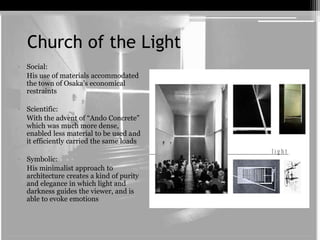
• Social: 
His use of materials accommodated 
the town of Osaka’s economical 
restraints 
• Scientific: 
With the advent of “Ando Concrete” 
which was much more dense, 
enabled less material to be used and 
it efficiently carried the same loads 
• Symbolic: 
His minimalist approach to 
architecture creates a kind of purity 
and elegance in which light and 
darkness guides the viewer, and is 
able to evoke emotions
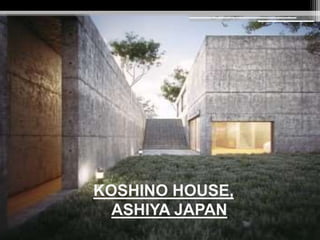
KOSHINO HOUSE, 
ASHIYA JAPAN
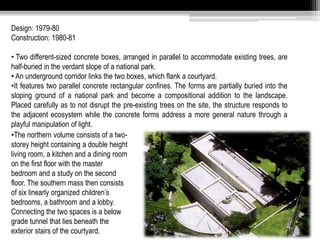
Design: 1979-80 
Construction: 1980-81 
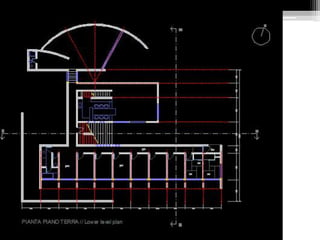
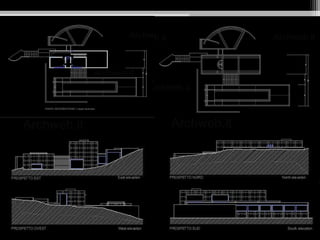
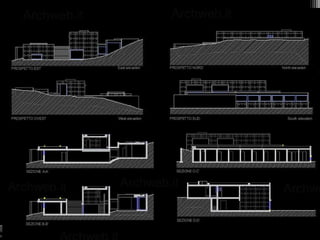
• Two different-sized concrete boxes, arranged in parallel to accommodate existing trees, are 
half-buried in the verdant slope of a national park. 
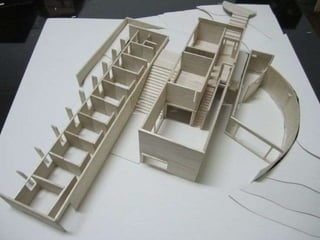
• An underground corridor links the two boxes, which flank a courtyard. 
•It features two parallel concrete rectangular confines. The forms are partially buried into the 
sloping ground of a national park and become a compositional addition to the landscape. 
Placed carefully as to not disrupt the pre-existing trees on the site, the structure responds to 
the adjacent ecosystem while the concrete forms address a more general nature through a 
playful manipulation of light. 
•The northern volume consists of a two-storey 
height containing a double height 
living room, a kitchen and a dining room 
on the first floor with the master 
bedroom and a study on the second 
floor. The southern mass then consists 
of six linearly organized children’s 
bedrooms, a bathroom and a lobby. 
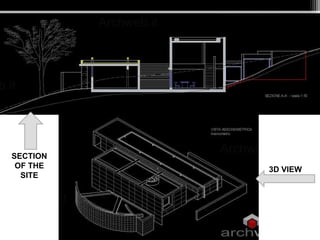
Connecting the two spaces is a below 
grade tunnel that lies beneath the 
exterior stairs of the courtyard.
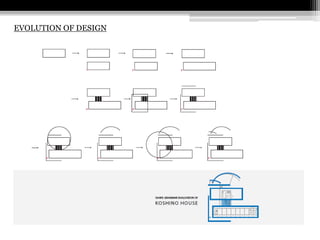
EVOLUTION OF DESIGN
SECTION 
OF THE 
SITE 
3D VIEW
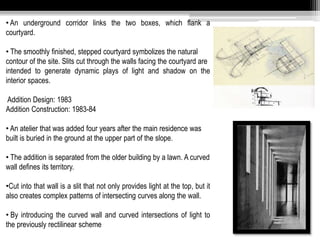
• An underground corridor links the two boxes, which flank a 
courtyard. 
• The smoothly finished, stepped courtyard symbolizes the natural 
contour of the site. Slits cut through the walls facing the courtyard are 
intended to generate dynamic plays of light and shadow on the 
interior spaces. 
Addition Design: 1983 
Addition Construction: 1983-84 
• An atelier that was added four years after the main residence was 
built is buried in the ground at the upper part of the slope. 
• The addition is separated from the older building by a lawn. A curved 
wall defines its territory. 
•Cut into that wall is a slit that not only provides light at the top, but it 
also creates complex patterns of intersecting curves along the wall. 
• By introducing the curved wall and curved intersections of light to 
the previously rectilinear scheme
2) NAOSHIMA CONTEMPORARY ART MUSEUM, NAOSHIMA, JAPAN 
Design: 1988-90 
Construction: 1990-92 
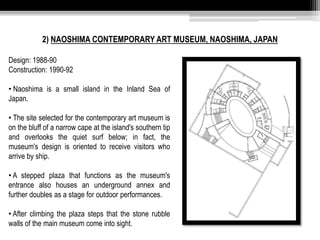
• Naoshima is a small island in the Inland Sea of 
Japan. 
• The site selected for the contemporary art museum is 
on the bluff of a narrow cape at the island's southern tip 
and overlooks the quiet surf below; in fact, the 
museum's design is oriented to receive visitors who 
arrive by ship. 
• A stepped plaza that functions as the museum's 
entrance also houses an underground annex and 
further doubles as a stage for outdoor performances. 
• After climbing the plaza steps that the stone rubble 
walls of the main museum come into sight.
• After the slope and the main building's entrance, the 
large underground art gallery, which is two levels high 
comes. 
• A hotel building, gallery, and stepped terrace all open 
towards the ocean, whose tranquil presence is drawn 
into the interior spaces. 
• Like outdoor sculpture in a museum compound, this 
architecture functions as an earthwork to produce a 
new landscape amid the vastness of nature. 
THE ANNEX  
Design: 1993-94 
Construction: 1994-95 
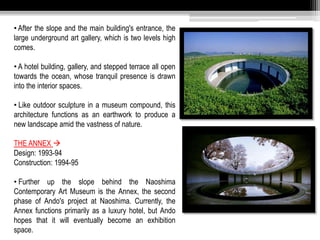
• Further up the slope behind the Naoshima 
Contemporary Art Museum is the Annex, the second 
phase of Ando's project at Naoshima. Currently, the 
Annex functions primarily as a luxury hotel, but Ando 
hopes that it will eventually become an exhibition 
space.
• Like the main complex, the Annex is partially buried into the hillside and integrated within the 
surrounding landscape. It can be reached by a cable car or by "processional" walking paths which 
enable the visitor to sustain a strong connection to the abundant nature and spectacular scenery. 
• The Annex is an elliptical building, framed by rectilinear outer walls made of the same stones that were 
used on the earlier buildings. 
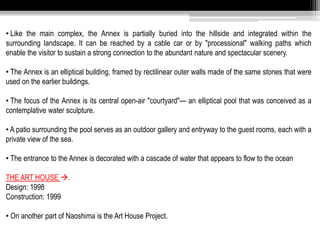
• The focus of the Annex is its central open-air "courtyard"— an elliptical pool that was conceived as a 
contemplative water sculpture. 
• A patio surrounding the pool serves as an outdoor gallery and entryway to the guest rooms, each with a 
private view of the sea. 
• The entrance to the Annex is decorated with a cascade of water that appears to flow to the ocean 
THE ART HOUSE . 
Design: 1998 
Construction: 1999 
• On another part of Naoshima is the Art House Project.
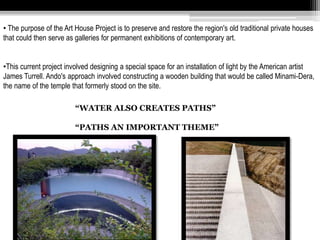
• The purpose of the Art House Project is to preserve and restore the region's old traditional private houses 
that could then serve as galleries for permanent exhibitions of contemporary art. 
•This current project involved designing a special space for an installation of light by the American artist 
James Turrell. Ando's approach involved constructing a wooden building that would be called Minami-Dera, 
the name of the temple that formerly stood on the site. 
“WATER ALSO CREATES PATHS” 
“PATHS AN IMPORTANT THEME”
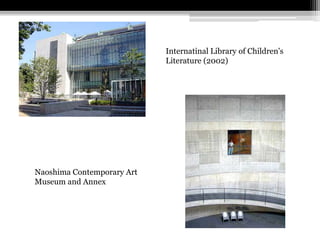
Internatinal Library of Children's 
Literature (2002) 
Naoshima Contemporary Art 
Museum and Annex
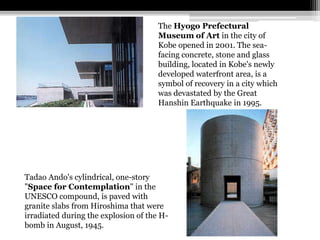
The Hyogo Prefectural 
Museum of Art in the city of 
Kobe opened in 2001. The sea-facing 
concrete, stone and glass 
building, located in Kobe's newly 
developed waterfront area, is a 
symbol of recovery in a city which 
was devastated by the Great 
Hanshin Earthquake in 1995. 
Tadao Ando's cylindrical, one-story 
"Space for Contemplation" in the 
UNESCO compound, is paved with 
granite slabs from Hiroshima that were 
irradiated during the explosion of the H-bomb 
in August, 1945.
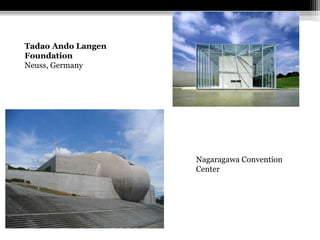
Tadao Ando Langen 
Foundation 
Neuss, Germany 
Nagaragawa Convention 
Center
“What I have sought to achieve is a spatiality that 
stimulates the human spirit, awakens the 
sensitivity and communicates with the deeper 
soul.” – Tadao Ando 
THANK YOU 
(^_-)

Tada ando

  • 1.
    ARCHITECT TADAO ANDO PRESENTED BY  ABHISHEK GOEL AMAN NEGI PRADEEP VERMA III RD YEAR - C
  • 2.
    BIOGRAPHY •Tadao Andowas born in Osaka, Japan, on 13TH SEPTEMBER 1941. • The self-educated architect with roots in Osaka, he spent time in nearby Kyoto and Nara, studying first-hand the great monuments of traditional Japanese architecture. • Between 1962 and 1969 he traveled to the United States, Europe, and Africa, learning about Western architecture, history, and techniques. • His studies of both traditional Japanese and modern architecture had a profound influence on his work and resulted in a unique blend of these rich traditions. • In 1968, Ando established Tadao Ando Architect and Associates in Osaka. • He is an honorary fellow in the architecture academies of six countries; he has been a visiting professor at Yale, Columbia, and Harvard Universities; and in 1997, he became Professor of Architecture at Tokyo University.
  • 3.
    EARLY LIFE •Andowas born in 1941 in Minato-ku, Osaka, Japan, and was raised in the city of Asahi-ku. He worked as a truck driver and boxer before settling on the profession of architect, despite never having formal training in the field. •Struck by the Frank Lloyd Wright designed Imperial Hotel on a trip to Tokyo as a second year high school student, he eventually decided to end his boxing career less than two years after graduating from high school to pursue architecture. •He attended night classes to learn drawing and took correspondence courses on interior design. He visited buildings designed by architects like Le Corbusier, Ludwig Mies Van der Rohe, Frank Lloyd Wright, and Louis Kahn before returning to Osaka in 1968 to establish his own design studio, Tadao Ando Architects and Associates. ANDO AT HIS YOUNG YEARS ANDO IN EARLY 90’S
  • 4.
    STYLE AND PHILOSOPHY • Considered a patron of Minimalism but doesn’t compromises with the design •Pure space enveloped in concrete rectangular forms - pure space and simple form • The column has become merely a symbol that addresses culture and history • Extensive use of Concrete and glass in the pure form • Interior of the building are the form itself, ridicules the idea of masking it • Simplified, rectilinear forms and bare, naked concrete walls that define the spaces within • Style- element of Light, Water through concrete and glass
  • 5.
    AWARDS Ando hasreceived numerous architecture awards, including the prestigious. •Alvar Aalto Medal 1985 •Pritzker Architecture Prize 1995 (Church Of Light, Ibaraki, Osaka, Japan) •Royal Gold Medal 1997 •AIA Gold Medal 2002 •International Union Of Architects Gold Medal 2005 •James Beard Award for Outstanding Restaurant Design 2008 (Morimoto, New York, United States)
  • 6.
  • 7.
    TYPICAL PLAN OF CHURC H OF LIGHT
  • 8.
    CHURCH OF LIGHT,IBARAKI, OSAKA, JAPAN Design: 1987-88 Construction: 1988-89 • Located in a quiet residential suburb of Osaka, this church derives its orientation from the direction of the sun. •The size of its site is only 838.6 Square meters and the size of the building itself is only 113.3 square meters, which` is roughly the size of a small house. • It consists of a rectangular volume sliced through at a fifteen-degree angle by a freestanding concrete wall that separates the entrance from the chapel. This division creates a threshold between the exterior and the sacred interior spaces. • The floor and pews are made of rough scaffolding planks, which emphasize the humble character of the space. LIGHT CREATES A SPIRITUAL CALM AND SENSE OF AWE…
  • 9.
    • Ando likesto use materials of substance for the details of buildings because the tactile experience enhances our perception of the architecture. • The space of the chapel is defined by light, the strong contrast between light and solid. In the chapel light enters from behind the altar from a cross cut in the concrete wall that extends vertically from floor to ceiling and horizontally from wall to wall, aligning perfectly with the joints in the concrete. At this intersection of light and solid the occupant is meant to become aware of the deep division between the spiritual and the secular within himself or herself.
  • 10.
  • 12.
    Church of theLight • Social: His use of materials accommodated the town of Osaka’s economical restraints • Scientific: With the advent of “Ando Concrete” which was much more dense, enabled less material to be used and it efficiently carried the same loads • Symbolic: His minimalist approach to architecture creates a kind of purity and elegance in which light and darkness guides the viewer, and is able to evoke emotions
  • 13.
  • 14.
    Design: 1979-80 Construction:1980-81 • Two different-sized concrete boxes, arranged in parallel to accommodate existing trees, are half-buried in the verdant slope of a national park. • An underground corridor links the two boxes, which flank a courtyard. •It features two parallel concrete rectangular confines. The forms are partially buried into the sloping ground of a national park and become a compositional addition to the landscape. Placed carefully as to not disrupt the pre-existing trees on the site, the structure responds to the adjacent ecosystem while the concrete forms address a more general nature through a playful manipulation of light. •The northern volume consists of a two-storey height containing a double height living room, a kitchen and a dining room on the first floor with the master bedroom and a study on the second floor. The southern mass then consists of six linearly organized children’s bedrooms, a bathroom and a lobby. Connecting the two spaces is a below grade tunnel that lies beneath the exterior stairs of the courtyard.
  • 16.
  • 20.
    SECTION OF THE SITE 3D VIEW
  • 21.
    • An undergroundcorridor links the two boxes, which flank a courtyard. • The smoothly finished, stepped courtyard symbolizes the natural contour of the site. Slits cut through the walls facing the courtyard are intended to generate dynamic plays of light and shadow on the interior spaces. Addition Design: 1983 Addition Construction: 1983-84 • An atelier that was added four years after the main residence was built is buried in the ground at the upper part of the slope. • The addition is separated from the older building by a lawn. A curved wall defines its territory. •Cut into that wall is a slit that not only provides light at the top, but it also creates complex patterns of intersecting curves along the wall. • By introducing the curved wall and curved intersections of light to the previously rectilinear scheme
  • 23.
    2) NAOSHIMA CONTEMPORARYART MUSEUM, NAOSHIMA, JAPAN Design: 1988-90 Construction: 1990-92 • Naoshima is a small island in the Inland Sea of Japan. • The site selected for the contemporary art museum is on the bluff of a narrow cape at the island's southern tip and overlooks the quiet surf below; in fact, the museum's design is oriented to receive visitors who arrive by ship. • A stepped plaza that functions as the museum's entrance also houses an underground annex and further doubles as a stage for outdoor performances. • After climbing the plaza steps that the stone rubble walls of the main museum come into sight.
  • 24.
    • After theslope and the main building's entrance, the large underground art gallery, which is two levels high comes. • A hotel building, gallery, and stepped terrace all open towards the ocean, whose tranquil presence is drawn into the interior spaces. • Like outdoor sculpture in a museum compound, this architecture functions as an earthwork to produce a new landscape amid the vastness of nature. THE ANNEX  Design: 1993-94 Construction: 1994-95 • Further up the slope behind the Naoshima Contemporary Art Museum is the Annex, the second phase of Ando's project at Naoshima. Currently, the Annex functions primarily as a luxury hotel, but Ando hopes that it will eventually become an exhibition space.
  • 25.
    • Like themain complex, the Annex is partially buried into the hillside and integrated within the surrounding landscape. It can be reached by a cable car or by "processional" walking paths which enable the visitor to sustain a strong connection to the abundant nature and spectacular scenery. • The Annex is an elliptical building, framed by rectilinear outer walls made of the same stones that were used on the earlier buildings. • The focus of the Annex is its central open-air "courtyard"— an elliptical pool that was conceived as a contemplative water sculpture. • A patio surrounding the pool serves as an outdoor gallery and entryway to the guest rooms, each with a private view of the sea. • The entrance to the Annex is decorated with a cascade of water that appears to flow to the ocean THE ART HOUSE . Design: 1998 Construction: 1999 • On another part of Naoshima is the Art House Project.
  • 26.
    • The purposeof the Art House Project is to preserve and restore the region's old traditional private houses that could then serve as galleries for permanent exhibitions of contemporary art. •This current project involved designing a special space for an installation of light by the American artist James Turrell. Ando's approach involved constructing a wooden building that would be called Minami-Dera, the name of the temple that formerly stood on the site. “WATER ALSO CREATES PATHS” “PATHS AN IMPORTANT THEME”
  • 27.
    Internatinal Library ofChildren's Literature (2002) Naoshima Contemporary Art Museum and Annex
  • 28.
    The Hyogo Prefectural Museum of Art in the city of Kobe opened in 2001. The sea-facing concrete, stone and glass building, located in Kobe's newly developed waterfront area, is a symbol of recovery in a city which was devastated by the Great Hanshin Earthquake in 1995. Tadao Ando's cylindrical, one-story "Space for Contemplation" in the UNESCO compound, is paved with granite slabs from Hiroshima that were irradiated during the explosion of the H-bomb in August, 1945.
  • 29.
    Tadao Ando Langen Foundation Neuss, Germany Nagaragawa Convention Center
  • 30.
    “What I havesought to achieve is a spatiality that stimulates the human spirit, awakens the sensitivity and communicates with the deeper soul.” – Tadao Ando THANK YOU (^_-)