PET (B1)
GRAMMAR REVIEW
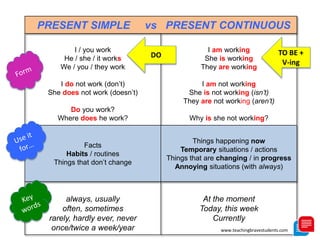
PRESENT SIMPLE vs PRESENT CONTINUOUS
I / you work
He / she / it works
We / you / they work
I do not work (don’t)
She does not work (doesn’t)
Do you work?
Where does he work?
I am working
She is working
They are working
I am not working
She is not working (isn’t)
They are not working (aren’t)
Why is she not working?
Facts
Habits / routines
Things that don’t change
Things happening now
Temporary situations / actions
Things that are changing / in progress
Annoying situations (with always)
always, usually
often, sometimes
rarely, hardly ever, never
once/twice a week/year
At the moment
Today, this week
Currently
www.teachingbravestudents.com
DO TO BE +
V-ing
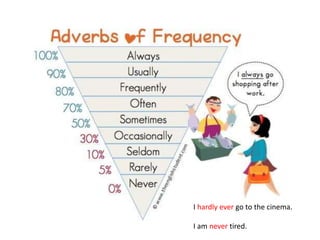
I hardly ever go to the cinema.
I am never tired.
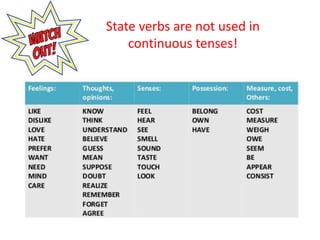
State verbs are not used in
continuous tenses!
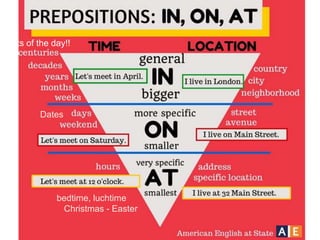
PREPOSITIONS OF TIME AND PLACE
bedtime, luchtime
Christmas - Easter
Dates
Parts of the day!!
6
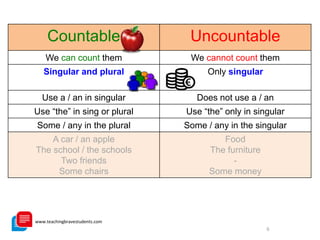
Countable Uncountable
We can count them We cannot count them
Singular and plural Only singular
Use a / an in singular Does not use a / an
Use “the” in sing or plural Use “the” only in singular
Some / any in the plural Some / any in the singular
A car / an apple
The school / the schools
Two friends
Some chairs
Food
The furniture
-
Some money
www.teachingbravestudents.com
7
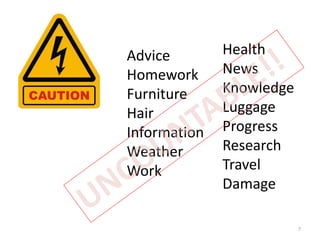
Advice
Homework
Furniture
Hair
Information
Weather
Work
Health
News
Knowledge
Luggage
Progress
Research
Travel
Damage
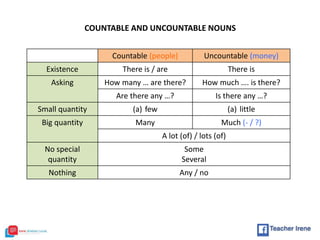
Countable (people) Uncountable (money)
Existence There is / are There is
Asking How many … are there? How much …. is there?
Are there any …? Is there any …?
Small quantity (a) few (a) little
Big quantity Many Much (- / ?)
A lot (of) / lots (of)
No special
quantity
Some
Several
Nothing Any / no
COUNTABLE AND UNCOUNTABLE NOUNS
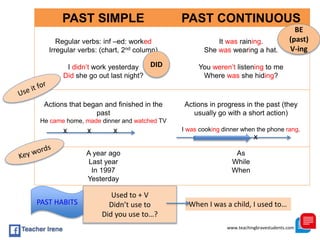
PAST SIMPLE PAST CONTINUOUS
Regular verbs: inf –ed: worked
Irregular verbs: (chart, 2nd column)
I didn’t work yesterday
Did she go out last night?
It was raining.
She was wearing a hat.
You weren’t listening to me
Where was she hiding?
Actions that began and finished in the
past
He came home, made dinner and watched TV
Actions in progress in the past (they
usually go with a short action)
I was cooking dinner when the phone rang.
A year ago
Last year
In 1997
Yesterday
As
While
When
Used to + V
Didn’t use to
Did you use to…?
When I was a child, I used to…
www.teachingbravestudents.com
x x x
x
DID
BE
(past)
V-ing
PAST HABITS
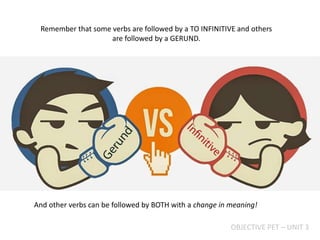
Remember that some verbs are followed by a TO INFINITIVE and others
are followed by a GERUND.
OBJECTIVE PET – UNIT 3
And other verbs can be followed by BOTH with a change in meaning!
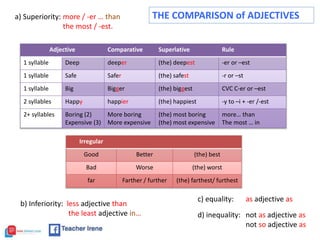
Adjective Comparative Superlative Rule
1 syllable Deep deeper (the) deepest -er or –est
1 syllable Safe Safer (the) safest -r or –st
1 syllable Big Bigger (the) biggest CVC C-er or –est
2 syllables Happy happier (the) happiest -y to –i + -er /-est
2+ syllables Boring (2)
Expensive (3)
More boring
More expensive
(the) most boring
(the) most expensive
more… than
The most … in
Irregular
Good Better (the) best
Bad Worse (the) worst
far Farther / further (the) farthest/ furthest
a) Superiority: more / -er … than
the most / -est.
b) Inferiority: less adjective than
the least adjective in…
c) equality: as adjective as
d) inequality: not as adjective as
not so adjective as
THE COMPARISON of ADJECTIVES
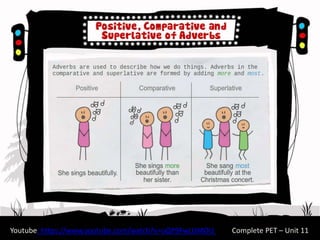
Complete PET – Unit 11Youtube: https://www.youtube.com/watch?v=uQP9FwLUMOU
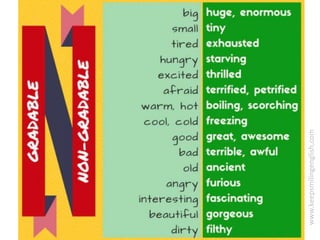
www.keepsmilingenglish,com
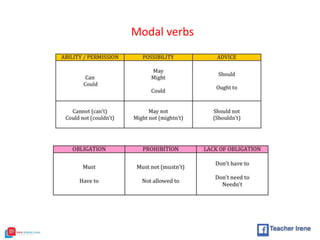
Modal verbs
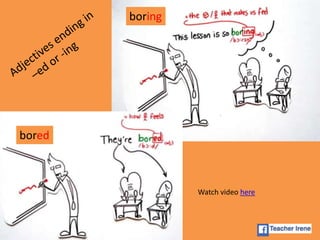
boring
bored
Watch video here
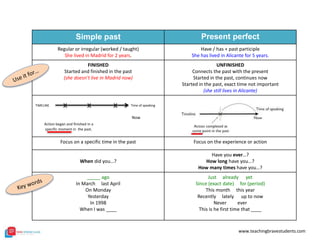
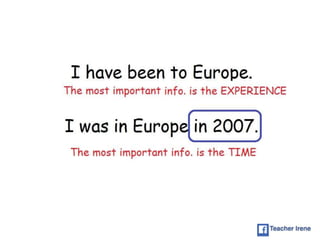
Simple past Present perfect
Regular or irregular (worked / taught)
She lived in Madrid for 2 years.
Have / has + past participle
She has lived in Alicante for 5 years.
FINISHED
Started and finished in the past
(she doesn’t live in Madrid now)
UNFINISHED
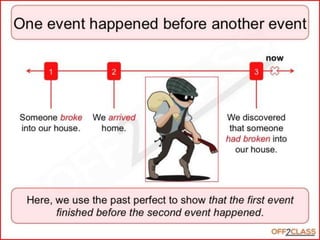
Connects the past with the present
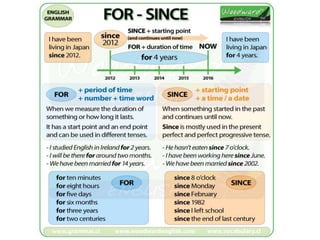
Started in the past, continues now
Started in the past, exact time not important
(she still lives in Alicante)
TIMELINE Time of speaking
Now
Action began and finished in a
specific moment in the past.
Focus on a specific time in the past Focus on the experience or action
When did you…?
Have you ever…?
How long have you…?
How many times have you…?
_____ ago
In March last April
On Monday
Yesterday
In 1998
When I was ____
Just already yet
Since (exact date) for (period)
This month this year
Recently lately up to now
Never ever
This is he first time that ____
www.teachingbravestudents.com
x x x
DEFINING NON DEFINING
Information Essential Non important
Pronouns All Except “that”
Commas ✖ ✔
Pronoun: always? object: not needed ✔
Defining:
The girl is my friend. She is sitting next to me. The girl who / that is sitting next to me is my friend.
The letter is sad. He sent it to me yesterday. The letter which / that /  he sent me yesterday is sad.
The gentleman is rich. His car is a Jaguar The gentleman whose car is a Jaguar is rich.
Non-defining:
The blond girl is my friend. She is sitting next to me. The blond girl, who is sitting next to me, is my friend.
His letter is sad. He sent it to me yesterday. His letter, which he sent me yesterday, is sad.
That old gentleman is rich. His car is a Jaguar. That old gentleman, whose car is a Jaguar, is rich.
Relative clauses
Have something done
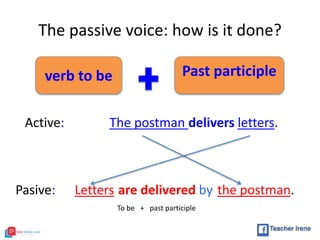
The passive voice: how is it done?
verb to be
28
Past participle
Active: The postman delivers letters.
Pasive: Letters the postman.are delivered by
To be + past participle
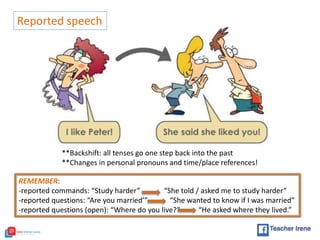
Reported speech
**Backshift: all tenses go one step back into the past
**Changes in personal pronouns and time/place references!
REMEMBER:
-reported commands: “Study harder” “She told / asked me to study harder”
-reported questions: “Are you married’” “She wanted to know if I was married”
-reported questions (open): “Where do you live?” “He asked where they lived.”
Adjective
Adjective
Are you...?
www.teachingbravestudents.com

Pet grammar review students

  • 1.
  • 2.
    PRESENT SIMPLE vsPRESENT CONTINUOUS I / you work He / she / it works We / you / they work I do not work (don’t) She does not work (doesn’t) Do you work? Where does he work? I am working She is working They are working I am not working She is not working (isn’t) They are not working (aren’t) Why is she not working? Facts Habits / routines Things that don’t change Things happening now Temporary situations / actions Things that are changing / in progress Annoying situations (with always) always, usually often, sometimes rarely, hardly ever, never once/twice a week/year At the moment Today, this week Currently www.teachingbravestudents.com DO TO BE + V-ing
  • 3.
    I hardly evergo to the cinema. I am never tired.
  • 4.
    State verbs arenot used in continuous tenses!
  • 5.
    PREPOSITIONS OF TIMEAND PLACE bedtime, luchtime Christmas - Easter Dates Parts of the day!!
  • 6.
    6 Countable Uncountable We cancount them We cannot count them Singular and plural Only singular Use a / an in singular Does not use a / an Use “the” in sing or plural Use “the” only in singular Some / any in the plural Some / any in the singular A car / an apple The school / the schools Two friends Some chairs Food The furniture - Some money www.teachingbravestudents.com
  • 7.
  • 8.
    Countable (people) Uncountable(money) Existence There is / are There is Asking How many … are there? How much …. is there? Are there any …? Is there any …? Small quantity (a) few (a) little Big quantity Many Much (- / ?) A lot (of) / lots (of) No special quantity Some Several Nothing Any / no COUNTABLE AND UNCOUNTABLE NOUNS
  • 9.
    PAST SIMPLE PASTCONTINUOUS Regular verbs: inf –ed: worked Irregular verbs: (chart, 2nd column) I didn’t work yesterday Did she go out last night? It was raining. She was wearing a hat. You weren’t listening to me Where was she hiding? Actions that began and finished in the past He came home, made dinner and watched TV Actions in progress in the past (they usually go with a short action) I was cooking dinner when the phone rang. A year ago Last year In 1997 Yesterday As While When Used to + V Didn’t use to Did you use to…? When I was a child, I used to… www.teachingbravestudents.com x x x x DID BE (past) V-ing PAST HABITS
  • 10.
    Remember that someverbs are followed by a TO INFINITIVE and others are followed by a GERUND. OBJECTIVE PET – UNIT 3 And other verbs can be followed by BOTH with a change in meaning!
  • 11.
    Adjective Comparative SuperlativeRule 1 syllable Deep deeper (the) deepest -er or –est 1 syllable Safe Safer (the) safest -r or –st 1 syllable Big Bigger (the) biggest CVC C-er or –est 2 syllables Happy happier (the) happiest -y to –i + -er /-est 2+ syllables Boring (2) Expensive (3) More boring More expensive (the) most boring (the) most expensive more… than The most … in Irregular Good Better (the) best Bad Worse (the) worst far Farther / further (the) farthest/ furthest a) Superiority: more / -er … than the most / -est. b) Inferiority: less adjective than the least adjective in… c) equality: as adjective as d) inequality: not as adjective as not so adjective as THE COMPARISON of ADJECTIVES
  • 12.
    Complete PET –Unit 11Youtube: https://www.youtube.com/watch?v=uQP9FwLUMOU
  • 13.
  • 14.
  • 15.
  • 16.
    Simple past Presentperfect Regular or irregular (worked / taught) She lived in Madrid for 2 years. Have / has + past participle She has lived in Alicante for 5 years. FINISHED Started and finished in the past (she doesn’t live in Madrid now) UNFINISHED Connects the past with the present Started in the past, continues now Started in the past, exact time not important (she still lives in Alicante) TIMELINE Time of speaking Now Action began and finished in a specific moment in the past. Focus on a specific time in the past Focus on the experience or action When did you…? Have you ever…? How long have you…? How many times have you…? _____ ago In March last April On Monday Yesterday In 1998 When I was ____ Just already yet Since (exact date) for (period) This month this year Recently lately up to now Never ever This is he first time that ____ www.teachingbravestudents.com x x x
  • 25.
    DEFINING NON DEFINING InformationEssential Non important Pronouns All Except “that” Commas ✖ ✔ Pronoun: always? object: not needed ✔ Defining: The girl is my friend. She is sitting next to me. The girl who / that is sitting next to me is my friend. The letter is sad. He sent it to me yesterday. The letter which / that /  he sent me yesterday is sad. The gentleman is rich. His car is a Jaguar The gentleman whose car is a Jaguar is rich. Non-defining: The blond girl is my friend. She is sitting next to me. The blond girl, who is sitting next to me, is my friend. His letter is sad. He sent it to me yesterday. His letter, which he sent me yesterday, is sad. That old gentleman is rich. His car is a Jaguar. That old gentleman, whose car is a Jaguar, is rich. Relative clauses
  • 26.
  • 28.
    The passive voice:how is it done? verb to be 28 Past participle Active: The postman delivers letters. Pasive: Letters the postman.are delivered by To be + past participle
  • 29.
    Reported speech **Backshift: alltenses go one step back into the past **Changes in personal pronouns and time/place references! REMEMBER: -reported commands: “Study harder” “She told / asked me to study harder” -reported questions: “Are you married’” “She wanted to know if I was married” -reported questions (open): “Where do you live?” “He asked where they lived.”
  • 31.
  • 32.
  • 33.