Lesson 1
Batxillerat 2018-19
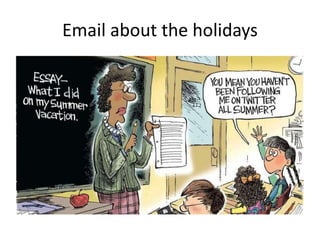
Email about the holidays
Talk to the person next to you
• Tell him/her about:
– Something fun you did last year
– Something great you have done this summer
– Something you are doing this year
– Something you plan to achieve
– What do you think 1st Batxillerat will be like
– What will you be doing in 10 years time
– What will you have achieved when you turn 30
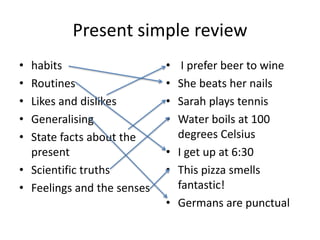
Present simple review
• habits
• Routines
• Likes and dislikes
• Generalising
• State facts about the
present
• Scientific truths
• Feelings and the senses
• I prefer beer to wine
• She beats her nails
• Sarah plays tennis
• Water boils at 100
degrees Celsius
• I get up at 6:30
• This pizza smells
fantastic!
• Germans are punctual
Present continuous review
• Visualizing
• Look up at the sky. What colour is it? Can you see any
clouds? Look down and you start to see trees and
buildings. What kind of trees can you see? What kind of
buildings? Are there a lot of buildings or a few? Are they
old or new? In front of one of the buildings, you see
people. Do you recognise them? They are doing
something. What are they doing? You look left and see a
tree. In front of the tree you see an animal. What kind of
animal is it? What is the animal doing? You look right and
you see someone near you. It’s a friend of yours. Who is
it? What’s their name? They are doing something. What
are they doing?
My Dream
• “In my dream I am standing ……… In front of
me I can see ……”
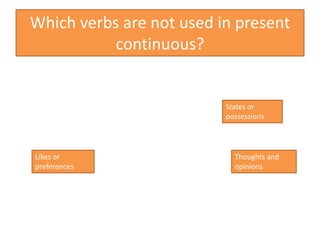
Which verbs are not used in present
continuous?
Likes or
preferences
Thoughts and
opinions
States or
possessions
LEARNING ABOUT THE PRESENT
PERFECT
Present Perfect
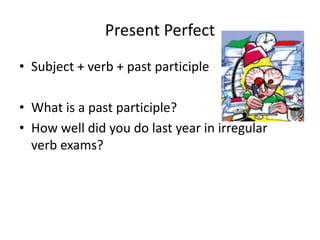
• Subject + verb + past participle
• What is a past participle?
• How well did you do last year in irregular
verb exams?
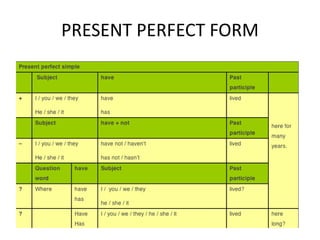
PRESENT PERFECT FORM
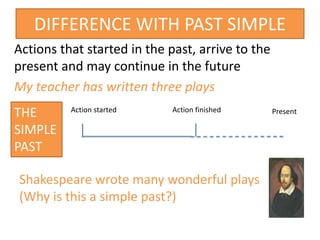
DIFFERENCE WITH PAST SIMPLE
Actions that started in the past, arrive to the
present and may continue in the future
My teacher has written three plays
Action started Action finished Present
Shakespeare wrote many wonderful plays
(Why is this a simple past?)
THE
SIMPLE
PAST
ACTIONS COMPLETED WITH NO
REFERENCE TO TIME
Use 1 of Present Perfect
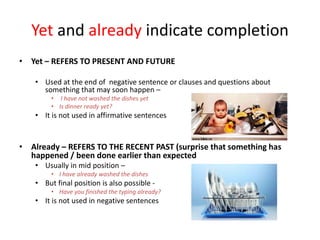
Yet and already indicate completion
• Yet – REFERS TO PRESENT AND FUTURE
• Used at the end of negative sentence or clauses and questions about
something that may soon happen –
• I have not washed the dishes yet
• Is dinner ready yet?
• It is not used in affirmative sentences
• Already – REFERS TO THE RECENT PAST (surprise that something has
happened / been done earlier than expected
• Usually in mid position –
• I have already washed the dishes
• But final position is also possible -
• Have you finished the typing already?
• It is not used in negative sentences
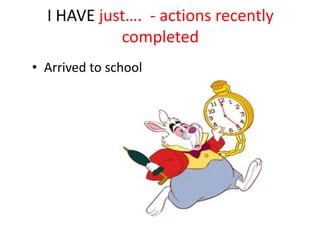
I HAVE just…. - actions recently
completed
• Arrived to school
UNCOMPLETED ACTIONS (WHICH
OFTEN REFER TO EXPERIENCE)
Use 2 of Present Perfect
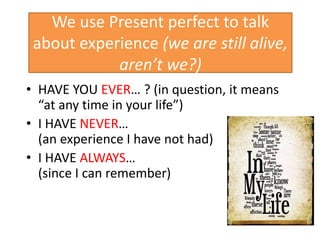
We use Present perfect to talk
about experience (we are still alive,
aren’t we?)
• HAVE YOU EVER… ? (in question, it means
“at any time in your life”)
• I HAVE NEVER…
(an experience I have not had)
• I HAVE ALWAYS…
(since I can remember)
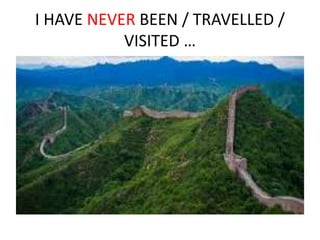
I HAVE NEVER BEEN / TRAVELLED /
VISITED …
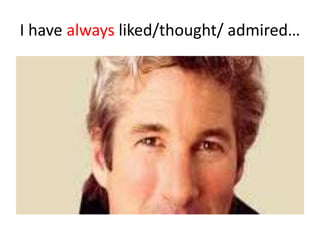
I have always liked/thought/ admired…
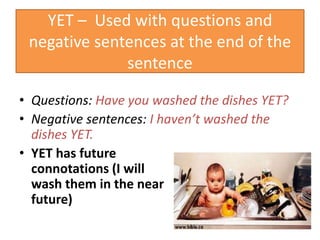
YET – Used with questions and
negative sentences at the end of the
sentence
• Questions: Have you washed the dishes YET?
• Negative sentences: I haven’t washed the
dishes YET.
• YET has future
connotations (I will
wash them in the near
future)
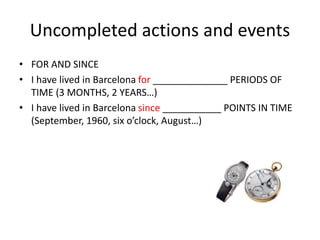
Uncompleted actions and events
• FOR AND SINCE
• I have lived in Barcelona for ______________ PERIODS OF
TIME (3 MONTHS, 2 YEARS…)
• I have lived in Barcelona since ___________ POINTS IN TIME
(September, 1960, six o’clock, August…)
SUMMARY ON USES OF THE
PRESENT PERFECT
• Actions completed (with no reference to time)
• TIME SPAN IS STILL PRESENT (ALTHOUGH THE ACTION IS PAST)
» ALREADY (Usually used in affirmative sentences. To talk
about something that has happened earlier than expected.)
» YET (Usually used in negative sentences to talk about
something that has not happened but will probably happen
soon)
• TIME SPAN IS ALREADY PAST
» JUST (a short time before)
• Actions Uncompleted actions that started in the past and reach the present
(including personal experience)
» For + periods of time
• I have lived in Hospitalet since the 1980ss
» Since + point in time
• I have lived in Hospitalet since I was a child
Spelling tips
• Lie  Lying
• Want ____ break freeto
DESCRIBING PEOPLE AND
RELATIONSHIPS
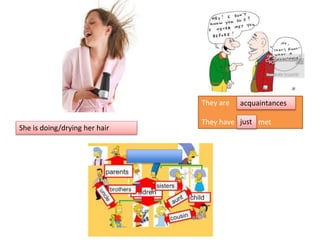
They are
They have _____ met
acquaintances
She is doing/drying her hair
just
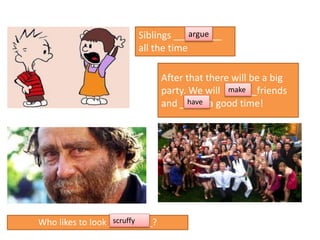
After that there will be a big
party. We will ______friends
and ____ a good time!
Who likes to look _________?
Siblings _________
all the time
argue
scruffy
have
make
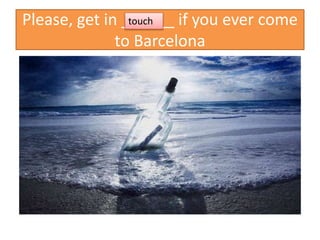
Please, get in ______ if you ever come
to Barcelona
touch
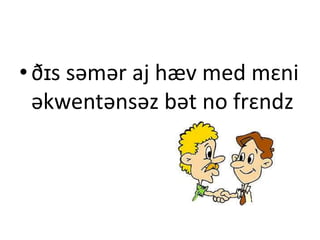
•ðɪs səmər aj hæv med mɛni
əkwentənsəz bət no frɛndz
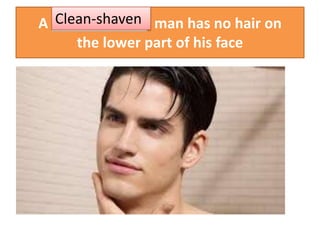
A ____________ man has no hair on
the lower part of his face
Clean-shaven
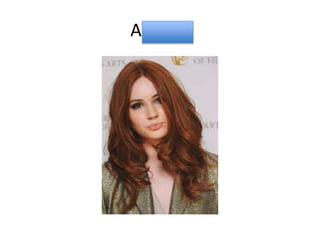
Auburn
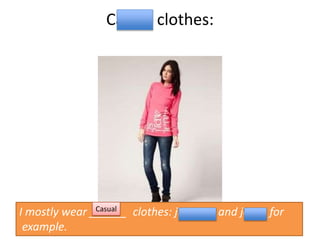
Casual clothes:
I mostly wear ______ clothes: jumpers and jeans for
example.
Casual
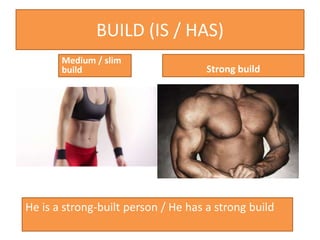
BUILD (IS / HAS)
Medium / slim
build Strong build
He is a strong-built person / He has a strong build
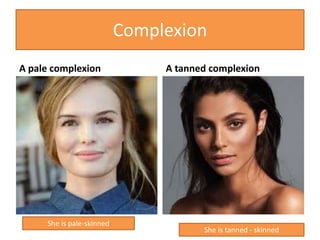
Complexion
A pale complexion A tanned complexion
She is pale-skinned
She is tanned - skinned
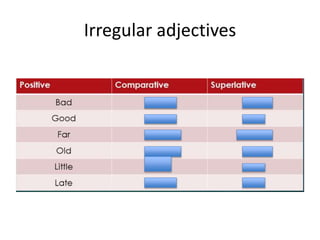
Irregular adjectives
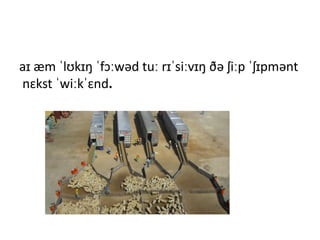
aɪ æm ˈlʊkɪŋ ˈfɔːwəd tuː rɪˈsiːvɪŋ ðə ʃiːp ˈʃɪpmənt
nɛkst ˈwiːkˈɛnd.
READING COMPREHENSION PAGE 6
Reading for gist
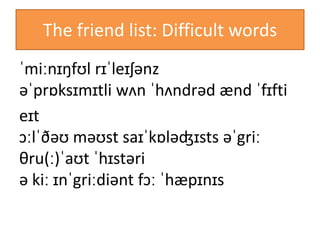
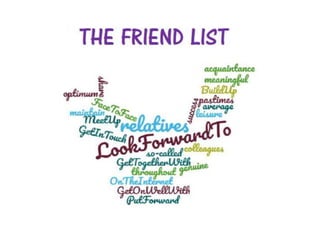
The friend list: Difficult words
ˈmiːnɪŋfʊl rɪˈleɪʃənz
əˈprɒksɪmɪtli wʌn ˈhʌndrəd ænd ˈfɪfti
eɪt
ɔːlˈðəʊ məʊst saɪˈkɒləʤɪsts əˈgriː
θru(ː)ˈaʊt ˈhɪstəri
ə kiː ɪnˈgriːdiənt fɔː ˈhæpɪnɪs
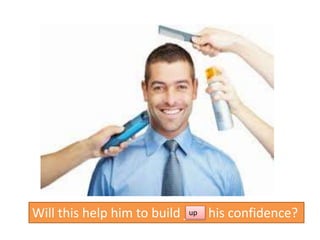
Will this help him to build ___ his confidence?up
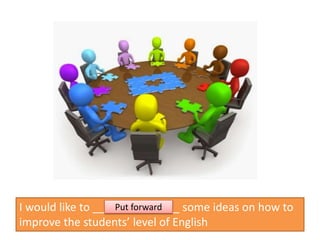
I would like to ______________ some ideas on how to
improve the students’ level of English
Put forward
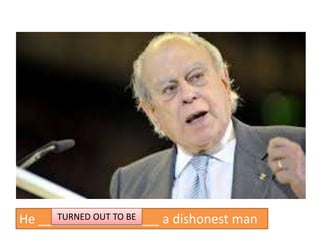
He _________________ a dishonest manTURNED OUT TO BE
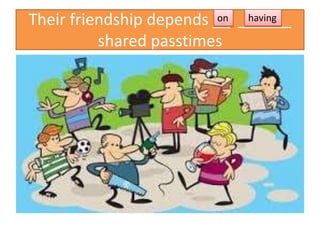
Their friendship depends __ ______
shared passtimes
on having
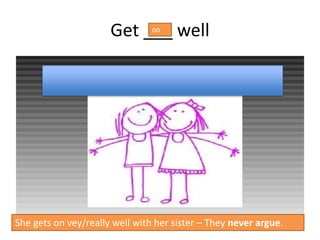
Get ___ well
She gets on vey/really well with her sister – They never argue.
on
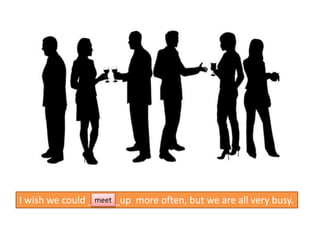
I wish we could ______up more often, but we are all very busy.meet
LISTENING COMPREHENSION
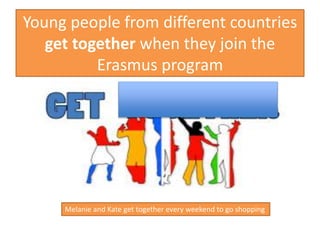
Young people from different countries
get together when they join the
Erasmus program
Melanie and Kate get together every weekend to go shopping
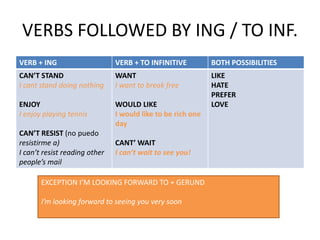
VERBS FOLLOWED BY ING / TO INF.
VERB + ING VERB + TO INFINITIVE BOTH POSSIBILITIES
CAN’T STAND
I cant stand doing nothing
ENJOY
I enjoy playing tennis
CAN’T RESIST (no puedo
resistirme a)
I can’t resist reading other
people’s mail
WANT
I want to break free
WOULD LIKE
I would like to be rich one
day
CANT’ WAIT
I can’t wait to see you!
LIKE
HATE
PREFER
LOVE
EXCEPTION I’M LOOKING FORWARD TO + GERUND
I’m looking forward to seeing you very soon
WORD BUILDING
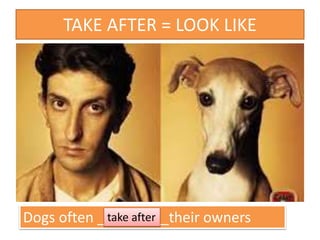
TAKE AFTER = LOOK LIKE
Dogs often _________their ownerstake after
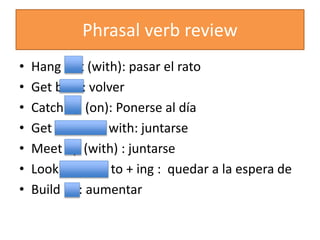
Phrasal verb review
• Hang out (with): pasar el rato
• Get back: volver
• Catch up (on): Ponerse al día
• Get together with: juntarse
• Meet up (with) : juntarse
• Look forward to + ing : quedar a la espera de
• Build up: aumentar
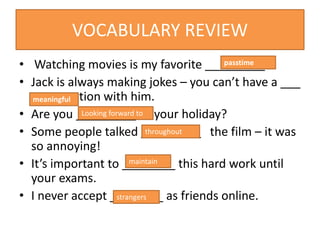
VOCABULARY REVIEW
• Watching movies is my favorite _________.
• Jack is always making jokes – you can’t have a ___
conversation with him.
• Are you _________ your holiday?
• Some people talked _________ the film – it was
so annoying!
• It’s important to ________ this hard work until
your exams.
• I never accept ________ as friends online.
passtime
meaningful
Looking forward to
throughout
maintain
strangers

Bat18 19-lesson 1 v3

  • 1.
  • 2.
  • 3.
    Talk to theperson next to you • Tell him/her about: – Something fun you did last year – Something great you have done this summer – Something you are doing this year – Something you plan to achieve – What do you think 1st Batxillerat will be like – What will you be doing in 10 years time – What will you have achieved when you turn 30
  • 4.
    Present simple review •habits • Routines • Likes and dislikes • Generalising • State facts about the present • Scientific truths • Feelings and the senses • I prefer beer to wine • She beats her nails • Sarah plays tennis • Water boils at 100 degrees Celsius • I get up at 6:30 • This pizza smells fantastic! • Germans are punctual
  • 5.
    Present continuous review •Visualizing • Look up at the sky. What colour is it? Can you see any clouds? Look down and you start to see trees and buildings. What kind of trees can you see? What kind of buildings? Are there a lot of buildings or a few? Are they old or new? In front of one of the buildings, you see people. Do you recognise them? They are doing something. What are they doing? You look left and see a tree. In front of the tree you see an animal. What kind of animal is it? What is the animal doing? You look right and you see someone near you. It’s a friend of yours. Who is it? What’s their name? They are doing something. What are they doing?
  • 6.
    My Dream • “Inmy dream I am standing ……… In front of me I can see ……”
  • 7.
    Which verbs arenot used in present continuous? Likes or preferences Thoughts and opinions States or possessions
  • 8.
    LEARNING ABOUT THEPRESENT PERFECT
  • 9.
    Present Perfect • Subject+ verb + past participle • What is a past participle? • How well did you do last year in irregular verb exams?
  • 10.
  • 11.
    DIFFERENCE WITH PASTSIMPLE Actions that started in the past, arrive to the present and may continue in the future My teacher has written three plays Action started Action finished Present Shakespeare wrote many wonderful plays (Why is this a simple past?) THE SIMPLE PAST
  • 12.
    ACTIONS COMPLETED WITHNO REFERENCE TO TIME Use 1 of Present Perfect
  • 13.
    Yet and alreadyindicate completion • Yet – REFERS TO PRESENT AND FUTURE • Used at the end of negative sentence or clauses and questions about something that may soon happen – • I have not washed the dishes yet • Is dinner ready yet? • It is not used in affirmative sentences • Already – REFERS TO THE RECENT PAST (surprise that something has happened / been done earlier than expected • Usually in mid position – • I have already washed the dishes • But final position is also possible - • Have you finished the typing already? • It is not used in negative sentences
  • 14.
    I HAVE just….- actions recently completed • Arrived to school
  • 15.
    UNCOMPLETED ACTIONS (WHICH OFTENREFER TO EXPERIENCE) Use 2 of Present Perfect
  • 16.
    We use Presentperfect to talk about experience (we are still alive, aren’t we?) • HAVE YOU EVER… ? (in question, it means “at any time in your life”) • I HAVE NEVER… (an experience I have not had) • I HAVE ALWAYS… (since I can remember)
  • 17.
    I HAVE NEVERBEEN / TRAVELLED / VISITED …
  • 18.
    I have alwaysliked/thought/ admired…
  • 19.
    YET – Usedwith questions and negative sentences at the end of the sentence • Questions: Have you washed the dishes YET? • Negative sentences: I haven’t washed the dishes YET. • YET has future connotations (I will wash them in the near future)
  • 20.
    Uncompleted actions andevents • FOR AND SINCE • I have lived in Barcelona for ______________ PERIODS OF TIME (3 MONTHS, 2 YEARS…) • I have lived in Barcelona since ___________ POINTS IN TIME (September, 1960, six o’clock, August…)
  • 23.
    SUMMARY ON USESOF THE PRESENT PERFECT • Actions completed (with no reference to time) • TIME SPAN IS STILL PRESENT (ALTHOUGH THE ACTION IS PAST) » ALREADY (Usually used in affirmative sentences. To talk about something that has happened earlier than expected.) » YET (Usually used in negative sentences to talk about something that has not happened but will probably happen soon) • TIME SPAN IS ALREADY PAST » JUST (a short time before) • Actions Uncompleted actions that started in the past and reach the present (including personal experience) » For + periods of time • I have lived in Hospitalet since the 1980ss » Since + point in time • I have lived in Hospitalet since I was a child
  • 24.
    Spelling tips • Lie Lying • Want ____ break freeto
  • 25.
  • 26.
    They are They have_____ met acquaintances She is doing/drying her hair just
  • 27.
    After that therewill be a big party. We will ______friends and ____ a good time! Who likes to look _________? Siblings _________ all the time argue scruffy have make
  • 28.
    Please, get in______ if you ever come to Barcelona touch
  • 29.
    •ðɪs səmər ajhæv med mɛni əkwentənsəz bət no frɛndz
  • 30.
    A ____________ manhas no hair on the lower part of his face Clean-shaven
  • 31.
  • 32.
    Casual clothes: I mostlywear ______ clothes: jumpers and jeans for example. Casual
  • 33.
    BUILD (IS /HAS) Medium / slim build Strong build He is a strong-built person / He has a strong build
  • 34.
    Complexion A pale complexionA tanned complexion She is pale-skinned She is tanned - skinned
  • 35.
  • 36.
    aɪ æm ˈlʊkɪŋˈfɔːwəd tuː rɪˈsiːvɪŋ ðə ʃiːp ˈʃɪpmənt nɛkst ˈwiːkˈɛnd.
  • 37.
  • 38.
  • 39.
    The friend list:Difficult words ˈmiːnɪŋfʊl rɪˈleɪʃənz əˈprɒksɪmɪtli wʌn ˈhʌndrəd ænd ˈfɪfti eɪt ɔːlˈðəʊ məʊst saɪˈkɒləʤɪsts əˈgriː θru(ː)ˈaʊt ˈhɪstəri ə kiː ɪnˈgriːdiənt fɔː ˈhæpɪnɪs
  • 40.
    Will this helphim to build ___ his confidence?up
  • 41.
    I would liketo ______________ some ideas on how to improve the students’ level of English Put forward
  • 42.
    He _________________ adishonest manTURNED OUT TO BE
  • 43.
    Their friendship depends__ ______ shared passtimes on having
  • 44.
    Get ___ well Shegets on vey/really well with her sister – They never argue. on
  • 45.
    I wish wecould ______up more often, but we are all very busy.meet
  • 46.
  • 48.
    Young people fromdifferent countries get together when they join the Erasmus program Melanie and Kate get together every weekend to go shopping
  • 49.
    VERBS FOLLOWED BYING / TO INF. VERB + ING VERB + TO INFINITIVE BOTH POSSIBILITIES CAN’T STAND I cant stand doing nothing ENJOY I enjoy playing tennis CAN’T RESIST (no puedo resistirme a) I can’t resist reading other people’s mail WANT I want to break free WOULD LIKE I would like to be rich one day CANT’ WAIT I can’t wait to see you! LIKE HATE PREFER LOVE EXCEPTION I’M LOOKING FORWARD TO + GERUND I’m looking forward to seeing you very soon
  • 50.
  • 51.
    TAKE AFTER =LOOK LIKE Dogs often _________their ownerstake after
  • 53.
    Phrasal verb review •Hang out (with): pasar el rato • Get back: volver • Catch up (on): Ponerse al día • Get together with: juntarse • Meet up (with) : juntarse • Look forward to + ing : quedar a la espera de • Build up: aumentar
  • 54.
    VOCABULARY REVIEW • Watchingmovies is my favorite _________. • Jack is always making jokes – you can’t have a ___ conversation with him. • Are you _________ your holiday? • Some people talked _________ the film – it was so annoying! • It’s important to ________ this hard work until your exams. • I never accept ________ as friends online. passtime meaningful Looking forward to throughout maintain strangers

Editor's Notes

  • #10 Set dates for irregular verb exams
  • #11 Nuria’s reflection Yet and already are used when time span is still present, while just is used with past actions that affect the present. It is more clear to me now how we use the present perfect to refer to past actions when we do not specify the time. Since we also use the present perfect with since and for, where time is important, that use of the present perfect was unclear to me.
  • #15 He has just… Just is used for a recent past action. Consequences arrive to the present (I am late, the teacher is going to punish me)
  • #18 I have never….
  • #20 Yet goes in final position Yet and already are used to talk about past actions with results in the present = The dishes are not washed TIME SPAN IS STILL PRESENT EVEN IF THE ACTION IS PAST What is the difference between yet and already? Can you make this question affirmative