GRAMMAR THAT WE HAVE
STUDIED IN 6è B
Present perfect
Ricard Saubi Teixidor
http://www.englishpage.com/verbpage/presentperfect.html
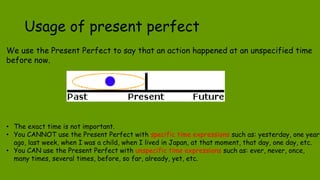
We use the Present Perfect to say that an action happened at an unspecified time
before now.
• The exact time is not important.
• You CANNOT use the Present Perfect with specific time expressions such as: yesterday, one year
ago, last week, when I was a child, when I lived in Japan, at that moment, that day, one day, etc.
• You CAN use the Present Perfect with unspecific time expressions such as: ever, never, once,
many times, several times, before, so far, already, yet, etc.
Usage of present perfect
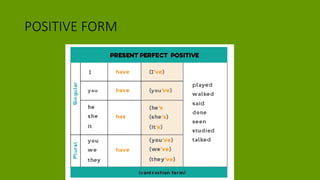
POSITIVE FORM
POSITIVE FORM
The positive is formed from the present tense of the
verb have and the past participle of a verb:
Jane has studied
John has phoned
I have worked
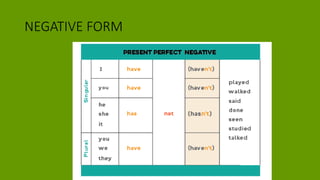
NEGATIVE FORM
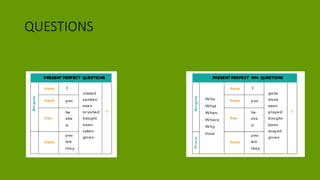
QUESTIONS
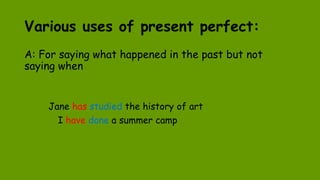
Various uses of present perfect:
A: For saying what happened in the past but not
saying when
Jane has studied the history of art
I have done a summer camp
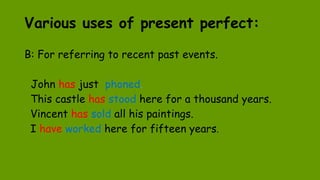
B: For referring to recent past events.
John has just phoned.
This castle has stood here for a thousand years.
Vincent has sold all his paintings.
I have worked here for fifteen years.
Various uses of present perfect:
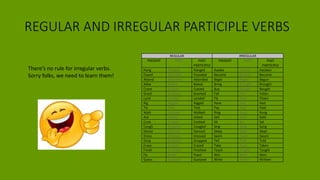
REGULAR AND IRREGULAR PARTICIPLE VERBS
REGULAR IRREGULAR
PRESENT PAST PAST
PARTICIPLE
PRESENT PAST PAST
PARTICIPLE
Hang Hanged Hanged Awake Awoke Awoken
Found Founded Founded Become Became Become
Attend Attended Attended Begin Began Begun
BAke Baked Baked Bring Brought Brought
Crave Craved Craved Buy Bought Bought
Grant Granted Granted Fall Fell Fallen
Land Landed Landed Fly Flew Flown
Rig Rigged Rigged Have Had Had
Tie Tied Tied Pay Paid Paid
Walk Walked Walked Ring Rang Rung
Ask Asked Asked Sell Sold Sold
Cook Cooked Cooked Sit Sat Sat
Cough Coughed Cougjed Sing Sang Sung
Dance Danced Danced Sleep Slept Slept
Dress Dressed Dressed Swim Swam Swum
Drop Dropped Dropped Tell Told Told
Erase Erased Erased Take Took Taken
Finish Finished Finished Teach Taught Taught
Fix Fixed Fixed Win Won Won
Guess Guessed Guessed Write Wrote Written
There’s no rule for irregular verbs.
Sorry folks, we need to learn them!
activities
• https://www.ego4u.com/en/cram-up/grammar/present-perfect-
simple/exercises?04
• https://www.ego4u.com/en/cram-up/grammar/present-perfect-
simple/exercises?05
• https://www.ego4u.com/en/cram-up/grammar/present-perfect-
simple/exercises?07
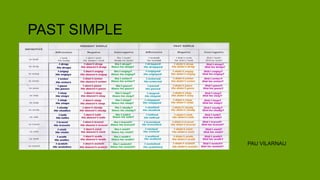
PAST SIMPLE
PAU VILARNAU
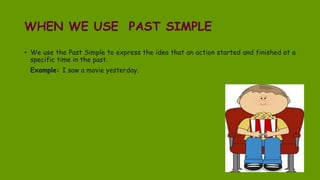
WHEN WE USE PAST SIMPLE
• We use the Past Simple to express the idea that an action started and finished at a
specific time in the past.
Example: I saw a movie yesterday.
They change to past following some rules.
REGULAR VERBS
PRESENT PAST
dance danced
share + d shared
like liked
PRESENT PAST
call called
walk + ed walked
check checked
PRESENT PAST
study studied
cry + ied cried
carry carried
When final “Y” is preceded by
a consonant, you drop: “Y” and
add ied.
PRESENT PAST
plan planned
permit permitted
control controlled
When the ending is: consonant + vowel
+ consonant and the stress is in the last
syllable, you repeat the last consonant.
IRREGULAR VERBS
When they change to past,
they don’t follow any rule!!
PRESENT PAST
Go
say
make
come
see
give
put
hit
think
teach
leave
feel
fall
Went
said
made
came
saw
gave
put
hit
thought
taught
left
felt
fell
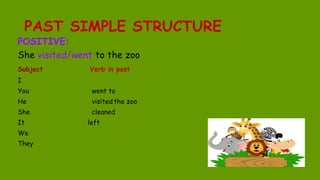
PAST SIMPLE STRUCTURE
POSITIVE:
She visited/went to the zoo
Subject Verb in past
I
You went to
He visited the zoo
She cleaned
It left
We
They
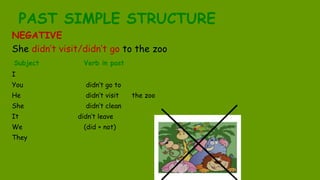
PAST SIMPLE STRUCTURE
NEGATIVE
She didn’t visit/didn’t go to the zoo
Subject Verb in past
I
You didn’t go to
He didn’t visit the zoo
She didn’t clean
It didn’t leave
We (did + not)
They
PAST SIMPLE STRUCTURE
INTERROGATIVE
Did she visit/go to the zoo?
Subject Verb in past
I
you go to
Did he visit the zoo?
she clean
it leave
we
they
BY ARNAU CASSÚ SERRADELL
Future
Some usual Verbs
• to be
• to have
• to do
• to make
• to take
• to get
• to go
• to come
• to leave
• to know
• to like
• to want
• to feel
• to begin, start
 I Will be
 I Will have
 I Will do
 I Will make
 I Will take
 I Will get
 I Will go
 I Will come
 I Will leave
 I Will know
 I Will like
 I Will want
 I Will feel
 I Will begin, start
 I Will end, finish
 I Will stay
 I Will change
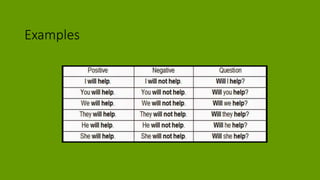
In english, verbs in future is: PRONOUN+WILL+INFINITIVE VERB .
Affirmative
• The affirmative form in future, is the same as in infinitive, but in front of the verb we add will.
• I will win the match.
• You will win the match.
• He will win the match.
• She will win the match.
• It will win the match.
• We will win the match.
• You will win the match.
• They will win the match
Negative
• The negative form is the same as in affirmative, but we add not after will.
• I will not win the match.
• You will not win the match.
• He will not win the match.
• She will not win the match.
• It will not win the match.
• We will not win the match.
• You will not win the match.
• They will not win the match
Interrogative
• In future questions the form is the same as in affirmative, but the pronoun is in the middle of will
and the verb.
• Will I run?
• Will you run
• Will he run?
• Will she run?
• Will it run?
• Will we run?
• Will you run?
• Will they run?
Examples
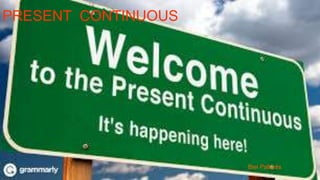
PRESENT CONTINUOUS
Biel Pallarés
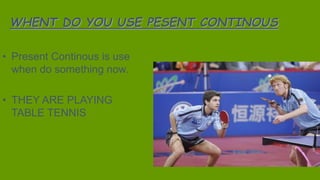
WHENT DO YOU USE PESENT CONTINOUS
• Present Continous is use
when do something now.
• THEY ARE PLAYING
TABLE TENNIS
The present continuous tense is formed from the present tense of
the verb be and the present participle (-ing form) of a verb
WHAT IS PRESENT CONTINUES ?
The present continuous tense is formed from the present tense of
the verb be and the present participle (-ing form) of a verb
Example
Jump: Jumping.
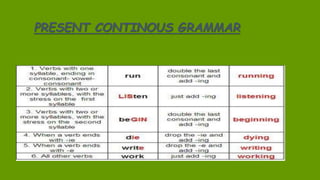
PRESENT CONTINOUS GRAMMAR
MY EXPLICATION:
1. TYPES
1.1 PLACE
1.2 TIME
1.3 OBJECTS
2. EXAMPLES
3.CURIOSITIES
TYPE: PLACE
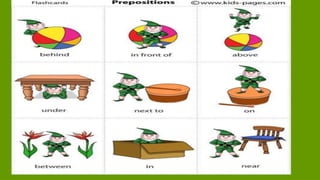
ON – TALKS ABOUT THE SURFACE.
INSIDE – EXPRESSES SOMETHING CONTAINED.
IN – TO INDICATE A LOCATION.
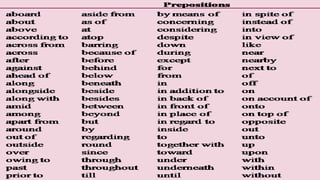
OVER, ABOVE – WHEN THE OBJECT IS HIGHER THAN A
POINT.
BETWEEN, AMONG, NEAR, BY, NEXT TO, OPPOSITE –
WHEN THE OBJECT IS CLOSE TO A POINT.
TYPE: TIME
• AT - IS USED WITH NOON, NIGHT, MIDNIGHT, AND
WITH THE TIME OF DAY.
• IN - IS USED WITH OTHER PARTS OF THE DAY, WITH
MONTHS, WITH YEARS, WITH SEASONS.
• ON - IS USED WITH DAYS.
• SINCE, FOR, BY, FROM UNTIL, DURING - EXPRESSES
EXTENDED TIME.
TYPE: OBJECTS
• FOR – WITH VERBS CALL, HOPE, LOOK, WAIT, WATCH,
AND WISH
• OF/ABOUT – WITH VERBS DREAM AND THINK
• OF – WITH VERBS APPROVE, CONSIST, AND SMELL
• AT – WITH VERBS GLANCE, LAUGH, LOOK, REJOICE,
SMILE, AND STARE
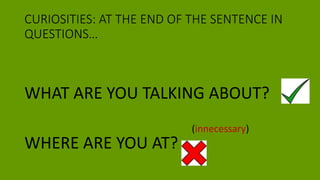
CURIOSITIES: AT THE END OF THE SENTENCE IN
QUESTIONS…
WHAT ARE YOU TALKING ABOUT?
WHERE ARE YOU AT?
(innecessary)
By Pau Lara
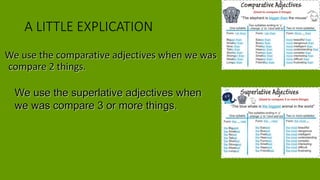
A LITTLE EXPLICATION
We use the comparative adjectives when we was
compare 2 things.
We use the superlative adjectives when
we was compare 3 or more things.
COMPARATIVE ADJECTIVES
• There are 3 Ways to write comparative adjectives:
• 1. The adjectives that you want to say in comparative sentences and has 1 syllable
you write: +er than at the final of the verb.
• Examples: Strong = stronger than… Tall = taller than…
• 2. The adjectives that you want to say in comparative sentences and has 2
syllables and ends in y, you write:
• + ier than at the final of the verb, but you want to replace the final y to the verb
to ier.
• Examples: Easy = easier than... Pretty = prettier than..
• 3. The adjectives that you want to say in comparative sentences and
has 2 syllables or more syllables you put a more before the adjective
and a than after the adjective.
• Example: Snakes are more dangerous than the rabbits.
SUPERLATIVE ADJECTIVES
• 1. The adjectives that you want to say in superlative sentences and has 1 syllable
you write: + the ...est at the final of the verb.
• Examples: Strong = the strongest… Tall = the tallest...
• 2. The adjectives that you want to say in comparative sentences and has 2
syllables and ends in y, you write:
• +the ...iest at the final of the verb, but you want to replace the final y to the
verb to iest.
• Examples: Easy = the easiest... Pretty = the prettiest...
SUPERLATIVE ADJECTIVES
• 3. The adjectives that you want to say in superlative sentences and
has 2 syllables or more you put a the most before the adjective.
• Example: Snakes are the most dangerous animal.
OTHERS
• The comparative and superlative adjectives writes to the same form
in present that in past or future. Only changes the context of the
sentence,
•
• Examples: Past = I went to the zoo, and the elephants are bigger
than the rabbits.
• Examples: Future = I will go to the zoo and I have been told that
elephants are bigger than rabbits.
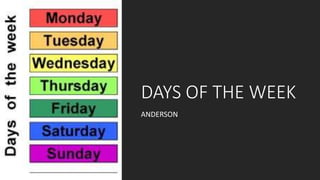
DAYS OF THE WEEK
ANDERSON
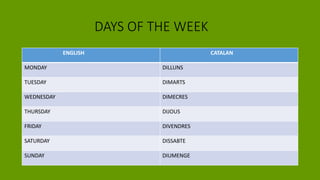
DAYS OF THE WEEK
ENGLISH CATALAN
MONDAY DILLUNS
TUESDAY DIMARTS
WEDNESDAY DIMECRES
THURSDAY DIJOUS
FRIDAY DIVENDRES
SATURDAY DISSABTE
SUNDAY DIUMENGE
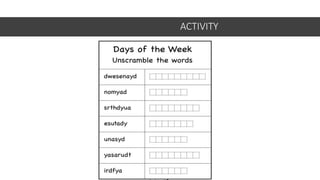
ACTIVITY
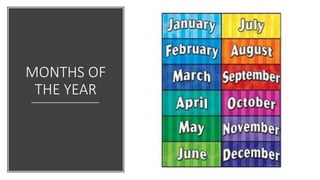
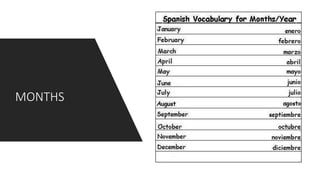
MONTHS OF
THE YEAR
MONTHS
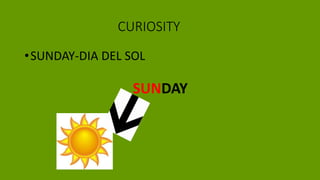
CURIOSITY
•SUNDAY-DIA DEL SOL
SUNDAY
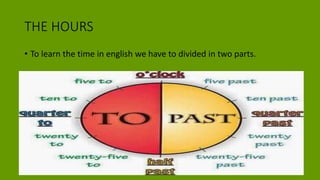
THE HOURS
By Carles Sala
THE HOURS
• To learn the time in english we have to divided in two parts.
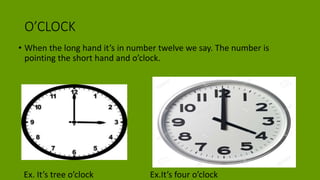
O’CLOCK
• When the long hand it’s in number twelve we say. The number is
pointing the short hand and o’clock.
Ex. It’s tree o’clock Ex.It’s four o’clock
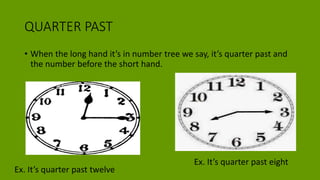
QUARTER PAST
• When the long hand it’s in number tree we say, it’s quarter past and
the number before the short hand.
Ex. It’s quarter past twelve
Ex. It’s quarter past eight
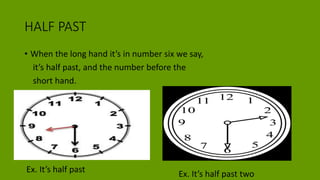
HALF PAST
• When the long hand it’s in number six we say,
it’s half past, and the number before the
short hand.
Ex. It’s half past Ex. It’s half past two

Power point de grammar 1

  • 1.
    GRAMMAR THAT WEHAVE STUDIED IN 6è B
  • 2.
    Present perfect Ricard SaubiTeixidor http://www.englishpage.com/verbpage/presentperfect.html
  • 3.
    We use thePresent Perfect to say that an action happened at an unspecified time before now. • The exact time is not important. • You CANNOT use the Present Perfect with specific time expressions such as: yesterday, one year ago, last week, when I was a child, when I lived in Japan, at that moment, that day, one day, etc. • You CAN use the Present Perfect with unspecific time expressions such as: ever, never, once, many times, several times, before, so far, already, yet, etc. Usage of present perfect
  • 4.
  • 5.
    POSITIVE FORM The positiveis formed from the present tense of the verb have and the past participle of a verb: Jane has studied John has phoned I have worked
  • 6.
  • 7.
  • 8.
    Various uses ofpresent perfect: A: For saying what happened in the past but not saying when Jane has studied the history of art I have done a summer camp
  • 9.
    B: For referringto recent past events. John has just phoned. This castle has stood here for a thousand years. Vincent has sold all his paintings. I have worked here for fifteen years. Various uses of present perfect:
  • 10.
    REGULAR AND IRREGULARPARTICIPLE VERBS REGULAR IRREGULAR PRESENT PAST PAST PARTICIPLE PRESENT PAST PAST PARTICIPLE Hang Hanged Hanged Awake Awoke Awoken Found Founded Founded Become Became Become Attend Attended Attended Begin Began Begun BAke Baked Baked Bring Brought Brought Crave Craved Craved Buy Bought Bought Grant Granted Granted Fall Fell Fallen Land Landed Landed Fly Flew Flown Rig Rigged Rigged Have Had Had Tie Tied Tied Pay Paid Paid Walk Walked Walked Ring Rang Rung Ask Asked Asked Sell Sold Sold Cook Cooked Cooked Sit Sat Sat Cough Coughed Cougjed Sing Sang Sung Dance Danced Danced Sleep Slept Slept Dress Dressed Dressed Swim Swam Swum Drop Dropped Dropped Tell Told Told Erase Erased Erased Take Took Taken Finish Finished Finished Teach Taught Taught Fix Fixed Fixed Win Won Won Guess Guessed Guessed Write Wrote Written There’s no rule for irregular verbs. Sorry folks, we need to learn them!
  • 11.
  • 12.
  • 13.
    WHEN WE USEPAST SIMPLE • We use the Past Simple to express the idea that an action started and finished at a specific time in the past. Example: I saw a movie yesterday.
  • 14.
    They change topast following some rules. REGULAR VERBS PRESENT PAST dance danced share + d shared like liked PRESENT PAST call called walk + ed walked check checked PRESENT PAST study studied cry + ied cried carry carried When final “Y” is preceded by a consonant, you drop: “Y” and add ied. PRESENT PAST plan planned permit permitted control controlled When the ending is: consonant + vowel + consonant and the stress is in the last syllable, you repeat the last consonant.
  • 15.
    IRREGULAR VERBS When theychange to past, they don’t follow any rule!! PRESENT PAST Go say make come see give put hit think teach leave feel fall Went said made came saw gave put hit thought taught left felt fell
  • 16.
    PAST SIMPLE STRUCTURE POSITIVE: Shevisited/went to the zoo Subject Verb in past I You went to He visited the zoo She cleaned It left We They
  • 17.
    PAST SIMPLE STRUCTURE NEGATIVE Shedidn’t visit/didn’t go to the zoo Subject Verb in past I You didn’t go to He didn’t visit the zoo She didn’t clean It didn’t leave We (did + not) They
  • 18.
    PAST SIMPLE STRUCTURE INTERROGATIVE Didshe visit/go to the zoo? Subject Verb in past I you go to Did he visit the zoo? she clean it leave we they
  • 19.
    BY ARNAU CASSÚSERRADELL Future
  • 20.
    Some usual Verbs •to be • to have • to do • to make • to take • to get • to go • to come • to leave • to know • to like • to want • to feel • to begin, start  I Will be  I Will have  I Will do  I Will make  I Will take  I Will get  I Will go  I Will come  I Will leave  I Will know  I Will like  I Will want  I Will feel  I Will begin, start  I Will end, finish  I Will stay  I Will change In english, verbs in future is: PRONOUN+WILL+INFINITIVE VERB .
  • 21.
    Affirmative • The affirmativeform in future, is the same as in infinitive, but in front of the verb we add will. • I will win the match. • You will win the match. • He will win the match. • She will win the match. • It will win the match. • We will win the match. • You will win the match. • They will win the match
  • 22.
    Negative • The negativeform is the same as in affirmative, but we add not after will. • I will not win the match. • You will not win the match. • He will not win the match. • She will not win the match. • It will not win the match. • We will not win the match. • You will not win the match. • They will not win the match
  • 23.
    Interrogative • In futurequestions the form is the same as in affirmative, but the pronoun is in the middle of will and the verb. • Will I run? • Will you run • Will he run? • Will she run? • Will it run? • Will we run? • Will you run? • Will they run?
  • 24.
  • 25.
  • 26.
    WHENT DO YOUUSE PESENT CONTINOUS • Present Continous is use when do something now. • THEY ARE PLAYING TABLE TENNIS
  • 27.
    The present continuoustense is formed from the present tense of the verb be and the present participle (-ing form) of a verb WHAT IS PRESENT CONTINUES ? The present continuous tense is formed from the present tense of the verb be and the present participle (-ing form) of a verb Example Jump: Jumping.
  • 28.
  • 31.
    MY EXPLICATION: 1. TYPES 1.1PLACE 1.2 TIME 1.3 OBJECTS 2. EXAMPLES 3.CURIOSITIES
  • 32.
    TYPE: PLACE ON –TALKS ABOUT THE SURFACE. INSIDE – EXPRESSES SOMETHING CONTAINED. IN – TO INDICATE A LOCATION. OVER, ABOVE – WHEN THE OBJECT IS HIGHER THAN A POINT. BETWEEN, AMONG, NEAR, BY, NEXT TO, OPPOSITE – WHEN THE OBJECT IS CLOSE TO A POINT.
  • 33.
    TYPE: TIME • AT- IS USED WITH NOON, NIGHT, MIDNIGHT, AND WITH THE TIME OF DAY. • IN - IS USED WITH OTHER PARTS OF THE DAY, WITH MONTHS, WITH YEARS, WITH SEASONS. • ON - IS USED WITH DAYS. • SINCE, FOR, BY, FROM UNTIL, DURING - EXPRESSES EXTENDED TIME.
  • 34.
    TYPE: OBJECTS • FOR– WITH VERBS CALL, HOPE, LOOK, WAIT, WATCH, AND WISH • OF/ABOUT – WITH VERBS DREAM AND THINK • OF – WITH VERBS APPROVE, CONSIST, AND SMELL • AT – WITH VERBS GLANCE, LAUGH, LOOK, REJOICE, SMILE, AND STARE
  • 36.
    CURIOSITIES: AT THEEND OF THE SENTENCE IN QUESTIONS… WHAT ARE YOU TALKING ABOUT? WHERE ARE YOU AT? (innecessary)
  • 37.
  • 38.
    A LITTLE EXPLICATION Weuse the comparative adjectives when we was compare 2 things. We use the superlative adjectives when we was compare 3 or more things.
  • 39.
    COMPARATIVE ADJECTIVES • Thereare 3 Ways to write comparative adjectives: • 1. The adjectives that you want to say in comparative sentences and has 1 syllable you write: +er than at the final of the verb. • Examples: Strong = stronger than… Tall = taller than… • 2. The adjectives that you want to say in comparative sentences and has 2 syllables and ends in y, you write: • + ier than at the final of the verb, but you want to replace the final y to the verb to ier. • Examples: Easy = easier than... Pretty = prettier than..
  • 40.
    • 3. Theadjectives that you want to say in comparative sentences and has 2 syllables or more syllables you put a more before the adjective and a than after the adjective. • Example: Snakes are more dangerous than the rabbits.
  • 41.
    SUPERLATIVE ADJECTIVES • 1.The adjectives that you want to say in superlative sentences and has 1 syllable you write: + the ...est at the final of the verb. • Examples: Strong = the strongest… Tall = the tallest... • 2. The adjectives that you want to say in comparative sentences and has 2 syllables and ends in y, you write: • +the ...iest at the final of the verb, but you want to replace the final y to the verb to iest. • Examples: Easy = the easiest... Pretty = the prettiest...
  • 42.
    SUPERLATIVE ADJECTIVES • 3.The adjectives that you want to say in superlative sentences and has 2 syllables or more you put a the most before the adjective. • Example: Snakes are the most dangerous animal.
  • 43.
    OTHERS • The comparativeand superlative adjectives writes to the same form in present that in past or future. Only changes the context of the sentence, • • Examples: Past = I went to the zoo, and the elephants are bigger than the rabbits. • Examples: Future = I will go to the zoo and I have been told that elephants are bigger than rabbits.
  • 44.
    DAYS OF THEWEEK ANDERSON
  • 45.
    DAYS OF THEWEEK ENGLISH CATALAN MONDAY DILLUNS TUESDAY DIMARTS WEDNESDAY DIMECRES THURSDAY DIJOUS FRIDAY DIVENDRES SATURDAY DISSABTE SUNDAY DIUMENGE
  • 46.
  • 47.
  • 48.
  • 49.
  • 50.
  • 51.
    THE HOURS • Tolearn the time in english we have to divided in two parts.
  • 52.
    O’CLOCK • When thelong hand it’s in number twelve we say. The number is pointing the short hand and o’clock. Ex. It’s tree o’clock Ex.It’s four o’clock
  • 53.
    QUARTER PAST • Whenthe long hand it’s in number tree we say, it’s quarter past and the number before the short hand. Ex. It’s quarter past twelve Ex. It’s quarter past eight
  • 54.
    HALF PAST • Whenthe long hand it’s in number six we say, it’s half past, and the number before the short hand. Ex. It’s half past Ex. It’s half past two