



Many adjectives ending in ‘-ing’
describe the effect that something
has on someone's feelings.
Some adjectives ending in ‘-ing’
describe a process or state that
continues over a period of time.
Many adjectives ending in ‘-ed’
describe people's feelings.
 Amazing          frightening
 Annoying         interesting
 Astonishing      shocking
 Boring           surprising
 Charming         terrifying
 Confusing        tiring
 Convincing       welcoming
 Depressing       worrying
 Disappointing
 Embarrassing
 Exciting
You use some ‘-ing’ adjectives to describe
something that continues over a period of time

             Ageing
             Booming
             Decreasing
             Dying
             Existing
             Increasing
             Living
             Remaining
Many ‘-ed’ adjectives describe
 people's feelings. They have the
 same form as the past participle of
 a transitive verb and have a passive
 meaning. For example, ‘a
 frightened person’ is a person who
 has been frightened by something.
 Amused          Surprised
 Astonished      Tired
 Bored           Troubled
 Delighted       Worried
 Depressed       Alarmed
 Disappointed
 Excited
 Frightened
 Interested
 Satisfied
 Shocked
CHOOSE THE CORRECT
    FORM OF THE
     ADJECTIVE.
THAT PICTUREIS FRIGHTENING /
         FRIGHTENED
  I SAW THAT PICTURE AND I
      GOT FRIGHTENED /
        FRIGHTENING
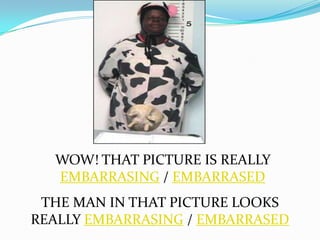
WOW! THAT PICTURE IS REALLY
  EMBARRASING / EMBARRASED
 THE MAN IN THAT PICTURE LOOKS
REALLY EMBARRASING / EMBARRASED
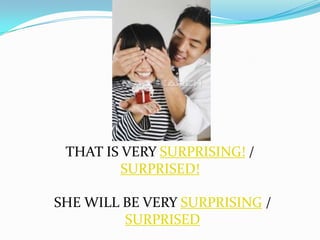
THAT IS VERY SURPRISING! /
         SURPRISED!

SHE WILL BE VERY SURPRISING /
         SURPRISED
PRESENT PERFECT
PRESENT PERFECT


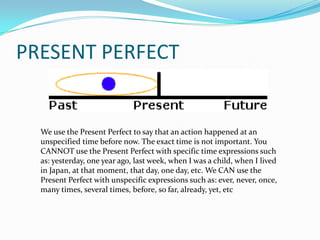
  We use the Present Perfect to say that an action happened at an
  unspecified time before now. The exact time is not important. You
  CANNOT use the Present Perfect with specific time expressions such
  as: yesterday, one year ago, last week, when I was a child, when I lived
  in Japan, at that moment, that day, one day, etc. We CAN use the
  Present Perfect with unspecific expressions such as: ever, never, once,
  many times, several times, before, so far, already, yet, etc
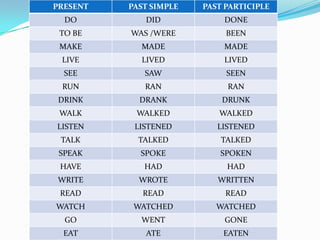
PRESENT   PAST SIMPLE   PAST PARTICIPLE
  DO         DID            DONE
 TO BE    WAS /WERE          BEEN
 MAKE       MADE            MADE
 LIVE       LIVED           LIVED
  SEE        SAW             SEEN
 RUN         RAN             RAN
 DRINK      DRANK           DRUNK
 WALK      WALKED          WALKED
LISTEN     LISTENED        LISTENED
 TALK       TALKED          TALKED
 SPEAK      SPOKE           SPOKEN
 HAVE        HAD             HAD
WRITE       WROTE          WRITTEN
 READ        READ            READ
WATCH      WATCHED         WATCHED
  GO        WENT            GONE
  EAT        ATE            EATEN
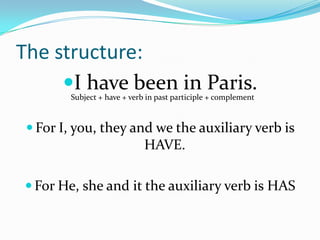
The structure:
     I have been in Paris.
        Subject + have + verb in past participle + complement


  For I, you, they and we the auxiliary verb is
                             HAVE.

 For He, she and it the auxiliary verb is HAS
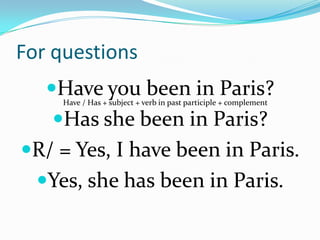
For questions
   Have you been in Paris?
     Have / Has + subject + verb in past participle + complement

   Has she been in Paris?
R/ = Yes, I have been in Paris.
  Yes, she has been in Paris.
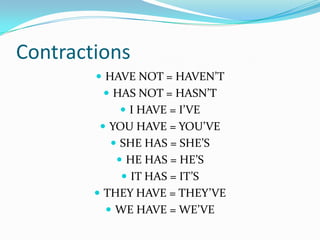
Contractions
         HAVE NOT = HAVEN’T
          HAS NOT = HASN’T
             I HAVE = I’VE
         YOU HAVE = YOU’VE
           SHE HAS = SHE’S
            HE HAS = HE’S
             IT HAS = IT’S
         THEY HAVE = THEY’VE
          WE HAVE = WE’VE
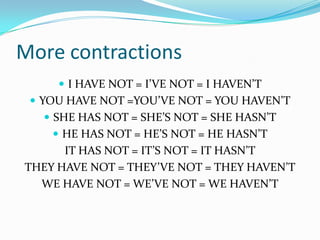
More contractions
      I HAVE NOT = I’VE NOT = I HAVEN’T
  YOU HAVE NOT =YOU’VE NOT = YOU HAVEN’T
    SHE HAS NOT = SHE’S NOT = SHE HASN’T
     HE HAS NOT = HE’S NOT = HE HASN’T
      IT HAS NOT = IT’S NOT = IT HASN’T
THEY HAVE NOT = THEY’VE NOT = THEY HAVEN’T
  WE HAVE NOT = WE’VE NOT = WE HAVEN’T
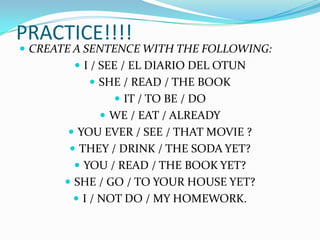
PRACTICE!!!!
 CREATE A SENTENCE WITH THE FOLLOWING:
         I / SEE / EL DIARIO DEL OTUN
           SHE / READ / THE BOOK
                IT / TO BE / DO
             WE / EAT / ALREADY
        YOU EVER / SEE / THAT MOVIE ?
        THEY / DRINK / THE SODA YET?
         YOU / READ / THE BOOK YET?
        SHE / GO / TO YOUR HOUSE YET?
         I / NOT DO / MY HOMEWORK.
GREAT JOB!!!!


    NEXT
INCORRECT! TRY
   AGAIN.


          GO BACK
GREAT JOB!!!!


    NEXT
INCORRECT! TRY
   AGAIN.


          GO BACK
GREAT JOB!!!!


    NEXT
INCORRECT! TRY
   AGAIN.


          GO BACK

Descriptive adj. and present perfect

  • 2.
    Many adjectives endingin ‘-ing’ describe the effect that something has on someone's feelings. Some adjectives ending in ‘-ing’ describe a process or state that continues over a period of time. Many adjectives ending in ‘-ed’ describe people's feelings.
  • 3.
     Amazing  frightening  Annoying  interesting  Astonishing  shocking  Boring  surprising  Charming  terrifying  Confusing  tiring  Convincing  welcoming  Depressing  worrying  Disappointing  Embarrassing  Exciting
  • 4.
    You use some‘-ing’ adjectives to describe something that continues over a period of time  Ageing  Booming  Decreasing  Dying  Existing  Increasing  Living  Remaining
  • 5.
    Many ‘-ed’ adjectivesdescribe people's feelings. They have the same form as the past participle of a transitive verb and have a passive meaning. For example, ‘a frightened person’ is a person who has been frightened by something.
  • 6.
     Amused  Surprised  Astonished  Tired  Bored  Troubled  Delighted  Worried  Depressed  Alarmed  Disappointed  Excited  Frightened  Interested  Satisfied  Shocked
  • 7.
    CHOOSE THE CORRECT FORM OF THE ADJECTIVE.
  • 8.
    THAT PICTUREIS FRIGHTENING/ FRIGHTENED I SAW THAT PICTURE AND I GOT FRIGHTENED / FRIGHTENING
  • 9.
    WOW! THAT PICTUREIS REALLY EMBARRASING / EMBARRASED THE MAN IN THAT PICTURE LOOKS REALLY EMBARRASING / EMBARRASED
  • 10.
    THAT IS VERYSURPRISING! / SURPRISED! SHE WILL BE VERY SURPRISING / SURPRISED
  • 11.
  • 12.
    PRESENT PERFECT We use the Present Perfect to say that an action happened at an unspecified time before now. The exact time is not important. You CANNOT use the Present Perfect with specific time expressions such as: yesterday, one year ago, last week, when I was a child, when I lived in Japan, at that moment, that day, one day, etc. We CAN use the Present Perfect with unspecific expressions such as: ever, never, once, many times, several times, before, so far, already, yet, etc
  • 13.
    PRESENT PAST SIMPLE PAST PARTICIPLE DO DID DONE TO BE WAS /WERE BEEN MAKE MADE MADE LIVE LIVED LIVED SEE SAW SEEN RUN RAN RAN DRINK DRANK DRUNK WALK WALKED WALKED LISTEN LISTENED LISTENED TALK TALKED TALKED SPEAK SPOKE SPOKEN HAVE HAD HAD WRITE WROTE WRITTEN READ READ READ WATCH WATCHED WATCHED GO WENT GONE EAT ATE EATEN
  • 14.
    The structure: I have been in Paris. Subject + have + verb in past participle + complement  For I, you, they and we the auxiliary verb is HAVE.  For He, she and it the auxiliary verb is HAS
  • 15.
    For questions Have you been in Paris? Have / Has + subject + verb in past participle + complement Has she been in Paris? R/ = Yes, I have been in Paris. Yes, she has been in Paris.
  • 16.
    Contractions  HAVE NOT = HAVEN’T  HAS NOT = HASN’T  I HAVE = I’VE  YOU HAVE = YOU’VE  SHE HAS = SHE’S  HE HAS = HE’S  IT HAS = IT’S  THEY HAVE = THEY’VE  WE HAVE = WE’VE
  • 17.
    More contractions  I HAVE NOT = I’VE NOT = I HAVEN’T  YOU HAVE NOT =YOU’VE NOT = YOU HAVEN’T  SHE HAS NOT = SHE’S NOT = SHE HASN’T  HE HAS NOT = HE’S NOT = HE HASN’T IT HAS NOT = IT’S NOT = IT HASN’T THEY HAVE NOT = THEY’VE NOT = THEY HAVEN’T WE HAVE NOT = WE’VE NOT = WE HAVEN’T
  • 18.
    PRACTICE!!!!  CREATE ASENTENCE WITH THE FOLLOWING:  I / SEE / EL DIARIO DEL OTUN  SHE / READ / THE BOOK  IT / TO BE / DO  WE / EAT / ALREADY  YOU EVER / SEE / THAT MOVIE ?  THEY / DRINK / THE SODA YET?  YOU / READ / THE BOOK YET?  SHE / GO / TO YOUR HOUSE YET?  I / NOT DO / MY HOMEWORK.
  • 19.
  • 20.
    INCORRECT! TRY AGAIN. GO BACK
  • 21.
  • 22.
    INCORRECT! TRY AGAIN. GO BACK
  • 23.
  • 24.
    INCORRECT! TRY AGAIN. GO BACK