MD. HABIBUR RAHMAN
ID NO: 20121107042
DEPARTMENT OF ACCE
BSMRSTU.
Welcome to my
presentation
My presentation topic is:
“Agrochemicals:
Classifications of
Pesticides & Insecticides”
What is agrochemicals?
Chemical products that used in agriculture are termed as
Agrochemicals.
Or
Agrochemicals may any substance that used to help
manage an agricultural ecosystem, or the community of
organisms in a farming area.
Types of agrochemicals
What are pesticides?
Pesticides are preparations for the eradication of plant
and animal pests, for the protection of plants, animals and man.
Or,
“Any substance or mixture of substances intended for
preventing, destroying, or controlling any pest, including vectors
of human or animal disease, unwanted species of plants or
animals, causing harm during the production, processing,
storage, transport, or marketing of food, agricultural
commodities, wood and wood products or animal feedstuffs”.
Classification of pesticides-
Classification & function of according to mode of action –
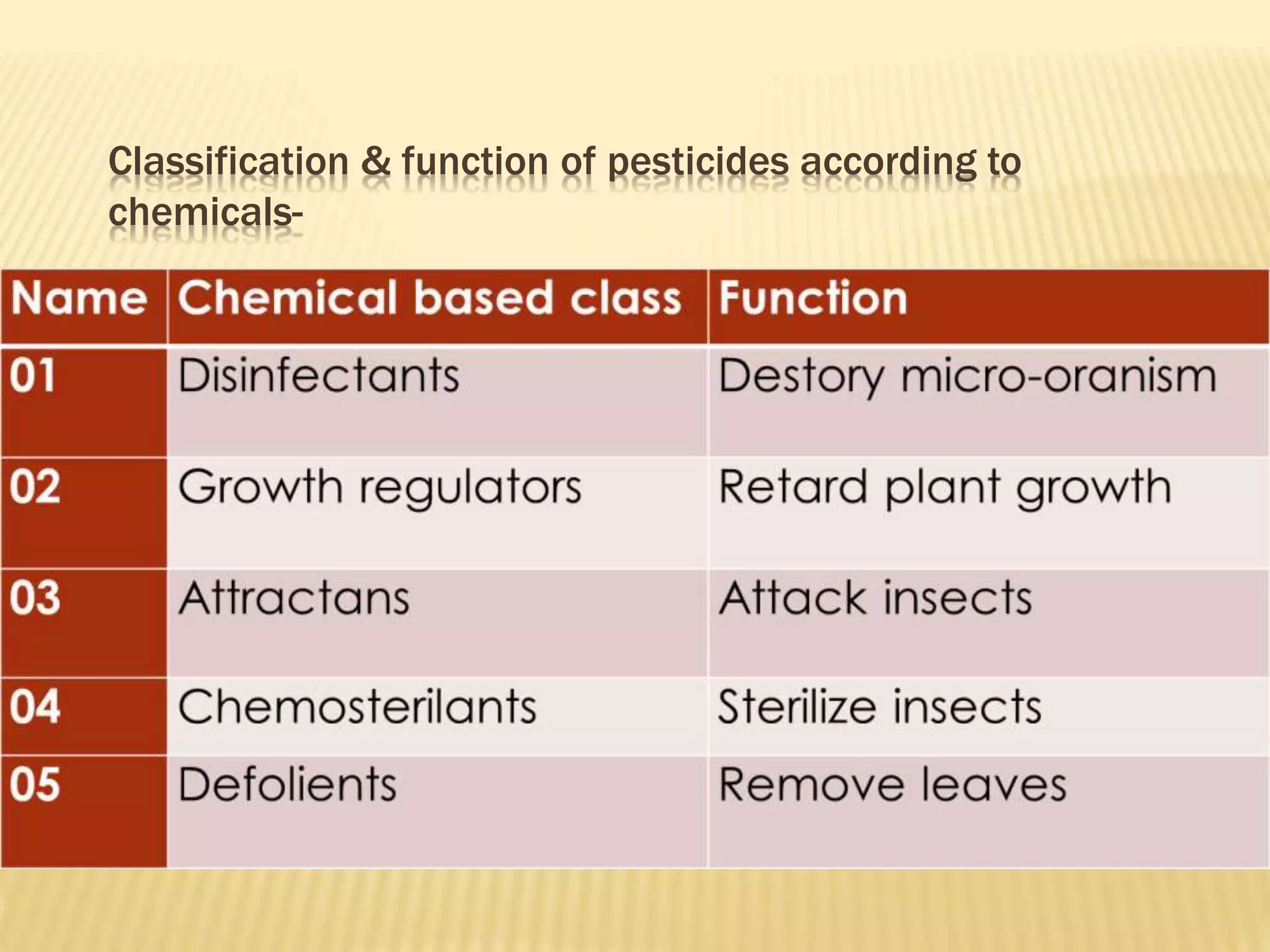
Classification & function of pesticides according to
chemicals-
First use of synthetic pesticides: 1940
2.26 million tons of active ingredients used in 2001.
25% of the world production used in developing
countries... where 99% of deaths
due to pesticides occur!
Use of pesticides
Use of pesticides – types of product
pesticides used in different settings: - agricultural
- veterinary
- domestic
- institutional
formulations: liquid, gel, paste, chalk, powder, granules,
pellets, baits...
concentrations: from 2% to 80% of active ingredient
containers: glass, plastic or metal flasks, bottles, drums,
traps, plastic bags or paper bags...
Continue.
What is insecticides?
Insecticide is a substance used to kill insects. They
include ovicides and larvicides used against insect
eggs and larvae, respectively. Insecticides are used in
agriculture, medicine, industry and by consumers.
on basis of activity insecticides can be classified in two major groups,
such as:-
a) systemic insecticides: which have residual or long term activity.
b) contact insecticides: which have no residual activity.
according to chemical nature insecticides can be classified in two major
groups, like-
a) inorganic insecticides,
b) organic insecticides.
Classification of insecticides –
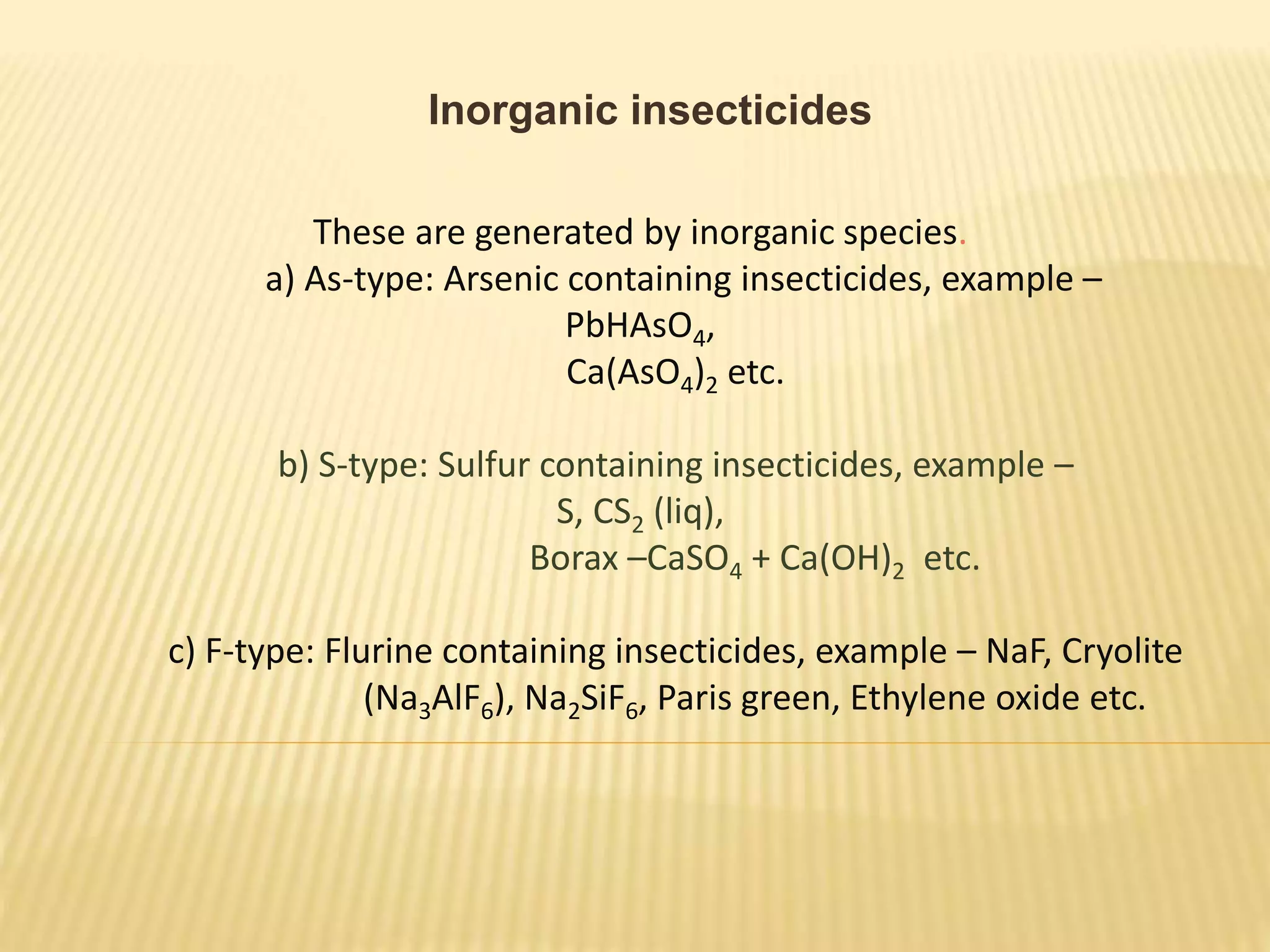
These are generated by inorganic species.
a) As-type: Arsenic containing insecticides, example –
PbHAsO4,
Ca(AsO4)2 etc.
b) S-type: Sulfur containing insecticides, example –
S, CS2 (liq),
Borax –CaSO4 + Ca(OH)2 etc.
c) F-type: Flurine containing insecticides, example – NaF, Cryolite
(Na3AlF6), Na2SiF6, Paris green, Ethylene oxide etc.
Inorganic insecticides
These are generated by organic species. These can be classed as –
a) Natural Organic Insecticides: These are naturally occurred.
Examples – Nicotine, Pyrethrins (C21H28O3), Rotenone (C23H22O6) etc.
b) Synthetic organic insecticides: These are synthetically generated. Such as-
1. Chlorine containing compounds –
DDT, Lindane (C6H6Cl6), Eldrin: C12H8Cl6 etc.
2. Phosphorus containing – TEPP, Di-thione, etc.
3. Organo-carbamates also insect's nervous system.
Examples – Isolan, Car. Organo-carbamatebayl etc.
Organic insecticides
Air pollution:
● The pesticides/ herbicides/ insecticides which are suspended in the air
contribute to air pollution, when they are carried away to other areas due to
wind.
● The phenomenon is also known as pesticide drift.
Water pollution:
● It refers to pollution of water bodies such as ponds, lakes or rivers due to
unintended mix up of synthetic herbicides/ fungicides/ pesticides
Soil pollution:
● It generally occurs when many of the pesticides/ insecticides/ herbicides is
used for a prolonged period of time which adversely affects the soil quality and
therefore polluting
Impact on the environment
PESTICIDES

PESTICIDES

  • 1.
    MD. HABIBUR RAHMAN IDNO: 20121107042 DEPARTMENT OF ACCE BSMRSTU. Welcome to my presentation
  • 2.
    My presentation topicis: “Agrochemicals: Classifications of Pesticides & Insecticides”
  • 3.
    What is agrochemicals? Chemicalproducts that used in agriculture are termed as Agrochemicals. Or Agrochemicals may any substance that used to help manage an agricultural ecosystem, or the community of organisms in a farming area.
  • 4.
  • 5.
    What are pesticides? Pesticidesare preparations for the eradication of plant and animal pests, for the protection of plants, animals and man. Or, “Any substance or mixture of substances intended for preventing, destroying, or controlling any pest, including vectors of human or animal disease, unwanted species of plants or animals, causing harm during the production, processing, storage, transport, or marketing of food, agricultural commodities, wood and wood products or animal feedstuffs”.
  • 6.
  • 7.
    Classification & functionof according to mode of action –
  • 9.
    Classification & functionof pesticides according to chemicals-
  • 10.
    First use ofsynthetic pesticides: 1940 2.26 million tons of active ingredients used in 2001. 25% of the world production used in developing countries... where 99% of deaths due to pesticides occur! Use of pesticides
  • 11.
    Use of pesticides– types of product pesticides used in different settings: - agricultural - veterinary - domestic - institutional formulations: liquid, gel, paste, chalk, powder, granules, pellets, baits... concentrations: from 2% to 80% of active ingredient containers: glass, plastic or metal flasks, bottles, drums, traps, plastic bags or paper bags... Continue.
  • 12.
    What is insecticides? Insecticideis a substance used to kill insects. They include ovicides and larvicides used against insect eggs and larvae, respectively. Insecticides are used in agriculture, medicine, industry and by consumers.
  • 13.
    on basis ofactivity insecticides can be classified in two major groups, such as:- a) systemic insecticides: which have residual or long term activity. b) contact insecticides: which have no residual activity. according to chemical nature insecticides can be classified in two major groups, like- a) inorganic insecticides, b) organic insecticides. Classification of insecticides –
  • 14.
    These are generatedby inorganic species. a) As-type: Arsenic containing insecticides, example – PbHAsO4, Ca(AsO4)2 etc. b) S-type: Sulfur containing insecticides, example – S, CS2 (liq), Borax –CaSO4 + Ca(OH)2 etc. c) F-type: Flurine containing insecticides, example – NaF, Cryolite (Na3AlF6), Na2SiF6, Paris green, Ethylene oxide etc. Inorganic insecticides
  • 15.
    These are generatedby organic species. These can be classed as – a) Natural Organic Insecticides: These are naturally occurred. Examples – Nicotine, Pyrethrins (C21H28O3), Rotenone (C23H22O6) etc. b) Synthetic organic insecticides: These are synthetically generated. Such as- 1. Chlorine containing compounds – DDT, Lindane (C6H6Cl6), Eldrin: C12H8Cl6 etc. 2. Phosphorus containing – TEPP, Di-thione, etc. 3. Organo-carbamates also insect's nervous system. Examples – Isolan, Car. Organo-carbamatebayl etc. Organic insecticides
  • 16.
    Air pollution: ● Thepesticides/ herbicides/ insecticides which are suspended in the air contribute to air pollution, when they are carried away to other areas due to wind. ● The phenomenon is also known as pesticide drift. Water pollution: ● It refers to pollution of water bodies such as ponds, lakes or rivers due to unintended mix up of synthetic herbicides/ fungicides/ pesticides Soil pollution: ● It generally occurs when many of the pesticides/ insecticides/ herbicides is used for a prolonged period of time which adversely affects the soil quality and therefore polluting Impact on the environment