Insect antifeedants and repellents – mode of
action, groups and uses.
AEN 202
Management of beneficial and harmful insects (2+1)
- presented by
M.SONALIKA
2019018095
• Antifeedants are chemicals that inhibit feeding in insects when applied
on the foliage (food) without impairing their appetite and gustatory
receptors or driving (repelling) them away from the food.
• They are also called gustatory repellents, feeding deterrents
and rejectants. Since do not feed on trated surface they die due to
starvation.
ANTIFEEDANTS
1. Triazenes - eg : acetanilide
2. Organotins: They are compounds containing tin. Eg : Triphenyl tin acetate
3. Carbamates: Eg : Baygon is a systemic antifeedants against cotton boll
weevil.
4. Botanicals: Antifeedants from non-host plants of the pest can be used for their
control The following antifeedants are produced from plants.
a) Pyrethrum
b) Neem
c) Apple factor
d) Solanum alkaloids
5. Miscellaneous compounds: Compounds like copper stearate, copper resinate,
mercuric chloride and Phosphon are good antifeedants.
Groups of antifeedants
Advantages:
• Affect plant feeders, but
safe to natural enemies
• Pest not immediately killed,
so natural enemies can feed
on them
• No phytotoxicity or
pollution
Disadvantages :
• Only chewing insects killed
and not sucking insects
• Not effective as sole
control measure, can be
included in IPM
Chemicals that cause insects to make oriented movements towards their
source are called insect attractants. They influence both gustatory (taste) and
olfactory (smell) receptors.
Types of Attractants:
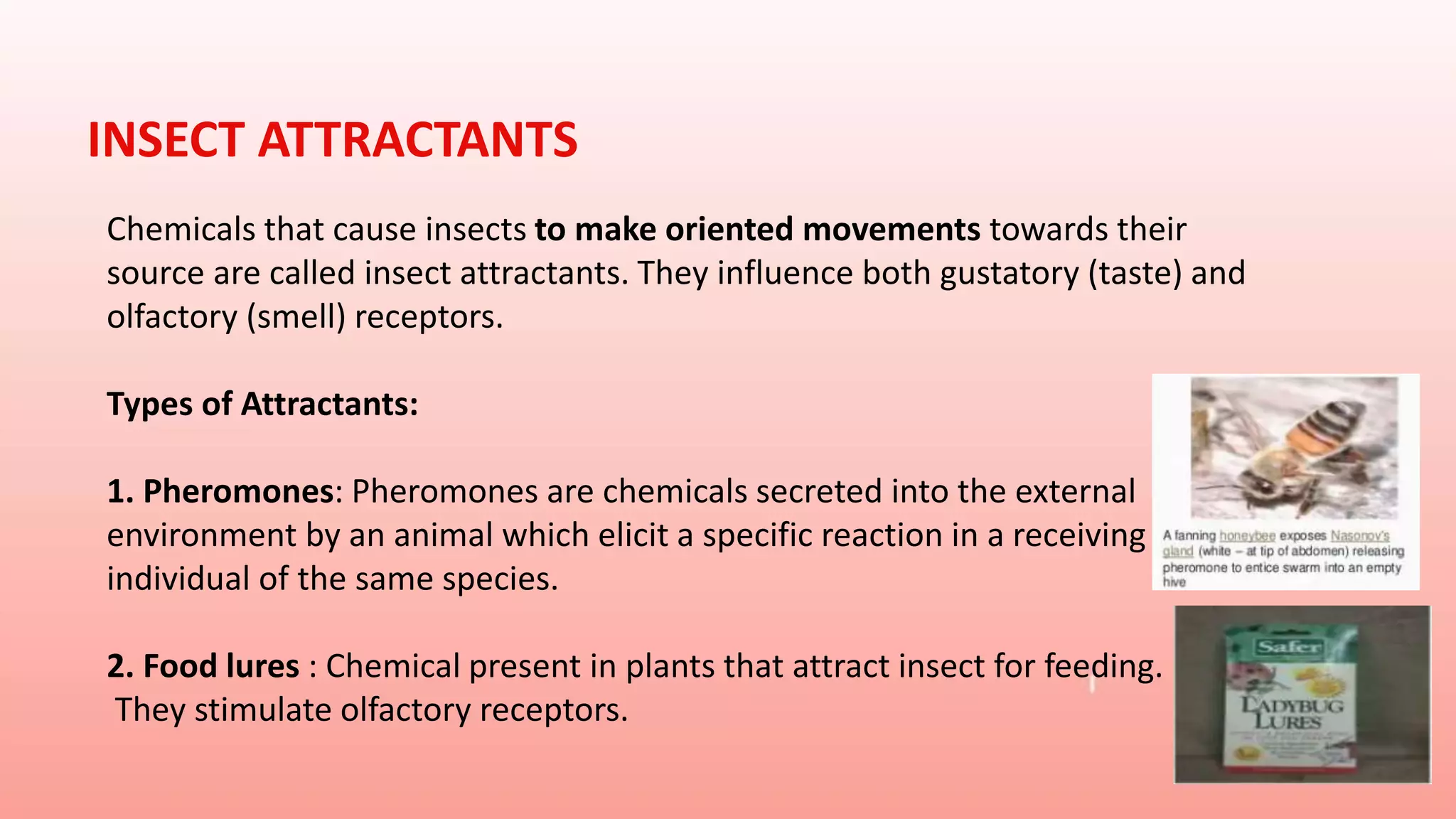
1. Pheromones: Pheromones are chemicals secreted into the external
environment by an animal which elicit a specific reaction in a receiving
individual of the same species.
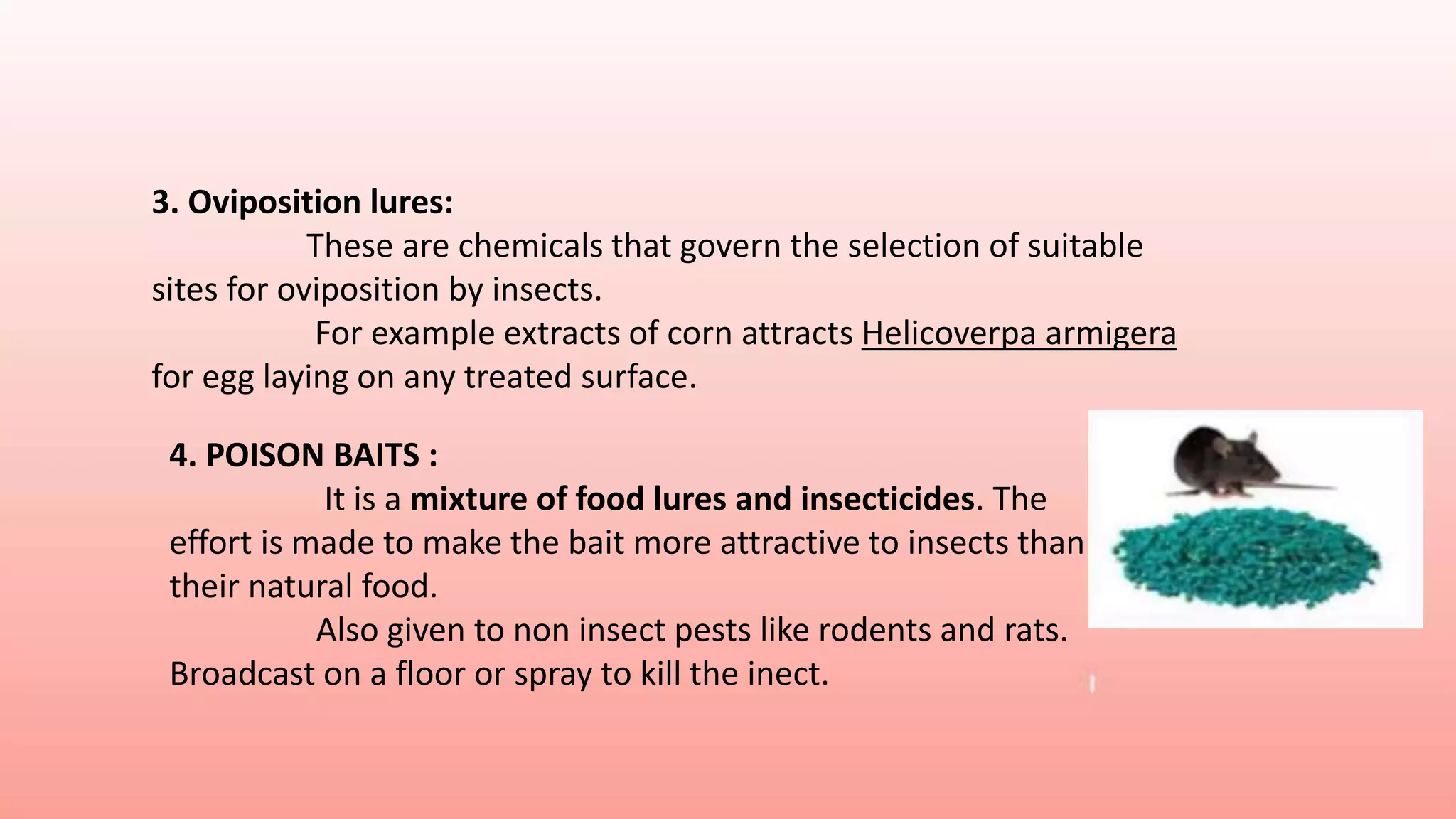
2. Food lures : Chemical present in plants that attract insect for feeding.
They stimulate olfactory receptors.
INSECT ATTRACTANTS
3. Oviposition lures:
These are chemicals that govern the selection of suitable
sites for oviposition by insects.
For example extracts of corn attracts Helicoverpa armigera
for egg laying on any treated surface.
4. POISON BAITS :
It is a mixture of food lures and insecticides. The
effort is made to make the bait more attractive to insects than
their natural food.
Also given to non insect pests like rodents and rats.
Broadcast on a floor or spray to kill the inect.
Chemicals that induce avoiding (oriented) movements in insects away from
their source are called repellents. They prevent insect damage to plants or
animals by rendering them unattractive, unpalatable or offensive.
2. Chemical repellents:
a) Repellents of Plant origin: oils
from Citronella, Camphor and
cedarwood and lemon grass
b) Synthetic repellents:dimethyl
phthalate ,naphthaene ,bordeaux
mixture and smoke
1. Physical repellents : Produce repellence by
physical means
a) Contact stimuli repellents: wax or oil
b) Auditory repellents: Amplified sound
c) Barrier repellents: Tar bands on trees and
mosquito nets
d) Visual repellents: Yellow light
e) Feeding repellents: Antifeedants are feeding
repellents. They inhibit feeding.
INSECT REPELLENTS (BUG SPRAY)
Types of repellents
Reference
1. Kubo, I., & Nakanishi, K. (1977). Insect antifeedants and repellents from
African plants.
2. Klocke, J. A., Balandrin, M. F., Barnby, M. A., & Yamasaki, R. B. (1989).
Limonoids, phenolics, and furanocoumarins as insect antifeedants,
repellents, and growth inhibitory compounds.
3. Nakanishi, K. (1980). Insect antifeedants from plants. In Insect biology in
the future (pp. 603-611). Academic Press.
4.Isman, M. B., & Miresmailli, S. (2011). Plant essential oils as repellents and
deterrents to agricultural pests. In Recent developments in invertebrate
repellents (pp. 67-77). American Chemical Society.
THANK YOU

Insect antifeedants and repellents – mode of action, groups and uses.pptx

  • 1.
    Insect antifeedants andrepellents – mode of action, groups and uses. AEN 202 Management of beneficial and harmful insects (2+1) - presented by M.SONALIKA 2019018095
  • 2.
    • Antifeedants arechemicals that inhibit feeding in insects when applied on the foliage (food) without impairing their appetite and gustatory receptors or driving (repelling) them away from the food. • They are also called gustatory repellents, feeding deterrents and rejectants. Since do not feed on trated surface they die due to starvation. ANTIFEEDANTS
  • 3.
    1. Triazenes -eg : acetanilide 2. Organotins: They are compounds containing tin. Eg : Triphenyl tin acetate 3. Carbamates: Eg : Baygon is a systemic antifeedants against cotton boll weevil. 4. Botanicals: Antifeedants from non-host plants of the pest can be used for their control The following antifeedants are produced from plants. a) Pyrethrum b) Neem c) Apple factor d) Solanum alkaloids 5. Miscellaneous compounds: Compounds like copper stearate, copper resinate, mercuric chloride and Phosphon are good antifeedants. Groups of antifeedants
  • 4.
    Advantages: • Affect plantfeeders, but safe to natural enemies • Pest not immediately killed, so natural enemies can feed on them • No phytotoxicity or pollution Disadvantages : • Only chewing insects killed and not sucking insects • Not effective as sole control measure, can be included in IPM
  • 5.
    Chemicals that causeinsects to make oriented movements towards their source are called insect attractants. They influence both gustatory (taste) and olfactory (smell) receptors. Types of Attractants: 1. Pheromones: Pheromones are chemicals secreted into the external environment by an animal which elicit a specific reaction in a receiving individual of the same species. 2. Food lures : Chemical present in plants that attract insect for feeding. They stimulate olfactory receptors. INSECT ATTRACTANTS
  • 6.
    3. Oviposition lures: Theseare chemicals that govern the selection of suitable sites for oviposition by insects. For example extracts of corn attracts Helicoverpa armigera for egg laying on any treated surface. 4. POISON BAITS : It is a mixture of food lures and insecticides. The effort is made to make the bait more attractive to insects than their natural food. Also given to non insect pests like rodents and rats. Broadcast on a floor or spray to kill the inect.
  • 7.
    Chemicals that induceavoiding (oriented) movements in insects away from their source are called repellents. They prevent insect damage to plants or animals by rendering them unattractive, unpalatable or offensive. 2. Chemical repellents: a) Repellents of Plant origin: oils from Citronella, Camphor and cedarwood and lemon grass b) Synthetic repellents:dimethyl phthalate ,naphthaene ,bordeaux mixture and smoke 1. Physical repellents : Produce repellence by physical means a) Contact stimuli repellents: wax or oil b) Auditory repellents: Amplified sound c) Barrier repellents: Tar bands on trees and mosquito nets d) Visual repellents: Yellow light e) Feeding repellents: Antifeedants are feeding repellents. They inhibit feeding. INSECT REPELLENTS (BUG SPRAY) Types of repellents
  • 8.
    Reference 1. Kubo, I.,& Nakanishi, K. (1977). Insect antifeedants and repellents from African plants. 2. Klocke, J. A., Balandrin, M. F., Barnby, M. A., & Yamasaki, R. B. (1989). Limonoids, phenolics, and furanocoumarins as insect antifeedants, repellents, and growth inhibitory compounds. 3. Nakanishi, K. (1980). Insect antifeedants from plants. In Insect biology in the future (pp. 603-611). Academic Press. 4.Isman, M. B., & Miresmailli, S. (2011). Plant essential oils as repellents and deterrents to agricultural pests. In Recent developments in invertebrate repellents (pp. 67-77). American Chemical Society.
  • 9.