The persuasive speech
The goal of a persuasive
speech:
• Convince your audience think, believe, or act
as you want them to.
Before we begin
Get out your writer’s notebook to write when I
ask you directed questions on the following
slides.
A persuasive speech seeks to
• Establish a fact
o E.g., Coffee drinkers have (do not have) a higher risk of
heart disease.
OR
• Change a belief
o E.g., It is (is not) wrong to avoid jury duty.
OR
• Move an audience to act on a policy
o E.g., Funding for space exploration should (should not) be
increased.
• Which one will you do with your research paper
topic?
Persuasive speeches use
various appeals
• Pathos
• Ethos
• Logos
• As I explain these, write down which one you
plan to use.
Persuasive speeches use
various appeals
• Emotional appeal (pathos)
o Cite specifics
o Use vivid language
o Include personal references
Persuasive speeches use
various appeals
• Establish your character and ethics (ethos)
o Show you are competent to be talking about your
topic
o Be sincere and genuine in your delivery
o Be energetic and enthusiastic about your topic
o Prove you are a credible voice on your topic
Persuasive speeches use
various appeals
• Apply logical reasoning (logos)
o Use reasons supported by evidence to
explain/justify your thesis
 Evidence from your life experience
 Evidence from your research
 Evidence from other people
Which type of appeal will you
use? Why?
• Pathos (emotion)
OR
• Ethos (character/ethics)
OR
• Logos (reasoning)
Persuasive speeches use various
appeals, and no matter what kind
of appeal you use,
• Maintain ethical standards
• It is unethical for public speakers
o To lie or deceive
o To distort
o To engage in name-calling
o To attack a person or an idea without giving evidence
o To deny the opposition the right to reply
• Avoid manipulating your audience.
o Persuade; do not manipulate
Adapt your persuasive speech
to your audience
• Toward your topic, your audience could be
o Mostly favorable
o Mostly neutral
o Mostly apathetic
o Mostly hostile
• You need to determine the audience’s stance
and read them as you are speaking to make
sure you adjust your delivery accordingly.
• What is THIS audience’s stance toward your
thesis?
o Write it down in your writer’s notebook!
Adapting to a favorable
audience
• A favorable audience means most of the
listeners agree with you.
• Need to sustain and build on their favorable
attitude.
Adapting to a neutral audience
• A neutral audience is one in which the
majority of the listeners have not reached a
decision about your thesis.
• They will listen to all sides of an argument
equally, so you need to give them information
to persuade them to take a stand.
Adapting to an apathetic
audience
• An apathetic audience is one in which the
majority of the listeners have no interest in
your thesis.
• Need to show how your thesis affects them
personally to persuade.
Adapting to a hostile audience
• A hostile audience is one in which the majority
of the listeners oppose your thesis.
• Need to show the listeners that they are being
fair in listening to you, that what you have to
say matters to them, and that you are worth
listening to.
Delivering your speech
convincingly
• Use, but don’t overuse, visual materials
• Google presentation slides
o With minimal information on them.
o Use them to emphasize key points.
o If everything you want to say is on the slides, why
should we listen to you?
• Or a Prezi!
o Still go for minimal and use the Prezi to
emphasize key points.
o A Prezi can get wickedly distracting, so be
careful.
Delivering your speech
convincingly
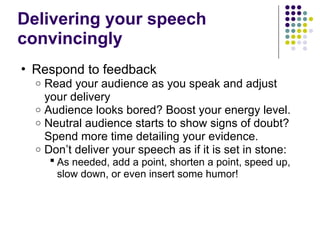
• Respond to feedback
o Read your audience as you speak and adjust
your delivery
o Audience looks bored? Boost your energy level.
o Neutral audience starts to show signs of doubt?
Spend more time detailing your evidence.
o Don’t deliver your speech as if it is set in stone:
 As needed, add a point, shorten a point, speed up,
slow down, or even insert some humor!
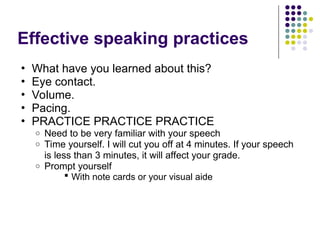
Effective speaking practices
• What have you learned about this?
• Eye contact.
• Volume.
• Pacing.
• PRACTICE PRACTICE PRACTICE
o Need to be very familiar with your speech
o Time yourself. I will cut you off at 4 minutes. If your speech
is less than 3 minutes, it will affect your grade.
o Prompt yourself
 With note cards or your visual aide
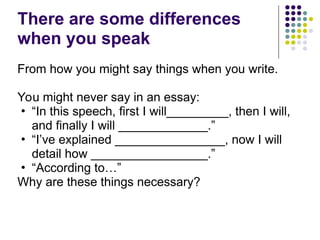
There are some differences
when you speak
From how you might say things when you write.
You might never say in an essay:
• “In this speech, first I will_________, then I will,
and finally I will _____________.”
• “I’ve explained ________________, now I will
detail how _________________.”
• “According to…”
Why are these things necessary?
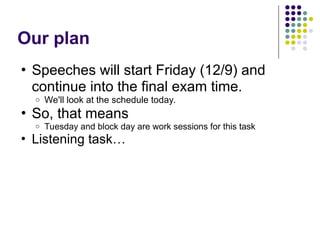
Our plan
• Speeches will start Friday (12/9) and
continue into the final exam time.
o We'll look at the schedule today.
• So, that means
o Tuesday and block day are work sessions for this task
• Listening task…

thepersuasivespeech-120415163438-phpapp02.ppt

  • 1.
  • 2.
    The goal ofa persuasive speech: • Convince your audience think, believe, or act as you want them to.
  • 3.
    Before we begin Getout your writer’s notebook to write when I ask you directed questions on the following slides.
  • 4.
    A persuasive speechseeks to • Establish a fact o E.g., Coffee drinkers have (do not have) a higher risk of heart disease. OR • Change a belief o E.g., It is (is not) wrong to avoid jury duty. OR • Move an audience to act on a policy o E.g., Funding for space exploration should (should not) be increased. • Which one will you do with your research paper topic?
  • 5.
    Persuasive speeches use variousappeals • Pathos • Ethos • Logos • As I explain these, write down which one you plan to use.
  • 6.
    Persuasive speeches use variousappeals • Emotional appeal (pathos) o Cite specifics o Use vivid language o Include personal references
  • 7.
    Persuasive speeches use variousappeals • Establish your character and ethics (ethos) o Show you are competent to be talking about your topic o Be sincere and genuine in your delivery o Be energetic and enthusiastic about your topic o Prove you are a credible voice on your topic
  • 8.
    Persuasive speeches use variousappeals • Apply logical reasoning (logos) o Use reasons supported by evidence to explain/justify your thesis  Evidence from your life experience  Evidence from your research  Evidence from other people
  • 9.
    Which type ofappeal will you use? Why? • Pathos (emotion) OR • Ethos (character/ethics) OR • Logos (reasoning)
  • 10.
    Persuasive speeches usevarious appeals, and no matter what kind of appeal you use, • Maintain ethical standards • It is unethical for public speakers o To lie or deceive o To distort o To engage in name-calling o To attack a person or an idea without giving evidence o To deny the opposition the right to reply • Avoid manipulating your audience. o Persuade; do not manipulate
  • 11.
    Adapt your persuasivespeech to your audience • Toward your topic, your audience could be o Mostly favorable o Mostly neutral o Mostly apathetic o Mostly hostile • You need to determine the audience’s stance and read them as you are speaking to make sure you adjust your delivery accordingly. • What is THIS audience’s stance toward your thesis? o Write it down in your writer’s notebook!
  • 12.
    Adapting to afavorable audience • A favorable audience means most of the listeners agree with you. • Need to sustain and build on their favorable attitude.
  • 13.
    Adapting to aneutral audience • A neutral audience is one in which the majority of the listeners have not reached a decision about your thesis. • They will listen to all sides of an argument equally, so you need to give them information to persuade them to take a stand.
  • 14.
    Adapting to anapathetic audience • An apathetic audience is one in which the majority of the listeners have no interest in your thesis. • Need to show how your thesis affects them personally to persuade.
  • 15.
    Adapting to ahostile audience • A hostile audience is one in which the majority of the listeners oppose your thesis. • Need to show the listeners that they are being fair in listening to you, that what you have to say matters to them, and that you are worth listening to.
  • 16.
    Delivering your speech convincingly •Use, but don’t overuse, visual materials • Google presentation slides o With minimal information on them. o Use them to emphasize key points. o If everything you want to say is on the slides, why should we listen to you? • Or a Prezi! o Still go for minimal and use the Prezi to emphasize key points. o A Prezi can get wickedly distracting, so be careful.
  • 17.
    Delivering your speech convincingly •Respond to feedback o Read your audience as you speak and adjust your delivery o Audience looks bored? Boost your energy level. o Neutral audience starts to show signs of doubt? Spend more time detailing your evidence. o Don’t deliver your speech as if it is set in stone:  As needed, add a point, shorten a point, speed up, slow down, or even insert some humor!
  • 18.
    Effective speaking practices •What have you learned about this? • Eye contact. • Volume. • Pacing. • PRACTICE PRACTICE PRACTICE o Need to be very familiar with your speech o Time yourself. I will cut you off at 4 minutes. If your speech is less than 3 minutes, it will affect your grade. o Prompt yourself  With note cards or your visual aide
  • 19.
    There are somedifferences when you speak From how you might say things when you write. You might never say in an essay: • “In this speech, first I will_________, then I will, and finally I will _____________.” • “I’ve explained ________________, now I will detail how _________________.” • “According to…” Why are these things necessary?
  • 20.
    Our plan • Speecheswill start Friday (12/9) and continue into the final exam time. o We'll look at the schedule today. • So, that means o Tuesday and block day are work sessions for this task • Listening task…