PERSPECTIVE DRAWING
A Power Point Presentation
By: Yash Pathania Sr. Lecturer [Arch.] GPCG, Amritsar
The 3 Dimensional World
2
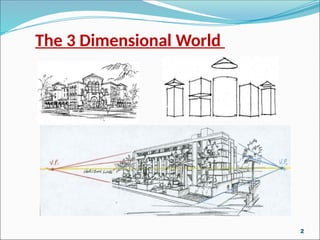
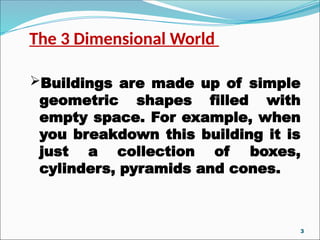
The 3 Dimensional World
Buildings are made up of simple
geometric shapes filled with
empty space. For example, when
you breakdown this building it is
just a collection of boxes,
cylinders, pyramids and cones.
3
REALITY
 The actual appearance of
the object (according to its
actual dimensions) is known
as the Reality.
 In other words , there are
true relationships between
various lines of plans,
elevations etc.
4
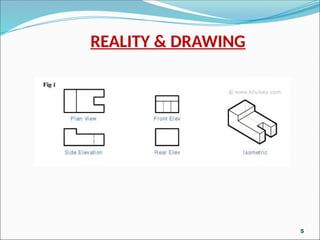
REALITY & DRAWING
5
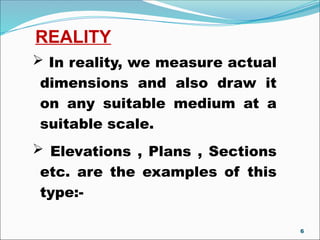
REALITY
 In reality, we measure actual
dimensions and also draw it
on any suitable medium at a
suitable scale.
 Elevations , Plans , Sections
etc. are the examples of this
type:-
6
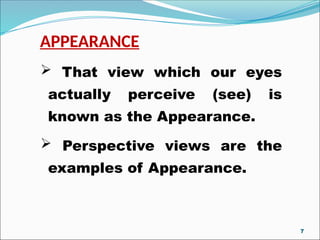
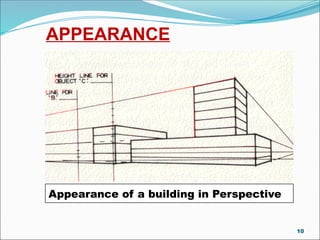
APPEARANCE
 That view which our eyes
actually perceive (see) is
known as the Appearance.
 Perspective views are the
examples of Appearance.
7
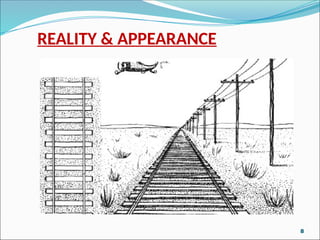
REALITY & APPEARANCE
8
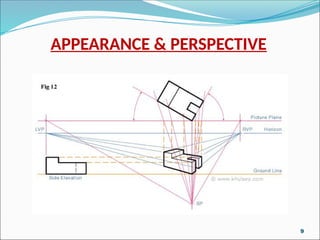
APPEARANCE & PERSPECTIVE
9
Appearance of a building in Perspective
APPEARANCE
10
INTRODUCTION
 An Architect can offer some
amazing images of one’s dream
house in architectural language.
 In other words an Architect
shows his prepared drawings in
the 3-d views to impress his
clients.
11
INTRODUCTION
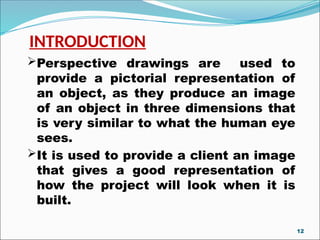
Perspective drawings are used to
provide a pictorial representation of
an object, as they produce an image
of an object in three dimensions that
is very similar to what the human eye
sees.
It is used to provide a client an image
that gives a good representation of
how the project will look when it is
built.
12
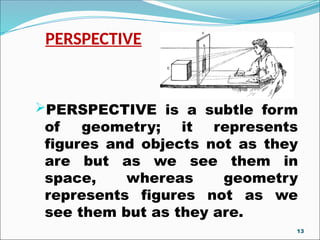
PERSPECTIVE
PERSPECTIVE is a subtle form
of geometry; it represents
figures and objects not as they
are but as we see them in
space, whereas geometry
represents figures not as we
see them but as they are.
13
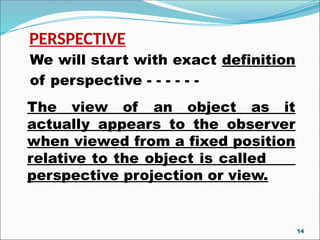
We will start with exact definition
of perspective - - - - - -
The view of an object as it
actually appears to the observer
when viewed from a fixed position
relative to the object is called
perspective projection or view.
PERSPECTIVE
14
INTRODUCTION
15
INTRODUCTION
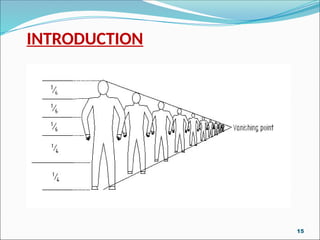
As an object gets further away
from a viewer, it appears smaller
and objects tend to approach a
vanishing point as they get further
from the viewer. Each person on
the perspective grid is 2m apart.
As the people appear smaller, the
gap between each person also
decreases.
16
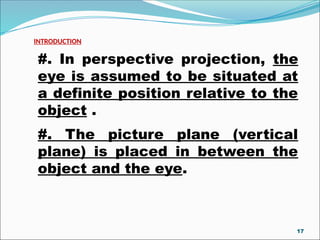
#. In perspective projection, the
eye is assumed to be situated at
a definite position relative to the
object .
#. The picture plane (vertical
plane) is placed in between the
object and the eye.
INTRODUCTION
17
#. Visual rays from the eye to
the object pierce the picture
plane and form an image on it.
#. This image is known as
perspective of the object.
INTRODUCTION
18
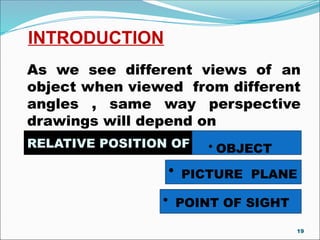
As we see different views of an
object when viewed from different
angles , same way perspective
drawings will depend on
RELATIVE POSITION OF
• PICTURE PLANE
• POINT OF SIGHT
• OBJECT
INTRODUCTION
19
TERMINOLOGY OF PERSPECTIVE
#. Before going further it would be better if
we understand general terms used in
perspective
#. Some of these are as follows---------
20
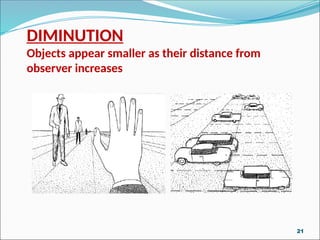
DIMINUTION
Objects appear smaller as their distance from
observer increases
21
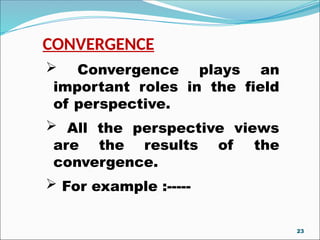
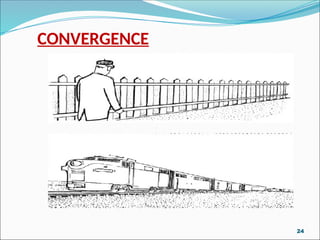
CONVERGENCE
Any two parallel lines seen by
the naked eyes , seem to be
meeting at a particular point
and suggesting as if they are
converging at some distant
point. This process is called
the convergence in the
perspective.
22
CONVERGENCE
 Convergence plays an
important roles in the field
of perspective.
 All the perspective views
are the results of the
convergence.
 For example :-----
23
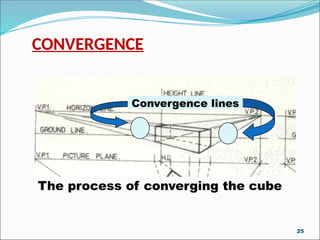
CONVERGENCE
24
CONVERGENCE
Convergence lines
The process of converging the cube
25
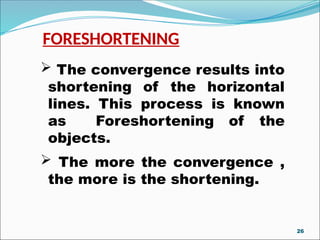
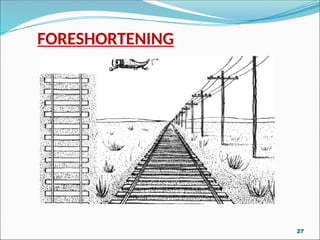
FORESHORTENING
 The convergence results into
shortening of the horizontal
lines. This process is known
as Foreshortening of the
objects.
 The more the convergence ,
the more is the shortening.
26
FORESHORTENING
27
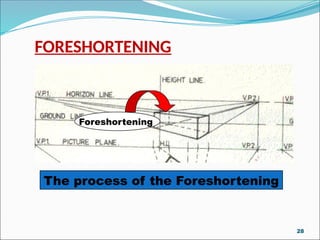
FORESHORTENING
Foreshortening
The process of the Foreshortening
28
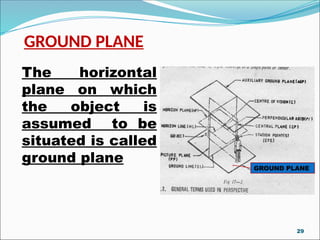
GROUND PLANE
The horizontal
plane on which
the object is
assumed to be
situated is called
ground plane
DRG-4
GROUND PLANE
29
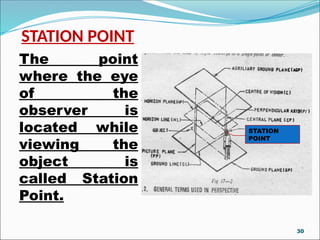
STATION POINT
The point
where the eye
of the
observer is
located while
viewing the
object is
called Station
Point.
DRG-4
STATION
POINT
30
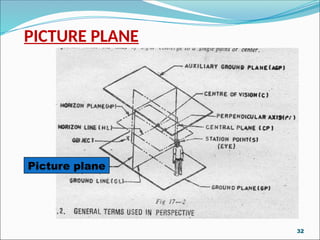
PICTURE PLANE
The vertical transparent plane
located between the station
point and the object is called
picture plane.
It is the plane on which the
picture is formed.
31
PICTURE PLANE
Picture plane
32
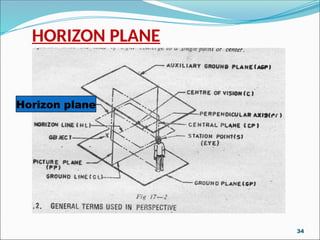
HORIZON PLANE
An imaginary horizontal plane
at the level of station point that
is observer’s eye , is called
horizontal plane .
This plane is above the ground
plane and perpendicular to the
picture plane.
33
HORIZON PLANE
Horizon plane
34
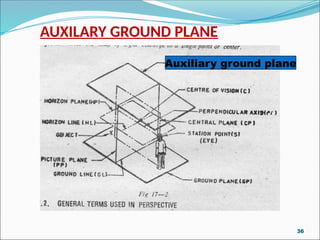
AUXILIARY GROUND PLANE
A horizontal plane which is
placed parallel and above the
horizon plane is called auxiliary
ground plane.
The top view of the object is
projected on this plane.
35
AUXILARY GROUND PLANE
Auxiliary ground plane
36
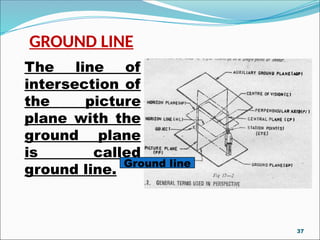
GROUND LINE
The line of
intersection of
the picture
plane with the
ground plane
is called
ground line.
DRG-4
Ground line
37
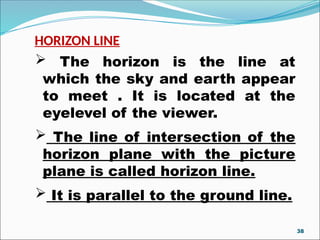
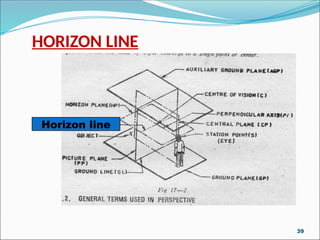
HORIZON LINE
 The horizon is the line at
which the sky and earth appear
to meet . It is located at the
eyelevel of the viewer.
 The line of intersection of the
horizon plane with the picture
plane is called horizon line.
 It is parallel to the ground line.
38
HORIZON LINE
Horizon line
39
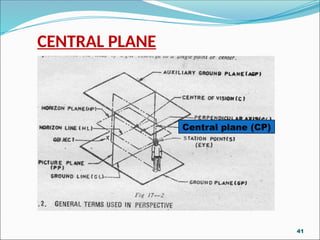
CENTRAL PLANE
An imaginary vertical plane
which passes through the station
point and centre of vision is
called central plane.
40
CENTRAL PLANE
Central plane (CP)
41
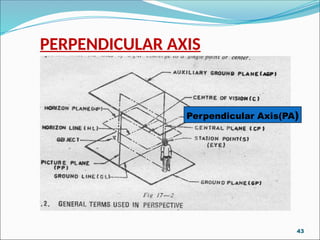
PERPENDICULAR AXIS
A line which is drawn through
the station point and
perpendicular to the picture
plane is called perpendicular
axis.
It is also called line of vision or
line of sight.
42
PERPENDICULAR AXIS
Perpendicular Axis(PA)
43
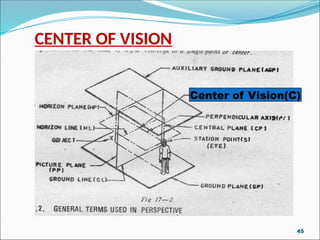
CENTER OF VISION
The point through which
the perpendicular axis
pierces the picture plane
and lies on the horizon line
is called the centre of
vision.
44
CENTER OF VISION
Center of Vision(C)
45
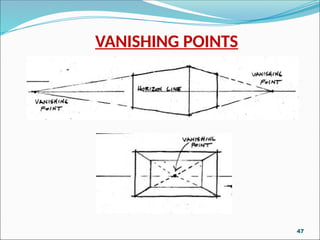
VANISHING POINTS
The points in space where
by definition , parallel lines
meet are called vanishing
points.
Every set of parallel lines but
not parallel to the picture
plane ,has a vanishing point.
46
VANISHING POINTS
47
VANISHING POINTS
The type of the perspectives
are also dependant upon the
number of these points.
For example:-
48
VANISHING POINTS
 One point perspective has one
vanishing point.
 Two point perspective has two
vanishing points.
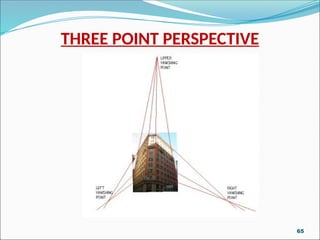
 Three point perspective has
three vanishing points.
49
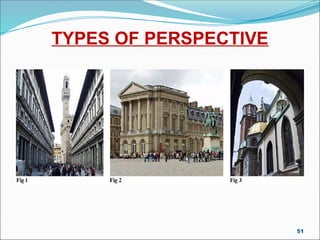
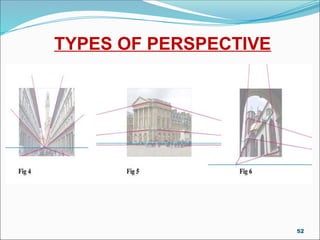
TYPES OF PERSPECTIVE
Mainly perspectives are of
three types ,according to the
number of vanishing points
required to make them------------
 ONE POINT OR PARALLEL
 TWO POINT OR ANGULAR
 THREE POINT OR OBLIQUE
50
TYPES OF PERSPECTIVE
51
TYPES OF PERSPECTIVE
52
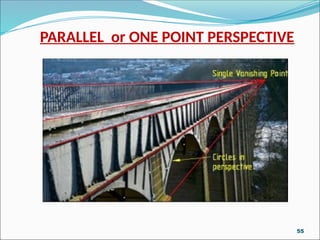
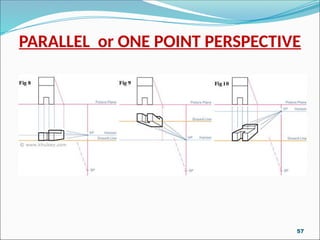
PARALLEL OR ONE POINT
PERSPECTIVE
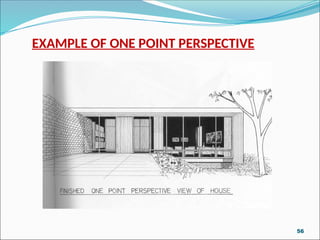
When one face of the object is
parallel to the picture plane and
the other perpendicular to it ,the
resulting picture is called
parallel or one point perspective.
53
PARALLEL or ONE POINT PERSPECTIVE
It is used when one face of the
object viewed is perpendicular to
the line of sight from the viewer.
The one point perspective is used
for representation of streetscape,
interiors of buildings and machine
parts.
54
PARALLEL or ONE POINT PERSPECTIVE
55
EXAMPLE OF ONE POINT PERSPECTIVE
DRG-5
56
PARALLEL or ONE POINT PERSPECTIVE
57
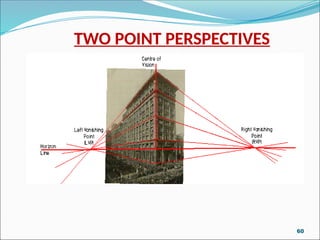
TWO POINT PERSPECTIVE
When two faces of the object
are inclined to picture plane
and others parallel to them ,
the resulting picture is called
angular or two point
perspectives.
58
TWO POINT PERSPECTIVES
The angular or two point
perspective is used for
representing exteriors of
buildings & large structures in
Architecture.
59
TWO POINT PERSPECTIVES
60
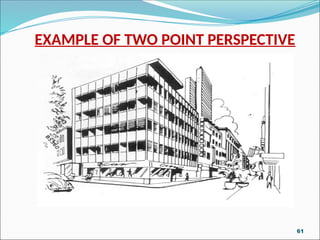
EXAMPLE OF TWO POINT PERSPECTIVE
DRG-6
61
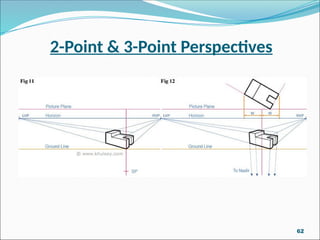
2-Point & 3-Point Perspectives
62
THREE POINT PERSPECTIVE
When all faces of the object
are oblique to the picture
plane , the resulting picture
is called oblique or three
point perspectives.
63
THREE POINT PERSPECTIVE
This is mainly used for
objects in space and for
skyscrapers etc.
And in this case we have
object which is inclined to
ground plane.
64
THREE POINT PERSPECTIVE
65
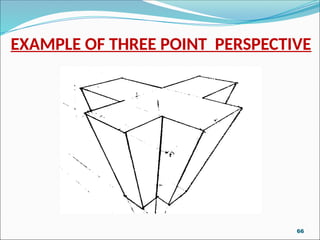
EXAMPLE OF THREE POINT PERSPECTIVE
DRG-7
66
PRINCIPLE
AIDS
OF
PERSPECTIVE
67
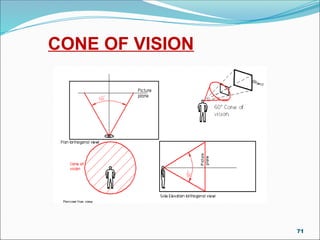
CONE OF VISION
 The cone of vision is required
to obtain the limits of the
drawing.
 The field of vision is known to
be more than 180 degrees .
 But it is not possible to see
clearly over this whole range.
68
CONE OF VISION
 The normal maximum
range within which it is
possible to see clearly and
easily is accepted as being
less than 90 degrees .
 And is seldom taken as
more than 60 degrees.
69
CONE OF VISION
 But for the purpose of
perspective drawing it is
usually limited to 60 degrees
or less.
 Any thing outside this cone
of vision will give us a
distorted view.
70
CONE OF VISION
71
CONE OF VISION
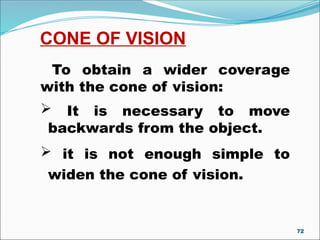
To obtain a wider coverage
with the cone of vision:
 It is necessary to move
backwards from the object.
 it is not enough simple to
widen the cone of vision.
72
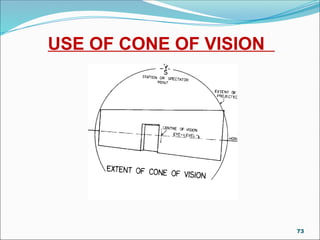
USE OF CONE OF VISION
DRG-10
73
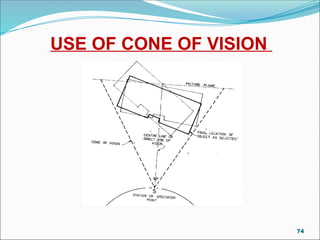
USE OF CONE OF VISION
DRG-11
74
CONE OF VISION
 When deciding on the position
from which to view the
building or object.
 It is necessary to fit the
whole- or the part which it is
intended to include in the
drawing-inside Cone of Vision.
75
CONE OF VISION
 Cone of Vision governs the
distance from which one
should view the object.
 The apex of the cone of
vision is known as the Station
Point, the Spectator Point or
the Viewing Point.
76
CONE OF VISION
 The centre line of this cone
is known as the Centre Line
of Vision or the Direct Line of
Vision.
 This line is represented in
plan by a vertical line and in
elevation by as horizontal
line.
77
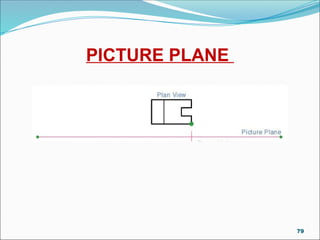
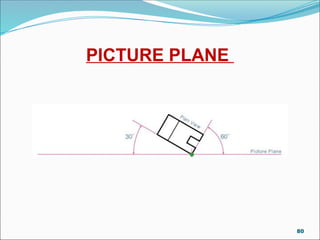
PICTURE PLANE
 The Picture Plane [PP] is an
imaginary plane on which the
perspective is supposed to be
drawn.
 This plane is shown as a line
in plan and is always at right
angles to the Direct Line of
Vision.
78
PICTURE PLANE
79
PICTURE PLANE
80
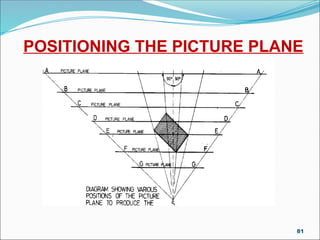
POSITIONING THE PICTURE PLANE
DRG-12
81
POSITIONING THE PICTURE PLANE
 Usually in side elevation the
Picture Plane is also shown as
a line at right angles to the
Ground Plane.
 As it is quite clear from the
following sketch.
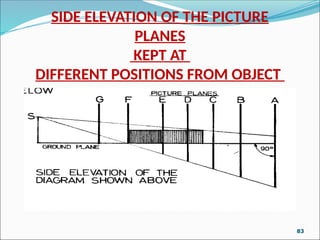
82
SIDE ELEVATION OF THE PICTURE
PLANES
KEPT AT
DIFFERENT POSITIONS FROM OBJECT
DRG-13
83
POSITIONING THE PICTURE PLANE
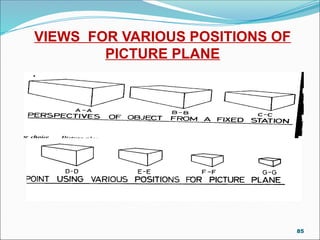
 As shown in the previous
diagrams it is quite clear that
the size of the object is very
much dependant on the
position of Picture Plane.
84
VIEWS FOR VARIOUS POSITIONS OF
PICTURE PLANE
DRG-14
85
POSITIONING THE PICTURE PLANE
 And it is also quite clear
from the figure that closer
the observer to the picture
plane , smaller the resulting
perspective.
86
POSITIONING THE PICTURE PLANE
The thing we must observe
here is that:
 It is the size only that is
varying according to the
position of Picture Plane,
otherwise there is no change
in shape/form or the view is
always the same.
87
HEIGHT LINE
 The height line is the line in
the perspective projection
used for taking all vertical
heights , which are measured
using the same scale as that
of plan.
88
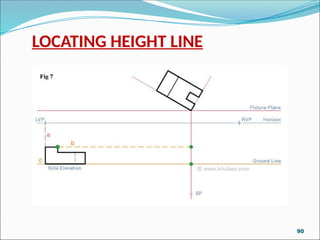
LOCATING HEIGHT LINE
 The location of this line is
found by projecting a line as
the continuation of one of the
longer sides of plan of the
object backward or forward to
meet the picture plane; to
mark its position as a point for
Height Line on Picture Plane.
89
LOCATING HEIGHT LINE
90
LOCATING HEIGHT LINE
 From this point where the
said two lines intersect each
other, a vertical line is drawn
to cross the Eye Level or
Horizon Line & right up to the
Ground Line.
91
EYE LEVEL OR HORIZON LINE
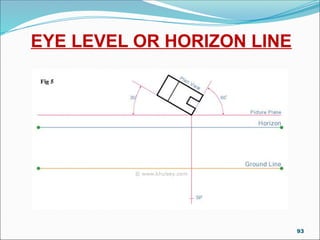
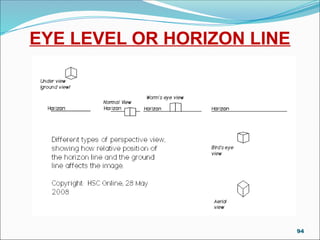
 The Eye Level , which
coincides with the Horizon
Line in the perspective
projection , is a horizontal
line drawn at a convenient
point above or below the plan
of the Picture Plane.
92
EYE LEVEL OR HORIZON LINE
93
EYE LEVEL OR HORIZON LINE
94
EYE LEVEL OR HORIZON LINE
 The location of this line is
entirely at the discretion of the
person.
 And the main consideration is
the space and the equipment
available to him.
95
EYE LEVEL OR HORIZON LINE
 As all lines projected on plan
have to be projected vertically
to this line .
 It is wise to select a position
in which this can be done with
the least effort.
96
EYE LEVEL OR HORIZON LINE
 This line represents the height
of the observing eye and all
heights are measured in relation
to this line.
97
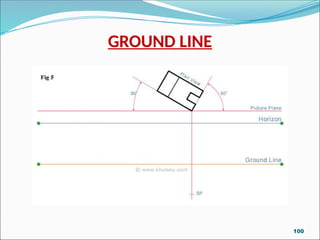
GROUND LINE
 The ground line in
perspective projection is the
line of the ground in relation
to the eye level.
 Under normal circumstances
this is considered to be 5 ft.
below the eye level or the
horizon line.
98
GROUND LINE
 The Ground Line is located in
perspective projection by
measuring down the height
line from the Horizon Line as
scale distance of 5 ft.
 All height measurements of
the object should be measured
from the ground line up.
99
GROUND LINE
100
VANISHING POINTS
#. Vanishing Points are points
located on the Picture Plane and
the Horizon Line to which the
lines of the perspective
projection will converge.
101
VANISHING POINTS
#. All lines on plan in one
direction will converge in the
perspective to the vanishing
points in the same direction.
#. The number of vanishing
points in a perspective may
vary .
102
VANISHING POINTS
#. Number of vanishing points
start from one and two in case
of two point perspective or
more depending on the
complicated objects.
103
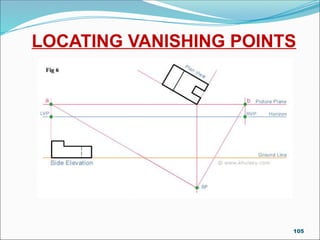
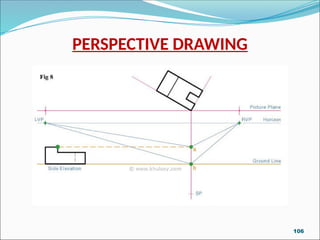
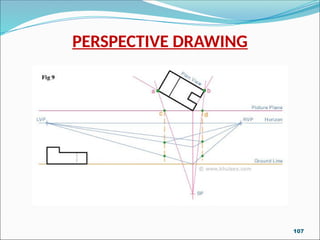
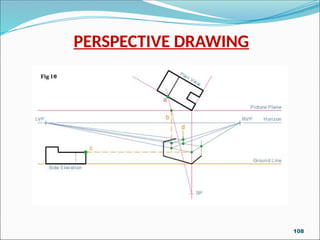
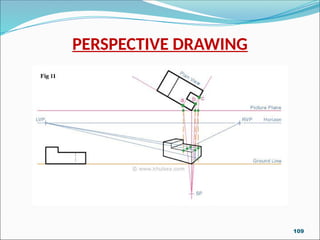
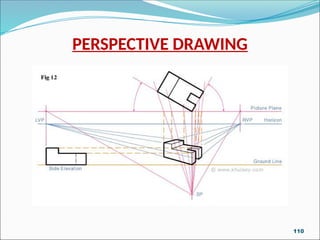
LOCATING VANISHING POINTS
#. The Vanishing Points are
found by drawing lines from the
Station Point parallel to the
sides of the object to meet the
Picture Plane in plan.
104
LOCATING VANISHING POINTS
105
PERSPECTIVE DRAWING
106
PERSPECTIVE DRAWING
107
PERSPECTIVE DRAWING
108
PERSPECTIVE DRAWING
109
PERSPECTIVE DRAWING
110
Elements of Perspective
Definition of Terms and some rules of thumb
Perspective: the method of drawing so that
objects represented have apparent depth
and distance…
The Merriam-Webster Dictionary
Picture Plane: the imaginary window that
frames the things you are attempting to
draw or paint
111
Elements of Perspective
Definition of Terms and some rules of thumb
Horizon Line – were the sky meets the earth
Eye Level - the horizontal level in line with
your eyes when you’re looking straight
ahead
Vanishing Point – the point at which all
parallel lines meet and or vanish as they
recede into the distance
112
Elements of Perspective
Definition of Terms and some rules of thumb
Converging Lines – parallel lines that
appear to approach the same point on the
horizon
Overlap – the placement of one object in
front of another to create the illusion of
depth
113
Elements of Perspective
Definition of Terms and some rules of thumb
Size and Space Variation – the drawing
of objects that are in reality equally
sized and spaced objects so that they
get smaller and closer together as they
approach the horizon
114
Elements of Perspective
Definition of Terms and some rules of thumb
Modeling – the shading and texturing of an
object in a drawing so that it appears to have
form, depth, a front, sides and a back, there is
something behind it if you could only see.
Color and Value Change – the use of a lighter
value of color in the areas you want to appear
further in the distance
115
Things appear to grow smaller as they
recede into the distance
All horizontal parallel lines that are
above the Eye Level line appear to go
downward as they recede into the
distance
Elements of Perspective
Rules of Thumb
116
Elements of Perspective
Rules of Thumb
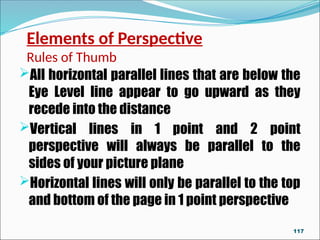
All horizontal parallel lines that are below the
Eye Level line appear to go upward as they
recede into the distance
Vertical lines in 1 point and 2 point
perspective will always be parallel to the
sides of your picture plane
Horizontal lines will only be parallel to the top
and bottom of the page in 1 point perspective
117
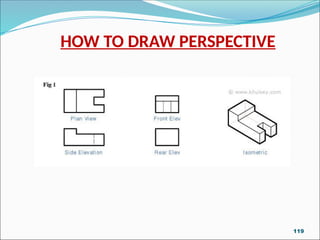
HOW TO DRAW PERSPECTIVE
For making perspective of any
object or building we should
have the following set of
drawings, drawn to some same
convenient scale:
 PLANS
 ELEVATIONS
 SECTIONS
118
HOW TO DRAW PERSPECTIVE
119
WE SHOULD CAREFULLY POSITION THE FOLLOWING
BEFORE STARTING TO DRAW A PERSPECTIVE
SELECTION OF:
 STATION POINT
 CONE OF VISION
 PICTURE PLANE
 HEIGHT LINE
 EYE LEVEL OR HORIZON LINE
 GROUND LINE
 VANISHING POINTS
120
The position of station point is
very important in making an
attractive perspective.
There fore , it should be located
at the point so as to view the
object in the best possible
manner.
SELECTION OF STATION POINT
121
SELECTION OF STATION POINT
There is no fixed rule as our
position of best station point
changes with the:
 SIZE OF OBJECT
 RELATIONSHIP BETWEEN VARIOUS
PARTS OF OBJECT
122
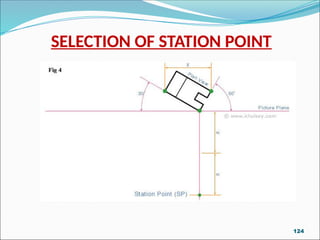
DEPENDANCE ON SIZE OF THE OBJECT
#. For large objects the station
point is usually taken at a
normal standing heights of a
person that is about 1.8 meters.
123
SELECTION OF STATION POINT
124
DEPENDANCE ON SIZE OF THE OBJECT
#. For small objects, the station
point should be fixed at such a
height so as to give a good view
of the top surface as well as side
surfaces.
125
RELATIONSHIP BETWEEN VARIOUS PARTS
OF OBJECT
#. For objects having heights
and widths more or less equal,
the station point may be fixed in
such a way that the angle
between the visual rays from the
station point to the outermost
boundaries of the object make
approximately 30 degree angle.
126
# Cone of vision should be
between 30-35 degrees all
round the Centre Line of Vision.
# The distance of the station
point from the picture plane
should be equal to twice the
greatest dimension of the
object.
WE MUST ENSURE
127
WE MUST ENSURE
#. The station point should be
so situated in front of the
object that the center of vision
be somewhat near the picture’s
centre.
128
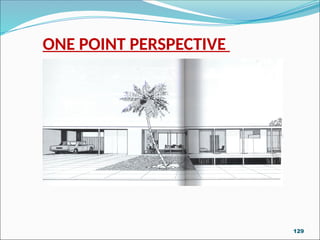
ONE POINT PERSPECTIVE
DRG-8
l
129
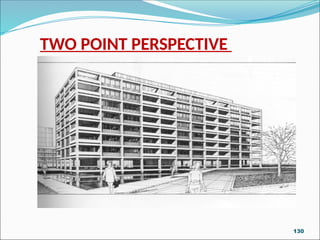
TWO POINT PERSPECTIVE
DRG-9
130

Perspective Drawing INTRO & TERMINOLOGY COLOR.pptx

  • 1.
    PERSPECTIVE DRAWING A PowerPoint Presentation By: Yash Pathania Sr. Lecturer [Arch.] GPCG, Amritsar
  • 2.
  • 3.
    The 3 DimensionalWorld Buildings are made up of simple geometric shapes filled with empty space. For example, when you breakdown this building it is just a collection of boxes, cylinders, pyramids and cones. 3
  • 4.
    REALITY  The actualappearance of the object (according to its actual dimensions) is known as the Reality.  In other words , there are true relationships between various lines of plans, elevations etc. 4
  • 5.
  • 6.
    REALITY  In reality,we measure actual dimensions and also draw it on any suitable medium at a suitable scale.  Elevations , Plans , Sections etc. are the examples of this type:- 6
  • 7.
    APPEARANCE  That viewwhich our eyes actually perceive (see) is known as the Appearance.  Perspective views are the examples of Appearance. 7
  • 8.
  • 9.
  • 10.
    Appearance of abuilding in Perspective APPEARANCE 10
  • 11.
    INTRODUCTION  An Architectcan offer some amazing images of one’s dream house in architectural language.  In other words an Architect shows his prepared drawings in the 3-d views to impress his clients. 11
  • 12.
    INTRODUCTION Perspective drawings areused to provide a pictorial representation of an object, as they produce an image of an object in three dimensions that is very similar to what the human eye sees. It is used to provide a client an image that gives a good representation of how the project will look when it is built. 12
  • 13.
    PERSPECTIVE PERSPECTIVE is asubtle form of geometry; it represents figures and objects not as they are but as we see them in space, whereas geometry represents figures not as we see them but as they are. 13
  • 14.
    We will startwith exact definition of perspective - - - - - - The view of an object as it actually appears to the observer when viewed from a fixed position relative to the object is called perspective projection or view. PERSPECTIVE 14
  • 15.
  • 16.
    INTRODUCTION As an objectgets further away from a viewer, it appears smaller and objects tend to approach a vanishing point as they get further from the viewer. Each person on the perspective grid is 2m apart. As the people appear smaller, the gap between each person also decreases. 16
  • 17.
    #. In perspectiveprojection, the eye is assumed to be situated at a definite position relative to the object . #. The picture plane (vertical plane) is placed in between the object and the eye. INTRODUCTION 17
  • 18.
    #. Visual raysfrom the eye to the object pierce the picture plane and form an image on it. #. This image is known as perspective of the object. INTRODUCTION 18
  • 19.
    As we seedifferent views of an object when viewed from different angles , same way perspective drawings will depend on RELATIVE POSITION OF • PICTURE PLANE • POINT OF SIGHT • OBJECT INTRODUCTION 19
  • 20.
    TERMINOLOGY OF PERSPECTIVE #.Before going further it would be better if we understand general terms used in perspective #. Some of these are as follows--------- 20
  • 21.
    DIMINUTION Objects appear smalleras their distance from observer increases 21
  • 22.
    CONVERGENCE Any two parallellines seen by the naked eyes , seem to be meeting at a particular point and suggesting as if they are converging at some distant point. This process is called the convergence in the perspective. 22
  • 23.
    CONVERGENCE  Convergence playsan important roles in the field of perspective.  All the perspective views are the results of the convergence.  For example :----- 23
  • 24.
  • 25.
  • 26.
    FORESHORTENING  The convergenceresults into shortening of the horizontal lines. This process is known as Foreshortening of the objects.  The more the convergence , the more is the shortening. 26
  • 27.
  • 28.
  • 29.
    GROUND PLANE The horizontal planeon which the object is assumed to be situated is called ground plane DRG-4 GROUND PLANE 29
  • 30.
    STATION POINT The point wherethe eye of the observer is located while viewing the object is called Station Point. DRG-4 STATION POINT 30
  • 31.
    PICTURE PLANE The verticaltransparent plane located between the station point and the object is called picture plane. It is the plane on which the picture is formed. 31
  • 32.
  • 33.
    HORIZON PLANE An imaginaryhorizontal plane at the level of station point that is observer’s eye , is called horizontal plane . This plane is above the ground plane and perpendicular to the picture plane. 33
  • 34.
  • 35.
    AUXILIARY GROUND PLANE Ahorizontal plane which is placed parallel and above the horizon plane is called auxiliary ground plane. The top view of the object is projected on this plane. 35
  • 36.
  • 37.
    GROUND LINE The lineof intersection of the picture plane with the ground plane is called ground line. DRG-4 Ground line 37
  • 38.
    HORIZON LINE  Thehorizon is the line at which the sky and earth appear to meet . It is located at the eyelevel of the viewer.  The line of intersection of the horizon plane with the picture plane is called horizon line.  It is parallel to the ground line. 38
  • 39.
  • 40.
    CENTRAL PLANE An imaginaryvertical plane which passes through the station point and centre of vision is called central plane. 40
  • 41.
  • 42.
    PERPENDICULAR AXIS A linewhich is drawn through the station point and perpendicular to the picture plane is called perpendicular axis. It is also called line of vision or line of sight. 42
  • 43.
  • 44.
    CENTER OF VISION Thepoint through which the perpendicular axis pierces the picture plane and lies on the horizon line is called the centre of vision. 44
  • 45.
    CENTER OF VISION Centerof Vision(C) 45
  • 46.
    VANISHING POINTS The pointsin space where by definition , parallel lines meet are called vanishing points. Every set of parallel lines but not parallel to the picture plane ,has a vanishing point. 46
  • 47.
  • 48.
    VANISHING POINTS The typeof the perspectives are also dependant upon the number of these points. For example:- 48
  • 49.
    VANISHING POINTS  Onepoint perspective has one vanishing point.  Two point perspective has two vanishing points.  Three point perspective has three vanishing points. 49
  • 50.
    TYPES OF PERSPECTIVE Mainlyperspectives are of three types ,according to the number of vanishing points required to make them------------  ONE POINT OR PARALLEL  TWO POINT OR ANGULAR  THREE POINT OR OBLIQUE 50
  • 51.
  • 52.
  • 53.
    PARALLEL OR ONEPOINT PERSPECTIVE When one face of the object is parallel to the picture plane and the other perpendicular to it ,the resulting picture is called parallel or one point perspective. 53
  • 54.
    PARALLEL or ONEPOINT PERSPECTIVE It is used when one face of the object viewed is perpendicular to the line of sight from the viewer. The one point perspective is used for representation of streetscape, interiors of buildings and machine parts. 54
  • 55.
    PARALLEL or ONEPOINT PERSPECTIVE 55
  • 56.
    EXAMPLE OF ONEPOINT PERSPECTIVE DRG-5 56
  • 57.
    PARALLEL or ONEPOINT PERSPECTIVE 57
  • 58.
    TWO POINT PERSPECTIVE Whentwo faces of the object are inclined to picture plane and others parallel to them , the resulting picture is called angular or two point perspectives. 58
  • 59.
    TWO POINT PERSPECTIVES Theangular or two point perspective is used for representing exteriors of buildings & large structures in Architecture. 59
  • 60.
  • 61.
    EXAMPLE OF TWOPOINT PERSPECTIVE DRG-6 61
  • 62.
    2-Point & 3-PointPerspectives 62
  • 63.
    THREE POINT PERSPECTIVE Whenall faces of the object are oblique to the picture plane , the resulting picture is called oblique or three point perspectives. 63
  • 64.
    THREE POINT PERSPECTIVE Thisis mainly used for objects in space and for skyscrapers etc. And in this case we have object which is inclined to ground plane. 64
  • 65.
  • 66.
    EXAMPLE OF THREEPOINT PERSPECTIVE DRG-7 66
  • 67.
  • 68.
    CONE OF VISION The cone of vision is required to obtain the limits of the drawing.  The field of vision is known to be more than 180 degrees .  But it is not possible to see clearly over this whole range. 68
  • 69.
    CONE OF VISION The normal maximum range within which it is possible to see clearly and easily is accepted as being less than 90 degrees .  And is seldom taken as more than 60 degrees. 69
  • 70.
    CONE OF VISION But for the purpose of perspective drawing it is usually limited to 60 degrees or less.  Any thing outside this cone of vision will give us a distorted view. 70
  • 71.
  • 72.
    CONE OF VISION Toobtain a wider coverage with the cone of vision:  It is necessary to move backwards from the object.  it is not enough simple to widen the cone of vision. 72
  • 73.
    USE OF CONEOF VISION DRG-10 73
  • 74.
    USE OF CONEOF VISION DRG-11 74
  • 75.
    CONE OF VISION When deciding on the position from which to view the building or object.  It is necessary to fit the whole- or the part which it is intended to include in the drawing-inside Cone of Vision. 75
  • 76.
    CONE OF VISION Cone of Vision governs the distance from which one should view the object.  The apex of the cone of vision is known as the Station Point, the Spectator Point or the Viewing Point. 76
  • 77.
    CONE OF VISION The centre line of this cone is known as the Centre Line of Vision or the Direct Line of Vision.  This line is represented in plan by a vertical line and in elevation by as horizontal line. 77
  • 78.
    PICTURE PLANE  ThePicture Plane [PP] is an imaginary plane on which the perspective is supposed to be drawn.  This plane is shown as a line in plan and is always at right angles to the Direct Line of Vision. 78
  • 79.
  • 80.
  • 81.
    POSITIONING THE PICTUREPLANE DRG-12 81
  • 82.
    POSITIONING THE PICTUREPLANE  Usually in side elevation the Picture Plane is also shown as a line at right angles to the Ground Plane.  As it is quite clear from the following sketch. 82
  • 83.
    SIDE ELEVATION OFTHE PICTURE PLANES KEPT AT DIFFERENT POSITIONS FROM OBJECT DRG-13 83
  • 84.
    POSITIONING THE PICTUREPLANE  As shown in the previous diagrams it is quite clear that the size of the object is very much dependant on the position of Picture Plane. 84
  • 85.
    VIEWS FOR VARIOUSPOSITIONS OF PICTURE PLANE DRG-14 85
  • 86.
    POSITIONING THE PICTUREPLANE  And it is also quite clear from the figure that closer the observer to the picture plane , smaller the resulting perspective. 86
  • 87.
    POSITIONING THE PICTUREPLANE The thing we must observe here is that:  It is the size only that is varying according to the position of Picture Plane, otherwise there is no change in shape/form or the view is always the same. 87
  • 88.
    HEIGHT LINE  Theheight line is the line in the perspective projection used for taking all vertical heights , which are measured using the same scale as that of plan. 88
  • 89.
    LOCATING HEIGHT LINE The location of this line is found by projecting a line as the continuation of one of the longer sides of plan of the object backward or forward to meet the picture plane; to mark its position as a point for Height Line on Picture Plane. 89
  • 90.
  • 91.
    LOCATING HEIGHT LINE From this point where the said two lines intersect each other, a vertical line is drawn to cross the Eye Level or Horizon Line & right up to the Ground Line. 91
  • 92.
    EYE LEVEL ORHORIZON LINE  The Eye Level , which coincides with the Horizon Line in the perspective projection , is a horizontal line drawn at a convenient point above or below the plan of the Picture Plane. 92
  • 93.
    EYE LEVEL ORHORIZON LINE 93
  • 94.
    EYE LEVEL ORHORIZON LINE 94
  • 95.
    EYE LEVEL ORHORIZON LINE  The location of this line is entirely at the discretion of the person.  And the main consideration is the space and the equipment available to him. 95
  • 96.
    EYE LEVEL ORHORIZON LINE  As all lines projected on plan have to be projected vertically to this line .  It is wise to select a position in which this can be done with the least effort. 96
  • 97.
    EYE LEVEL ORHORIZON LINE  This line represents the height of the observing eye and all heights are measured in relation to this line. 97
  • 98.
    GROUND LINE  Theground line in perspective projection is the line of the ground in relation to the eye level.  Under normal circumstances this is considered to be 5 ft. below the eye level or the horizon line. 98
  • 99.
    GROUND LINE  TheGround Line is located in perspective projection by measuring down the height line from the Horizon Line as scale distance of 5 ft.  All height measurements of the object should be measured from the ground line up. 99
  • 100.
  • 101.
    VANISHING POINTS #. VanishingPoints are points located on the Picture Plane and the Horizon Line to which the lines of the perspective projection will converge. 101
  • 102.
    VANISHING POINTS #. Alllines on plan in one direction will converge in the perspective to the vanishing points in the same direction. #. The number of vanishing points in a perspective may vary . 102
  • 103.
    VANISHING POINTS #. Numberof vanishing points start from one and two in case of two point perspective or more depending on the complicated objects. 103
  • 104.
    LOCATING VANISHING POINTS #.The Vanishing Points are found by drawing lines from the Station Point parallel to the sides of the object to meet the Picture Plane in plan. 104
  • 105.
  • 106.
  • 107.
  • 108.
  • 109.
  • 110.
  • 111.
    Elements of Perspective Definitionof Terms and some rules of thumb Perspective: the method of drawing so that objects represented have apparent depth and distance… The Merriam-Webster Dictionary Picture Plane: the imaginary window that frames the things you are attempting to draw or paint 111
  • 112.
    Elements of Perspective Definitionof Terms and some rules of thumb Horizon Line – were the sky meets the earth Eye Level - the horizontal level in line with your eyes when you’re looking straight ahead Vanishing Point – the point at which all parallel lines meet and or vanish as they recede into the distance 112
  • 113.
    Elements of Perspective Definitionof Terms and some rules of thumb Converging Lines – parallel lines that appear to approach the same point on the horizon Overlap – the placement of one object in front of another to create the illusion of depth 113
  • 114.
    Elements of Perspective Definitionof Terms and some rules of thumb Size and Space Variation – the drawing of objects that are in reality equally sized and spaced objects so that they get smaller and closer together as they approach the horizon 114
  • 115.
    Elements of Perspective Definitionof Terms and some rules of thumb Modeling – the shading and texturing of an object in a drawing so that it appears to have form, depth, a front, sides and a back, there is something behind it if you could only see. Color and Value Change – the use of a lighter value of color in the areas you want to appear further in the distance 115
  • 116.
    Things appear togrow smaller as they recede into the distance All horizontal parallel lines that are above the Eye Level line appear to go downward as they recede into the distance Elements of Perspective Rules of Thumb 116
  • 117.
    Elements of Perspective Rulesof Thumb All horizontal parallel lines that are below the Eye Level line appear to go upward as they recede into the distance Vertical lines in 1 point and 2 point perspective will always be parallel to the sides of your picture plane Horizontal lines will only be parallel to the top and bottom of the page in 1 point perspective 117
  • 118.
    HOW TO DRAWPERSPECTIVE For making perspective of any object or building we should have the following set of drawings, drawn to some same convenient scale:  PLANS  ELEVATIONS  SECTIONS 118
  • 119.
    HOW TO DRAWPERSPECTIVE 119
  • 120.
    WE SHOULD CAREFULLYPOSITION THE FOLLOWING BEFORE STARTING TO DRAW A PERSPECTIVE SELECTION OF:  STATION POINT  CONE OF VISION  PICTURE PLANE  HEIGHT LINE  EYE LEVEL OR HORIZON LINE  GROUND LINE  VANISHING POINTS 120
  • 121.
    The position ofstation point is very important in making an attractive perspective. There fore , it should be located at the point so as to view the object in the best possible manner. SELECTION OF STATION POINT 121
  • 122.
    SELECTION OF STATIONPOINT There is no fixed rule as our position of best station point changes with the:  SIZE OF OBJECT  RELATIONSHIP BETWEEN VARIOUS PARTS OF OBJECT 122
  • 123.
    DEPENDANCE ON SIZEOF THE OBJECT #. For large objects the station point is usually taken at a normal standing heights of a person that is about 1.8 meters. 123
  • 124.
  • 125.
    DEPENDANCE ON SIZEOF THE OBJECT #. For small objects, the station point should be fixed at such a height so as to give a good view of the top surface as well as side surfaces. 125
  • 126.
    RELATIONSHIP BETWEEN VARIOUSPARTS OF OBJECT #. For objects having heights and widths more or less equal, the station point may be fixed in such a way that the angle between the visual rays from the station point to the outermost boundaries of the object make approximately 30 degree angle. 126
  • 127.
    # Cone ofvision should be between 30-35 degrees all round the Centre Line of Vision. # The distance of the station point from the picture plane should be equal to twice the greatest dimension of the object. WE MUST ENSURE 127
  • 128.
    WE MUST ENSURE #.The station point should be so situated in front of the object that the center of vision be somewhat near the picture’s centre. 128
  • 129.
  • 130.