6.3 Narrative Writing Pattern
Narration is storytelling from the perspective of a narrator, and
the story may be true, false, imaginary,
or a combination. A narration can be about past, present, or
future events, and it can be short or the
length of a novel—it is important to note that more complex
narrative forms of writing frequently
combine a variety of time frames. For the purposes of your own
writing, which will usually consist of a
short assignment of approximately two to five pages, it is ideal
to narrate from the perspective of one
time frame. The event, or plot, of the narration may come from
your own personal experience, or it may
be a hypothetical situation or an event that you imagine. If the
assignment states that you can make up
a hypothetical or imaginary situation, then that is assumed and
is fair to do so in your writing. However,
if the assignment calls for a narrative based on something that
actually occurred, be sure to select an
actual event and stick to the facts of that event in writing your
paper.
The Purpose of Narrative
The purpose of a narrative may be simply to entertain or engage
the reader, or the story might have a
more specific purpose such as to share a personally significant
event or to teach a lesson, or moral.
When we tell a story using a narration strategy, we attempt to
bring the subject and the events to life
for readers so that they can share in the experience and the
emotions of the experience. To accomplish
this goal, we must make sure to incorporate certain important
elements in the narrative. Most of us
remember being told stories as children, and we love a good
story that holds our interest. We have also
probably known someone who is a poor storyteller, who rambles
on or gives too much detail, who goes
off track, or who ruins the ending. For our narration to have
impact, we must tell a story that grabs and
holds the audience's attention, provides important and
appropriate details, and discusses events in a
clear and well-organized sequence.
Consider the Audience
When you write narrative papers, remember to think about the
writing situation and consider the
purpose and the audience for your paper. You might be
interested in the topic, but is it appropriate for
the assignment you have been given and for an academic
audience? Also consider aspects of the
rhetorical context such as the backgrounds and the attitudes of
the audience. Anticipate how the
audience is likely to react to your narrative. Will they like or
dislike what you write? How do you want
them to feel when they have read the story? Answers to these
questions can help you determine what
to write and how to write it.
Develop the Thesis
Review Chapter 5 for information on how to construct an
effective thesis. Recall that a thesis statement
is a claim that the writer must argue and prove over the course
of an essay. All good narrations make a
point and have a clear purpose. Do not leave readers wondering,
"So what?" after they have read your
paper. Make sure that they understand the significance of your
story and the primary idea you want to
share with them. In other words, why is the story important? If
the assignment is asking you to
articulate your personal position, then you should write a thesis
that will suggest why your position is
important.
In this case, you would also write topic sentences that link up
with the thesis statement and claims that
interpret evidence. However, if you are writing fiction or a
short narrative, it usually will not contain a
direct thesis statement, and will likely convey significance in
the story through the articulation of a key
theme or concept that the story builds toward and resolves to
some extent. If your story has a message
such as a lesson or a moral, also make sure that the message is
clear to the reader either through an
explicit argument (in the form of a thesis and well-argued
paragraphs) or an implicit argument (through
the careful structuring of a theme or issue).
Develop the Plot
As you learned earlier, plot is the order, or sequence, of events
that unfold in your story. It is crucial that
you organize these events so that, by the end of the story, they
make sense to the reader and build up
to a crucial moment in the narrative. Your story should have
some creative tension, and decisions about
how to organize events often depend on how you want to
incorporate that creative tension into the
story.
Creative tension is the stress and interest created when a story
has an unresolved problem or
disagreement, a decision that must be made, or a dilemma or
conflict that must be resolved. Without
creative tension, a story is boring. Stories that incorporate
creative tension capture and hold our
interest. You build tension when your story includes surprising
events, when an action leads to an
unexpected consequence, or when factors complicate an issue
and must be sorted out before they can
be resolved. Include creative tension such as this in your
narrative and carefully consider when to reveal
key information and when to hold it back. Also make certain to
resolve that creative tension by the end
of your story. It is a careful balancing act: too much creative
tension could result in undercommunication
with the audience, but revealing everything will likely make the
story a bit dull.
Developing a Good Plot
The plot is the central story of the narrative. Conflicts might be
external or internal. The protagonist's
goal should matter to other characters. Consider what must
happen for the protagonist to reach his/her
goal.
<span id="w52180" class="werd">&nbsp;</span>
Critical Thinking Questions
Why is it important to create creative or dramatic tension in a
plot?
How might you create such tension in your own writing?
Anticipate and Answer Possible Reader Questions
When telling a story, do not leave your readers hanging by
failing to answer important questions they
may have while they read. As you create your narrative,
anticipate what readers will need to know and
include this information in the story. Remember what your
needs are as a reader of a narrative and try
to take that into consideration as you write. For instance, it is
likely that you appreciate the appropriate
context, background, and enough content to understand what is
happening in the narrative, so you
should assume your readers will as well.
Use Language and Dialogue Effectively
Effective personal writing includes using specific, concrete
language that allows the audience to imagine
with their senses. A writer's use of dialogue can enrich a
personal narrative or creative story.
Concrete Language
Words can be categorized as either abstract or concrete.
Abstract words such as freedom, peace, love,
and success have no physical substance; we cannot see, hear,
touch, smell, or taste them. Concrete
words, on the other hand, represent people, places, and things
we can see, hear, touch, smell, or taste.
Concrete words such as book, child, apple, and ice are specific
and tangible, and they represent physical
objects rather than ideas, qualities, or concepts. They conjure
up pictures in our minds of our own
experiences with these objects. Good narration often utilizes the
writing pattern of description,
discussed later in this chapter, to ensure that readers have a
clear mental picture of the story's setting
or scene and its characters. Try to paint pictures by using
concrete words that describe physical objects
and people and help readers visualize or imagine what you want
them to see.
Effective Dialogue
In narration, dialogue is a verbal exchange between two or more
characters in a text. You can make
characters come to life and give them personalities by
incorporating dialogue in your narration and
letting them tell the story in their own words. Writing dialogue
effectively takes practice. It is useful to
look at examples of dialogue in texts to see how it operates.
Notice the dialogue in James McBride's
autobiographical narrative "Shul/School":
One afternoon I came home from school and cornered Mommy
while she was cooking dinner. "Ma,
what's a tragic mulatto?" I asked.
Anger flashed across her face like lightning and her nose, which
tends to redden and swell in anger, blew
up like a balloon. 'Where'd you hear that?' she asked.
"I read it in a book."
"For God's sake, you're no tragic mul—What book is this?"
"Just a book I read."
"Don't read that book anymore." She sucked her teeth. "Tragic
mulatto. What a stupid thing to call
somebody! Somebody called you that?"
"No."
"Don't ever use that term."
"Am I black or white?"
"You're a human being," she snapped. "Educate yourself or
you'll be a nobody!" (McBride, 1996/2008, p.
482)
In this excerpt from "Schul/School," dialogue serves to directly
confront the issue of race as it is
experienced by McBride. This dialogue conveys to the reader
what the experience may have felt like
from the viewpoint of McBride as a child, not McBride the adult
who is reflecting back on the
experience. If McBride had written this from the perspective of
an adult narrating this experience in
paragraph form, it simply would not be as powerful. Here, the
dialogue form allows us as readers to feel
as if we are part of the moment, wondering how someone could
be called a "mulatto," and how that
differs from McBride's own sense of himself.
Maintain Clear Narrative Order
Writers use a number of different strategies to organize
information and, often, the choice of how to
organize is based on your judgment of what would be most
effective. Below are some organizational
strategies to consider as you plan your paper and present the
material. You are not required to use one
of these arrangements; just be sure that your paper flows well
and is organized logically. As described in
Chapter 5, two of the possible ways of organizing a narrative
are chronological order and spatial order.
Events arranged in a chronological order are organized by time,
and may start with the earliest event
and go forward in time to the present or start from the present
and go backward in time. Information
arranged according to spatial order is organized by direction—
for example, left to right, north to south,
or up to down. A third organizational structure that has great
significance for narrative is dramatic order
or structure.

The dramatic structure is common in many short stories, novels,
screenplays, and other types of creative
writing. It can also be used effectively in your personal papers.
The dramatic structure has five elements,
which are described below:
the opening paragraphs, which establish the setting and
characters and introduce the situation that
contains the creative tension;
the rising action, which takes up the majority of the story and
includes the interaction and/or dialogue
between the characters, the building of tension, and the
introduction of other elements of the story;
the climax or turning point, the moment in which the conflict
comes into sharp focus and is resolved;
the falling action, or aftermath, where the rest of the story falls
into place; and
the concluding paragraphs or sections, where some of the loose
ends are wrapped up and the story is
brought to a close. Note that you do not need to resolve
everything, and in fact trying to do so might
sound reductive. You should, however, provide some resolution
to the main concern of the narrative.
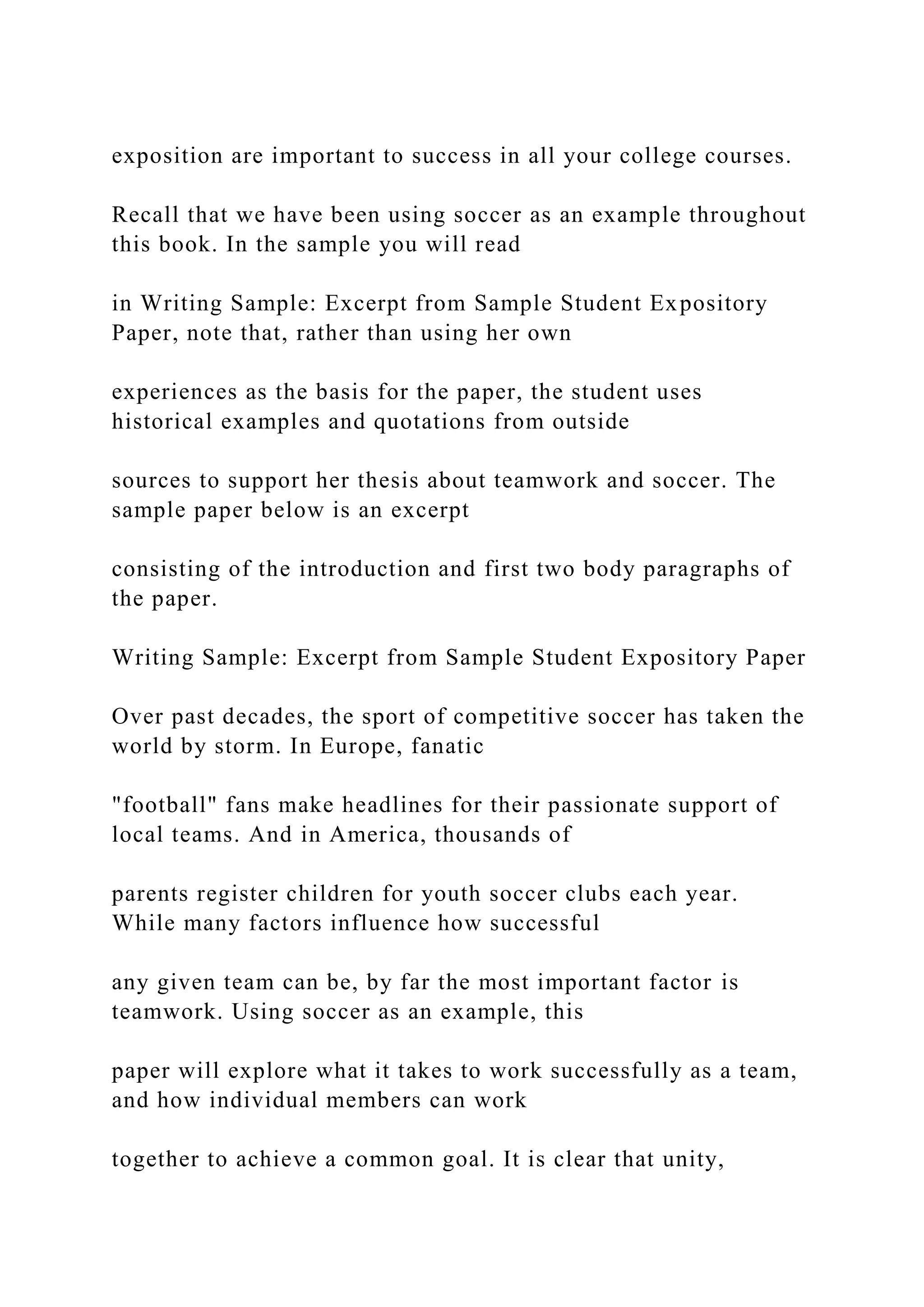
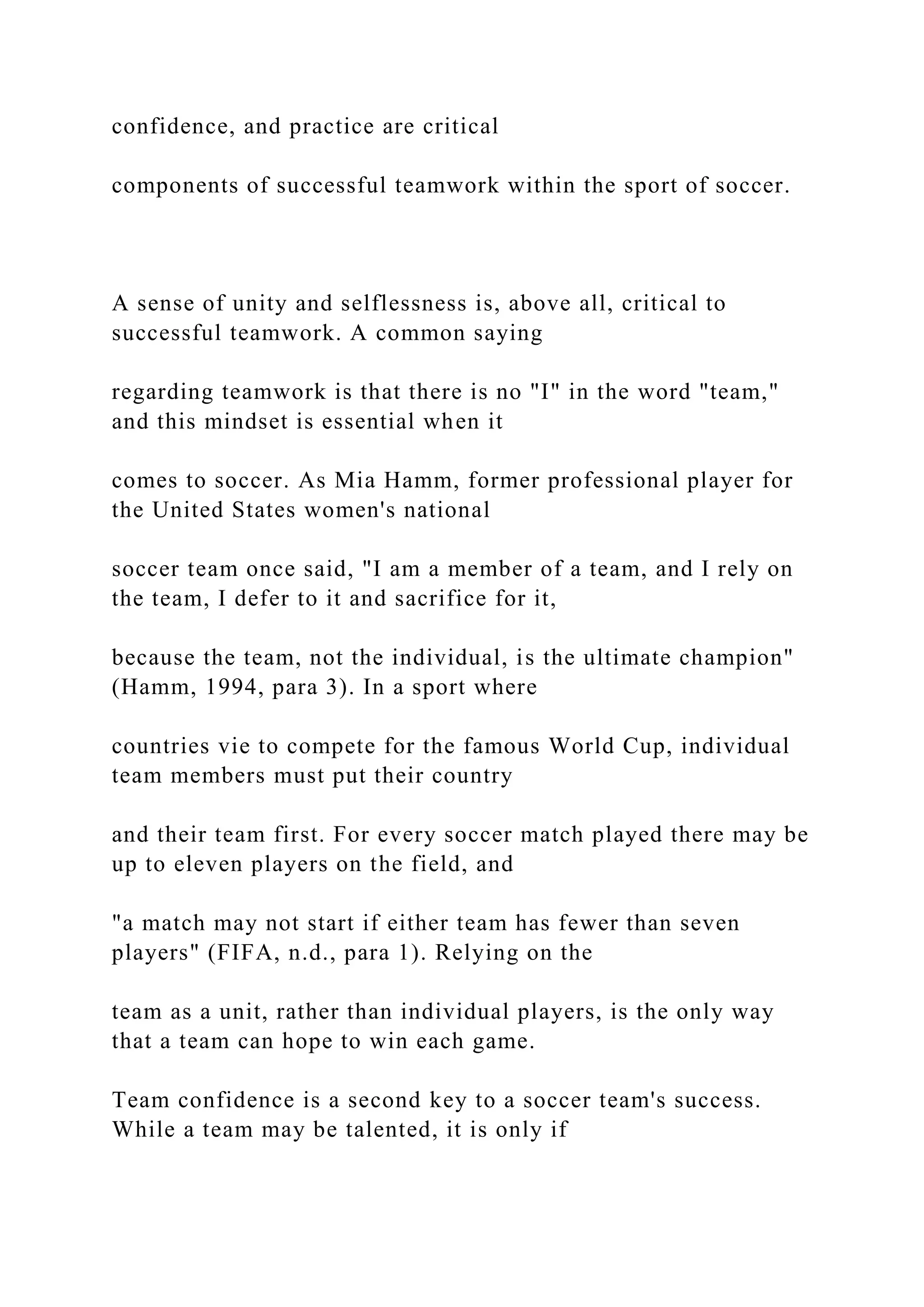
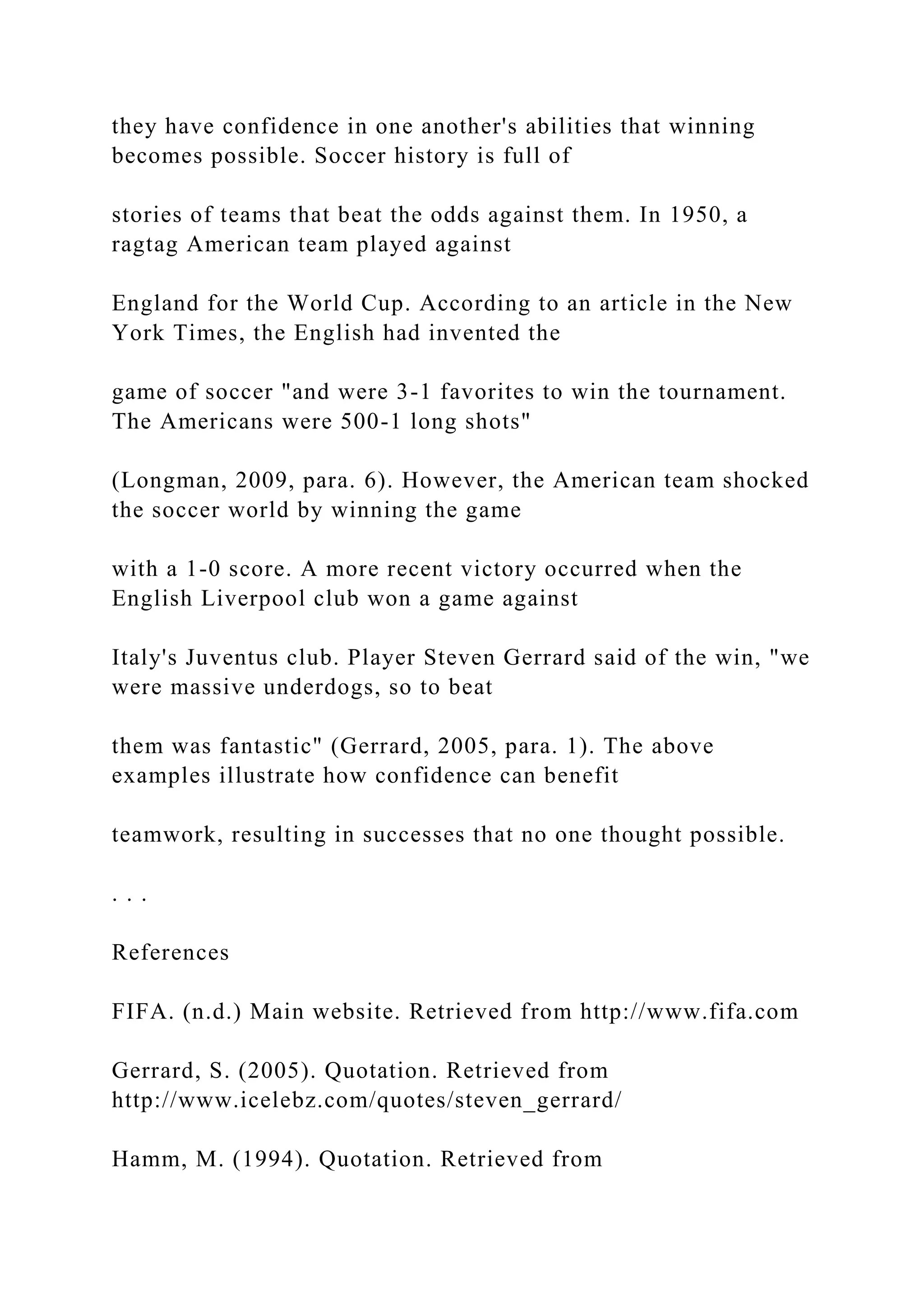
See Writing Sample: Soccer Personal Essay for an example of
the personal soccer paper we began in
Chapters 4 and 5. Notice how each paragraph focuses on one
main idea that supports the thesis, while
the author also maintains a clear narrative order using the
chronological arrangement to lead the reader
from her early experiences playing soccer to how soccer has
made her the person she is today.
Writing Sample: Soccer Personal Essay
What is the most fulfilling part about playing competitive
soccer? Perhaps you guessed winning
trophies, adrenaline highs, or staying in great shape. But in my
experience, bonding with teammates and
learning how to be a true team player tops the list. Thinking
back on my many years as a soccer player, I
have realized how important the game of soccer has been in
developing my greatest friendships, along
with a positive attitude towards teamwork that has in turn
influenced other aspects of my life. Playing
soccer has caused me to grow as a person, influencing my
values and the outlook on life I have today.
For one thing, soccer has helped me to make friendships that
have lasted throughout the stages of my
life. I remember loving soccer from day one, even if I barely
understood the concept of the game. When
I was just 6 years old, my mother signed me up for a local
AYSO team (American Youth Soccer
Organization) that played around the corner from our church. I
had always been a spunky and energetic
little girl, preferring to climb trees rather than play with Barbie
dolls, but soccer brought out something
new in me. Suddenly, I had to learn the rules of the game, and
to learn how to work with a bunch of
other girls that I just met. In that first year or two, it was all
about being together with my teammates,
kicking around the small black-and-white ball, wondering what
we would eat for snack time, and pulling
up grass with our fingers. Luckily, a couple of those girls grew
into two of my best friends. Now that we
are starting our own families, we can think back on those days
and get excited about signing up our own
children for soccer one day.
Continuing to play soccer throughout my life has also taught me
a great deal about what it means to
work hard and work as a team. Unlike some of the girls from
AYSO, I kept playing soccer in middle
school and high school and beyond, and it was during these
years that soccer began to challenge me and
shape me. Many people don't realize the incredible commitment
that is required when you play a
competitive team sport. First, there's the fact that you practice
almost every day, which is physically
draining. When I would return home from a long day of school
and soccer practice, that's when my
homework and chores would only just begin. But in order to be
at your peak condition and help your
team when they need you on the field, you have to find the time
and energy to handle it all. Spending so
much time with the girls on my team taught us how to function
as a unit. We knew we could count on
each other, whether it was to show up for practice on time, help
defend our goal during a game, or grab
an ice pack for a teammate's injury. Being a team player isn't
something that I left behind on the high
school soccer field. When our son Toby was born 3 years ago,
my husband Jayden and I had to support
one another more than ever before, juggling our family, jobs,
and finances. Like soccer, becoming a
parent has been the ultimate challenge and yet so rewarding at
the same time.
Soccer has also allowed me to have a familiar path toward
fitness and wellness that I can take any time
that I begin to feel out of shape or unhealthy. Now that I'm in
my thirties and am raising my first child, it
hasn't always been easy to find time to exercise, or to make my
health a priority. But while I'm shorter
on time than ever these days, soccer taught me to value my
dedication to physical activity and health.
So a year after Toby was born, I joined a local adult team,
partly to try to lose some of the baby weight
and get back into shape. Now, my old jeans are finally starting
to fit again, and I made friends with
another new mom whose son is the same age as mine. When I
could easily have been overwhelmed by
new responsibilities and put my health on the back burner, my
soccer background helped me stay
disciplined and focused.
Overall, I would not be the person I am today without the years
I spent playing competitive soccer. Not
only did I learn to love the game itself, but I also learned how
to make friends, be part of team, balance
my time, and stay positive and healthy in multiple aspects of my
life. While I'm sure I could have learned
these lessons without playing soccer, I would not have learned
them to the same degree. Those many
days of sweat, late nights, singing on the bus, and games won
and lost have stayed with me over the
years. I still love soccer to this day, and cannot wait for the
time to come when I can buy Toby his first
jersey and pair of cleats.
6.4 Descriptive Writing Pattern
Description is a pattern of writing that can be defined as
painting pictures with words. When we
describe a person, place, object, or event, we provide details
about its physical characteristics. As we
discussed earlier, description and narration are often used
together because description helps make the
story we are narrating clearer and more vivid.
Pixtal/SuperStock
Descriptive writing avoids general words in favor of the
specific. It is far more effective to describe your
individual instruments than to refer generally to your musical
equipment.
The Purpose of Description
Effective description requires using carefully chosen language
that creates the visual image you want
readers to have of your story's subject. However, you can use
description in other types of writing
besides narration. For example, in a persuasive paper (which
will be discussed in Chapter 7), you might
use description to help readers understand the seriousness of a
problem before you attempt to
convince them to take action to solve that problem.
Use Specific Language
To be descriptive, use specific terms and avoid vague and
general words. Break the poor writing habit of
using vague, informal "catch all" words such as things, stuff,
and lots of. Instead of writing "I have lots of
music stuff and other things in my room," be specific and name
each object or write a general statement
and then expand it by specifically naming the various objects.
For instance, you might write, "I have
several musical instruments in my room including a guitar, a
saxophone, and a set of drums, along with
my radio and portable media player." In all forms of writing,
avoid using passive voice, forms of the verb
"be." For instance, if someone says, "Snacks are being eaten,"
the word "being" is a form of the word
"be" and is passive. Passive voice often adds unnecessary words
and creates ambiguity at the sentence
level: Instead, use a descriptive verb to indicate precisely what
you mean. To take out passive voice, you
could say, "Jennifer is eating snacks," which directly identifies
the subject of the sentence as actively
doing something.
Select Specific Details
Good description includes important details that help paint the
picture for the reader by "filling in the
blanks" in the visual image. Details help you focus the reader's
attention on characteristics that make
people, places, objects, and events unique and help them "come
alive" for readers. Look beyond the
obvious for specific characteristics of what you are describing
to help readers "see" it too.
Let us imagine, for example, that you are asked to describe your
office workspace. You would probably
begin with a description of the size and shape of your desk and
the objects around the desk. But then
you should look beyond the obvious and try to find specific
characteristics of your workspace that make
it unique from that of other workspaces. Try to elaborate on the
basic description with carefully selected
details that give readers a sense of the person who occupies that
space.
For example, you might write, "The basic black-and-white décor
of the cubicle is shattered by bold
splashes of fire engine red, forest green, and pale yellow. Bright
red coffee cups are strategically placed
within easy reach of the computer and hold pens, paper clips,
rubber bands, and other assorted
necessities. The mugs contrast sharply with the four dark green
sets of file folders neatly arranged,
alphabetically by topic, in stacking black metal file holders.
However, dozens of tiny yellow Post-it™
notes disrupt the sense of organization as they litter the
computer screen and desk with reminders
about everything from meetings and project deadlines to
groceries and family birthdays." It is precisely
these specific details and uses of descriptive language that make
these words more than just words—
they become an imagistic scene the reader can visualize.
Use Descriptive Language
When you use description in personal writing, you seek to
involve readers in the story by helping them
see, hear, touch, smell, or taste what you are telling them. You
do this by using language that elicits
emotional responses from your readers. Words can have
different connotations, or emotional impact. In
most of your college writing, you want to choose words that
discuss or explain issues without stirring
emotions. However, in personal writing, the opposite is true;
you want to deliberately choose words
that paint a picture, evoke sensory experience, or that stir the
reader's emotions.
For example, if you want to paint a negative picture of an alley
in a rundown part of town, rather than
simply stating that it "smells bad because it is littered with junk
and rotting garbage," you might take
readers on a journey with you down this alley by describing it
this way: "As I tripped over bent and
rusted tin cans, jagged pieces of broken glass, and large plastic
bags of unknown contents, the putrid
smell of rotting food filled my nose. Suddenly, I found myself
swatting huge, black horseflies that
swarmed around me." Can you visualize that alley better now?
Descriptive language refers to words that are vivid, expressive,
and highly specific to the topic you are
writing on. Instead of stating that you smelled a strong odor,
you might specifically describe it by saying
that it was pungent, bitter, sweet, or spicy. Paint a clear picture
of sensations and emotions for the
reader as well. For instance, rather than writing that you were
angry, you might use the words livid,
enraged, or fuming with anger to discuss your feelings—or
better yet, you could explain a facial
expression that conveys anger rather than simply saying you
were "enraged." Table 6.2 provides you
with some descriptive alternatives to common verbs, adjectives,
and adverbs. Use the alternative words
in this list to help make your writing more vivid. Descriptive
language tends to express an evaluation of
something. Because it expresses an evaluation or perspective,
there is no such thing as completely
objective description. However, the best description would be
one that is carefully informed and that
does not exaggerate ("He is absolutely always happy") or
understate ("Though he is an Honors student,
he is really only average in his performance"). Description
should aim for accuracy and fairness and
avoid exaggeration for the purpose of effect.
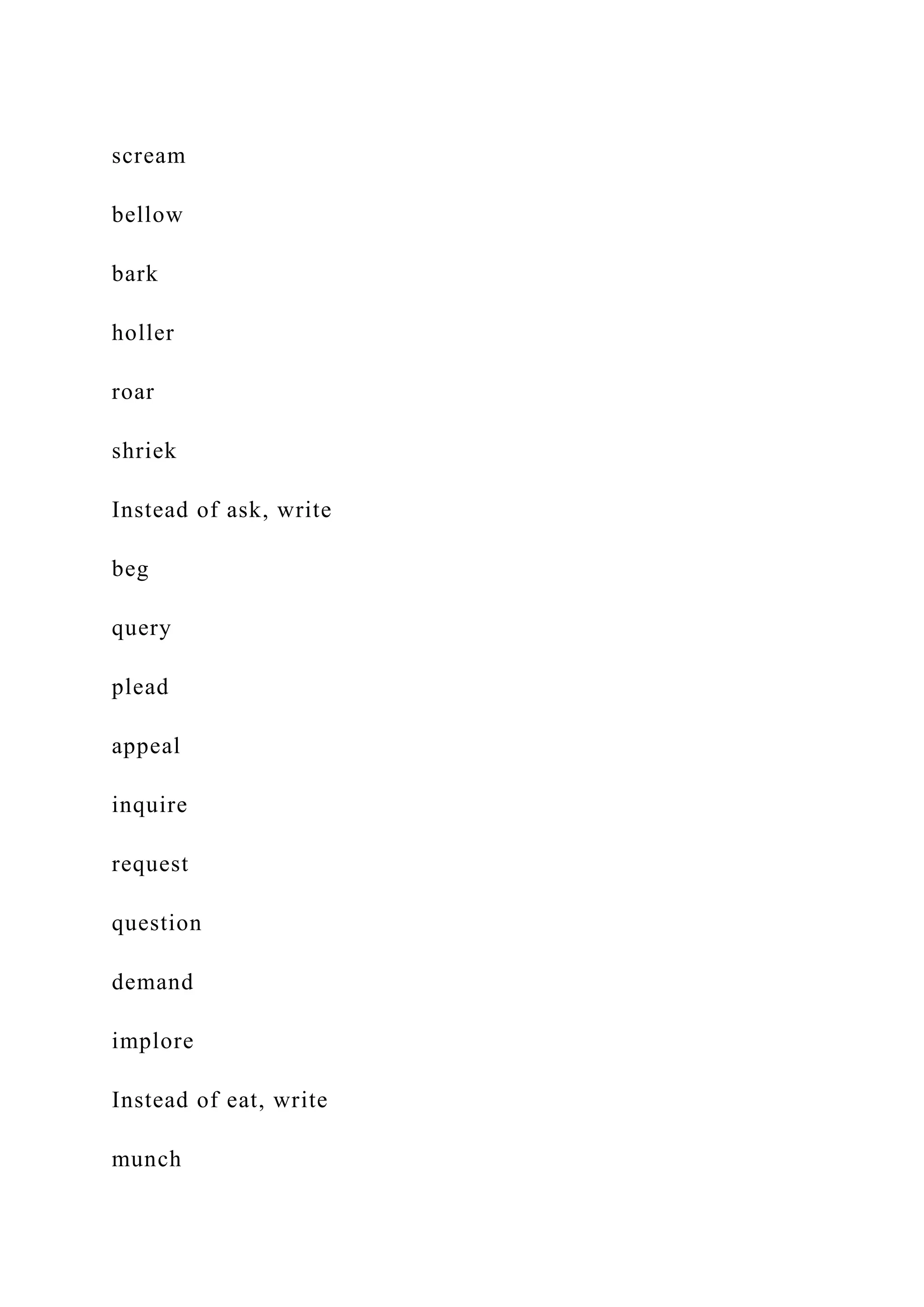
Table 6.2: Alternatives to common verbs, adjectives, and
adverbs
Instead of see, write
spy
spot
observe
notice
perceive
witness
glance
detect
discern
glimpse
recognize
Instead of say or tell,
write
cry
yell
shout
exclaim
whisper
scream
bellow
bark
holler
roar
shriek
Instead of ask, write
beg
query
plead
appeal
inquire
request
question
demand
implore
Instead of eat, write
munch
swallow
consume
devour
gobble
gorge
wolf
chomp
Instead of run or go,
write
fly
job
flee
race
dart
dash
rush
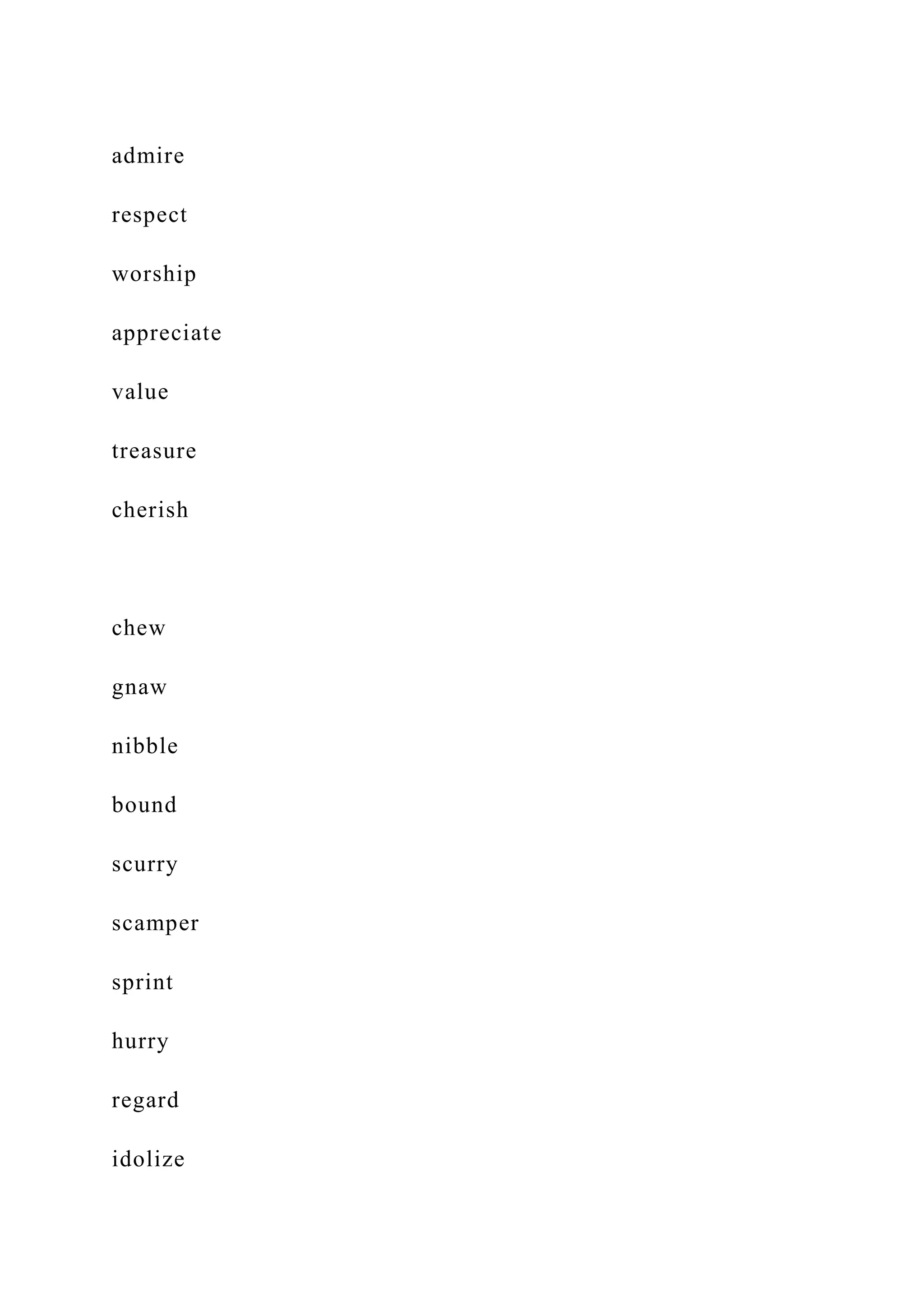
Instead of like, write
adore
admire
respect
worship
appreciate
value
treasure
cherish
chew
gnaw
nibble
bound
scurry
scamper
sprint
hurry
regard
idolize
treasure
relish
Instead of look, write
gaze
stare
glance
glare
glimpse
peep
peek
gape
gawk
scrutinize
survey
study
Instead of take, write
grasp
capture
seize
catch
pocket
grab
pilfer
snatch
lift
pinch
steal
nab
Instead of think,
write
believe
reflect
imagine
consider
contemplate
ponder
deliberate
meditate
mull over
ruminate
muse
wonder
Instead of angry, write
livid
enraged
fuming
irritated
irate
heated
annoyed
furious
incensed
outraged
infuriated
Instead of pretty, write
cute
adorable
attractive
beautiful
alluring
glamorous
handsome
lovely
charming
endearing
appealing
gorgeous
Instead of happy,
write
giddy
elated
pleased
glad
joyful
cheerful
blissful
ecstatic
delighted
jovial
amused
excited
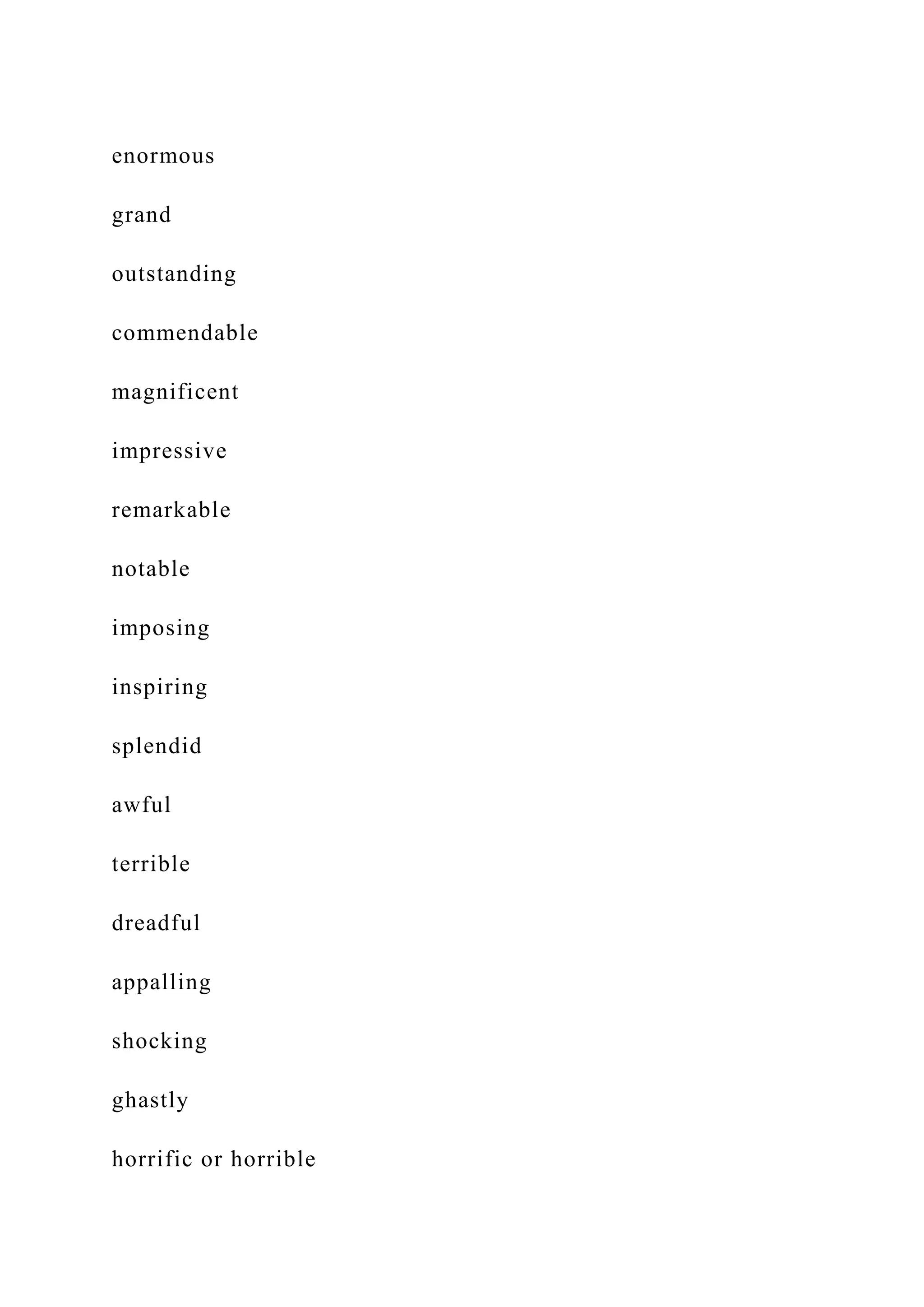
Instead of good or great,
write
Instead of bad, write
evil
Instead of sad, write
glum
huge
immense
enormous
grand
outstanding
commendable
magnificent
impressive
remarkable
notable
imposing
inspiring
splendid
awful
terrible
dreadful
appalling
shocking
ghastly
horrific or horrible
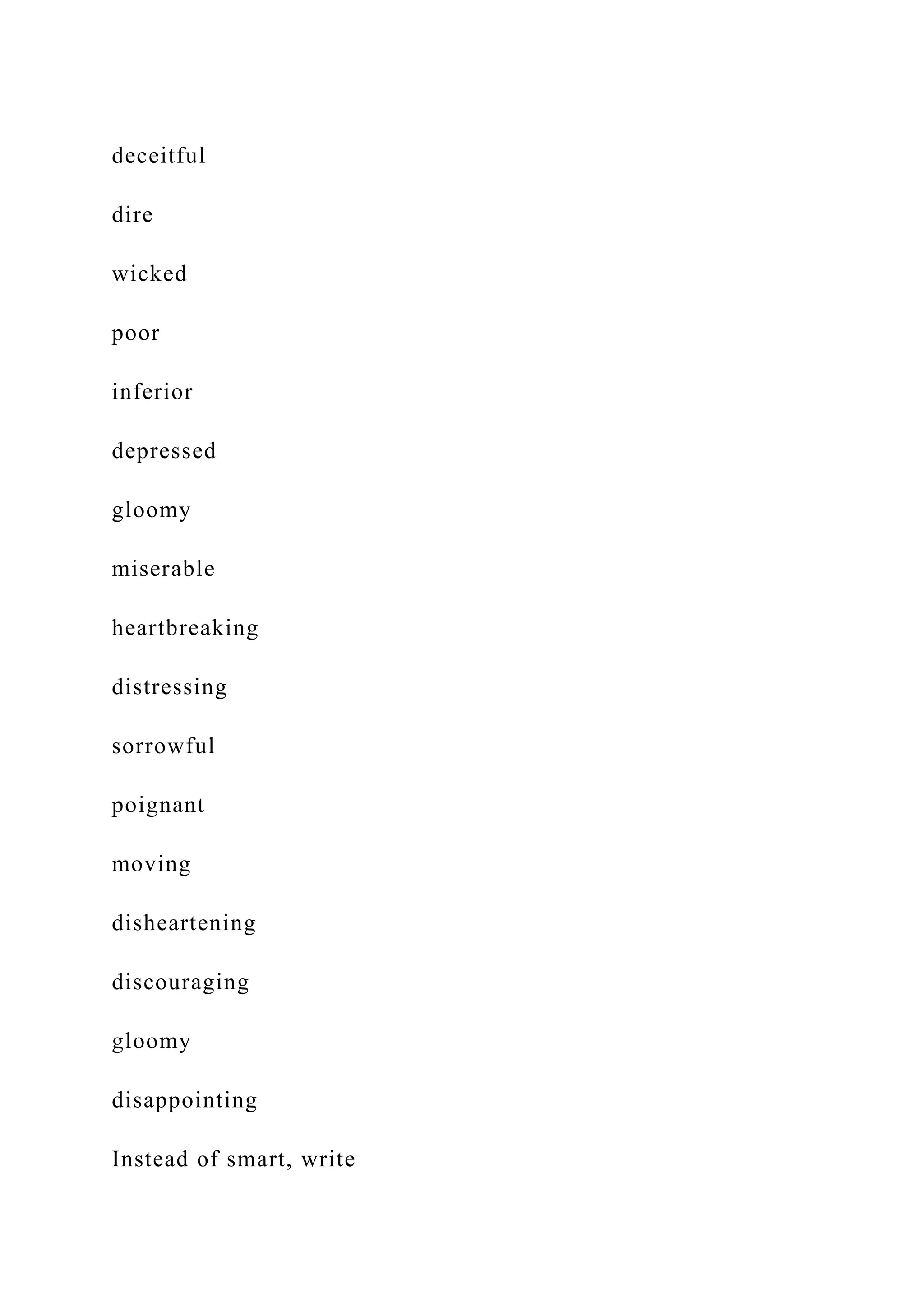
deceitful
dire
wicked
poor
inferior
depressed
gloomy
miserable
heartbreaking
distressing
sorrowful
poignant
moving
disheartening
discouraging
gloomy
disappointing
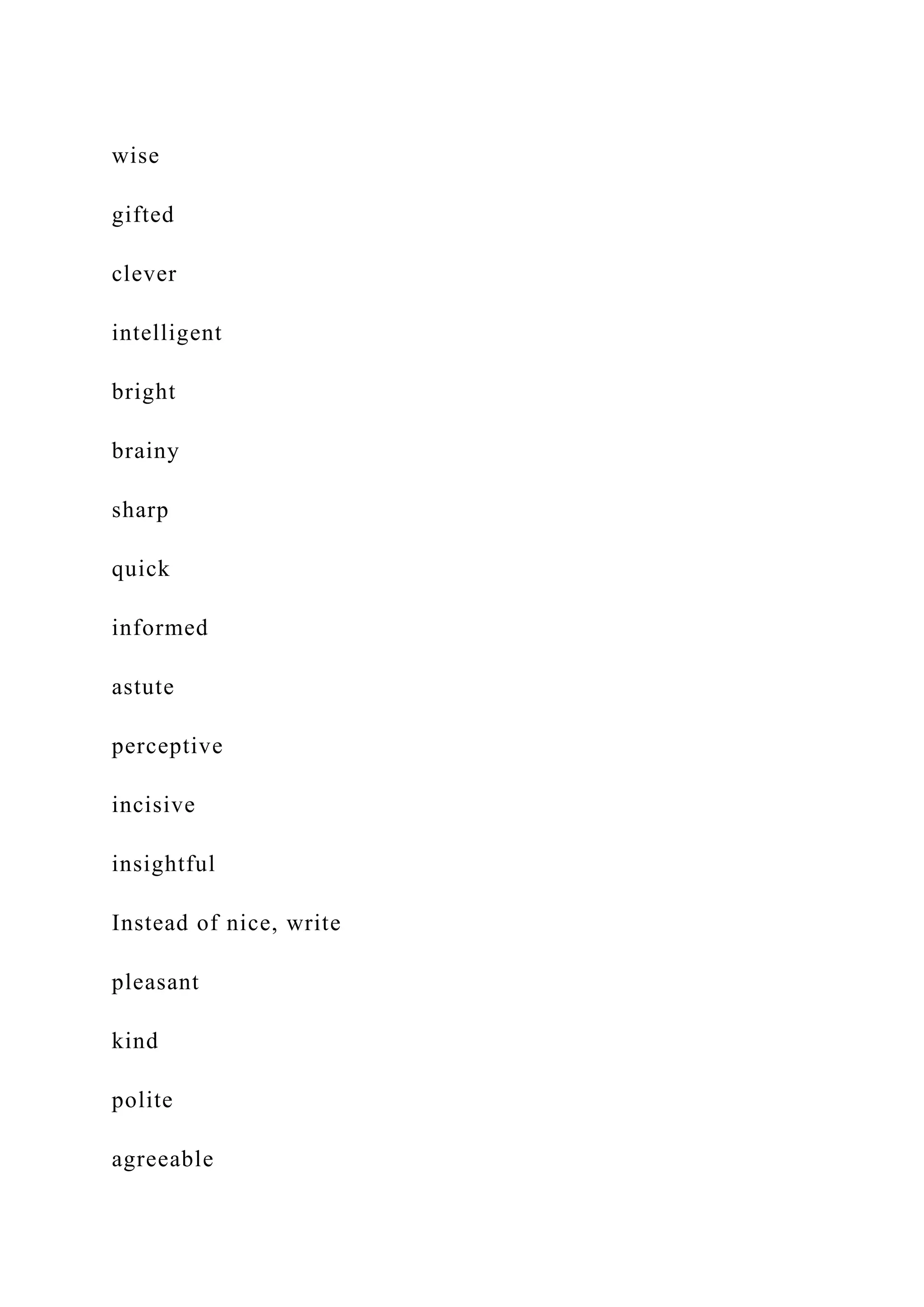
Instead of smart, write
wise
gifted
clever
intelligent
bright
brainy
sharp
quick
informed
astute
perceptive
incisive
insightful
Instead of nice, write
pleasant
kind
polite
agreeable
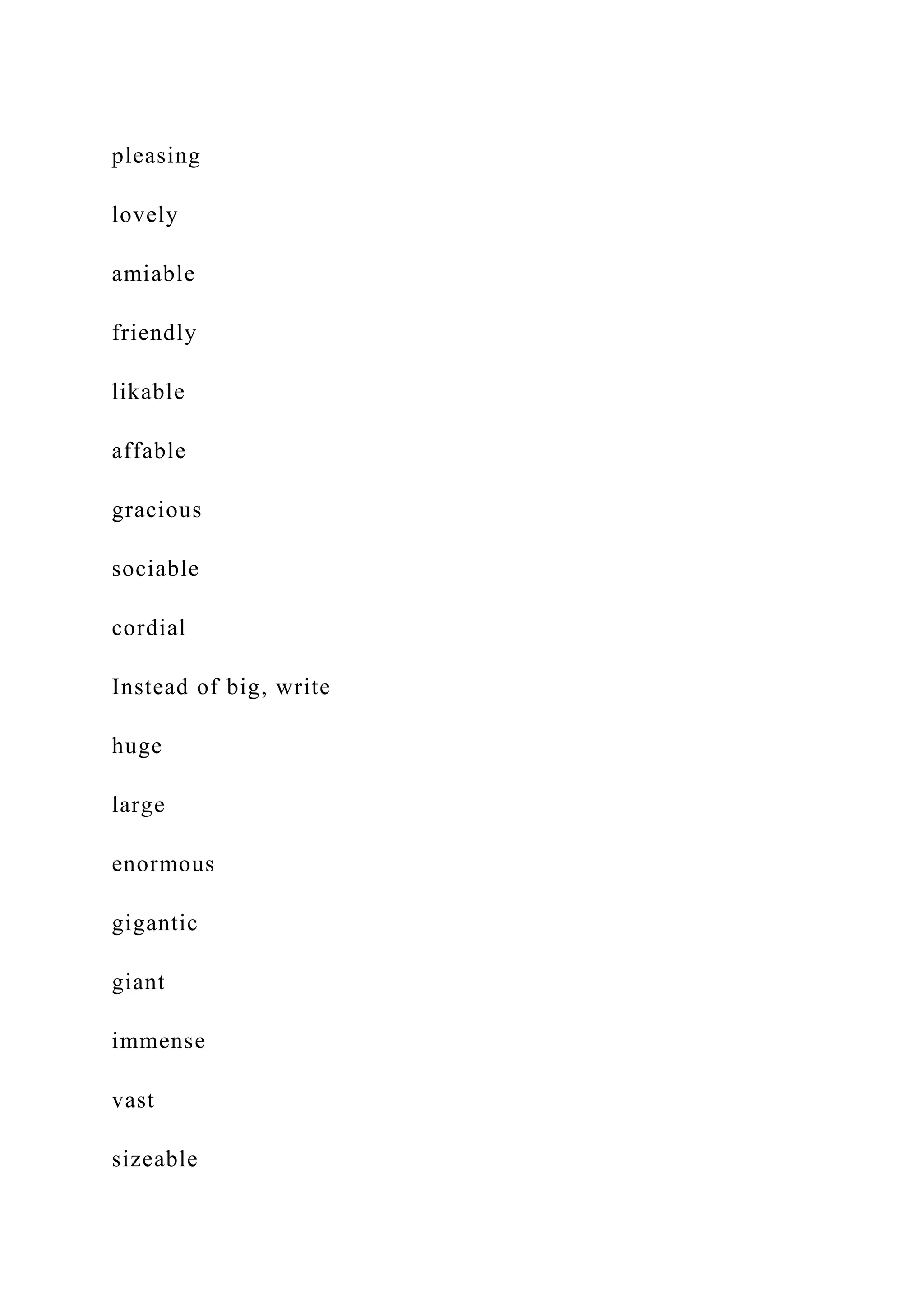
pleasing
lovely
amiable
friendly
likable
affable
gracious
sociable
cordial
Instead of big, write
huge
large
enormous
gigantic
giant
immense
vast
sizeable
massive
colossal
tremendous
towering
soaring
Compare the Unfamiliar to the Familiar
One useful way to help readers visualize what you are
describing is to compare it to something they
might already know. For example, suppose you are describing a
flower. You could comment on the color
and the size of the flower by saying that it is pink and tiny.
However, the color pink has many different
shades, and the word tiny has a wide range of interpretations.
So, instead you might state, "The color of
the flower was the same hue as that of the pink candy
Valentine's Day hearts."
When you report your observations of something; share personal
experiences; or describe a person,
place, object, or event, remember to use the elements of
effective description to make your ideas clear
and vivid to your readers. Read the combination narration and
description essay by professional writer
Anna Quindlen (2007) found at
http://www.newsweek.com/quindlen-how-old-dog-teaches-me-
tricks-
http://www.newsweek.com/quindlen-how-old-dog-teaches-me-
tricks-about-life-97257
about-life-97257. This essay illustrates many of the
characteristics of effective narration and description
we have discussed in this chapter. See if you can identify the
strategies she uses to paint a picture of her
beloved dog. On a separate sheet of paper, generate a list of
strategies you see operating in the essay.
Chapter Summary
At times your discussion-post assignments may be personal
writing assignments, and other
writing assignments will be combination papers that have one or
more sections that must be
written using personal writing patterns, so it is necessary to
know how this form of writing
differs from expository, persuasive, and argument papers.
Personal papers ask you to express your own thoughts, ideas,
and opinions about a subject.
They can be written to tell a story about yourself or others; to
describe a person, place, object,
or event; or to express personal opinions on an issue. They may
be called essays, opinion
papers, reflective papers, or creative writing assignments.
Personal papers, or the personal
sections of a combination paper, have three important
characteristics:
1. They are generally written from a first-person point of view,
unless you are narrating a story
about another person.
2. They are logically organized and do not have headings that
interrupt the flow of the writing.
3. They are written in a conversational tone that is appropriate
for an academic audience and
may contain dialogue.
Personal writing often uses specific writing patterns. Each of
these patterns—including
narration, description, and responses to reading—has its own
specific elements, which you
must incorporate if your personal writing is to be effective.
While narrative essays should
communicate a clear purpose such as in the case of articulating
a position, creative writing
pieces may not contain either a direct or an implied thesis.
Descriptive writing is the use of
vivid, imagistic language that incorporates the senses, so in
order to write descriptively, one
should use language that pertains to all of the senses. This also
allows readers to visualize the
scene the writer creates. Because personal writing uses your
imagination or asks you to reflect
on your own experiences and viewpoints, it can be a useful tool
to help stimulate your
creativity and to give you valuable experience in expressing
your ideas in written form.
Key Terms
http://www.newsweek.com/quindlen-how-old-dog-teaches-me-
tricks-about-life-97257
abstract words
concrete words
combination paper
creative tension
creative writing
description
descriptive language
dialogue
narration
nonfiction
opinion
opinion paper
plot
reflective paper
response paper
Persuasion and Argument
7
https://content.ashford.edu/books/AUENG121.13.2/sections/cov
er/books/AUENG121.13.2/sections/cover/books/AUENG121.13.
2/sections/cover/books/AUENG121.13.2/sections/cover/books/A
UENG121.13.2/sections/cover/books/AUENG121.13.2/sections/
cover/books/AUENG121.13.2/sections/cover/books/AUENG121
.13.2/sections/cover/books/AUENG121.13.2/sections/cover/boo
ks/AUENG121.13.2/sections/cover/books/AUENG121.13.2/secti
ons/cover/books/AUENG121.13.2/sections/cover/books/AUENG
121.13.2/sections/cover/books/AUENG121.13.2/sections/cover/
books/AUENG121.13.2/sections/cover
https://content.ashford.edu/books/AUENG121.13.2/sections/cov
er/books/AUENG121.13.2/sections/cover/books/AUENG121.13.
2/sections/cover/books/AUENG121.13.2/sections/cover/books/A
UENG121.13.2/sections/cover/books/AUENG121.13.2/sections/
cover/books/AUENG121.13.2/sections/cover/books/AUENG121
.13.2/sections/cover/books/AUENG121.13.2/sections/cover/boo
ks/AUENG121.13.2/sections/cover/books/AUENG121.13.2/secti
ons/cover/books/AUENG121.13.2/sections/cover/books/AUENG
121.13.2/sections/cover/books/AUENG121.13.2/sections/cover/
books/AUENG121.13.2/sections/cover
https://content.ashford.edu/books/AUENG121.13.2/sections/cov
er/books/AUENG121.13.2/sections/cover/books/AUENG121.13.
2/sections/cover/books/AUENG121.13.2/sections/cover/books/A
UENG121.13.2/sections/cover/books/AUENG121.13.2/sections/
cover/books/AUENG121.13.2/sections/cover/books/AUENG121
.13.2/sections/cover/books/AUENG121.13.2/sections/cover/boo
ks/AUENG121.13.2/sections/cover/books/AUENG121.13.2/secti
ons/cover/books/AUENG121.13.2/sections/cover/books/AUENG
121.13.2/sections/cover/books/AUENG121.13.2/sections/cover/
books/AUENG121.13.2/sections/cover
https://content.ashford.edu/books/AUENG121.13.2/sections/cov
er/books/AUENG121.13.2/sections/cover/books/AUENG121.13.
2/sections/cover/books/AUENG121.13.2/sections/cover/books/A
UENG121.13.2/sections/cover/books/AUENG121.13.2/sections/
cover/books/AUENG121.13.2/sections/cover/books/AUENG121
.13.2/sections/cover/books/AUENG121.13.2/sections/cover/boo
ks/AUENG121.13.2/sections/cover/books/AUENG121.13.2/secti
ons/cover/books/AUENG121.13.2/sections/cover/books/AUENG
121.13.2/sections/cover/books/AUENG121.13.2/sections/cover/
books/AUENG121.13.2/sections/cover
https://content.ashford.edu/books/AUENG121.13.2/sections/cov
er/books/AUENG121.13.2/sections/cover/books/AUENG121.13.
2/sections/cover/books/AUENG121.13.2/sections/cover/books/A
UENG121.13.2/sections/cover/books/AUENG121.13.2/sections/
cover/books/AUENG121.13.2/sections/cover/books/AUENG121
.13.2/sections/cover/books/AUENG121.13.2/sections/cover/boo
ks/AUENG121.13.2/sections/cover/books/AUENG121.13.2/secti
ons/cover/books/AUENG121.13.2/sections/cover/books/AUENG
121.13.2/sections/cover/books/AUENG121.13.2/sections/cover/
books/AUENG121.13.2/sections/cover
https://content.ashford.edu/books/AUENG121.13.2/sections/cov
er/books/AUENG121.13.2/sections/cover/books/AUENG121.13.
2/sections/cover/books/AUENG121.13.2/sections/cover/books/A
UENG121.13.2/sections/cover/books/AUENG121.13.2/sections/
cover/books/AUENG121.13.2/sections/cover/books/AUENG121
.13.2/sections/cover/books/AUENG121.13.2/sections/cover/boo
ks/AUENG121.13.2/sections/cover/books/AUENG121.13.2/secti
ons/cover/books/AUENG121.13.2/sections/cover/books/AUENG
121.13.2/sections/cover/books/AUENG121.13.2/sections/cover/
books/AUENG121.13.2/sections/cover
https://content.ashford.edu/books/AUENG121.13.2/sections/cov
er/books/AUENG121.13.2/sections/cover/books/AUENG121.13.
2/sections/cover/books/AUENG121.13.2/sections/cover/books/A
UENG121.13.2/sections/cover/books/AUENG121.13.2/sections/
cover/books/AUENG121.13.2/sections/cover/books/AUENG121
.13.2/sections/cover/books/AUENG121.13.2/sections/cover/boo
ks/AUENG121.13.2/sections/cover/books/AUENG121.13.2/secti
ons/cover/books/AUENG121.13.2/sections/cover/books/AUENG
121.13.2/sections/cover/books/AUENG121.13.2/sections/cover/
books/AUENG121.13.2/sections/cover
https://content.ashford.edu/books/AUENG121.13.2/sections/cov
er/books/AUENG121.13.2/sections/cover/books/AUENG121.13.
2/sections/cover/books/AUENG121.13.2/sections/cover/books/A
UENG121.13.2/sections/cover/books/AUENG121.13.2/sections/
cover/books/AUENG121.13.2/sections/cover/books/AUENG121
.13.2/sections/cover/books/AUENG121.13.2/sections/cover/boo
ks/AUENG121.13.2/sections/cover/books/AUENG121.13.2/secti
ons/cover/books/AUENG121.13.2/sections/cover/books/AUENG
121.13.2/sections/cover/books/AUENG121.13.2/sections/cover/
books/AUENG121.13.2/sections/cover
https://content.ashford.edu/books/AUENG121.13.2/sections/cov
er/books/AUENG121.13.2/sections/cover/books/AUENG121.13.
2/sections/cover/books/AUENG121.13.2/sections/cover/books/A
UENG121.13.2/sections/cover/books/AUENG121.13.2/sections/
cover/books/AUENG121.13.2/sections/cover/books/AUENG121
.13.2/sections/cover/books/AUENG121.13.2/sections/cover/boo
ks/AUENG121.13.2/sections/cover/books/AUENG121.13.2/secti
ons/cover/books/AUENG121.13.2/sections/cover/books/AUENG
121.13.2/sections/cover/books/AUENG121.13.2/sections/cover/
books/AUENG121.13.2/sections/cover
https://content.ashford.edu/books/AUENG121.13.2/sections/cov
er/books/AUENG121.13.2/sections/cover/books/AUENG121.13.
2/sections/cover/books/AUENG121.13.2/sections/cover/books/A
UENG121.13.2/sections/cover/books/AUENG121.13.2/sections/
cover/books/AUENG121.13.2/sections/cover/books/AUENG121
.13.2/sections/cover/books/AUENG121.13.2/sections/cover/boo
ks/AUENG121.13.2/sections/cover/books/AUENG121.13.2/secti
ons/cover/books/AUENG121.13.2/sections/cover/books/AUENG
121.13.2/sections/cover/books/AUENG121.13.2/sections/cover/
books/AUENG121.13.2/sections/cover
https://content.ashford.edu/books/AUENG121.13.2/sections/cov
er/books/AUENG121.13.2/sections/cover/books/AUENG121.13.
2/sections/cover/books/AUENG121.13.2/sections/cover/books/A
UENG121.13.2/sections/cover/books/AUENG121.13.2/sections/
cover/books/AUENG121.13.2/sections/cover/books/AUENG121
.13.2/sections/cover/books/AUENG121.13.2/sections/cover/boo
ks/AUENG121.13.2/sections/cover/books/AUENG121.13.2/secti
ons/cover/books/AUENG121.13.2/sections/cover/books/AUENG
121.13.2/sections/cover/books/AUENG121.13.2/sections/cover/
books/AUENG121.13.2/sections/cover
https://content.ashford.edu/books/AUENG121.13.2/sections/cov
er/books/AUENG121.13.2/sections/cover/books/AUENG121.13.
2/sections/cover/books/AUENG121.13.2/sections/cover/books/A
UENG121.13.2/sections/cover/books/AUENG121.13.2/sections/
cover/books/AUENG121.13.2/sections/cover/books/AUENG121
.13.2/sections/cover/books/AUENG121.13.2/sections/cover/boo
ks/AUENG121.13.2/sections/cover/books/AUENG121.13.2/secti
ons/cover/books/AUENG121.13.2/sections/cover/books/AUENG
121.13.2/sections/cover/books/AUENG121.13.2/sections/cover/
books/AUENG121.13.2/sections/cover
https://content.ashford.edu/books/AUENG121.13.2/sections/cov
er/books/AUENG121.13.2/sections/cover/books/AUENG121.13.
2/sections/cover/books/AUENG121.13.2/sections/cover/books/A
UENG121.13.2/sections/cover/books/AUENG121.13.2/sections/
cover/books/AUENG121.13.2/sections/cover/books/AUENG121
.13.2/sections/cover/books/AUENG121.13.2/sections/cover/boo
ks/AUENG121.13.2/sections/cover/books/AUENG121.13.2/secti
ons/cover/books/AUENG121.13.2/sections/cover/books/AUENG
121.13.2/sections/cover/books/AUENG121.13.2/sections/cover/
books/AUENG121.13.2/sections/cover
https://content.ashford.edu/books/AUENG121.13.2/sections/cov
er/books/AUENG121.13.2/sections/cover/books/AUENG121.13.
2/sections/cover/books/AUENG121.13.2/sections/cover/books/A
UENG121.13.2/sections/cover/books/AUENG121.13.2/sections/
cover/books/AUENG121.13.2/sections/cover/books/AUENG121
.13.2/sections/cover/books/AUENG121.13.2/sections/cover/boo
ks/AUENG121.13.2/sections/cover/books/AUENG121.13.2/secti
ons/cover/books/AUENG121.13.2/sections/cover/books/AUENG
121.13.2/sections/cover/books/AUENG121.13.2/sections/cover/
books/AUENG121.13.2/sections/cover
https://content.ashford.edu/books/AUENG121.13.2/sections/cov
er/books/AUENG121.13.2/sections/cover/books/AUENG121.13.
2/sections/cover/books/AUENG121.13.2/sections/cover/books/A
UENG121.13.2/sections/cover/books/AUENG121.13.2/sections/
cover/books/AUENG121.13.2/sections/cover/books/AUENG121
.13.2/sections/cover/books/AUENG121.13.2/sections/cover/boo
ks/AUENG121.13.2/sections/cover/books/AUENG121.13.2/secti
ons/cover/books/AUENG121.13.2/sections/cover/books/AUENG
121.13.2/sections/cover/books/AUENG121.13.2/sections/cover/
books/AUENG121.13.2/sections/cover
Corbis/SuperStock
If you wish to persuade me, you must think my thoughts, feel
my feelings, and
speak my words.
—Cicero
Learning Objectives
After reading this chapter, you should be able to:
nterpret different types of persuasive writing assignments,
including position papers,
proposals, replies to readings, and argumentative essays.
writing assignments, including
the use of Aristotelian persuasion methods, proper tone and
language, and other
conventions.
point of view, essay structure, and
argument conventions.
We have been exposed to and have practiced persuasion all our
lives. As infants, we learned
that crying could be a successful means of getting our needs
met. As we progressed into
adulthood, our needs and desires became increasingly complex,
and so did the strategies we
employed to persuade others to meet them. When we turn on the
radio or television, read
newspapers or magazines, or log on to the Internet, we are
exposed to advertising messages
designed to sell us goods or services. We are engaged in
persuasion at work and school when
we discuss issues with others and attempt to convince them to
share our opinions on those
issues. We cannot escape persuasion at home either. Attempts at
persuasion take place when
we talk with friends and family and try to influence one
another's decisions or when
telemarketers request contributions to a charitable cause, to
convince us to vote a certain way,
or to sell us goods or services. Whenever people have a
personal point of view on a subject and
attempt to influence others to share that point of view, they are
engaged in persuasion. You
will often be assigned to write persuasive and argument papers
in your college courses; such
papers are designed to help you improve your critical thinking
ability, to increase your
awareness of the persuasion and argument in your everyday life,
and to help you master the
techniques for effectively sharing your views with others.
7.1 Understanding Persuasion and Argument
When you hear the word argument, you may think of a
disagreement or a quarrel. However, the word
has a different meaning when it is used in connection with
college writing. Persuasion and argument
both seek to influence others to adopt a certain belief or point
of view or to convince them to take some
action. These two forms of writing differ in that persuasive
writing seeks to convince readers or an
audience to act or think a certain way, it generally uses rhetoric,
and it may include the use of pathos,
which is an appeal to the reader's emotions. Argument is a
specific type of persuasive writing that uses a
structured method of persuading others, primarily through
logical reasoning, and generally does not use
pathos. When you are assigned an argument paper, you are
being asked to construct a paper in which
you use critical thinking and logical reasoning to determine the
relative truth of something or to
convince someone of the validity of a point of view. Critical
thinking is the mental process of
conceptualizing, applying, analyzing, synthesizing, and
evaluating information to arrive at a conclusion.
As discussed in earlier chapters, persuasion is the attempt to
influence others to adopt a certain belief
or point of view or to convince them to take some action.
Whenever we attempt to change the way
someone thinks or feels about an issue, to encourage others to
accept our opinion on a subject, or take
an action we advocate, we are engaged in persuasion.
Persuasion is neither good nor bad; it can be used
for both moral and immoral purposes. Our motives for
attempting to persuade others and the methods
we use determine whether our persuasive attempts are ethical.
The History of Persuasion
Digital Vision/Thinkstock
Many of the highest paid personnel in the business world have
achieved their status due in part to
superior persuasive skills.
The study of persuasion has a long history. The Greek
philosopher Aristotle wrote a classic document on
the subject, titled Rhetoric, during the fourth century BCE. In
it, he describes the three types of
persuasion (logos, ethos, and pathos) we discussed in Chapter 1.
The Roman philosopher, statesman,
and orator Cicero, who lived in the first century BCE, also
wrote extensively on the subject. A more
modern classic on how to deal with people, How to Win Friends
and Influence People by Dale Carnegie,
was published more than 70 years ago and remains one of the
most popular international bestselling
books of all time (Carnegie, 2009). Several chapters of the book
are devoted to the subjects of how to
change people's minds and how to get them to do what you want
them to do.
Books on the subject of persuasion would fill an entire
bookcase because, as Carnegie stated, "Dealing
with people is probably the biggest problem you face, especially
if you are in business" (Carnegie, 2009,
p. xvi). Carnegie Institute of Technology revealed that even in
technical occupations, such as
engineering, about 15% of a person's financial success is based
on technical knowledge and about 85% is
based on skill in dealing with and leading people (2009). As
Carnegie discovered, often the highest paid
personnel in a company are not those who have the most
technical knowledge, but those who have that
technical knowledge plus the ability to express ideas and to
influence others.
The study of persuasion is so extensive that we can barely
scratch the surface of this subject in a single
chapter of this text. However, some of your writing assignments
will likely require persuasive writing,
and the basic principles of this type of writing can be learned.
Understanding these principles will help
you not only successfully complete these assignments but also
deal with other situations throughout
your life.
Differences Between Persuasion and Argument
The terms persuasion and argument are often used
interchangeably; however, they are not exactly
synonymous. Persuasion and argument are similar in that they
both seek to influence others. As we
discussed above, while persuasion is the more general of the
two terms and refers to the act of
influencing other people, argument is a specific type of
persuasive writing that relies on logic and
evidence. The more general category of persuasion can use
logic, emotions, or even the speaker's
credibility, as methods with which to convince an audience.
Argument is the specific category of
persuasion that uses structured, reasoned methods. Therefore,
all argument is persuasion, but not all
persuasion is argument.
Persuasive papers attempt to change the minds of readers or
convince them to accept the writer's
opinion on a subject. Persuasive writing is often personal.
While it may seem as though a writer is simply
arguing a point, the "argument" is fairly one-sided because it is
written from a personal viewpoint, and
the writer considers his or her opinion to be the correct one on
an issue. Persuasive writers should not
ignore other viewpoints; however, the focus is on the writer's
opinion. Persuasive writing also usually
uses appeals to emotion to sway readers, and it often relies on
the audience's emotions to strengthen
the persuasive impact.
On the other hand, the argument paper uses logical reasoning to
arrive at a reasonable interpretation of
a problem or text. When writers construct arguments, they
recognize that other reasonable views exist
on the subject. The writer ought to take the opposing views into
account and counter or overcome them
through reason and logic (Campsall, 2010). Argument requires
following a specific set of steps to lead
readers from a set of premises, or foundational claims—which
form the basis of the argument—to a
logical conclusion. Writers might make several claims that all
logically lead to one conclusion before
proceeding to the next part of the argument, which would
consist of another set of claims. We cover the
elements of both persuasion and argument in more detail later in
this chapter.
7.2 Persuasive and Argumentative Writing Assignments
You will often encounter persuasive and argumentative writing
assignments in your college courses;
Writing in Action: Example of Persuasion and Argument
Writing Assignments shows some examples of
these types of assignments. These assignments often require
taking a position on an issue and defending
it, proposing a solution to a problem or recommending a course
of action, evaluating the evidence a
writer presents to support his or her point of view, recognizing
errors in logic, or arguing a point of view.
Writing in Action: Examples of Persuasion and Argument
Writing Assignments
Key words and action verbs are underlined in the following
examples.
Write an eight-page paper in which you examine the practical,
ethical/social obligations; the need for
appropriate actions; and the optimal ethical, decision-making
processes existing in one of the four
following topic areas: The Role of Government, The Role of
Corporations, Environmental Issues, or
Ethical Integrity. [Expository] You must use at least five (5)
scholarly outside sources [Research] in
constructing your argument. [Argument]
Write a persuasive paper in which you state what you believe to
be the most pressing economic
problem facing our country today and what you believe should
be done to solve this problem.
[Persuasion]
Write an eight-page paper about a real contemporary problem
where you see the status quo as lined up
against something that is just or in favor of something that is
unjust. Make a case for what you think
would be just and argue for measures that should be taken to
counteract that injustice. Justify the
measures you propose. If you can make this assignment about
your own experience or community, then
all the better—but you must support your arguments and use at
least 8 to 10 outside sources in your
argument. [Argument]
Write an argumentative paper on one of the following topics.
Choose a topic where you can see at least
two points of view and present both points. If you feel so
strongly about a topic that you cannot see
another point of view, avoid writing about it. [Argument]
Suggested Topics
Should homosexual individuals be allowed the same rights that
heterosexuals have, such as marriage?
Should abortions be legal?
Are affirmative action laws fair?
Should America have stronger gun control laws?
Should assisted suicide be legal?
Are charter schools/vouchers detrimental to the American
educational system?
Should the death penalty be abolished?
Should animals be used in medical research?
Is global warming a genuine threat to the planet?
Should human cloning be legal?
Should embryonic stem cell research be federally funded?
Write a final research paper that focuses on a legal issue or
situation related to a business environment
or activity that you have experienced or about which you have
knowledge. Include a detailed description
of the topic; an analytical discussion of the legal issues
involved, including examining the issue from
different viewpoints; and a discussion of ethical considerations.
Write a well-defined and logically stated
argument to support your position on the issue or situation.
Include five research sources in addition to
your text. [Argument]
Write a six- to eight-page paper in which you tackle a current,
controversial issue and use persuasion to
convince your audience that your position on the issue is
correct. Your paper should incorporate several
methods of persuasion in the hope of "proving your point" to
your instructor. Find a topic you feel
passionate about. The list below can help you with ideas that
may be appropriate for your paper. Some
topics to consider could be the following: [Persuasion]
Abortion
Capital punishment
Socialism
Gun control
Smoking/secondhand smoke
Stem cell research
Lowering the alcohol drinking age
Reinstituting the military draft
Home schooling
Corporal punishment in schools
Position Papers
A position paper is an essay in which you take a stand, or state
your opinion, on a controversial issue.
Your purpose is to convince your readers that your position on
the issue is the best or the correct one.
You might use either a persuasive writing pattern or an
argumentative writing pattern to accomplish
your goal. Writing in Action: Example of a Position Paper
Assignment That Requires an Argument
provides an example of a position paper assignment from a
college course that requires an argument.
Writing in Action: Example of a Position Paper Assignment
That Is a Case Study illustrates a position
paper assignment that is also a case study. The assignment asks
you to study marketing problems and
opportunities, to investigate alternative solutions (recall that
investigating a problem or topic is a form
of exposition), and then to propose a solution (which is an
element of persuasive writing). Remember
that assignments sometimes call for different types of writing in
one essay.
Writing in Action: Example of a Position Paper Assignment
That Requires an Argument
Example: Some argue that the United States is falling behind
the major producers of computer
equipment in world trading markets. Do you agree or disagree?
Assume that the data examined in your
readings is sufficient evidence to support or not support your
argument. Use an Export/Imports Excel
spreadsheet workbook to support your analysis.
Writing in Action: Example of a Position Paper Assignment
That Is a Case Study
Example: Choose a case study from one of these four cases:
Case 6-1: Microsoft Corp.
Case 6-4: Slendertone
Case 6-18: Amazon.com, Inc.
Case 6-23: Telus Mobility
Assume the role of a management consultant reporting to the
CEO and board of directors in the chosen
organization. Research the salient information and background
in the case, present a clear definition of
marketing problems and opportunities in the company, and
make astute strategic recommendations to
management on how to deal with these issues.
Proposals
Proposals are persuasive reports that identify a problem and
recommend a solution to that problem.
Proposal paper assignments may come from your writing
classes, communication classes, or perhaps
business classes. They are a frequently used style of writing in
the work-force. They are most commonly
used in organizational communications, where they may be
written to investigate and solve internal
organizational issues or as sales documents to propose
providing goods or services to another
organization. Sales proposals may be solicited proposals, where
the request for the proposal is made by
an organization, or unsolicited proposals that you initiate and
present to management.
The persuasive section of a proposal assignment is an example
of a solicited proposal, in which you are
being requested to propose solutions. For some solicited
proposals, a company might issue a formal
Request for Proposal (RFP). The RFP will generally specify
how the proposal should be written and the
information that must be included. Both informal solicited
proposals and unsolicited proposals you write
to bring an issue to management's attention should be written
using the persuasive writing pattern.
Business and professional writing courses or technical writing
courses may also ask you to create writing
proposals.
Response Papers
In your college courses, you may be asked to write a response
paper, where you are required to respond
to material you have read and to make a judgment about it. In
assignments such as these, you must
often use expository writing to identify and discuss an issue and
then write a persuasive section of the
paper in which you state an opinion on an issue and defend it.
As a student, your ability to argue well
and to persuade the reader will aid your overall analysis of
reading materials. Writing in Action: Example
of an Evaluation Assignment That Requires Expository and
Persuasive Writing illustrates an evaluation
assignment from an environmental studies course that requires
this combination of expository and
persuasive writing.
Writing in Action: Example of an Evaluation Assignment That
Requires Expository and Persuasive Writing
Example: Identify and evaluate an ecosystem of interest within
your local area. As part of your
evaluation, you are to integrate the principles and key learning
you have acquired as they relate to the
identifiable organisms, soil content and possible contaminants,
energy flow, habitats, and niches that
exist within this particular ecosystem. Also discuss the
biodiversity or lack of diversity within your
ecosystem and possible reasons for the lack of diversity such as
atmospheric pollution, weather
catastrophe, climate changes or man-made influences. Discuss
what measures are being taken locally to
preserve biodiversity, remediate, and protect these areas. What
considerations do you think should or
need to be taken into account with respect to the ecosystem and
biodiversity?
7.3 Persuasive Writing Pattern
In this section of the chapter, we discuss the general persuasive
writing pattern, including the
conventions of persuasive writing. We will conduct a more in-
depth examination of the three persuasive
strategies or appeals to readers and provide examples. And we
will look at how tone, point of view, and
structure are employed effectively in persuasive writing.
One way to incorporate emotional appeals in persuasive writing
is through the use of rhetorical devices,
which are special uses of language used for a particular effect.
Rhetorical devices can help persuasive
writing capture and hold the reader's attention and improve the
impact of statements. For instance,
they can be useful in creating visual images. Be careful, though,
not to overdo their use. The following
sentence illustrates this fact:
I am excited about the new product! It is great news for the
industry! In fact, it is terrific! When I saw it, I
thought, it is about time! Congratulations! I wish you the best
of luck!
This writer has overused the exclamation point, so that by the
end, it seems almost comical rather than
genuinely excited. Take care not to overuse any tone or writing
technique because doing so can make
the writing lose seriousness or credibility. That said, below are
some examples of common rhetorical
devices that can be helpful to persuasive writing when they are
used sparingly.
Emotive language
Example: How can we expect a broken, penniless, and desperate
man to find a job?
Exaggeration
Example: Everything is always completely wrong.
Metaphor (an implied comparison between two things)
Example: Her smile was sunshine in my dreary world.
Simile (a comparison between two things that uses the words
"like" or "as")
Example: Her smile was like a ray of sunshine in my dreary
world.
Irony (a figure of speech that illustrates a contrast between
reality and appearance)
Example: It was hard to believe, but he was absent on the day
he was to receive his award for perfect
attendance.
Alliteration (repetition of initial consonants in words in a
series)
Example: Careful and cost-efficient collaboration can ensure
company success.
Antithesis (placing two opposing ideas together in a sentence)
Example: The closing words from American patriot Patrick
Henry's speech at St. John's Church in
Richmond, Virginia, in 1775, just prior to the American
Revolutionary War: "Give me liberty or give me
death" (Wirt, 1836). This statement suggests that without liberty
or freedom, death is the next best
option. The claim is tying together two opposing ideas that are
not necessarily in direct contrast with
one another.
Three Means of Persuasion
In Rhetoric, Aristotle identified three different methods or
means of persuasion, one of which is the
character of the speaker or writer (as cited in Rapp, 2010). In
other words, Aristotle suggested that we
can attempt to persuade on the basis of the character of the
person making the persuasive appeal,
through emotional appeals, or through logic. Let us look at each
of these means of persuasion
separately.
Ethos: Character of the Speaker or Writer
Kirthmon Dozier/Associated Press
Credibility is an important aspect of persuasion. Because
Michael Jordan was one of the greatest
basketball players of all time, fans trusted his endorsement of
Nike basketball shoes.
Aristotle's word ethos refers to the nature, character, or
credibility of a person. We can persuade,
Aristotle stated, if the audience thinks we are credible or
believable (Rapp, 2010). The primary reason
advertisers hire famous sports figures or other celebrities to
endorse their products is because of this
credibility. If basketball superstar Michael Jordan can fly
through the air and average 28 points a game
wearing Nike shoes, they must be excellent shoes, right (Rovell,
2008)?
Jordan was a credible spokesperson for athletic shoes because
he was a great athlete, because
audiences believed he was knowledgeable about athletic shoes,
and because audiences trusted him to
tell them the truth. Trust is an important component of
credibility, and loss of trust is one reason why
celebrities who are embroiled in scandals often lose lucrative
product endorsement contracts. Once
trust and credibility are lost, they are difficult to regain, and the
effectiveness of the persuasive message
is diminished.
To have credibility in writing a persuasive paper, your reader
must perceive you as knowledgeable,
believable, trustworthy, and qualified to write about a subject.
If you write about something you have
experienced personally or about which you have knowledge, be
sure to state this in your paper; it can
establish your credibility. However, you do not have to have
personal knowledge or be an expert in a
subject in order to write about it. You can support your
statements by conducting research and using
evidence to back up what you say. Evidence consists of personal
examples, facts, statistics, or the words
of credible outside authorities or other believable sources. (We
discuss the subject of evidence in more
detail later in this chapter when we discuss logical appeals.)
Opinions, on the other hand, are not
legitimate pieces of evidence. Anyone can state an opinion, but
if a person supports an idea with careful
evidence, then it is no longer "opinion"; rather, it is thoughtful
interpretation. However, when you state
your personal opinion in a persuasive paper and are not an
expert on the subject, make certain you
supply evidence to support what you say. Also make sure to
give credit to any sources by including in-
text citations and a properly completed reference list prepared
in your college's required
documentation style.
Pathos: Appeal to the Reader's Emotions
Often, to be persuasive we must touch people's hearts as well as
their minds. Or, as 17th-century
philosopher George Campbell wrote in his book, The
Philosophy of Rhetoric, "When persuasion is the
end, passion also must be engaged" (as cited in Lucas, 1998, p.
425). Emotional appeals, what Aristotle
referred to as pathos, can help move people to action and
influence their judgments, and this can be
used for ethical purposes. We do not always make rational
decisions. Often, our feelings or emotions
influence our actions. Advertisers are aware of that fact when
they attempt to persuade us to buy their
products, use their services, or contribute to their organizations.
Television commercial producers who
attempt to persuade us to help the homeless, abused animals, or
victims of natural disasters know that
strong photographs or videos depicting the horror of these
terrible situations will touch peoples' hearts
and make it more likely that they will be persuaded to help.
However, a strong persuasive paper does
not rely solely on emotional appeals to convince readers; you
must also give people logical reasons to
accept your point of view on an issue.
Some common emotional appeals are listed below. As you read
this list, think of advertisements you
have read, heard, or watched on television that use these
appeals.
Fear. Fear of loss of our home, family, and belongings due to
theft and natural disaster; serious illness or
injury; being assaulted; being injured in traffic accidents; being
rejected or not liked by others; economic
hardship or loss of a job—all are commonly used appeals to
fear.
Compassion. Appeals for contributions to help earthquake
victims, victims of domestic violence, abused
or neglected animals, starving children around the world, and
other such causes use the human capacity
for compassion as a powerful persuasive tool.
Pride. A sense of pride in one's country, family, community,
ethnic heritage, or personal
accomplishments can be a motivation for many people to take
action. This appeal is often coupled with
the appeal to self-gratification such as "You deserve it!" or
"You have earned it!"
Anger. Anger can often move people to action. That anger can
be directed against anyone—for example,
suspected terrorists, government officials, business executives
who receive large bonuses when their
companies are in trouble, large companies in general, or thieves
and other criminals.
Shame. When we are ashamed of ourselves for not helping
people less fortunate than ourselves, for
having material possessions while others do not, for not doing
our best, for not living up to what others
expect of us, or for not conforming to the ideals set for us by
our families or our religious teachings, we
can often be motivated to change our behavior.
Admiration or love of others. Many persuasive appeals are
aimed at a basic human need to be liked, to
be admired, to find love, and to belong. We humans are social
creatures, and the opinion others have of
us is a powerful motivator that influences how we live (Lucas,
1998).
People have many emotions and needs, and the list above is not
all-inclusive. Keep in mind that people
are more often persuaded to act in ways they think are in their
best interest and that meet their own
needs as well as yours. Appealing to the emotions of your
readers can engage them in the issue you are
presenting, and showing them how their actions will benefit
them personally can be a powerful method
of obtaining support for ideas you propose.
Logos: Logical Appeals
You can be a credible writer, and you may include strong
emotional appeals in your writing; however, if
what you say does not make sense or is not reasonable, you will
not win over your readers. Appeals to
logic and reason are important components in persuasive
writing. Use of logic involves reasoning and
analyzing issues in an attempt to understand and explain them.
Remember that if you have personal
experience on an issue, your experience may give you some
credibility; however, to be persuasive, you
must also back up your viewpoints and statements with evidence
and a well-reasoned position. You may
also have a reasonable conclusion, but if the steps you take to
get there are not well-thought-out, you
will lose credibility and will not be persuasive. Before readers
will be convinced to change their way of
thinking, they must believe that what you say makes sense, is
factual, and is reasonable.
For example, let us suppose you want to persuade people to
exercise for good health. Here are types of
evidence you might choose to use to support your point of view
on this issue and to convince others to
share your opinion. Remember, if you use material from outside
sources, you must document those
sources in the proper documentation style in the text of your
paper and in a reference list at the end.
Examples from your own experiences are only suitable evidence
for a personal essay.
Example: By exercising 30 minutes each day, I have lowered my
blood pressure to a point where I no
longer have to take daily blood pressure medication.
A real-life example such as this takes the subject of health and
exercise from the objective realm of
science and makes it personal. The statement enhances your
credibility and the possibility that readers
will accept your opinion on this subject. If, on the other hand,
you offer a claim with no evidence such as
saying: "If I eat right, I will absolutely lose 2 pounds a week,"
your statement has no credibility because
you have no real evidence. This is merely a hypothetical and
therefore is not proof.
Use facts, statements that are not in dispute or that can be
proven to be true by reasoning, experiment,
or personal experience. You obtain facts through observation,
reading, research, or your own
experiences.
Example: Exercise is beneficial for your physical and mental
health. In this example, the writer is stating
a fact that is not in dispute and has been verified by research.
Because it is common knowledge and is
not in dispute, you do not need to provide a source for this
statement.
Statistics, data that can be represented numerically, provide
excellent support for your statements
because they are specific and concrete. For example, you might
make the following statement:
"Childhood obesity is on the rise in the United States." To
support that statement, you might include the
following statistics: "Between 1976 and 1980, approximately
5% of youth 2 to 19 years of age were
obese. In 2006, the rate had increased to 16.3%" (Dietz, 2009,
para. 5).
Include statements from authorities or experts in their fields.
These statements may be direct
quotations or paraphrased (put in your own words). In either
case, however, you must cite the source of
these statements in the text of the paper and in the reference
list. For example, in your paper on
exercise and health, you might write, "In early 2010, First Lady
Michelle Obama, U.S. Health and Human
Services Secretary Kathleen Sebelius, and Surgeon General Dr.
Regina Benjamin announced plans to help
Americans live healthier lives through better nutrition and
regular exercise" (U.S. Department of Health
and Human Services, 2010).
Tone and Language
As we have discussed previously, persuasive writing uses logic
and reasoning, but it often attempts to
engage the hearts, as well as the minds, of readers through
emotional appeals. Language usage is
particularly important for persuasive writing, so be sure to
consider the effects of the language you
choose. First, remember to use connotative language that has a
strong emotional appeal. Second, be
ethical in your use of emotion. Do not use emotion to make
personal attacks on those who hold
viewpoints different from your own. You may point out what is
wrong with other viewpoints, but again
do not engage in personal attacks or use emotional appeals to
characterize the opinions of others.
Finally, do not use emotion in place of facts or simply for
dramatic effect. Emotional appeals should have
a purpose, be honest and not attempt to mislead, and not be used
just for effect or for gratuitous
reasons.
Point of View
When you seek to persuade, you try to establish common ground
between yourself and your readers.
One way to do this is to find some initial points on which you
can agree and then to work from those
points to forge a bond on other points as well. A speaker or
writer should consider whether the
audience shares a similar viewpoint or whether the audience
will require extra techniques of
persuasion. The audience's political views, social views,
economic background, and even their age
should inform one's writing. If a person were giving a speech, it
would be appropriate to talk directly to
the audience using a second-person point of view (you or your)
or a first-person plural point of view that
illustrates a bond (we, our). Third person is often used in
speeches to form a connection between the
speaker and audience in terms of purpose. If your instructor
asks you to write a persuasive paper or
speech, you should ask whether or not the use of first person
would be effective.
Structure and Supporting Ideas
Like other effective college papers, persuasive papers have a
clear and well-structured introduction,
body, and conclusion, and a clear thesis. Follow the guidelines
in Chapter 5 for structuring your paper
and make sure that your persuasive paper includes the following
additional information:
Introduction. In the introduction, you must introduce the
controversial issue. Then, you might want to
present the two sides of the issues. For example, you might
state, "Some people believe we should . . . .
However, others believe we should not . . . ." Then state your
opinion on the issue in the form of your
thesis statement. Give at least two or three reasons why you
believe the way you do.
Body. In separate paragraphs of the body of your persuasive
paper, take each of the reasons why you
believe the way you do and explain why. Use examples,
statistics, or the words of experts to support
your statements and aid in your explanations.
Conclusion. Make sure to reinforce or restate your thesis
statement, point out a solution to the issue, or
propose that your readers take some action. Then create a sense
of closure by creating a strong ending
to your paper.
Putting It All Together: Sample Persuasive Essay
The writing sample below contains the first paragraphs and the
conclusion from a persuasive student
essay about soccer. As you read this article, see if you can
identify the thesis statement and the ways in
which the writer supports her viewpoint. Also try to locate
rhetorical devices or strategies that are used
by the author and be prepared to discuss these in class.
Writing Sample: Persuasive Soccer Essay
Soccer is just a hobby. It's not something that you can build
your life around. Young athletes might hear
sayings like these often, but they are not necessarily true. If you
think that physical sports such as soccer
are simply about burning calories, this paper should help you to
reconsider the ways that playing soccer
can impact your life. Competitive soccer can not only help you
work out your stress and stay in shape,
but can teach you key values such as teamwork and time
management, and can influence your character
and values for the better.
Playing soccer can provide the essential benefits of reducing
your stress and keeping you in great
physical condition. Everyone requires an outlet for stress, and
soccer is one way that you can help stress
disappear. Playing outside in the sun, breathing fresh air, and
getting your heart rate up can all serve to
clear your mind of stress and worries. Playing a team sport like
soccer also promotes the habit of
exercising on a regular basis, paving the way for healthy
workout habits later in life. By challenging
yourself physically at each practice and giving your all during
games, you can get in shape, stay in shape,
and make physical activity a constant and natural presence in
your life.
. . .
Now that I have shared the various ways that playing
competitive soccer can enrich your life experiences
and impact your character, I hope that you look at the value of
team sports with new eyes. Before you
dismiss team sports as no more than a simple "hobby," consider
the ways in which a sport like soccer
can influence your stress levels, physical fitness, teamwork
values, and time management skills. Then
you can choose to sign up for a fun-filled activity that will
make you focused, fit, and dedicated, and
maybe rack up some great wins along the way.
7.4 Argument Writing Pattern
Earlier, we stated that in a persuasive writing pattern your paper
is generally one-sided because you are
writing from a personal viewpoint and attempting to convince
readers that your opinion is the correct
one or the best one. We also stated that emotional appeals are
often an integral part of the persuasion.
iStockphoto/Thinkstock
In argumentative writing, your goal is to convince the reader of
your point of view through patterns of
logic, reason, and evidence.
In an argument, you are also trying to persuade readers by using
evidence and reason or a logical
structure of claims/premises, evidence, and conclusions.
However, the point you are making is not the
one you like the most or the one you feel most strongly about
emotionally. It is the one that you can
prove to your readers makes the most sense, based on logical
reasoning. You may use emotion in your
presentation as well, but the primary method of convincing
readers to accept your point of view in an
argument paper is through logic.
Another major difference between a persuasive paper and an
argument is what is used to support your
proposed solution. A persuasive paper relies on personal
experience, examples, rhetorical devices, and
other such strategies to stir your readers into changing their
minds or taking some action. Argument, on
the other hand, uses facts, statistics, and the words of others
you gather through research to accomplish
the persuasion. You might think of argument as teaching your
readers the facts about an issue. Once the
audience sees the facts, you reason, they will then have no
choice but to accept your perspective on the
issue as the best option. Thus, an argument paper does not
attempt to gain support for your personal
opinion. Rather, it builds a case, much like constructing a
building brick by brick, until the reader must
agree to see the issue as you do.
Argument Conventions
When writing an argument essay, select a method of reasoning
to utilize—either inductive or deductive.
These methods follow different structures for argumentation. In
addition to considering how a writer
will structure his argument, in order to produce an essay that is
logically sound, a writer must avoid
logical fallacies which weaken claims, key points, and
conclusions the writer is trying to make.
Two Methods of Reasoning: Inductive and Deductive
When you argue, you can use one of two different methods of
structuring your argument: deductive or
inductive reasoning. With deductive reasoning, you begin your
argument by making a general statement
and then apply that generalization to a specific situation. This
may mean starting off with an argument
and then supporting it later.
Example: Rashes are caused by allergic reactions. I get a rash
every time I eat strawberries. I must be
allergic to strawberries.
Inductive reasoning is the opposite of deduction. With inductive
reasoning, you argue from the specific
to the general. Using this type of reasoning, you observe a
specific situation, analyze it, and make a
generalization from the facts you observe. Inductive reasoning
is often used in the physical and social
sciences. After a generalization is made, researchers then
confirm it through additional observation or
testing. With inductive reasoning, you gradually lead to your
conclusion after carefully analyzing details
and evidence. Inductive reasoning, for instance, is the process
of the scientific method, but it also may
be used to carefully develop a conclusion only at the end of the
paper.
Example: I ate strawberries last week and broke out in a rash.
Every time I have eaten strawberries, I
have had a rash. I will get a rash if I eat these strawberries
today.
Avoid Logical Fallacies
When we argue, it is possible to fall into the trap of using faulty
logic. Faulty logic is a mistake in
reasoning that is referred to as a fallacy. Many of these fallacies
were identified in ancient documents
regarding the study of rhetoric (the art of using language in
order to persuade), so many of them have
Latin names. Some mistakes, or fallacies, to avoid include:
Ad hominem ("attacking the person"): With this fallacy, the
writer attacks or makes an irrelevant
comment about the character or the motive of the person making
a statement instead of arguing the
statement itself.
Example: The legislator opposing this tax plan is a liberal, so he
does not understand tax issues.
Ad populum ("to the crowd"): This fallacy occurs when
widespread acceptance of something is assumed
to make it true or right.
Example: Another state adopted a similar plan, so it must be a
good idea.
Appeals to authority: An appeal to authority occurs when a
person claims he or she is correct by
claiming that an authority figure or expert supports the idea, so
therefore it must be correct (rather than
proving the argument to be true through careful premises and
conclusions). To try to prove an
argument, a writer may say that his or her point is correct
because a famous scientist once said
something similar. This is different from actually proving one's
point with claims, evidence, and
conclusions that logically result from these claims and pieces of
evidence.
Example: The current president agrees with my position, so
clearly it is correct.
Begging the question: With this fallacy, the writer assumes as
true the very thing that he or she is trying
to prove. This fallacy is actually a circular argument: The claim
essentially says the same thing as the
conclusion. Sometimes, as in the case of the example below, the
circularity is disguised by using a
synonym (unfair) for the original term or phrase (not assessed
on everyone equitably).
Example: Taxes are not assessed on everyone equitably, so they
are unfair.
Either/or or false dilemma: This fallacy gives readers only two
choices, at opposite extremes from each
other. Remember that other choices are also possible, and
perhaps neither choice is appropriate.
Example: Would you rather keep paying higher taxes or support
the governor's plan?
Equivocation: the misuse of multiple meanings of the same
term. Equivocation is often used to make a
case by intentionally overstating what one is actually trying to
prove.
Example: "You're born from nothing. You go back to nothing.
What do you lose? Nothing! So always look
on the bright side of life. . . ."—Monty Python. Obviously, you
lose "something" when you die, even if
you believe you are born from nothing. What you lose is your
life.
False analogy: the comparison of two things that are not
analogous in terms of the thing that is
compared in the discussion. The two items may be comparable
in other respects, but not in terms of
what the person is trying to compare.
Example: Braeburn apples are far more delicious than navel
oranges. It is apparent that apples are
better than oranges.
Faulty emotional appeal: As we discussed previously, although
argument is based primarily on logic, you
may make legitimate emotional appeals as part of your
argument. However, if the emotional appeal is
irrelevant to the argument or draws attention away from the
issues being argued, it may fall into the
category of a faulty emotional appeal.
Example: If you do not support this tax plan after all the hours
of labor that have gone into preparing it,
legislators of both parties will be angry.
Hasty generalization: This fallacy draws a general conclusion
on the basis of insufficient evidence. In the
example that follows, we do not know how many businesses
fail, on average, each year. Therefore, the
number 200 is not sufficient evidence to support the argument.
Also note that sometimes two fallacies
can occur at the same time. This example could also be seen as
an example of post hoc ergo propter
hoc, discussed below.
Example: The 200 businesses that failed in our state this year
happened because a new tax plan was not
implemented.
Intentional fallacy: This fallacy is identified as occurring when
an interpretation is based on what
someone claims the individual "intended." The truth is we never
really know what a writer intended,
even if we have read an entire novel, and even if we have done
some research about it. And even if you
were to read an author's personal journals, you still would not
really know what the author "intended"
in a particular novel.
Example: Maxine Hong Kingston believes that it is impossible
to retain your Chinese identity if you
become an American, as you can see from China Men.
Non sequitur ("it does not follow"): This fallacy occurs when
the writer makes a statement that does not
logically follow from the statement that preceded it.
Example: If you like the governor, you will want to vote for this
tax plan.
Post hoc ergo propter hoc ("after this, therefore because of
this"): The post hoc fallacy happens when
the writer assumes that the occurrence of one incident is the
cause of the second incident because the
first incident happened before the second. Simply because two
things occur near each other in time
does not mean that one caused the other. There may be many
factors, not simply one, that contribute
to a particular incident.
Example: The last time we passed a tax plan, our economy went
into a recession.
Slippery slope: When you assert that taking a specific step will
lead to additional steps, you must provide
evidence of this fact. Otherwise, you are guilty of a slippery
slope fallacy.
Example: If we do not pass this tax plan, we will not pass a
budget or any other laws, and government
will shut down completely.
Straw man: This fallacy occurs when someone attacks an
argument by attacking an unrelated position in
order to make it easy to refute. The attack often centers on an
idea that is only tangentially related to
the topic discussed.
Example: If you are in favor of universal healthcare, you are a
socialist, so you are not very American
anyhow.
Read the following two arguments and see if you can identify
the elements of effective argument that
we have discussed in this chapter. The first article is an
example of a persuasive article arguing in
support of issuing national ID cards to U.S. citizens from the
New York Times:
Writing Sample
October 13, 2001
Why Fear National ID Cards?
By Alan M. Dershowitz
CAMBRIDGE, Mass.—At many bridges and tunnels across the
country, drivers avoid long delays at the
toll booths with an unobtrusive device that fits on a car's
dashboard. Instead of fumbling for change,
they drive right through; the device sends a radio signal that
records their passage. They are billed later.
It's a tradeoff between privacy and convenience: the toll-takers
know more about you – when you
entered and left Manhattan, for instance – but you save time and
money.
An optional national identity card could be used in a similar
way, offering a similar kind of tradeoff: a
little less anonymity for a lot more security. Anyone who had
the card could be allowed to pass through
airports or building security more expeditiously, and anyone
who opted out could be examined much
more closely.
As a civil libertarian, I am instinctively skeptical of such
tradeoffs. But I support a national identity card
with a chip that can match the holder's fingerprint. It could be
an effective tool for preventing terrorism,
reducing the need for other law-enforcement mechanisms –
especially racial and ethnic profiling – that
pose even greater dangers to civil liberties.
I can hear the objections: What about the specter of Big
Brother? What about fears of identity cards
leading to more intrusive measures? (The National Rifle
Association, for example, worries that a
government that registered people might also decide to register
guns.) What about fears that such cards
would lead to increased deportation of illegal immigrants?
First, we already require photo ID's for many activities,
including flying, driving, drinking and check-
cashing. And fingerprints differ from photographs only in that
they are harder to fake. The vast majority
of Americans routinely carry photo ID's in their wallets and
pocketbooks. These ID's are issued by state
motor vehicle bureaus and other public and private entities. A
national card would be uniform and
difficult to forge or alter. It would reduce the likelihood that
someone could, intentionally or not, get
lost in the cracks of multiple bureaucracies.
The fear of an intrusive government can be addressed by setting
criteria for any official who demands to
see the card. Even without a national card, people are always
being asked to show identification. The
existence of a national card need not change the rules about
when ID can properly be demanded. It is
true that the card would facilitate the deportation of illegal
immigrants. But President Bush has
proposed giving legal status to many of the illegal immigrants
now in this country. And legal immigrants
would actually benefit from a national ID card that could
demonstrate their status to government
officials.
Finally, there is the question of the right to anonymity. I don't
believe we can afford to recognize such a
right in this age of terrorism. No such right is hinted at in the
Constitution. And though the Supreme
Court has identified a right to privacy, privacy and anonymity
are not the same. American taxpayers,
voters and drivers long ago gave up any right of anonymity
without loss of our right to engage in lawful
conduct within zones of privacy. Rights are a function of
experience, and our recent experiences teach
that it is far too easy to be anonymous – even to create a false
identity – in this large and decentralized
country. A national ID card would not prevent all threats of
terrorism, but it would make it more difficult
for potential terrorists to hide in open view, as many of the
Sept. 11 hijackers apparently managed to
do.
A national ID card could actually enhance civil liberties by
reducing the need for racial and ethnic
stereotyping. There would be no excuse for hassling someone
merely because he belongs to a particular
racial or ethnic group if he presented a card that matched his
print and that permitted his name to be
checked instantly against the kind of computerized criminal-
history retrieval systems that are already in
use. (If there is too much personal information in the system, or
if the information is being used
improperly, that is a separate issue. The only information the
card need contain is name, address, photo
and print.)
From a civil liberties perspective, I prefer a system that takes a
little bit of freedom from all to one that
takes a great deal of freedom and dignity from the few –
especially since those few are usually from a
racially or ethnically disfavored group. A national ID card
would be much more effective in preventing
terrorism than profiling millions of men simply because of their
appearance.
Source: Alan M. Dershowitz, Why Fear National ID Cards?,
New York Times, October 13, 2001. Copyright
© 2001 New York Times. Reprinted by permission.
The second article opposes the issue and was published 2
months later in the same newspaper:
Writing Sample
December 24, 2001
Threat of National ID
By William Safire
WASHINGTON—A device is now available to help pet owners
find lost animals. It's a little chip implanted
under the skin in the back of the neck; any animal shelter can
quickly scan lost dogs or cats and pick up
the address of the worried owner. That's a good side of
identification technology. There's a bad side:
fear of terrorism has placed Americans in danger of trading our
"right to be left alone" for the false
sense of security of a national identification card.
All of us are willing to give up some of our personal privacy in
return for greater safety. That's why we
gladly suffer the pat-down and "wanding" at airports, and show
a local photo ID before boarding. Such
precautions contribute to our peace of mind.
However, the fear of terror attack is being exploited by law
enforcement sweeping for suspects as well
as by commercial marketers seeking prospects. It has
emboldened the zealots of intrusion to press for
the holy grail of snoopery – a mandatory national ID.
Police unconcerned with the sanctity of an individual's home
have already developed heat sensors to let
them look inside people's houses. The federal "Carnivore"
surveillance system feeds on your meatiest e-
mail. Think you can encrypt your way to privacy? The Justice
Department is proud of its new "Magic
Lantern": all attempts by computer owners to encode their
messages can now be overwhelmed by an
electronic bug the F.B.I. can plant on your keyboard to read
every stroke.
But in the dreams of Big Brother and his cousin, Big Marketing,
nothing can compare to forcing every
person in the United States – under penalty of law – to carry
what the totalitarians used to call "papers."
The plastic card would not merely show a photograph, signature
and address, as driver's licenses do.
That's only the beginning. In time, and with exquisite
refinements, the card would contain not only a
fingerprint, description of DNA and the details of your eye's
iris, but a host of other information about
you.
Hospitals would say: How about a chip providing a complete
medical history in case of emergencies?
Merchants would add a chip for credit rating, bank accounts and
product preferences, while divorced
spouses would lobby for a rundown of net assets and yearly
expenditures. Politicians would like to know
voting records and political affiliation. Cops, of course, would
insist on a record of arrests, speeding
tickets, E-Z pass auto movements and links to suspicious Web
sites and associates.
All this information and more is being collected already. With a
national ID system, however, it can all be
centered in a single dossier, even pressed on a single card –
with a copy of that card in a national
databank, supposedly confidential but available to any
imaginative hacker.
What about us libertarian misfits who take the trouble to try to
"opt out"? We will not be able to travel,
or buy on credit, or participate in tomorrow's normal life. Soon
enough, police as well as employers will
consider those who resist full disclosure of their financial,
academic, medical, religious, social and
political affiliations to be suspect.
The universal use and likely abuse of the national ID – a
discredit card – will trigger questions like: When
did you begin subscribing to these publications and why were
you visiting that spicy or seditious Web
site? Why are you afraid to show us your papers on demand?
Why are you paying cash? What do you
have to hide? Today's diatribe will be scorned as alarmist by the
same security-mongers who shrugged
off our attorney general's attempt to abolish habeas corpus
(which libertarian protests and the Bush
administration's sober second thoughts seem to be aborting).
But the lust to take advantage of the
public's fear of terrorist penetration by penetrating everyone's
private lives – this time including the
lives of U.S. citizens protected by the Fourth Amendment – is
gaining popularity.
Beware: It is not just an efficient little card to speed you though
lines faster or to buy you sure-fire
protection from suicide bombers. A national ID card would be a
ticket to the loss of much of your
personal freedom. Its size could then be reduced for
implantation under the skin in the back of your
neck.
Source: William Safire, "Threat of National ID," New York
Times, December 24, 2001. Copyright © 2001
New York Times. Reprinted by permission.
Toulmin's Model of Argument
One of the most common methods for structuring an argument
was developed by 20th-century
rhetorician and University of California professor Stephen E.
Toulmin. His model for practical reasoning
is widely used and consists of the following six elements the
argument must address.
The Claim
The first element in Toulmin's model, the claim, is the point the
writer is trying to make or the statement
the writer wants others to accept. It often appears as the thesis
statement in an argument. Toulmin
suggests that claims can be divided into three types:
Statements of fact are claims that focus on statements that can
be scientifically verified or that, in time,
could be proven to be true.
Statements of value are claims that involve opinion, attitudes,
judgments, or subjective evaluations of
issues.
Statements of policy are claims that contain the words should or
ought to and advocate a course of
action to be taken.
The topic itself does not determine whether a statement is one
of fact, value, or policy; the way the
claim is phrased determines the type of claim. For example, you
could structure an argument on taxes
where your claim/thesis might be, "The income tax in this state
will be higher (or lower) under the
governor's new tax proposal." This would be a statement of fact
because you could review the tax
proposal and find evidence to support your statement and could
back up your claim with statistics,
comparisons, and/or examples.
Your claim would be a statement of value if you phrased it this
way: "Taxes are unfair." Now you are
stating a personal opinion. You would have to define what you
think is fair and then attempt to convince
readers to agree with you.
As an alternative, you might frame your claim as a statement of
policy by phrasing your claim this way:
"State income tax should be abolished." In this case, you might
argue that taxes are not assessed on all
people in the state equally. Therefore, they are unfair, and the
state income tax should be abolished.
The Grounds
The grounds, the second element in the Toulmin model, refers
to the proof or the evidence the writer
provides to support the claim. The grounds are the basis of the
argument and the proof of the claim.
Grounds can include verifiable facts, statistics, the words of
credible others (quoted or paraphrased),
research findings, physical evidence, and analysis and
reasoning. For instance, one could say, "A flat
federal tax is the best form of taxation because there will be
less tax evasion as a result of a flat tax."
The Warrant
The warrant, the third element in Toulmin's model, is the
connection, or bridge, between the claim and
the grounds. The warrant may be stated; however, many times it
is unstated and is based on underlying
reasoning. For example, if your claim is "Taxes are not assessed
on all citizens equally," the warrant
would be the inference/assumption that taxes should be assessed
on everyone equally. Warrants can be
based on ethos (character or source credibility), pathos
(emotional appeals), logos (reasoning) or, as in
this case, shared values such as fairness or free speech. In
pursuing the idea of a flat federal tax, one
could say, "There will be less tax evasion because a flat tax will
be considered more fair by the public."
The Backing
The fourth element of the model, the backing, consists of
additional support for the warrant. The
backing helps develop the argument by providing evidence and
reasons in the paper that explain or
bolster the warrant. A writer could argue, "A flat tax will lead
to more tax collection because people will
be less inclined toward evading their taxes." The backing might
consist of further evidence for this claim
such as, perhaps, a poll of individuals who did not pay their
taxes that showed that many of them
claimed they would be more likely to pay their taxes if the
country implemented a flat tax.
The Qualifier
The qualifier is the fifth element of Toulmin's model, and it
refers to the degree of force or probability to
be attached to the claim. Words such as most, usually, always,
or sometimes are qualifiers and may limit
the extent to which the claim applies. For instance, one could
say, "People are generally less inclined
towards breaking the law when they perceive it as fair."
The Reservation
The reservation is the final element in the Toulmin model and
consists of the statements the writer
makes that acknowledge exceptions or limitations to the
argument or conditions under which the
argument would not apply (Jolliff, 1998). For example, one
could say, "The flat federal tax is sure to
increase the nation's overall economic health, except during
years of extreme recession when
unemployment is unusually high."
Tone and Language
Remember that argument primarily uses appeals to logic and
reasoning. Although you are taking a
personal position on an issue, your argument should be made
based on objective and factual evidence.
You should craft your interpretation of the evidence by
attending to the evidence carefully; by reading
to understand its deeper implications; and by spending a great
deal of time thinking through your
argument in order to make sure that you have a logically
cohesive reading or interpretation. Avoid
emotional language and choose words that have neutral
denotative meanings. Argue in the spirit of
analyzing the evidence carefully, not simply defending what
you might "feel" like arguing. Your
argument should not follow your "gut reaction" but should
follow the details and the complexity of the
issue you are discussing.
Point of View
Argument papers require that you look at an issue objectively.
Thus, when you write an argument, you
should generally use a third-person point of view ("Authorities
believe . . . ," "They state . . . ," "The
research shows . . . "). It is permissible to use first person (I,
me, my) when you state your position on
the issue, but make sure to support your position primarily with
factual information, not personal
experiences.
Structure and Supporting Ideas
When preparing an argument paper, first select your topic.
(Review Chapter 4 for guidance on how to
choose and narrow a topic.) Then do some preliminary research
on the topic. You may already have an
opinion and an idea about the position you want to take on the
issue; however, you must make sure
that you can find sufficient research information to support your
position. Also consider your audience.
Where do you believe your readers will stand on this issue?
What evidence do you think you will need to
convince them to agree with your position? Then develop your
paper, following the structure outlined in
Chapter 4 and the writing process outlined in Chapter 5, and
make sure to include the following
additional information in your paper:
Introduction. In the introduction of your paper, introduce the
topic and provide some background so
that readers understand the issue and the foundation for your
argument. Assert your claim/thesis, tell
readers why you have chosen this position, and provide reasons
for your viewpoint. In the introduction,
you may also include counterarguments and refute them briefly.
You will argue them more completely
in the body of the paper.
Body. In the body of your paper, assert each main point in your
claim and provide evidence and
reasoning to support your points. Also present counterarguments
you think readers might make and
give the reasoning behind the counterarguments as well. Make
sure that you have researched these
opposing views and understand them. Explain why the
counterarguments are not valid and why your
position is better. A writer can also add to someone else's
argument by extending the discussion as a
valid form of counterargument. At other times, one may agree
with parts of someone else's argument
and disagree with other parts. If that is the case, then the writer
should simply explain which parts of
the argument he or she agrees with and which he or she
disagrees with. These strategies should also be
used in the event that you have to write a research paper or
integrate some scholarly criticism into your
paper.
Conclusion. Finally, in the conclusion of your paper, restate
your claim and reiterate why the issue is
important. Summarize the main points of your argument.
Provide strong closure to your argument,
using the strategies for an effective conclusion discussed in
Chapter 5.
When you write an argument paper, remember what you have
learned about the importance of
organizing ideas logically and using transitions to move
between the introduction, body, and conclusion.
Remember that in an argument you must persuade readers by
using logical reasoning, and good
transitions will help ensure that readers can follow your
argument.
Putting It All Together: Sample Argument Paper
The following is a sample student argument paper on whether
flag burning should be legal. Notice how
the paper is structured and how the writer makes use of logical
claims and evidence to support her
position.
Writing Sample: Student Argument Paper
To Burn or Not to Burn: Should Flag Burning Be Legal?
Freedom of speech and expression is a right given to all
Americans in the First Amendment of the
Constitution. However, it is a difficult concept to embrace when
individuals are faced with ideas they
oppose. In this kind of situation, the protection guaranteed to
American citizens becomes even more
important. The First Amendment was designed not only to
protect the freedom to express ideas and
sentiments with which one agrees but also the ideas and
sentiments with which one disagrees. It is
precisely for this reason that the government should maintain
the right of individuals to express their
dissatisfaction with the policies of the government through the
act of flag burning and not amend the
Constitution to make such an act illegal.
The first reason why the government should not ban flag
burning is that it is a form of expression that is
covered by the right to free speech. The First Amendment to the
U.S. Constitution states that "Congress
shall make no law . . . abridging the freedom of speech, or of
the press; or the right of the people
peaceably to assemble, and to petition the government for a
redress of grievances" (Legal Information
Institute, 1992a). This amendment guarantees American citizens
the right to express their dissatisfaction
with the policies of the government without fear of
consequences, including arrest, so long as the
demonstration does not violate laws. The act of flag burning is a
means to express this kind of
dissatisfaction. To make a law that prohibits this means of
expression would not only inhibit free speech
but take away a means of petitioning the government to address
grievances.
Furthermore, the counterargument that flag burning somehow
constitutes treason is groundless, so flag
burning should be allowed. Some may argue that flag burning
should not be protected speech because
such an offense should be considered treasonous. They believe
that the American flag is a symbol of this
country that should be maintained and protected. It is true that
the flag is a symbol of this nation; it is
because of its status as a national symbol that the burning of the
flag holds so much power in
representing dissatisfaction with the nation's policies. However,
should such an act be considered
treason? According to Article Three, Section Three of the
Constitution, treason is defined as consisting
"only in levying war against them, or in adhering to their
enemies, giving them aid or comfort" (Legal
Information Institute, 1992b). By applying this definition of
treason to the act of flag burning, flag
burning would not qualify as a treasonous act unless an
amendment were added to the Constitution to
redefine treason. Therefore, it should remain a legal means of
expressing dissatisfaction with the
government.
A final reason why flag burning should not be banned is that it
is an act that allows marginalized or
minority groups a means of expression, and the right for even
those in the minority to be heard is a
fundamental American principle. Freedom of speech is an
important right guaranteed to all Americans.
The difficulty in protecting freedom of speech is not in
protecting the speech with which one agrees but
protecting the speech with which one does not. This is why it is
vital that freedom of speech is protected
for all speech. The dissident voice can help maintain the
balance of power by expressing the sentiments
of the minority. Critics claim that expressing sentiments in this
way is somehow unpatriotic. This is an
unfair statement. It has been argued by some, including those in
Congress, that protecting the right of
Americans to burn the flag is in fact an act of patriotism (Paul,
2003). Patriotism is defined as the love of
or devotion to one's country. What is more patriotic than
protecting the rights of all American citizens to
express their own point of view on the direction of the nation's
policies in any peaceful means
necessary? It is clear that protecting all forms of speech is an
act of expressing one's patriotism, no
matter how difficult this may be.
In conclusion, the right of Americans to express dissent with the
government through the act of flag
burning should be protected. It is a fundamental right
guaranteed by the First Amendment of the
Constitution. Any arguments that such an act is somehow
treasonous or unpatriotic are not only unfair
but not sound. It is for this reason that Congress should not add
an amendment to the Constitution to
outlaw flag burning.
References
Legal Information Institute. (1992a). Bill of Rights. Retrieved
from
http://topics.law.cornell.edu/constitution/billofrights
Legal Information Institute. (1992b). United States Constitution
Article III. Retrieved from
http://topics.law.cornell.edu/constitution/articleiii
Paul, R. (2003). The Flag Burning Amendment. Retrieved from
http://www.lewrockwell.com/paul/paul99.html
Chapter Summary
Persuasive and argumentative writing assignments are common
in college courses and are
designed to improve your critical thinking ability and to
increase your awareness of the
elements of effective persuasion and argument that you
encounter daily. Although the terms
persuasion and argument are often used interchangeably, they
have different meanings.
Persuasion refers to influencing other people through the
character or credibility of the writer
(ethos), through emotional appeals (pathos), or through logical
appeals (logos). Writers should
also consider tone, language use, and point of view when
writing a persuasive paper, as these
contribute to the overall persuasiveness of the final piece of
writing. Argument, on the other
hand, is a structured method of persuasion that seeks to
influence others primarily through
logical reasoning, but it can follow either deductive or inductive
patterns of analysis. Avoiding
logical fallacies is crucial in constructing a solid argument.
Toulmin's model of argumentation
provides a standard for how writers should best to construct an
argument-based paragraph or
http://topics.law.cornell.edu/constitution/billofrights
http://topics.law.cornell.edu/constitution/articleiii
http://www.lewrockwell.com/paul/paul99.html
essay. Tone, language, and point of view are equally important
to consider with argument-
based essays as they are for persuasive essays. Also consider
the structural guidelines that are
here for each type of essay.
Because we may often need to persuade others either in writing
or in person, mastering the
techniques of persuasion and argument can be some of the most
powerful and useful tools we
can acquire through our college writing.
Key Terms
alliteration
antithesis
backing
critical thinking
deductive reasoning
evidence
facts
fallacy
grounds
inductive reasoning
irony
metaphor
position paper
premises
proposals
https://content.ashford.edu/books/AUENG121.13.2/sections/cov
er/books/AUENG121.13.2/sections/cover/books/AUENG121.13.
2/sections/cover/books/AUENG121.13.2/sections/cover/books/A
UENG121.13.2/sections/cover/books/AUENG121.13.2/sections/
cover/books/AUENG121.13.2/sections/cover/books/AUENG121
.13.2/sections/cover/books/AUENG121.13.2/sections/cover/boo
ks/AUENG121.13.2/sections/cover/books/AUENG121.13.2/secti
ons/cover/books/AUENG121.13.2/sections/cover/books/AUENG
121.13.2/sections/cover/books/AUENG121.13.2/sections/cover/
books/AUENG121.13.2/sections/cover/books/AUENG121.13.2/s
ections/cover/books/AUENG121.13.2/sections/cover/books/AU
ENG121.13.2/sections/cover/books/AUENG121.13.2/sections/co
ver/books/AUENG121.13.2/sections/cover
https://content.ashford.edu/books/AUENG121.13.2/sections/cov
er/books/AUENG121.13.2/sections/cover/books/AUENG121.13.
2/sections/cover/books/AUENG121.13.2/sections/cover/books/A
UENG121.13.2/sections/cover/books/AUENG121.13.2/sections/
cover/books/AUENG121.13.2/sections/cover/books/AUENG121
.13.2/sections/cover/books/AUENG121.13.2/sections/cover/boo
ks/AUENG121.13.2/sections/cover/books/AUENG121.13.2/secti
ons/cover/books/AUENG121.13.2/sections/cover/books/AUENG
121.13.2/sections/cover/books/AUENG121.13.2/sections/cover/
books/AUENG121.13.2/sections/cover/books/AUENG121.13.2/s
ections/cover/books/AUENG121.13.2/sections/cover/books/AU
ENG121.13.2/sections/cover/books/AUENG121.13.2/sections/co
ver/books/AUENG121.13.2/sections/cover
https://content.ashford.edu/books/AUENG121.13.2/sections/cov
er/books/AUENG121.13.2/sections/cover/books/AUENG121.13.
2/sections/cover/books/AUENG121.13.2/sections/cover/books/A
UENG121.13.2/sections/cover/books/AUENG121.13.2/sections/
cover/books/AUENG121.13.2/sections/cover/books/AUENG121
.13.2/sections/cover/books/AUENG121.13.2/sections/cover/boo
ks/AUENG121.13.2/sections/cover/books/AUENG121.13.2/secti
ons/cover/books/AUENG121.13.2/sections/cover/books/AUENG
121.13.2/sections/cover/books/AUENG121.13.2/sections/cover/
books/AUENG121.13.2/sections/cover/books/AUENG121.13.2/s
ections/cover/books/AUENG121.13.2/sections/cover/books/AU
ENG121.13.2/sections/cover/books/AUENG121.13.2/sections/co
ver/books/AUENG121.13.2/sections/cover
https://content.ashford.edu/books/AUENG121.13.2/sections/cov
er/books/AUENG121.13.2/sections/cover/books/AUENG121.13.
2/sections/cover/books/AUENG121.13.2/sections/cover/books/A
UENG121.13.2/sections/cover/books/AUENG121.13.2/sections/
cover/books/AUENG121.13.2/sections/cover/books/AUENG121
.13.2/sections/cover/books/AUENG121.13.2/sections/cover/boo
ks/AUENG121.13.2/sections/cover/books/AUENG121.13.2/secti
ons/cover/books/AUENG121.13.2/sections/cover/books/AUENG
121.13.2/sections/cover/books/AUENG121.13.2/sections/cover/
books/AUENG121.13.2/sections/cover/books/AUENG121.13.2/s
ections/cover/books/AUENG121.13.2/sections/cover/books/AU
ENG121.13.2/sections/cover/books/AUENG121.13.2/sections/co
ver/books/AUENG121.13.2/sections/cover
https://content.ashford.edu/books/AUENG121.13.2/sections/cov
er/books/AUENG121.13.2/sections/cover/books/AUENG121.13.
2/sections/cover/books/AUENG121.13.2/sections/cover/books/A
UENG121.13.2/sections/cover/books/AUENG121.13.2/sections/
cover/books/AUENG121.13.2/sections/cover/books/AUENG121
.13.2/sections/cover/books/AUENG121.13.2/sections/cover/boo
ks/AUENG121.13.2/sections/cover/books/AUENG121.13.2/secti
ons/cover/books/AUENG121.13.2/sections/cover/books/AUENG
121.13.2/sections/cover/books/AUENG121.13.2/sections/cover/
books/AUENG121.13.2/sections/cover/books/AUENG121.13.2/s
ections/cover/books/AUENG121.13.2/sections/cover/books/AU
ENG121.13.2/sections/cover/books/AUENG121.13.2/sections/co
ver/books/AUENG121.13.2/sections/cover
https://content.ashford.edu/books/AUENG121.13.2/sections/cov
er/books/AUENG121.13.2/sections/cover/books/AUENG121.13.
2/sections/cover/books/AUENG121.13.2/sections/cover/books/A
UENG121.13.2/sections/cover/books/AUENG121.13.2/sections/
cover/books/AUENG121.13.2/sections/cover/books/AUENG121
.13.2/sections/cover/books/AUENG121.13.2/sections/cover/boo
ks/AUENG121.13.2/sections/cover/books/AUENG121.13.2/secti
ons/cover/books/AUENG121.13.2/sections/cover/books/AUENG
121.13.2/sections/cover/books/AUENG121.13.2/sections/cover/
books/AUENG121.13.2/sections/cover/books/AUENG121.13.2/s
ections/cover/books/AUENG121.13.2/sections/cover/books/AU
ENG121.13.2/sections/cover/books/AUENG121.13.2/sections/co
ver/books/AUENG121.13.2/sections/cover
https://content.ashford.edu/books/AUENG121.13.2/sections/cov
er/books/AUENG121.13.2/sections/cover/books/AUENG121.13.
2/sections/cover/books/AUENG121.13.2/sections/cover/books/A
UENG121.13.2/sections/cover/books/AUENG121.13.2/sections/
cover/books/AUENG121.13.2/sections/cover/books/AUENG121
.13.2/sections/cover/books/AUENG121.13.2/sections/cover/boo
ks/AUENG121.13.2/sections/cover/books/AUENG121.13.2/secti
ons/cover/books/AUENG121.13.2/sections/cover/books/AUENG
121.13.2/sections/cover/books/AUENG121.13.2/sections/cover/
books/AUENG121.13.2/sections/cover/books/AUENG121.13.2/s
ections/cover/books/AUENG121.13.2/sections/cover/books/AU
ENG121.13.2/sections/cover/books/AUENG121.13.2/sections/co
ver/books/AUENG121.13.2/sections/cover
https://content.ashford.edu/books/AUENG121.13.2/sections/cov
er/books/AUENG121.13.2/sections/cover/books/AUENG121.13.
2/sections/cover/books/AUENG121.13.2/sections/cover/books/A
UENG121.13.2/sections/cover/books/AUENG121.13.2/sections/
cover/books/AUENG121.13.2/sections/cover/books/AUENG121
.13.2/sections/cover/books/AUENG121.13.2/sections/cover/boo
ks/AUENG121.13.2/sections/cover/books/AUENG121.13.2/secti
ons/cover/books/AUENG121.13.2/sections/cover/books/AUENG
121.13.2/sections/cover/books/AUENG121.13.2/sections/cover/
books/AUENG121.13.2/sections/cover/books/AUENG121.13.2/s
ections/cover/books/AUENG121.13.2/sections/cover/books/AU
ENG121.13.2/sections/cover/books/AUENG121.13.2/sections/co
ver/books/AUENG121.13.2/sections/cover
https://content.ashford.edu/books/AUENG121.13.2/sections/cov
er/books/AUENG121.13.2/sections/cover/books/AUENG121.13.
2/sections/cover/books/AUENG121.13.2/sections/cover/books/A
UENG121.13.2/sections/cover/books/AUENG121.13.2/sections/
cover/books/AUENG121.13.2/sections/cover/books/AUENG121
.13.2/sections/cover/books/AUENG121.13.2/sections/cover/boo
ks/AUENG121.13.2/sections/cover/books/AUENG121.13.2/secti
ons/cover/books/AUENG121.13.2/sections/cover/books/AUENG
121.13.2/sections/cover/books/AUENG121.13.2/sections/cover/
books/AUENG121.13.2/sections/cover/books/AUENG121.13.2/s
ections/cover/books/AUENG121.13.2/sections/cover/books/AU
ENG121.13.2/sections/cover/books/AUENG121.13.2/sections/co
ver/books/AUENG121.13.2/sections/cover
https://content.ashford.edu/books/AUENG121.13.2/sections/cov
er/books/AUENG121.13.2/sections/cover/books/AUENG121.13.
2/sections/cover/books/AUENG121.13.2/sections/cover/books/A
UENG121.13.2/sections/cover/books/AUENG121.13.2/sections/
cover/books/AUENG121.13.2/sections/cover/books/AUENG121
.13.2/sections/cover/books/AUENG121.13.2/sections/cover/boo
ks/AUENG121.13.2/sections/cover/books/AUENG121.13.2/secti
ons/cover/books/AUENG121.13.2/sections/cover/books/AUENG
121.13.2/sections/cover/books/AUENG121.13.2/sections/cover/
books/AUENG121.13.2/sections/cover/books/AUENG121.13.2/s
ections/cover/books/AUENG121.13.2/sections/cover/books/AU
ENG121.13.2/sections/cover/books/AUENG121.13.2/sections/co
ver/books/AUENG121.13.2/sections/cover
https://content.ashford.edu/books/AUENG121.13.2/sections/cov
er/books/AUENG121.13.2/sections/cover/books/AUENG121.13.
2/sections/cover/books/AUENG121.13.2/sections/cover/books/A
UENG121.13.2/sections/cover/books/AUENG121.13.2/sections/
cover/books/AUENG121.13.2/sections/cover/books/AUENG121
.13.2/sections/cover/books/AUENG121.13.2/sections/cover/boo
ks/AUENG121.13.2/sections/cover/books/AUENG121.13.2/secti
ons/cover/books/AUENG121.13.2/sections/cover/books/AUENG
121.13.2/sections/cover/books/AUENG121.13.2/sections/cover/
books/AUENG121.13.2/sections/cover/books/AUENG121.13.2/s
ections/cover/books/AUENG121.13.2/sections/cover/books/AU
ENG121.13.2/sections/cover/books/AUENG121.13.2/sections/co
ver/books/AUENG121.13.2/sections/cover
https://content.ashford.edu/books/AUENG121.13.2/sections/cov
er/books/AUENG121.13.2/sections/cover/books/AUENG121.13.
2/sections/cover/books/AUENG121.13.2/sections/cover/books/A
UENG121.13.2/sections/cover/books/AUENG121.13.2/sections/
cover/books/AUENG121.13.2/sections/cover/books/AUENG121
.13.2/sections/cover/books/AUENG121.13.2/sections/cover/boo
ks/AUENG121.13.2/sections/cover/books/AUENG121.13.2/secti
ons/cover/books/AUENG121.13.2/sections/cover/books/AUENG
121.13.2/sections/cover/books/AUENG121.13.2/sections/cover/
books/AUENG121.13.2/sections/cover/books/AUENG121.13.2/s
ections/cover/books/AUENG121.13.2/sections/cover/books/AU
ENG121.13.2/sections/cover/books/AUENG121.13.2/sections/co
ver/books/AUENG121.13.2/sections/cover
https://content.ashford.edu/books/AUENG121.13.2/sections/cov
er/books/AUENG121.13.2/sections/cover/books/AUENG121.13.
2/sections/cover/books/AUENG121.13.2/sections/cover/books/A
UENG121.13.2/sections/cover/books/AUENG121.13.2/sections/
cover/books/AUENG121.13.2/sections/cover/books/AUENG121
.13.2/sections/cover/books/AUENG121.13.2/sections/cover/boo
ks/AUENG121.13.2/sections/cover/books/AUENG121.13.2/secti
ons/cover/books/AUENG121.13.2/sections/cover/books/AUENG
121.13.2/sections/cover/books/AUENG121.13.2/sections/cover/
books/AUENG121.13.2/sections/cover/books/AUENG121.13.2/s
ections/cover/books/AUENG121.13.2/sections/cover/books/AU
ENG121.13.2/sections/cover/books/AUENG121.13.2/sections/co
ver/books/AUENG121.13.2/sections/cover
https://content.ashford.edu/books/AUENG121.13.2/sections/cov
er/books/AUENG121.13.2/sections/cover/books/AUENG121.13.
2/sections/cover/books/AUENG121.13.2/sections/cover/books/A
UENG121.13.2/sections/cover/books/AUENG121.13.2/sections/
cover/books/AUENG121.13.2/sections/cover/books/AUENG121
.13.2/sections/cover/books/AUENG121.13.2/sections/cover/boo
ks/AUENG121.13.2/sections/cover/books/AUENG121.13.2/secti
ons/cover/books/AUENG121.13.2/sections/cover/books/AUENG
121.13.2/sections/cover/books/AUENG121.13.2/sections/cover/
books/AUENG121.13.2/sections/cover/books/AUENG121.13.2/s
ections/cover/books/AUENG121.13.2/sections/cover/books/AU
ENG121.13.2/sections/cover/books/AUENG121.13.2/sections/co
ver/books/AUENG121.13.2/sections/cover
https://content.ashford.edu/books/AUENG121.13.2/sections/cov
er/books/AUENG121.13.2/sections/cover/books/AUENG121.13.
2/sections/cover/books/AUENG121.13.2/sections/cover/books/A
UENG121.13.2/sections/cover/books/AUENG121.13.2/sections/
cover/books/AUENG121.13.2/sections/cover/books/AUENG121
.13.2/sections/cover/books/AUENG121.13.2/sections/cover/boo
ks/AUENG121.13.2/sections/cover/books/AUENG121.13.2/secti
ons/cover/books/AUENG121.13.2/sections/cover/books/AUENG
121.13.2/sections/cover/books/AUENG121.13.2/sections/cover/
books/AUENG121.13.2/sections/cover/books/AUENG121.13.2/s
ections/cover/books/AUENG121.13.2/sections/cover/books/AU
ENG121.13.2/sections/cover/books/AUENG121.13.2/sections/co
ver/books/AUENG121.13.2/sections/cover
qualifier
reservation
rhetorical devices
simile
statistics
Exposition
8
https://content.ashford.edu/books/AUENG121.13.2/sections/cov
er/books/AUENG121.13.2/sections/cover/books/AUENG121.13.
2/sections/cover/books/AUENG121.13.2/sections/cover/books/A
UENG121.13.2/sections/cover/books/AUENG121.13.2/sections/
cover/books/AUENG121.13.2/sections/cover/books/AUENG121
.13.2/sections/cover/books/AUENG121.13.2/sections/cover/boo
ks/AUENG121.13.2/sections/cover/books/AUENG121.13.2/secti
ons/cover/books/AUENG121.13.2/sections/cover/books/AUENG
121.13.2/sections/cover/books/AUENG121.13.2/sections/cover/
books/AUENG121.13.2/sections/cover/books/AUENG121.13.2/s
ections/cover/books/AUENG121.13.2/sections/cover/books/AU
ENG121.13.2/sections/cover/books/AUENG121.13.2/sections/co
ver/books/AUENG121.13.2/sections/cover
https://content.ashford.edu/books/AUENG121.13.2/sections/cov
er/books/AUENG121.13.2/sections/cover/books/AUENG121.13.
2/sections/cover/books/AUENG121.13.2/sections/cover/books/A
UENG121.13.2/sections/cover/books/AUENG121.13.2/sections/
cover/books/AUENG121.13.2/sections/cover/books/AUENG121
.13.2/sections/cover/books/AUENG121.13.2/sections/cover/boo
ks/AUENG121.13.2/sections/cover/books/AUENG121.13.2/secti
ons/cover/books/AUENG121.13.2/sections/cover/books/AUENG
121.13.2/sections/cover/books/AUENG121.13.2/sections/cover/
books/AUENG121.13.2/sections/cover/books/AUENG121.13.2/s
ections/cover/books/AUENG121.13.2/sections/cover/books/AU
ENG121.13.2/sections/cover/books/AUENG121.13.2/sections/co
ver/books/AUENG121.13.2/sections/cover
https://content.ashford.edu/books/AUENG121.13.2/sections/cov
er/books/AUENG121.13.2/sections/cover/books/AUENG121.13.
2/sections/cover/books/AUENG121.13.2/sections/cover/books/A
UENG121.13.2/sections/cover/books/AUENG121.13.2/sections/
cover/books/AUENG121.13.2/sections/cover/books/AUENG121
.13.2/sections/cover/books/AUENG121.13.2/sections/cover/boo
ks/AUENG121.13.2/sections/cover/books/AUENG121.13.2/secti
ons/cover/books/AUENG121.13.2/sections/cover/books/AUENG
121.13.2/sections/cover/books/AUENG121.13.2/sections/cover/
books/AUENG121.13.2/sections/cover/books/AUENG121.13.2/s
ections/cover/books/AUENG121.13.2/sections/cover/books/AU
ENG121.13.2/sections/cover/books/AUENG121.13.2/sections/co
ver/books/AUENG121.13.2/sections/cover
https://content.ashford.edu/books/AUENG121.13.2/sections/cov
er/books/AUENG121.13.2/sections/cover/books/AUENG121.13.
2/sections/cover/books/AUENG121.13.2/sections/cover/books/A
UENG121.13.2/sections/cover/books/AUENG121.13.2/sections/
cover/books/AUENG121.13.2/sections/cover/books/AUENG121
.13.2/sections/cover/books/AUENG121.13.2/sections/cover/boo
ks/AUENG121.13.2/sections/cover/books/AUENG121.13.2/secti
ons/cover/books/AUENG121.13.2/sections/cover/books/AUENG
121.13.2/sections/cover/books/AUENG121.13.2/sections/cover/
books/AUENG121.13.2/sections/cover/books/AUENG121.13.2/s
ections/cover/books/AUENG121.13.2/sections/cover/books/AU
ENG121.13.2/sections/cover/books/AUENG121.13.2/sections/co
ver/books/AUENG121.13.2/sections/cover
https://content.ashford.edu/books/AUENG121.13.2/sections/cov
er/books/AUENG121.13.2/sections/cover/books/AUENG121.13.
2/sections/cover/books/AUENG121.13.2/sections/cover/books/A
UENG121.13.2/sections/cover/books/AUENG121.13.2/sections/
cover/books/AUENG121.13.2/sections/cover/books/AUENG121
.13.2/sections/cover/books/AUENG121.13.2/sections/cover/boo
ks/AUENG121.13.2/sections/cover/books/AUENG121.13.2/secti
ons/cover/books/AUENG121.13.2/sections/cover/books/AUENG
121.13.2/sections/cover/books/AUENG121.13.2/sections/cover/
books/AUENG121.13.2/sections/cover/books/AUENG121.13.2/s
ections/cover/books/AUENG121.13.2/sections/cover/books/AU
ENG121.13.2/sections/cover/books/AUENG121.13.2/sections/co
ver/books/AUENG121.13.2/sections/cover
John Fedele/Blend Images/SuperStock
When I'm explaining something to you, if I'm being long-
winded, and twisty in a
non-productive way, I could make you feel vaguely insulted.
And you'd have a right
to be.
—George Saunders
Learning Objectives
After reading this chapter, you should be able to:
point of view, structure, and tone.
description of expository essays.
ssay by understanding the patterns
involved in comparison-and-contrast
writing.
involved in cause-and-effect writing.
involved in analytical writing.
When you browse newspapers or magazines, surf the Web for
information, read business
reports and memos, look through a cookbook or catalog, or
follow instructions to assemble a
child's toy, you are viewing examples of exposition. Exposition
conveys information or explains
a subject to readers. It is often assigned in college to expose
you to new subjects and to allow
you to demonstrate your understanding of these subjects. You
will find exposition and
expository writing not only in your college classes but also at a
workplace and in your personal
life.
Technical writing and business and professional writing are also
specialized categories of
expository writing that involve communicating complex
information to users for specific
purposes. You will not be expected to produce many of these
types of materials in college
unless you take specific courses in these subjects. However,
whenever you are asked to prepare
instructions, step-by-step directions to perform an operation, or
procedures for accomplishing
a task, remember to apply the elements of exposition. The pages
that follow will discuss key
features of expository writing, including their conventions, and
will offer detailed information
about specific forms of expository writing most typical to the
college classroom—informative
writing, reflective writing, comparison-and-contrast essays,
cause-and-effect essays, and
analytical papers.
8.1 Understanding Expository Writing
Exposition, or expository writing, is writing with the purpose of
describing, explaining, or analyzing. It is
one of the most common types of writing you will encounter in
your college courses. Many of your
college assignments will require you to read exposition, to write
expository papers, or to use exposition
for sections of a paper. In fact, this text is an example of
exposition. The primary purpose of exposition is
to share information. Exposition is used for a variety of specific
reasons, some of which are listed below:
Inform readers about a topic
Clarify or explain a theory, concept, or idea
Define terms and their uses
Analyze an issue
Instruct readers in how to perform a task
Objectively describe an item
Explore or evaluate ideas
Summarize ideas
Interpret a subject so that readers understand it.
Because most issues must be discussed or explained before they
can be argued or researched,
exposition will also be a component of many combination
papers you will write in your college courses.
Before you share a personal experience (personal paper), take a
position on an issue (persuasive paper),
or conduct research to learn more about a subject (research
paper), you must usually explain the
subject, define relevant terms, and provide background
information about your topic. The elements of
exposition are important to success in all your college courses.
Recall that we have been using soccer as an example throughout
this book. In the sample you will read
in Writing Sample: Excerpt from Sample Student Expository
Paper, note that, rather than using her own
experiences as the basis for the paper, the student uses
historical examples and quotations from outside
sources to support her thesis about teamwork and soccer. The
sample paper below is an excerpt
consisting of the introduction and first two body paragraphs of
the paper.
Writing Sample: Excerpt from Sample Student Expository Paper
Over past decades, the sport of competitive soccer has taken the
world by storm. In Europe, fanatic
"football" fans make headlines for their passionate support of
local teams. And in America, thousands of
parents register children for youth soccer clubs each year.
While many factors influence how successful
any given team can be, by far the most important factor is
teamwork. Using soccer as an example, this
paper will explore what it takes to work successfully as a team,
and how individual members can work
together to achieve a common goal. It is clear that unity,
confidence, and practice are critical
components of successful teamwork within the sport of soccer.
A sense of unity and selflessness is, above all, critical to
successful teamwork. A common saying
regarding teamwork is that there is no "I" in the word "team,"
and this mindset is essential when it
comes to soccer. As Mia Hamm, former professional player for
the United States women's national
soccer team once said, "I am a member of a team, and I rely on
the team, I defer to it and sacrifice for it,
because the team, not the individual, is the ultimate champion"
(Hamm, 1994, para 3). In a sport where
countries vie to compete for the famous World Cup, individual
team members must put their country
and their team first. For every soccer match played there may be
up to eleven players on the field, and
"a match may not start if either team has fewer than seven
players" (FIFA, n.d., para 1). Relying on the
team as a unit, rather than individual players, is the only way
that a team can hope to win each game.
Team confidence is a second key to a soccer team's success.
While a team may be talented, it is only if
they have confidence in one another's abilities that winning
becomes possible. Soccer history is full of
stories of teams that beat the odds against them. In 1950, a
ragtag American team played against
England for the World Cup. According to an article in the New
York Times, the English had invented the
game of soccer "and were 3-1 favorites to win the tournament.
The Americans were 500-1 long shots"
(Longman, 2009, para. 6). However, the American team shocked
the soccer world by winning the game
with a 1-0 score. A more recent victory occurred when the
English Liverpool club won a game against
Italy's Juventus club. Player Steven Gerrard said of the win, "we
were massive underdogs, so to beat
them was fantastic" (Gerrard, 2005, para. 1). The above
examples illustrate how confidence can benefit
teamwork, resulting in successes that no one thought possible.
. . .
References
FIFA. (n.d.) Main website. Retrieved from http://www.fifa.com
Gerrard, S. (2005). Quotation. Retrieved from
http://www.icelebz.com/quotes/steven_gerrard/
Hamm, M. (1994). Quotation. Retrieved from
http://www.values.com/inspirational-sayings-
billboards/56-Passion
Longman, J. (2009, December 9). How a 'band of no-hopers'
forged U.S. soccer's finest day. The New
York Times. Retrieved from
http://www.nytimes.com/2009/12/10/sports/soccer/10soccer.htm
l?pagewanted=all&_r=0
Many of the essays you will be assigned in college courses call
for an expository paper. When you are
asked to write a brief informative paper, to respond to readings,
to analyze or critique an issue, to
compare and contrast theories or points of view, to explain a
subject, or to explore causes and effects,
you should use exposition to construct your essay. Writing in
Action: Sample Expository Paper
Assignments lists some sample expository writing assignments
from actual courses. Note that each of
these assignments asks you to share information, not to give
your personal opinion of the issue. This
characteristic should alert you that an expository response is
needed.
Writing in Action: Sample Expository Paper Assignments
http://www.fifa.com/
http://www.icelebz.com/quotes/steven_gerrard/
http://www.values.com/inspirational-sayings-billboards/56-
Passion
http://www.values.com/inspirational-sayings-billboards/56-
Passion
http://www.nytimes.com/2009/12/10/sports/soccer/10soccer.htm
l?pagewanted=all&_r=0
Key words and action verbs are underlined in the following
examples:
Identify two different cultures in the world and examine their
traditions. Based on the behaviors,
customs, and beliefs of each of the two cultures, discuss how
personalities and identities are formed
and shared within the two different cultures.
Compose a two- to three-page essay using examples from two or
more works read during the week.
Reflect upon how literature reflects communities. You do not
need resources outside the course
materials for this essay; however, you must cite the works from
the texts.
A scholarly study of literature connects or compares works from
different genres by using one literary
element. This is your assignment: Find a way to connect or
compare one literary work to two others.
Compare and contrast the thought and philosophy of two
philosophers mentioned in the text. Write an
eight- to ten-page paper in which you address a brief history of
the philosophers and discuss the view of
each philosopher on metaphysics, epistemology, ethics, free
will and/or determinism, personal identity,
and the existence of God.
Write an essay in which you summarize the stereotypes
associated with the following groups and
provide an explanation as to whether these stereotypes are
positive, negative, or both: (1) politicians,
(2) tattooed persons, (3) feminists, and (4) senior citizens.
Write a five- to seven-page paper in which you discuss the
advantages and disadvantages of bilingual
education in elementary school classrooms.
Write an eight-page reflective paper in which you demonstrate
your understanding of the reading
assignments and the implications of your new knowledge in this
course. Integrate your readings and
class discussions into your own work and life experience.
Include explanations and examples from your
previous experience. The purpose of the reflective paper is for
you to culminate the learning achieved in
the course by describing your understanding and application of
knowledge in the philosophy of human
conduct.
Tone and Language
Because expository writing deals with factual information, it
should be devoid of emotion. Make sure to
use formal language and to choose words that have clear,
descriptive, nonemotional denotative
meanings. This does not mean that your writing must be boring.
Expository writing is about serious
subjects, but it can also be rich with details, engage the reader,
and be interesting to read.
Point of View
Expository writing should be objective and unbiased. Unlike
personal or persuasive writing, your
expository paper should not reveal your opinion or judgment of
the information. Your task is simply to
present it as fairly and accurately as you can. Expository
writing focuses on the subject matter, so it
generally uses a third-person point of view (he, she, they, the
subject, the author). This focus can be lost
when the point of view is shifted to the writer by using first
person (I, me, my, our) or to the reader by
using second person (you, your). However, when you write
information that instructs someone how to
perform a task, you may use a second-person viewpoint (you) or
a viewpoint where the second person is
understood—for example, an instruction directed to the reader,
such as "[You] Open the folder."
Structure and Supporting Ideas
While expository papers generally follow the best practices laid
out in Chapter 5, the sections below give
additional details on how to structure a successful expository
paper.
Thesis Statement
Remember that, like all well-written papers, expository papers
must have a clear thesis. Make sure that
your paper has a focus and a primary idea you want to get
across to your readers. Here are some sample
expository thesis statements and stronger, revised versions of
each:
First draft thesis: Many factors contributed to the rise of the
suburbs, especially the development of the
automobile.
Revised thesis: The development of commuter trains and the
automobile, along with the desire for
people to be outside the city, contributed to the rise of the
suburbs in America.
First draft thesis: Cheese is primarily made by curdling milk
and then by giving it time to age.
Revised thesis: Cheese is made by a process of curdling milk,
separating the curd from the whey, and
drying and packing the curd, followed by an aging process.
Various lengths of the aging process create
different tastes, and even the scents in the room where the aging
occurs can be used to impart flavor
into the cheese.
First draft thesis: According to Virginia Woolf, in A Room of
One's Own, women must be granted the
proper space to think and write.
Revised thesis: Virginia Woolf's A Room of One's Own
suggests that economic, social, and academic
issues limit most women's ability to write in their time.
Paragraph Organization and Transitions
A well-written expository essay is organized in the sequence in
which events occur, the order in which
ideas should be considered, or the priority of the items
discussed. When you use exposition to provide
directions or to write instructions or procedures, it is imperative
that you arrange the information in
chronological order, the order in which tasks are performed, to
ensure that the reader follows them
correctly. Use of transitions is also critical in expository writing
to ensure that readers do not get lost in
your explanations and can follow along with your presentation
of material. Signal word such as first,
after, next, last, and for example are especially useful for this
purpose. For example, if you are sharing
information from an article you read in a magazine, and you
have three main points to make, use signal
words like these underlined terms to let readers know when you
move from one main point to another:
"The first point stated in the article is . . . . Second, the article
suggests that . . . . Finally, the article
recommends . . . ."
Short expository papers are read sequentially from beginning to
end and do not usually contain
headings, which are short phrases that separate and organize
sections of the paper. However, with
longer or more complex exposition, headings can be useful to
help readers quickly and easily find
information they need. In longer papers, use headings whenever
you believe they will help readers stay
on track with the information you are presenting.
Supporting Details
Finally, remember that when you present information, you must
support your statements. Effective
exposition supports ideas with facts, explanations, details, and
examples to ensure that those ideas are
clear to readers. When you state a main idea in your paper,
make sure to develop that idea by following
your statement with supporting ideas that are logically
organized to make them clear and
understandable. Unless a statement is a well-known fact, you
must go on to explain that statement and
support it in some way.
8.2 Conventions of Expository Writing
Exposition often incorporates conventions, or specific writing
methods, that can help make your
writing accurate, complete, clear, and focused. Use these
conventions, as appropriate, in your
expository writing to improve the effectiveness of your papers.
Expository essays are generally
written in the third person, unless your instructor specifically
asks you to do otherwise.
Expository essays are analytical essays and are asking for
objective interpretations—that is,
interpretations based on facts, details, or the language of texts
you are asked to analyze.
Definition
Ingram Publishing/Thinkstock
In choosing your words carefully, you can create an image for
the reader to visualize.
Because information you present must be understandable to
your readers, defining terms is
particularly important in expository writing. Defining terms is a
way to explain what a term
means by labeling it and/or providing synonyms. In your
expository writing, define any terms
that you anticipate your readers might not understand. In a
complex document, you might
include these definitions in a vocabulary list or a glossary at the
end of a document. For a
shorter document, weave your definitions in the text in the
paragraphs themselves, as we did
above when we defined the word conventions. If you believe a
term or a concept might still be
misunderstood, even with the definition, include an example to
show the reader how the term
is used in a sentence.
Classification
Classification is a method of organizing information to help
readers understand it; to classify,
we group items in a category with other items that share similar
characteristics and state the
essential features of the item. For example, if you wanted to
define the Microsoft PowerPoint™
software program, you might classify it by stating that it is a
presentation development tool
(the category) that contains background templates (essential
feature) to allow users to create a
presentation with a unified look (essential feature).
Description
Description is "painting pictures with words," which allows the
reader to visualize the content
of the essay. When we describe something, we list its
characteristics and features or give an
example to help illustrate it and create a mental picture of the
item in the reader's mind.
Description is often used with narration to help make
information clear and vivid; however, it is
also used in expository writing to clarify ideas and to help
readers visualize an item clearly in
their minds. By using description and including specific details
that appeal to the reader's five
senses and support or explain what we say, we can help the
reader understand the information
more clearly.
8.3 Informative Writing
In some courses, particularly those in business and management,
you will be asked to prepare
reports or to share information about a project. This kind of a
report would require you to use
informative writing, a type of expository writing that provides
the reader with facts about a
particular topic, such as a description of how something works.
The Purpose of Informative Writing
Informative writing is meant to educate the reader and answer
the questions "how" or "why"
about the given topic. This type of writing usually involves
more than one subject and concerns
complex issues that must be described and discussed in detail.
Informative reports may require
that you perform research and then share your research findings
in the report. In general,
informative writing does not include persuasive elements.
However, some reports, such as
recommendation reports and proposals, are persuasive in nature.
Many reports are informative
and are designed to provide information to help organizational
decision making. These
informative reports should be written as expository documents.
Understanding Informative Writing
You can recognize an informative writing assignment because
the assignment will ask you to
describe the details of a topic or explain to the reader how a
process works, such as in the
example below:
Example: Describe in detail the process of hydraulic fracturing,
or "fracking," and its effect on
groundwater. Remember to include factual information about
the process as well as accurate
data about the effect on groundwater.
Notice that the assignment does not ask you to persuade or
advise the reader, but to provide
factual details only. This is a sign that you will need to write an
informative report to answer the
prompt.
Structure of Informative Papers
Informative writing can be of any length, from one or two pages
to several hundred pages.
Keep in mind that not all types of informative papers will
require a formal thesis. For example, if
you were to write a paper describing how to build a piece of
furniture, your opening paragraph
would not need to include a thesis. Such a paper does not
require you to make a claim or
persuade the reader, but to explain the steps in a process.
However, there are some types of informative papers that will
require a thesis. Usually, this will
be a combination paper, such as an informative analysis paper
or an informative persuasive
paper. These types of papers ask you to give factual details
supported by primary or secondary
research, and then to analyze those details or persuade the
reader to accept your
interpretation of the factual information.
8.4 Comparison and Contrast Writing
Top Photo Group/Thinkstock
Comparing and contrasting ideas can help your reader
understand a complex issue.
A comparison-and-contrast paper examines both similarities and
differences in the same paper.
Comparison and contrast are two sides of the same coin. When
you compare subjects, you show how
they are alike; when you contrast them, you show how they are
different. In effective comparison-and-
contrast papers, though, one or the other is generally the focus
and has more emphasis.
The Purpose of Comparison-and-Contrast Writing
Comparison and contrast are useful in helping readers
understand issues. They can also be helpful in
evaluating options, narrowing down choices, and making
decisions. Often without realizing it, we use
these patterns every day, for decisions small and large. When
we decide whether we want to have a
blueberry muffin or an apple for breakfast, choose whether to
watch the news or a reality show on
television, select a brand of soda, or determine which university
to attend to complete our college
degree, we are using comparison and contrast and making
decisions from among various alternatives.
We may not consciously weigh all the pros and cons of each
alternative before making the decision;
however, some factors usually sway our decision one way or the
other. For example, we may decide to
have the muffin on the basis of taste or select the apple based
on calorie count.
Understanding Comparison-and-Contrast Writing
You can recognize a comparison-and-contrast assignment
because the assignment will ask you to
examine two or more issues. It may not specifically use the
words compare or contrast. Instead, it may
ask you to discuss similarities and differences, advantages and
disadvantages, pros and cons, or the
relative merits of one subject over another. It might also use
comparative words as in the following
comparative assignment:
Example: Your manager is considering the purchase of a new
printer for the office and has asked you to
prepare a report that discusses the features of available printers
that will help her determine which
brand and model would be the most cost effective to purchase.
The word most is the comparative word that gives you the clue
that a comparison‐and‐contrast paper is
required.
To use comparison and contrast, the subjects you choose must
have some similarities, or comparison is
difficult, if not impossible. You have probably heard the
expression, "You can't compare them; it is like
comparing apples and oranges." Actually, this saying is untrue;
you can compare apples and oranges
because they have some common features. They are both edible,
they are both fruits, and they are both
juicy. It would be much more difficult to compare apples and
bicycles or oranges and rubber bands.
Let us look at the elements of effective comparison and contrast
and discuss how to incorporate them in
any comparison-and-contrast papers you write.
Find Commonalities and Differences
An expository comparison-and-contrast paper simply presents
and examines factors or issues to help
the reader make his or her own decision about an issue. When
you compare and/or contrast, your job is
to consciously think about the factors that might influence a
decision, to discuss these factors, and to
weigh them or comment on them in the paper. In a comparison-
and-contrast paper, you do not
necessarily make the decision yourself or attempt to influence
the reader one way or the other. If you
do so, your paper will be a combination of expository and
persuasive writing.
You might begin the prewriting process of your comparison-
and-contrast paper by creating a list or a
table of the features the subjects have in common and the
features they have that are different. For
example, with our printer comparison above, you might ask
yourself: What printers are available? What
features do the available printers have in common? What are the
major differences among them? You
might consider features such as the cost of the toner cartridge,
the paper size accepted, the printing
speed, the printing volume or capacity, and the availability of a
preview screen or of tech support. Table
8.1 illustrates a table constructed to show the similarities and
differences in the printers that were
researched.
Table 8.1: Example of a comparison-and-contrast table
Printer A Printer B Printer C Printer D
Purchase
Price
$199 $150 $299 $350
Basic Features
Type of
printer
Laser Laser Laser Laser
Color or
monochrome
Monochrome Monochrome Monochrome Monochrome
Connection USB,
Ethernet
USB,
Ethernet,
wireless
USB, parallel,
Ethernet
USB, parallel,
serial,
Ethernet
Max. paper
size
Legal Legal Legal Letter
Speed and Capacity
Rated speed 30 pp. per
min
23 pp. per
min
25 pp. per
min
33 pp. per
min
Print volume 25,000 pp.
per month
15,000 pp.
per month
11,000 pp.
per month
25,000 pp.
per month
Paper
capacity
300 sheets 250 sheets 150 sheets 200 sheets
Special Features
Duplexing Yes No No Yes
LCD preview
screen
No Yes No Yes
Cost per
Page
2.7¢ 1.8¢ 2.8¢ 1.6¢
Cost of Toner
and Number
of Prints
$62
2,300 pp.
$46
2,600 pp.
$55
2,000 pp.
$56
3,500 pp.
Tech Support
With
purchase of
service pkg.
($150/year)
Toll-free
number
weekdays
only 8-5 EST
Toll-free
number
available
24/7
With
purchase of
service pkg.
($99/year)
Once you have created your list or table of similarities and
differences, you must examine the lists and
choose a basis for comparison. Our printers, for example, have
many features, but not all of them will be
important or appropriate for your paper. Your assignment asks
you to focus on which printer would be
the most cost effective. A feature such as the availability of a
preview screen, for example, may not be
important for a decision based on cost effectiveness.
The basis of comparison that you decide to discuss in your
paper will be the similarities and/or
differences among the printers that are important to the
purchase decision. In other words, which
printer features must be considered if you are making the
decision based on cost effectiveness? If the
available printers are very similar, you might briefly mention
the common features they share and focus
your paper on exploring the contrasts in more depth. On the
other hand, if subjects are very different,
the similarities might be the most interesting and the most
important to explore.
One way to approach the basis of comparison is to first set some
criteria for that comparison. Your
assignment asks you to determine cost effectiveness, so you
know that the initial price of the printers is
an important criterion. Because printers can range in cost from
below $100 to more than $1,000, you
might decide to use printers under $400 as a basis for
comparison, as we did in our example. If so, make
sure to explain your reason for this choice in your paper.
Let us say that you work for a law firm, and you know that your
company must be able to print on both
letter-sized and legal-sized paper. It would probably not be cost
effective to buy a second printer just for
the legal-sized documents, so a printer that can print on both
letter- and legal-sized paper will be an
important criterion. Use issues such as these to narrow down the
features of the items you are
comparing into the ones you think will be most important when
making the purchase decision. To help
you construct your paper, you might list, highlight, or circle the
features on the printed material from
your research that you intend to compare and contrast in your
paper.
Structure of Comparison-and-Contrast Papers
Like all well-written papers, your comparison-and-contrast
paper should have a clear and focused thesis
statement. Your thesis statement should be an answer to a
meaningful interpretive question you have
about a text, experiment, policy, or other scenario. Write down
this thesis statement as a tentative idea
of your primary point. In our printer example, the thesis
statement was suggested in the assignment
itself when it asked you to focus on cost effectiveness. Some
comparison-and-contrast expository
papers are also combination papers that ask you to formulate an
argument toward the end of the paper
after you have carefully assessed the main features of each
primary concept.
Select an Organizational Arrangement
Comparison-and-contrast papers are most often arranged in one
of two different ways: a block
arrangement or a point-by-point arrangement. A block
arrangement mentions all the features about one
subject before it moves on to another subject. Let us go back to
our printer example and imagine that
you found three printers that meet the criteria you developed. A
block arrangement outline for a
discussion of the features of these three printers might look
something like Figure 8.1. Notice that all the
features for printer A that you selected for your basis of
comparison are discussed before you discuss
printers B and C. Remember that all features you mentioned
regarding printer A must also be
mentioned when you construct the sections of the paper relating
to printers B and C.
Figure 8.1: Example of a block arrangement
A second method of arranging a comparison-and-contrast paper
is called the point-by-point
arrangement. When you compare or contrast subjects point by
point, you choose one feature at a time
and alternate between the subjects when discussing that feature.
For example, you might take the
feature of a low cost per page. You might first explain that the
cost per page is based on the cost of the
printer cartridge and the number of pages printed. Then, you
would discuss the cost per page for printer
A, printer B, and printer C. After you have discussed this
feature as it relates to all three printers, you
would then move on to the second feature you want to compare,
printing on both letter- and legal-sized
paper, and compare this feature on printers A, B, and C.
Continue this way until you have compared and
contrasted each feature you outlined in your thesis statement.
Review Figure 8.2 to see how a paper
with a point-by-point arrangement would be constructed.
Figure 8.2: Example of a point-by-point arrangement
The point-by-point arrangement is preferable if your paper is
lengthy or if the subject matter is complex.
With lengthy or complex subjects, a point-by-point comparison
makes it less likely that your readers will
become lost or confused during the comparisons and contrasts.
Every writing situation is different, and you may see some
professional essays that combine comparison
and contrast in the same paper. You may choose this
combination approach yourself if you have a
complex issue to discuss. However, don't try to combine the
patterns unless you are extremely careful
not to confuse yourself or your readers with this combined
approach. You would need to use very
careful signal words and transitional sentences to make the
format of your paper—and your reasons for
structuring it in this way—clear.
Make the Comparison or Contrast Apparent to Readers
When you are comparing or contrasting items, do not just list
the features of one item and then the
features of another. Instead, show how the items are related to
one another. Remember to use
transitions, which we discussed in Chapter 5, to indicate the
relationship among items. See how much
easier the information is to understand and how much better the
writing flows in the second example
below when transitions are inserted to show the relationships
among the various printers:
Poor example: Printer A prints 30 pages per minute and 25,000
pages per month. Printer B prints 23
pages per minute and 15,000 pages per month. Printer C prints
25 pages per minute and 11,000 pages
per month. Printer D prints 30 pages per minute and 25,000
pages per month.
Better example: Both Printers A and D print 30 pages per
minute and produce 25,000 pages per month.
By contrast, printer B prints only 23 pages per minute and
15,000 pages per month, while printer C
prints a little faster at 25 pages per minute but produces the
fewest prints at only 11,000 pages per
month.
Table 8.2 shows a list of transitions that indicate similarity
(comparison) and difference (contrast).
Table 8.2: Signal words that indicate similar or different items
Words that show
similarity/comparison
like, likewise, similar, similarly, in the same way, just as,
for example, such, at the same time, along these lines,
by analogy, comparably, both, all, accordingly, in
comparison, analogous, comparable
Words that show
difference/contrast
however, unlike, on the other hand, but, yet, still, nor,
though, while, nevertheless, nonetheless, on the
contrary, in contrast, by contrast, although, albeit,
instead, rather, conversely, otherwise, in spite of,
alternately, alternatively, more than, most, fewer than,
fewest
The following link contains an excellent example of a
comparison-and-contrast essay. As you read this
essay, see if you can identify the elements of an effective
comparison-and-contrast essay that we have
discussed in this chapter: http://faculty.ucc.edu/english-
chewning/catton.htm.
8.5 Cause-and-Effect Writing
Another pattern of exposition that you may be required to use in
your college writing is a cause-and-
effect paper, which explores the relationship between
underlying factors and influences and their
consequences. Cause-and-effect writing allows us to identify or
to speculate about the reasons why
something happened, to understand the results of a particular
action, or both. The cause is the action
that made the situation occur, and the effect is the result of that
action. Cause-and-effect relationships,
however, are rarely that simple.
The Purpose of Cause-and-Effect Writing
http://faculty.ucc.edu/english-chewning/catton.htm
Exactostock/SuperStock
A cause-and-effect pattern may be used to support a persuasive
paper arguing that smoking causes lung
cancer.
Cause-and-effect writing explores, attempts to explain, or
investigates probable causes and probable
effects. It does not attempt to prove anything; you may explore
various causes, or the degree to which
various causes led to something. If your paper argues for a
particular point of view and attempts to
convince readers that your viewpoint is correct, you have moved
from expository writing to persuasive
writing. Note that an assignment may be a combination paper
that asks you to explore causes and
effects and then to develop an interpretation of the primary
causes toward the end of the paper—this
would mean that you develop an argument after addressing a
variety of causes and effects.
Thus, cause-and-effect writing is often used as a preface to
persuasive and argumentative writing.
Before you can persuade someone to accept your point of view
or convince him or her to take some
action you recommend, you must first give them reasons why
they should do so. Just as an attorney
must argue in court and provide evidence to support that
argument to attempt to prove that someone
committed a crime, you must also make a strong and compelling
argument and provide sufficient
evidence when you attempt to prove a cause-and-effect
relationship between two issues.
Mastering the skills of this pattern of exposition is essential for
effective persuasive writing. Click on the
link below and read the sample essay that discusses U.S. health
care:
http://imprimis.hillsdale.edu/file/archives/pdf/2009_03_Imprimi
s.pdf
Can you identify the section of the essay that is written using
the cause-and-effect pattern and the point
at which the author switches to persuasive writing?
Understanding Cause-and-Effect Writing
Any essay that asks you to investigate, illuminate, or assess
contributory causes of some particular effect
qualifies as a cause-and-effect paper. A paper may ask you to
identify the particular causes leading up to
a historical event. A different assignment may ask you to
discuss and evaluate the factors that
contributed to a particular environmental change. A more
typical assignment for an English course may
ask you to identify the reasons for a particular change in a
character.
Causal Analysis
Often you will observe a problem or situation, and you will
want to determine its cause or causes.
Typically, there may be several underlying causes to a problem,
and if you write an essay about cause
and effect, you will decide what the main causes are that
contribute to the scenario you are examining.
Let us say, for example, that you notice the grass in your
backyard is turning brown, and you want to
know why. Finding causes is similar to creating links in a chain.
If you can connect one link in the chain to
the next link and the next and the next, eventually you will have
a fairly strong chain (and a fairly clear
picture of the cause of a problem). In fact, looking for causes is
often referred to as creating a causal
chain (Figure 8.3). Follow these steps to create this causal
chain:
http://imprimis.hillsdale.edu/file/archives/pdf/2009_03_Imprimi
s.pdf
Begin with the observed effect: the brown grass.
Speculate on possible factors that might have caused the
problem.
Assess the probability of each of these possibilities or
investigate them one by one to attempt to
eliminate them.
Conclude with the probable cause.
Figure 8.3: A causal chain
To elaborate on the example of the suburbs mentioned earlier in
the chapter, another possible causal
analysis assignment could ask you to consider why suburbs
proliferated in America. In the 1910s, the
development of streetcar lines enabled people to move out of
cities. In the 1920s, rapid expansion of
automobile use and availability combined with the
decentralization of manufacturing (manufacturers
moved out of cities to cheaper areas where they could build
bigger plants) contributed to the
development of the suburbs. After World War II, the biggest
suburban expansion in the United States
was due to consumer demand, marriages, and the baby boom.
Forms of Cause-and-Effect Relationships
You can recognize cause-and-effect writing assignments
because they will ask you to discuss or explain
the reasons why something occurred or contain the key
words/phrases if . . . then, as a result of . . . , as
a consequence of . . . , the reasons for . . . , therefore, or
because. Following is a link to a professional
cause-and-effect essay that uses one of the forms of cause-and-
effect relationships listed in Table 8.3:
http://imprimis.hillsdale.edu/file/archives/pdf/2009_02_Imprimi
s.pdf. Can you identify the relationship
the writer employs?
Table 8.3: Types of cause-and-effect relationships
Cause-and-Effect
Relationship
Example
Single cause with
multiple effects
Single cause: Walmart opens a superstore in a community.
Multiple effects: new jobs, more selection and convenience
for shoppers, increased sales tax revenue for community,
loss of business for local stores, loss of jobs with
competitors, and loss of parking revenue for city downtown
area
Single effect with
multiple causes
Single effect: You own a local restaurant, and business is
slow lately.
Multiple causes: families trying to save money by eating at
home, people want more nutritious food choices than you
offer, outside family activities make it too difficult for
families to eat together at the same time, an E. coli health
problem at another restaurant has kept them away from
restaurants, and a new restaurant opened down the street
Multiple causes
and multiple
effects
Multiple causes: historical disputes among people in the
Middle East, political differences, religious differences,
outside interference by other nations, fringe political
groups, changing economic conditions, disputes over land
and natural resources
Multiple effects: Palestinian and Israeli conflict, political
issues in Middle East countries, growth of militarism,
growth in power and personal wealth of the elite, rise in
http://imprimis.hillsdale.edu/file/archives/pdf/2009_02_Imprimi
s.pdf
Islamic militancy, global struggle to control access to oil
reserves
Series of events The clearest example of a series of events is the
poem that
Benjamin Franklin made famous by placing it in his book
Poor Richard's Almanac, which shows that a seemingly
minor event can lead to significant consequences:
"For Want of a Nail"
For want of a nail the shoe was lost.
For want of a shoe the horse was lost.
For want of a horse the rider was lost.
For want of a rider the battle was lost.
For want of a battle the kingdom was lost.
And all for the want of a horseshoe nail.
(Hoyt & Roberts, 2009)
When you write a cause-and-effect paper, you are attempting to
understand the relationship between
decision, actions, and events and their causes and effects. It is
important to recognize, however, that
simply because two events occurred near each other in time, one
did not necessarily cause the other.
For instance, perhaps a traveler returned from an airplane flight
across country and, a few days later,
came down with the flu. If that traveler assumes, without any
evidence, that the airplane flight caused
her flu, she would be guilty of an error known as the post hoc
ergo propter hoc fallacy. The term post
hoc ergo propter hoc is a Latin phrase that means "after this
therefore because of this," and a fallacy is a
logical error or a mistake in reasoning. If two events happen
next to each other in time, we cannot
simply assume that because one event happened after another,
the first event was the cause of the
second. The traveler might speculate that the flu could have
been caused by a bug she picked up on the
flight, but it might also have been a coincidence that the flight
and the flu occurred near each other in
time.
Structure of Cause-and-Effect Papers
Like a comparison-and-contrast paper, cause-and-effect writing
can be structured in one of two ways.
After constructing your introduction, the first option is to begin
the body of the paper with causes, to
discuss them thoroughly, and then move on to discussing
effects. For more complex situations, you will
likely have to choose a few main causes and just a few of the
most significant effects. A second option is
to discuss a cause and its effects thoroughly and then move on
to other causes and other effects, if
necessary. This method may only work if the causes are very
separate from one another—but if the
causes are directly linked to one another, it will likely be more
effective to discuss the entire set of
causes first—the entire causal chain—before moving on to the
significant effects.
8.6 Analytical Writing
Another common type of expository writing assignment you will
encounter in your college
courses is that of the analytical paper, which asks you to
respond to material you have read
and to provide insight into the meaning of that material. When
we analyze something, we
break it into its component parts in an attempt to understand it
more thoroughly.
The Purpose of Analytical Writing
In your courses, you may be asked to interpret a piece of
literature, a philosophical perspective,
or a theory. Interpretive writing does not merely summarize
events, and it does not judge
them. It focuses on helping readers understand the meaning and
analyzing how the writer
conveyed that meaning. If you are asked to evaluate ideas and
then judge, argue, or defend
your interpretation, your paper will be a combination of
expository and persuasive writing. In
an analytical paper that is expository but not persuasive, you
will simply analyze and explain
issues and support your interpretation with details and specific
examples from the material
itself.
Analytical papers are called by many different names. In a
process analysis or process
explanation paper, for instance, you are asked to analyze a task
or operation that moves
through a series of steps. The process might be a physical one
such as the writing process, a
mental one such as the decision-making process, a mechanical
one such as the process for
canning fruit, or a natural process such as breathing. Process
explanation papers require you to
understand and communicate the main components of a process
usually in sequential, time
order, and to understand the logical connections among the
various elements of the process.
Understanding Analytical Writing
Another type of analytical paper is a mechanism description or
analysis. In this type of paper,
you break a simple or complex piece of equipment into its
component parts, describe those
parts, and attempt to show how it works. People write
mechanism descriptions about objects
as simple as a ballpoint pen or as complex as a rocket engine.
An example of this might be
found in an owner's manual for an appliance. You likely would
not have to write this kind of
paper, but if you did, it would probably be for a science class
that is asking you to describe a
scientific mechanism.
In your college courses, you might also be asked to construct
problem–solution papers. These
analytical papers define a problem, suggest alternative solutions
to the problem, and discuss
each potential solution. Like many other expository papers,
problem–solution papers often
form the foundation for persuasive writing. After the problem is
identified and alternatives
discussed, the writer may then make a proposal or structure a
persuasive report to recommend
a particular solution be adopted. This kind of paper might be
written for a public policy course
in which you would write a proposal on some sort of current
policy or for advocating the
adoption of a new policy.
Structure of Analytical Papers
All the analytical papers we have discussed incorporate the
characteristics outlined earlier in
this chapter for expository papers. They have as their common
goal to share information with
readers. They also deal with factual information and share this
information, in an objective
manner, with readers. As you read the sample analytical essay
written by an actual student
below, please pay particular attention to the structure of the
essay and the ways in which the
main idea is developed.
To read the full annotated paper, click here.
https://ne.edgecastcdn.net/0004BA/constellation/Articulate/EN
G121_2e/ch_8.pdf
Chapter Summary
Exposition, or expository writing, is one of the most common
types of writing you will
encounter in your college classes and in the workplace. When
we write expository papers, we
share information with readers. Exposition can have many
purposes—to inform readers about a
topic, to clarify or explain a concept or idea, to define terms, to
analyze a subject or text, to
instruct readers, to describe an item, to explore ideas, or to
interpret a subject so that it is
understandable to readers.
Because effective exposition requires that readers understand
the information you present, it is
imperative that your writing be accurate, complete, clear, and
focused. To accomplish these
goals, exposition uses formal language and employs words that
have clear, descriptive,
nonemotional denotative meanings. It also often incorporates
specific writing conventions such
as definition, classification, and description to ensure that
readers understand the information
presented.
A wide range and variety of different types of academic and
professional papers fall into the
category of expository writing, including essays, informative
reports, reflective papers, and
interpretive papers. Many discussion-post responses also require
a response that is written in
an expository manner. Some types of exposition follow
prescribed patterns that have their own
specific elements or approaches. Comparison-and-contrast,
cause-and-effect, and analytical
papers are categories of exposition that require specific formats
and structures—and these
papers are frequently reflective papers (rather than simply
informing readers of a topic, they
tend to ask students to analyze and synthesize material).
Although exposition encompasses a
broad field of many types of papers, the basic principles of this
type of writing are provided in
this chapter. Mastering the essentials of exposition we have
discussed here will give you the
tools you need to excel at many of your writing tasks both in
college and in your present or
future career.
Key Terms
analytical paper
block arrangement
causal chain
https://content.ashford.edu/books/AUENG121.13.2/sections/cov
er/books/AUENG121.13.2/sections/cover/books/AUENG121.13.
2/sections/cover/books/AUENG121.13.2/sections/cover/books/A
UENG121.13.2/sections/cover/books/AUENG121.13.2/sections/
cover/books/AUENG121.13.2/sections/cover/books/AUENG121
.13.2/sections/cover/books/AUENG121.13.2/sections/cover/boo
ks/AUENG121.13.2/sections/cover/books/AUENG121.13.2/secti
ons/cover/books/AUENG121.13.2/sections/cover/books/AUENG
121.13.2/sections/cover/books/AUENG121.13.2/sections/cover
https://content.ashford.edu/books/AUENG121.13.2/sections/cov
er/books/AUENG121.13.2/sections/cover/books/AUENG121.13.
2/sections/cover/books/AUENG121.13.2/sections/cover/books/A
UENG121.13.2/sections/cover/books/AUENG121.13.2/sections/
cover/books/AUENG121.13.2/sections/cover/books/AUENG121
.13.2/sections/cover/books/AUENG121.13.2/sections/cover/boo
ks/AUENG121.13.2/sections/cover/books/AUENG121.13.2/secti
ons/cover/books/AUENG121.13.2/sections/cover/books/AUENG
121.13.2/sections/cover/books/AUENG121.13.2/sections/cover
https://content.ashford.edu/books/AUENG121.13.2/sections/cov
er/books/AUENG121.13.2/sections/cover/books/AUENG121.13.
2/sections/cover/books/AUENG121.13.2/sections/cover/books/A
UENG121.13.2/sections/cover/books/AUENG121.13.2/sections/
cover/books/AUENG121.13.2/sections/cover/books/AUENG121
.13.2/sections/cover/books/AUENG121.13.2/sections/cover/boo
ks/AUENG121.13.2/sections/cover/books/AUENG121.13.2/secti
ons/cover/books/AUENG121.13.2/sections/cover/books/AUENG
121.13.2/sections/cover/books/AUENG121.13.2/sections/cover
cause-and-effect paper
chronological order
classification
comparison-and-contrast paper
defining terms
description
informative writing
mechanism description
point-by-point arrangement
post hoc ergo propter hoc
problem–solution paper
https://content.ashford.edu/books/AUENG121.13.2/sections/cov
er/books/AUENG121.13.2/sections/cover/books/AUENG121.13.
2/sections/cover/books/AUENG121.13.2/sections/cover/books/A
UENG121.13.2/sections/cover/books/AUENG121.13.2/sections/
cover/books/AUENG121.13.2/sections/cover/books/AUENG121
.13.2/sections/cover/books/AUENG121.13.2/sections/cover/boo
ks/AUENG121.13.2/sections/cover/books/AUENG121.13.2/secti
ons/cover/books/AUENG121.13.2/sections/cover/books/AUENG
121.13.2/sections/cover/books/AUENG121.13.2/sections/cover
https://content.ashford.edu/books/AUENG121.13.2/sections/cov
er/books/AUENG121.13.2/sections/cover/books/AUENG121.13.
2/sections/cover/books/AUENG121.13.2/sections/cover/books/A
UENG121.13.2/sections/cover/books/AUENG121.13.2/sections/
cover/books/AUENG121.13.2/sections/cover/books/AUENG121
.13.2/sections/cover/books/AUENG121.13.2/sections/cover/boo
ks/AUENG121.13.2/sections/cover/books/AUENG121.13.2/secti
ons/cover/books/AUENG121.13.2/sections/cover/books/AUENG
121.13.2/sections/cover/books/AUENG121.13.2/sections/cover
https://content.ashford.edu/books/AUENG121.13.2/sections/cov
er/books/AUENG121.13.2/sections/cover/books/AUENG121.13.
2/sections/cover/books/AUENG121.13.2/sections/cover/books/A
UENG121.13.2/sections/cover/books/AUENG121.13.2/sections/
cover/books/AUENG121.13.2/sections/cover/books/AUENG121
.13.2/sections/cover/books/AUENG121.13.2/sections/cover/boo
ks/AUENG121.13.2/sections/cover/books/AUENG121.13.2/secti
ons/cover/books/AUENG121.13.2/sections/cover/books/AUENG
121.13.2/sections/cover/books/AUENG121.13.2/sections/cover
https://content.ashford.edu/books/AUENG121.13.2/sections/cov
er/books/AUENG121.13.2/sections/cover/books/AUENG121.13.
2/sections/cover/books/AUENG121.13.2/sections/cover/books/A
UENG121.13.2/sections/cover/books/AUENG121.13.2/sections/
cover/books/AUENG121.13.2/sections/cover/books/AUENG121
.13.2/sections/cover/books/AUENG121.13.2/sections/cover/boo
ks/AUENG121.13.2/sections/cover/books/AUENG121.13.2/secti
ons/cover/books/AUENG121.13.2/sections/cover/books/AUENG
121.13.2/sections/cover/books/AUENG121.13.2/sections/cover
https://content.ashford.edu/books/AUENG121.13.2/sections/cov
er/books/AUENG121.13.2/sections/cover/books/AUENG121.13.
2/sections/cover/books/AUENG121.13.2/sections/cover/books/A
UENG121.13.2/sections/cover/books/AUENG121.13.2/sections/
cover/books/AUENG121.13.2/sections/cover/books/AUENG121
.13.2/sections/cover/books/AUENG121.13.2/sections/cover/boo
ks/AUENG121.13.2/sections/cover/books/AUENG121.13.2/secti
ons/cover/books/AUENG121.13.2/sections/cover/books/AUENG
121.13.2/sections/cover/books/AUENG121.13.2/sections/cover
https://content.ashford.edu/books/AUENG121.13.2/sections/cov
er/books/AUENG121.13.2/sections/cover/books/AUENG121.13.
2/sections/cover/books/AUENG121.13.2/sections/cover/books/A
UENG121.13.2/sections/cover/books/AUENG121.13.2/sections/
cover/books/AUENG121.13.2/sections/cover/books/AUENG121
.13.2/sections/cover/books/AUENG121.13.2/sections/cover/boo
ks/AUENG121.13.2/sections/cover/books/AUENG121.13.2/secti
ons/cover/books/AUENG121.13.2/sections/cover/books/AUENG
121.13.2/sections/cover/books/AUENG121.13.2/sections/cover
https://content.ashford.edu/books/AUENG121.13.2/sections/cov
er/books/AUENG121.13.2/sections/cover/books/AUENG121.13.
2/sections/cover/books/AUENG121.13.2/sections/cover/books/A
UENG121.13.2/sections/cover/books/AUENG121.13.2/sections/
cover/books/AUENG121.13.2/sections/cover/books/AUENG121
.13.2/sections/cover/books/AUENG121.13.2/sections/cover/boo
ks/AUENG121.13.2/sections/cover/books/AUENG121.13.2/secti
ons/cover/books/AUENG121.13.2/sections/cover/books/AUENG
121.13.2/sections/cover/books/AUENG121.13.2/sections/cover
https://content.ashford.edu/books/AUENG121.13.2/sections/cov
er/books/AUENG121.13.2/sections/cover/books/AUENG121.13.
2/sections/cover/books/AUENG121.13.2/sections/cover/books/A
UENG121.13.2/sections/cover/books/AUENG121.13.2/sections/
cover/books/AUENG121.13.2/sections/cover/books/AUENG121
.13.2/sections/cover/books/AUENG121.13.2/sections/cover/boo
ks/AUENG121.13.2/sections/cover/books/AUENG121.13.2/secti
ons/cover/books/AUENG121.13.2/sections/cover/books/AUENG
121.13.2/sections/cover/books/AUENG121.13.2/sections/cover
https://content.ashford.edu/books/AUENG121.13.2/sections/cov
er/books/AUENG121.13.2/sections/cover/books/AUENG121.13.
2/sections/cover/books/AUENG121.13.2/sections/cover/books/A
UENG121.13.2/sections/cover/books/AUENG121.13.2/sections/
cover/books/AUENG121.13.2/sections/cover/books/AUENG121
.13.2/sections/cover/books/AUENG121.13.2/sections/cover/boo
ks/AUENG121.13.2/sections/cover/books/AUENG121.13.2/secti
ons/cover/books/AUENG121.13.2/sections/cover/books/AUENG
121.13.2/sections/cover/books/AUENG121.13.2/sections/cover
https://content.ashford.edu/books/AUENG121.13.2/sections/cov
er/books/AUENG121.13.2/sections/cover/books/AUENG121.13.
2/sections/cover/books/AUENG121.13.2/sections/cover/books/A
UENG121.13.2/sections/cover/books/AUENG121.13.2/sections/
cover/books/AUENG121.13.2/sections/cover/books/AUENG121
.13.2/sections/cover/books/AUENG121.13.2/sections/cover/boo
ks/AUENG121.13.2/sections/cover/books/AUENG121.13.2/secti
ons/cover/books/AUENG121.13.2/sections/cover/books/AUENG
121.13.2/sections/cover/books/AUENG121.13.2/sections/cover
https://content.ashford.edu/books/AUENG121.13.2/sections/cov
er/books/AUENG121.13.2/sections/cover/books/AUENG121.13.
2/sections/cover/books/AUENG121.13.2/sections/cover/books/A
UENG121.13.2/sections/cover/books/AUENG121.13.2/sections/
cover/books/AUENG121.13.2/sections/cover/books/AUENG121
.13.2/sections/cover/books/AUENG121.13.2/sections/cover/boo
ks/AUENG121.13.2/sections/cover/books/AUENG121.13.2/secti
ons/cover/books/AUENG121.13.2/sections/cover/books/AUENG
121.13.2/sections/cover/books/AUENG121.13.2/sections/coverC
hapter SummaryKey TermsLearning ObjectivesChapter
SummaryKey TermsLearning Objectives8.2 Conventions of
Expository WritingDefinitionClassificationDescription8.3
Informative WritingThe Purpose of Informative
WritingUnderstanding Informative WritingStructure of
Informative Papers8.6 Analytical WritingThe Purpose of
Analytical WritingUnderstanding Analytical WritingStructure of
Analytical PapersChapter SummaryKey Terms

6.3 Narrative Writing Pattern Narration is storytelling f.docx

  • 1.
    6.3 Narrative WritingPattern Narration is storytelling from the perspective of a narrator, and the story may be true, false, imaginary, or a combination. A narration can be about past, present, or future events, and it can be short or the length of a novel—it is important to note that more complex narrative forms of writing frequently combine a variety of time frames. For the purposes of your own writing, which will usually consist of a short assignment of approximately two to five pages, it is ideal to narrate from the perspective of one time frame. The event, or plot, of the narration may come from your own personal experience, or it may be a hypothetical situation or an event that you imagine. If the assignment states that you can make up a hypothetical or imaginary situation, then that is assumed and is fair to do so in your writing. However, if the assignment calls for a narrative based on something that actually occurred, be sure to select an actual event and stick to the facts of that event in writing your paper.
  • 2.
    The Purpose ofNarrative The purpose of a narrative may be simply to entertain or engage the reader, or the story might have a more specific purpose such as to share a personally significant event or to teach a lesson, or moral. When we tell a story using a narration strategy, we attempt to bring the subject and the events to life for readers so that they can share in the experience and the emotions of the experience. To accomplish this goal, we must make sure to incorporate certain important elements in the narrative. Most of us remember being told stories as children, and we love a good story that holds our interest. We have also probably known someone who is a poor storyteller, who rambles on or gives too much detail, who goes off track, or who ruins the ending. For our narration to have impact, we must tell a story that grabs and holds the audience's attention, provides important and appropriate details, and discusses events in a clear and well-organized sequence. Consider the Audience When you write narrative papers, remember to think about the writing situation and consider the
  • 3.
    purpose and theaudience for your paper. You might be interested in the topic, but is it appropriate for the assignment you have been given and for an academic audience? Also consider aspects of the rhetorical context such as the backgrounds and the attitudes of the audience. Anticipate how the audience is likely to react to your narrative. Will they like or dislike what you write? How do you want them to feel when they have read the story? Answers to these questions can help you determine what to write and how to write it. Develop the Thesis Review Chapter 5 for information on how to construct an effective thesis. Recall that a thesis statement is a claim that the writer must argue and prove over the course of an essay. All good narrations make a point and have a clear purpose. Do not leave readers wondering, "So what?" after they have read your paper. Make sure that they understand the significance of your story and the primary idea you want to share with them. In other words, why is the story important? If the assignment is asking you to
  • 4.
    articulate your personalposition, then you should write a thesis that will suggest why your position is important. In this case, you would also write topic sentences that link up with the thesis statement and claims that interpret evidence. However, if you are writing fiction or a short narrative, it usually will not contain a direct thesis statement, and will likely convey significance in the story through the articulation of a key theme or concept that the story builds toward and resolves to some extent. If your story has a message such as a lesson or a moral, also make sure that the message is clear to the reader either through an explicit argument (in the form of a thesis and well-argued paragraphs) or an implicit argument (through the careful structuring of a theme or issue). Develop the Plot As you learned earlier, plot is the order, or sequence, of events that unfold in your story. It is crucial that you organize these events so that, by the end of the story, they make sense to the reader and build up to a crucial moment in the narrative. Your story should have some creative tension, and decisions about
  • 5.
    how to organizeevents often depend on how you want to incorporate that creative tension into the story. Creative tension is the stress and interest created when a story has an unresolved problem or disagreement, a decision that must be made, or a dilemma or conflict that must be resolved. Without creative tension, a story is boring. Stories that incorporate creative tension capture and hold our interest. You build tension when your story includes surprising events, when an action leads to an unexpected consequence, or when factors complicate an issue and must be sorted out before they can be resolved. Include creative tension such as this in your narrative and carefully consider when to reveal key information and when to hold it back. Also make certain to resolve that creative tension by the end of your story. It is a careful balancing act: too much creative tension could result in undercommunication with the audience, but revealing everything will likely make the story a bit dull. Developing a Good Plot The plot is the central story of the narrative. Conflicts might be external or internal. The protagonist's
  • 6.
    goal should matterto other characters. Consider what must happen for the protagonist to reach his/her goal. <span id="w52180" class="werd">&nbsp;</span> Critical Thinking Questions Why is it important to create creative or dramatic tension in a plot? How might you create such tension in your own writing? Anticipate and Answer Possible Reader Questions When telling a story, do not leave your readers hanging by failing to answer important questions they may have while they read. As you create your narrative, anticipate what readers will need to know and include this information in the story. Remember what your needs are as a reader of a narrative and try to take that into consideration as you write. For instance, it is likely that you appreciate the appropriate context, background, and enough content to understand what is happening in the narrative, so you should assume your readers will as well.
  • 7.
    Use Language andDialogue Effectively Effective personal writing includes using specific, concrete language that allows the audience to imagine with their senses. A writer's use of dialogue can enrich a personal narrative or creative story. Concrete Language Words can be categorized as either abstract or concrete. Abstract words such as freedom, peace, love, and success have no physical substance; we cannot see, hear, touch, smell, or taste them. Concrete words, on the other hand, represent people, places, and things we can see, hear, touch, smell, or taste. Concrete words such as book, child, apple, and ice are specific and tangible, and they represent physical objects rather than ideas, qualities, or concepts. They conjure up pictures in our minds of our own experiences with these objects. Good narration often utilizes the writing pattern of description, discussed later in this chapter, to ensure that readers have a clear mental picture of the story's setting or scene and its characters. Try to paint pictures by using concrete words that describe physical objects and people and help readers visualize or imagine what you want them to see.
  • 8.
    Effective Dialogue In narration,dialogue is a verbal exchange between two or more characters in a text. You can make characters come to life and give them personalities by incorporating dialogue in your narration and letting them tell the story in their own words. Writing dialogue effectively takes practice. It is useful to look at examples of dialogue in texts to see how it operates. Notice the dialogue in James McBride's autobiographical narrative "Shul/School": One afternoon I came home from school and cornered Mommy while she was cooking dinner. "Ma, what's a tragic mulatto?" I asked. Anger flashed across her face like lightning and her nose, which tends to redden and swell in anger, blew up like a balloon. 'Where'd you hear that?' she asked. "I read it in a book." "For God's sake, you're no tragic mul—What book is this?" "Just a book I read." "Don't read that book anymore." She sucked her teeth. "Tragic mulatto. What a stupid thing to call
  • 9.
    somebody! Somebody calledyou that?" "No." "Don't ever use that term." "Am I black or white?" "You're a human being," she snapped. "Educate yourself or you'll be a nobody!" (McBride, 1996/2008, p. 482) In this excerpt from "Schul/School," dialogue serves to directly confront the issue of race as it is experienced by McBride. This dialogue conveys to the reader what the experience may have felt like from the viewpoint of McBride as a child, not McBride the adult who is reflecting back on the experience. If McBride had written this from the perspective of an adult narrating this experience in paragraph form, it simply would not be as powerful. Here, the dialogue form allows us as readers to feel as if we are part of the moment, wondering how someone could be called a "mulatto," and how that differs from McBride's own sense of himself. Maintain Clear Narrative Order
  • 10.
    Writers use anumber of different strategies to organize information and, often, the choice of how to organize is based on your judgment of what would be most effective. Below are some organizational strategies to consider as you plan your paper and present the material. You are not required to use one of these arrangements; just be sure that your paper flows well and is organized logically. As described in Chapter 5, two of the possible ways of organizing a narrative are chronological order and spatial order. Events arranged in a chronological order are organized by time, and may start with the earliest event and go forward in time to the present or start from the present and go backward in time. Information arranged according to spatial order is organized by direction— for example, left to right, north to south, or up to down. A third organizational structure that has great significance for narrative is dramatic order or structure. The dramatic structure is common in many short stories, novels, screenplays, and other types of creative writing. It can also be used effectively in your personal papers. The dramatic structure has five elements,

  • 11.
    which are describedbelow: the opening paragraphs, which establish the setting and characters and introduce the situation that contains the creative tension; the rising action, which takes up the majority of the story and includes the interaction and/or dialogue between the characters, the building of tension, and the introduction of other elements of the story; the climax or turning point, the moment in which the conflict comes into sharp focus and is resolved; the falling action, or aftermath, where the rest of the story falls into place; and the concluding paragraphs or sections, where some of the loose ends are wrapped up and the story is brought to a close. Note that you do not need to resolve everything, and in fact trying to do so might sound reductive. You should, however, provide some resolution to the main concern of the narrative. See Writing Sample: Soccer Personal Essay for an example of the personal soccer paper we began in Chapters 4 and 5. Notice how each paragraph focuses on one main idea that supports the thesis, while
  • 12.
    the author alsomaintains a clear narrative order using the chronological arrangement to lead the reader from her early experiences playing soccer to how soccer has made her the person she is today. Writing Sample: Soccer Personal Essay What is the most fulfilling part about playing competitive soccer? Perhaps you guessed winning trophies, adrenaline highs, or staying in great shape. But in my experience, bonding with teammates and learning how to be a true team player tops the list. Thinking back on my many years as a soccer player, I have realized how important the game of soccer has been in developing my greatest friendships, along with a positive attitude towards teamwork that has in turn influenced other aspects of my life. Playing soccer has caused me to grow as a person, influencing my values and the outlook on life I have today. For one thing, soccer has helped me to make friendships that have lasted throughout the stages of my life. I remember loving soccer from day one, even if I barely understood the concept of the game. When I was just 6 years old, my mother signed me up for a local AYSO team (American Youth Soccer Organization) that played around the corner from our church. I
  • 13.
    had always beena spunky and energetic little girl, preferring to climb trees rather than play with Barbie dolls, but soccer brought out something new in me. Suddenly, I had to learn the rules of the game, and to learn how to work with a bunch of other girls that I just met. In that first year or two, it was all about being together with my teammates, kicking around the small black-and-white ball, wondering what we would eat for snack time, and pulling up grass with our fingers. Luckily, a couple of those girls grew into two of my best friends. Now that we are starting our own families, we can think back on those days and get excited about signing up our own children for soccer one day. Continuing to play soccer throughout my life has also taught me a great deal about what it means to work hard and work as a team. Unlike some of the girls from AYSO, I kept playing soccer in middle school and high school and beyond, and it was during these years that soccer began to challenge me and shape me. Many people don't realize the incredible commitment that is required when you play a competitive team sport. First, there's the fact that you practice almost every day, which is physically
  • 14.
    draining. When Iwould return home from a long day of school and soccer practice, that's when my homework and chores would only just begin. But in order to be at your peak condition and help your team when they need you on the field, you have to find the time and energy to handle it all. Spending so much time with the girls on my team taught us how to function as a unit. We knew we could count on each other, whether it was to show up for practice on time, help defend our goal during a game, or grab an ice pack for a teammate's injury. Being a team player isn't something that I left behind on the high school soccer field. When our son Toby was born 3 years ago, my husband Jayden and I had to support one another more than ever before, juggling our family, jobs, and finances. Like soccer, becoming a parent has been the ultimate challenge and yet so rewarding at the same time. Soccer has also allowed me to have a familiar path toward fitness and wellness that I can take any time that I begin to feel out of shape or unhealthy. Now that I'm in my thirties and am raising my first child, it
  • 15.
    hasn't always beeneasy to find time to exercise, or to make my health a priority. But while I'm shorter on time than ever these days, soccer taught me to value my dedication to physical activity and health. So a year after Toby was born, I joined a local adult team, partly to try to lose some of the baby weight and get back into shape. Now, my old jeans are finally starting to fit again, and I made friends with another new mom whose son is the same age as mine. When I could easily have been overwhelmed by new responsibilities and put my health on the back burner, my soccer background helped me stay disciplined and focused. Overall, I would not be the person I am today without the years I spent playing competitive soccer. Not only did I learn to love the game itself, but I also learned how to make friends, be part of team, balance my time, and stay positive and healthy in multiple aspects of my life. While I'm sure I could have learned these lessons without playing soccer, I would not have learned them to the same degree. Those many days of sweat, late nights, singing on the bus, and games won and lost have stayed with me over the years. I still love soccer to this day, and cannot wait for the
  • 16.
    time to comewhen I can buy Toby his first jersey and pair of cleats. 6.4 Descriptive Writing Pattern Description is a pattern of writing that can be defined as painting pictures with words. When we describe a person, place, object, or event, we provide details about its physical characteristics. As we discussed earlier, description and narration are often used together because description helps make the story we are narrating clearer and more vivid. Pixtal/SuperStock Descriptive writing avoids general words in favor of the specific. It is far more effective to describe your individual instruments than to refer generally to your musical equipment. The Purpose of Description Effective description requires using carefully chosen language that creates the visual image you want readers to have of your story's subject. However, you can use description in other types of writing
  • 17.
    besides narration. Forexample, in a persuasive paper (which will be discussed in Chapter 7), you might use description to help readers understand the seriousness of a problem before you attempt to convince them to take action to solve that problem. Use Specific Language To be descriptive, use specific terms and avoid vague and general words. Break the poor writing habit of using vague, informal "catch all" words such as things, stuff, and lots of. Instead of writing "I have lots of music stuff and other things in my room," be specific and name each object or write a general statement and then expand it by specifically naming the various objects. For instance, you might write, "I have several musical instruments in my room including a guitar, a saxophone, and a set of drums, along with my radio and portable media player." In all forms of writing, avoid using passive voice, forms of the verb "be." For instance, if someone says, "Snacks are being eaten," the word "being" is a form of the word "be" and is passive. Passive voice often adds unnecessary words and creates ambiguity at the sentence
  • 18.
    level: Instead, usea descriptive verb to indicate precisely what you mean. To take out passive voice, you could say, "Jennifer is eating snacks," which directly identifies the subject of the sentence as actively doing something. Select Specific Details Good description includes important details that help paint the picture for the reader by "filling in the blanks" in the visual image. Details help you focus the reader's attention on characteristics that make people, places, objects, and events unique and help them "come alive" for readers. Look beyond the obvious for specific characteristics of what you are describing to help readers "see" it too. Let us imagine, for example, that you are asked to describe your office workspace. You would probably begin with a description of the size and shape of your desk and the objects around the desk. But then you should look beyond the obvious and try to find specific characteristics of your workspace that make it unique from that of other workspaces. Try to elaborate on the basic description with carefully selected details that give readers a sense of the person who occupies that space.
  • 19.
    For example, youmight write, "The basic black-and-white décor of the cubicle is shattered by bold splashes of fire engine red, forest green, and pale yellow. Bright red coffee cups are strategically placed within easy reach of the computer and hold pens, paper clips, rubber bands, and other assorted necessities. The mugs contrast sharply with the four dark green sets of file folders neatly arranged, alphabetically by topic, in stacking black metal file holders. However, dozens of tiny yellow Post-it™ notes disrupt the sense of organization as they litter the computer screen and desk with reminders about everything from meetings and project deadlines to groceries and family birthdays." It is precisely these specific details and uses of descriptive language that make these words more than just words— they become an imagistic scene the reader can visualize. Use Descriptive Language When you use description in personal writing, you seek to involve readers in the story by helping them see, hear, touch, smell, or taste what you are telling them. You do this by using language that elicits emotional responses from your readers. Words can have
  • 20.
    different connotations, oremotional impact. In most of your college writing, you want to choose words that discuss or explain issues without stirring emotions. However, in personal writing, the opposite is true; you want to deliberately choose words that paint a picture, evoke sensory experience, or that stir the reader's emotions. For example, if you want to paint a negative picture of an alley in a rundown part of town, rather than simply stating that it "smells bad because it is littered with junk and rotting garbage," you might take readers on a journey with you down this alley by describing it this way: "As I tripped over bent and rusted tin cans, jagged pieces of broken glass, and large plastic bags of unknown contents, the putrid smell of rotting food filled my nose. Suddenly, I found myself swatting huge, black horseflies that swarmed around me." Can you visualize that alley better now? Descriptive language refers to words that are vivid, expressive, and highly specific to the topic you are writing on. Instead of stating that you smelled a strong odor, you might specifically describe it by saying
  • 21.
    that it waspungent, bitter, sweet, or spicy. Paint a clear picture of sensations and emotions for the reader as well. For instance, rather than writing that you were angry, you might use the words livid, enraged, or fuming with anger to discuss your feelings—or better yet, you could explain a facial expression that conveys anger rather than simply saying you were "enraged." Table 6.2 provides you with some descriptive alternatives to common verbs, adjectives, and adverbs. Use the alternative words in this list to help make your writing more vivid. Descriptive language tends to express an evaluation of something. Because it expresses an evaluation or perspective, there is no such thing as completely objective description. However, the best description would be one that is carefully informed and that does not exaggerate ("He is absolutely always happy") or understate ("Though he is an Honors student, he is really only average in his performance"). Description should aim for accuracy and fairness and avoid exaggeration for the purpose of effect. Table 6.2: Alternatives to common verbs, adjectives, and adverbs Instead of see, write
  • 22.
  • 23.
    scream bellow bark holler roar shriek Instead of ask,write beg query plead appeal inquire request question demand implore Instead of eat, write munch
  • 24.
    swallow consume devour gobble gorge wolf chomp Instead of runor go, write fly job flee race dart dash rush Instead of like, write adore
  • 25.
  • 26.
    treasure relish Instead of look,write gaze stare glance glare glimpse peep peek gape gawk scrutinize survey study Instead of take, write grasp capture
  • 27.
  • 28.
    deliberate meditate mull over ruminate muse wonder Instead ofangry, write livid enraged fuming irritated irate heated annoyed furious incensed outraged infuriated
  • 29.
    Instead of pretty,write cute adorable attractive beautiful alluring glamorous handsome lovely charming endearing appealing gorgeous Instead of happy, write giddy elated pleased
  • 30.
    glad joyful cheerful blissful ecstatic delighted jovial amused excited Instead of goodor great, write Instead of bad, write evil Instead of sad, write glum huge immense
  • 31.
  • 32.
  • 33.
  • 34.
    pleasing lovely amiable friendly likable affable gracious sociable cordial Instead of big,write huge large enormous gigantic giant immense vast sizeable
  • 35.
    massive colossal tremendous towering soaring Compare the Unfamiliarto the Familiar One useful way to help readers visualize what you are describing is to compare it to something they might already know. For example, suppose you are describing a flower. You could comment on the color and the size of the flower by saying that it is pink and tiny. However, the color pink has many different shades, and the word tiny has a wide range of interpretations. So, instead you might state, "The color of the flower was the same hue as that of the pink candy Valentine's Day hearts." When you report your observations of something; share personal experiences; or describe a person, place, object, or event, remember to use the elements of effective description to make your ideas clear and vivid to your readers. Read the combination narration and description essay by professional writer
  • 36.
    Anna Quindlen (2007)found at http://www.newsweek.com/quindlen-how-old-dog-teaches-me- tricks- http://www.newsweek.com/quindlen-how-old-dog-teaches-me- tricks-about-life-97257 about-life-97257. This essay illustrates many of the characteristics of effective narration and description we have discussed in this chapter. See if you can identify the strategies she uses to paint a picture of her beloved dog. On a separate sheet of paper, generate a list of strategies you see operating in the essay. Chapter Summary At times your discussion-post assignments may be personal writing assignments, and other writing assignments will be combination papers that have one or more sections that must be written using personal writing patterns, so it is necessary to know how this form of writing differs from expository, persuasive, and argument papers. Personal papers ask you to express your own thoughts, ideas, and opinions about a subject. They can be written to tell a story about yourself or others; to describe a person, place, object,
  • 37.
    or event; orto express personal opinions on an issue. They may be called essays, opinion papers, reflective papers, or creative writing assignments. Personal papers, or the personal sections of a combination paper, have three important characteristics: 1. They are generally written from a first-person point of view, unless you are narrating a story about another person. 2. They are logically organized and do not have headings that interrupt the flow of the writing. 3. They are written in a conversational tone that is appropriate for an academic audience and may contain dialogue. Personal writing often uses specific writing patterns. Each of these patterns—including narration, description, and responses to reading—has its own specific elements, which you must incorporate if your personal writing is to be effective. While narrative essays should communicate a clear purpose such as in the case of articulating a position, creative writing pieces may not contain either a direct or an implied thesis.
  • 38.
    Descriptive writing isthe use of vivid, imagistic language that incorporates the senses, so in order to write descriptively, one should use language that pertains to all of the senses. This also allows readers to visualize the scene the writer creates. Because personal writing uses your imagination or asks you to reflect on your own experiences and viewpoints, it can be a useful tool to help stimulate your creativity and to give you valuable experience in expressing your ideas in written form. Key Terms http://www.newsweek.com/quindlen-how-old-dog-teaches-me- tricks-about-life-97257 abstract words concrete words combination paper creative tension creative writing description descriptive language
  • 39.
    dialogue narration nonfiction opinion opinion paper plot reflective paper responsepaper Persuasion and Argument 7 https://content.ashford.edu/books/AUENG121.13.2/sections/cov er/books/AUENG121.13.2/sections/cover/books/AUENG121.13. 2/sections/cover/books/AUENG121.13.2/sections/cover/books/A UENG121.13.2/sections/cover/books/AUENG121.13.2/sections/ cover/books/AUENG121.13.2/sections/cover/books/AUENG121 .13.2/sections/cover/books/AUENG121.13.2/sections/cover/boo ks/AUENG121.13.2/sections/cover/books/AUENG121.13.2/secti ons/cover/books/AUENG121.13.2/sections/cover/books/AUENG 121.13.2/sections/cover/books/AUENG121.13.2/sections/cover/ books/AUENG121.13.2/sections/cover https://content.ashford.edu/books/AUENG121.13.2/sections/cov er/books/AUENG121.13.2/sections/cover/books/AUENG121.13.
  • 40.
    2/sections/cover/books/AUENG121.13.2/sections/cover/books/A UENG121.13.2/sections/cover/books/AUENG121.13.2/sections/ cover/books/AUENG121.13.2/sections/cover/books/AUENG121 .13.2/sections/cover/books/AUENG121.13.2/sections/cover/boo ks/AUENG121.13.2/sections/cover/books/AUENG121.13.2/secti ons/cover/books/AUENG121.13.2/sections/cover/books/AUENG 121.13.2/sections/cover/books/AUENG121.13.2/sections/cover/ books/AUENG121.13.2/sections/cover https://content.ashford.edu/books/AUENG121.13.2/sections/cov er/books/AUENG121.13.2/sections/cover/books/AUENG121.13. 2/sections/cover/books/AUENG121.13.2/sections/cover/books/A UENG121.13.2/sections/cover/books/AUENG121.13.2/sections/ cover/books/AUENG121.13.2/sections/cover/books/AUENG121 .13.2/sections/cover/books/AUENG121.13.2/sections/cover/boo ks/AUENG121.13.2/sections/cover/books/AUENG121.13.2/secti ons/cover/books/AUENG121.13.2/sections/cover/books/AUENG 121.13.2/sections/cover/books/AUENG121.13.2/sections/cover/ books/AUENG121.13.2/sections/cover https://content.ashford.edu/books/AUENG121.13.2/sections/cov er/books/AUENG121.13.2/sections/cover/books/AUENG121.13. 2/sections/cover/books/AUENG121.13.2/sections/cover/books/A UENG121.13.2/sections/cover/books/AUENG121.13.2/sections/ cover/books/AUENG121.13.2/sections/cover/books/AUENG121 .13.2/sections/cover/books/AUENG121.13.2/sections/cover/boo ks/AUENG121.13.2/sections/cover/books/AUENG121.13.2/secti ons/cover/books/AUENG121.13.2/sections/cover/books/AUENG 121.13.2/sections/cover/books/AUENG121.13.2/sections/cover/ books/AUENG121.13.2/sections/cover https://content.ashford.edu/books/AUENG121.13.2/sections/cov er/books/AUENG121.13.2/sections/cover/books/AUENG121.13. 2/sections/cover/books/AUENG121.13.2/sections/cover/books/A UENG121.13.2/sections/cover/books/AUENG121.13.2/sections/ cover/books/AUENG121.13.2/sections/cover/books/AUENG121 .13.2/sections/cover/books/AUENG121.13.2/sections/cover/boo ks/AUENG121.13.2/sections/cover/books/AUENG121.13.2/secti ons/cover/books/AUENG121.13.2/sections/cover/books/AUENG
  • 41.
    121.13.2/sections/cover/books/AUENG121.13.2/sections/cover/ books/AUENG121.13.2/sections/cover https://content.ashford.edu/books/AUENG121.13.2/sections/cov er/books/AUENG121.13.2/sections/cover/books/AUENG121.13. 2/sections/cover/books/AUENG121.13.2/sections/cover/books/A UENG121.13.2/sections/cover/books/AUENG121.13.2/sections/ cover/books/AUENG121.13.2/sections/cover/books/AUENG121 .13.2/sections/cover/books/AUENG121.13.2/sections/cover/boo ks/AUENG121.13.2/sections/cover/books/AUENG121.13.2/secti ons/cover/books/AUENG121.13.2/sections/cover/books/AUENG 121.13.2/sections/cover/books/AUENG121.13.2/sections/cover/ books/AUENG121.13.2/sections/cover https://content.ashford.edu/books/AUENG121.13.2/sections/cov er/books/AUENG121.13.2/sections/cover/books/AUENG121.13. 2/sections/cover/books/AUENG121.13.2/sections/cover/books/A UENG121.13.2/sections/cover/books/AUENG121.13.2/sections/ cover/books/AUENG121.13.2/sections/cover/books/AUENG121 .13.2/sections/cover/books/AUENG121.13.2/sections/cover/boo ks/AUENG121.13.2/sections/cover/books/AUENG121.13.2/secti ons/cover/books/AUENG121.13.2/sections/cover/books/AUENG 121.13.2/sections/cover/books/AUENG121.13.2/sections/cover/ books/AUENG121.13.2/sections/cover https://content.ashford.edu/books/AUENG121.13.2/sections/cov er/books/AUENG121.13.2/sections/cover/books/AUENG121.13. 2/sections/cover/books/AUENG121.13.2/sections/cover/books/A UENG121.13.2/sections/cover/books/AUENG121.13.2/sections/ cover/books/AUENG121.13.2/sections/cover/books/AUENG121 .13.2/sections/cover/books/AUENG121.13.2/sections/cover/boo ks/AUENG121.13.2/sections/cover/books/AUENG121.13.2/secti ons/cover/books/AUENG121.13.2/sections/cover/books/AUENG 121.13.2/sections/cover/books/AUENG121.13.2/sections/cover/ books/AUENG121.13.2/sections/cover https://content.ashford.edu/books/AUENG121.13.2/sections/cov er/books/AUENG121.13.2/sections/cover/books/AUENG121.13. 2/sections/cover/books/AUENG121.13.2/sections/cover/books/A UENG121.13.2/sections/cover/books/AUENG121.13.2/sections/
  • 42.
    cover/books/AUENG121.13.2/sections/cover/books/AUENG121 .13.2/sections/cover/books/AUENG121.13.2/sections/cover/boo ks/AUENG121.13.2/sections/cover/books/AUENG121.13.2/secti ons/cover/books/AUENG121.13.2/sections/cover/books/AUENG 121.13.2/sections/cover/books/AUENG121.13.2/sections/cover/ books/AUENG121.13.2/sections/cover https://content.ashford.edu/books/AUENG121.13.2/sections/cov er/books/AUENG121.13.2/sections/cover/books/AUENG121.13. 2/sections/cover/books/AUENG121.13.2/sections/cover/books/A UENG121.13.2/sections/cover/books/AUENG121.13.2/sections/ cover/books/AUENG121.13.2/sections/cover/books/AUENG121 .13.2/sections/cover/books/AUENG121.13.2/sections/cover/boo ks/AUENG121.13.2/sections/cover/books/AUENG121.13.2/secti ons/cover/books/AUENG121.13.2/sections/cover/books/AUENG 121.13.2/sections/cover/books/AUENG121.13.2/sections/cover/ books/AUENG121.13.2/sections/cover https://content.ashford.edu/books/AUENG121.13.2/sections/cov er/books/AUENG121.13.2/sections/cover/books/AUENG121.13. 2/sections/cover/books/AUENG121.13.2/sections/cover/books/A UENG121.13.2/sections/cover/books/AUENG121.13.2/sections/ cover/books/AUENG121.13.2/sections/cover/books/AUENG121 .13.2/sections/cover/books/AUENG121.13.2/sections/cover/boo ks/AUENG121.13.2/sections/cover/books/AUENG121.13.2/secti ons/cover/books/AUENG121.13.2/sections/cover/books/AUENG 121.13.2/sections/cover/books/AUENG121.13.2/sections/cover/ books/AUENG121.13.2/sections/cover https://content.ashford.edu/books/AUENG121.13.2/sections/cov er/books/AUENG121.13.2/sections/cover/books/AUENG121.13. 2/sections/cover/books/AUENG121.13.2/sections/cover/books/A UENG121.13.2/sections/cover/books/AUENG121.13.2/sections/ cover/books/AUENG121.13.2/sections/cover/books/AUENG121 .13.2/sections/cover/books/AUENG121.13.2/sections/cover/boo ks/AUENG121.13.2/sections/cover/books/AUENG121.13.2/secti ons/cover/books/AUENG121.13.2/sections/cover/books/AUENG 121.13.2/sections/cover/books/AUENG121.13.2/sections/cover/ books/AUENG121.13.2/sections/cover
  • 43.
    https://content.ashford.edu/books/AUENG121.13.2/sections/cov er/books/AUENG121.13.2/sections/cover/books/AUENG121.13. 2/sections/cover/books/AUENG121.13.2/sections/cover/books/A UENG121.13.2/sections/cover/books/AUENG121.13.2/sections/ cover/books/AUENG121.13.2/sections/cover/books/AUENG121 .13.2/sections/cover/books/AUENG121.13.2/sections/cover/boo ks/AUENG121.13.2/sections/cover/books/AUENG121.13.2/secti ons/cover/books/AUENG121.13.2/sections/cover/books/AUENG 121.13.2/sections/cover/books/AUENG121.13.2/sections/cover/ books/AUENG121.13.2/sections/cover https://content.ashford.edu/books/AUENG121.13.2/sections/cov er/books/AUENG121.13.2/sections/cover/books/AUENG121.13. 2/sections/cover/books/AUENG121.13.2/sections/cover/books/A UENG121.13.2/sections/cover/books/AUENG121.13.2/sections/ cover/books/AUENG121.13.2/sections/cover/books/AUENG121 .13.2/sections/cover/books/AUENG121.13.2/sections/cover/boo ks/AUENG121.13.2/sections/cover/books/AUENG121.13.2/secti ons/cover/books/AUENG121.13.2/sections/cover/books/AUENG 121.13.2/sections/cover/books/AUENG121.13.2/sections/cover/ books/AUENG121.13.2/sections/cover https://content.ashford.edu/books/AUENG121.13.2/sections/cov er/books/AUENG121.13.2/sections/cover/books/AUENG121.13. 2/sections/cover/books/AUENG121.13.2/sections/cover/books/A UENG121.13.2/sections/cover/books/AUENG121.13.2/sections/ cover/books/AUENG121.13.2/sections/cover/books/AUENG121 .13.2/sections/cover/books/AUENG121.13.2/sections/cover/boo ks/AUENG121.13.2/sections/cover/books/AUENG121.13.2/secti ons/cover/books/AUENG121.13.2/sections/cover/books/AUENG 121.13.2/sections/cover/books/AUENG121.13.2/sections/cover/ books/AUENG121.13.2/sections/cover Corbis/SuperStock If you wishto persuade me, you must think my thoughts, feel
  • 44.
    my feelings, and speakmy words. —Cicero Learning Objectives After reading this chapter, you should be able to: nterpret different types of persuasive writing assignments, including position papers, proposals, replies to readings, and argumentative essays. writing assignments, including the use of Aristotelian persuasion methods, proper tone and language, and other conventions. point of view, essay structure, and argument conventions. We have been exposed to and have practiced persuasion all our lives. As infants, we learned
  • 45.
    that crying couldbe a successful means of getting our needs met. As we progressed into adulthood, our needs and desires became increasingly complex, and so did the strategies we employed to persuade others to meet them. When we turn on the radio or television, read newspapers or magazines, or log on to the Internet, we are exposed to advertising messages designed to sell us goods or services. We are engaged in persuasion at work and school when we discuss issues with others and attempt to convince them to share our opinions on those issues. We cannot escape persuasion at home either. Attempts at persuasion take place when we talk with friends and family and try to influence one another's decisions or when telemarketers request contributions to a charitable cause, to convince us to vote a certain way, or to sell us goods or services. Whenever people have a personal point of view on a subject and attempt to influence others to share that point of view, they are engaged in persuasion. You will often be assigned to write persuasive and argument papers in your college courses; such
  • 46.
    papers are designedto help you improve your critical thinking ability, to increase your awareness of the persuasion and argument in your everyday life, and to help you master the techniques for effectively sharing your views with others. 7.1 Understanding Persuasion and Argument When you hear the word argument, you may think of a disagreement or a quarrel. However, the word has a different meaning when it is used in connection with college writing. Persuasion and argument both seek to influence others to adopt a certain belief or point of view or to convince them to take some action. These two forms of writing differ in that persuasive writing seeks to convince readers or an audience to act or think a certain way, it generally uses rhetoric, and it may include the use of pathos, which is an appeal to the reader's emotions. Argument is a specific type of persuasive writing that uses a structured method of persuading others, primarily through logical reasoning, and generally does not use pathos. When you are assigned an argument paper, you are being asked to construct a paper in which
  • 47.
    you use criticalthinking and logical reasoning to determine the relative truth of something or to convince someone of the validity of a point of view. Critical thinking is the mental process of conceptualizing, applying, analyzing, synthesizing, and evaluating information to arrive at a conclusion. As discussed in earlier chapters, persuasion is the attempt to influence others to adopt a certain belief or point of view or to convince them to take some action. Whenever we attempt to change the way someone thinks or feels about an issue, to encourage others to accept our opinion on a subject, or take an action we advocate, we are engaged in persuasion. Persuasion is neither good nor bad; it can be used for both moral and immoral purposes. Our motives for attempting to persuade others and the methods we use determine whether our persuasive attempts are ethical. The History of Persuasion Digital Vision/Thinkstock Many of the highest paid personnel in the business world have achieved their status due in part to
  • 48.
    superior persuasive skills. Thestudy of persuasion has a long history. The Greek philosopher Aristotle wrote a classic document on the subject, titled Rhetoric, during the fourth century BCE. In it, he describes the three types of persuasion (logos, ethos, and pathos) we discussed in Chapter 1. The Roman philosopher, statesman, and orator Cicero, who lived in the first century BCE, also wrote extensively on the subject. A more modern classic on how to deal with people, How to Win Friends and Influence People by Dale Carnegie, was published more than 70 years ago and remains one of the most popular international bestselling books of all time (Carnegie, 2009). Several chapters of the book are devoted to the subjects of how to change people's minds and how to get them to do what you want them to do. Books on the subject of persuasion would fill an entire bookcase because, as Carnegie stated, "Dealing with people is probably the biggest problem you face, especially if you are in business" (Carnegie, 2009, p. xvi). Carnegie Institute of Technology revealed that even in
  • 49.
    technical occupations, suchas engineering, about 15% of a person's financial success is based on technical knowledge and about 85% is based on skill in dealing with and leading people (2009). As Carnegie discovered, often the highest paid personnel in a company are not those who have the most technical knowledge, but those who have that technical knowledge plus the ability to express ideas and to influence others. The study of persuasion is so extensive that we can barely scratch the surface of this subject in a single chapter of this text. However, some of your writing assignments will likely require persuasive writing, and the basic principles of this type of writing can be learned. Understanding these principles will help you not only successfully complete these assignments but also deal with other situations throughout your life. Differences Between Persuasion and Argument The terms persuasion and argument are often used interchangeably; however, they are not exactly synonymous. Persuasion and argument are similar in that they both seek to influence others. As we
  • 50.
    discussed above, whilepersuasion is the more general of the two terms and refers to the act of influencing other people, argument is a specific type of persuasive writing that relies on logic and evidence. The more general category of persuasion can use logic, emotions, or even the speaker's credibility, as methods with which to convince an audience. Argument is the specific category of persuasion that uses structured, reasoned methods. Therefore, all argument is persuasion, but not all persuasion is argument. Persuasive papers attempt to change the minds of readers or convince them to accept the writer's opinion on a subject. Persuasive writing is often personal. While it may seem as though a writer is simply arguing a point, the "argument" is fairly one-sided because it is written from a personal viewpoint, and the writer considers his or her opinion to be the correct one on an issue. Persuasive writers should not ignore other viewpoints; however, the focus is on the writer's opinion. Persuasive writing also usually uses appeals to emotion to sway readers, and it often relies on the audience's emotions to strengthen the persuasive impact.
  • 51.
    On the otherhand, the argument paper uses logical reasoning to arrive at a reasonable interpretation of a problem or text. When writers construct arguments, they recognize that other reasonable views exist on the subject. The writer ought to take the opposing views into account and counter or overcome them through reason and logic (Campsall, 2010). Argument requires following a specific set of steps to lead readers from a set of premises, or foundational claims—which form the basis of the argument—to a logical conclusion. Writers might make several claims that all logically lead to one conclusion before proceeding to the next part of the argument, which would consist of another set of claims. We cover the elements of both persuasion and argument in more detail later in this chapter. 7.2 Persuasive and Argumentative Writing Assignments You will often encounter persuasive and argumentative writing assignments in your college courses; Writing in Action: Example of Persuasion and Argument Writing Assignments shows some examples of
  • 52.
    these types ofassignments. These assignments often require taking a position on an issue and defending it, proposing a solution to a problem or recommending a course of action, evaluating the evidence a writer presents to support his or her point of view, recognizing errors in logic, or arguing a point of view. Writing in Action: Examples of Persuasion and Argument Writing Assignments Key words and action verbs are underlined in the following examples. Write an eight-page paper in which you examine the practical, ethical/social obligations; the need for appropriate actions; and the optimal ethical, decision-making processes existing in one of the four following topic areas: The Role of Government, The Role of Corporations, Environmental Issues, or Ethical Integrity. [Expository] You must use at least five (5) scholarly outside sources [Research] in constructing your argument. [Argument] Write a persuasive paper in which you state what you believe to be the most pressing economic problem facing our country today and what you believe should be done to solve this problem. [Persuasion]
  • 53.
    Write an eight-pagepaper about a real contemporary problem where you see the status quo as lined up against something that is just or in favor of something that is unjust. Make a case for what you think would be just and argue for measures that should be taken to counteract that injustice. Justify the measures you propose. If you can make this assignment about your own experience or community, then all the better—but you must support your arguments and use at least 8 to 10 outside sources in your argument. [Argument] Write an argumentative paper on one of the following topics. Choose a topic where you can see at least two points of view and present both points. If you feel so strongly about a topic that you cannot see another point of view, avoid writing about it. [Argument] Suggested Topics Should homosexual individuals be allowed the same rights that heterosexuals have, such as marriage? Should abortions be legal? Are affirmative action laws fair? Should America have stronger gun control laws?
  • 54.
    Should assisted suicidebe legal? Are charter schools/vouchers detrimental to the American educational system? Should the death penalty be abolished? Should animals be used in medical research? Is global warming a genuine threat to the planet? Should human cloning be legal? Should embryonic stem cell research be federally funded? Write a final research paper that focuses on a legal issue or situation related to a business environment or activity that you have experienced or about which you have knowledge. Include a detailed description of the topic; an analytical discussion of the legal issues involved, including examining the issue from different viewpoints; and a discussion of ethical considerations. Write a well-defined and logically stated argument to support your position on the issue or situation. Include five research sources in addition to your text. [Argument] Write a six- to eight-page paper in which you tackle a current,
  • 55.
    controversial issue anduse persuasion to convince your audience that your position on the issue is correct. Your paper should incorporate several methods of persuasion in the hope of "proving your point" to your instructor. Find a topic you feel passionate about. The list below can help you with ideas that may be appropriate for your paper. Some topics to consider could be the following: [Persuasion] Abortion Capital punishment Socialism Gun control Smoking/secondhand smoke Stem cell research Lowering the alcohol drinking age Reinstituting the military draft Home schooling Corporal punishment in schools Position Papers A position paper is an essay in which you take a stand, or state
  • 56.
    your opinion, ona controversial issue. Your purpose is to convince your readers that your position on the issue is the best or the correct one. You might use either a persuasive writing pattern or an argumentative writing pattern to accomplish your goal. Writing in Action: Example of a Position Paper Assignment That Requires an Argument provides an example of a position paper assignment from a college course that requires an argument. Writing in Action: Example of a Position Paper Assignment That Is a Case Study illustrates a position paper assignment that is also a case study. The assignment asks you to study marketing problems and opportunities, to investigate alternative solutions (recall that investigating a problem or topic is a form of exposition), and then to propose a solution (which is an element of persuasive writing). Remember that assignments sometimes call for different types of writing in one essay. Writing in Action: Example of a Position Paper Assignment That Requires an Argument Example: Some argue that the United States is falling behind the major producers of computer
  • 57.
    equipment in worldtrading markets. Do you agree or disagree? Assume that the data examined in your readings is sufficient evidence to support or not support your argument. Use an Export/Imports Excel spreadsheet workbook to support your analysis. Writing in Action: Example of a Position Paper Assignment That Is a Case Study Example: Choose a case study from one of these four cases: Case 6-1: Microsoft Corp. Case 6-4: Slendertone Case 6-18: Amazon.com, Inc. Case 6-23: Telus Mobility Assume the role of a management consultant reporting to the CEO and board of directors in the chosen organization. Research the salient information and background in the case, present a clear definition of marketing problems and opportunities in the company, and make astute strategic recommendations to management on how to deal with these issues. Proposals Proposals are persuasive reports that identify a problem and
  • 58.
    recommend a solutionto that problem. Proposal paper assignments may come from your writing classes, communication classes, or perhaps business classes. They are a frequently used style of writing in the work-force. They are most commonly used in organizational communications, where they may be written to investigate and solve internal organizational issues or as sales documents to propose providing goods or services to another organization. Sales proposals may be solicited proposals, where the request for the proposal is made by an organization, or unsolicited proposals that you initiate and present to management. The persuasive section of a proposal assignment is an example of a solicited proposal, in which you are being requested to propose solutions. For some solicited proposals, a company might issue a formal Request for Proposal (RFP). The RFP will generally specify how the proposal should be written and the information that must be included. Both informal solicited proposals and unsolicited proposals you write to bring an issue to management's attention should be written using the persuasive writing pattern.
  • 59.
    Business and professionalwriting courses or technical writing courses may also ask you to create writing proposals. Response Papers In your college courses, you may be asked to write a response paper, where you are required to respond to material you have read and to make a judgment about it. In assignments such as these, you must often use expository writing to identify and discuss an issue and then write a persuasive section of the paper in which you state an opinion on an issue and defend it. As a student, your ability to argue well and to persuade the reader will aid your overall analysis of reading materials. Writing in Action: Example of an Evaluation Assignment That Requires Expository and Persuasive Writing illustrates an evaluation assignment from an environmental studies course that requires this combination of expository and persuasive writing. Writing in Action: Example of an Evaluation Assignment That Requires Expository and Persuasive Writing Example: Identify and evaluate an ecosystem of interest within your local area. As part of your
  • 60.
    evaluation, you areto integrate the principles and key learning you have acquired as they relate to the identifiable organisms, soil content and possible contaminants, energy flow, habitats, and niches that exist within this particular ecosystem. Also discuss the biodiversity or lack of diversity within your ecosystem and possible reasons for the lack of diversity such as atmospheric pollution, weather catastrophe, climate changes or man-made influences. Discuss what measures are being taken locally to preserve biodiversity, remediate, and protect these areas. What considerations do you think should or need to be taken into account with respect to the ecosystem and biodiversity? 7.3 Persuasive Writing Pattern In this section of the chapter, we discuss the general persuasive writing pattern, including the conventions of persuasive writing. We will conduct a more in- depth examination of the three persuasive strategies or appeals to readers and provide examples. And we will look at how tone, point of view, and structure are employed effectively in persuasive writing. One way to incorporate emotional appeals in persuasive writing
  • 61.
    is through theuse of rhetorical devices, which are special uses of language used for a particular effect. Rhetorical devices can help persuasive writing capture and hold the reader's attention and improve the impact of statements. For instance, they can be useful in creating visual images. Be careful, though, not to overdo their use. The following sentence illustrates this fact: I am excited about the new product! It is great news for the industry! In fact, it is terrific! When I saw it, I thought, it is about time! Congratulations! I wish you the best of luck! This writer has overused the exclamation point, so that by the end, it seems almost comical rather than genuinely excited. Take care not to overuse any tone or writing technique because doing so can make the writing lose seriousness or credibility. That said, below are some examples of common rhetorical devices that can be helpful to persuasive writing when they are used sparingly. Emotive language Example: How can we expect a broken, penniless, and desperate
  • 62.
    man to finda job? Exaggeration Example: Everything is always completely wrong. Metaphor (an implied comparison between two things) Example: Her smile was sunshine in my dreary world. Simile (a comparison between two things that uses the words "like" or "as") Example: Her smile was like a ray of sunshine in my dreary world. Irony (a figure of speech that illustrates a contrast between reality and appearance) Example: It was hard to believe, but he was absent on the day he was to receive his award for perfect attendance. Alliteration (repetition of initial consonants in words in a series) Example: Careful and cost-efficient collaboration can ensure company success. Antithesis (placing two opposing ideas together in a sentence) Example: The closing words from American patriot Patrick Henry's speech at St. John's Church in Richmond, Virginia, in 1775, just prior to the American
  • 63.
    Revolutionary War: "Giveme liberty or give me death" (Wirt, 1836). This statement suggests that without liberty or freedom, death is the next best option. The claim is tying together two opposing ideas that are not necessarily in direct contrast with one another. Three Means of Persuasion In Rhetoric, Aristotle identified three different methods or means of persuasion, one of which is the character of the speaker or writer (as cited in Rapp, 2010). In other words, Aristotle suggested that we can attempt to persuade on the basis of the character of the person making the persuasive appeal, through emotional appeals, or through logic. Let us look at each of these means of persuasion separately. Ethos: Character of the Speaker or Writer Kirthmon Dozier/Associated Press Credibility is an important aspect of persuasion. Because Michael Jordan was one of the greatest
  • 64.
    basketball players ofall time, fans trusted his endorsement of Nike basketball shoes. Aristotle's word ethos refers to the nature, character, or credibility of a person. We can persuade, Aristotle stated, if the audience thinks we are credible or believable (Rapp, 2010). The primary reason advertisers hire famous sports figures or other celebrities to endorse their products is because of this credibility. If basketball superstar Michael Jordan can fly through the air and average 28 points a game wearing Nike shoes, they must be excellent shoes, right (Rovell, 2008)? Jordan was a credible spokesperson for athletic shoes because he was a great athlete, because audiences believed he was knowledgeable about athletic shoes, and because audiences trusted him to tell them the truth. Trust is an important component of credibility, and loss of trust is one reason why celebrities who are embroiled in scandals often lose lucrative product endorsement contracts. Once trust and credibility are lost, they are difficult to regain, and the effectiveness of the persuasive message is diminished.
  • 65.
    To have credibilityin writing a persuasive paper, your reader must perceive you as knowledgeable, believable, trustworthy, and qualified to write about a subject. If you write about something you have experienced personally or about which you have knowledge, be sure to state this in your paper; it can establish your credibility. However, you do not have to have personal knowledge or be an expert in a subject in order to write about it. You can support your statements by conducting research and using evidence to back up what you say. Evidence consists of personal examples, facts, statistics, or the words of credible outside authorities or other believable sources. (We discuss the subject of evidence in more detail later in this chapter when we discuss logical appeals.) Opinions, on the other hand, are not legitimate pieces of evidence. Anyone can state an opinion, but if a person supports an idea with careful evidence, then it is no longer "opinion"; rather, it is thoughtful interpretation. However, when you state your personal opinion in a persuasive paper and are not an expert on the subject, make certain you supply evidence to support what you say. Also make sure to give credit to any sources by including in-
  • 66.
    text citations anda properly completed reference list prepared in your college's required documentation style. Pathos: Appeal to the Reader's Emotions Often, to be persuasive we must touch people's hearts as well as their minds. Or, as 17th-century philosopher George Campbell wrote in his book, The Philosophy of Rhetoric, "When persuasion is the end, passion also must be engaged" (as cited in Lucas, 1998, p. 425). Emotional appeals, what Aristotle referred to as pathos, can help move people to action and influence their judgments, and this can be used for ethical purposes. We do not always make rational decisions. Often, our feelings or emotions influence our actions. Advertisers are aware of that fact when they attempt to persuade us to buy their products, use their services, or contribute to their organizations. Television commercial producers who attempt to persuade us to help the homeless, abused animals, or victims of natural disasters know that strong photographs or videos depicting the horror of these terrible situations will touch peoples' hearts and make it more likely that they will be persuaded to help.
  • 67.
    However, a strongpersuasive paper does not rely solely on emotional appeals to convince readers; you must also give people logical reasons to accept your point of view on an issue. Some common emotional appeals are listed below. As you read this list, think of advertisements you have read, heard, or watched on television that use these appeals. Fear. Fear of loss of our home, family, and belongings due to theft and natural disaster; serious illness or injury; being assaulted; being injured in traffic accidents; being rejected or not liked by others; economic hardship or loss of a job—all are commonly used appeals to fear. Compassion. Appeals for contributions to help earthquake victims, victims of domestic violence, abused or neglected animals, starving children around the world, and other such causes use the human capacity for compassion as a powerful persuasive tool. Pride. A sense of pride in one's country, family, community, ethnic heritage, or personal accomplishments can be a motivation for many people to take
  • 68.
    action. This appealis often coupled with the appeal to self-gratification such as "You deserve it!" or "You have earned it!" Anger. Anger can often move people to action. That anger can be directed against anyone—for example, suspected terrorists, government officials, business executives who receive large bonuses when their companies are in trouble, large companies in general, or thieves and other criminals. Shame. When we are ashamed of ourselves for not helping people less fortunate than ourselves, for having material possessions while others do not, for not doing our best, for not living up to what others expect of us, or for not conforming to the ideals set for us by our families or our religious teachings, we can often be motivated to change our behavior. Admiration or love of others. Many persuasive appeals are aimed at a basic human need to be liked, to be admired, to find love, and to belong. We humans are social creatures, and the opinion others have of us is a powerful motivator that influences how we live (Lucas, 1998). People have many emotions and needs, and the list above is not all-inclusive. Keep in mind that people
  • 69.
    are more oftenpersuaded to act in ways they think are in their best interest and that meet their own needs as well as yours. Appealing to the emotions of your readers can engage them in the issue you are presenting, and showing them how their actions will benefit them personally can be a powerful method of obtaining support for ideas you propose. Logos: Logical Appeals You can be a credible writer, and you may include strong emotional appeals in your writing; however, if what you say does not make sense or is not reasonable, you will not win over your readers. Appeals to logic and reason are important components in persuasive writing. Use of logic involves reasoning and analyzing issues in an attempt to understand and explain them. Remember that if you have personal experience on an issue, your experience may give you some credibility; however, to be persuasive, you must also back up your viewpoints and statements with evidence and a well-reasoned position. You may also have a reasonable conclusion, but if the steps you take to get there are not well-thought-out, you will lose credibility and will not be persuasive. Before readers
  • 70.
    will be convincedto change their way of thinking, they must believe that what you say makes sense, is factual, and is reasonable. For example, let us suppose you want to persuade people to exercise for good health. Here are types of evidence you might choose to use to support your point of view on this issue and to convince others to share your opinion. Remember, if you use material from outside sources, you must document those sources in the proper documentation style in the text of your paper and in a reference list at the end. Examples from your own experiences are only suitable evidence for a personal essay. Example: By exercising 30 minutes each day, I have lowered my blood pressure to a point where I no longer have to take daily blood pressure medication. A real-life example such as this takes the subject of health and exercise from the objective realm of science and makes it personal. The statement enhances your credibility and the possibility that readers will accept your opinion on this subject. If, on the other hand, you offer a claim with no evidence such as
  • 71.
    saying: "If Ieat right, I will absolutely lose 2 pounds a week," your statement has no credibility because you have no real evidence. This is merely a hypothetical and therefore is not proof. Use facts, statements that are not in dispute or that can be proven to be true by reasoning, experiment, or personal experience. You obtain facts through observation, reading, research, or your own experiences. Example: Exercise is beneficial for your physical and mental health. In this example, the writer is stating a fact that is not in dispute and has been verified by research. Because it is common knowledge and is not in dispute, you do not need to provide a source for this statement. Statistics, data that can be represented numerically, provide excellent support for your statements because they are specific and concrete. For example, you might make the following statement: "Childhood obesity is on the rise in the United States." To support that statement, you might include the following statistics: "Between 1976 and 1980, approximately 5% of youth 2 to 19 years of age were obese. In 2006, the rate had increased to 16.3%" (Dietz, 2009,
  • 72.
    para. 5). Include statementsfrom authorities or experts in their fields. These statements may be direct quotations or paraphrased (put in your own words). In either case, however, you must cite the source of these statements in the text of the paper and in the reference list. For example, in your paper on exercise and health, you might write, "In early 2010, First Lady Michelle Obama, U.S. Health and Human Services Secretary Kathleen Sebelius, and Surgeon General Dr. Regina Benjamin announced plans to help Americans live healthier lives through better nutrition and regular exercise" (U.S. Department of Health and Human Services, 2010). Tone and Language As we have discussed previously, persuasive writing uses logic and reasoning, but it often attempts to engage the hearts, as well as the minds, of readers through emotional appeals. Language usage is particularly important for persuasive writing, so be sure to consider the effects of the language you choose. First, remember to use connotative language that has a strong emotional appeal. Second, be
  • 73.
    ethical in youruse of emotion. Do not use emotion to make personal attacks on those who hold viewpoints different from your own. You may point out what is wrong with other viewpoints, but again do not engage in personal attacks or use emotional appeals to characterize the opinions of others. Finally, do not use emotion in place of facts or simply for dramatic effect. Emotional appeals should have a purpose, be honest and not attempt to mislead, and not be used just for effect or for gratuitous reasons. Point of View When you seek to persuade, you try to establish common ground between yourself and your readers. One way to do this is to find some initial points on which you can agree and then to work from those points to forge a bond on other points as well. A speaker or writer should consider whether the audience shares a similar viewpoint or whether the audience will require extra techniques of persuasion. The audience's political views, social views, economic background, and even their age
  • 74.
    should inform one'swriting. If a person were giving a speech, it would be appropriate to talk directly to the audience using a second-person point of view (you or your) or a first-person plural point of view that illustrates a bond (we, our). Third person is often used in speeches to form a connection between the speaker and audience in terms of purpose. If your instructor asks you to write a persuasive paper or speech, you should ask whether or not the use of first person would be effective. Structure and Supporting Ideas Like other effective college papers, persuasive papers have a clear and well-structured introduction, body, and conclusion, and a clear thesis. Follow the guidelines in Chapter 5 for structuring your paper and make sure that your persuasive paper includes the following additional information: Introduction. In the introduction, you must introduce the controversial issue. Then, you might want to present the two sides of the issues. For example, you might state, "Some people believe we should . . . . However, others believe we should not . . . ." Then state your opinion on the issue in the form of your thesis statement. Give at least two or three reasons why you
  • 75.
    believe the wayyou do. Body. In separate paragraphs of the body of your persuasive paper, take each of the reasons why you believe the way you do and explain why. Use examples, statistics, or the words of experts to support your statements and aid in your explanations. Conclusion. Make sure to reinforce or restate your thesis statement, point out a solution to the issue, or propose that your readers take some action. Then create a sense of closure by creating a strong ending to your paper. Putting It All Together: Sample Persuasive Essay The writing sample below contains the first paragraphs and the conclusion from a persuasive student essay about soccer. As you read this article, see if you can identify the thesis statement and the ways in which the writer supports her viewpoint. Also try to locate rhetorical devices or strategies that are used by the author and be prepared to discuss these in class. Writing Sample: Persuasive Soccer Essay Soccer is just a hobby. It's not something that you can build your life around. Young athletes might hear
  • 76.
    sayings like theseoften, but they are not necessarily true. If you think that physical sports such as soccer are simply about burning calories, this paper should help you to reconsider the ways that playing soccer can impact your life. Competitive soccer can not only help you work out your stress and stay in shape, but can teach you key values such as teamwork and time management, and can influence your character and values for the better. Playing soccer can provide the essential benefits of reducing your stress and keeping you in great physical condition. Everyone requires an outlet for stress, and soccer is one way that you can help stress disappear. Playing outside in the sun, breathing fresh air, and getting your heart rate up can all serve to clear your mind of stress and worries. Playing a team sport like soccer also promotes the habit of exercising on a regular basis, paving the way for healthy workout habits later in life. By challenging yourself physically at each practice and giving your all during games, you can get in shape, stay in shape, and make physical activity a constant and natural presence in your life.
  • 77.
    . . . Nowthat I have shared the various ways that playing competitive soccer can enrich your life experiences and impact your character, I hope that you look at the value of team sports with new eyes. Before you dismiss team sports as no more than a simple "hobby," consider the ways in which a sport like soccer can influence your stress levels, physical fitness, teamwork values, and time management skills. Then you can choose to sign up for a fun-filled activity that will make you focused, fit, and dedicated, and maybe rack up some great wins along the way. 7.4 Argument Writing Pattern Earlier, we stated that in a persuasive writing pattern your paper is generally one-sided because you are writing from a personal viewpoint and attempting to convince readers that your opinion is the correct one or the best one. We also stated that emotional appeals are often an integral part of the persuasion. iStockphoto/Thinkstock
  • 78.
    In argumentative writing,your goal is to convince the reader of your point of view through patterns of logic, reason, and evidence. In an argument, you are also trying to persuade readers by using evidence and reason or a logical structure of claims/premises, evidence, and conclusions. However, the point you are making is not the one you like the most or the one you feel most strongly about emotionally. It is the one that you can prove to your readers makes the most sense, based on logical reasoning. You may use emotion in your presentation as well, but the primary method of convincing readers to accept your point of view in an argument paper is through logic. Another major difference between a persuasive paper and an argument is what is used to support your proposed solution. A persuasive paper relies on personal experience, examples, rhetorical devices, and other such strategies to stir your readers into changing their minds or taking some action. Argument, on the other hand, uses facts, statistics, and the words of others you gather through research to accomplish the persuasion. You might think of argument as teaching your readers the facts about an issue. Once the
  • 79.
    audience sees thefacts, you reason, they will then have no choice but to accept your perspective on the issue as the best option. Thus, an argument paper does not attempt to gain support for your personal opinion. Rather, it builds a case, much like constructing a building brick by brick, until the reader must agree to see the issue as you do. Argument Conventions When writing an argument essay, select a method of reasoning to utilize—either inductive or deductive. These methods follow different structures for argumentation. In addition to considering how a writer will structure his argument, in order to produce an essay that is logically sound, a writer must avoid logical fallacies which weaken claims, key points, and conclusions the writer is trying to make. Two Methods of Reasoning: Inductive and Deductive When you argue, you can use one of two different methods of structuring your argument: deductive or inductive reasoning. With deductive reasoning, you begin your argument by making a general statement
  • 80.
    and then applythat generalization to a specific situation. This may mean starting off with an argument and then supporting it later. Example: Rashes are caused by allergic reactions. I get a rash every time I eat strawberries. I must be allergic to strawberries. Inductive reasoning is the opposite of deduction. With inductive reasoning, you argue from the specific to the general. Using this type of reasoning, you observe a specific situation, analyze it, and make a generalization from the facts you observe. Inductive reasoning is often used in the physical and social sciences. After a generalization is made, researchers then confirm it through additional observation or testing. With inductive reasoning, you gradually lead to your conclusion after carefully analyzing details and evidence. Inductive reasoning, for instance, is the process of the scientific method, but it also may be used to carefully develop a conclusion only at the end of the paper. Example: I ate strawberries last week and broke out in a rash. Every time I have eaten strawberries, I have had a rash. I will get a rash if I eat these strawberries today.
  • 81.
    Avoid Logical Fallacies Whenwe argue, it is possible to fall into the trap of using faulty logic. Faulty logic is a mistake in reasoning that is referred to as a fallacy. Many of these fallacies were identified in ancient documents regarding the study of rhetoric (the art of using language in order to persuade), so many of them have Latin names. Some mistakes, or fallacies, to avoid include: Ad hominem ("attacking the person"): With this fallacy, the writer attacks or makes an irrelevant comment about the character or the motive of the person making a statement instead of arguing the statement itself. Example: The legislator opposing this tax plan is a liberal, so he does not understand tax issues. Ad populum ("to the crowd"): This fallacy occurs when widespread acceptance of something is assumed to make it true or right. Example: Another state adopted a similar plan, so it must be a good idea. Appeals to authority: An appeal to authority occurs when a
  • 82.
    person claims heor she is correct by claiming that an authority figure or expert supports the idea, so therefore it must be correct (rather than proving the argument to be true through careful premises and conclusions). To try to prove an argument, a writer may say that his or her point is correct because a famous scientist once said something similar. This is different from actually proving one's point with claims, evidence, and conclusions that logically result from these claims and pieces of evidence. Example: The current president agrees with my position, so clearly it is correct. Begging the question: With this fallacy, the writer assumes as true the very thing that he or she is trying to prove. This fallacy is actually a circular argument: The claim essentially says the same thing as the conclusion. Sometimes, as in the case of the example below, the circularity is disguised by using a synonym (unfair) for the original term or phrase (not assessed on everyone equitably). Example: Taxes are not assessed on everyone equitably, so they are unfair. Either/or or false dilemma: This fallacy gives readers only two
  • 83.
    choices, at oppositeextremes from each other. Remember that other choices are also possible, and perhaps neither choice is appropriate. Example: Would you rather keep paying higher taxes or support the governor's plan? Equivocation: the misuse of multiple meanings of the same term. Equivocation is often used to make a case by intentionally overstating what one is actually trying to prove. Example: "You're born from nothing. You go back to nothing. What do you lose? Nothing! So always look on the bright side of life. . . ."—Monty Python. Obviously, you lose "something" when you die, even if you believe you are born from nothing. What you lose is your life. False analogy: the comparison of two things that are not analogous in terms of the thing that is compared in the discussion. The two items may be comparable in other respects, but not in terms of what the person is trying to compare. Example: Braeburn apples are far more delicious than navel oranges. It is apparent that apples are better than oranges.
  • 84.
    Faulty emotional appeal:As we discussed previously, although argument is based primarily on logic, you may make legitimate emotional appeals as part of your argument. However, if the emotional appeal is irrelevant to the argument or draws attention away from the issues being argued, it may fall into the category of a faulty emotional appeal. Example: If you do not support this tax plan after all the hours of labor that have gone into preparing it, legislators of both parties will be angry. Hasty generalization: This fallacy draws a general conclusion on the basis of insufficient evidence. In the example that follows, we do not know how many businesses fail, on average, each year. Therefore, the number 200 is not sufficient evidence to support the argument. Also note that sometimes two fallacies can occur at the same time. This example could also be seen as an example of post hoc ergo propter hoc, discussed below. Example: The 200 businesses that failed in our state this year happened because a new tax plan was not implemented.
  • 85.
    Intentional fallacy: Thisfallacy is identified as occurring when an interpretation is based on what someone claims the individual "intended." The truth is we never really know what a writer intended, even if we have read an entire novel, and even if we have done some research about it. And even if you were to read an author's personal journals, you still would not really know what the author "intended" in a particular novel. Example: Maxine Hong Kingston believes that it is impossible to retain your Chinese identity if you become an American, as you can see from China Men. Non sequitur ("it does not follow"): This fallacy occurs when the writer makes a statement that does not logically follow from the statement that preceded it. Example: If you like the governor, you will want to vote for this tax plan. Post hoc ergo propter hoc ("after this, therefore because of this"): The post hoc fallacy happens when the writer assumes that the occurrence of one incident is the cause of the second incident because the first incident happened before the second. Simply because two things occur near each other in time
  • 86.
    does not meanthat one caused the other. There may be many factors, not simply one, that contribute to a particular incident. Example: The last time we passed a tax plan, our economy went into a recession. Slippery slope: When you assert that taking a specific step will lead to additional steps, you must provide evidence of this fact. Otherwise, you are guilty of a slippery slope fallacy. Example: If we do not pass this tax plan, we will not pass a budget or any other laws, and government will shut down completely. Straw man: This fallacy occurs when someone attacks an argument by attacking an unrelated position in order to make it easy to refute. The attack often centers on an idea that is only tangentially related to the topic discussed. Example: If you are in favor of universal healthcare, you are a socialist, so you are not very American anyhow. Read the following two arguments and see if you can identify the elements of effective argument that
  • 87.
    we have discussedin this chapter. The first article is an example of a persuasive article arguing in support of issuing national ID cards to U.S. citizens from the New York Times: Writing Sample October 13, 2001 Why Fear National ID Cards? By Alan M. Dershowitz CAMBRIDGE, Mass.—At many bridges and tunnels across the country, drivers avoid long delays at the toll booths with an unobtrusive device that fits on a car's dashboard. Instead of fumbling for change, they drive right through; the device sends a radio signal that records their passage. They are billed later. It's a tradeoff between privacy and convenience: the toll-takers know more about you – when you entered and left Manhattan, for instance – but you save time and money. An optional national identity card could be used in a similar way, offering a similar kind of tradeoff: a little less anonymity for a lot more security. Anyone who had the card could be allowed to pass through
  • 88.
    airports or buildingsecurity more expeditiously, and anyone who opted out could be examined much more closely. As a civil libertarian, I am instinctively skeptical of such tradeoffs. But I support a national identity card with a chip that can match the holder's fingerprint. It could be an effective tool for preventing terrorism, reducing the need for other law-enforcement mechanisms – especially racial and ethnic profiling – that pose even greater dangers to civil liberties. I can hear the objections: What about the specter of Big Brother? What about fears of identity cards leading to more intrusive measures? (The National Rifle Association, for example, worries that a government that registered people might also decide to register guns.) What about fears that such cards would lead to increased deportation of illegal immigrants? First, we already require photo ID's for many activities, including flying, driving, drinking and check- cashing. And fingerprints differ from photographs only in that they are harder to fake. The vast majority of Americans routinely carry photo ID's in their wallets and pocketbooks. These ID's are issued by state
  • 89.
    motor vehicle bureausand other public and private entities. A national card would be uniform and difficult to forge or alter. It would reduce the likelihood that someone could, intentionally or not, get lost in the cracks of multiple bureaucracies. The fear of an intrusive government can be addressed by setting criteria for any official who demands to see the card. Even without a national card, people are always being asked to show identification. The existence of a national card need not change the rules about when ID can properly be demanded. It is true that the card would facilitate the deportation of illegal immigrants. But President Bush has proposed giving legal status to many of the illegal immigrants now in this country. And legal immigrants would actually benefit from a national ID card that could demonstrate their status to government officials. Finally, there is the question of the right to anonymity. I don't believe we can afford to recognize such a right in this age of terrorism. No such right is hinted at in the Constitution. And though the Supreme Court has identified a right to privacy, privacy and anonymity
  • 90.
    are not thesame. American taxpayers, voters and drivers long ago gave up any right of anonymity without loss of our right to engage in lawful conduct within zones of privacy. Rights are a function of experience, and our recent experiences teach that it is far too easy to be anonymous – even to create a false identity – in this large and decentralized country. A national ID card would not prevent all threats of terrorism, but it would make it more difficult for potential terrorists to hide in open view, as many of the Sept. 11 hijackers apparently managed to do. A national ID card could actually enhance civil liberties by reducing the need for racial and ethnic stereotyping. There would be no excuse for hassling someone merely because he belongs to a particular racial or ethnic group if he presented a card that matched his print and that permitted his name to be checked instantly against the kind of computerized criminal- history retrieval systems that are already in use. (If there is too much personal information in the system, or if the information is being used
  • 91.
    improperly, that isa separate issue. The only information the card need contain is name, address, photo and print.) From a civil liberties perspective, I prefer a system that takes a little bit of freedom from all to one that takes a great deal of freedom and dignity from the few – especially since those few are usually from a racially or ethnically disfavored group. A national ID card would be much more effective in preventing terrorism than profiling millions of men simply because of their appearance. Source: Alan M. Dershowitz, Why Fear National ID Cards?, New York Times, October 13, 2001. Copyright © 2001 New York Times. Reprinted by permission. The second article opposes the issue and was published 2 months later in the same newspaper: Writing Sample December 24, 2001 Threat of National ID By William Safire WASHINGTON—A device is now available to help pet owners find lost animals. It's a little chip implanted
  • 92.
    under the skinin the back of the neck; any animal shelter can quickly scan lost dogs or cats and pick up the address of the worried owner. That's a good side of identification technology. There's a bad side: fear of terrorism has placed Americans in danger of trading our "right to be left alone" for the false sense of security of a national identification card. All of us are willing to give up some of our personal privacy in return for greater safety. That's why we gladly suffer the pat-down and "wanding" at airports, and show a local photo ID before boarding. Such precautions contribute to our peace of mind. However, the fear of terror attack is being exploited by law enforcement sweeping for suspects as well as by commercial marketers seeking prospects. It has emboldened the zealots of intrusion to press for the holy grail of snoopery – a mandatory national ID. Police unconcerned with the sanctity of an individual's home have already developed heat sensors to let them look inside people's houses. The federal "Carnivore" surveillance system feeds on your meatiest e- mail. Think you can encrypt your way to privacy? The Justice
  • 93.
    Department is proudof its new "Magic Lantern": all attempts by computer owners to encode their messages can now be overwhelmed by an electronic bug the F.B.I. can plant on your keyboard to read every stroke. But in the dreams of Big Brother and his cousin, Big Marketing, nothing can compare to forcing every person in the United States – under penalty of law – to carry what the totalitarians used to call "papers." The plastic card would not merely show a photograph, signature and address, as driver's licenses do. That's only the beginning. In time, and with exquisite refinements, the card would contain not only a fingerprint, description of DNA and the details of your eye's iris, but a host of other information about you. Hospitals would say: How about a chip providing a complete medical history in case of emergencies? Merchants would add a chip for credit rating, bank accounts and product preferences, while divorced spouses would lobby for a rundown of net assets and yearly expenditures. Politicians would like to know voting records and political affiliation. Cops, of course, would insist on a record of arrests, speeding
  • 94.
    tickets, E-Z passauto movements and links to suspicious Web sites and associates. All this information and more is being collected already. With a national ID system, however, it can all be centered in a single dossier, even pressed on a single card – with a copy of that card in a national databank, supposedly confidential but available to any imaginative hacker. What about us libertarian misfits who take the trouble to try to "opt out"? We will not be able to travel, or buy on credit, or participate in tomorrow's normal life. Soon enough, police as well as employers will consider those who resist full disclosure of their financial, academic, medical, religious, social and political affiliations to be suspect. The universal use and likely abuse of the national ID – a discredit card – will trigger questions like: When did you begin subscribing to these publications and why were you visiting that spicy or seditious Web site? Why are you afraid to show us your papers on demand? Why are you paying cash? What do you have to hide? Today's diatribe will be scorned as alarmist by the same security-mongers who shrugged
  • 95.
    off our attorneygeneral's attempt to abolish habeas corpus (which libertarian protests and the Bush administration's sober second thoughts seem to be aborting). But the lust to take advantage of the public's fear of terrorist penetration by penetrating everyone's private lives – this time including the lives of U.S. citizens protected by the Fourth Amendment – is gaining popularity. Beware: It is not just an efficient little card to speed you though lines faster or to buy you sure-fire protection from suicide bombers. A national ID card would be a ticket to the loss of much of your personal freedom. Its size could then be reduced for implantation under the skin in the back of your neck. Source: William Safire, "Threat of National ID," New York Times, December 24, 2001. Copyright © 2001 New York Times. Reprinted by permission. Toulmin's Model of Argument One of the most common methods for structuring an argument was developed by 20th-century rhetorician and University of California professor Stephen E.
  • 96.
    Toulmin. His modelfor practical reasoning is widely used and consists of the following six elements the argument must address. The Claim The first element in Toulmin's model, the claim, is the point the writer is trying to make or the statement the writer wants others to accept. It often appears as the thesis statement in an argument. Toulmin suggests that claims can be divided into three types: Statements of fact are claims that focus on statements that can be scientifically verified or that, in time, could be proven to be true. Statements of value are claims that involve opinion, attitudes, judgments, or subjective evaluations of issues. Statements of policy are claims that contain the words should or ought to and advocate a course of action to be taken. The topic itself does not determine whether a statement is one of fact, value, or policy; the way the claim is phrased determines the type of claim. For example, you could structure an argument on taxes
  • 97.
    where your claim/thesismight be, "The income tax in this state will be higher (or lower) under the governor's new tax proposal." This would be a statement of fact because you could review the tax proposal and find evidence to support your statement and could back up your claim with statistics, comparisons, and/or examples. Your claim would be a statement of value if you phrased it this way: "Taxes are unfair." Now you are stating a personal opinion. You would have to define what you think is fair and then attempt to convince readers to agree with you. As an alternative, you might frame your claim as a statement of policy by phrasing your claim this way: "State income tax should be abolished." In this case, you might argue that taxes are not assessed on all people in the state equally. Therefore, they are unfair, and the state income tax should be abolished. The Grounds The grounds, the second element in the Toulmin model, refers to the proof or the evidence the writer provides to support the claim. The grounds are the basis of the argument and the proof of the claim.
  • 98.
    Grounds can includeverifiable facts, statistics, the words of credible others (quoted or paraphrased), research findings, physical evidence, and analysis and reasoning. For instance, one could say, "A flat federal tax is the best form of taxation because there will be less tax evasion as a result of a flat tax." The Warrant The warrant, the third element in Toulmin's model, is the connection, or bridge, between the claim and the grounds. The warrant may be stated; however, many times it is unstated and is based on underlying reasoning. For example, if your claim is "Taxes are not assessed on all citizens equally," the warrant would be the inference/assumption that taxes should be assessed on everyone equally. Warrants can be based on ethos (character or source credibility), pathos (emotional appeals), logos (reasoning) or, as in this case, shared values such as fairness or free speech. In pursuing the idea of a flat federal tax, one could say, "There will be less tax evasion because a flat tax will be considered more fair by the public." The Backing
  • 99.
    The fourth elementof the model, the backing, consists of additional support for the warrant. The backing helps develop the argument by providing evidence and reasons in the paper that explain or bolster the warrant. A writer could argue, "A flat tax will lead to more tax collection because people will be less inclined toward evading their taxes." The backing might consist of further evidence for this claim such as, perhaps, a poll of individuals who did not pay their taxes that showed that many of them claimed they would be more likely to pay their taxes if the country implemented a flat tax. The Qualifier The qualifier is the fifth element of Toulmin's model, and it refers to the degree of force or probability to be attached to the claim. Words such as most, usually, always, or sometimes are qualifiers and may limit the extent to which the claim applies. For instance, one could say, "People are generally less inclined towards breaking the law when they perceive it as fair." The Reservation The reservation is the final element in the Toulmin model and consists of the statements the writer
  • 100.
    makes that acknowledgeexceptions or limitations to the argument or conditions under which the argument would not apply (Jolliff, 1998). For example, one could say, "The flat federal tax is sure to increase the nation's overall economic health, except during years of extreme recession when unemployment is unusually high." Tone and Language Remember that argument primarily uses appeals to logic and reasoning. Although you are taking a personal position on an issue, your argument should be made based on objective and factual evidence. You should craft your interpretation of the evidence by attending to the evidence carefully; by reading to understand its deeper implications; and by spending a great deal of time thinking through your argument in order to make sure that you have a logically cohesive reading or interpretation. Avoid emotional language and choose words that have neutral denotative meanings. Argue in the spirit of analyzing the evidence carefully, not simply defending what you might "feel" like arguing. Your argument should not follow your "gut reaction" but should follow the details and the complexity of the
  • 101.
    issue you arediscussing. Point of View Argument papers require that you look at an issue objectively. Thus, when you write an argument, you should generally use a third-person point of view ("Authorities believe . . . ," "They state . . . ," "The research shows . . . "). It is permissible to use first person (I, me, my) when you state your position on the issue, but make sure to support your position primarily with factual information, not personal experiences. Structure and Supporting Ideas When preparing an argument paper, first select your topic. (Review Chapter 4 for guidance on how to choose and narrow a topic.) Then do some preliminary research on the topic. You may already have an opinion and an idea about the position you want to take on the issue; however, you must make sure that you can find sufficient research information to support your position. Also consider your audience. Where do you believe your readers will stand on this issue?
  • 102.
    What evidence doyou think you will need to convince them to agree with your position? Then develop your paper, following the structure outlined in Chapter 4 and the writing process outlined in Chapter 5, and make sure to include the following additional information in your paper: Introduction. In the introduction of your paper, introduce the topic and provide some background so that readers understand the issue and the foundation for your argument. Assert your claim/thesis, tell readers why you have chosen this position, and provide reasons for your viewpoint. In the introduction, you may also include counterarguments and refute them briefly. You will argue them more completely in the body of the paper. Body. In the body of your paper, assert each main point in your claim and provide evidence and reasoning to support your points. Also present counterarguments you think readers might make and give the reasoning behind the counterarguments as well. Make sure that you have researched these opposing views and understand them. Explain why the counterarguments are not valid and why your
  • 103.
    position is better.A writer can also add to someone else's argument by extending the discussion as a valid form of counterargument. At other times, one may agree with parts of someone else's argument and disagree with other parts. If that is the case, then the writer should simply explain which parts of the argument he or she agrees with and which he or she disagrees with. These strategies should also be used in the event that you have to write a research paper or integrate some scholarly criticism into your paper. Conclusion. Finally, in the conclusion of your paper, restate your claim and reiterate why the issue is important. Summarize the main points of your argument. Provide strong closure to your argument, using the strategies for an effective conclusion discussed in Chapter 5. When you write an argument paper, remember what you have learned about the importance of organizing ideas logically and using transitions to move between the introduction, body, and conclusion. Remember that in an argument you must persuade readers by using logical reasoning, and good transitions will help ensure that readers can follow your
  • 104.
    argument. Putting It AllTogether: Sample Argument Paper The following is a sample student argument paper on whether flag burning should be legal. Notice how the paper is structured and how the writer makes use of logical claims and evidence to support her position. Writing Sample: Student Argument Paper To Burn or Not to Burn: Should Flag Burning Be Legal? Freedom of speech and expression is a right given to all Americans in the First Amendment of the Constitution. However, it is a difficult concept to embrace when individuals are faced with ideas they oppose. In this kind of situation, the protection guaranteed to American citizens becomes even more important. The First Amendment was designed not only to protect the freedom to express ideas and sentiments with which one agrees but also the ideas and sentiments with which one disagrees. It is precisely for this reason that the government should maintain the right of individuals to express their
  • 105.
    dissatisfaction with thepolicies of the government through the act of flag burning and not amend the Constitution to make such an act illegal. The first reason why the government should not ban flag burning is that it is a form of expression that is covered by the right to free speech. The First Amendment to the U.S. Constitution states that "Congress shall make no law . . . abridging the freedom of speech, or of the press; or the right of the people peaceably to assemble, and to petition the government for a redress of grievances" (Legal Information Institute, 1992a). This amendment guarantees American citizens the right to express their dissatisfaction with the policies of the government without fear of consequences, including arrest, so long as the demonstration does not violate laws. The act of flag burning is a means to express this kind of dissatisfaction. To make a law that prohibits this means of expression would not only inhibit free speech but take away a means of petitioning the government to address grievances. Furthermore, the counterargument that flag burning somehow constitutes treason is groundless, so flag burning should be allowed. Some may argue that flag burning
  • 106.
    should not beprotected speech because such an offense should be considered treasonous. They believe that the American flag is a symbol of this country that should be maintained and protected. It is true that the flag is a symbol of this nation; it is because of its status as a national symbol that the burning of the flag holds so much power in representing dissatisfaction with the nation's policies. However, should such an act be considered treason? According to Article Three, Section Three of the Constitution, treason is defined as consisting "only in levying war against them, or in adhering to their enemies, giving them aid or comfort" (Legal Information Institute, 1992b). By applying this definition of treason to the act of flag burning, flag burning would not qualify as a treasonous act unless an amendment were added to the Constitution to redefine treason. Therefore, it should remain a legal means of expressing dissatisfaction with the government. A final reason why flag burning should not be banned is that it is an act that allows marginalized or minority groups a means of expression, and the right for even those in the minority to be heard is a
  • 107.
    fundamental American principle.Freedom of speech is an important right guaranteed to all Americans. The difficulty in protecting freedom of speech is not in protecting the speech with which one agrees but protecting the speech with which one does not. This is why it is vital that freedom of speech is protected for all speech. The dissident voice can help maintain the balance of power by expressing the sentiments of the minority. Critics claim that expressing sentiments in this way is somehow unpatriotic. This is an unfair statement. It has been argued by some, including those in Congress, that protecting the right of Americans to burn the flag is in fact an act of patriotism (Paul, 2003). Patriotism is defined as the love of or devotion to one's country. What is more patriotic than protecting the rights of all American citizens to express their own point of view on the direction of the nation's policies in any peaceful means necessary? It is clear that protecting all forms of speech is an act of expressing one's patriotism, no matter how difficult this may be. In conclusion, the right of Americans to express dissent with the
  • 108.
    government through theact of flag burning should be protected. It is a fundamental right guaranteed by the First Amendment of the Constitution. Any arguments that such an act is somehow treasonous or unpatriotic are not only unfair but not sound. It is for this reason that Congress should not add an amendment to the Constitution to outlaw flag burning. References Legal Information Institute. (1992a). Bill of Rights. Retrieved from http://topics.law.cornell.edu/constitution/billofrights Legal Information Institute. (1992b). United States Constitution Article III. Retrieved from http://topics.law.cornell.edu/constitution/articleiii Paul, R. (2003). The Flag Burning Amendment. Retrieved from http://www.lewrockwell.com/paul/paul99.html Chapter Summary Persuasive and argumentative writing assignments are common in college courses and are designed to improve your critical thinking ability and to increase your awareness of the
  • 109.
    elements of effectivepersuasion and argument that you encounter daily. Although the terms persuasion and argument are often used interchangeably, they have different meanings. Persuasion refers to influencing other people through the character or credibility of the writer (ethos), through emotional appeals (pathos), or through logical appeals (logos). Writers should also consider tone, language use, and point of view when writing a persuasive paper, as these contribute to the overall persuasiveness of the final piece of writing. Argument, on the other hand, is a structured method of persuasion that seeks to influence others primarily through logical reasoning, but it can follow either deductive or inductive patterns of analysis. Avoiding logical fallacies is crucial in constructing a solid argument. Toulmin's model of argumentation provides a standard for how writers should best to construct an argument-based paragraph or http://topics.law.cornell.edu/constitution/billofrights http://topics.law.cornell.edu/constitution/articleiii http://www.lewrockwell.com/paul/paul99.html
  • 110.
    essay. Tone, language,and point of view are equally important to consider with argument- based essays as they are for persuasive essays. Also consider the structural guidelines that are here for each type of essay. Because we may often need to persuade others either in writing or in person, mastering the techniques of persuasion and argument can be some of the most powerful and useful tools we can acquire through our college writing. Key Terms alliteration antithesis backing critical thinking deductive reasoning evidence facts fallacy grounds
  • 111.
    inductive reasoning irony metaphor position paper premises proposals https://content.ashford.edu/books/AUENG121.13.2/sections/cov er/books/AUENG121.13.2/sections/cover/books/AUENG121.13. 2/sections/cover/books/AUENG121.13.2/sections/cover/books/A UENG121.13.2/sections/cover/books/AUENG121.13.2/sections/ cover/books/AUENG121.13.2/sections/cover/books/AUENG121 .13.2/sections/cover/books/AUENG121.13.2/sections/cover/boo ks/AUENG121.13.2/sections/cover/books/AUENG121.13.2/secti ons/cover/books/AUENG121.13.2/sections/cover/books/AUENG 121.13.2/sections/cover/books/AUENG121.13.2/sections/cover/ books/AUENG121.13.2/sections/cover/books/AUENG121.13.2/s ections/cover/books/AUENG121.13.2/sections/cover/books/AU ENG121.13.2/sections/cover/books/AUENG121.13.2/sections/co ver/books/AUENG121.13.2/sections/cover https://content.ashford.edu/books/AUENG121.13.2/sections/cov er/books/AUENG121.13.2/sections/cover/books/AUENG121.13. 2/sections/cover/books/AUENG121.13.2/sections/cover/books/A UENG121.13.2/sections/cover/books/AUENG121.13.2/sections/ cover/books/AUENG121.13.2/sections/cover/books/AUENG121 .13.2/sections/cover/books/AUENG121.13.2/sections/cover/boo ks/AUENG121.13.2/sections/cover/books/AUENG121.13.2/secti ons/cover/books/AUENG121.13.2/sections/cover/books/AUENG 121.13.2/sections/cover/books/AUENG121.13.2/sections/cover/ books/AUENG121.13.2/sections/cover/books/AUENG121.13.2/s ections/cover/books/AUENG121.13.2/sections/cover/books/AU
  • 112.
    ENG121.13.2/sections/cover/books/AUENG121.13.2/sections/co ver/books/AUENG121.13.2/sections/cover https://content.ashford.edu/books/AUENG121.13.2/sections/cov er/books/AUENG121.13.2/sections/cover/books/AUENG121.13. 2/sections/cover/books/AUENG121.13.2/sections/cover/books/A UENG121.13.2/sections/cover/books/AUENG121.13.2/sections/ cover/books/AUENG121.13.2/sections/cover/books/AUENG121 .13.2/sections/cover/books/AUENG121.13.2/sections/cover/boo ks/AUENG121.13.2/sections/cover/books/AUENG121.13.2/secti ons/cover/books/AUENG121.13.2/sections/cover/books/AUENG 121.13.2/sections/cover/books/AUENG121.13.2/sections/cover/ books/AUENG121.13.2/sections/cover/books/AUENG121.13.2/s ections/cover/books/AUENG121.13.2/sections/cover/books/AU ENG121.13.2/sections/cover/books/AUENG121.13.2/sections/co ver/books/AUENG121.13.2/sections/cover https://content.ashford.edu/books/AUENG121.13.2/sections/cov er/books/AUENG121.13.2/sections/cover/books/AUENG121.13. 2/sections/cover/books/AUENG121.13.2/sections/cover/books/A UENG121.13.2/sections/cover/books/AUENG121.13.2/sections/ cover/books/AUENG121.13.2/sections/cover/books/AUENG121 .13.2/sections/cover/books/AUENG121.13.2/sections/cover/boo ks/AUENG121.13.2/sections/cover/books/AUENG121.13.2/secti ons/cover/books/AUENG121.13.2/sections/cover/books/AUENG 121.13.2/sections/cover/books/AUENG121.13.2/sections/cover/ books/AUENG121.13.2/sections/cover/books/AUENG121.13.2/s ections/cover/books/AUENG121.13.2/sections/cover/books/AU ENG121.13.2/sections/cover/books/AUENG121.13.2/sections/co ver/books/AUENG121.13.2/sections/cover https://content.ashford.edu/books/AUENG121.13.2/sections/cov er/books/AUENG121.13.2/sections/cover/books/AUENG121.13. 2/sections/cover/books/AUENG121.13.2/sections/cover/books/A UENG121.13.2/sections/cover/books/AUENG121.13.2/sections/ cover/books/AUENG121.13.2/sections/cover/books/AUENG121 .13.2/sections/cover/books/AUENG121.13.2/sections/cover/boo ks/AUENG121.13.2/sections/cover/books/AUENG121.13.2/secti ons/cover/books/AUENG121.13.2/sections/cover/books/AUENG
  • 113.
    121.13.2/sections/cover/books/AUENG121.13.2/sections/cover/ books/AUENG121.13.2/sections/cover/books/AUENG121.13.2/s ections/cover/books/AUENG121.13.2/sections/cover/books/AU ENG121.13.2/sections/cover/books/AUENG121.13.2/sections/co ver/books/AUENG121.13.2/sections/cover https://content.ashford.edu/books/AUENG121.13.2/sections/cov er/books/AUENG121.13.2/sections/cover/books/AUENG121.13. 2/sections/cover/books/AUENG121.13.2/sections/cover/books/A UENG121.13.2/sections/cover/books/AUENG121.13.2/sections/ cover/books/AUENG121.13.2/sections/cover/books/AUENG121 .13.2/sections/cover/books/AUENG121.13.2/sections/cover/boo ks/AUENG121.13.2/sections/cover/books/AUENG121.13.2/secti ons/cover/books/AUENG121.13.2/sections/cover/books/AUENG 121.13.2/sections/cover/books/AUENG121.13.2/sections/cover/ books/AUENG121.13.2/sections/cover/books/AUENG121.13.2/s ections/cover/books/AUENG121.13.2/sections/cover/books/AU ENG121.13.2/sections/cover/books/AUENG121.13.2/sections/co ver/books/AUENG121.13.2/sections/cover https://content.ashford.edu/books/AUENG121.13.2/sections/cov er/books/AUENG121.13.2/sections/cover/books/AUENG121.13. 2/sections/cover/books/AUENG121.13.2/sections/cover/books/A UENG121.13.2/sections/cover/books/AUENG121.13.2/sections/ cover/books/AUENG121.13.2/sections/cover/books/AUENG121 .13.2/sections/cover/books/AUENG121.13.2/sections/cover/boo ks/AUENG121.13.2/sections/cover/books/AUENG121.13.2/secti ons/cover/books/AUENG121.13.2/sections/cover/books/AUENG 121.13.2/sections/cover/books/AUENG121.13.2/sections/cover/ books/AUENG121.13.2/sections/cover/books/AUENG121.13.2/s ections/cover/books/AUENG121.13.2/sections/cover/books/AU ENG121.13.2/sections/cover/books/AUENG121.13.2/sections/co ver/books/AUENG121.13.2/sections/cover https://content.ashford.edu/books/AUENG121.13.2/sections/cov er/books/AUENG121.13.2/sections/cover/books/AUENG121.13. 2/sections/cover/books/AUENG121.13.2/sections/cover/books/A UENG121.13.2/sections/cover/books/AUENG121.13.2/sections/ cover/books/AUENG121.13.2/sections/cover/books/AUENG121
  • 114.
    .13.2/sections/cover/books/AUENG121.13.2/sections/cover/boo ks/AUENG121.13.2/sections/cover/books/AUENG121.13.2/secti ons/cover/books/AUENG121.13.2/sections/cover/books/AUENG 121.13.2/sections/cover/books/AUENG121.13.2/sections/cover/ books/AUENG121.13.2/sections/cover/books/AUENG121.13.2/s ections/cover/books/AUENG121.13.2/sections/cover/books/AU ENG121.13.2/sections/cover/books/AUENG121.13.2/sections/co ver/books/AUENG121.13.2/sections/cover https://content.ashford.edu/books/AUENG121.13.2/sections/cov er/books/AUENG121.13.2/sections/cover/books/AUENG121.13. 2/sections/cover/books/AUENG121.13.2/sections/cover/books/A UENG121.13.2/sections/cover/books/AUENG121.13.2/sections/ cover/books/AUENG121.13.2/sections/cover/books/AUENG121 .13.2/sections/cover/books/AUENG121.13.2/sections/cover/boo ks/AUENG121.13.2/sections/cover/books/AUENG121.13.2/secti ons/cover/books/AUENG121.13.2/sections/cover/books/AUENG 121.13.2/sections/cover/books/AUENG121.13.2/sections/cover/ books/AUENG121.13.2/sections/cover/books/AUENG121.13.2/s ections/cover/books/AUENG121.13.2/sections/cover/books/AU ENG121.13.2/sections/cover/books/AUENG121.13.2/sections/co ver/books/AUENG121.13.2/sections/cover https://content.ashford.edu/books/AUENG121.13.2/sections/cov er/books/AUENG121.13.2/sections/cover/books/AUENG121.13. 2/sections/cover/books/AUENG121.13.2/sections/cover/books/A UENG121.13.2/sections/cover/books/AUENG121.13.2/sections/ cover/books/AUENG121.13.2/sections/cover/books/AUENG121 .13.2/sections/cover/books/AUENG121.13.2/sections/cover/boo ks/AUENG121.13.2/sections/cover/books/AUENG121.13.2/secti ons/cover/books/AUENG121.13.2/sections/cover/books/AUENG 121.13.2/sections/cover/books/AUENG121.13.2/sections/cover/ books/AUENG121.13.2/sections/cover/books/AUENG121.13.2/s ections/cover/books/AUENG121.13.2/sections/cover/books/AU ENG121.13.2/sections/cover/books/AUENG121.13.2/sections/co ver/books/AUENG121.13.2/sections/cover https://content.ashford.edu/books/AUENG121.13.2/sections/cov er/books/AUENG121.13.2/sections/cover/books/AUENG121.13.
  • 115.
    2/sections/cover/books/AUENG121.13.2/sections/cover/books/A UENG121.13.2/sections/cover/books/AUENG121.13.2/sections/ cover/books/AUENG121.13.2/sections/cover/books/AUENG121 .13.2/sections/cover/books/AUENG121.13.2/sections/cover/boo ks/AUENG121.13.2/sections/cover/books/AUENG121.13.2/secti ons/cover/books/AUENG121.13.2/sections/cover/books/AUENG 121.13.2/sections/cover/books/AUENG121.13.2/sections/cover/ books/AUENG121.13.2/sections/cover/books/AUENG121.13.2/s ections/cover/books/AUENG121.13.2/sections/cover/books/AU ENG121.13.2/sections/cover/books/AUENG121.13.2/sections/co ver/books/AUENG121.13.2/sections/cover https://content.ashford.edu/books/AUENG121.13.2/sections/cov er/books/AUENG121.13.2/sections/cover/books/AUENG121.13. 2/sections/cover/books/AUENG121.13.2/sections/cover/books/A UENG121.13.2/sections/cover/books/AUENG121.13.2/sections/ cover/books/AUENG121.13.2/sections/cover/books/AUENG121 .13.2/sections/cover/books/AUENG121.13.2/sections/cover/boo ks/AUENG121.13.2/sections/cover/books/AUENG121.13.2/secti ons/cover/books/AUENG121.13.2/sections/cover/books/AUENG 121.13.2/sections/cover/books/AUENG121.13.2/sections/cover/ books/AUENG121.13.2/sections/cover/books/AUENG121.13.2/s ections/cover/books/AUENG121.13.2/sections/cover/books/AU ENG121.13.2/sections/cover/books/AUENG121.13.2/sections/co ver/books/AUENG121.13.2/sections/cover https://content.ashford.edu/books/AUENG121.13.2/sections/cov er/books/AUENG121.13.2/sections/cover/books/AUENG121.13. 2/sections/cover/books/AUENG121.13.2/sections/cover/books/A UENG121.13.2/sections/cover/books/AUENG121.13.2/sections/ cover/books/AUENG121.13.2/sections/cover/books/AUENG121 .13.2/sections/cover/books/AUENG121.13.2/sections/cover/boo ks/AUENG121.13.2/sections/cover/books/AUENG121.13.2/secti ons/cover/books/AUENG121.13.2/sections/cover/books/AUENG 121.13.2/sections/cover/books/AUENG121.13.2/sections/cover/ books/AUENG121.13.2/sections/cover/books/AUENG121.13.2/s ections/cover/books/AUENG121.13.2/sections/cover/books/AU ENG121.13.2/sections/cover/books/AUENG121.13.2/sections/co
  • 116.
    ver/books/AUENG121.13.2/sections/cover https://content.ashford.edu/books/AUENG121.13.2/sections/cov er/books/AUENG121.13.2/sections/cover/books/AUENG121.13. 2/sections/cover/books/AUENG121.13.2/sections/cover/books/A UENG121.13.2/sections/cover/books/AUENG121.13.2/sections/ cover/books/AUENG121.13.2/sections/cover/books/AUENG121 .13.2/sections/cover/books/AUENG121.13.2/sections/cover/boo ks/AUENG121.13.2/sections/cover/books/AUENG121.13.2/secti ons/cover/books/AUENG121.13.2/sections/cover/books/AUENG 121.13.2/sections/cover/books/AUENG121.13.2/sections/cover/ books/AUENG121.13.2/sections/cover/books/AUENG121.13.2/s ections/cover/books/AUENG121.13.2/sections/cover/books/AU ENG121.13.2/sections/cover/books/AUENG121.13.2/sections/co ver/books/AUENG121.13.2/sections/cover https://content.ashford.edu/books/AUENG121.13.2/sections/cov er/books/AUENG121.13.2/sections/cover/books/AUENG121.13. 2/sections/cover/books/AUENG121.13.2/sections/cover/books/A UENG121.13.2/sections/cover/books/AUENG121.13.2/sections/ cover/books/AUENG121.13.2/sections/cover/books/AUENG121 .13.2/sections/cover/books/AUENG121.13.2/sections/cover/boo ks/AUENG121.13.2/sections/cover/books/AUENG121.13.2/secti ons/cover/books/AUENG121.13.2/sections/cover/books/AUENG 121.13.2/sections/cover/books/AUENG121.13.2/sections/cover/ books/AUENG121.13.2/sections/cover/books/AUENG121.13.2/s ections/cover/books/AUENG121.13.2/sections/cover/books/AU ENG121.13.2/sections/cover/books/AUENG121.13.2/sections/co ver/books/AUENG121.13.2/sections/cover qualifier reservation rhetorical devices simile
  • 117.
    statistics Exposition 8 https://content.ashford.edu/books/AUENG121.13.2/sections/cov er/books/AUENG121.13.2/sections/cover/books/AUENG121.13. 2/sections/cover/books/AUENG121.13.2/sections/cover/books/A UENG121.13.2/sections/cover/books/AUENG121.13.2/sections/ cover/books/AUENG121.13.2/sections/cover/books/AUENG121 .13.2/sections/cover/books/AUENG121.13.2/sections/cover/boo ks/AUENG121.13.2/sections/cover/books/AUENG121.13.2/secti ons/cover/books/AUENG121.13.2/sections/cover/books/AUENG 121.13.2/sections/cover/books/AUENG121.13.2/sections/cover/ books/AUENG121.13.2/sections/cover/books/AUENG121.13.2/s ections/cover/books/AUENG121.13.2/sections/cover/books/AU ENG121.13.2/sections/cover/books/AUENG121.13.2/sections/co ver/books/AUENG121.13.2/sections/cover https://content.ashford.edu/books/AUENG121.13.2/sections/cov er/books/AUENG121.13.2/sections/cover/books/AUENG121.13. 2/sections/cover/books/AUENG121.13.2/sections/cover/books/A UENG121.13.2/sections/cover/books/AUENG121.13.2/sections/ cover/books/AUENG121.13.2/sections/cover/books/AUENG121 .13.2/sections/cover/books/AUENG121.13.2/sections/cover/boo ks/AUENG121.13.2/sections/cover/books/AUENG121.13.2/secti ons/cover/books/AUENG121.13.2/sections/cover/books/AUENG 121.13.2/sections/cover/books/AUENG121.13.2/sections/cover/ books/AUENG121.13.2/sections/cover/books/AUENG121.13.2/s ections/cover/books/AUENG121.13.2/sections/cover/books/AU ENG121.13.2/sections/cover/books/AUENG121.13.2/sections/co ver/books/AUENG121.13.2/sections/cover https://content.ashford.edu/books/AUENG121.13.2/sections/cov
  • 118.
    er/books/AUENG121.13.2/sections/cover/books/AUENG121.13. 2/sections/cover/books/AUENG121.13.2/sections/cover/books/A UENG121.13.2/sections/cover/books/AUENG121.13.2/sections/ cover/books/AUENG121.13.2/sections/cover/books/AUENG121 .13.2/sections/cover/books/AUENG121.13.2/sections/cover/boo ks/AUENG121.13.2/sections/cover/books/AUENG121.13.2/secti ons/cover/books/AUENG121.13.2/sections/cover/books/AUENG 121.13.2/sections/cover/books/AUENG121.13.2/sections/cover/ books/AUENG121.13.2/sections/cover/books/AUENG121.13.2/s ections/cover/books/AUENG121.13.2/sections/cover/books/AU ENG121.13.2/sections/cover/books/AUENG121.13.2/sections/co ver/books/AUENG121.13.2/sections/cover https://content.ashford.edu/books/AUENG121.13.2/sections/cov er/books/AUENG121.13.2/sections/cover/books/AUENG121.13. 2/sections/cover/books/AUENG121.13.2/sections/cover/books/A UENG121.13.2/sections/cover/books/AUENG121.13.2/sections/ cover/books/AUENG121.13.2/sections/cover/books/AUENG121 .13.2/sections/cover/books/AUENG121.13.2/sections/cover/boo ks/AUENG121.13.2/sections/cover/books/AUENG121.13.2/secti ons/cover/books/AUENG121.13.2/sections/cover/books/AUENG 121.13.2/sections/cover/books/AUENG121.13.2/sections/cover/ books/AUENG121.13.2/sections/cover/books/AUENG121.13.2/s ections/cover/books/AUENG121.13.2/sections/cover/books/AU ENG121.13.2/sections/cover/books/AUENG121.13.2/sections/co ver/books/AUENG121.13.2/sections/cover https://content.ashford.edu/books/AUENG121.13.2/sections/cov er/books/AUENG121.13.2/sections/cover/books/AUENG121.13. 2/sections/cover/books/AUENG121.13.2/sections/cover/books/A UENG121.13.2/sections/cover/books/AUENG121.13.2/sections/ cover/books/AUENG121.13.2/sections/cover/books/AUENG121 .13.2/sections/cover/books/AUENG121.13.2/sections/cover/boo ks/AUENG121.13.2/sections/cover/books/AUENG121.13.2/secti ons/cover/books/AUENG121.13.2/sections/cover/books/AUENG 121.13.2/sections/cover/books/AUENG121.13.2/sections/cover/ books/AUENG121.13.2/sections/cover/books/AUENG121.13.2/s ections/cover/books/AUENG121.13.2/sections/cover/books/AU
  • 119.
    ENG121.13.2/sections/cover/books/AUENG121.13.2/sections/co ver/books/AUENG121.13.2/sections/cover John Fedele/Blend Images/SuperStock WhenI'm explaining something to you, if I'm being long- winded, and twisty in a non-productive way, I could make you feel vaguely insulted. And you'd have a right to be. —George Saunders Learning Objectives After reading this chapter, you should be able to: point of view, structure, and tone. description of expository essays. ssay by understanding the patterns involved in comparison-and-contrast
  • 120.
    writing. involved in cause-and-effectwriting. involved in analytical writing. When you browse newspapers or magazines, surf the Web for information, read business reports and memos, look through a cookbook or catalog, or follow instructions to assemble a child's toy, you are viewing examples of exposition. Exposition conveys information or explains a subject to readers. It is often assigned in college to expose you to new subjects and to allow you to demonstrate your understanding of these subjects. You will find exposition and expository writing not only in your college classes but also at a workplace and in your personal life. Technical writing and business and professional writing are also specialized categories of expository writing that involve communicating complex information to users for specific purposes. You will not be expected to produce many of these types of materials in college
  • 121.
    unless you takespecific courses in these subjects. However, whenever you are asked to prepare instructions, step-by-step directions to perform an operation, or procedures for accomplishing a task, remember to apply the elements of exposition. The pages that follow will discuss key features of expository writing, including their conventions, and will offer detailed information about specific forms of expository writing most typical to the college classroom—informative writing, reflective writing, comparison-and-contrast essays, cause-and-effect essays, and analytical papers. 8.1 Understanding Expository Writing Exposition, or expository writing, is writing with the purpose of describing, explaining, or analyzing. It is one of the most common types of writing you will encounter in your college courses. Many of your college assignments will require you to read exposition, to write expository papers, or to use exposition for sections of a paper. In fact, this text is an example of exposition. The primary purpose of exposition is
  • 122.
    to share information.Exposition is used for a variety of specific reasons, some of which are listed below: Inform readers about a topic Clarify or explain a theory, concept, or idea Define terms and their uses Analyze an issue Instruct readers in how to perform a task Objectively describe an item Explore or evaluate ideas Summarize ideas Interpret a subject so that readers understand it. Because most issues must be discussed or explained before they can be argued or researched, exposition will also be a component of many combination papers you will write in your college courses. Before you share a personal experience (personal paper), take a position on an issue (persuasive paper), or conduct research to learn more about a subject (research paper), you must usually explain the subject, define relevant terms, and provide background information about your topic. The elements of
  • 123.
    exposition are importantto success in all your college courses. Recall that we have been using soccer as an example throughout this book. In the sample you will read in Writing Sample: Excerpt from Sample Student Expository Paper, note that, rather than using her own experiences as the basis for the paper, the student uses historical examples and quotations from outside sources to support her thesis about teamwork and soccer. The sample paper below is an excerpt consisting of the introduction and first two body paragraphs of the paper. Writing Sample: Excerpt from Sample Student Expository Paper Over past decades, the sport of competitive soccer has taken the world by storm. In Europe, fanatic "football" fans make headlines for their passionate support of local teams. And in America, thousands of parents register children for youth soccer clubs each year. While many factors influence how successful any given team can be, by far the most important factor is teamwork. Using soccer as an example, this paper will explore what it takes to work successfully as a team, and how individual members can work together to achieve a common goal. It is clear that unity,
  • 124.
    confidence, and practiceare critical components of successful teamwork within the sport of soccer. A sense of unity and selflessness is, above all, critical to successful teamwork. A common saying regarding teamwork is that there is no "I" in the word "team," and this mindset is essential when it comes to soccer. As Mia Hamm, former professional player for the United States women's national soccer team once said, "I am a member of a team, and I rely on the team, I defer to it and sacrifice for it, because the team, not the individual, is the ultimate champion" (Hamm, 1994, para 3). In a sport where countries vie to compete for the famous World Cup, individual team members must put their country and their team first. For every soccer match played there may be up to eleven players on the field, and "a match may not start if either team has fewer than seven players" (FIFA, n.d., para 1). Relying on the team as a unit, rather than individual players, is the only way that a team can hope to win each game. Team confidence is a second key to a soccer team's success. While a team may be talented, it is only if
  • 125.
    they have confidencein one another's abilities that winning becomes possible. Soccer history is full of stories of teams that beat the odds against them. In 1950, a ragtag American team played against England for the World Cup. According to an article in the New York Times, the English had invented the game of soccer "and were 3-1 favorites to win the tournament. The Americans were 500-1 long shots" (Longman, 2009, para. 6). However, the American team shocked the soccer world by winning the game with a 1-0 score. A more recent victory occurred when the English Liverpool club won a game against Italy's Juventus club. Player Steven Gerrard said of the win, "we were massive underdogs, so to beat them was fantastic" (Gerrard, 2005, para. 1). The above examples illustrate how confidence can benefit teamwork, resulting in successes that no one thought possible. . . . References FIFA. (n.d.) Main website. Retrieved from http://www.fifa.com Gerrard, S. (2005). Quotation. Retrieved from http://www.icelebz.com/quotes/steven_gerrard/ Hamm, M. (1994). Quotation. Retrieved from
  • 126.
    http://www.values.com/inspirational-sayings- billboards/56-Passion Longman, J. (2009,December 9). How a 'band of no-hopers' forged U.S. soccer's finest day. The New York Times. Retrieved from http://www.nytimes.com/2009/12/10/sports/soccer/10soccer.htm l?pagewanted=all&_r=0 Many of the essays you will be assigned in college courses call for an expository paper. When you are asked to write a brief informative paper, to respond to readings, to analyze or critique an issue, to compare and contrast theories or points of view, to explain a subject, or to explore causes and effects, you should use exposition to construct your essay. Writing in Action: Sample Expository Paper Assignments lists some sample expository writing assignments from actual courses. Note that each of these assignments asks you to share information, not to give your personal opinion of the issue. This characteristic should alert you that an expository response is needed. Writing in Action: Sample Expository Paper Assignments http://www.fifa.com/
  • 127.
    http://www.icelebz.com/quotes/steven_gerrard/ http://www.values.com/inspirational-sayings-billboards/56- Passion http://www.values.com/inspirational-sayings-billboards/56- Passion http://www.nytimes.com/2009/12/10/sports/soccer/10soccer.htm l?pagewanted=all&_r=0 Key words andaction verbs are underlined in the following examples: Identify two different cultures in the world and examine their traditions. Based on the behaviors, customs, and beliefs of each of the two cultures, discuss how personalities and identities are formed and shared within the two different cultures. Compose a two- to three-page essay using examples from two or more works read during the week. Reflect upon how literature reflects communities. You do not need resources outside the course materials for this essay; however, you must cite the works from the texts. A scholarly study of literature connects or compares works from different genres by using one literary element. This is your assignment: Find a way to connect or compare one literary work to two others. Compare and contrast the thought and philosophy of two
  • 128.
    philosophers mentioned inthe text. Write an eight- to ten-page paper in which you address a brief history of the philosophers and discuss the view of each philosopher on metaphysics, epistemology, ethics, free will and/or determinism, personal identity, and the existence of God. Write an essay in which you summarize the stereotypes associated with the following groups and provide an explanation as to whether these stereotypes are positive, negative, or both: (1) politicians, (2) tattooed persons, (3) feminists, and (4) senior citizens. Write a five- to seven-page paper in which you discuss the advantages and disadvantages of bilingual education in elementary school classrooms. Write an eight-page reflective paper in which you demonstrate your understanding of the reading assignments and the implications of your new knowledge in this course. Integrate your readings and class discussions into your own work and life experience. Include explanations and examples from your previous experience. The purpose of the reflective paper is for you to culminate the learning achieved in the course by describing your understanding and application of
  • 129.
    knowledge in thephilosophy of human conduct. Tone and Language Because expository writing deals with factual information, it should be devoid of emotion. Make sure to use formal language and to choose words that have clear, descriptive, nonemotional denotative meanings. This does not mean that your writing must be boring. Expository writing is about serious subjects, but it can also be rich with details, engage the reader, and be interesting to read. Point of View Expository writing should be objective and unbiased. Unlike personal or persuasive writing, your expository paper should not reveal your opinion or judgment of the information. Your task is simply to present it as fairly and accurately as you can. Expository writing focuses on the subject matter, so it generally uses a third-person point of view (he, she, they, the subject, the author). This focus can be lost when the point of view is shifted to the writer by using first person (I, me, my, our) or to the reader by
  • 130.
    using second person(you, your). However, when you write information that instructs someone how to perform a task, you may use a second-person viewpoint (you) or a viewpoint where the second person is understood—for example, an instruction directed to the reader, such as "[You] Open the folder." Structure and Supporting Ideas While expository papers generally follow the best practices laid out in Chapter 5, the sections below give additional details on how to structure a successful expository paper. Thesis Statement Remember that, like all well-written papers, expository papers must have a clear thesis. Make sure that your paper has a focus and a primary idea you want to get across to your readers. Here are some sample expository thesis statements and stronger, revised versions of each: First draft thesis: Many factors contributed to the rise of the suburbs, especially the development of the automobile. Revised thesis: The development of commuter trains and the automobile, along with the desire for
  • 131.
    people to beoutside the city, contributed to the rise of the suburbs in America. First draft thesis: Cheese is primarily made by curdling milk and then by giving it time to age. Revised thesis: Cheese is made by a process of curdling milk, separating the curd from the whey, and drying and packing the curd, followed by an aging process. Various lengths of the aging process create different tastes, and even the scents in the room where the aging occurs can be used to impart flavor into the cheese. First draft thesis: According to Virginia Woolf, in A Room of One's Own, women must be granted the proper space to think and write. Revised thesis: Virginia Woolf's A Room of One's Own suggests that economic, social, and academic issues limit most women's ability to write in their time. Paragraph Organization and Transitions A well-written expository essay is organized in the sequence in which events occur, the order in which ideas should be considered, or the priority of the items discussed. When you use exposition to provide
  • 132.
    directions or towrite instructions or procedures, it is imperative that you arrange the information in chronological order, the order in which tasks are performed, to ensure that the reader follows them correctly. Use of transitions is also critical in expository writing to ensure that readers do not get lost in your explanations and can follow along with your presentation of material. Signal word such as first, after, next, last, and for example are especially useful for this purpose. For example, if you are sharing information from an article you read in a magazine, and you have three main points to make, use signal words like these underlined terms to let readers know when you move from one main point to another: "The first point stated in the article is . . . . Second, the article suggests that . . . . Finally, the article recommends . . . ." Short expository papers are read sequentially from beginning to end and do not usually contain headings, which are short phrases that separate and organize sections of the paper. However, with longer or more complex exposition, headings can be useful to help readers quickly and easily find
  • 133.
    information they need.In longer papers, use headings whenever you believe they will help readers stay on track with the information you are presenting. Supporting Details Finally, remember that when you present information, you must support your statements. Effective exposition supports ideas with facts, explanations, details, and examples to ensure that those ideas are clear to readers. When you state a main idea in your paper, make sure to develop that idea by following your statement with supporting ideas that are logically organized to make them clear and understandable. Unless a statement is a well-known fact, you must go on to explain that statement and support it in some way. 8.2 Conventions of Expository Writing Exposition often incorporates conventions, or specific writing methods, that can help make your writing accurate, complete, clear, and focused. Use these conventions, as appropriate, in your expository writing to improve the effectiveness of your papers. Expository essays are generally
  • 134.
    written in thethird person, unless your instructor specifically asks you to do otherwise. Expository essays are analytical essays and are asking for objective interpretations—that is, interpretations based on facts, details, or the language of texts you are asked to analyze. Definition Ingram Publishing/Thinkstock In choosing your words carefully, you can create an image for the reader to visualize. Because information you present must be understandable to your readers, defining terms is particularly important in expository writing. Defining terms is a way to explain what a term means by labeling it and/or providing synonyms. In your expository writing, define any terms that you anticipate your readers might not understand. In a complex document, you might include these definitions in a vocabulary list or a glossary at the end of a document. For a
  • 135.
    shorter document, weaveyour definitions in the text in the paragraphs themselves, as we did above when we defined the word conventions. If you believe a term or a concept might still be misunderstood, even with the definition, include an example to show the reader how the term is used in a sentence. Classification Classification is a method of organizing information to help readers understand it; to classify, we group items in a category with other items that share similar characteristics and state the essential features of the item. For example, if you wanted to define the Microsoft PowerPoint™ software program, you might classify it by stating that it is a presentation development tool (the category) that contains background templates (essential feature) to allow users to create a presentation with a unified look (essential feature). Description Description is "painting pictures with words," which allows the reader to visualize the content
  • 136.
    of the essay.When we describe something, we list its characteristics and features or give an example to help illustrate it and create a mental picture of the item in the reader's mind. Description is often used with narration to help make information clear and vivid; however, it is also used in expository writing to clarify ideas and to help readers visualize an item clearly in their minds. By using description and including specific details that appeal to the reader's five senses and support or explain what we say, we can help the reader understand the information more clearly. 8.3 Informative Writing In some courses, particularly those in business and management, you will be asked to prepare reports or to share information about a project. This kind of a report would require you to use informative writing, a type of expository writing that provides the reader with facts about a
  • 137.
    particular topic, suchas a description of how something works. The Purpose of Informative Writing Informative writing is meant to educate the reader and answer the questions "how" or "why" about the given topic. This type of writing usually involves more than one subject and concerns complex issues that must be described and discussed in detail. Informative reports may require that you perform research and then share your research findings in the report. In general, informative writing does not include persuasive elements. However, some reports, such as recommendation reports and proposals, are persuasive in nature. Many reports are informative and are designed to provide information to help organizational decision making. These informative reports should be written as expository documents. Understanding Informative Writing You can recognize an informative writing assignment because the assignment will ask you to describe the details of a topic or explain to the reader how a process works, such as in the example below:
  • 138.
    Example: Describe indetail the process of hydraulic fracturing, or "fracking," and its effect on groundwater. Remember to include factual information about the process as well as accurate data about the effect on groundwater. Notice that the assignment does not ask you to persuade or advise the reader, but to provide factual details only. This is a sign that you will need to write an informative report to answer the prompt. Structure of Informative Papers Informative writing can be of any length, from one or two pages to several hundred pages. Keep in mind that not all types of informative papers will require a formal thesis. For example, if you were to write a paper describing how to build a piece of furniture, your opening paragraph would not need to include a thesis. Such a paper does not require you to make a claim or persuade the reader, but to explain the steps in a process. However, there are some types of informative papers that will
  • 139.
    require a thesis.Usually, this will be a combination paper, such as an informative analysis paper or an informative persuasive paper. These types of papers ask you to give factual details supported by primary or secondary research, and then to analyze those details or persuade the reader to accept your interpretation of the factual information. 8.4 Comparison and Contrast Writing Top Photo Group/Thinkstock Comparing and contrasting ideas can help your reader understand a complex issue. A comparison-and-contrast paper examines both similarities and differences in the same paper. Comparison and contrast are two sides of the same coin. When you compare subjects, you show how they are alike; when you contrast them, you show how they are different. In effective comparison-and-
  • 140.
    contrast papers, though,one or the other is generally the focus and has more emphasis. The Purpose of Comparison-and-Contrast Writing Comparison and contrast are useful in helping readers understand issues. They can also be helpful in evaluating options, narrowing down choices, and making decisions. Often without realizing it, we use these patterns every day, for decisions small and large. When we decide whether we want to have a blueberry muffin or an apple for breakfast, choose whether to watch the news or a reality show on television, select a brand of soda, or determine which university to attend to complete our college degree, we are using comparison and contrast and making decisions from among various alternatives. We may not consciously weigh all the pros and cons of each alternative before making the decision; however, some factors usually sway our decision one way or the other. For example, we may decide to have the muffin on the basis of taste or select the apple based on calorie count. Understanding Comparison-and-Contrast Writing You can recognize a comparison-and-contrast assignment because the assignment will ask you to
  • 141.
    examine two ormore issues. It may not specifically use the words compare or contrast. Instead, it may ask you to discuss similarities and differences, advantages and disadvantages, pros and cons, or the relative merits of one subject over another. It might also use comparative words as in the following comparative assignment: Example: Your manager is considering the purchase of a new printer for the office and has asked you to prepare a report that discusses the features of available printers that will help her determine which brand and model would be the most cost effective to purchase. The word most is the comparative word that gives you the clue that a comparison‐and‐contrast paper is required. To use comparison and contrast, the subjects you choose must have some similarities, or comparison is difficult, if not impossible. You have probably heard the expression, "You can't compare them; it is like comparing apples and oranges." Actually, this saying is untrue; you can compare apples and oranges because they have some common features. They are both edible, they are both fruits, and they are both
  • 142.
    juicy. It wouldbe much more difficult to compare apples and bicycles or oranges and rubber bands. Let us look at the elements of effective comparison and contrast and discuss how to incorporate them in any comparison-and-contrast papers you write. Find Commonalities and Differences An expository comparison-and-contrast paper simply presents and examines factors or issues to help the reader make his or her own decision about an issue. When you compare and/or contrast, your job is to consciously think about the factors that might influence a decision, to discuss these factors, and to weigh them or comment on them in the paper. In a comparison- and-contrast paper, you do not necessarily make the decision yourself or attempt to influence the reader one way or the other. If you do so, your paper will be a combination of expository and persuasive writing. You might begin the prewriting process of your comparison- and-contrast paper by creating a list or a table of the features the subjects have in common and the features they have that are different. For
  • 143.
    example, with ourprinter comparison above, you might ask yourself: What printers are available? What features do the available printers have in common? What are the major differences among them? You might consider features such as the cost of the toner cartridge, the paper size accepted, the printing speed, the printing volume or capacity, and the availability of a preview screen or of tech support. Table 8.1 illustrates a table constructed to show the similarities and differences in the printers that were researched. Table 8.1: Example of a comparison-and-contrast table Printer A Printer B Printer C Printer D Purchase Price $199 $150 $299 $350 Basic Features Type of printer Laser Laser Laser Laser
  • 144.
    Color or monochrome Monochrome MonochromeMonochrome Monochrome Connection USB, Ethernet USB, Ethernet, wireless USB, parallel, Ethernet USB, parallel, serial, Ethernet Max. paper size Legal Legal Legal Letter Speed and Capacity
  • 145.
    Rated speed 30pp. per min 23 pp. per min 25 pp. per min 33 pp. per min Print volume 25,000 pp. per month 15,000 pp. per month 11,000 pp. per month 25,000 pp. per month Paper capacity
  • 146.
    300 sheets 250sheets 150 sheets 200 sheets Special Features Duplexing Yes No No Yes LCD preview screen No Yes No Yes Cost per Page 2.7¢ 1.8¢ 2.8¢ 1.6¢ Cost of Toner and Number of Prints $62 2,300 pp. $46 2,600 pp. $55 2,000 pp.
  • 147.
    $56 3,500 pp. Tech Support With purchaseof service pkg. ($150/year) Toll-free number weekdays only 8-5 EST Toll-free number available 24/7 With purchase of service pkg.
  • 148.
    ($99/year) Once you havecreated your list or table of similarities and differences, you must examine the lists and choose a basis for comparison. Our printers, for example, have many features, but not all of them will be important or appropriate for your paper. Your assignment asks you to focus on which printer would be the most cost effective. A feature such as the availability of a preview screen, for example, may not be important for a decision based on cost effectiveness. The basis of comparison that you decide to discuss in your paper will be the similarities and/or differences among the printers that are important to the purchase decision. In other words, which printer features must be considered if you are making the decision based on cost effectiveness? If the available printers are very similar, you might briefly mention the common features they share and focus your paper on exploring the contrasts in more depth. On the other hand, if subjects are very different, the similarities might be the most interesting and the most important to explore.
  • 149.
    One way toapproach the basis of comparison is to first set some criteria for that comparison. Your assignment asks you to determine cost effectiveness, so you know that the initial price of the printers is an important criterion. Because printers can range in cost from below $100 to more than $1,000, you might decide to use printers under $400 as a basis for comparison, as we did in our example. If so, make sure to explain your reason for this choice in your paper. Let us say that you work for a law firm, and you know that your company must be able to print on both letter-sized and legal-sized paper. It would probably not be cost effective to buy a second printer just for the legal-sized documents, so a printer that can print on both letter- and legal-sized paper will be an important criterion. Use issues such as these to narrow down the features of the items you are comparing into the ones you think will be most important when making the purchase decision. To help you construct your paper, you might list, highlight, or circle the features on the printed material from your research that you intend to compare and contrast in your paper. Structure of Comparison-and-Contrast Papers
  • 150.
    Like all well-writtenpapers, your comparison-and-contrast paper should have a clear and focused thesis statement. Your thesis statement should be an answer to a meaningful interpretive question you have about a text, experiment, policy, or other scenario. Write down this thesis statement as a tentative idea of your primary point. In our printer example, the thesis statement was suggested in the assignment itself when it asked you to focus on cost effectiveness. Some comparison-and-contrast expository papers are also combination papers that ask you to formulate an argument toward the end of the paper after you have carefully assessed the main features of each primary concept. Select an Organizational Arrangement Comparison-and-contrast papers are most often arranged in one of two different ways: a block arrangement or a point-by-point arrangement. A block arrangement mentions all the features about one subject before it moves on to another subject. Let us go back to our printer example and imagine that you found three printers that meet the criteria you developed. A block arrangement outline for a
  • 151.
    discussion of thefeatures of these three printers might look something like Figure 8.1. Notice that all the features for printer A that you selected for your basis of comparison are discussed before you discuss printers B and C. Remember that all features you mentioned regarding printer A must also be mentioned when you construct the sections of the paper relating to printers B and C. Figure 8.1: Example of a block arrangement A second method of arranging a comparison-and-contrast paper is called the point-by-point arrangement. When you compare or contrast subjects point by point, you choose one feature at a time and alternate between the subjects when discussing that feature. For example, you might take the
  • 152.
    feature of alow cost per page. You might first explain that the cost per page is based on the cost of the printer cartridge and the number of pages printed. Then, you would discuss the cost per page for printer A, printer B, and printer C. After you have discussed this feature as it relates to all three printers, you would then move on to the second feature you want to compare, printing on both letter- and legal-sized paper, and compare this feature on printers A, B, and C. Continue this way until you have compared and contrasted each feature you outlined in your thesis statement. Review Figure 8.2 to see how a paper with a point-by-point arrangement would be constructed. Figure 8.2: Example of a point-by-point arrangement The point-by-point arrangement is preferable if your paper is lengthy or if the subject matter is complex.
  • 153.
    With lengthy orcomplex subjects, a point-by-point comparison makes it less likely that your readers will become lost or confused during the comparisons and contrasts. Every writing situation is different, and you may see some professional essays that combine comparison and contrast in the same paper. You may choose this combination approach yourself if you have a complex issue to discuss. However, don't try to combine the patterns unless you are extremely careful not to confuse yourself or your readers with this combined approach. You would need to use very careful signal words and transitional sentences to make the format of your paper—and your reasons for structuring it in this way—clear. Make the Comparison or Contrast Apparent to Readers When you are comparing or contrasting items, do not just list the features of one item and then the features of another. Instead, show how the items are related to one another. Remember to use transitions, which we discussed in Chapter 5, to indicate the relationship among items. See how much easier the information is to understand and how much better the writing flows in the second example
  • 154.
    below when transitionsare inserted to show the relationships among the various printers: Poor example: Printer A prints 30 pages per minute and 25,000 pages per month. Printer B prints 23 pages per minute and 15,000 pages per month. Printer C prints 25 pages per minute and 11,000 pages per month. Printer D prints 30 pages per minute and 25,000 pages per month. Better example: Both Printers A and D print 30 pages per minute and produce 25,000 pages per month. By contrast, printer B prints only 23 pages per minute and 15,000 pages per month, while printer C prints a little faster at 25 pages per minute but produces the fewest prints at only 11,000 pages per month. Table 8.2 shows a list of transitions that indicate similarity (comparison) and difference (contrast). Table 8.2: Signal words that indicate similar or different items Words that show similarity/comparison like, likewise, similar, similarly, in the same way, just as, for example, such, at the same time, along these lines,
  • 155.
    by analogy, comparably,both, all, accordingly, in comparison, analogous, comparable Words that show difference/contrast however, unlike, on the other hand, but, yet, still, nor, though, while, nevertheless, nonetheless, on the contrary, in contrast, by contrast, although, albeit, instead, rather, conversely, otherwise, in spite of, alternately, alternatively, more than, most, fewer than, fewest The following link contains an excellent example of a comparison-and-contrast essay. As you read this essay, see if you can identify the elements of an effective comparison-and-contrast essay that we have discussed in this chapter: http://faculty.ucc.edu/english- chewning/catton.htm. 8.5 Cause-and-Effect Writing Another pattern of exposition that you may be required to use in your college writing is a cause-and-
  • 156.
    effect paper, whichexplores the relationship between underlying factors and influences and their consequences. Cause-and-effect writing allows us to identify or to speculate about the reasons why something happened, to understand the results of a particular action, or both. The cause is the action that made the situation occur, and the effect is the result of that action. Cause-and-effect relationships, however, are rarely that simple. The Purpose of Cause-and-Effect Writing http://faculty.ucc.edu/english-chewning/catton.htm Exactostock/SuperStock A cause-and-effect pattern may be used to support a persuasive paper arguing that smoking causes lung cancer. Cause-and-effect writing explores, attempts to explain, or investigates probable causes and probable effects. It does not attempt to prove anything; you may explore various causes, or the degree to which various causes led to something. If your paper argues for a
  • 157.
    particular point ofview and attempts to convince readers that your viewpoint is correct, you have moved from expository writing to persuasive writing. Note that an assignment may be a combination paper that asks you to explore causes and effects and then to develop an interpretation of the primary causes toward the end of the paper—this would mean that you develop an argument after addressing a variety of causes and effects. Thus, cause-and-effect writing is often used as a preface to persuasive and argumentative writing. Before you can persuade someone to accept your point of view or convince him or her to take some action you recommend, you must first give them reasons why they should do so. Just as an attorney must argue in court and provide evidence to support that argument to attempt to prove that someone committed a crime, you must also make a strong and compelling argument and provide sufficient evidence when you attempt to prove a cause-and-effect relationship between two issues. Mastering the skills of this pattern of exposition is essential for effective persuasive writing. Click on the link below and read the sample essay that discusses U.S. health
  • 158.
    care: http://imprimis.hillsdale.edu/file/archives/pdf/2009_03_Imprimi s.pdf Can you identifythe section of the essay that is written using the cause-and-effect pattern and the point at which the author switches to persuasive writing? Understanding Cause-and-Effect Writing Any essay that asks you to investigate, illuminate, or assess contributory causes of some particular effect qualifies as a cause-and-effect paper. A paper may ask you to identify the particular causes leading up to a historical event. A different assignment may ask you to discuss and evaluate the factors that contributed to a particular environmental change. A more typical assignment for an English course may ask you to identify the reasons for a particular change in a character. Causal Analysis Often you will observe a problem or situation, and you will want to determine its cause or causes. Typically, there may be several underlying causes to a problem, and if you write an essay about cause and effect, you will decide what the main causes are that
  • 159.
    contribute to thescenario you are examining. Let us say, for example, that you notice the grass in your backyard is turning brown, and you want to know why. Finding causes is similar to creating links in a chain. If you can connect one link in the chain to the next link and the next and the next, eventually you will have a fairly strong chain (and a fairly clear picture of the cause of a problem). In fact, looking for causes is often referred to as creating a causal chain (Figure 8.3). Follow these steps to create this causal chain: http://imprimis.hillsdale.edu/file/archives/pdf/2009_03_Imprimi s.pdf Begin with the observed effect: the brown grass. Speculate on possible factors that might have caused the problem. Assess the probability of each of these possibilities or investigate them one by one to attempt to eliminate them. Conclude with the probable cause. Figure 8.3: A causal chain
  • 160.
    To elaborate onthe example of the suburbs mentioned earlier in the chapter, another possible causal analysis assignment could ask you to consider why suburbs proliferated in America. In the 1910s, the development of streetcar lines enabled people to move out of cities. In the 1920s, rapid expansion of automobile use and availability combined with the decentralization of manufacturing (manufacturers moved out of cities to cheaper areas where they could build bigger plants) contributed to the development of the suburbs. After World War II, the biggest suburban expansion in the United States was due to consumer demand, marriages, and the baby boom. Forms of Cause-and-Effect Relationships You can recognize cause-and-effect writing assignments because they will ask you to discuss or explain the reasons why something occurred or contain the key words/phrases if . . . then, as a result of . . . , as a consequence of . . . , the reasons for . . . , therefore, or because. Following is a link to a professional cause-and-effect essay that uses one of the forms of cause-and-
  • 161.
    effect relationships listedin Table 8.3: http://imprimis.hillsdale.edu/file/archives/pdf/2009_02_Imprimi s.pdf. Can you identify the relationship the writer employs? Table 8.3: Types of cause-and-effect relationships Cause-and-Effect Relationship Example Single cause with multiple effects Single cause: Walmart opens a superstore in a community. Multiple effects: new jobs, more selection and convenience for shoppers, increased sales tax revenue for community, loss of business for local stores, loss of jobs with competitors, and loss of parking revenue for city downtown area Single effect with multiple causes Single effect: You own a local restaurant, and business is
  • 162.
    slow lately. Multiple causes:families trying to save money by eating at home, people want more nutritious food choices than you offer, outside family activities make it too difficult for families to eat together at the same time, an E. coli health problem at another restaurant has kept them away from restaurants, and a new restaurant opened down the street Multiple causes and multiple effects Multiple causes: historical disputes among people in the Middle East, political differences, religious differences, outside interference by other nations, fringe political groups, changing economic conditions, disputes over land and natural resources Multiple effects: Palestinian and Israeli conflict, political issues in Middle East countries, growth of militarism, growth in power and personal wealth of the elite, rise in
  • 163.
    http://imprimis.hillsdale.edu/file/archives/pdf/2009_02_Imprimi s.pdf Islamic militancy, globalstruggle to control access to oil reserves Series of events The clearest example of a series of events is the poem that Benjamin Franklin made famous by placing it in his book Poor Richard's Almanac, which shows that a seemingly minor event can lead to significant consequences: "For Want of a Nail" For want of a nail the shoe was lost. For want of a shoe the horse was lost. For want of a horse the rider was lost. For want of a rider the battle was lost. For want of a battle the kingdom was lost. And all for the want of a horseshoe nail. (Hoyt & Roberts, 2009) When you write a cause-and-effect paper, you are attempting to understand the relationship between
  • 164.
    decision, actions, andevents and their causes and effects. It is important to recognize, however, that simply because two events occurred near each other in time, one did not necessarily cause the other. For instance, perhaps a traveler returned from an airplane flight across country and, a few days later, came down with the flu. If that traveler assumes, without any evidence, that the airplane flight caused her flu, she would be guilty of an error known as the post hoc ergo propter hoc fallacy. The term post hoc ergo propter hoc is a Latin phrase that means "after this therefore because of this," and a fallacy is a logical error or a mistake in reasoning. If two events happen next to each other in time, we cannot simply assume that because one event happened after another, the first event was the cause of the second. The traveler might speculate that the flu could have been caused by a bug she picked up on the flight, but it might also have been a coincidence that the flight and the flu occurred near each other in time. Structure of Cause-and-Effect Papers Like a comparison-and-contrast paper, cause-and-effect writing can be structured in one of two ways.
  • 165.
    After constructing yourintroduction, the first option is to begin the body of the paper with causes, to discuss them thoroughly, and then move on to discussing effects. For more complex situations, you will likely have to choose a few main causes and just a few of the most significant effects. A second option is to discuss a cause and its effects thoroughly and then move on to other causes and other effects, if necessary. This method may only work if the causes are very separate from one another—but if the causes are directly linked to one another, it will likely be more effective to discuss the entire set of causes first—the entire causal chain—before moving on to the significant effects. 8.6 Analytical Writing Another common type of expository writing assignment you will encounter in your college courses is that of the analytical paper, which asks you to respond to material you have read and to provide insight into the meaning of that material. When we analyze something, we break it into its component parts in an attempt to understand it
  • 166.
    more thoroughly. The Purposeof Analytical Writing In your courses, you may be asked to interpret a piece of literature, a philosophical perspective, or a theory. Interpretive writing does not merely summarize events, and it does not judge them. It focuses on helping readers understand the meaning and analyzing how the writer conveyed that meaning. If you are asked to evaluate ideas and then judge, argue, or defend your interpretation, your paper will be a combination of expository and persuasive writing. In an analytical paper that is expository but not persuasive, you will simply analyze and explain issues and support your interpretation with details and specific examples from the material itself. Analytical papers are called by many different names. In a process analysis or process explanation paper, for instance, you are asked to analyze a task or operation that moves through a series of steps. The process might be a physical one such as the writing process, a
  • 167.
    mental one suchas the decision-making process, a mechanical one such as the process for canning fruit, or a natural process such as breathing. Process explanation papers require you to understand and communicate the main components of a process usually in sequential, time order, and to understand the logical connections among the various elements of the process. Understanding Analytical Writing Another type of analytical paper is a mechanism description or analysis. In this type of paper, you break a simple or complex piece of equipment into its component parts, describe those parts, and attempt to show how it works. People write mechanism descriptions about objects as simple as a ballpoint pen or as complex as a rocket engine. An example of this might be found in an owner's manual for an appliance. You likely would not have to write this kind of paper, but if you did, it would probably be for a science class that is asking you to describe a scientific mechanism.
  • 168.
    In your collegecourses, you might also be asked to construct problem–solution papers. These analytical papers define a problem, suggest alternative solutions to the problem, and discuss each potential solution. Like many other expository papers, problem–solution papers often form the foundation for persuasive writing. After the problem is identified and alternatives discussed, the writer may then make a proposal or structure a persuasive report to recommend a particular solution be adopted. This kind of paper might be written for a public policy course in which you would write a proposal on some sort of current policy or for advocating the adoption of a new policy. Structure of Analytical Papers All the analytical papers we have discussed incorporate the characteristics outlined earlier in this chapter for expository papers. They have as their common goal to share information with readers. They also deal with factual information and share this information, in an objective manner, with readers. As you read the sample analytical essay written by an actual student
  • 169.
    below, please payparticular attention to the structure of the essay and the ways in which the main idea is developed. To read the full annotated paper, click here. https://ne.edgecastcdn.net/0004BA/constellation/Articulate/EN G121_2e/ch_8.pdf Chapter Summary Exposition, or expository writing, is one of the most common types of writing you will encounter in your college classes and in the workplace. When we write expository papers, we share information with readers. Exposition can have many purposes—to inform readers about a topic, to clarify or explain a concept or idea, to define terms, to analyze a subject or text, to instruct readers, to describe an item, to explore ideas, or to interpret a subject so that it is understandable to readers. Because effective exposition requires that readers understand
  • 170.
    the information youpresent, it is imperative that your writing be accurate, complete, clear, and focused. To accomplish these goals, exposition uses formal language and employs words that have clear, descriptive, nonemotional denotative meanings. It also often incorporates specific writing conventions such as definition, classification, and description to ensure that readers understand the information presented. A wide range and variety of different types of academic and professional papers fall into the category of expository writing, including essays, informative reports, reflective papers, and interpretive papers. Many discussion-post responses also require a response that is written in an expository manner. Some types of exposition follow prescribed patterns that have their own specific elements or approaches. Comparison-and-contrast, cause-and-effect, and analytical papers are categories of exposition that require specific formats and structures—and these papers are frequently reflective papers (rather than simply informing readers of a topic, they
  • 171.
    tend to askstudents to analyze and synthesize material). Although exposition encompasses a broad field of many types of papers, the basic principles of this type of writing are provided in this chapter. Mastering the essentials of exposition we have discussed here will give you the tools you need to excel at many of your writing tasks both in college and in your present or future career. Key Terms analytical paper block arrangement causal chain https://content.ashford.edu/books/AUENG121.13.2/sections/cov er/books/AUENG121.13.2/sections/cover/books/AUENG121.13. 2/sections/cover/books/AUENG121.13.2/sections/cover/books/A UENG121.13.2/sections/cover/books/AUENG121.13.2/sections/ cover/books/AUENG121.13.2/sections/cover/books/AUENG121 .13.2/sections/cover/books/AUENG121.13.2/sections/cover/boo ks/AUENG121.13.2/sections/cover/books/AUENG121.13.2/secti ons/cover/books/AUENG121.13.2/sections/cover/books/AUENG 121.13.2/sections/cover/books/AUENG121.13.2/sections/cover https://content.ashford.edu/books/AUENG121.13.2/sections/cov er/books/AUENG121.13.2/sections/cover/books/AUENG121.13. 2/sections/cover/books/AUENG121.13.2/sections/cover/books/A UENG121.13.2/sections/cover/books/AUENG121.13.2/sections/
  • 172.
    cover/books/AUENG121.13.2/sections/cover/books/AUENG121 .13.2/sections/cover/books/AUENG121.13.2/sections/cover/boo ks/AUENG121.13.2/sections/cover/books/AUENG121.13.2/secti ons/cover/books/AUENG121.13.2/sections/cover/books/AUENG 121.13.2/sections/cover/books/AUENG121.13.2/sections/cover https://content.ashford.edu/books/AUENG121.13.2/sections/cov er/books/AUENG121.13.2/sections/cover/books/AUENG121.13. 2/sections/cover/books/AUENG121.13.2/sections/cover/books/A UENG121.13.2/sections/cover/books/AUENG121.13.2/sections/ cover/books/AUENG121.13.2/sections/cover/books/AUENG121 .13.2/sections/cover/books/AUENG121.13.2/sections/cover/boo ks/AUENG121.13.2/sections/cover/books/AUENG121.13.2/secti ons/cover/books/AUENG121.13.2/sections/cover/books/AUENG 121.13.2/sections/cover/books/AUENG121.13.2/sections/cover cause-and-effect paper chronological order classification comparison-and-contrastpaper defining terms description informative writing mechanism description point-by-point arrangement post hoc ergo propter hoc
  • 173.
    problem–solution paper https://content.ashford.edu/books/AUENG121.13.2/sections/cov er/books/AUENG121.13.2/sections/cover/books/AUENG121.13. 2/sections/cover/books/AUENG121.13.2/sections/cover/books/A UENG121.13.2/sections/cover/books/AUENG121.13.2/sections/ cover/books/AUENG121.13.2/sections/cover/books/AUENG121 .13.2/sections/cover/books/AUENG121.13.2/sections/cover/boo ks/AUENG121.13.2/sections/cover/books/AUENG121.13.2/secti ons/cover/books/AUENG121.13.2/sections/cover/books/AUENG 121.13.2/sections/cover/books/AUENG121.13.2/sections/cover https://content.ashford.edu/books/AUENG121.13.2/sections/cov er/books/AUENG121.13.2/sections/cover/books/AUENG121.13. 2/sections/cover/books/AUENG121.13.2/sections/cover/books/A UENG121.13.2/sections/cover/books/AUENG121.13.2/sections/ cover/books/AUENG121.13.2/sections/cover/books/AUENG121 .13.2/sections/cover/books/AUENG121.13.2/sections/cover/boo ks/AUENG121.13.2/sections/cover/books/AUENG121.13.2/secti ons/cover/books/AUENG121.13.2/sections/cover/books/AUENG 121.13.2/sections/cover/books/AUENG121.13.2/sections/cover https://content.ashford.edu/books/AUENG121.13.2/sections/cov er/books/AUENG121.13.2/sections/cover/books/AUENG121.13. 2/sections/cover/books/AUENG121.13.2/sections/cover/books/A UENG121.13.2/sections/cover/books/AUENG121.13.2/sections/ cover/books/AUENG121.13.2/sections/cover/books/AUENG121 .13.2/sections/cover/books/AUENG121.13.2/sections/cover/boo ks/AUENG121.13.2/sections/cover/books/AUENG121.13.2/secti ons/cover/books/AUENG121.13.2/sections/cover/books/AUENG 121.13.2/sections/cover/books/AUENG121.13.2/sections/cover https://content.ashford.edu/books/AUENG121.13.2/sections/cov er/books/AUENG121.13.2/sections/cover/books/AUENG121.13.
  • 174.
    2/sections/cover/books/AUENG121.13.2/sections/cover/books/A UENG121.13.2/sections/cover/books/AUENG121.13.2/sections/ cover/books/AUENG121.13.2/sections/cover/books/AUENG121 .13.2/sections/cover/books/AUENG121.13.2/sections/cover/boo ks/AUENG121.13.2/sections/cover/books/AUENG121.13.2/secti ons/cover/books/AUENG121.13.2/sections/cover/books/AUENG 121.13.2/sections/cover/books/AUENG121.13.2/sections/cover https://content.ashford.edu/books/AUENG121.13.2/sections/cov er/books/AUENG121.13.2/sections/cover/books/AUENG121.13. 2/sections/cover/books/AUENG121.13.2/sections/cover/books/A UENG121.13.2/sections/cover/books/AUENG121.13.2/sections/ cover/books/AUENG121.13.2/sections/cover/books/AUENG121 .13.2/sections/cover/books/AUENG121.13.2/sections/cover/boo ks/AUENG121.13.2/sections/cover/books/AUENG121.13.2/secti ons/cover/books/AUENG121.13.2/sections/cover/books/AUENG 121.13.2/sections/cover/books/AUENG121.13.2/sections/cover https://content.ashford.edu/books/AUENG121.13.2/sections/cov er/books/AUENG121.13.2/sections/cover/books/AUENG121.13. 2/sections/cover/books/AUENG121.13.2/sections/cover/books/A UENG121.13.2/sections/cover/books/AUENG121.13.2/sections/ cover/books/AUENG121.13.2/sections/cover/books/AUENG121 .13.2/sections/cover/books/AUENG121.13.2/sections/cover/boo ks/AUENG121.13.2/sections/cover/books/AUENG121.13.2/secti ons/cover/books/AUENG121.13.2/sections/cover/books/AUENG 121.13.2/sections/cover/books/AUENG121.13.2/sections/cover https://content.ashford.edu/books/AUENG121.13.2/sections/cov er/books/AUENG121.13.2/sections/cover/books/AUENG121.13. 2/sections/cover/books/AUENG121.13.2/sections/cover/books/A UENG121.13.2/sections/cover/books/AUENG121.13.2/sections/ cover/books/AUENG121.13.2/sections/cover/books/AUENG121 .13.2/sections/cover/books/AUENG121.13.2/sections/cover/boo ks/AUENG121.13.2/sections/cover/books/AUENG121.13.2/secti ons/cover/books/AUENG121.13.2/sections/cover/books/AUENG 121.13.2/sections/cover/books/AUENG121.13.2/sections/cover https://content.ashford.edu/books/AUENG121.13.2/sections/cov er/books/AUENG121.13.2/sections/cover/books/AUENG121.13.
  • 175.
    2/sections/cover/books/AUENG121.13.2/sections/cover/books/A UENG121.13.2/sections/cover/books/AUENG121.13.2/sections/ cover/books/AUENG121.13.2/sections/cover/books/AUENG121 .13.2/sections/cover/books/AUENG121.13.2/sections/cover/boo ks/AUENG121.13.2/sections/cover/books/AUENG121.13.2/secti ons/cover/books/AUENG121.13.2/sections/cover/books/AUENG 121.13.2/sections/cover/books/AUENG121.13.2/sections/cover https://content.ashford.edu/books/AUENG121.13.2/sections/cov er/books/AUENG121.13.2/sections/cover/books/AUENG121.13. 2/sections/cover/books/AUENG121.13.2/sections/cover/books/A UENG121.13.2/sections/cover/books/AUENG121.13.2/sections/ cover/books/AUENG121.13.2/sections/cover/books/AUENG121 .13.2/sections/cover/books/AUENG121.13.2/sections/cover/boo ks/AUENG121.13.2/sections/cover/books/AUENG121.13.2/secti ons/cover/books/AUENG121.13.2/sections/cover/books/AUENG 121.13.2/sections/cover/books/AUENG121.13.2/sections/cover https://content.ashford.edu/books/AUENG121.13.2/sections/cov er/books/AUENG121.13.2/sections/cover/books/AUENG121.13. 2/sections/cover/books/AUENG121.13.2/sections/cover/books/A UENG121.13.2/sections/cover/books/AUENG121.13.2/sections/ cover/books/AUENG121.13.2/sections/cover/books/AUENG121 .13.2/sections/cover/books/AUENG121.13.2/sections/cover/boo ks/AUENG121.13.2/sections/cover/books/AUENG121.13.2/secti ons/cover/books/AUENG121.13.2/sections/cover/books/AUENG 121.13.2/sections/cover/books/AUENG121.13.2/sections/cover https://content.ashford.edu/books/AUENG121.13.2/sections/cov er/books/AUENG121.13.2/sections/cover/books/AUENG121.13. 2/sections/cover/books/AUENG121.13.2/sections/cover/books/A UENG121.13.2/sections/cover/books/AUENG121.13.2/sections/ cover/books/AUENG121.13.2/sections/cover/books/AUENG121 .13.2/sections/cover/books/AUENG121.13.2/sections/cover/boo ks/AUENG121.13.2/sections/cover/books/AUENG121.13.2/secti ons/cover/books/AUENG121.13.2/sections/cover/books/AUENG 121.13.2/sections/cover/books/AUENG121.13.2/sections/coverC hapter SummaryKey TermsLearningObjectivesChapter SummaryKey TermsLearning Objectives8.2 Conventions of
  • 176.
    Expository WritingDefinitionClassificationDescription8.3 Informative WritingThePurpose of Informative WritingUnderstanding Informative WritingStructure of Informative Papers8.6 Analytical WritingThe Purpose of Analytical WritingUnderstanding Analytical WritingStructure of Analytical PapersChapter SummaryKey Terms