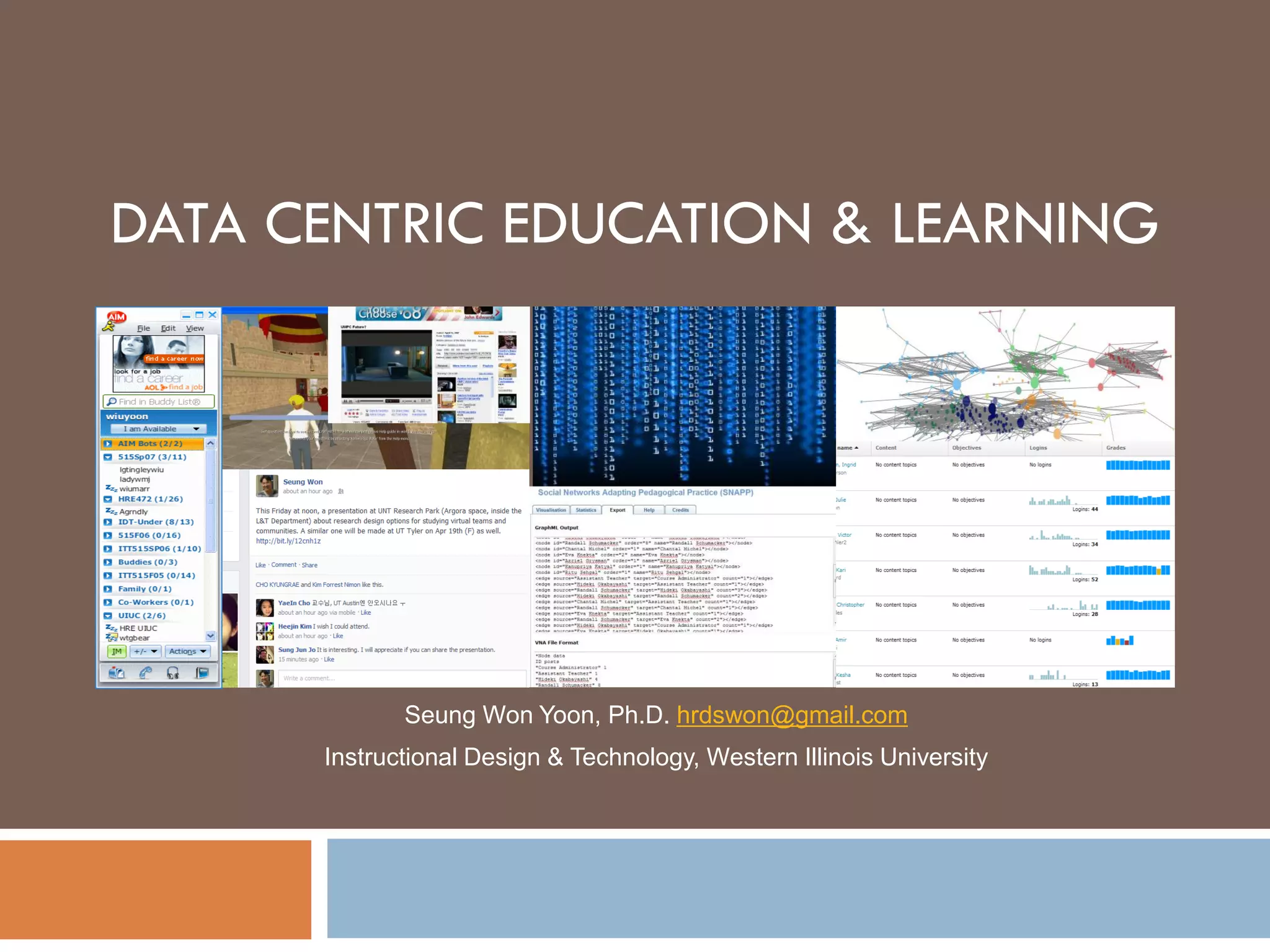
DATA CENTRIC EDUCATION & LEARNING
Seung Won Yoon, Ph.D. hrdswon@gmail.com
Instructional Design & Technology, Western Illinois University
Project & Case Examples
Outline
Technology in Education: Past
Now and Future
Design Frameworks
1
2
3
4
Assumptions
 Strategies first, then technologies.
 If great people/tool vs. bad culture/system, latter wins.
 Most technology integration has failed. Innovation adoption
has been tough. Workshop or training to (big) data/analytics
will always have minimal impacts.
 Learning and performance must be integrated.
Technologies in the Past
 Technologies in education
 Process: Instructional design, learning strategy, 4C/ID (for complex
contents), learning environments, design based research, etc.
 Media: radio, TV, CBT, video, PC, multimedia, Web, virtual worlds, …
now, analytics & network analysis (paradigm change? Anything new?)
 Education: Industry lowest in adopting technologies
 People will always focus more on new media
 Media vs. methods debate
 New technology has never replaced ‘old’
Present & Future
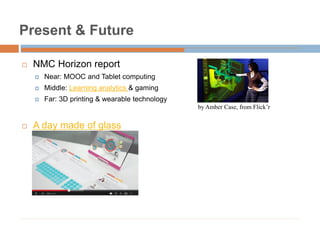
 NMC Horizon report
 Near: MOOC and Tablet computing
 Middle: Learning analytics & gaming
 Far: 3D printing & wearable technology
 A day made of glass
by Amber Case, from Flick’r
What’s New about Data-centric Learning?
 Tablet, phone, devices connected to the cloud
 Real-time feedback (pacing)
 Adaptive contents (individualization)
 Instructional precision/effectiveness (previous knowledge)
 Analyzed and used to augment teacher/student capabilities
Watters. A. (2011, July). How data and analytics will change education.
Data-centric Education & Learning
 LMS: grade, log, forum postings
 Student/institutional records
 Web 2.0/3.0 – digital trails
 Top 100 learning tools – more data
 Data sources (in addition to social media):
 PSLC’s learning datasets
 Carnegie Melon University
 Stanford’s multimodal learning analytics
 Stanford’s large network data collection
 Society for Learning Analytics Research datasets
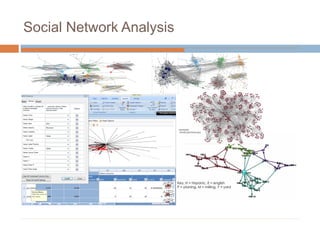
Social Network Analysis
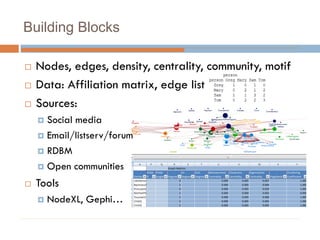
Building Blocks
 Nodes, edges, density, centrality, community, motif
 Data: Affiliation matrix, edge list
 Sources:
 Social media
 Email/listserv/forum
 RDBM
 Open communities
 Tools
 NodeXL, Gephi…
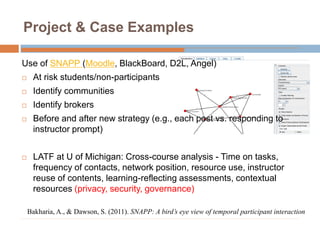
Project & Case Examples
Use of SNAPP (Moodle, BlackBoard, D2L, Angel)
 At risk students/non-participants
 Identify communities
 Identify brokers
 Before and after new strategy (e.g., each post vs. responding to
instructor prompt)
 LATF at U of Michigan: Cross-course analysis - Time on tasks,
frequency of contacts, network position, resource use, instructor
reuse of contents, learning-reflecting assessments, contextual
resources (privacy, security, governance)
Bakharia, A., & Dawson, S. (2011). SNAPP: A bird’s eye view of temporal participant interaction
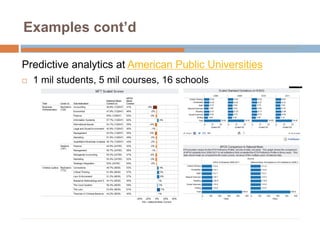
Examples cont’d
Predictive analytics at American Public Universities
 1 mil students, 5 mil courses, 16 schools
Examples cont’d
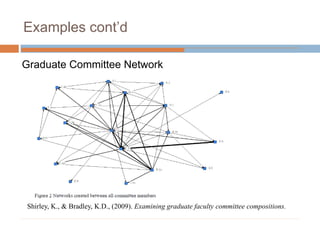
Graduate Committee Network
Shirley, K., & Bradley, K.D., (2009). Examining graduate faculty committee compositions.
Examples cont’d
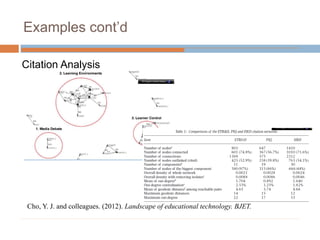
Citation Analysis
Cho, Y. J. and colleagues. (2012). Landscape of educational technology. BJET.
Examples cont’d
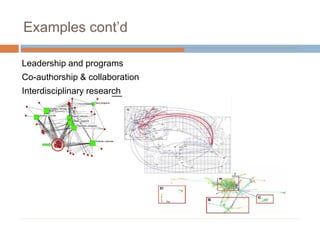
Leadership and programs
Co-authorship & collaboration
Interdisciplinary research
In the Workplace
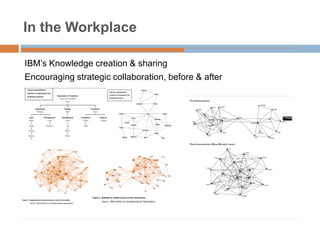
IBM’s Knowledge creation & sharing
Encouraging strategic collaboration, before & after
Design Frameworks
 Learning must take place in the context of work or performing
tasks.
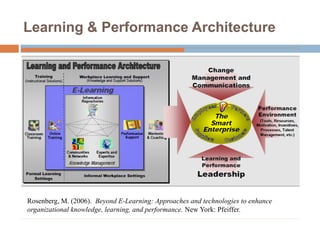
Learning & Performance Architecture
Rosenberg, M. (2006). Beyond E-Learning: Approaches and technologies to enhance
organizational knowledge, learning, and performance. New York: Pfeiffer.
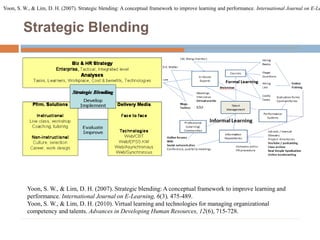
Strategic Blending
Yoon, S. W., & Lim, D. H. (2007). Strategic blending: A conceptual framework to improve learning and performance. International Journal on E-Le
Yoon, S. W., & Lim, D. H. (2007). Strategic blending: A conceptual framework to improve learning and
performance. International Journal on E-Learning, 6(3), 475-489.
Yoon, S. W., & Lim, D. H. (2010). Virtual learning and technologies for managing organizational
competency and talents. Advances in Developing Human Resources, 12(6), 715-728.
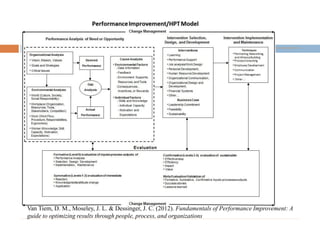
HPT Model
Van Tiem, D. M., Moseley, J. L. & Dessinger, J. C. (2012). Fundamentals of Performance Improvement: A
guide to optimizing results through people, process, and organizations
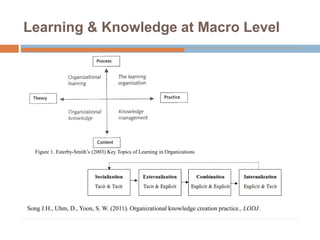
Learning & Knowledge at Macro Level
Figure 1. Esterby-Smith’s (2003) Key Topics of Learning in Organizations
Song J.H., Uhm, D., Yoon, S. W. (2011). Organizational knowledge creation practice., LODJ.
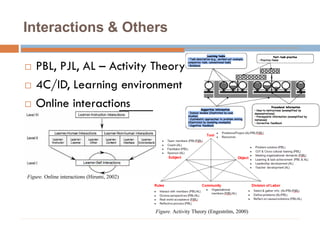
Interactions & Others
 PBL, PJL, AL – Activity Theory
 4C/ID, Learning environment
 Online interactions
Figure. Activity Theory (Engeström, 2000)
Figure. Online interactions (Hirumi, 2002)
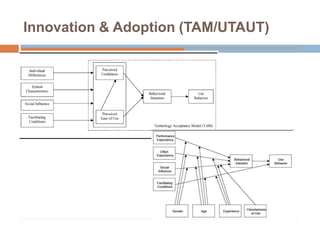
Innovation & Adoption (TAM/UTAUT)
Conclusions
 It’s not about if (big) data/analytics is different;
it’s about doing the right thing & doing things right
 Must be treated as the same as business intelligence
 Tools & frameworks are here, are you ready?

DATA CENTRIC EDUCATION & LEARNING

  • 1.
    DATA CENTRIC EDUCATION& LEARNING Seung Won Yoon, Ph.D. hrdswon@gmail.com Instructional Design & Technology, Western Illinois University
  • 2.
    Project & CaseExamples Outline Technology in Education: Past Now and Future Design Frameworks 1 2 3 4
  • 3.
    Assumptions  Strategies first,then technologies.  If great people/tool vs. bad culture/system, latter wins.  Most technology integration has failed. Innovation adoption has been tough. Workshop or training to (big) data/analytics will always have minimal impacts.  Learning and performance must be integrated.
  • 4.
    Technologies in thePast  Technologies in education  Process: Instructional design, learning strategy, 4C/ID (for complex contents), learning environments, design based research, etc.  Media: radio, TV, CBT, video, PC, multimedia, Web, virtual worlds, … now, analytics & network analysis (paradigm change? Anything new?)  Education: Industry lowest in adopting technologies  People will always focus more on new media  Media vs. methods debate  New technology has never replaced ‘old’
  • 5.
    Present & Future NMC Horizon report  Near: MOOC and Tablet computing  Middle: Learning analytics & gaming  Far: 3D printing & wearable technology  A day made of glass by Amber Case, from Flick’r
  • 6.
    What’s New aboutData-centric Learning?  Tablet, phone, devices connected to the cloud  Real-time feedback (pacing)  Adaptive contents (individualization)  Instructional precision/effectiveness (previous knowledge)  Analyzed and used to augment teacher/student capabilities Watters. A. (2011, July). How data and analytics will change education.
  • 7.
    Data-centric Education &Learning  LMS: grade, log, forum postings  Student/institutional records  Web 2.0/3.0 – digital trails  Top 100 learning tools – more data  Data sources (in addition to social media):  PSLC’s learning datasets  Carnegie Melon University  Stanford’s multimodal learning analytics  Stanford’s large network data collection  Society for Learning Analytics Research datasets
  • 8.
  • 9.
    Building Blocks  Nodes,edges, density, centrality, community, motif  Data: Affiliation matrix, edge list  Sources:  Social media  Email/listserv/forum  RDBM  Open communities  Tools  NodeXL, Gephi…
  • 10.
    Project & CaseExamples Use of SNAPP (Moodle, BlackBoard, D2L, Angel)  At risk students/non-participants  Identify communities  Identify brokers  Before and after new strategy (e.g., each post vs. responding to instructor prompt)  LATF at U of Michigan: Cross-course analysis - Time on tasks, frequency of contacts, network position, resource use, instructor reuse of contents, learning-reflecting assessments, contextual resources (privacy, security, governance) Bakharia, A., & Dawson, S. (2011). SNAPP: A bird’s eye view of temporal participant interaction
  • 11.
    Examples cont’d Predictive analyticsat American Public Universities  1 mil students, 5 mil courses, 16 schools
  • 12.
    Examples cont’d Graduate CommitteeNetwork Shirley, K., & Bradley, K.D., (2009). Examining graduate faculty committee compositions.
  • 13.
    Examples cont’d Citation Analysis Cho,Y. J. and colleagues. (2012). Landscape of educational technology. BJET.
  • 14.
    Examples cont’d Leadership andprograms Co-authorship & collaboration Interdisciplinary research
  • 15.
    In the Workplace IBM’sKnowledge creation & sharing Encouraging strategic collaboration, before & after
  • 16.
    Design Frameworks  Learningmust take place in the context of work or performing tasks.
  • 17.
    Learning & PerformanceArchitecture Rosenberg, M. (2006). Beyond E-Learning: Approaches and technologies to enhance organizational knowledge, learning, and performance. New York: Pfeiffer.
  • 18.
    Strategic Blending Yoon, S.W., & Lim, D. H. (2007). Strategic blending: A conceptual framework to improve learning and performance. International Journal on E-Le Yoon, S. W., & Lim, D. H. (2007). Strategic blending: A conceptual framework to improve learning and performance. International Journal on E-Learning, 6(3), 475-489. Yoon, S. W., & Lim, D. H. (2010). Virtual learning and technologies for managing organizational competency and talents. Advances in Developing Human Resources, 12(6), 715-728.
  • 19.
    HPT Model Van Tiem,D. M., Moseley, J. L. & Dessinger, J. C. (2012). Fundamentals of Performance Improvement: A guide to optimizing results through people, process, and organizations
  • 20.
    Learning & Knowledgeat Macro Level Figure 1. Esterby-Smith’s (2003) Key Topics of Learning in Organizations Song J.H., Uhm, D., Yoon, S. W. (2011). Organizational knowledge creation practice., LODJ.
  • 21.
    Interactions & Others PBL, PJL, AL – Activity Theory  4C/ID, Learning environment  Online interactions Figure. Activity Theory (Engeström, 2000) Figure. Online interactions (Hirumi, 2002)
  • 22.
  • 23.
    Conclusions  It’s notabout if (big) data/analytics is different; it’s about doing the right thing & doing things right  Must be treated as the same as business intelligence  Tools & frameworks are here, are you ready?