Discourse,
  Computation and
Context – Sociocultural
   DCLA Revisited


    Simon Knight @sjgknight
    http://people.kmi.open.ac.uk/knight/

    Karen Littleton
    http://www.open.ac.uk/education-and-
    languages/main/people/k.s.littleton


CC-BY-NC http://xkcd.com/1085/
Acknowledgements/References
This talk is based on:
Knight, S, and Littleton, K. “Discourse, Computation
and Context – Sociocultural DCLA Revisited.” In 1st
International Workshop on Discourse-Centric
Learning Analytics. Leuven, Belgium, 2013.
http://oro.open.ac.uk/36640/

Thanks to the anonymous reviewers, my
supervisors Simon and Karen, Yulan He and Rebecca
Ferguson for helpful comments and conversations.
Context in context
1.   Research around discourse for learning
2.   Particular emphasis on context
3.   Current work in DCLA
4.   Remaining challenge
5.   Moving forward
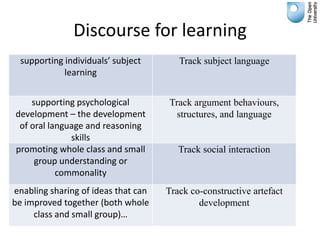
Discourse for learning
  supporting individuals’ subject       Track subject language
             learning


    supporting psychological         Track argument behaviours,
development – the development          structures, and language
 of oral language and reasoning
              skills
promoting whole class and small         Track social interaction
     group understanding or
           commonality
enabling sharing of ideas that can   Track co-constructive artefact
be improved together (both whole             development
     class and small group)…
Context in learning discourse

Common Knowledge
• Shared Perspective
• Built through discourse and joint action
• It both constitutes a context, and is a dynamic
  facet of context
Temporal Context
Mercer, Neil (2008) “The Seeds of Time: Why Classroom
Dialogue Needs a Temporal Analysis.”
• Education is not a series of discrete events
• Dialogue mediates this long term process
• Yet this aspect is not well theorised or
  empirically studied
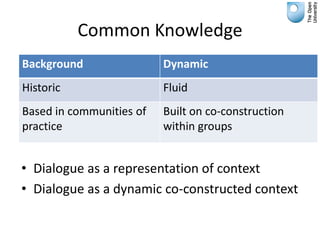
Common Knowledge
Background                Dynamic
Historic                  Fluid
Based in communities of   Built on co-construction
practice                  within groups


• Dialogue as a representation of context
• Dialogue as a dynamic co-constructed context
Context in learning discourse
Exploratory Talk and
Accountable Talk
• Critical constructive
  engagement
• Justifications given
• Active participation
• Reasoning is visible, and
  talk is accountable –
  participants Interthink
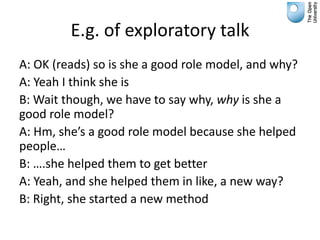
E.g. of exploratory talk
A: OK (reads) so is she a good role model, and why?
A: Yeah I think she is
B: Wait though, we have to say why, why is she a
good role model?
A: Hm, she’s a good role model because she helped
people…
B: ….she helped them to get better
A: Yeah, and she helped them in like, a new way?
B: Right, she started a new method
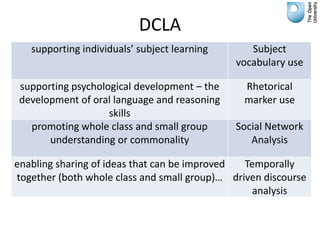
DCLA
   supporting individuals’ subject learning      Subject
                                              vocabulary use

 supporting psychological development – the     Rhetorical
 development of oral language and reasoning     marker use
                    skills
   promoting whole class and small group      Social Network
       understanding or commonality              Analysis

enabling sharing of ideas that can be improved  Temporally
together (both whole class and small group)… driven discourse
                                                  analysis
What do we want?
• Domain general analytics
• For peer talk rather than peer/teacher or
  peer/conversation agent
• With a focus on common knowledge, and
  exploratory talk – related to positive outcomes
Combining DCLA
Education is interested in progress – getting from
here to there. Methods can be combined to:
1. identify the apt-concepts for any particular
   discourse (row 1)
2. understand the network of intercolutors and
   their contributions – conceptual & rhetorical
   interthinking resources (rows 2 and 3)
3. and understanding how these discourses are
   related across time and location (row 4)
The Challenge for context…
• Moving beyond understanding where
  someone else is
• To understanding how they got there too (and
  who they travelled with)
• And the (joint) artefacts they created, left
  behind, and plan to create

What is happening v. what is being done
E.g. of exploratory talk
A: OK (reads) so is she a good role model, and why?
A: Yeah I think she is
B: Wait though, we have to say why, why is she a
good role model?
A: Hm, she’s a good role model because she helped
people…
B: ….she helped them to get better
A: Yeah, and she helped them in like, a new way?
B: Right, she started a new method
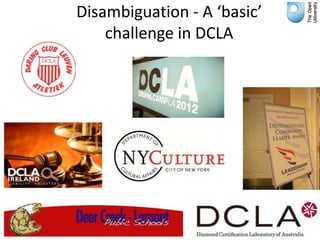
Disambiguation - A ‘basic’
    challenge in DCLA
Example problems in DCLA & Education
• “Context is a problem, isn’t it?” Rhetoric and anaphora
  are linguistic problems (as are speech acts such as ‘can
  you pass the salt?’)
• “Stop that!” “is that right?” spoken by a child or
  teacher is rather different
• “What were the key medical developments?” Asked at
  start/end of lesson, or of different students
• “The wiglywoo” Words (or non-words) take on new
  meanings through on going dialogue
• “should think about x” Can be an imperative, a
  hypothesis, a question/suggestion, etc.
Documents v. Conversations
• Documents – relatively stable snapshots of
  distribution of topics
• Conversations unfold, and topics are renegotiated

Thus Introne and Drescher:
• Analyse sequences of replies to understand word
  clusters, changes, merges, splits to model co-
  occurrence as opposed to modelling based on
  dictionaries or other corpora
Methods as Context
The data we train on, and the processes we use have an
impact on classifications and how we can treat them

• Training sets require human coders – their methods are
  an aspect of context
• Document splitting which treats each turn as a
  document may gloss temporal aspects of context
• Smoothing across turns may rectify this (cf current
  evidence)
• Other methods for temporal analysis
Methods as Context
• Topic modelling for knowledge flow (and
  cohesive ties) (domain, and possibly social
  network specific) – Transactivity
• Plus exploratory talk markers (domain-
  general)
Discourse as Context
Discourse:
1. exists within a particular context and
   mediates it, and
2. creates context, as a dynamic, collaborative,
   discursive property.
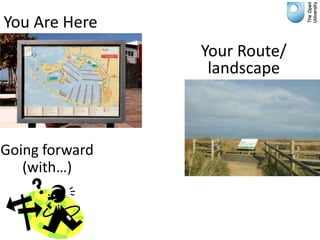
You Are Here
                Your Route/
                 landscape


Going forward
   (with…)
Parallels in Pragmatic Web?
Move from:
1. syntax (logical forms and symbolic structures)
2. semantics (meaning of symbols) – preoccupation with
    standardisation based on ontologies
3. pragmatics address the evolving contexts and
    practices of creating, using, and developing epistemic
    artifacts.
Language in action: The shift “from…language as a tool of
representing the world to its view as a means of
interacting with the world.” *22:39+
Context, language in action, community networks
A note of caution
• DCLA has novel potential for new assessment
  practices
• However, we should tread cautiously…“in
  developing tools with limited – but perhaps
  unstated – views on the nature of language
  use for learning”
• Once we can detect – how do we support?
  (offline work)
Thank you for listening


@sjgknight
sjgknight@gmail.com
http://people.kmi.open.ac.uk/knight/

Dcla13 discourse, computation and context – sociocultural dcla

  • 1.
    Discourse, Computationand Context – Sociocultural DCLA Revisited Simon Knight @sjgknight http://people.kmi.open.ac.uk/knight/ Karen Littleton http://www.open.ac.uk/education-and- languages/main/people/k.s.littleton CC-BY-NC http://xkcd.com/1085/
  • 2.
    Acknowledgements/References This talk isbased on: Knight, S, and Littleton, K. “Discourse, Computation and Context – Sociocultural DCLA Revisited.” In 1st International Workshop on Discourse-Centric Learning Analytics. Leuven, Belgium, 2013. http://oro.open.ac.uk/36640/ Thanks to the anonymous reviewers, my supervisors Simon and Karen, Yulan He and Rebecca Ferguson for helpful comments and conversations.
  • 3.
    Context in context 1. Research around discourse for learning 2. Particular emphasis on context 3. Current work in DCLA 4. Remaining challenge 5. Moving forward
  • 4.
    Discourse for learning supporting individuals’ subject Track subject language learning supporting psychological Track argument behaviours, development – the development structures, and language of oral language and reasoning skills promoting whole class and small Track social interaction group understanding or commonality enabling sharing of ideas that can Track co-constructive artefact be improved together (both whole development class and small group)…
  • 5.
    Context in learningdiscourse Common Knowledge • Shared Perspective • Built through discourse and joint action • It both constitutes a context, and is a dynamic facet of context
  • 6.
    Temporal Context Mercer, Neil(2008) “The Seeds of Time: Why Classroom Dialogue Needs a Temporal Analysis.” • Education is not a series of discrete events • Dialogue mediates this long term process • Yet this aspect is not well theorised or empirically studied
  • 7.
    Common Knowledge Background Dynamic Historic Fluid Based in communities of Built on co-construction practice within groups • Dialogue as a representation of context • Dialogue as a dynamic co-constructed context
  • 8.
    Context in learningdiscourse Exploratory Talk and Accountable Talk • Critical constructive engagement • Justifications given • Active participation • Reasoning is visible, and talk is accountable – participants Interthink
  • 9.
    E.g. of exploratorytalk A: OK (reads) so is she a good role model, and why? A: Yeah I think she is B: Wait though, we have to say why, why is she a good role model? A: Hm, she’s a good role model because she helped people… B: ….she helped them to get better A: Yeah, and she helped them in like, a new way? B: Right, she started a new method
  • 10.
    DCLA supporting individuals’ subject learning Subject vocabulary use supporting psychological development – the Rhetorical development of oral language and reasoning marker use skills promoting whole class and small group Social Network understanding or commonality Analysis enabling sharing of ideas that can be improved Temporally together (both whole class and small group)… driven discourse analysis
  • 11.
    What do wewant? • Domain general analytics • For peer talk rather than peer/teacher or peer/conversation agent • With a focus on common knowledge, and exploratory talk – related to positive outcomes
  • 12.
    Combining DCLA Education isinterested in progress – getting from here to there. Methods can be combined to: 1. identify the apt-concepts for any particular discourse (row 1) 2. understand the network of intercolutors and their contributions – conceptual & rhetorical interthinking resources (rows 2 and 3) 3. and understanding how these discourses are related across time and location (row 4)
  • 13.
    The Challenge forcontext… • Moving beyond understanding where someone else is • To understanding how they got there too (and who they travelled with) • And the (joint) artefacts they created, left behind, and plan to create What is happening v. what is being done
  • 14.
    E.g. of exploratorytalk A: OK (reads) so is she a good role model, and why? A: Yeah I think she is B: Wait though, we have to say why, why is she a good role model? A: Hm, she’s a good role model because she helped people… B: ….she helped them to get better A: Yeah, and she helped them in like, a new way? B: Right, she started a new method
  • 15.
    Disambiguation - A‘basic’ challenge in DCLA
  • 16.
    Example problems inDCLA & Education • “Context is a problem, isn’t it?” Rhetoric and anaphora are linguistic problems (as are speech acts such as ‘can you pass the salt?’) • “Stop that!” “is that right?” spoken by a child or teacher is rather different • “What were the key medical developments?” Asked at start/end of lesson, or of different students • “The wiglywoo” Words (or non-words) take on new meanings through on going dialogue • “should think about x” Can be an imperative, a hypothesis, a question/suggestion, etc.
  • 17.
    Documents v. Conversations •Documents – relatively stable snapshots of distribution of topics • Conversations unfold, and topics are renegotiated Thus Introne and Drescher: • Analyse sequences of replies to understand word clusters, changes, merges, splits to model co- occurrence as opposed to modelling based on dictionaries or other corpora
  • 18.
    Methods as Context Thedata we train on, and the processes we use have an impact on classifications and how we can treat them • Training sets require human coders – their methods are an aspect of context • Document splitting which treats each turn as a document may gloss temporal aspects of context • Smoothing across turns may rectify this (cf current evidence) • Other methods for temporal analysis
  • 19.
    Methods as Context •Topic modelling for knowledge flow (and cohesive ties) (domain, and possibly social network specific) – Transactivity • Plus exploratory talk markers (domain- general)
  • 20.
    Discourse as Context Discourse: 1.exists within a particular context and mediates it, and 2. creates context, as a dynamic, collaborative, discursive property.
  • 21.
    You Are Here Your Route/ landscape Going forward (with…)
  • 22.
    Parallels in PragmaticWeb? Move from: 1. syntax (logical forms and symbolic structures) 2. semantics (meaning of symbols) – preoccupation with standardisation based on ontologies 3. pragmatics address the evolving contexts and practices of creating, using, and developing epistemic artifacts. Language in action: The shift “from…language as a tool of representing the world to its view as a means of interacting with the world.” *22:39+ Context, language in action, community networks
  • 23.
    A note ofcaution • DCLA has novel potential for new assessment practices • However, we should tread cautiously…“in developing tools with limited – but perhaps unstated – views on the nature of language use for learning” • Once we can detect – how do we support? (offline work)
  • 24.
    Thank you forlistening @sjgknight sjgknight@gmail.com http://people.kmi.open.ac.uk/knight/

Editor's Notes

  • #5 Knight, Simon. “Creating a Supportive Environment for Classroom Dialogue.” In Developing Interactive Teaching and Learning Using the IWB, edited by Sara Hennessy, Paul Warwick, Lloyd Brown, Diane Rawlins, and Caroline Neale. Open University Press, 2013. ISBN: 9780335263165
  • #6 use it however you like all I ask is a credit link to : thegoldguys.blogspot.com/ or www.lumaxart.com/http://www.flickr.com/photos/lumaxart/2626680380/“Wherever education is taking place, commonality – a shared perspective – is key, and dialogue is the tool used to create such a perspective [2]”This shared perspective has been termed “common knowledge” [2], the body of shared contextual knowledge which is built up through discourse and joint action, and forms the basis for further communication. Thus, in this perspective, “common knowledge” forms a key constitutive part of context for speakers in a discourse, as well as being a fundamental aspect of education – in which a mutuality of understanding is crucial.
  • #7 www.temporalweb.net/files/time-300x300.jpg – NOT CC licence but it’s on an EU project website so may be covered by such licence? Needs checking
  • #10 Made up fairly generic (although broadly based on discussions about role models I recorded in my MPhil research). Note the building on ideas, the use of ‘because’, questioning, cohesive tiesIn discourse analysis, markers for such talk include explanatory terms such as for example; I think; because/’cause; if;also.
  • #15 Made up fairly generic (although broadly based on discussions about role models I recorded in my MPhil research). Note the building on ideas, the use of ‘because’, questioning, cohesive tiesIn discourse analysis, markers for such talk include explanatory terms such as for example; I think; because/’cause; if;also.
  • #16 http://www.google.com/imgres?hl=en&biw=1366&bih=498&tbm=isch&tbnid=pzFgWj8EiGtxBM:&imgrefurl=http://www.dcla.be/index.php%3Fpage%3Dsecretariaat&docid=NBhma3aos5eWTM&imgurl=http://dropfolder.dcla.be/fotosnieuws/DCLA-logo.jpg&w=200&h=196&ei=w0VdUenOKrHu0gWewIHIBw&zoom=1&ved=1t:3588,r:11,s:0,i:118&iact=rc&dur=441&page=1&tbnh=156&tbnw=160&start=0&ndsp=14&tx=35&ty=26http://www.google.com/imgres?hl=en&biw=1366&bih=498&tbm=isch&tbnid=OgIIQb3_PmOw3M:&imgrefurl=http://www.whiteflash.com/about-diamonds/news/dcla-recognized-by-cibjo-as.htm&docid=eFGhM1Vg1RlYGM&imgurl=http://pics1.whiteflash.com/articlefiles/378-dcla.jpg&w=477&h=155&ei=w0VdUenOKrHu0gWewIHIBw&zoom=1&ved=1t:3588,r:24,s:0,i:167&iact=rc&dur=540&page=2&tbnh=111&tbnw=330&start=14&ndsp=19&tx=104&ty=19https://encrypted-tbn3.gstatic.com/images?q=tbn:ANd9GcTQsGeIbeixyEXFXIDp717IPidKJNU3zDKPtYE77QVK_GryQLqVhttp://www.google.com/imgres?start=110&hl=en&biw=1366&bih=498&tbm=isch&tbnid=zt4zkbmACdxMEM:&imgrefurl=http://www.flickr.com/photos/fregans_photos/7689163100/&docid=DU8-fKIxcdXh1M&itg=1&imgurl=http://farm9.staticflickr.com/8011/7689163100_76cd438296_z.jpg&w=640&h=427&ei=GkZdUcOcHui90QXPvYDQAg&zoom=1&ved=1t:3588,r:10,s:100,i:34&iact=rc&dur=1690&page=7&tbnh=183&tbnw=275&ndsp=21&tx=111&ty=69http://www.google.com/imgres?start=110&hl=en&biw=1366&bih=498&tbm=isch&tbnid=WvgIQ1pue99yCM:&imgrefurl=http://dcla.ie/&docid=K-2G-6sOUvFV6M&imgurl=http://dcla.ie/images/gallery/gallery-300px-5.jpg&w=300&h=200&ei=GkZdUcOcHui90QXPvYDQAg&zoom=1&ved=1t:3588,r:18,s:100,i:58&iact=rc&dur=395&page=7&tbnh=160&tbnw=234&ndsp=21&tx=194&ty=56http://www.google.com/imgres?start=150&hl=en&biw=1366&bih=498&tbm=isch&tbnid=-GuiDdS8AvKNKM:&imgrefurl=http://www.isorch.org/blog/wp-content/uploads/2012/11/&docid=8Iv1X9YoXfaPCM&imgurl=http://www.isorch.org/blog/wp-content/uploads/2012/11/DCLA-large.jpg&w=703&h=325&ei=GkZdUcOcHui90QXPvYDQAg&zoom=1&ved=1t:3588,r:57,s:100,i:175&iact=rc&dur=324&page=9&tbnh=152&tbnw=330&ndsp=19&tx=150&ty=60http://www.google.com/imgres?start=150&hl=en&biw=1366&bih=498&tbm=isch&tbnid=5mS8kA6rAd5UgM:&imgrefurl=http://www.leadershipgreatersyracuse.org/home/vw/1/itemid/153.aspx&docid=68GQaLECkLBbGM&imgurl=http://www.leadershipgreatersyracuse.org/Portals/7/DCLA%2525202012%252520Entrance.JPG&w=720&h=480&ei=GkZdUcOcHui90QXPvYDQAg&zoom=1&ved=1t:3588,r:67,s:100,i:205&iact=rc&dur=600&page=9&tbnh=183&tbnw=275&ndsp=19&tx=113&ty=94
  • #18 7. Introne, J.E. and Drescher, M. Analyzing the flow of knowledge in computer mediated teams. Proceedings of the 2013 conference on Computer supported cooperative work, ACM (2013), 341–356.
  • #19 Thanks in particular to Yulan, Rebecca, Simon and Karen for helpful discussion on this slideHidden Markov for last mention
  • #20 Thanks in particular to Yulan, Rebecca, Simon and Karen for helpful discussion on this slide
  • #22 Knowing you’re “here” is not always so helpful without knowing the rest of the landscape.Understanding you’re wearing snow gear – so likely to be heading that way is important part of context.“I derive no pleasure from it” – understanding you’re with someone who flat out refuses to walk in the rain may also be.Simon Huguet [CC-BY-SA-2.0 (http://creativecommons.org/licenses/by-sa/2.0)], via Wikimedia Commons http://commons.wikimedia.org/wiki/File:Viewing_point_for_disabled_visitors_-_geograph.org.uk_-_1077435.jpg By Frank Vincentz (Own work) [GFDL (http://www.gnu.org/copyleft/fdl.html) or CC-BY-SA-3.0 (http://creativecommons.org/licenses/by-sa/3.0)], via Wikimedia Commons http://commons.wikimedia.org/wiki/File:Yaiza_Playa_Blanca_-_Marina_Rubic%C3%B3n_03_ies.jpg
  • #23 Hakkarainen, K., R. Engeström, S. Paavola, P. Pohjola, and T. Honkela. “Knowledge Practices, Epistemic Technologies, and Pragmatic Web.” In Proceedings of I-KNOW, 9:683–694, 2009. http://citeseerx.ist.psu.edu/viewdoc/download?doi=10.1.1.157.91rep=rep1type=pdf.http://people.kmi.open.ac.uk/knight/2013/01/the-pragmatic-web-more-than-just-semantics-contextualised/