1
Grades 11
DAILY
LESSON
LOG
School GENERAL TINIO NATIONAL
H.S
Grade Level 11
Teacher MARY ANN J. ROMERO Learning Area Personal Development
Teaching Dates and
Time
Week 1 Quarter First
2
Resource
(LR)portal
3
B. Other Learning
Resource
IV. PROCEDURES
A. Reviewing previous
lesson or presenting
the new lesson
ORIENTATION
1. Classroom Rules
2. Talk about the
Course Personal
Development, its
content and
objectives
3. Discuss the
requirements
needed for Personal
Development.
Ask the students to
answer the Self-Concept
Inventory.
Tell the students that the
best way to develop
oneself is to express their
talents and gifts in a way
they enjoy.
Provide ”My Banner – The
Treasure Within Me”
activity to the students
B. Establishing
purpose for
lesson
a
the
Group the class into 5-6
groups. Ask them to
prepare a talent show to
be presented on the third
session.
Ask the students to give
their insight regarding on
the previous activity.
Emphasize to them that
the purpose of the activity
is determining on how
they see themselves.
Ask the students to
perform their prepared
talent. After the
performance, the students
need
to give their qualitative
comments.
Explain to the students on
how the previous activities
help them in determining
all the positive things that
happened to them or the
positive attributes that
they have.
C.Presenting
examples/instances of
the new lesson
Show some pictures to
the class. Let them
describe the picture.
Discuss what Selfconcept
is.
Explain to the students
that the said performance
displays the talents of the
students and make use all
their personal resources.
Explain the importance of
knowing what your
strengths are and
identifying your
weaknesses.
4
D.Discussing new
concepts and
practicing new skills # 1
Let the student imagine
himself/herself to who and
what he/she want to be and
the “real” him/her.
Discuss Personal
Effectiveness.
Discuss the SWOT
Analysis.
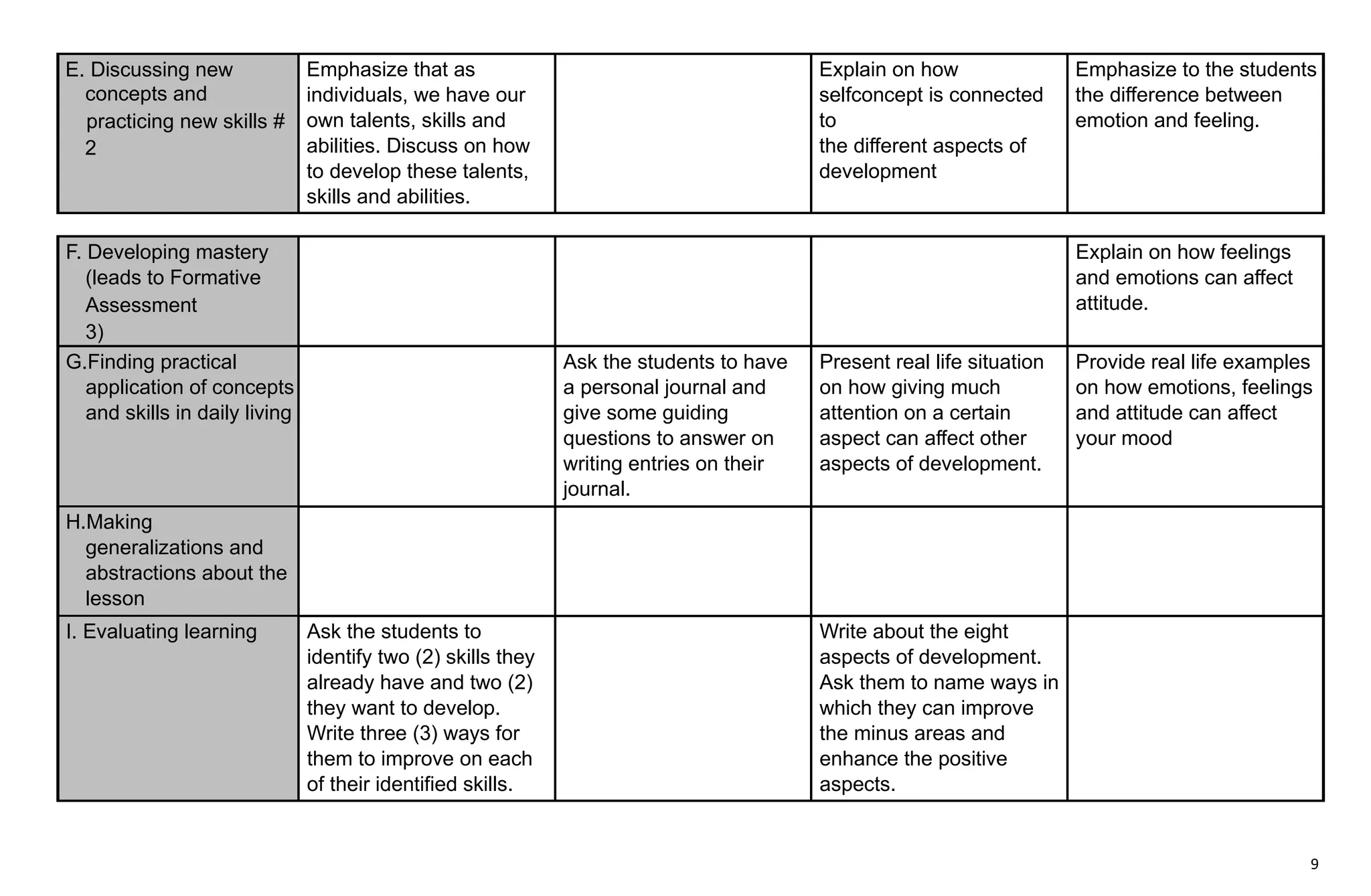
E. Discussing new
concepts
Discuss the difference
between
Emphasize that as
individuals,
and practicing new
skills # 2
actual self and ideal self. we have our own talents,
skills and abilities. Discuss
on how to develop these
talents, skills and abilities.
F. Developing mastery
(leads to Formative
Assessment
3)
Discuss self-image.
G.Finding practical
application of concepts
and skills in daily living
Emphasize to the students
the importance of knowing
who and what you are
when it comes to dealing
with self and other people.
H.Making generalizations
and abstractions about
the lesson
Ask the students to right
their insights and
realizations in their
journals.
Ask the students to write
their reflections regarding
on their banner.
5
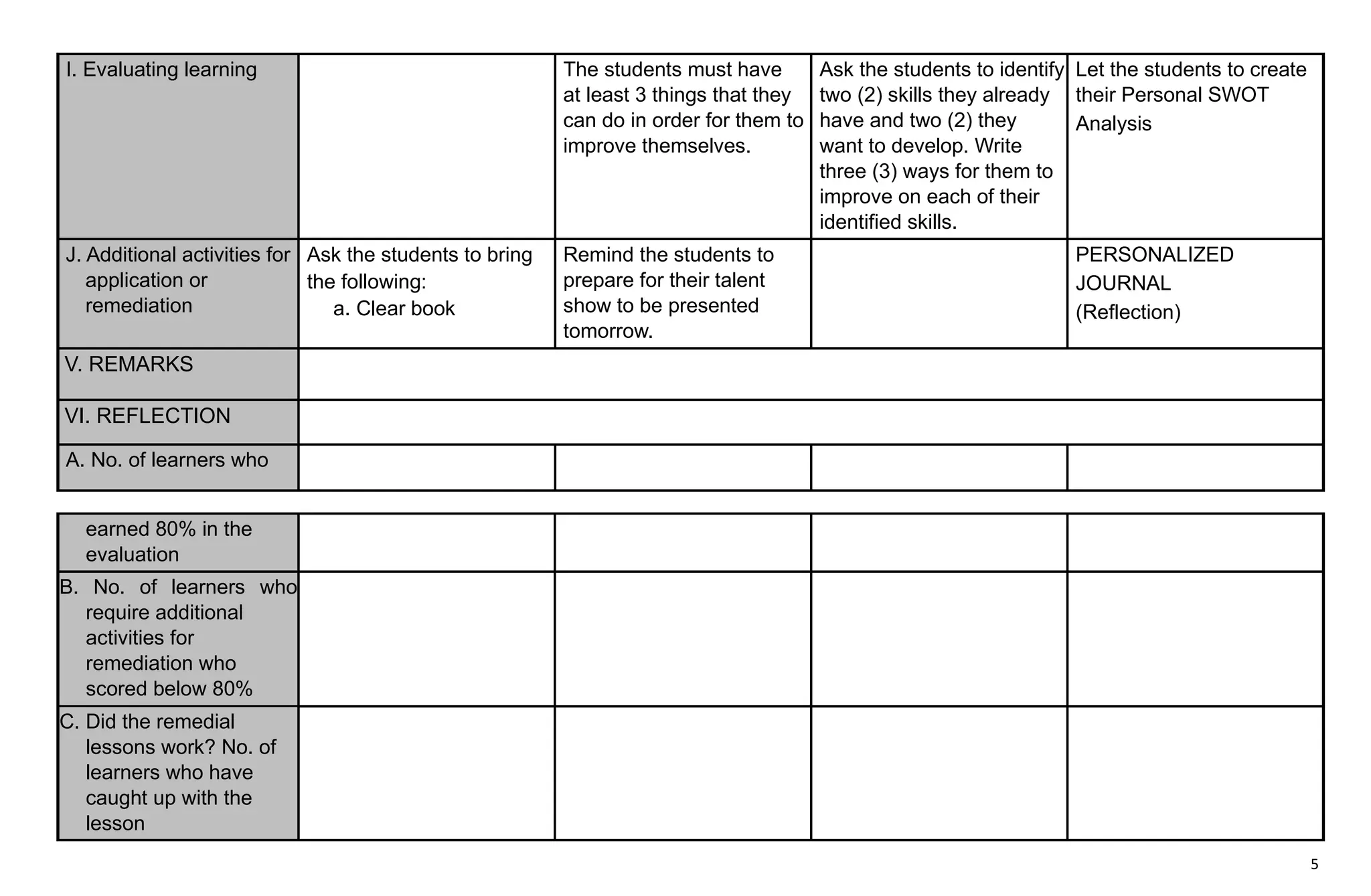
I. Evaluating learning The students must have
at least 3 things that they
can do in order for them to
improve themselves.
Ask the students to identify
two (2) skills they already
have and two (2) they
want to develop. Write
three (3) ways for them to
improve on each of their
identified skills.
Let the students to create
their Personal SWOT
Analysis
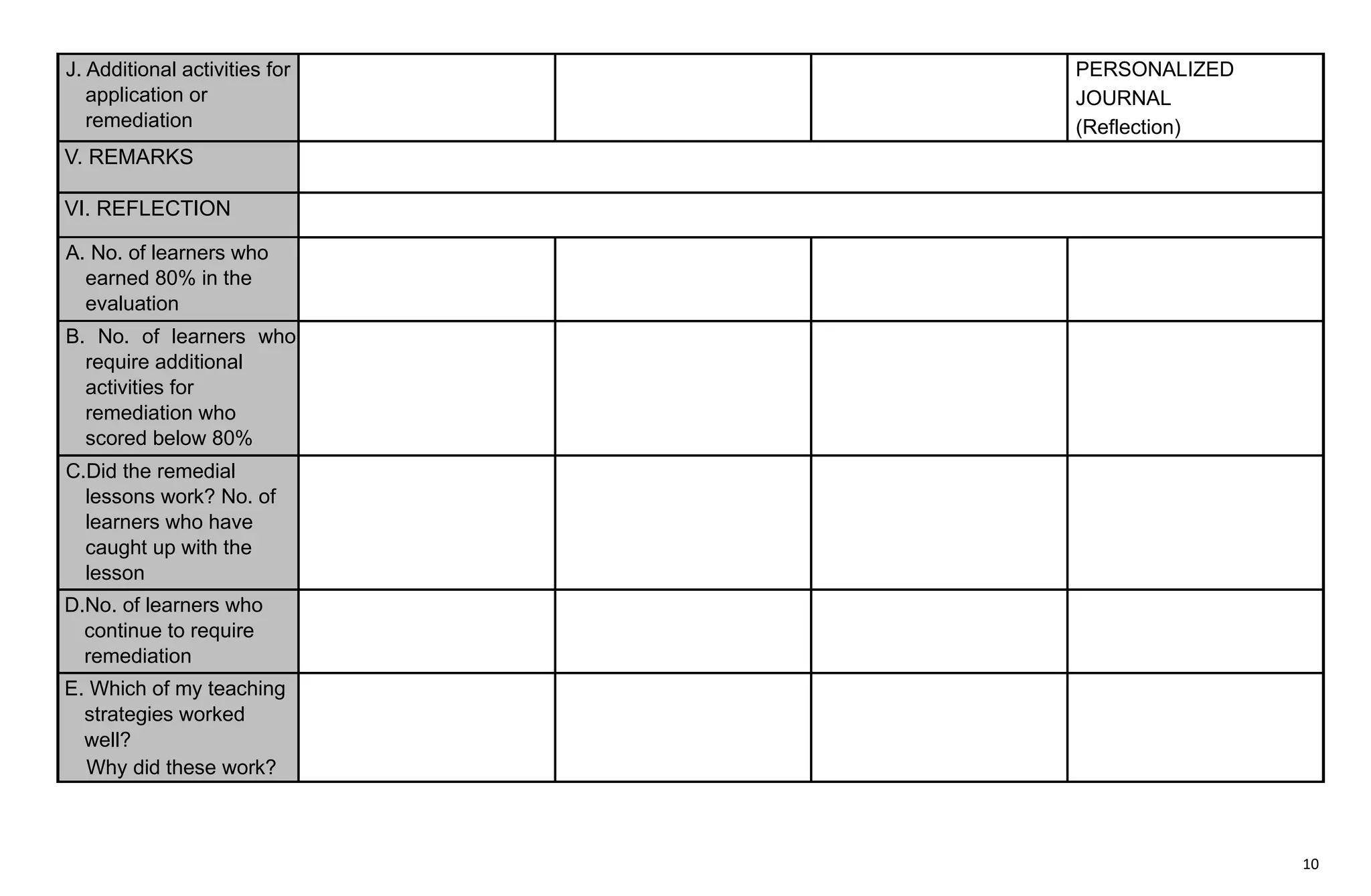
J. Additional activities for
application or
remediation
Ask the students to bring
the following:
a. Clear book
Remind the students to
prepare for their talent
show to be presented
tomorrow.
PERSONALIZED
JOURNAL
(Reflection)
V. REMARKS
VI. REFLECTION
A. No. of learners who
earned 80% in the
evaluation
B. No. of learners who
require additional
activities for
remediation who
scored below 80%
C. Did the remedial
lessons work? No. of
learners who have
caught up with the
lesson
6
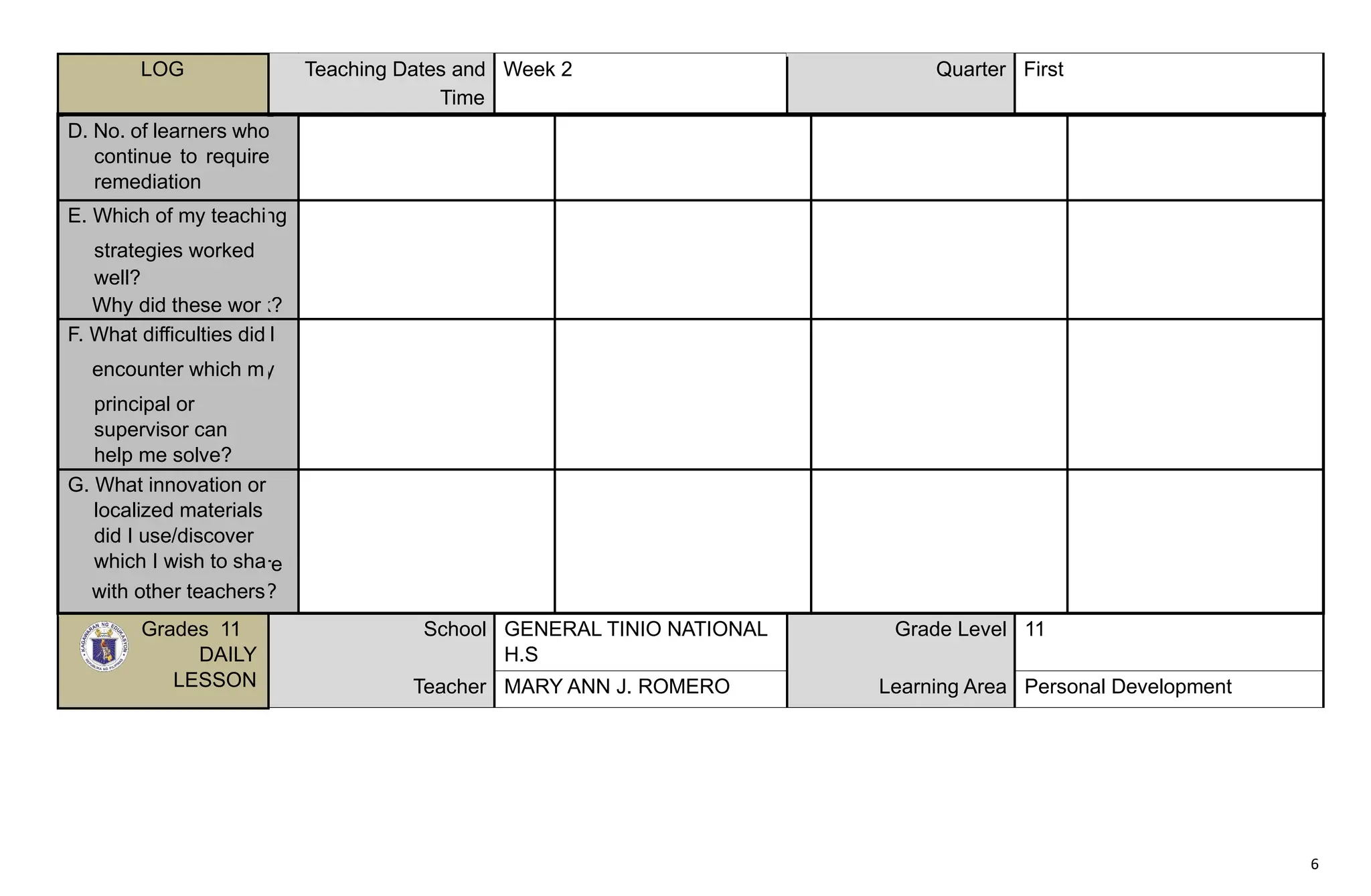
LOG Teaching Dates and
Time
Week 2 Quarter First
D. No. of learners who
continue to require
remediation
E. Which of my teaching
strategies worked
well?
Why did these work?
F. What difficulties did I
encounter which my
principal or
supervisor can
help me solve?
G. What innovation or
localized materials
did I use/discover
which I wish to share
with other teachers?
Grades 11
DAILY
LESSON
School GENERAL TINIO NATIONAL
H.S
Grade Level 11
Teacher MARY ANN J. ROMERO Learning Area Personal Development
7
B. Other Learning
Resource
8
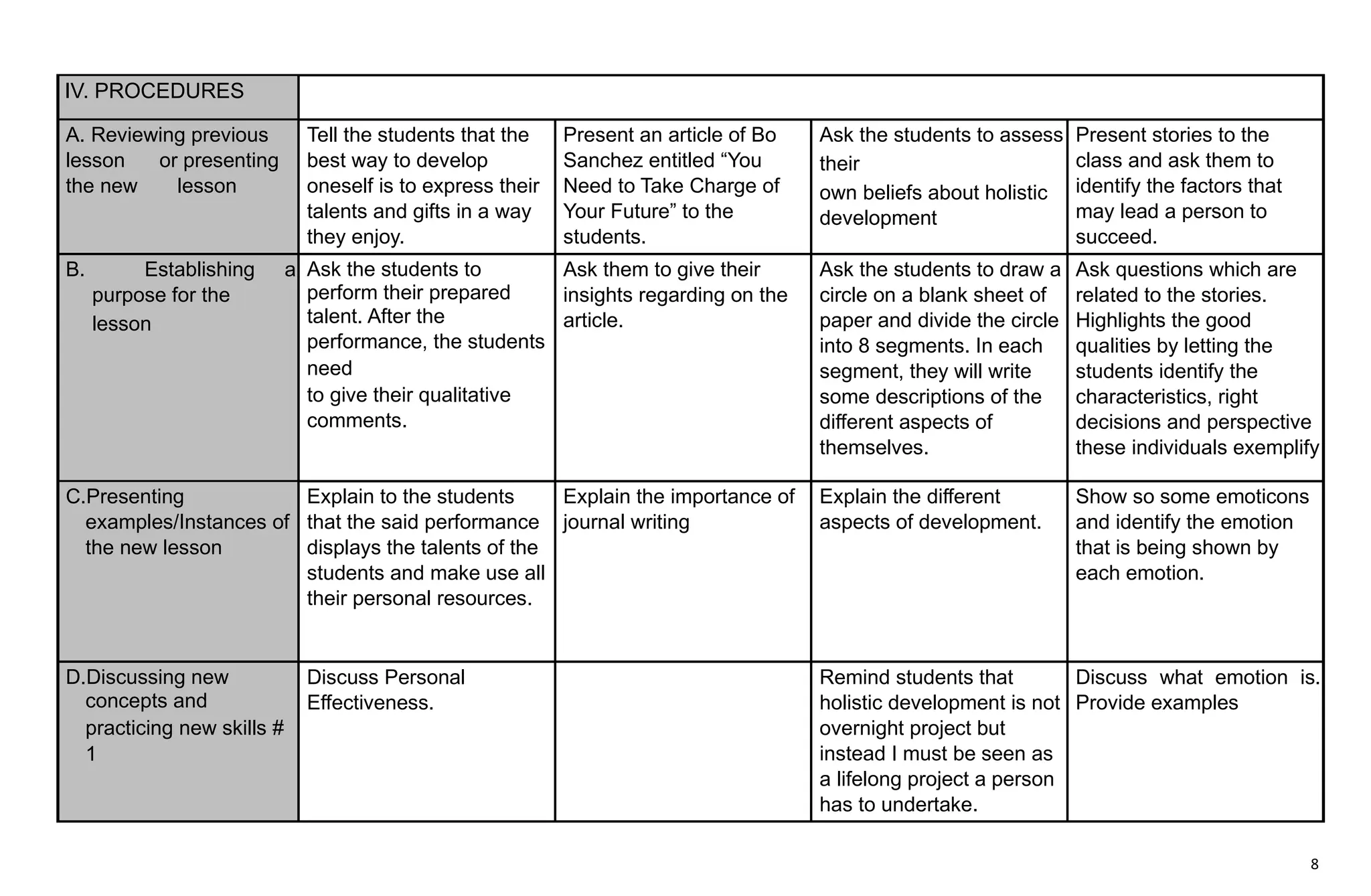
IV. PROCEDURES
A. Reviewing previous
lesson or presenting
the new lesson
Tell the students that the
best way to develop
oneself is to express their
talents and gifts in a way
they enjoy.
Present an article of Bo
Sanchez entitled “You
Need to Take Charge of
Your Future” to the
students.
Ask the students to assess
their
own beliefs about holistic
development
Present stories to the
class and ask them to
identify the factors that
may lead a person to
succeed.
B. Establishing a
purpose for the
lesson
Ask the students to
perform their prepared
talent. After the
performance, the students
need
to give their qualitative
comments.
Ask them to give their
insights regarding on the
article.
Ask the students to draw a
circle on a blank sheet of
paper and divide the circle
into 8 segments. In each
segment, they will write
some descriptions of the
different aspects of
themselves.
Ask questions which are
related to the stories.
Highlights the good
qualities by letting the
students identify the
characteristics, right
decisions and perspective
these individuals exemplify
C.Presenting
examples/Instances of
the new lesson
Explain to the students
that the said performance
displays the talents of the
students and make use all
their personal resources.
Explain the importance of
journal writing
Explain the different
aspects of development.
Show so some emoticons
and identify the emotion
that is being shown by
each emotion.
D.Discussing new
concepts and
practicing new skills #
1
Discuss Personal
Effectiveness.
Remind students that
holistic development is not
overnight project but
instead I must be seen as
a lifelong project a person
has to undertake.
Discuss what emotion is.
Provide examples
9
E. Discussing new
concepts and
practicing new skills #
2
Emphasize that as
individuals, we have our
own talents, skills and
abilities. Discuss on how
to develop these talents,
skills and abilities.
Explain on how
selfconcept is connected
to
the different aspects of
development
Emphasize to the students
the difference between
emotion and feeling.
F. Developing mastery
(leads to Formative
Assessment
3)
Explain on how feelings
and emotions can affect
attitude.
G.Finding practical
application of concepts
and skills in daily living
Ask the students to have
a personal journal and
give some guiding
questions to answer on
writing entries on their
journal.
Present real life situation
on how giving much
attention on a certain
aspect can affect other
aspects of development.
Provide real life examples
on how emotions, feelings
and attitude can affect
your mood
H.Making
generalizations and
abstractions about the
lesson
I. Evaluating learning Ask the students to
identify two (2) skills they
already have and two (2)
they want to develop.
Write three (3) ways for
them to improve on each
of their identified skills.
Write about the eight
aspects of development.
Ask them to name ways in
which they can improve
the minus areas and
enhance the positive
aspects.
10
J. Additional activities for
application or
remediation
PERSONALIZED
JOURNAL
(Reflection)
V. REMARKS
VI. REFLECTION
A. No. of learners who
earned 80% in the
evaluation
B. No. of learners who
require additional
activities for
remediation who
scored below 80%
C.Did the remedial
lessons work? No. of
learners who have
caught up with the
lesson
D.No. of learners who
continue to require
remediation
E. Which of my teaching
strategies worked
well?
Why did these work?
11
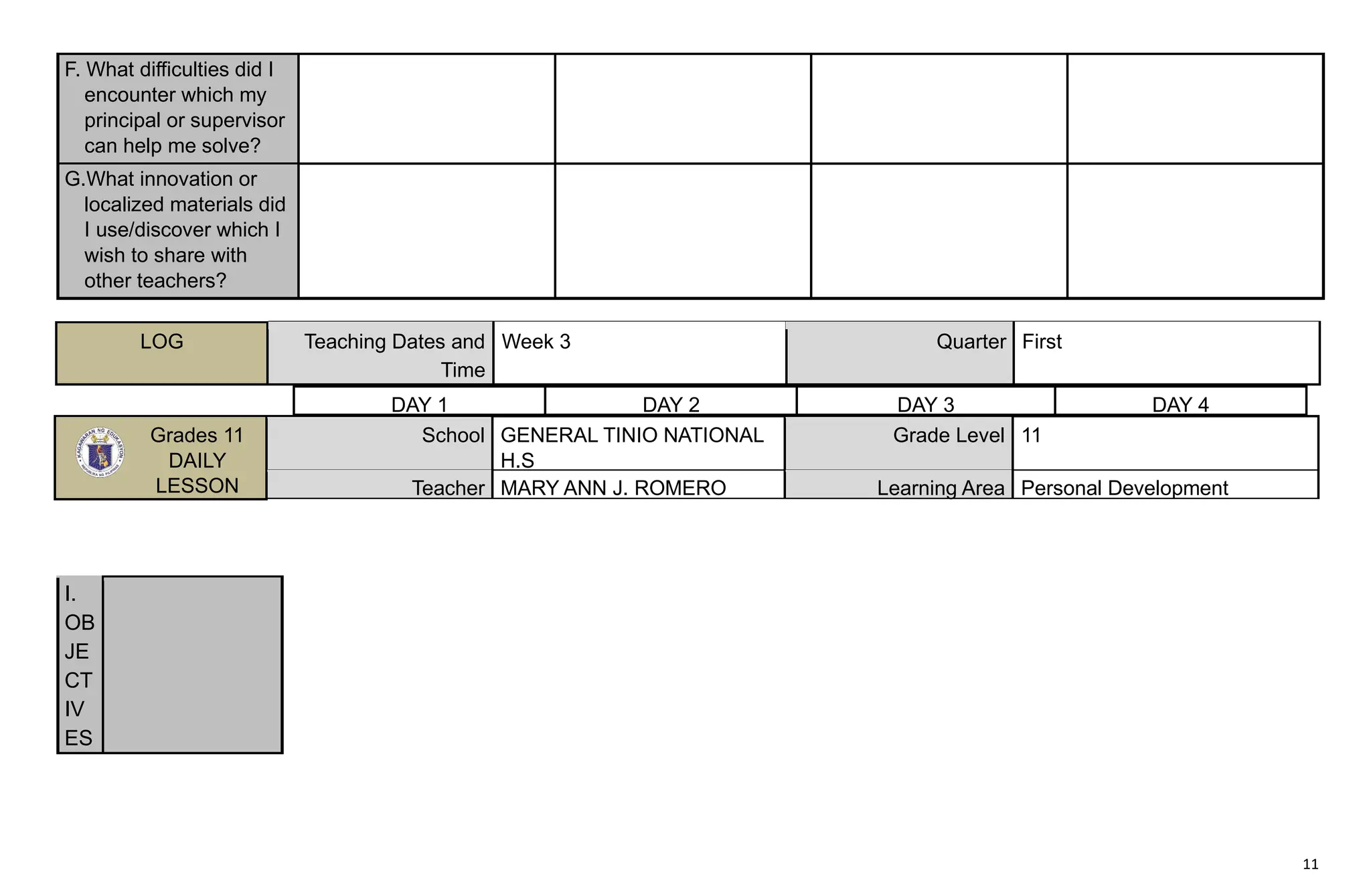
F. What difficulties did I
encounter which my
principal or supervisor
can help me solve?
G.What innovation or
localized materials did
I use/discover which I
wish to share with
other teachers?
LOG Teaching Dates and
Time
Week 3 Quarter First
I.
OB
JE
CT
IV
ES
Grades 11
DAILY
LESSON
School GENERAL TINIO NATIONAL
H.S
Grade Level 11
Teacher MARY ANN J. ROMERO Learning Area Personal Development
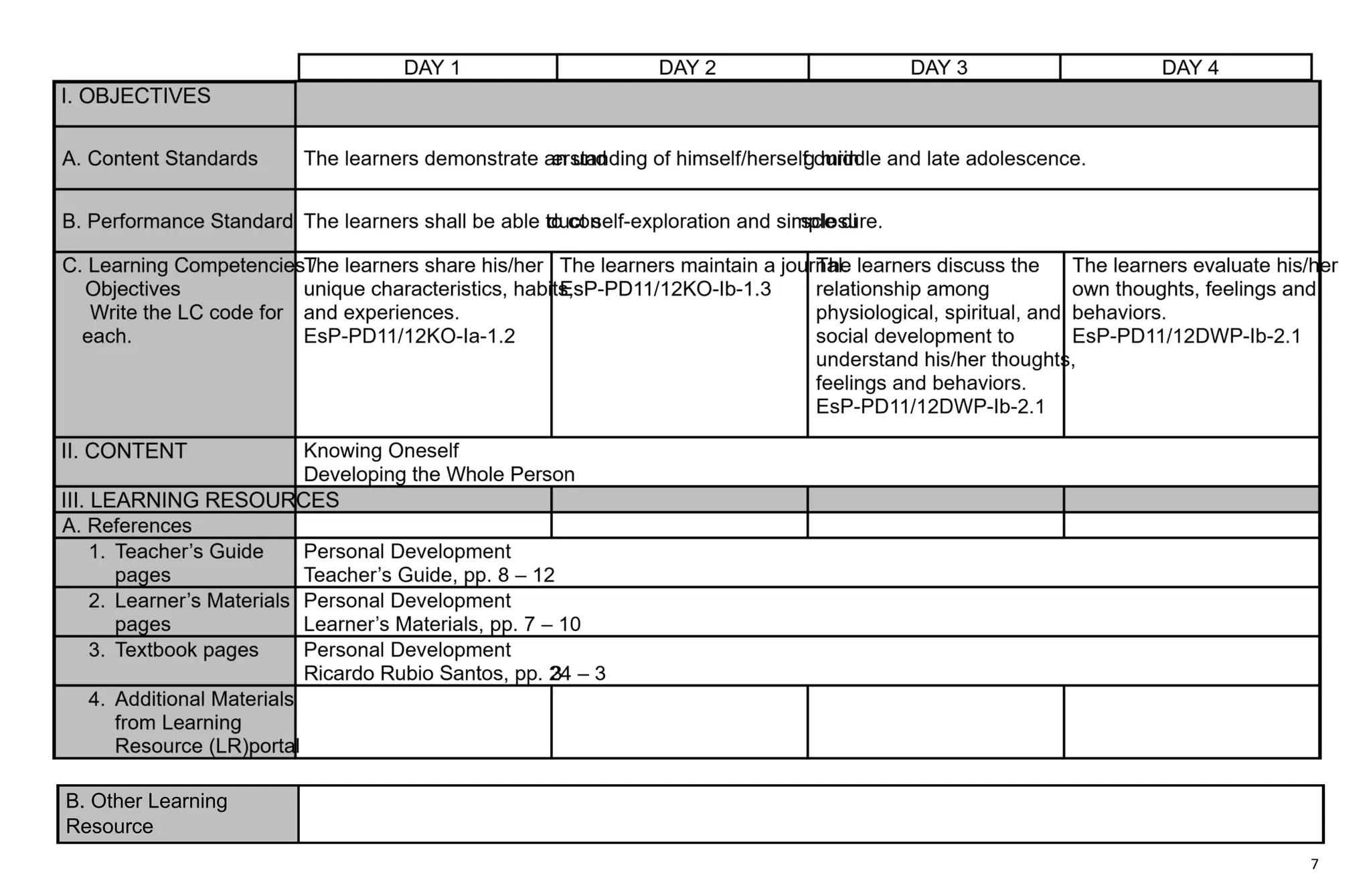
DAY 1 DAY 2 DAY 3 DAY 4
12
A.
Co
nte
nt
Sta
nd
ard
s
The learners
demonstrate an
understanding of
the various
aspects of holistic
development:
physiological,
cognitive,
psychological,
spiritual, and
social
development
B.
Per
for
ma
nc
e
Sta
nd
ard
The learners shall
be able to
illustrate the
connections
between
thoughts, feelings,
and behaviors in
a person’s
holistic
development
13
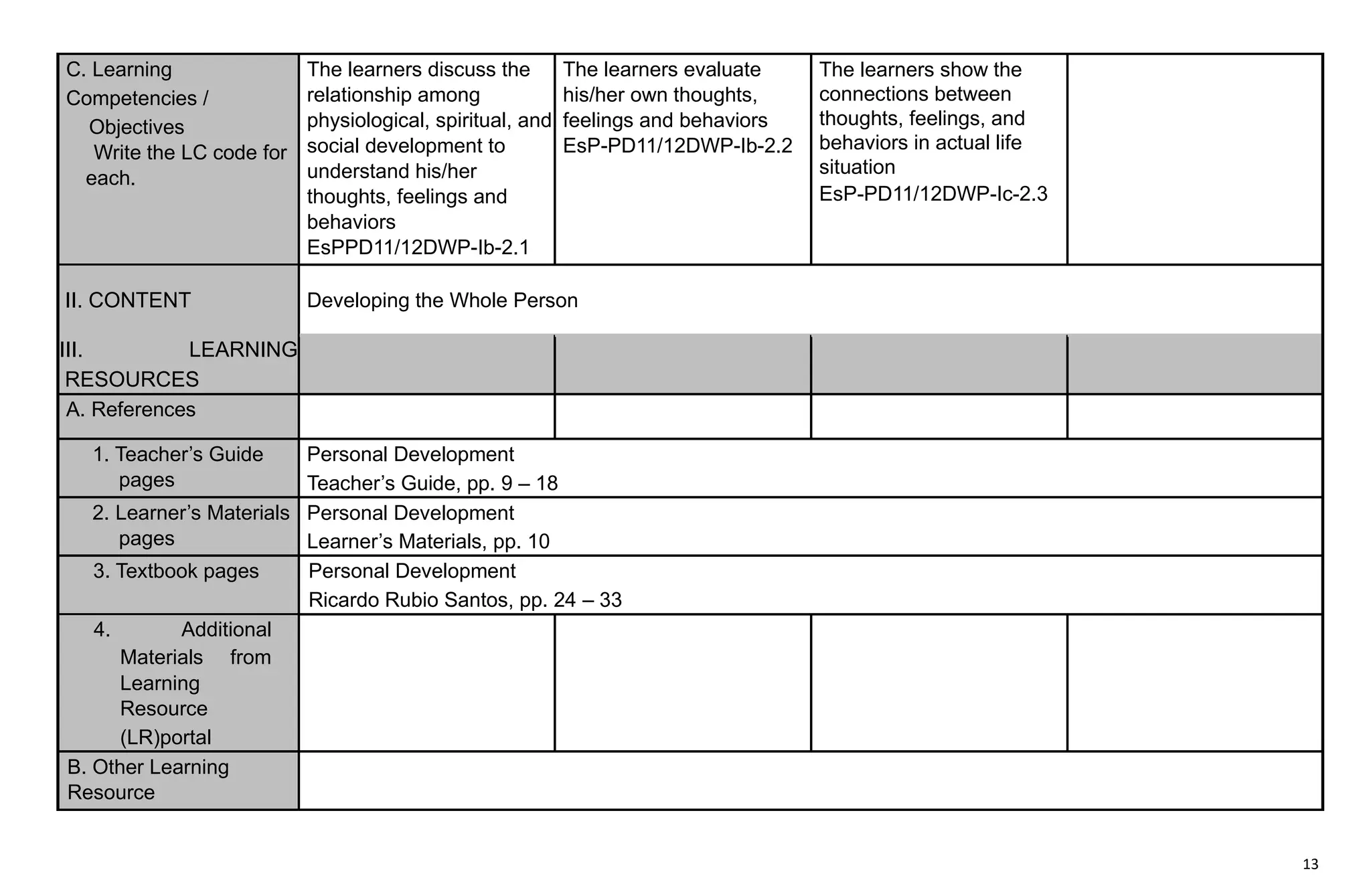
C. Learning
Competencies /
Objectives
Write the LC code for
each.
The learners discuss the
relationship among
physiological, spiritual, and
social development to
understand his/her
thoughts, feelings and
behaviors
EsPPD11/12DWP-Ib-2.1
The learners evaluate
his/her own thoughts,
feelings and behaviors
EsP-PD11/12DWP-Ib-2.2
The learners show the
connections between
thoughts, feelings, and
behaviors in actual life
situation
EsP-PD11/12DWP-Ic-2.3
II. CONTENT Developing the Whole Person
III. LEARNING
RESOURCES
A. References
1. Teacher’s Guide
pages
Personal Development
Teacher’s Guide, pp. 9 – 18
2. Learner’s Materials
pages
Personal Development
Learner’s Materials, pp. 10
3. Textbook pages Personal Development
Ricardo Rubio Santos, pp. 24 – 33
4. Additional
Materials from
Learning
Resource
(LR)portal
B. Other Learning
Resource
14
IV. PROCEDURES
A. Reviewing previous
lesson or presenting the
new lesson
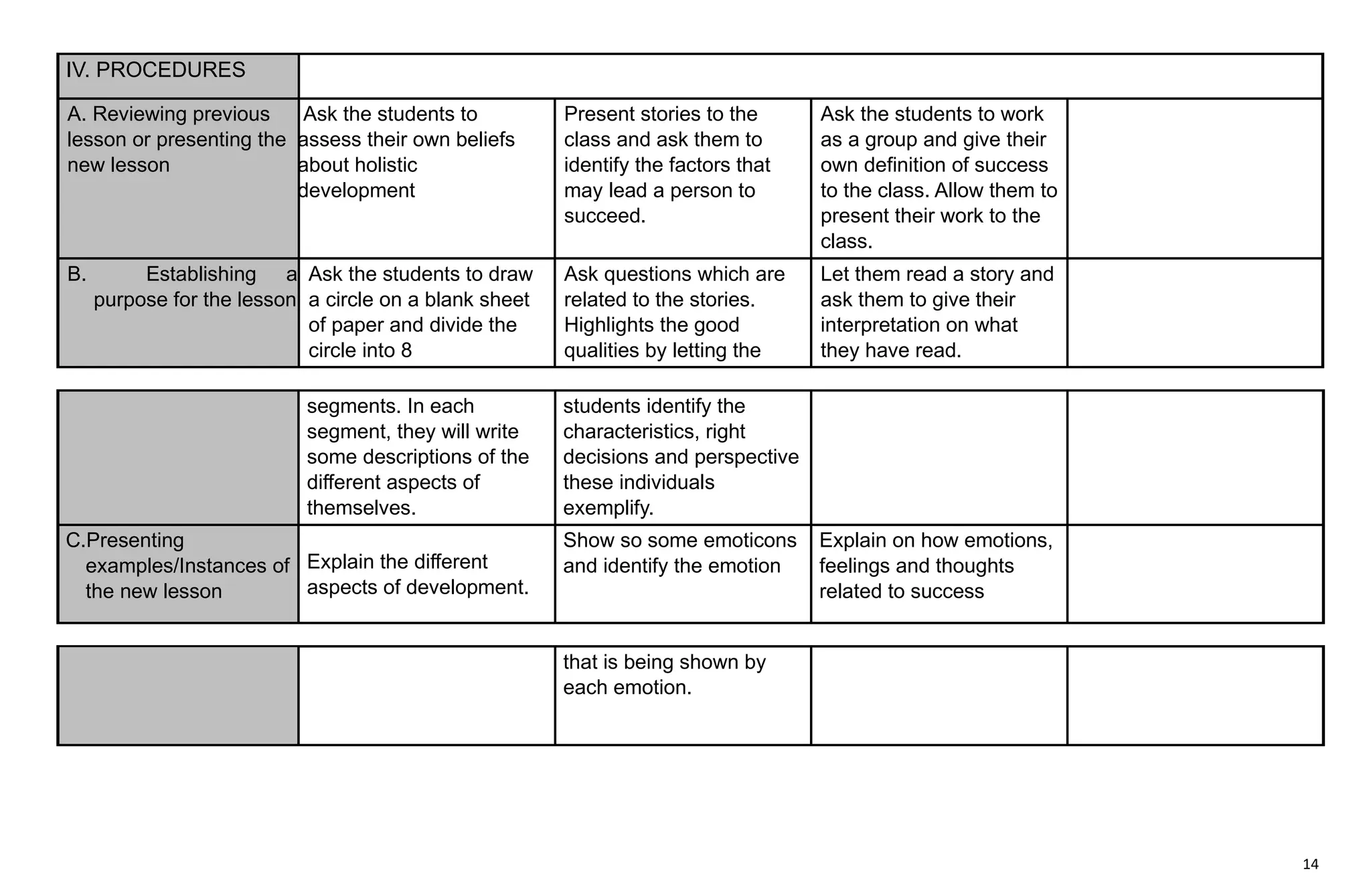
Ask the students to
assess their own beliefs
about holistic
development
Present stories to the
class and ask them to
identify the factors that
may lead a person to
succeed.
Ask the students to work
as a group and give their
own definition of success
to the class. Allow them to
present their work to the
class.
B. Establishing a
purpose for the lesson
Ask the students to draw
a circle on a blank sheet
of paper and divide the
circle into 8
Ask questions which are
related to the stories.
Highlights the good
qualities by letting the
Let them read a story and
ask them to give their
interpretation on what
they have read.
segments. In each
segment, they will write
some descriptions of the
different aspects of
themselves.
students identify the
characteristics, right
decisions and perspective
these individuals
exemplify.
C.Presenting
examples/Instances of
the new lesson
Explain the different
aspects of development.
Show so some emoticons
and identify the emotion
Explain on how emotions,
feelings and thoughts
related to success
that is being shown by
each emotion.
15
D.Discussing new
concepts and
practicing new skills #
1
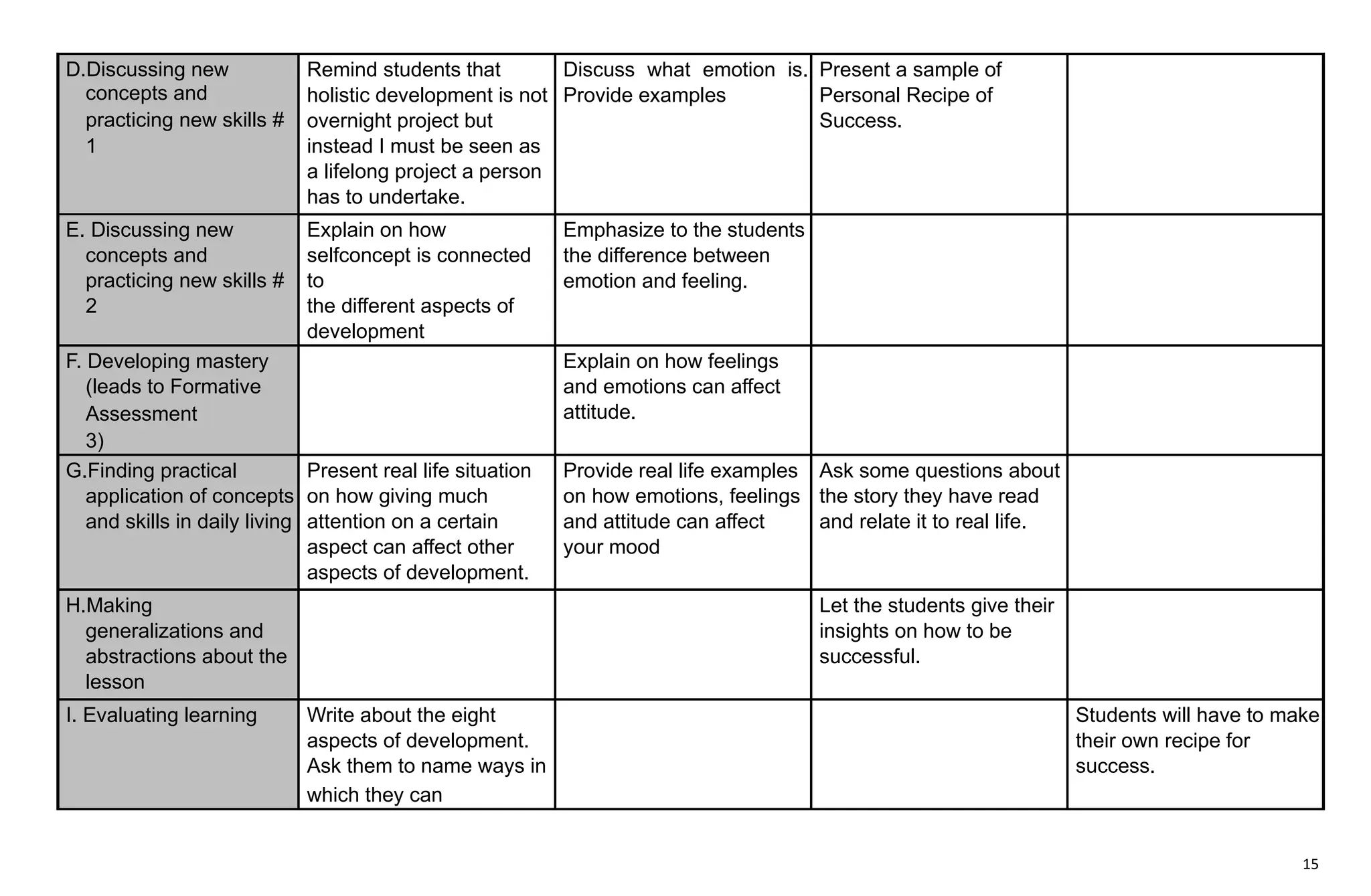
Remind students that
holistic development is not
overnight project but
instead I must be seen as
a lifelong project a person
has to undertake.
Discuss what emotion is.
Provide examples
Present a sample of
Personal Recipe of
Success.
E. Discussing new
concepts and
practicing new skills #
2
Explain on how
selfconcept is connected
to
the different aspects of
development
Emphasize to the students
the difference between
emotion and feeling.
F. Developing mastery
(leads to Formative
Assessment
3)
Explain on how feelings
and emotions can affect
attitude.
G.Finding practical
application of concepts
and skills in daily living
Present real life situation
on how giving much
attention on a certain
aspect can affect other
aspects of development.
Provide real life examples
on how emotions, feelings
and attitude can affect
your mood
Ask some questions about
the story they have read
and relate it to real life.
H.Making
generalizations and
abstractions about the
lesson
Let the students give their
insights on how to be
successful.
I. Evaluating learning Write about the eight
aspects of development.
Ask them to name ways in
which they can
Students will have to make
their own recipe for
success.
16
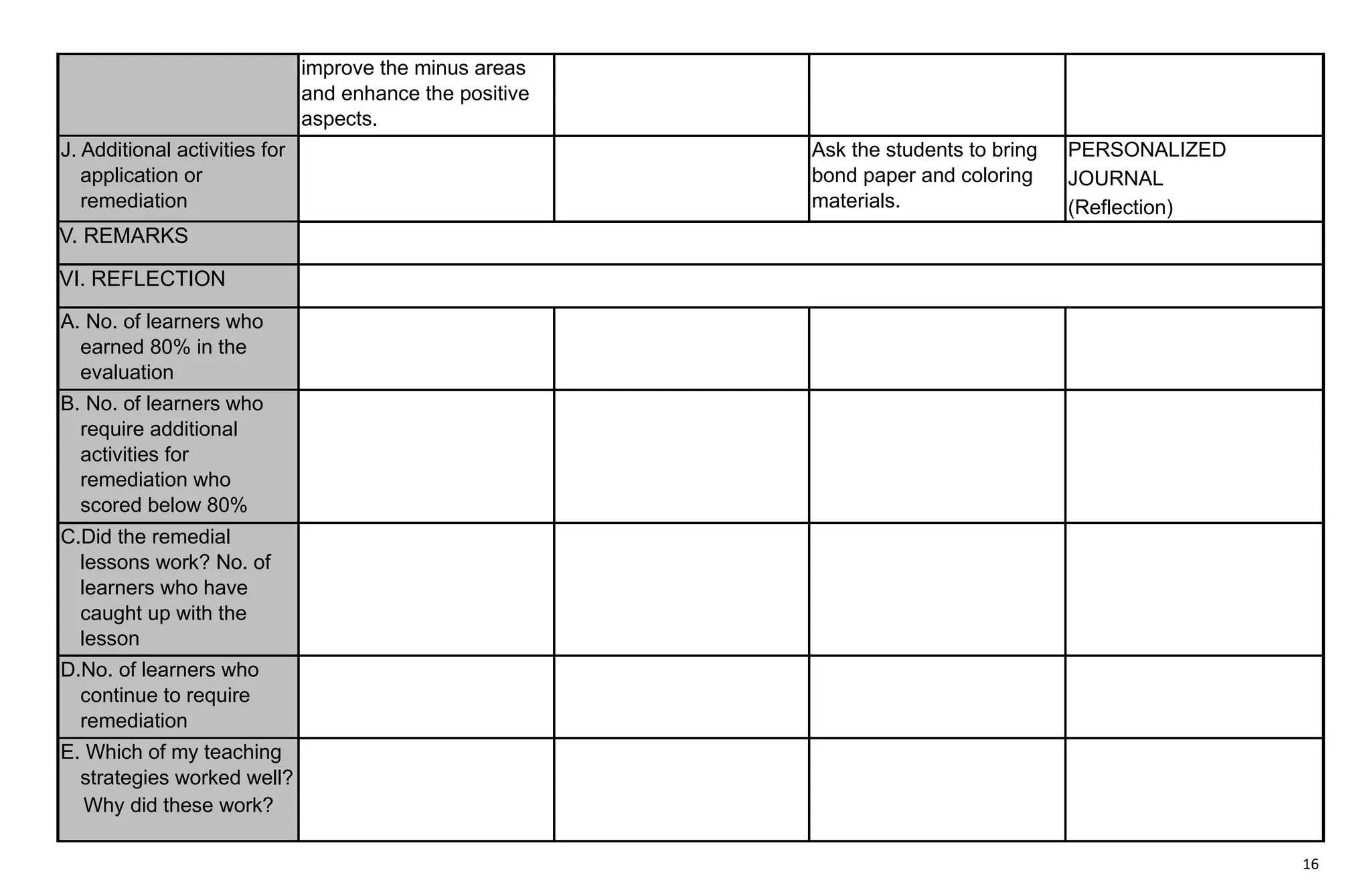
improve the minus areas
and enhance the positive
aspects.
J. Additional activities for
application or
remediation
Ask the students to bring
bond paper and coloring
materials.
PERSONALIZED
JOURNAL
(Reflection)
V. REMARKS
VI. REFLECTION
A. No. of learners who
earned 80% in the
evaluation
B. No. of learners who
require additional
activities for
remediation who
scored below 80%
C.Did the remedial
lessons work? No. of
learners who have
caught up with the
lesson
D.No. of learners who
continue to require
remediation
E. Which of my teaching
strategies worked well?
Why did these work?
17
F. What difficulties did I
encounter which my
principal or supervisor
can help me solve?
G.What innovation or
localized materials did
I use/discover which I
wish to share with
other teachers?
DAY 1 DAY 2 DAY 3 DAY 4
I. OBJECTIVES
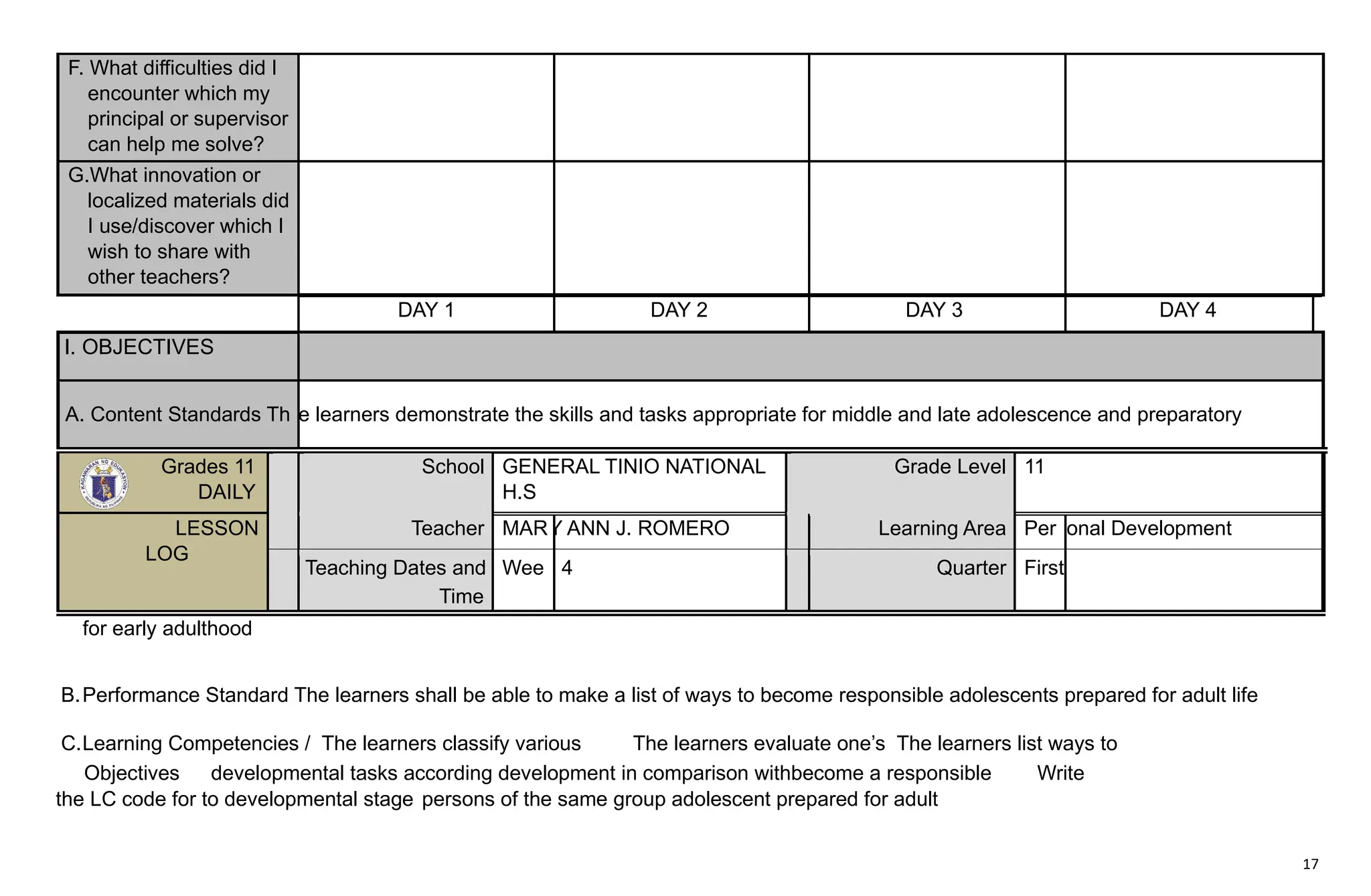
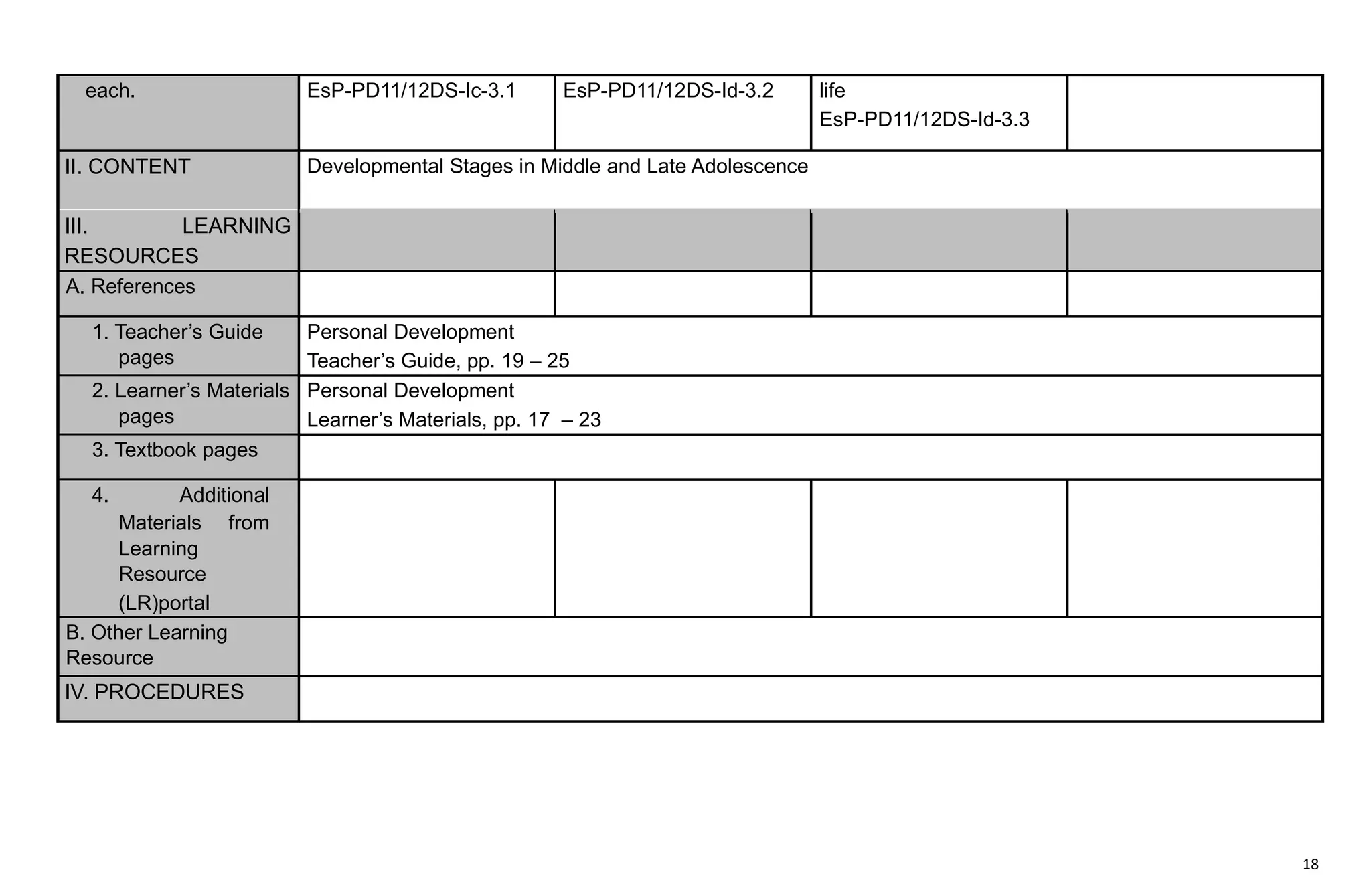
A. Content Standards Th e learners demonstrate the skills and tasks appropriate for middle and late adolescence and preparatory
Grades 11
DAILY
School GENERAL TINIO NATIONAL
H.S
Grade Level 11
LESSON
LOG
Teacher MARY ANN J. ROMERO Learning Area Personal Development
Teaching Dates and
Time
Week 4 Quarter First
for early adulthood
B.Performance Standard The learners shall be able to make a list of ways to become responsible adolescents prepared for adult life
C.Learning Competencies / The learners classify various The learners evaluate one’s The learners list ways to
Objectives developmental tasks according development in comparison withbecome a responsible Write
the LC code for to developmental stage persons of the same group adolescent prepared for adult
18
each. EsP-PD11/12DS-Ic-3.1 EsP-PD11/12DS-Id-3.2 life
EsP-PD11/12DS-Id-3.3
II. CONTENT Developmental Stages in Middle and Late Adolescence
III. LEARNING
RESOURCES
A. References
1. Teacher’s Guide
pages
Personal Development
Teacher’s Guide, pp. 19 – 25
2. Learner’s Materials
pages
Personal Development
Learner’s Materials, pp. 17 – 23
3. Textbook pages
4. Additional
Materials from
Learning
Resource
(LR)portal
B. Other Learning
Resource
IV. PROCEDURES
19
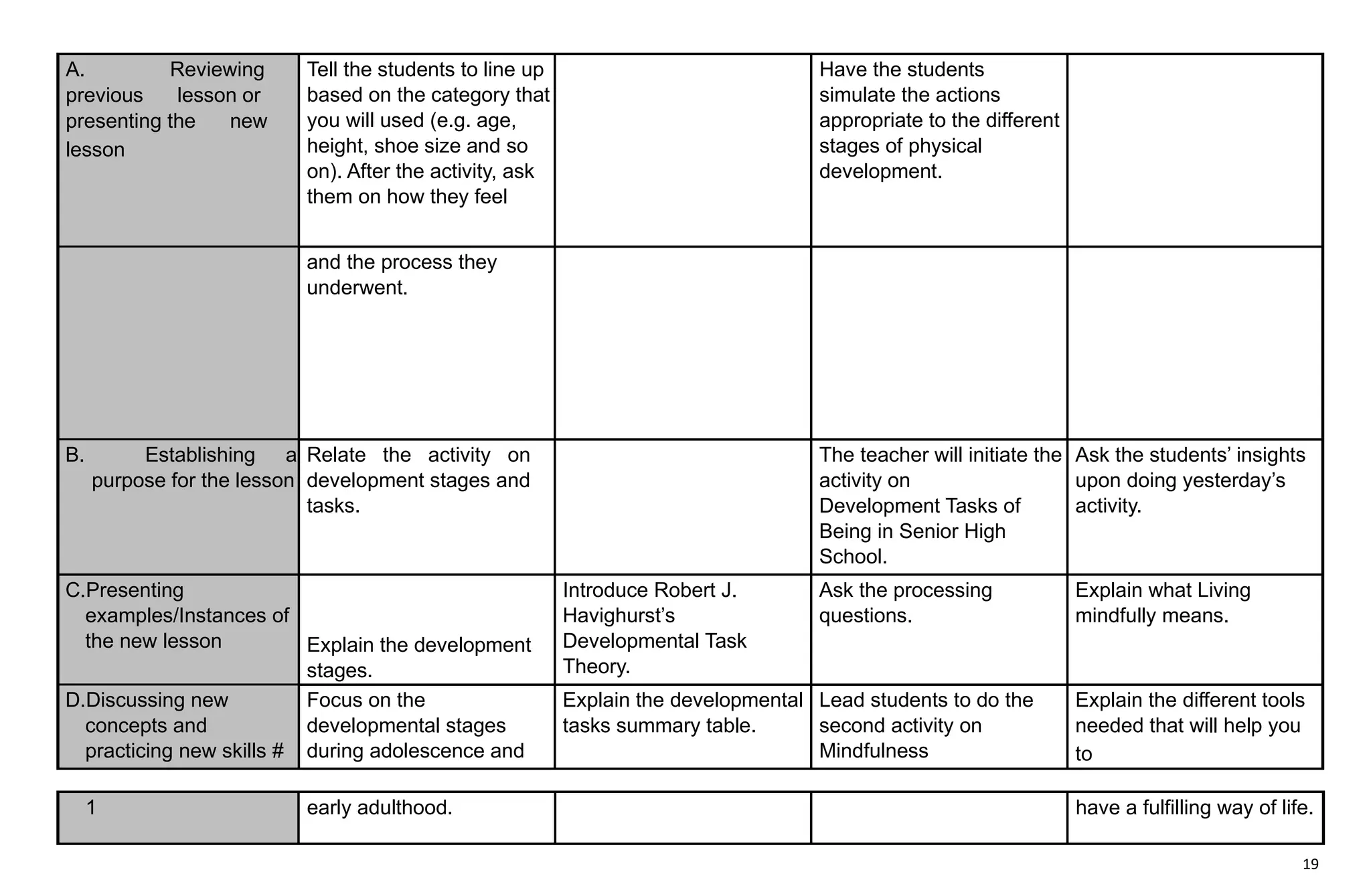
A. Reviewing
previous lesson or
presenting the new
lesson
Tell the students to line up
based on the category that
you will used (e.g. age,
height, shoe size and so
on). After the activity, ask
them on how they feel
Have the students
simulate the actions
appropriate to the different
stages of physical
development.
and the process they
underwent.
B. Establishing a
purpose for the lesson
Relate the activity on
development stages and
tasks.
The teacher will initiate the
activity on
Development Tasks of
Being in Senior High
School.
Ask the students’ insights
upon doing yesterday’s
activity.
C.Presenting
examples/Instances of
the new lesson Explain the development
stages.
Introduce Robert J.
Havighurst’s
Developmental Task
Theory.
Ask the processing
questions.
Explain what Living
mindfully means.
D.Discussing new
concepts and
practicing new skills #
Focus on the
developmental stages
during adolescence and
Explain the developmental
tasks summary table.
Lead students to do the
second activity on
Mindfulness
Explain the different tools
needed that will help you
to
1 early adulthood. have a fulfilling way of life.
20
E. Discussing new
concepts and
practicing new skills #
2
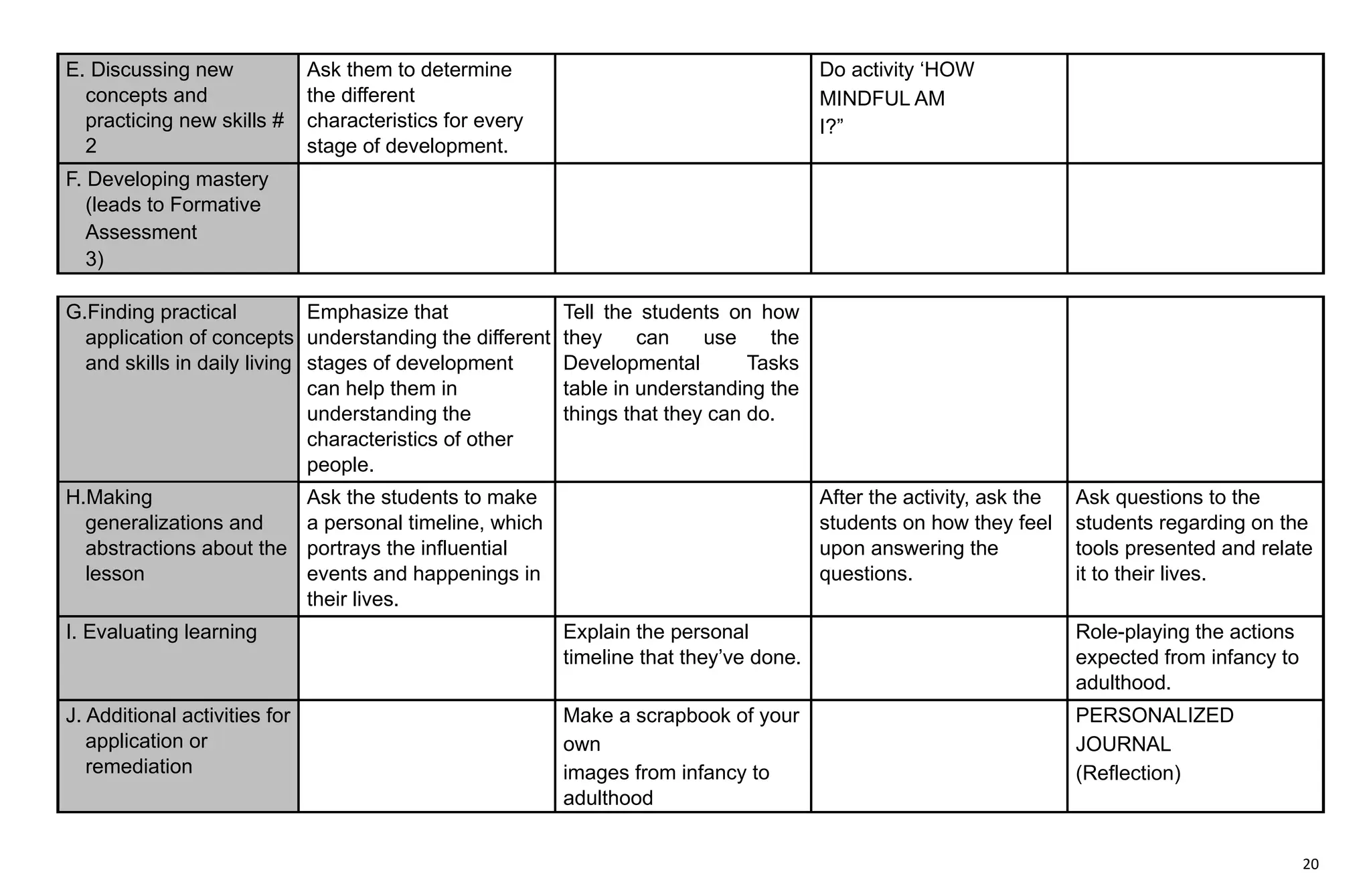
Ask them to determine
the different
characteristics for every
stage of development.
Do activity ‘HOW
MINDFUL AM
I?”
F. Developing mastery
(leads to Formative
Assessment
3)
G.Finding practical
application of concepts
and skills in daily living
Emphasize that
understanding the different
stages of development
can help them in
understanding the
characteristics of other
people.
Tell the students on how
they can use the
Developmental Tasks
table in understanding the
things that they can do.
H.Making
generalizations and
abstractions about the
lesson
Ask the students to make
a personal timeline, which
portrays the influential
events and happenings in
their lives.
After the activity, ask the
students on how they feel
upon answering the
questions.
Ask questions to the
students regarding on the
tools presented and relate
it to their lives.
I. Evaluating learning Explain the personal
timeline that they’ve done.
Role-playing the actions
expected from infancy to
adulthood.
J. Additional activities for
application or
remediation
Make a scrapbook of your
own
images from infancy to
adulthood
PERSONALIZED
JOURNAL
(Reflection)
21
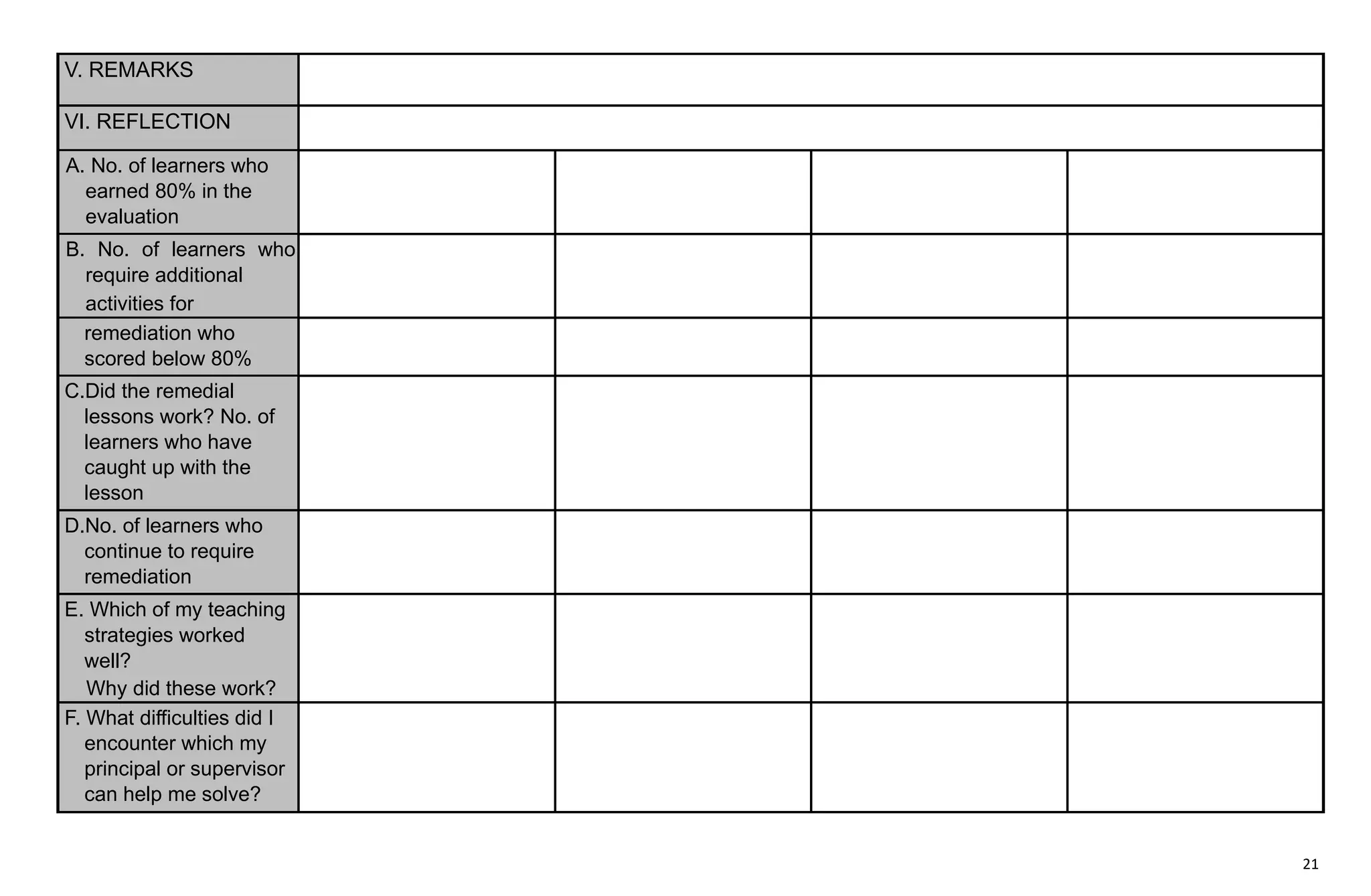
V. REMARKS
VI. REFLECTION
A. No. of learners who
earned 80% in the
evaluation
B. No. of learners who
require additional
activities for
remediation who
scored below 80%
C.Did the remedial
lessons work? No. of
learners who have
caught up with the
lesson
D.No. of learners who
continue to require
remediation
E. Which of my teaching
strategies worked
well?
Why did these work?
F. What difficulties did I
encounter which my
principal or supervisor
can help me solve?
22
G.What innovation or
localized materials did
I use/discover which I
wish to share with
other teachers?
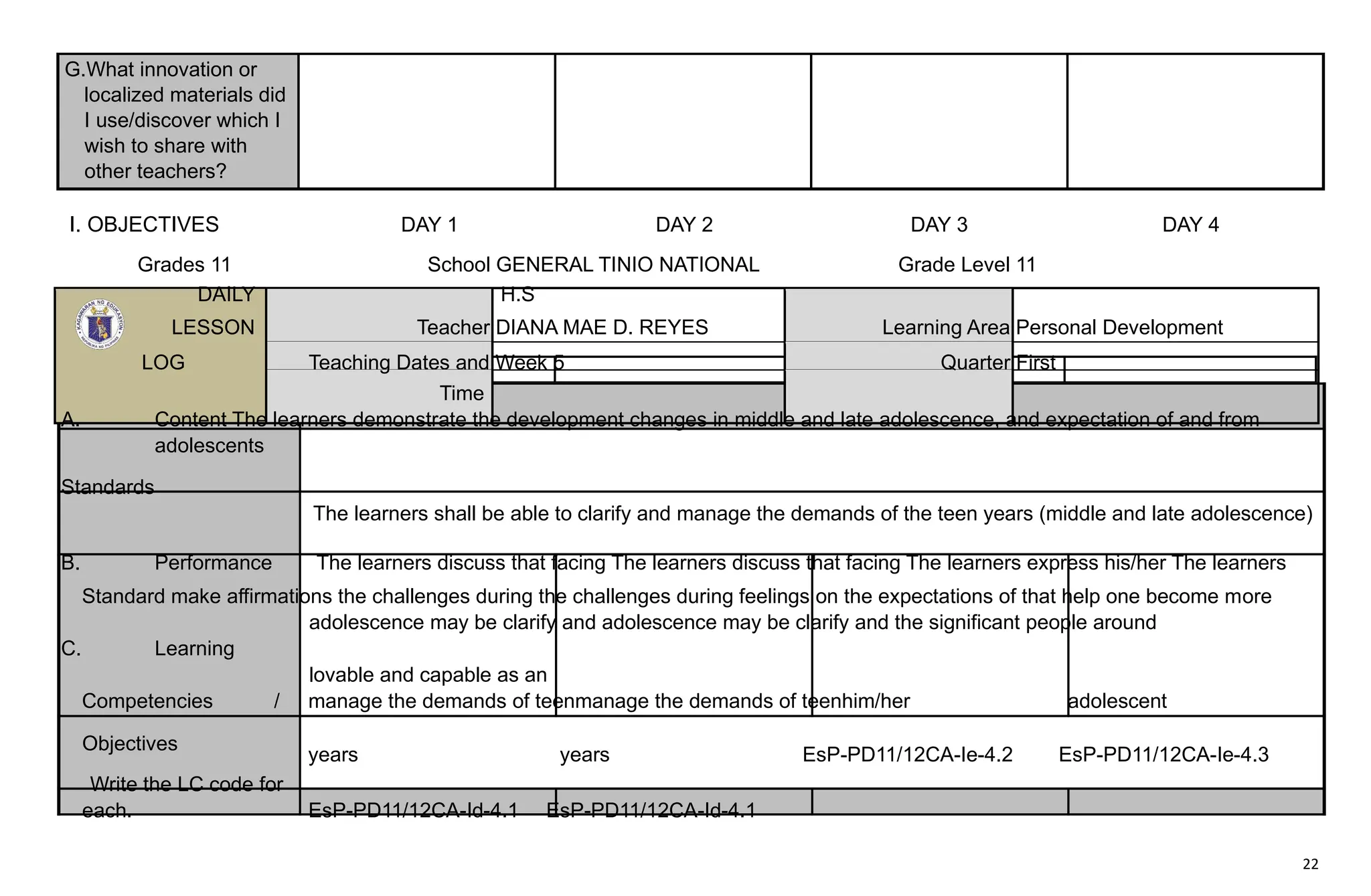
I. OBJECTIVES DAY 1 DAY 2 DAY 3 DAY 4
Grades 11 School GENERAL TINIO NATIONAL Grade Level 11
DAILY H.S
LESSON Teacher DIANA MAE D. REYES Learning Area Personal Development
LOG Teaching Dates and Week 5 Quarter First
Time
A. Content The learners demonstrate the development changes in middle and late adolescence, and expectation of and from
adolescents
Standards
The learners shall be able to clarify and manage the demands of the teen years (middle and late adolescence)
B. Performance The learners discuss that facing The learners discuss that facing The learners express his/her The learners
Standard make affirmations the challenges during the challenges during feelings on the expectations of that help one become more
adolescence may be clarify and adolescence may be clarify and the significant people around
C. Learning
lovable and capable as an
Competencies / manage the demands of teenmanage the demands of teenhim/her adolescent
Objectives
years years EsP-PD11/12CA-Ie-4.2 EsP-PD11/12CA-Ie-4.3
Write the LC code for
each. EsP-PD11/12CA-Id-4.1 EsP-PD11/12CA-Id-4.1
23
The Challenges of Middle and Late Adolescence
II. CONTENT
24
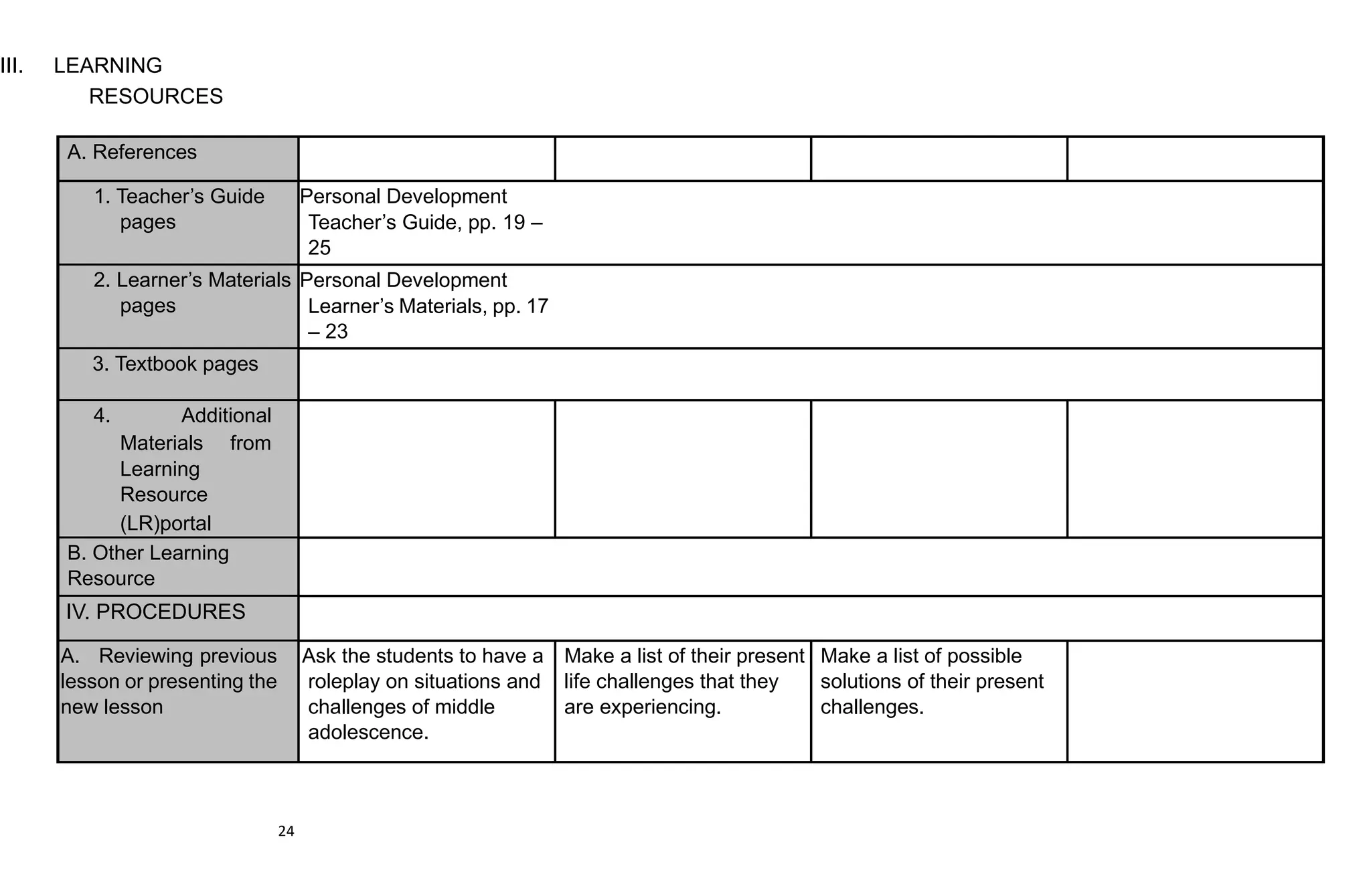
III. LEARNING
RESOURCES
A. References
1. Teacher’s Guide
pages
Personal Development
Teacher’s Guide, pp. 19 –
25
2. Learner’s Materials
pages
Personal Development
Learner’s Materials, pp. 17
– 23
3. Textbook pages
4. Additional
Materials from
Learning
Resource
(LR)portal
B. Other Learning
Resource
IV. PROCEDURES
A. Reviewing previous
lesson or presenting the
new lesson
Ask the students to have a
roleplay on situations and
challenges of middle
adolescence.
Make a list of their present
life challenges that they
are experiencing.
Make a list of possible
solutions of their present
challenges.
25
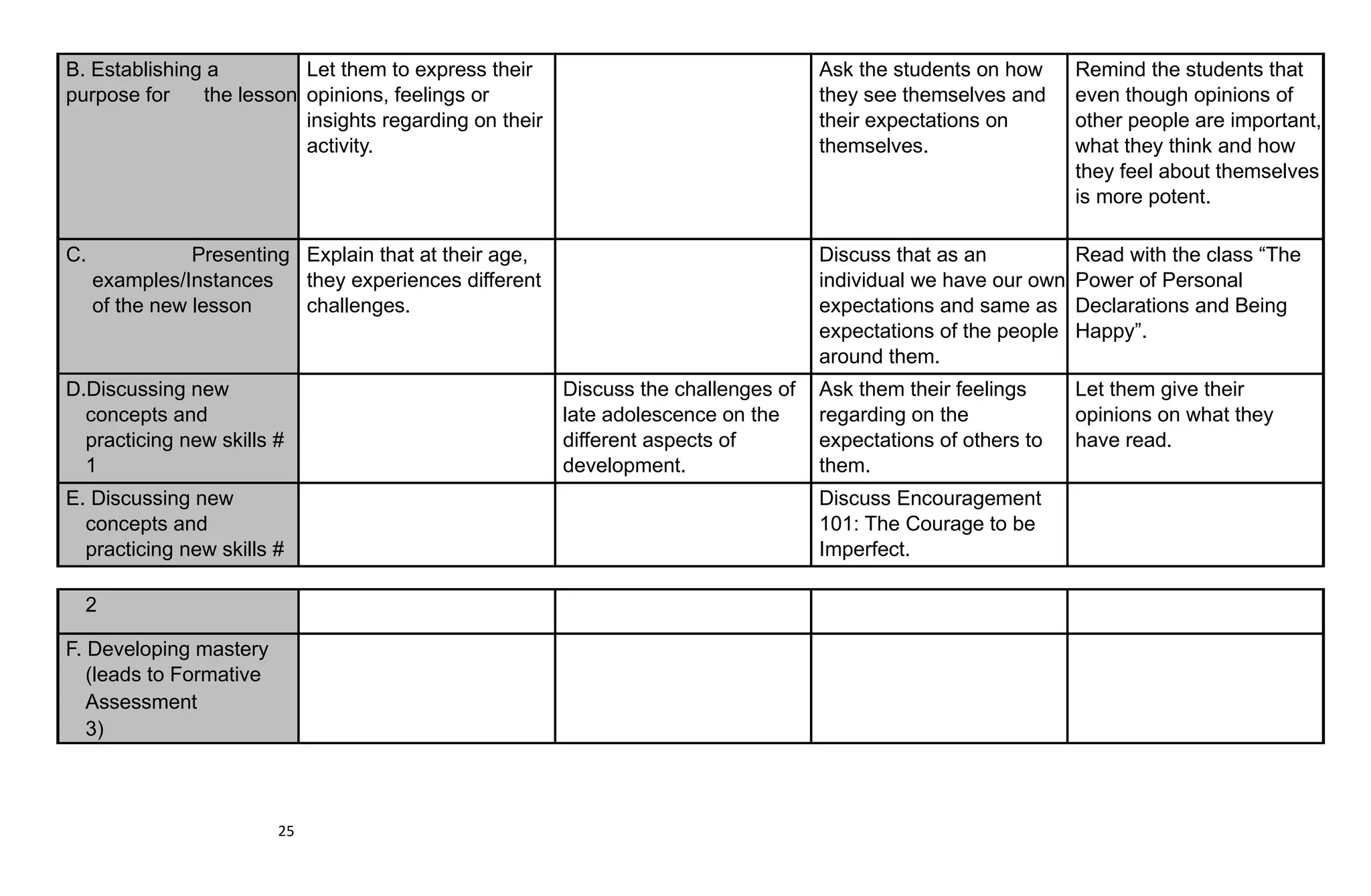
B. Establishing a
purpose for the lesson
Let them to express their
opinions, feelings or
insights regarding on their
activity.
Ask the students on how
they see themselves and
their expectations on
themselves.
Remind the students that
even though opinions of
other people are important,
what they think and how
they feel about themselves
is more potent.
C. Presenting
examples/Instances
of the new lesson
Explain that at their age,
they experiences different
challenges.
Discuss that as an
individual we have our own
expectations and same as
expectations of the people
around them.
Read with the class “The
Power of Personal
Declarations and Being
Happy”.
D.Discussing new
concepts and
practicing new skills #
1
Discuss the challenges of
late adolescence on the
different aspects of
development.
Ask them their feelings
regarding on the
expectations of others to
them.
Let them give their
opinions on what they
have read.
E. Discussing new
concepts and
practicing new skills #
Discuss Encouragement
101: The Courage to be
Imperfect.
2
F. Developing mastery
(leads to Formative
Assessment
3)
26
G.Finding practical
application of concepts
and skills in daily living
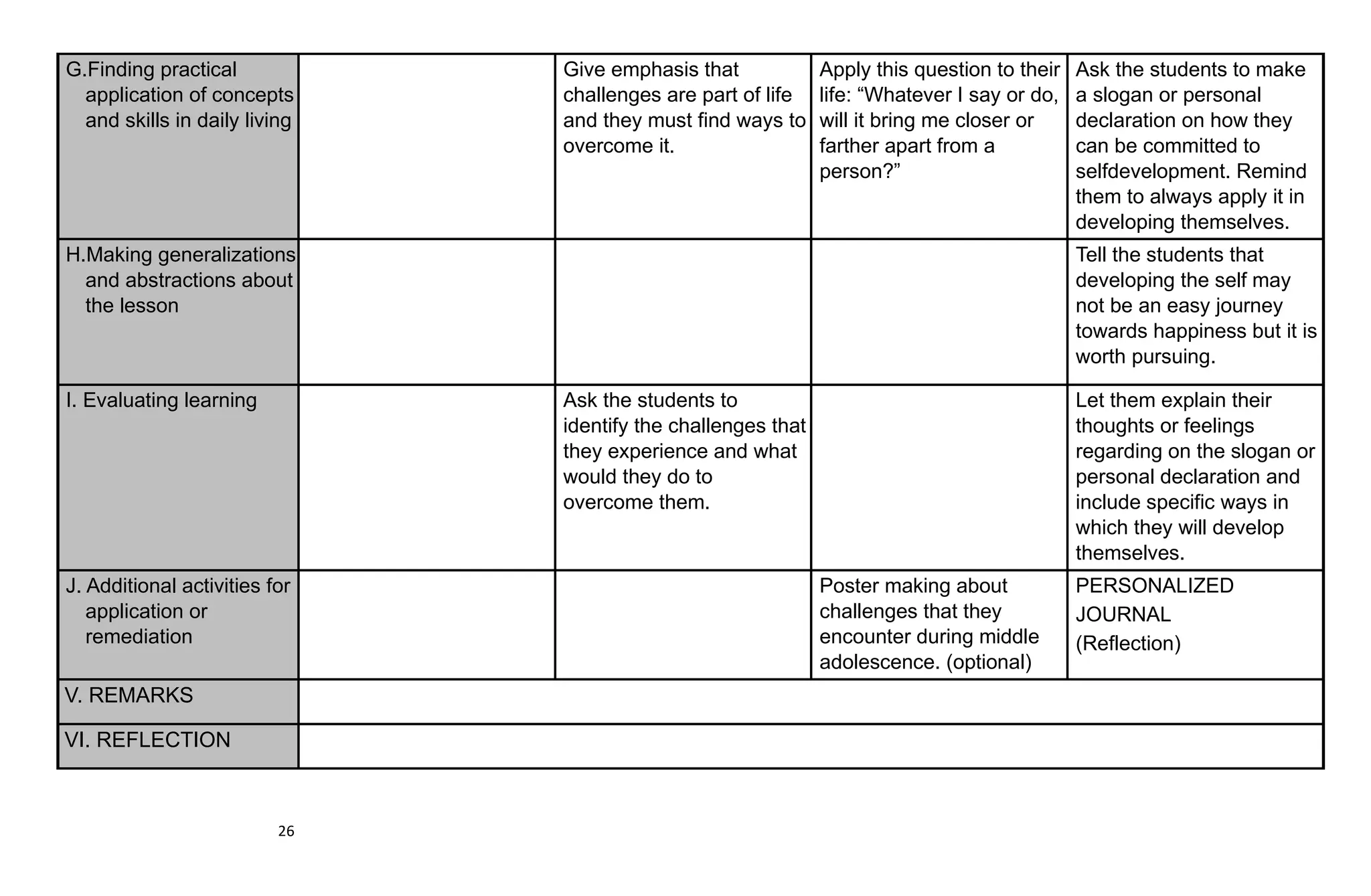
Give emphasis that
challenges are part of life
and they must find ways to
overcome it.
Apply this question to their
life: “Whatever I say or do,
will it bring me closer or
farther apart from a
person?”
Ask the students to make
a slogan or personal
declaration on how they
can be committed to
selfdevelopment. Remind
them to always apply it in
developing themselves.
H.Making generalizations
and abstractions about
the lesson
Tell the students that
developing the self may
not be an easy journey
towards happiness but it is
worth pursuing.
I. Evaluating learning Ask the students to
identify the challenges that
they experience and what
would they do to
overcome them.
Let them explain their
thoughts or feelings
regarding on the slogan or
personal declaration and
include specific ways in
which they will develop
themselves.
J. Additional activities for
application or
remediation
Poster making about
challenges that they
encounter during middle
adolescence. (optional)
PERSONALIZED
JOURNAL
(Reflection)
V. REMARKS
VI. REFLECTION
27
A. No. of learners who
earned 80% in the
evaluation
B. No. of learners who
require
additional activities for
remediation who scored
below 80%
C.Did the remedial
lessons work? No. of
learners who have
caught up with the
lesson
D.No. of learners who
continue to require
remediation
E. Which of my teaching
strategies worked well?
Why did these work?
F. What difficulties did I
encounter which my
principal or supervisor
can help me solve?
28
29
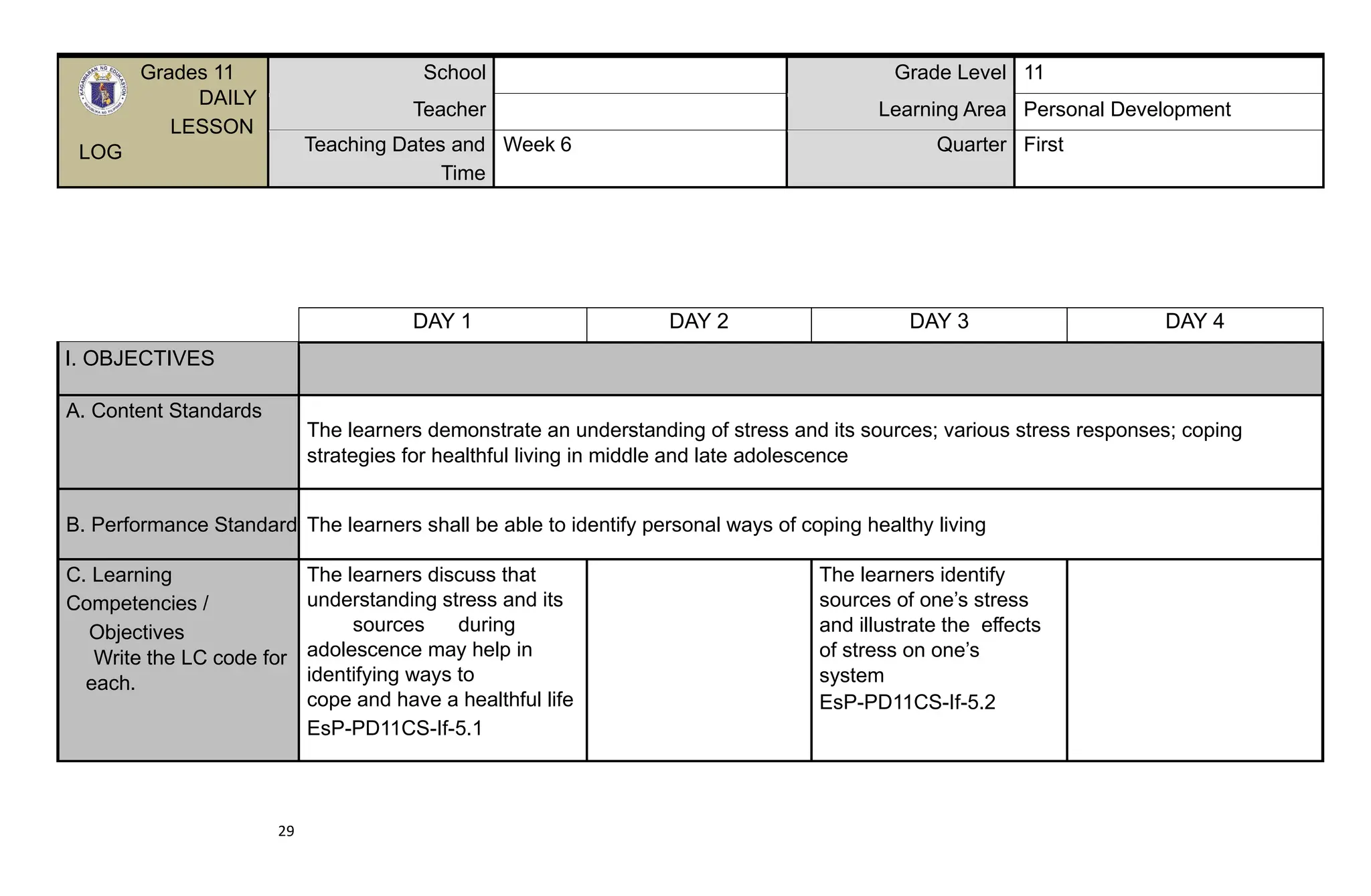
Grades 11
DAILY
LESSON
LOG
School Grade Level 11
Teacher Learning Area Personal Development
Teaching Dates and
Time
Week 6 Quarter First
DAY 1 DAY 2 DAY 3 DAY 4
I. OBJECTIVES
A. Content Standards
The learners demonstrate an understanding of stress and its sources; various stress responses; coping
strategies for healthful living in middle and late adolescence
B. Performance Standard The learners shall be able to identify personal ways of coping healthy living
C. Learning
Competencies /
Objectives
Write the LC code for
each.
The learners discuss that
understanding stress and its
sources during
adolescence may help in
identifying ways to
cope and have a healthful life
EsP-PD11CS-If-5.1
The learners identify
sources of one’s stress
and illustrate the effects
of stress on one’s
system
EsP-PD11CS-If-5.2
30
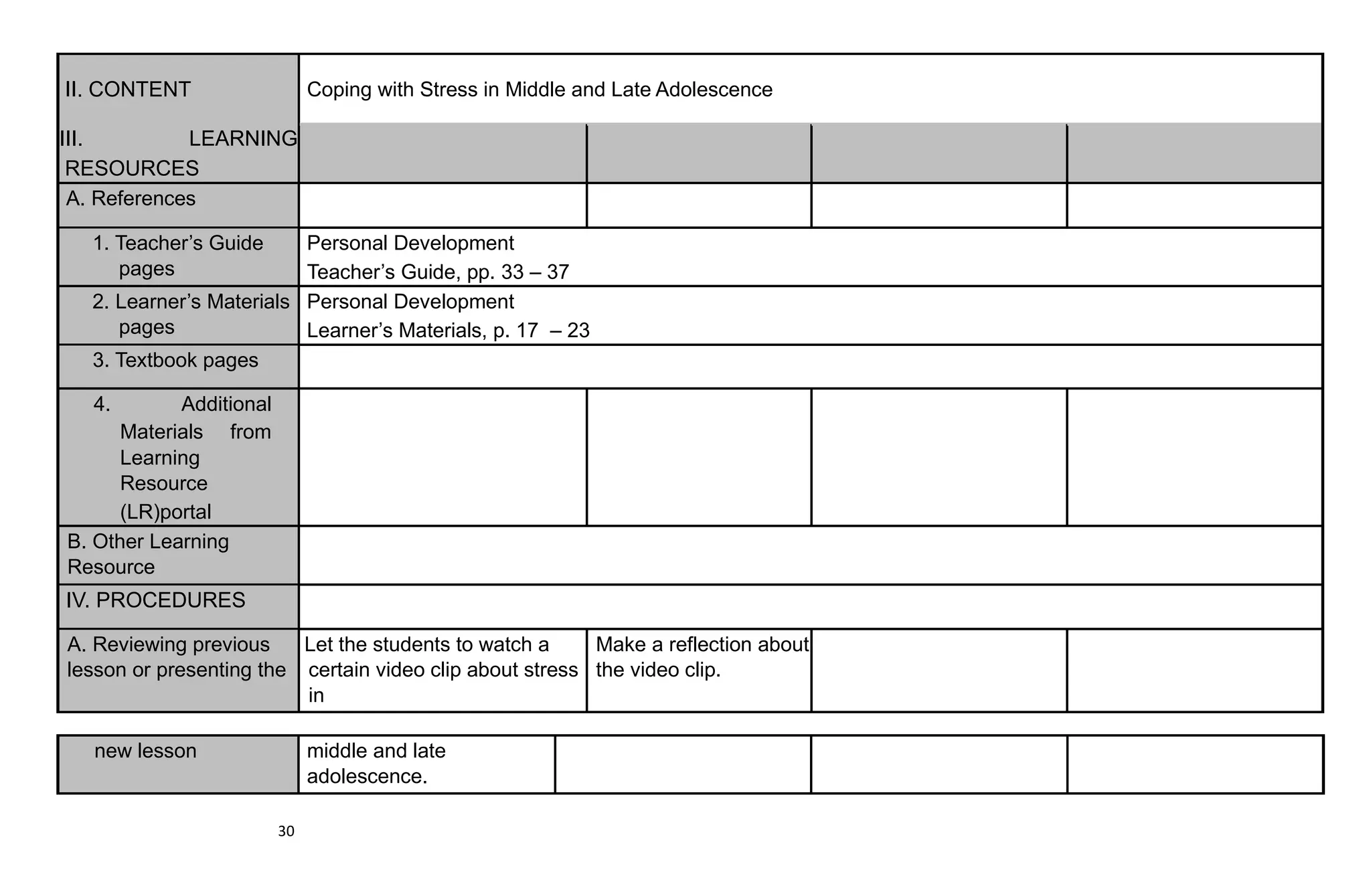
II. CONTENT Coping with Stress in Middle and Late Adolescence
III. LEARNING
RESOURCES
A. References
1. Teacher’s Guide
pages
Personal Development
Teacher’s Guide, pp. 33 – 37
2. Learner’s Materials
pages
Personal Development
Learner’s Materials, p. 17 – 23
3. Textbook pages
4. Additional
Materials from
Learning
Resource
(LR)portal
B. Other Learning
Resource
IV. PROCEDURES
A. Reviewing previous
lesson or presenting the
Let the students to watch a
certain video clip about stress
in
Make a reflection about
the video clip.
new lesson middle and late
adolescence.
31
B. Establishing a
purpose for the
lesson
Ask the students to give
their insights on the video.
Ask them to give what
causes them to be
stressed.
Discuss with the students
how stress is a part of
everyday life and the
difference between good
stress and bad stress.
Provide students with 15
minutes of quiet time.
C.Presenting
examples/Instances of
the new lesson
Ask the students what
they understand by
“stress” and whether they
have experienced stress.
Discuss what Stress
Management is.
Have the students to
brainstorm the types of
good stress and bad
stress.
D.Discussing new
concepts and
practicing new skills #
1
Discuss the meaning of
stress.
Explain the different
causes and effects of
stress.
Ask them how they
commonly feel when they
“lose their cool”.
E. Discussing new
concepts and
practicing new skills #
2
Give some situations
where in stress is
experienced.
Discuss Stress response
F. Developing mastery
(leads to Formative
Assessment
3)
G.Finding practical
application of concepts
and skills in daily living
Ask the students to
identify what causes them
to be stressed by
answering the activity
“What causes you to “lose
your control”?
Ask the students to
determine the signs if they
are experiencing stress.
32
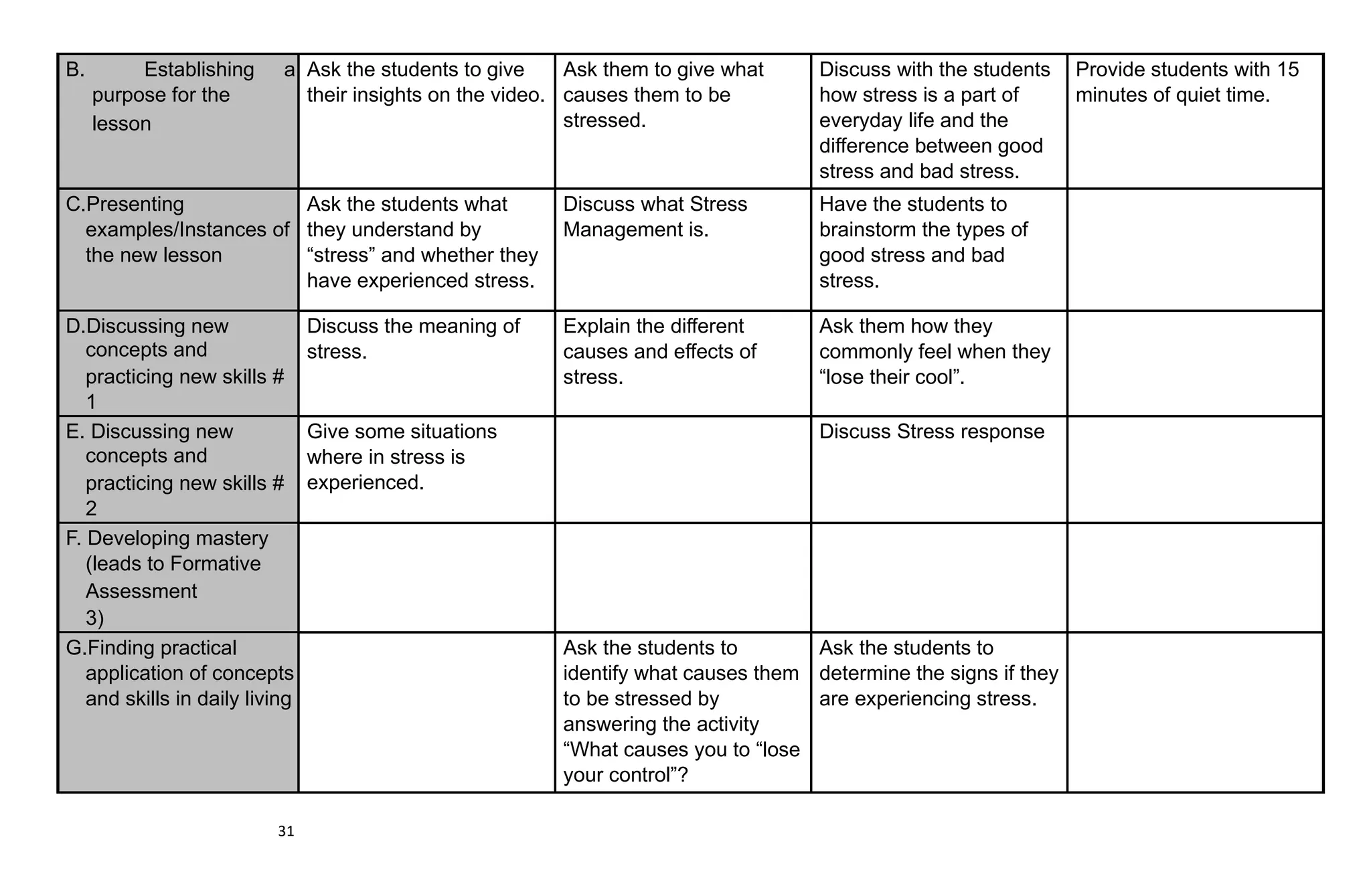
H.Making
generalizations and
abstractions about the
lesson
Ask the students to
complete Activity: Stress
Signals and share their
responses.
Students may share the
experience of how they felt
before, during and after
the activity and to previous
discussions.
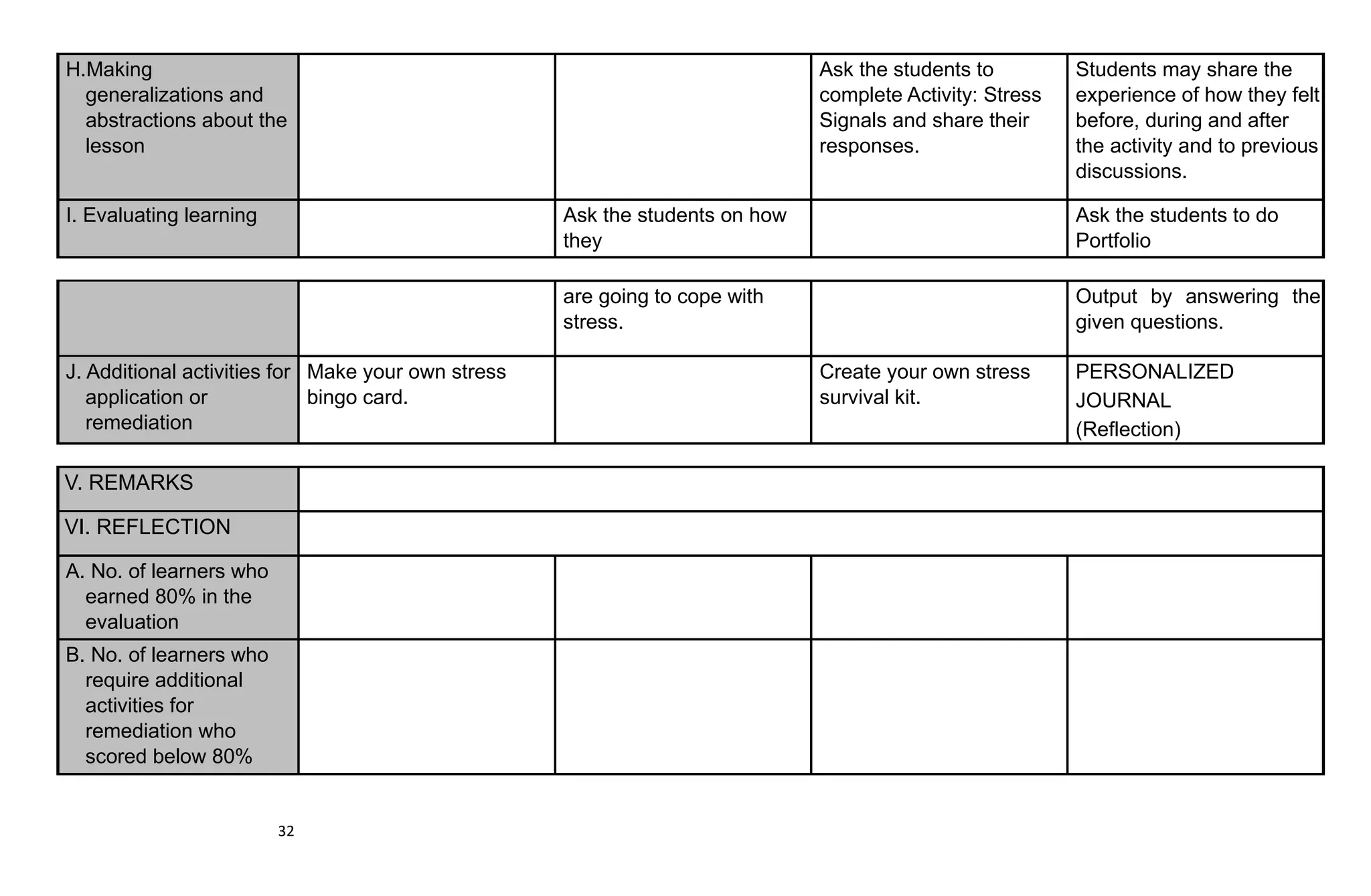
I. Evaluating learning Ask the students on how
they
Ask the students to do
Portfolio
are going to cope with
stress.
Output by answering the
given questions.
J. Additional activities for
application or
remediation
Make your own stress
bingo card.
Create your own stress
survival kit.
PERSONALIZED
JOURNAL
(Reflection)
V. REMARKS
VI. REFLECTION
A. No. of learners who
earned 80% in the
evaluation
B. No. of learners who
require additional
activities for
remediation who
scored below 80%
33
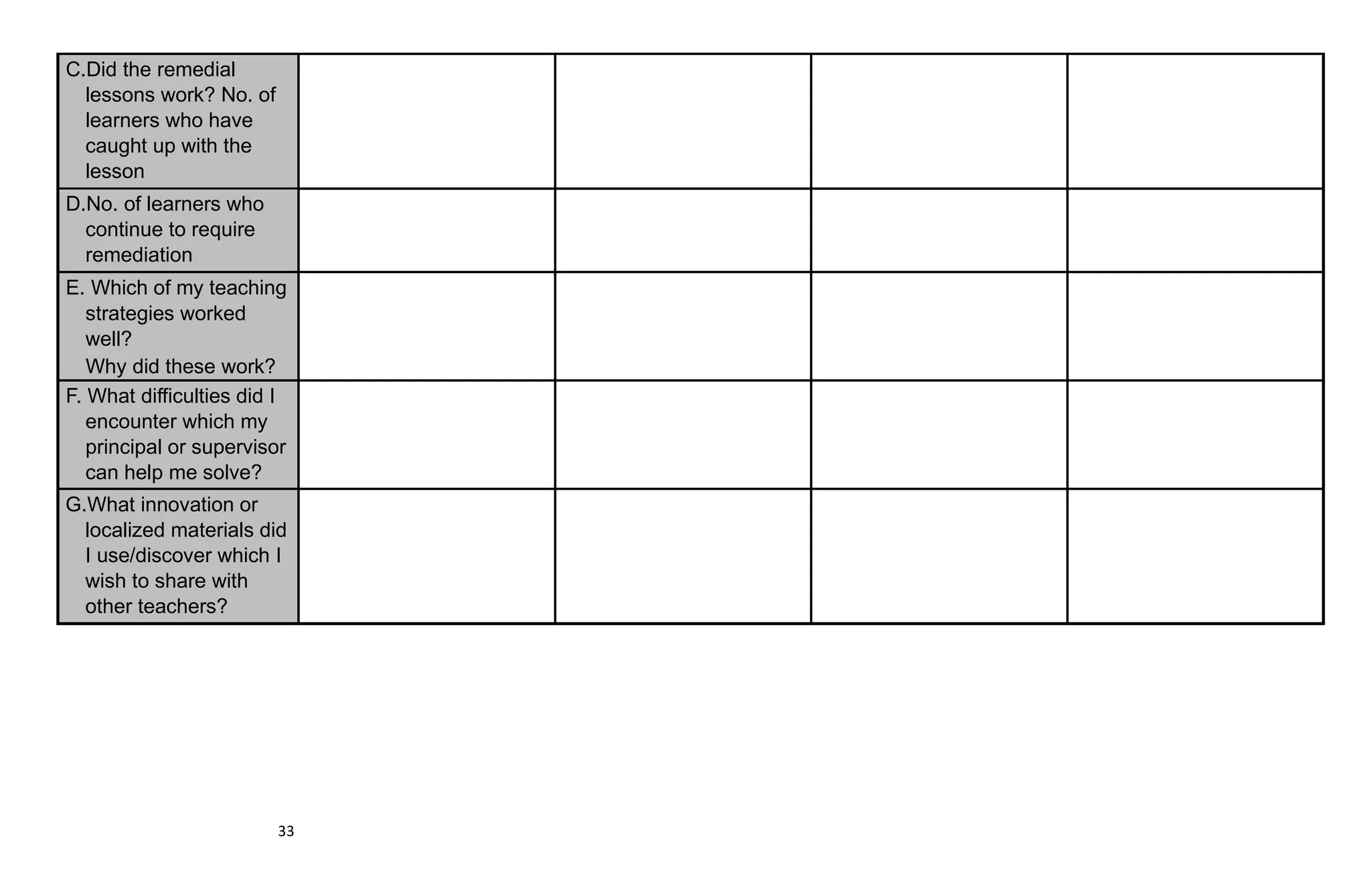
C.Did the remedial
lessons work? No. of
learners who have
caught up with the
lesson
D.No. of learners who
continue to require
remediation
E. Which of my teaching
strategies worked
well?
Why did these work?
F. What difficulties did I
encounter which my
principal or supervisor
can help me solve?
G.What innovation or
localized materials did
I use/discover which I
wish to share with
other teachers?
34
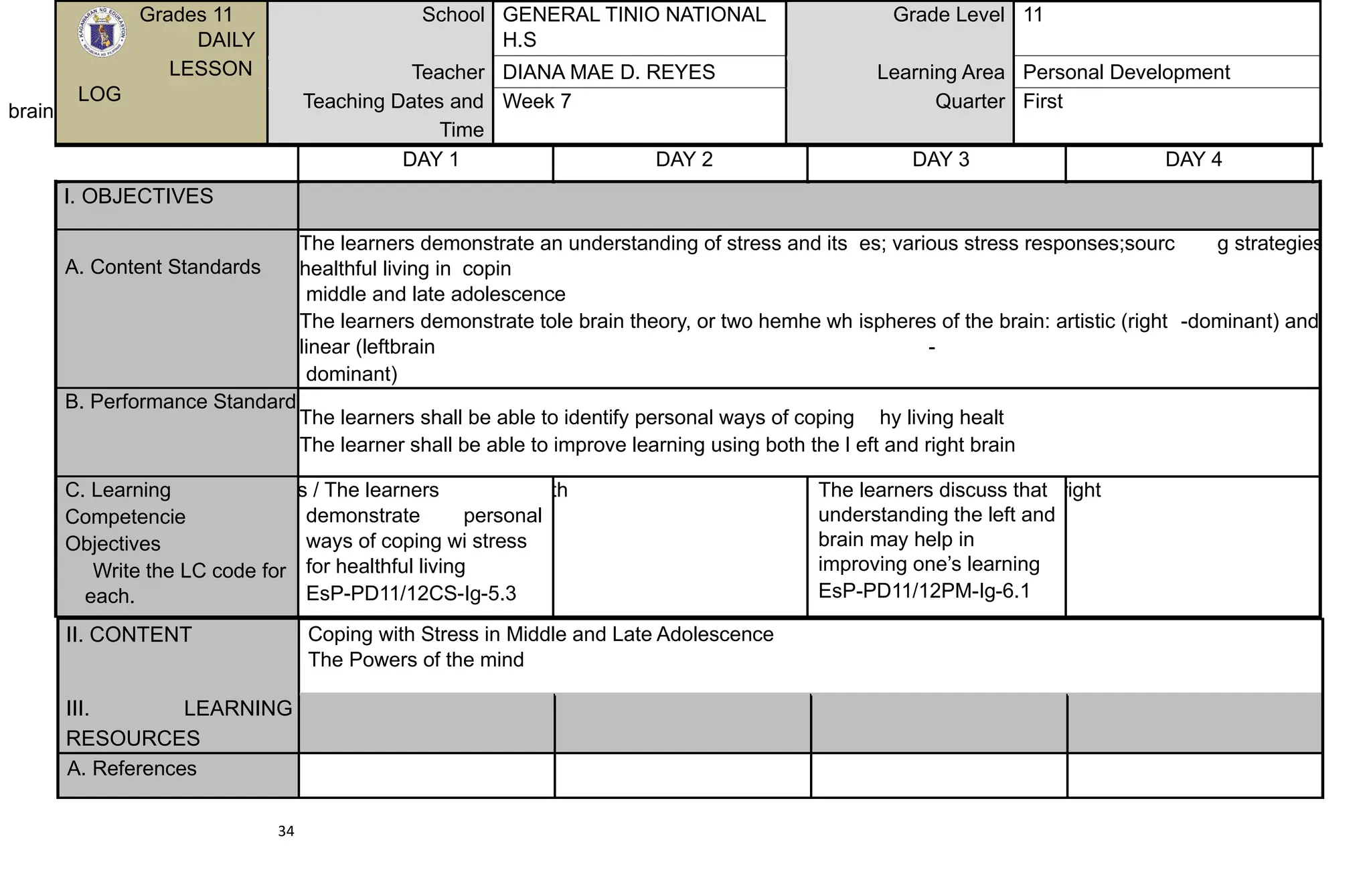
brain
II. CONTENT Coping with Stress in Middle and Late Adolescence
The Powers of the mind
III. LEARNING
RESOURCES
A. References
Grades 11
DAILY
LESSON
LOG
School GENERAL TINIO NATIONAL
H.S
Grade Level 11
Teacher DIANA MAE D. REYES Learning Area Personal Development
Teaching Dates and
Time
Week 7 Quarter First
DAY 1 DAY 2 DAY 3 DAY 4
I. OBJECTIVES
A. Content Standards
The learners demonstrate an understanding of stress and its es; various stress responses;sourc g strategies for
healthful living in copin
middle and late adolescence
The learners demonstrate tole brain theory, or two hemhe wh ispheres of the brain: artistic (right -dominant) and
linear (leftbrain -
dominant)
B. Performance Standard
The learners shall be able to identify personal ways of coping hy living healt
The learner shall be able to improve learning using both the l eft and right brain
C. Learning
Competencie
Objectives
Write the LC code for
each.
s / The learners
demonstrate personal
ways of coping wi stress
for healthful living
EsP-PD11/12CS-Ig-5.3
th The learners discuss that
understanding the left and
brain may help in
improving one’s learning
EsP-PD11/12PM-Ig-6.1
right
35
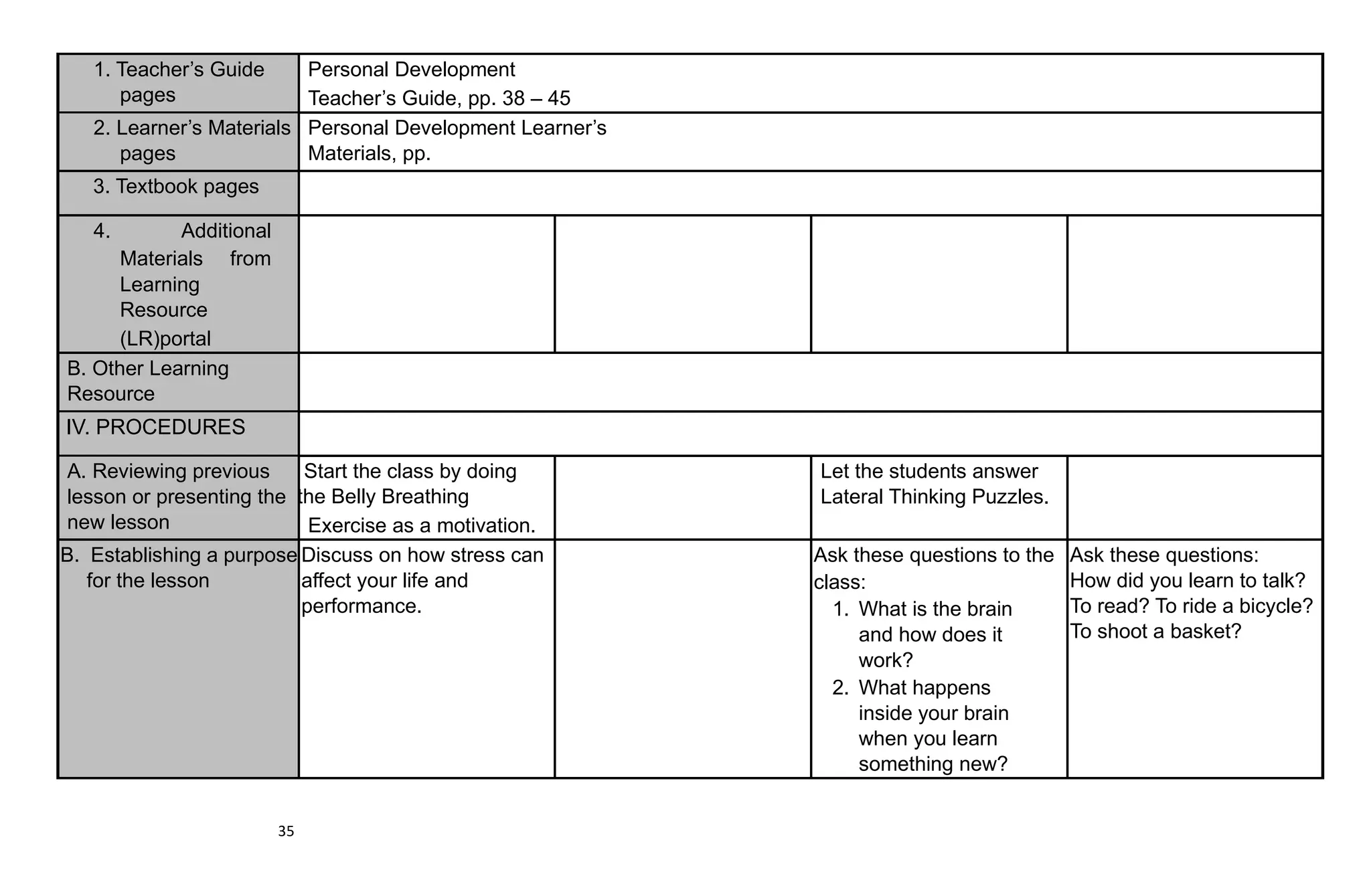
1. Teacher’s Guide
pages
Personal Development
Teacher’s Guide, pp. 38 – 45
2. Learner’s Materials
pages
Personal Development Learner’s
Materials, pp.
3. Textbook pages
4. Additional
Materials from
Learning
Resource
(LR)portal
B. Other Learning
Resource
IV. PROCEDURES
A. Reviewing previous
lesson or presenting the
new lesson
Start the class by doing
the Belly Breathing
Exercise as a motivation.
Let the students answer
Lateral Thinking Puzzles.
B. Establishing a purpose
for the lesson
Discuss on how stress can
affect your life and
performance.
Ask these questions to the
class:
1. What is the brain
and how does it
work?
2. What happens
inside your brain
when you learn
something new?
Ask these questions:
How did you learn to talk?
To read? To ride a bicycle?
To shoot a basket?
36
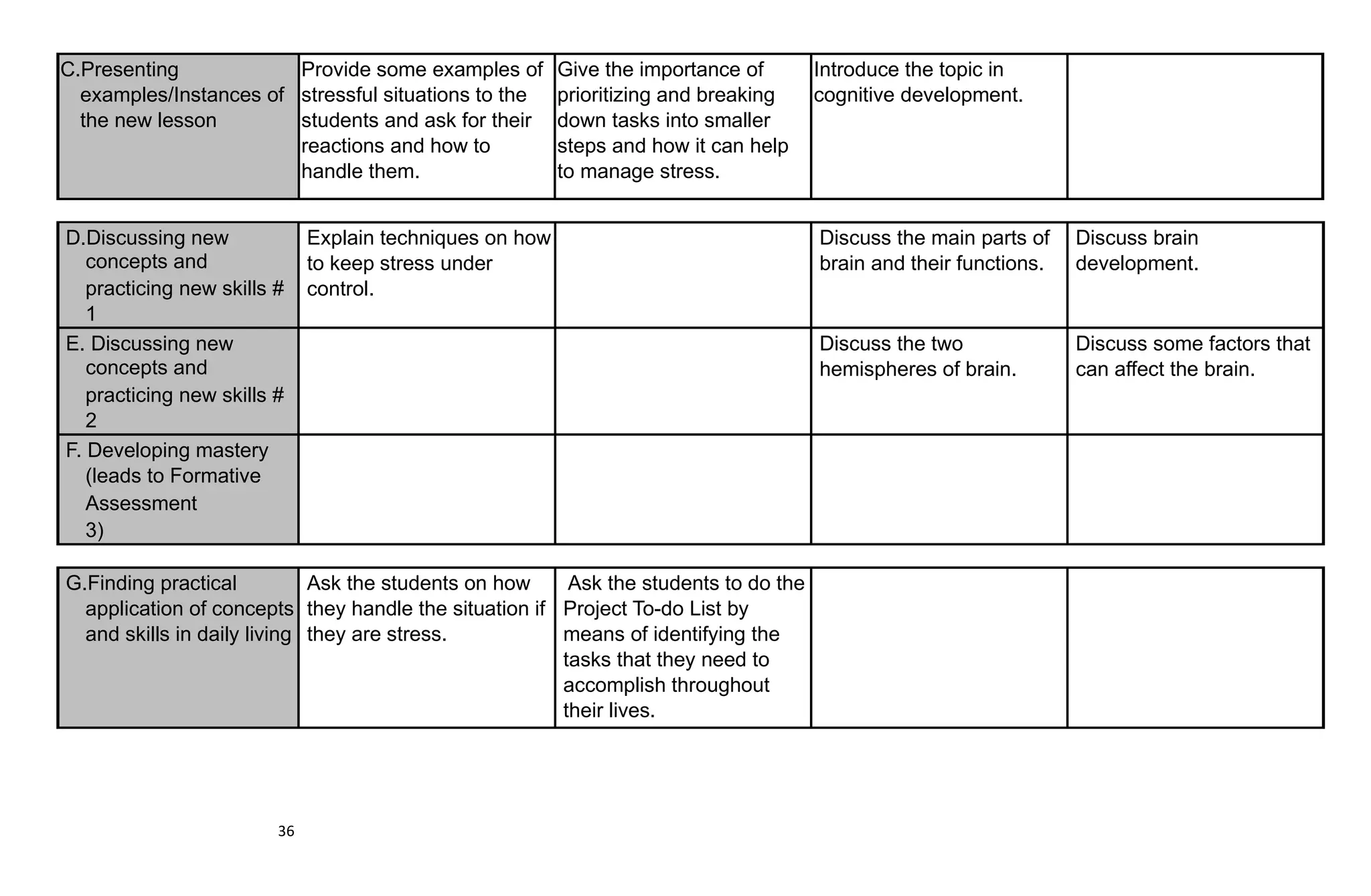
C.Presenting
examples/Instances of
the new lesson
Provide some examples of
stressful situations to the
students and ask for their
reactions and how to
handle them.
Give the importance of
prioritizing and breaking
down tasks into smaller
steps and how it can help
to manage stress.
Introduce the topic in
cognitive development.
D.Discussing new
concepts and
practicing new skills #
1
Explain techniques on how
to keep stress under
control.
Discuss the main parts of
brain and their functions.
Discuss brain
development.
E. Discussing new
concepts and
practicing new skills #
2
Discuss the two
hemispheres of brain.
Discuss some factors that
can affect the brain.
F. Developing mastery
(leads to Formative
Assessment
3)
G.Finding practical
application of concepts
and skills in daily living
Ask the students on how
they handle the situation if
they are stress.
Ask the students to do the
Project To-do List by
means of identifying the
tasks that they need to
accomplish throughout
their lives.
37
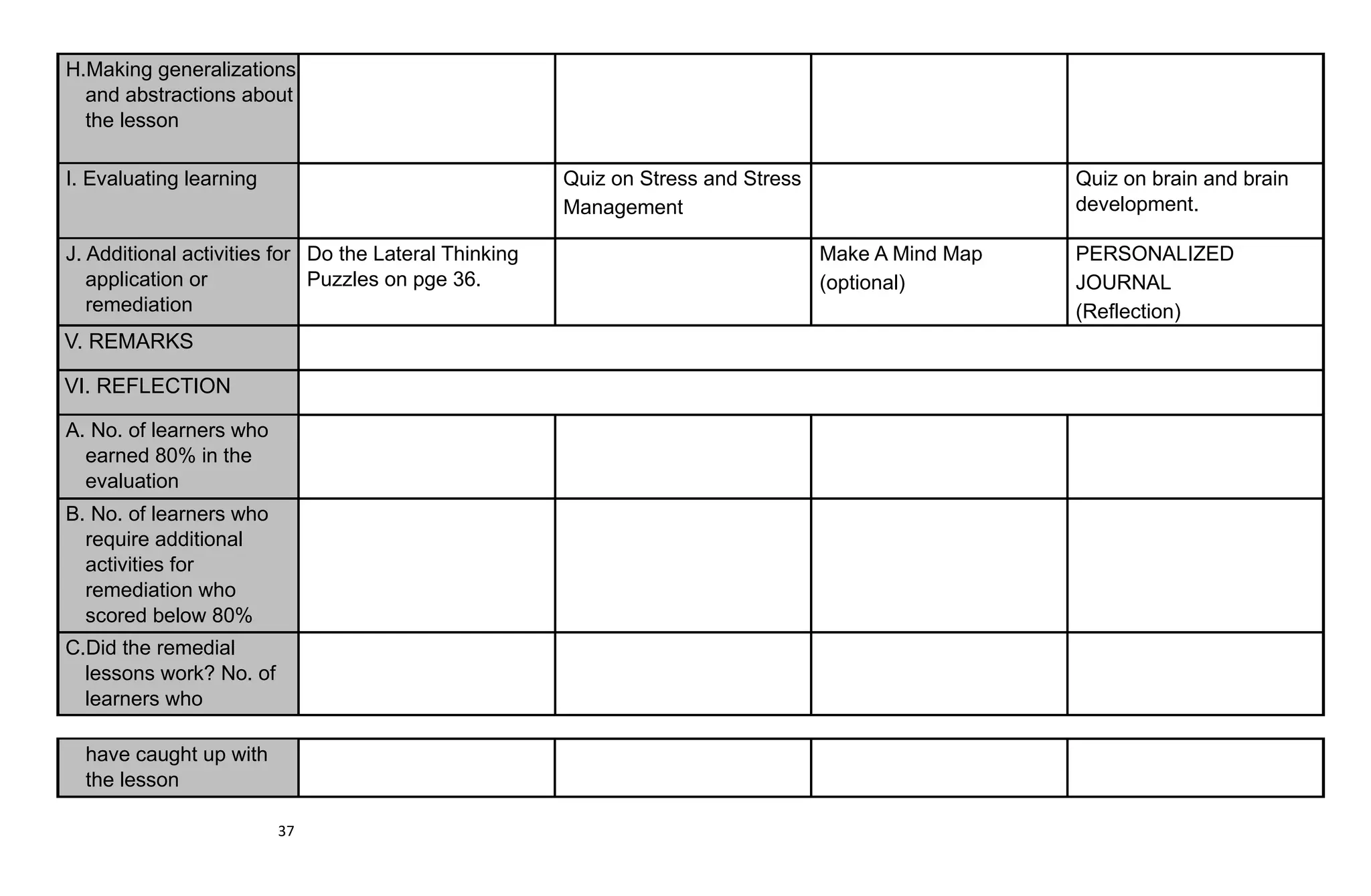
H.Making generalizations
and abstractions about
the lesson
I. Evaluating learning Quiz on Stress and Stress
Management
Quiz on brain and brain
development.
J. Additional activities for
application or
remediation
Do the Lateral Thinking
Puzzles on pge 36.
Make A Mind Map
(optional)
PERSONALIZED
JOURNAL
(Reflection)
V. REMARKS
VI. REFLECTION
A. No. of learners who
earned 80% in the
evaluation
B. No. of learners who
require additional
activities for
remediation who
scored below 80%
C.Did the remedial
lessons work? No. of
learners who
have caught up with
the lesson
38
D.No. of learners who
continue to require
remediation
E. Which of my teaching
strategies worked
well?
Why did these work?
F. What difficulties did I
encounter which my
principal or supervisor
can help me solve?
G.What innovation or
localized materials did
I use/discover which I
wish to share with
other teachers?
Grades 11
DAILY
LESSON
LOG
School GENERAL TINIO NATIONAL
H.S
Grade Level 11
Teacher DIANA MAE D. REYES Learning Area Personal Development
Teaching Dates and
Time
Week 8 Quarter First
39
40
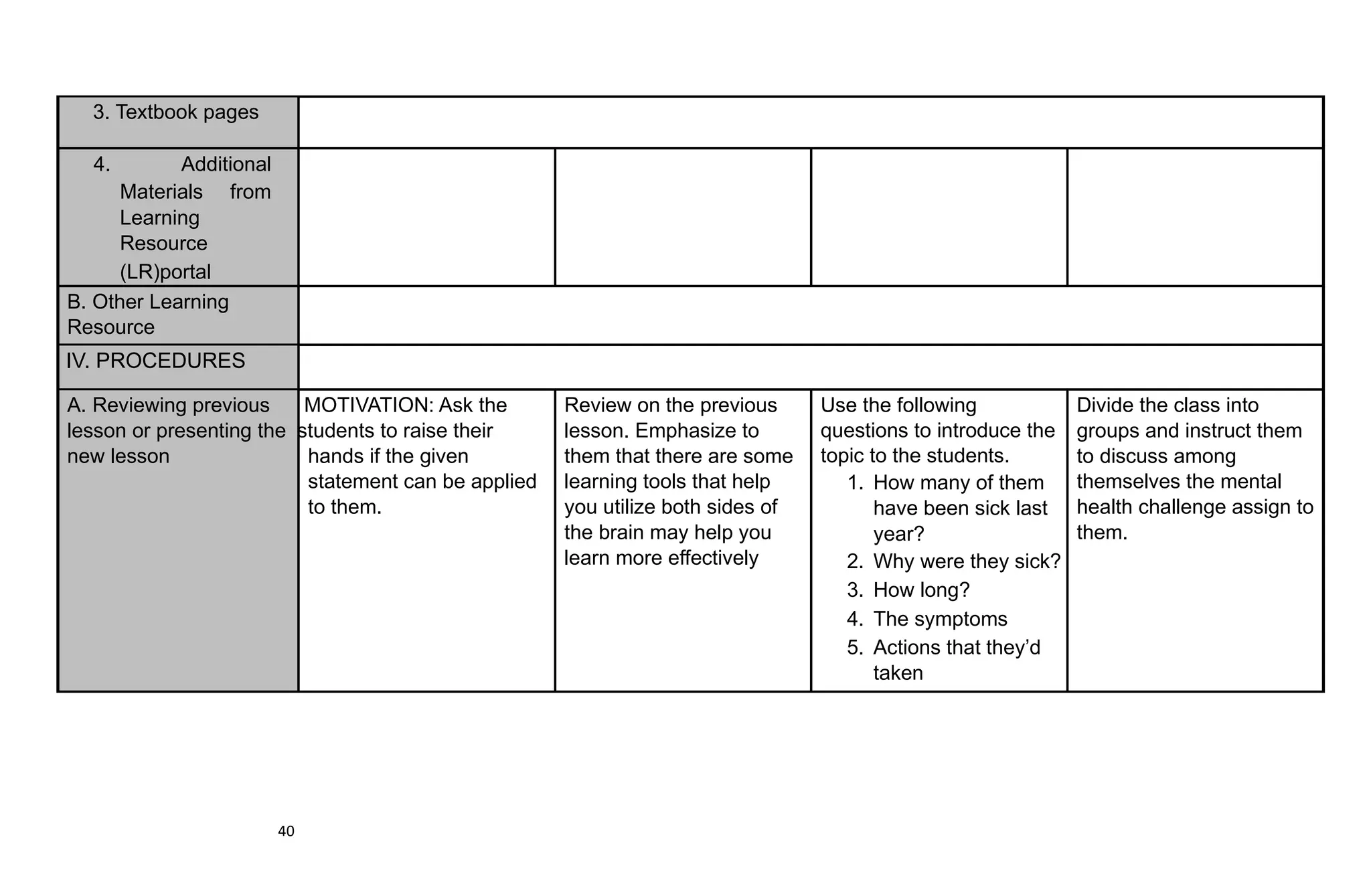
3. Textbook pages
4. Additional
Materials from
Learning
Resource
(LR)portal
B. Other Learning
Resource
IV. PROCEDURES
A. Reviewing previous
lesson or presenting the
new lesson
MOTIVATION: Ask the
students to raise their
hands if the given
statement can be applied
to them.
Review on the previous
lesson. Emphasize to
them that there are some
learning tools that help
you utilize both sides of
the brain may help you
learn more effectively
Use the following
questions to introduce the
topic to the students.
1. How many of them
have been sick last
year?
2. Why were they sick?
3. How long?
4. The symptoms
5. Actions that they’d
taken
Divide the class into
groups and instruct them
to discuss among
themselves the mental
health challenge assign to
them.
41
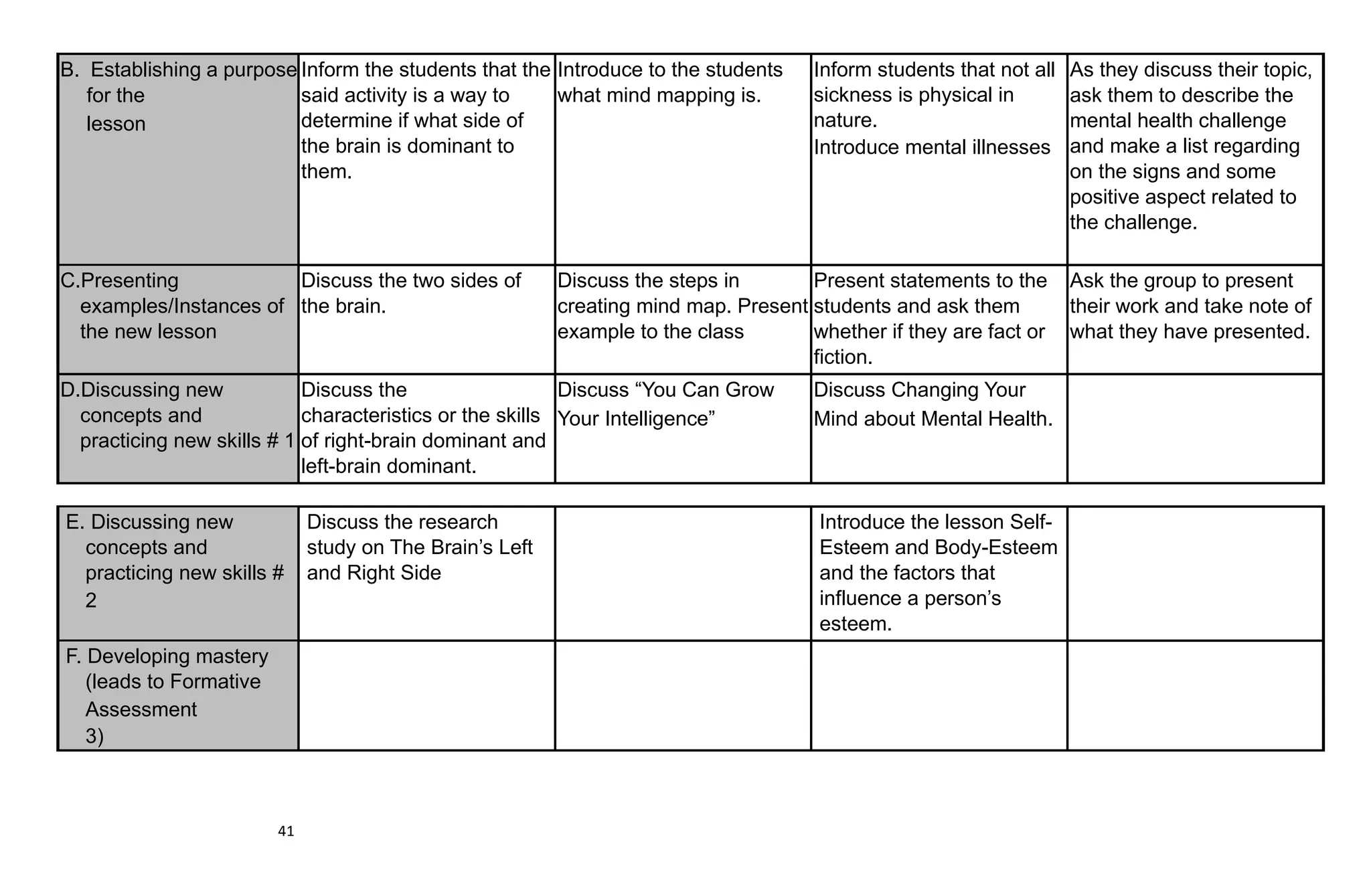
B. Establishing a purpose
for the
lesson
Inform the students that the
said activity is a way to
determine if what side of
the brain is dominant to
them.
Introduce to the students
what mind mapping is.
Inform students that not all
sickness is physical in
nature.
Introduce mental illnesses
As they discuss their topic,
ask them to describe the
mental health challenge
and make a list regarding
on the signs and some
positive aspect related to
the challenge.
C.Presenting
examples/Instances of
the new lesson
Discuss the two sides of
the brain.
Discuss the steps in
creating mind map. Present
example to the class
Present statements to the
students and ask them
whether if they are fact or
fiction.
Ask the group to present
their work and take note of
what they have presented.
D.Discussing new
concepts and
practicing new skills # 1
Discuss the
characteristics or the skills
of right-brain dominant and
left-brain dominant.
Discuss “You Can Grow
Your Intelligence”
Discuss Changing Your
Mind about Mental Health.
E. Discussing new
concepts and
practicing new skills #
2
Discuss the research
study on The Brain’s Left
and Right Side
Introduce the lesson Self-
Esteem and Body-Esteem
and the factors that
influence a person’s
esteem.
F. Developing mastery
(leads to Formative
Assessment
3)
42
G.Finding practical
application of concepts
and skills in daily living
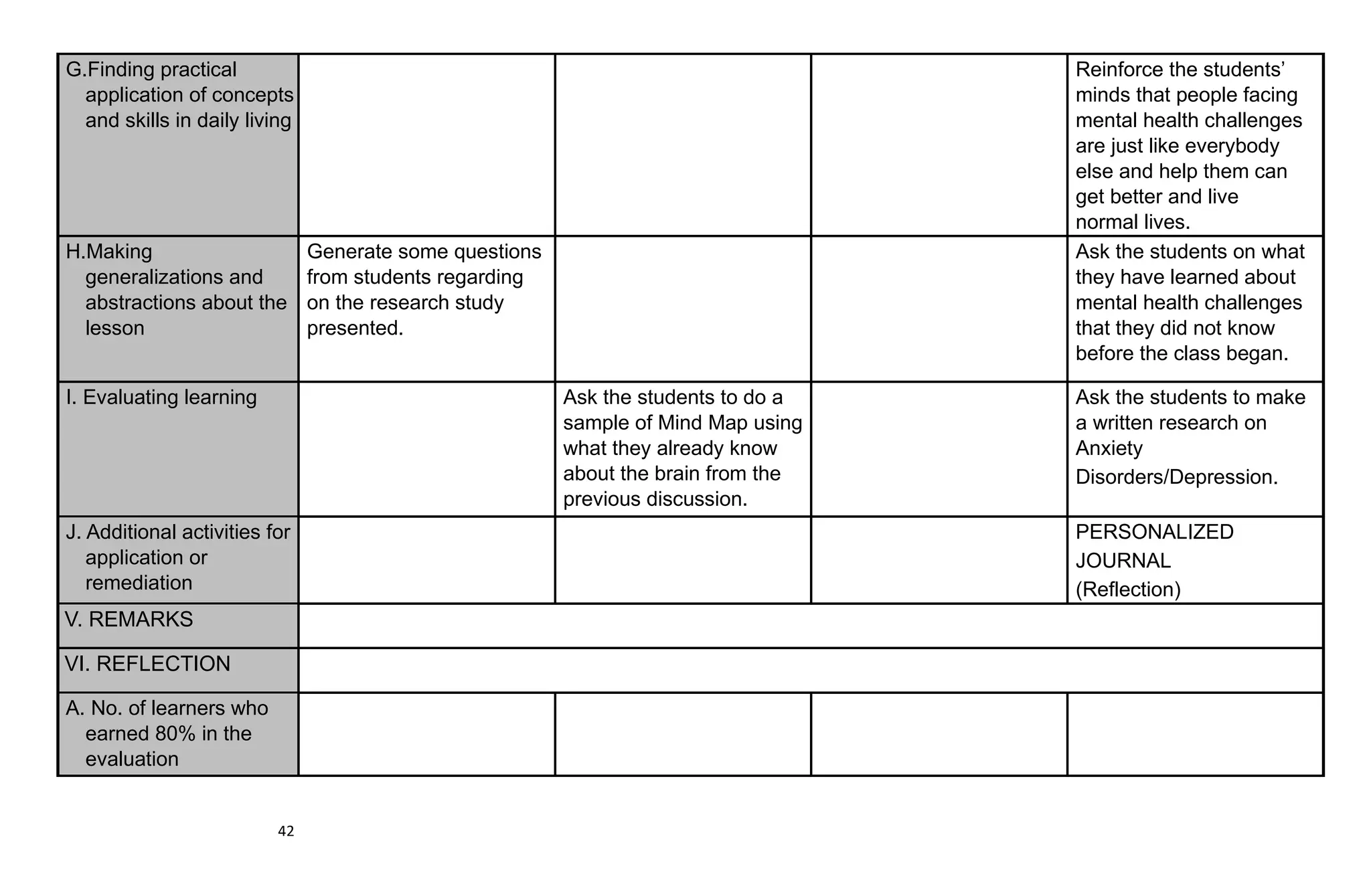
Reinforce the students’
minds that people facing
mental health challenges
are just like everybody
else and help them can
get better and live
normal lives.
H.Making
generalizations and
abstractions about the
lesson
Generate some questions
from students regarding
on the research study
presented.
Ask the students on what
they have learned about
mental health challenges
that they did not know
before the class began.
I. Evaluating learning Ask the students to do a
sample of Mind Map using
what they already know
about the brain from the
previous discussion.
Ask the students to make
a written research on
Anxiety
Disorders/Depression.
J. Additional activities for
application or
remediation
PERSONALIZED
JOURNAL
(Reflection)
V. REMARKS
VI. REFLECTION
A. No. of learners who
earned 80% in the
evaluation
43
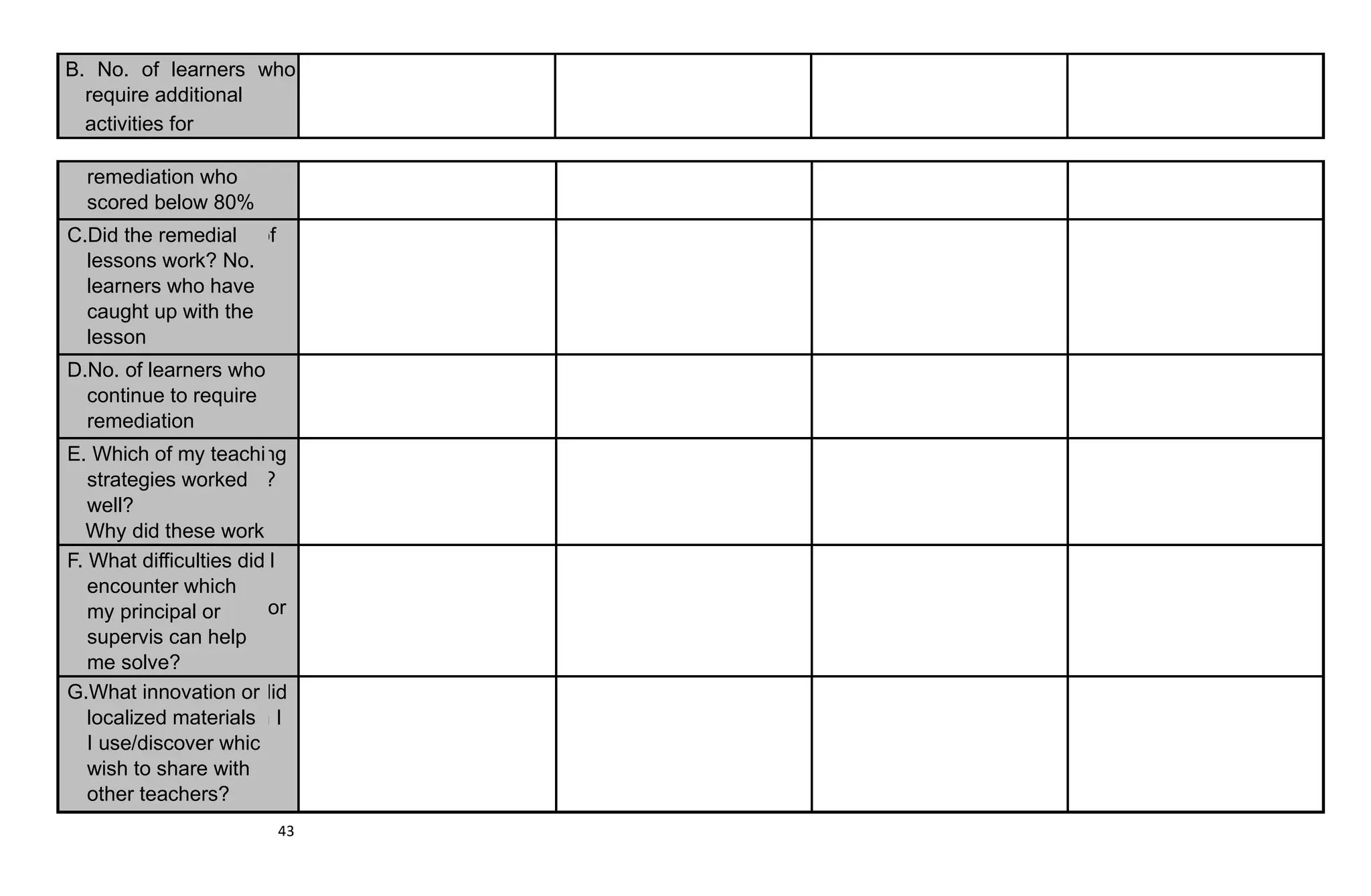
B. No. of learners who
require additional
activities for
remediation who
scored below 80%
C.Did the remedial
lessons work? No.
learners who have
caught up with the
lesson
of
D.No. of learners who
continue to require
remediation
E. Which of my teachi
strategies worked
well?
Why did these work
ng
?
F. What difficulties did
encounter which
my principal or
supervis can help
me solve?
I
or
G.What innovation or
localized materials
I use/discover whic
wish to share with
other teachers?
did
h I
44
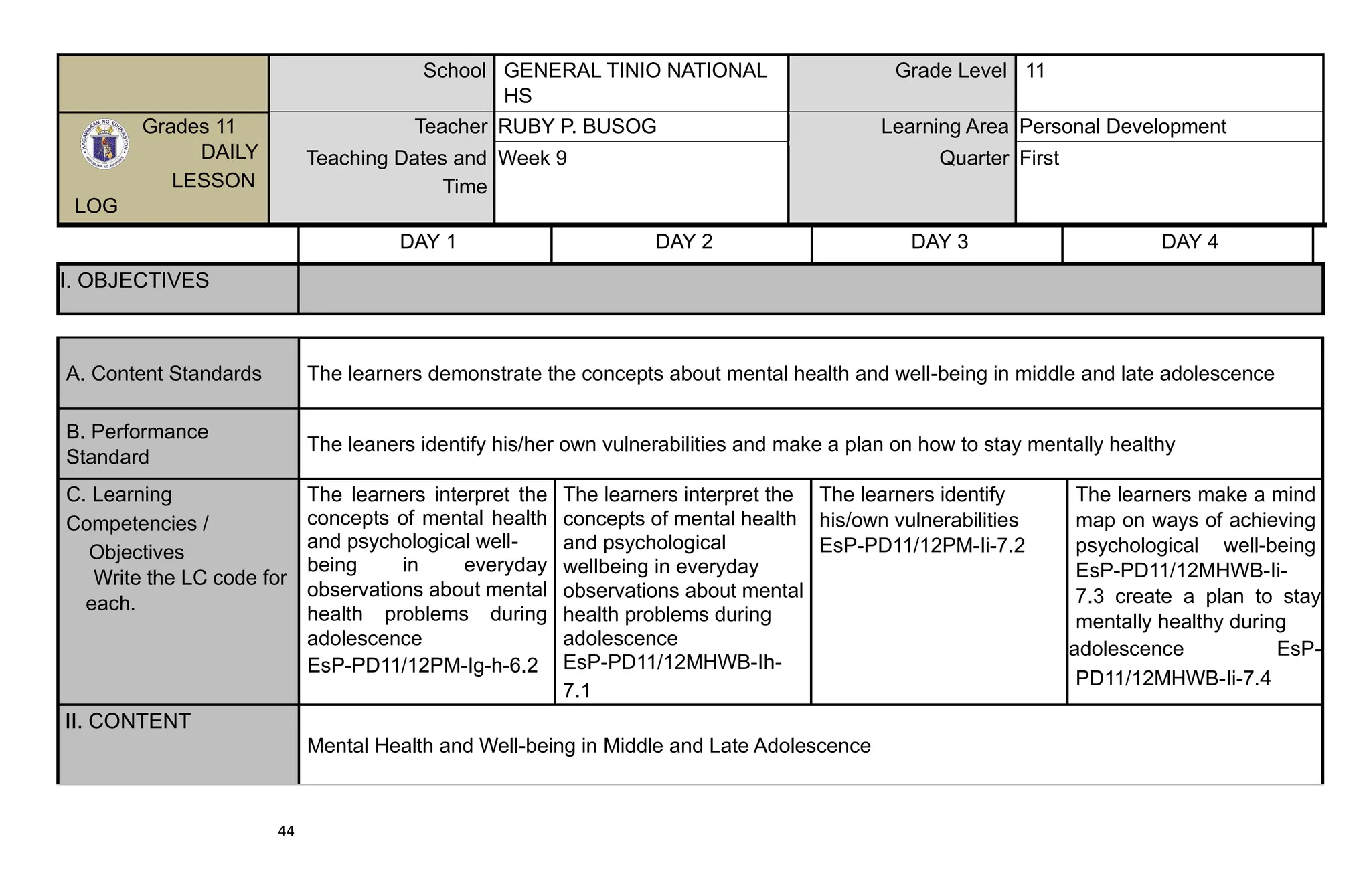
School GENERAL TINIO NATIONAL
HS
Grade Level 11
Grades 11
DAILY
LESSON
LOG
Teacher RUBY P. BUSOG Learning Area Personal Development
Teaching Dates and
Time
Week 9 Quarter First
DAY 1 DAY 2 DAY 3 DAY 4
I. OBJECTIVES
A. Content Standards The learners demonstrate the concepts about mental health and well-being in middle and late adolescence
B. Performance
Standard
The leaners identify his/her own vulnerabilities and make a plan on how to stay mentally healthy
C. Learning
Competencies /
Objectives
Write the LC code for
each.
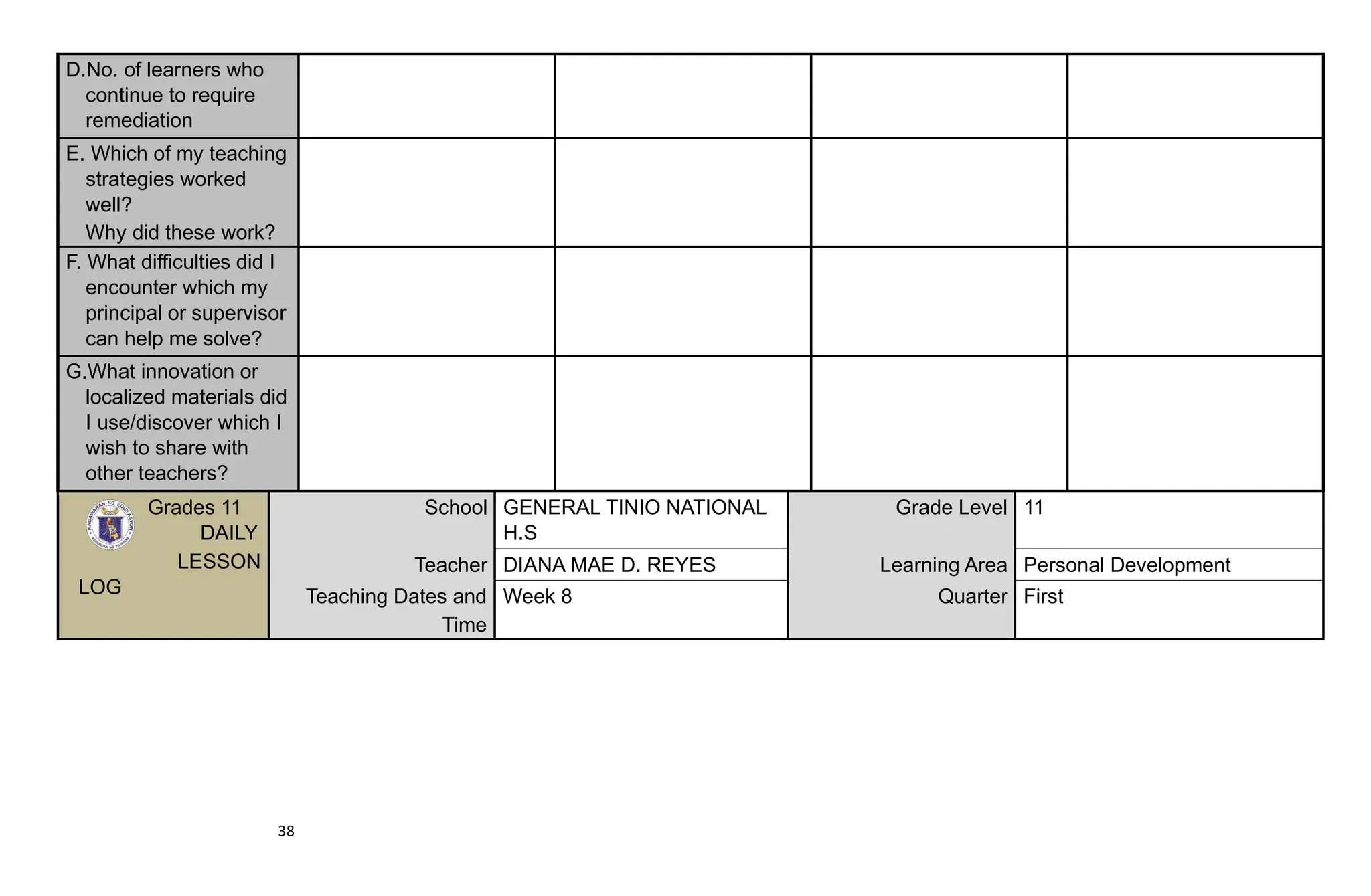
The learners interpret the
concepts of mental health
and psychological well-
being in everyday
observations about mental
health problems during
adolescence
EsP-PD11/12PM-Ig-h-6.2
The learners interpret the
concepts of mental health
and psychological
wellbeing in everyday
observations about mental
health problems during
adolescence
EsP-PD11/12MHWB-Ih-
7.1
The learners identify
his/own vulnerabilities
EsP-PD11/12PM-Ii-7.2
The learners make a mind
map on ways of achieving
psychological well-being
EsP-PD11/12MHWB-Ii-
7.3 create a plan to stay
mentally healthy during
adolescence EsP-
PD11/12MHWB-Ii-7.4
II. CONTENT
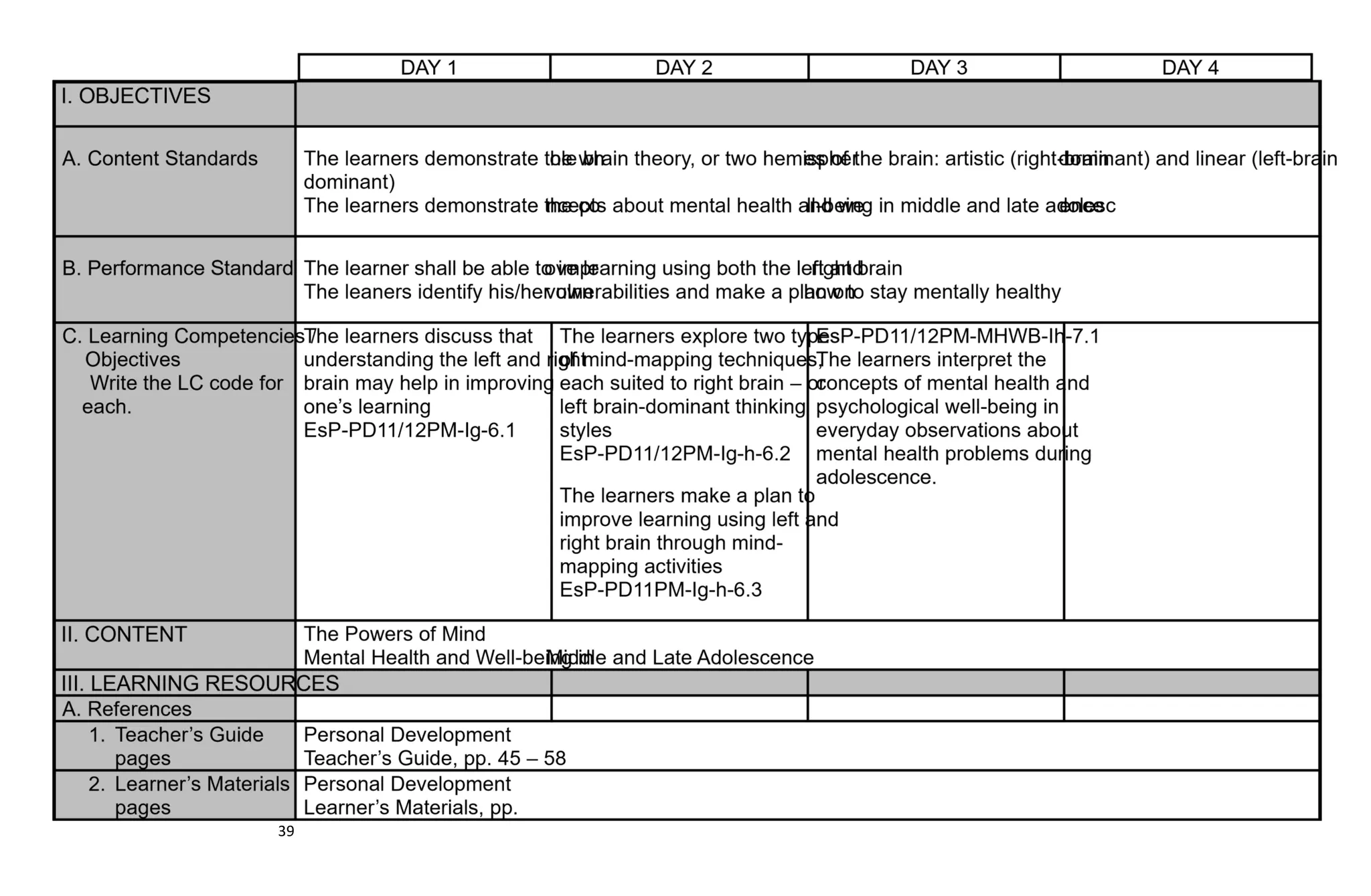
Mental Health and Well-being in Middle and Late Adolescence
45
III. LEARNING
RESOURCES
A. References
1. Teacher’s Guide
pages
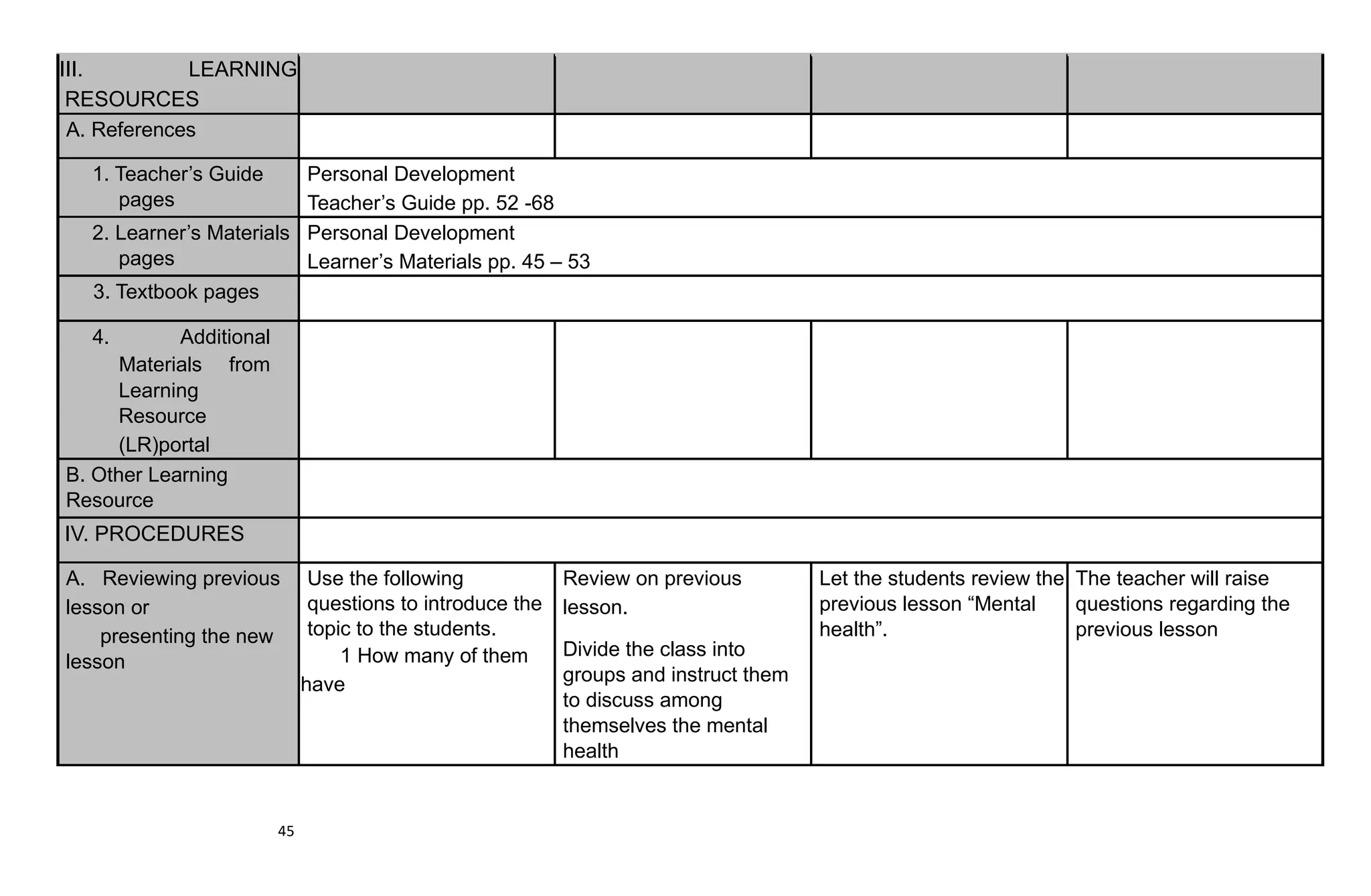
Personal Development
Teacher’s Guide pp. 52 -68
2. Learner’s Materials
pages
Personal Development
Learner’s Materials pp. 45 – 53
3. Textbook pages
4. Additional
Materials from
Learning
Resource
(LR)portal
B. Other Learning
Resource
IV. PROCEDURES
A. Reviewing previous
lesson or
presenting the new
lesson
Use the following
questions to introduce the
topic to the students.
1 How many of them
have
Review on previous
lesson.
Divide the class into
groups and instruct them
to discuss among
themselves the mental
health
Let the students review the
previous lesson “Mental
health”.
The teacher will raise
questions regarding the
previous lesson
46
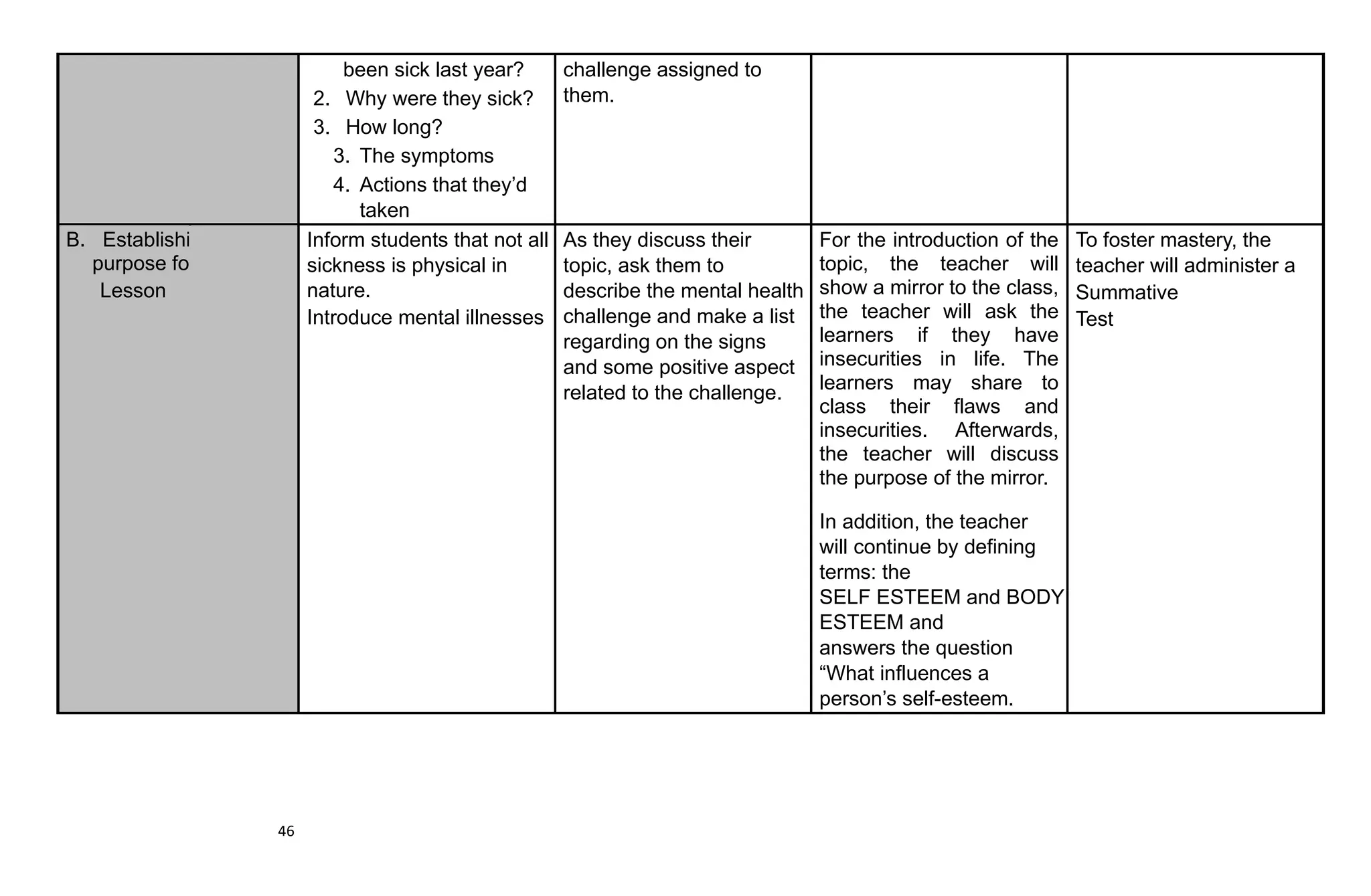
been sick last year?
2. Why were they sick?
3. How long?
3. The symptoms
4. Actions that they’d
taken
challenge assigned to
them.
B. Establishing a
purpose for the
Lesson
Inform students that not all
sickness is physical in
nature.
Introduce mental illnesses
As they discuss their
topic, ask them to
describe the mental health
challenge and make a list
regarding on the signs
and some positive aspect
related to the challenge.
For the introduction of the
topic, the teacher will
show a mirror to the class,
the teacher will ask the
learners if they have
insecurities in life. The
learners may share to
class their flaws and
insecurities. Afterwards,
the teacher will discuss
the purpose of the mirror.
In addition, the teacher
will continue by defining
terms: the
SELF ESTEEM and BODY
ESTEEM and
answers the question
“What influences a
person’s self-esteem.
To foster mastery, the
teacher will administer a
Summative
Test
47
C. Presenting
examples/Instances
of the new lesson
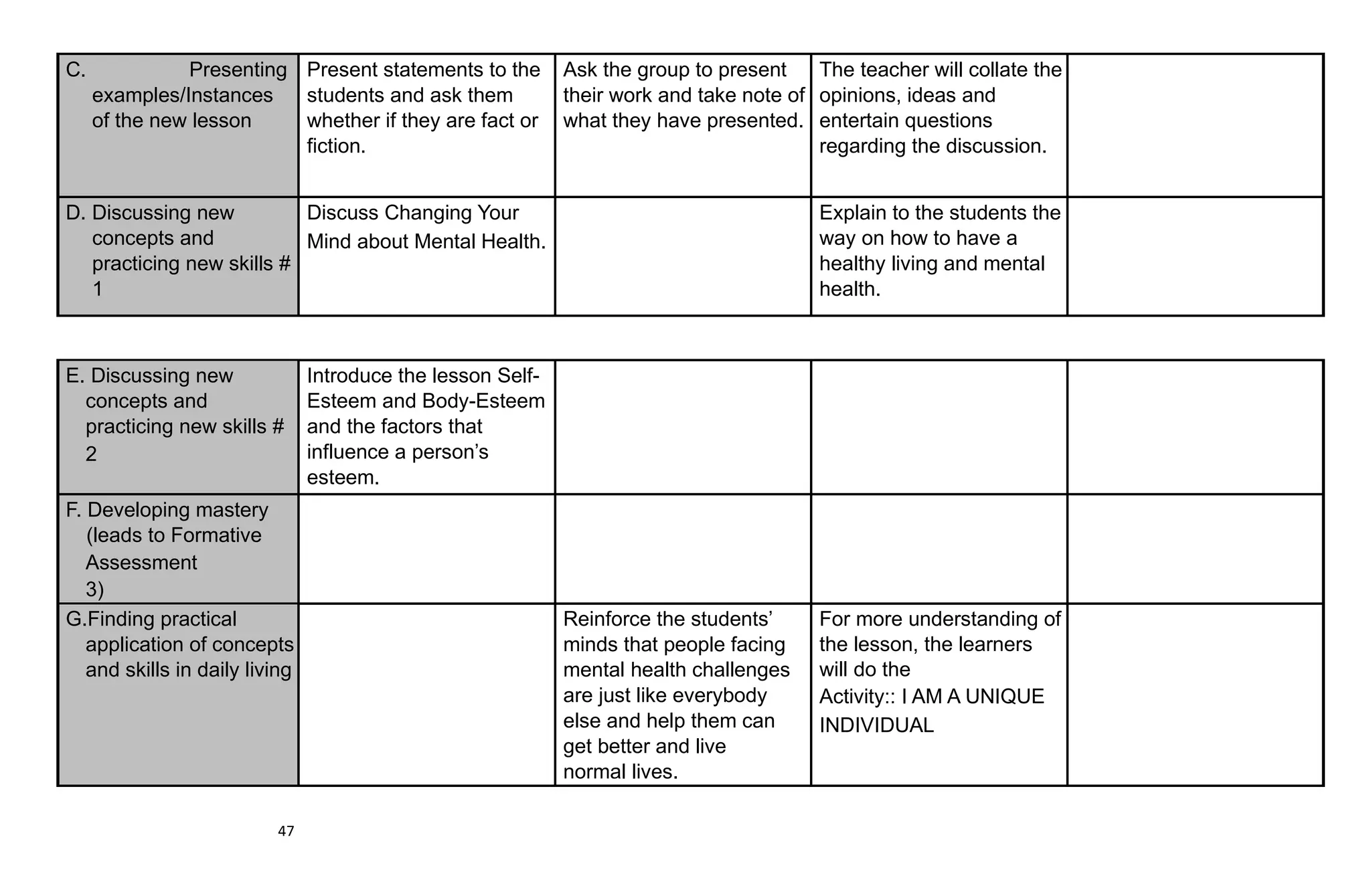
Present statements to the
students and ask them
whether if they are fact or
fiction.
Ask the group to present
their work and take note of
what they have presented.
The teacher will collate the
opinions, ideas and
entertain questions
regarding the discussion.
D. Discussing new
concepts and
practicing new skills #
1
Discuss Changing Your
Mind about Mental Health.
Explain to the students the
way on how to have a
healthy living and mental
health.
E. Discussing new
concepts and
practicing new skills #
2
Introduce the lesson Self-
Esteem and Body-Esteem
and the factors that
influence a person’s
esteem.
F. Developing mastery
(leads to Formative
Assessment
3)
G.Finding practical
application of concepts
and skills in daily living
Reinforce the students’
minds that people facing
mental health challenges
are just like everybody
else and help them can
get better and live
normal lives.
For more understanding of
the lesson, the learners
will do the
Activity:: I AM A UNIQUE
INDIVIDUAL
48
H.Making generalizations
and abstractions about
the lesson
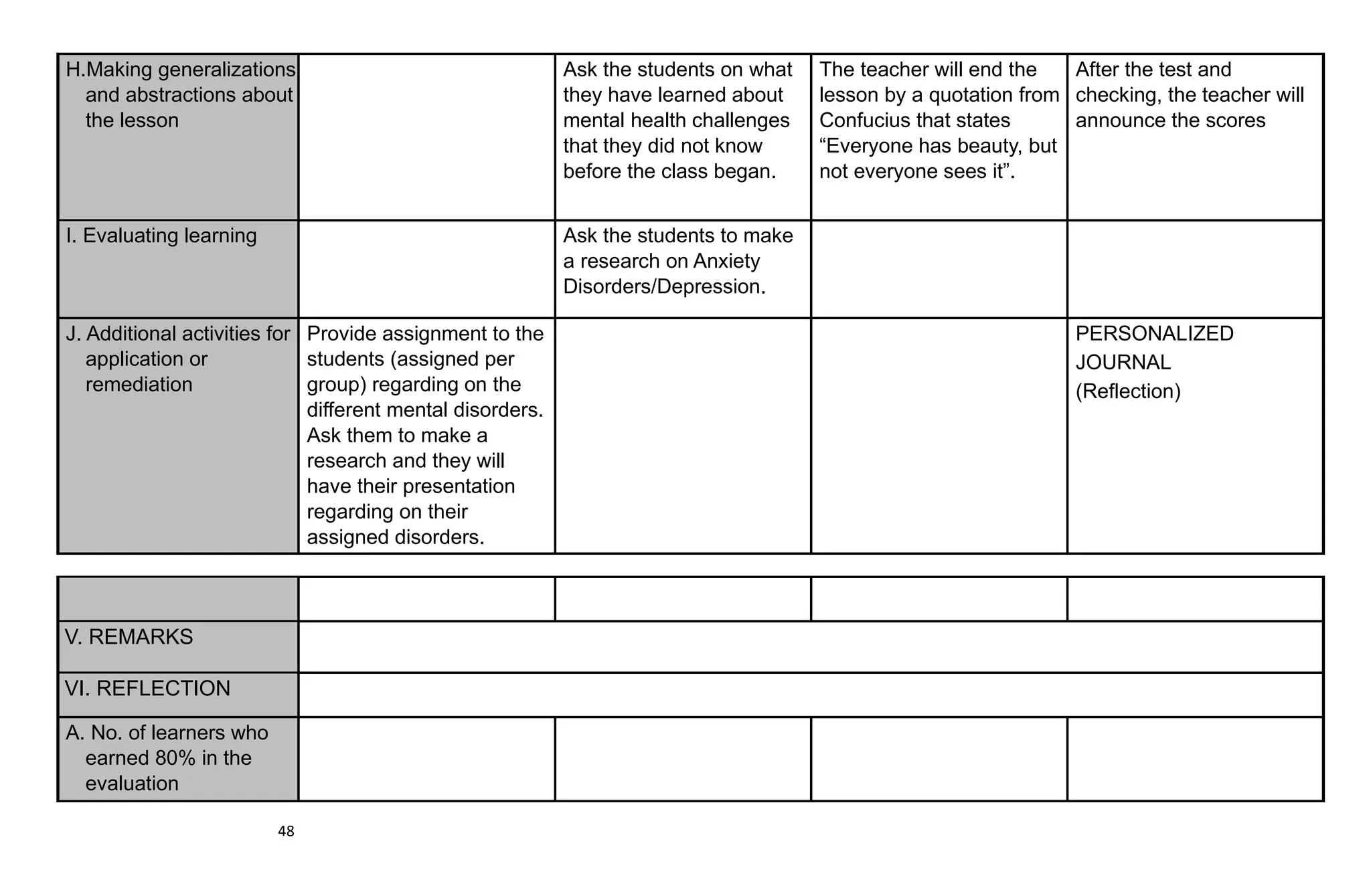
Ask the students on what
they have learned about
mental health challenges
that they did not know
before the class began.
The teacher will end the
lesson by a quotation from
Confucius that states
“Everyone has beauty, but
not everyone sees it”.
After the test and
checking, the teacher will
announce the scores
I. Evaluating learning Ask the students to make
a research on Anxiety
Disorders/Depression.
J. Additional activities for
application or
remediation
Provide assignment to the
students (assigned per
group) regarding on the
different mental disorders.
Ask them to make a
research and they will
have their presentation
regarding on their
assigned disorders.
PERSONALIZED
JOURNAL
(Reflection)
V. REMARKS
VI. REFLECTION
A. No. of learners who
earned 80% in the
evaluation
49
B. No. of learners who
require additional
activities for
remediation who
scored below 80%
C.Did the remedial
lessons work? No. of
learners who have
caught up with the
lesson
D.No. of learners who
continue to require
remediation
E. Which of my teaching
strategies worked
well?
Why did these work?
F. What difficulties did I
encounter which my
principal or supervisor
can help me solve?
G.What innovation or
localized materials did
I use/discover which I
wish to share with
other teachers?
50
Grades 11
DAILY
LESSON
LOG
School GENERAL TINIO NATIONAL
HS
Grade Level 11
Teacher RUBY P. BUSOG Learning Area Personal Development
Teaching Dates and
Time
Week 10 & 11 Quarter First
DAY 1 DAY 2 DAY 3 DAY 4
I. OBJECTIVES
A. Content Standards The learners demonstrate an understanding of the different types of emotions and how they are expressed
B. Performance
Standard
The learners shall be able to identify ways to communicate and manage emotions in a healthy manner
C. Learning
Competencies /
Objectives
Write the LC code for
each.
The learners discuss that
understanding the intensity
and differentiation of emotions
may
help in
communicating
emotional
expressions EsP-
PD11/12EI-Ii-j-8.1
The learners explore
one’s positive and
negative emotions and
how one expresses or
hides them
EsP-PD11/12EI-Ij-8.2
The learners demonstrate
and create ways to
manage various
emotions
EsP-PD11/12EI-Ij-8.3
II. CONTENT Emotional Intelligence
51
III. LEARNING
RESOURCES
A. References
5. Teacher’s Guide
pages
pp. 68 – 76
6. Learner’s
Materials pages
pp. 54 – 59
7. Textbook pages
8. Additional
Materials from
Learning
Resource
(LR)portal
B. Other Learning
Resource
IV. PROCEDURES
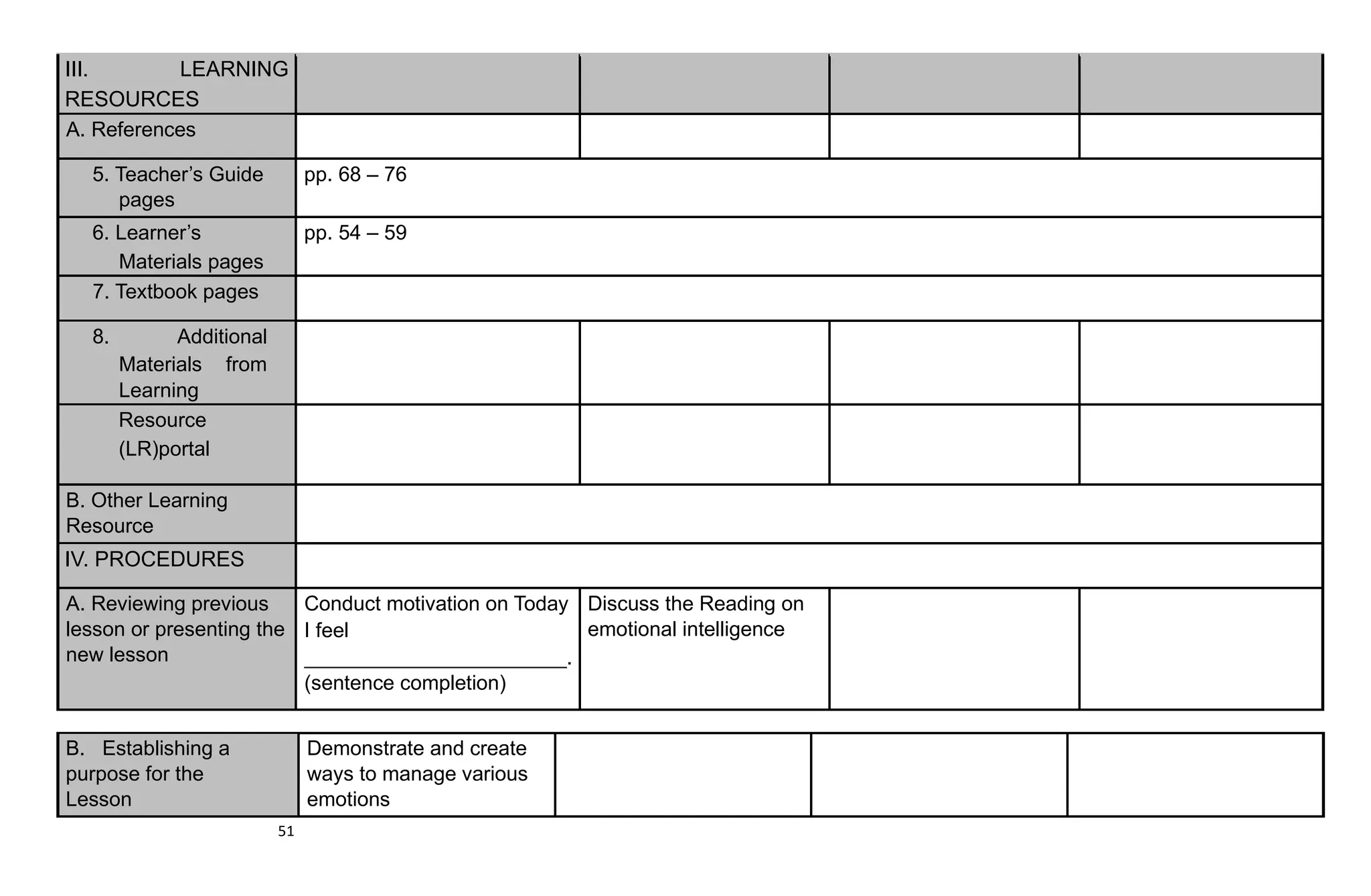
A. Reviewing previous
lesson or presenting the
new lesson
Conduct motivation on Today
I feel
_______________________.
(sentence completion)
Discuss the Reading on
emotional intelligence
B. Establishing a
purpose for the
Lesson
Demonstrate and create
ways to manage various
emotions
52
C. Presenting
examples/Instances
of the new lesson
Activity: Introduction to
emotions (page 56)
D. Discussing new
concepts and
practicing new skills #
1
Activity: Exploring
emotions
(page 56)
Activity: I am (page 56)
Activity: Am I Assertive?
: Get a grip on
anger
(page 58)
E. Discussing new
concepts and
practicing new skills #
2
I am the BOSS of my
feelings! (page 58)
F. Developing mastery
(leads to Formative
Assessment
3)
G.Finding practical
application of concepts
and skills in daily living
Demonstrate and create
ways to manage various
emotions
H.Making generalizations
and abstractions about
the lesson
Reflection on Exploring
Emotions and I am.
Portfolio Output
I. Evaluating learning Responsible Action sheet
53
J. Additional activities for
application or
remediation
PERSONALIZED
JOURNAL
(Reflection)
V. REMARKS
VI. REFLECTION
A. No. of learners who
earned 80% in the
evaluation
B. No. of learners who
require
additional activities for
remediation who
scored below 80%
C. Did the remedial
lessons work? No. of
learners who have
caught up with the
lesson
D.No. of learners who
continue to require
remediation
E. Which of my teaching
strategies worked
well?
Why did these work?
54
F. What difficulties did I
encounter which my
principal or supervisor
can help me solve?
G.What innovation or
localized materials did
I use/discover which I
wish to share with
other teachers?
DAY 1 DAY 2 DAY 3 DAY 4
Grades
1 to
DAILY
LESSON
LOG
School GENERAL TINIO
NATIONAL HS
Grade Level 11
Teacher RUBY P. BUSOG Learning Area Personal Development
Teaching Dates
and
Time
Week 12 Quarter First
I. OBJECTIVES
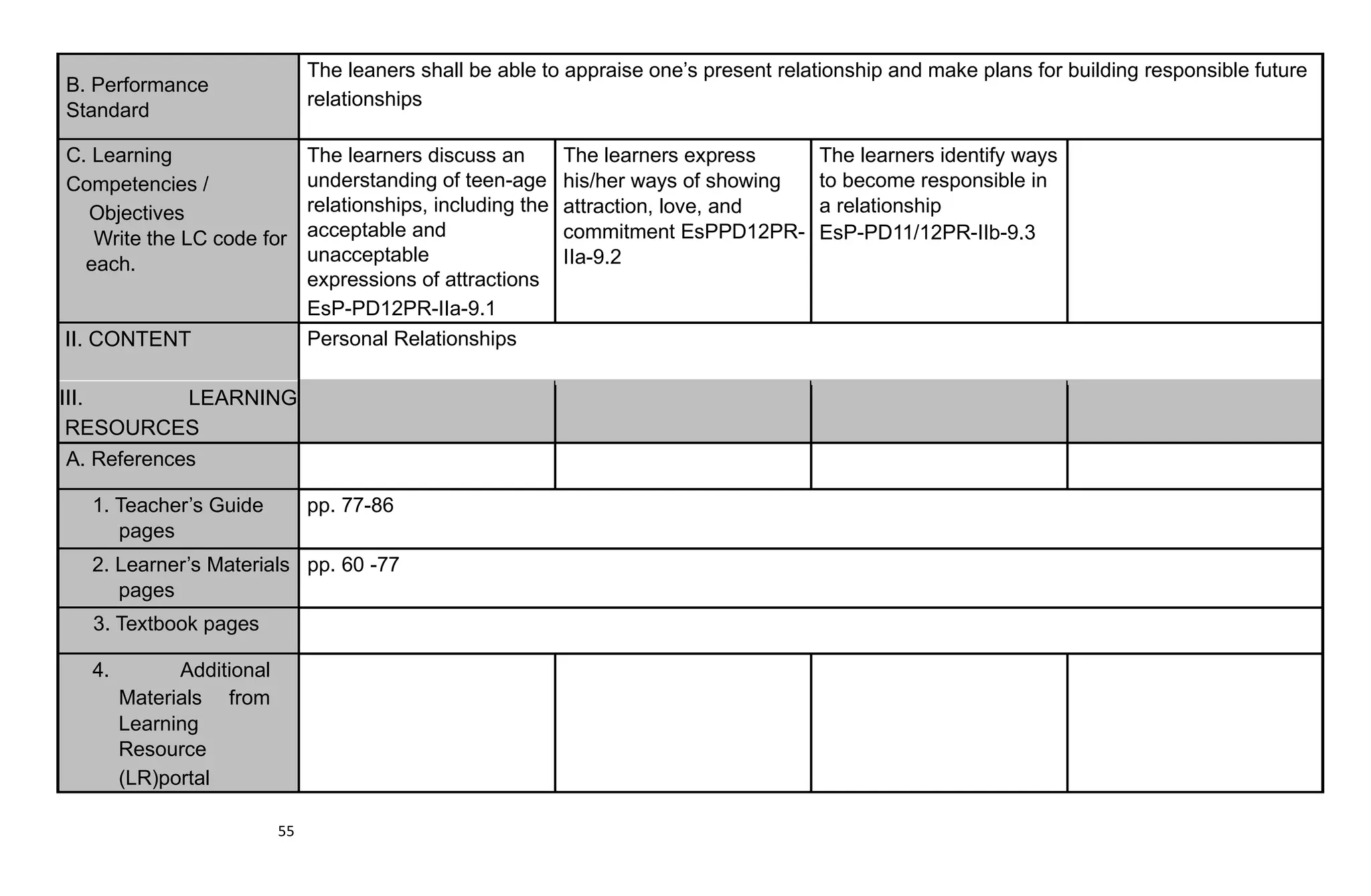
A. Content Standards The learners demonstrate the dynamics of attraction, love, and commitment
55
B. Performance
Standard
The leaners shall be able to appraise one’s present relationship and make plans for building responsible future
relationships
C. Learning
Competencies /
Objectives
Write the LC code for
each.
The learners discuss an
understanding of teen-age
relationships, including the
acceptable and
unacceptable
expressions of attractions
EsP-PD12PR-IIa-9.1
The learners express
his/her ways of showing
attraction, love, and
commitment EsPPD12PR-
IIa-9.2
The learners identify ways
to become responsible in
a relationship
EsP-PD11/12PR-IIb-9.3
II. CONTENT Personal Relationships
III. LEARNING
RESOURCES
A. References
1. Teacher’s Guide
pages
pp. 77-86
2. Learner’s Materials
pages
pp. 60 -77
3. Textbook pages
4. Additional
Materials from
Learning
Resource
(LR)portal
56
B. Other Learning
Resource
IV. PROCEDURES
A. Reviewing
previous lesson or
presenting the new
lesson
Ask the students what they
understand by the
following words/terms:
a. Relationships
Statements on
Relationships (page 60)
Make a statement about
your own point of view,
which is the most
important personal
relationships that you
cherish
b. Personal
relationships
c. Love
d. Commitment
e. Attraction
most.
57
B. Establishing a
purpose for the lesson
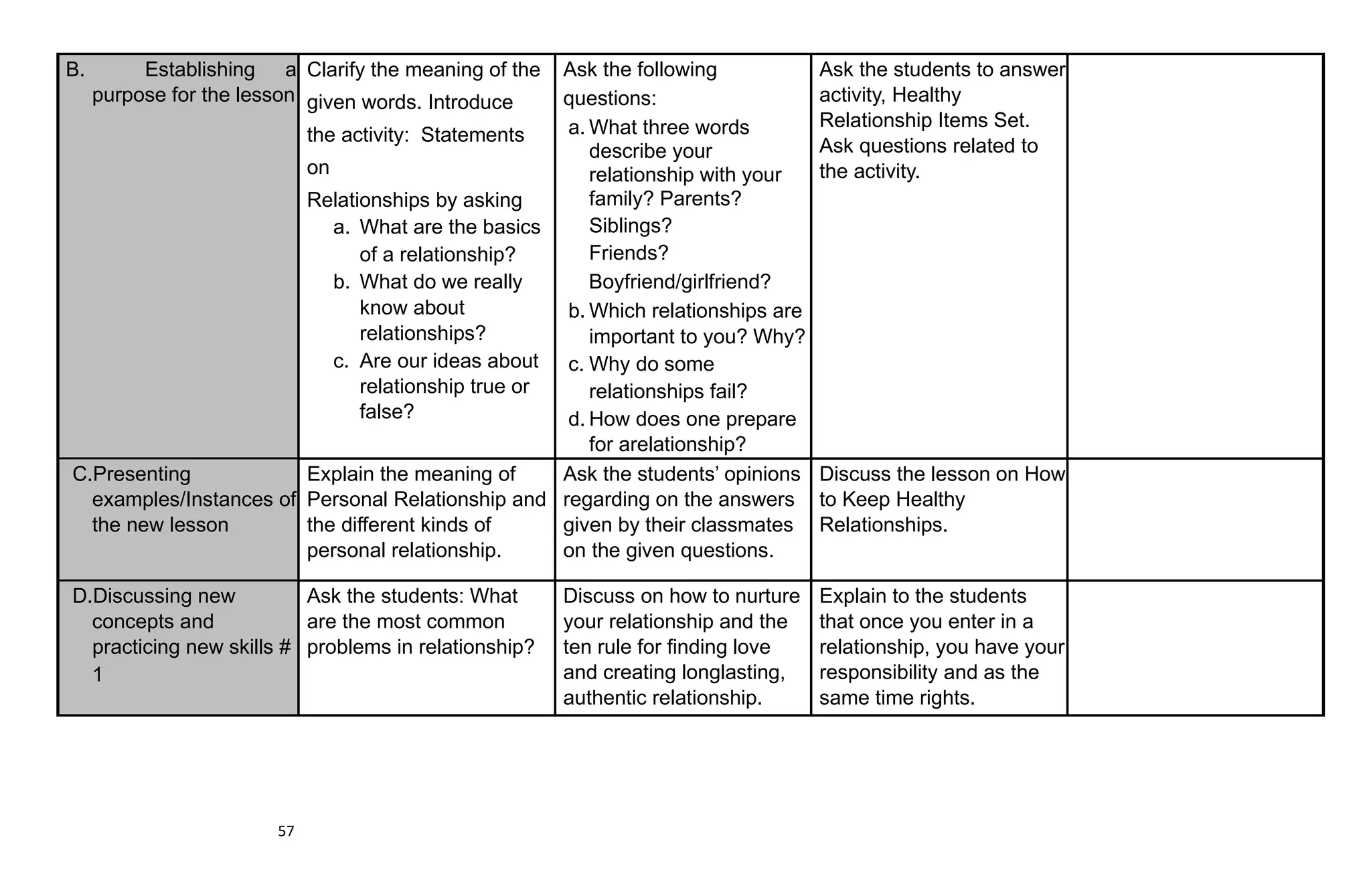
Clarify the meaning of the
given words. Introduce
the activity: Statements
on
Relationships by asking
a. What are the basics
of a relationship?
b. What do we really
know about
relationships?
c. Are our ideas about
relationship true or
false?
Ask the following
questions:
a. What three words
describe your
relationship with your
family? Parents?
Siblings?
Friends?
Boyfriend/girlfriend?
b. Which relationships are
important to you? Why?
c. Why do some
relationships fail?
d. How does one prepare
for arelationship?
Ask the students to answer
activity, Healthy
Relationship Items Set.
Ask questions related to
the activity.
C.Presenting
examples/Instances of
the new lesson
Explain the meaning of
Personal Relationship and
the different kinds of
personal relationship.
Ask the students’ opinions
regarding on the answers
given by their classmates
on the given questions.
Discuss the lesson on How
to Keep Healthy
Relationships.
D.Discussing new
concepts and
practicing new skills #
1
Ask the students: What
are the most common
problems in relationship?
Discuss on how to nurture
your relationship and the
ten rule for finding love
and creating longlasting,
authentic relationship.
Explain to the students
that once you enter in a
relationship, you have your
responsibility and as the
same time rights.
58
E. Discussing new
concepts and
practicing new skills #
2
Explain the basic rights in
a relationship.
F. Developing mastery
(leads to Formative
Assessment 3)
G.Finding practical
application of
concepts and skills in
daily living
Ask the students their own
opinion regarding on how
to keep healthy
relationship and their
rights upon having a
relationship.
H.Making
generalizations and
abstractions about
the lesson
Ask the students why
personal relationship is
important.
Ask them to make their
generalization or reflection
regarding on what have
been discussed.
59
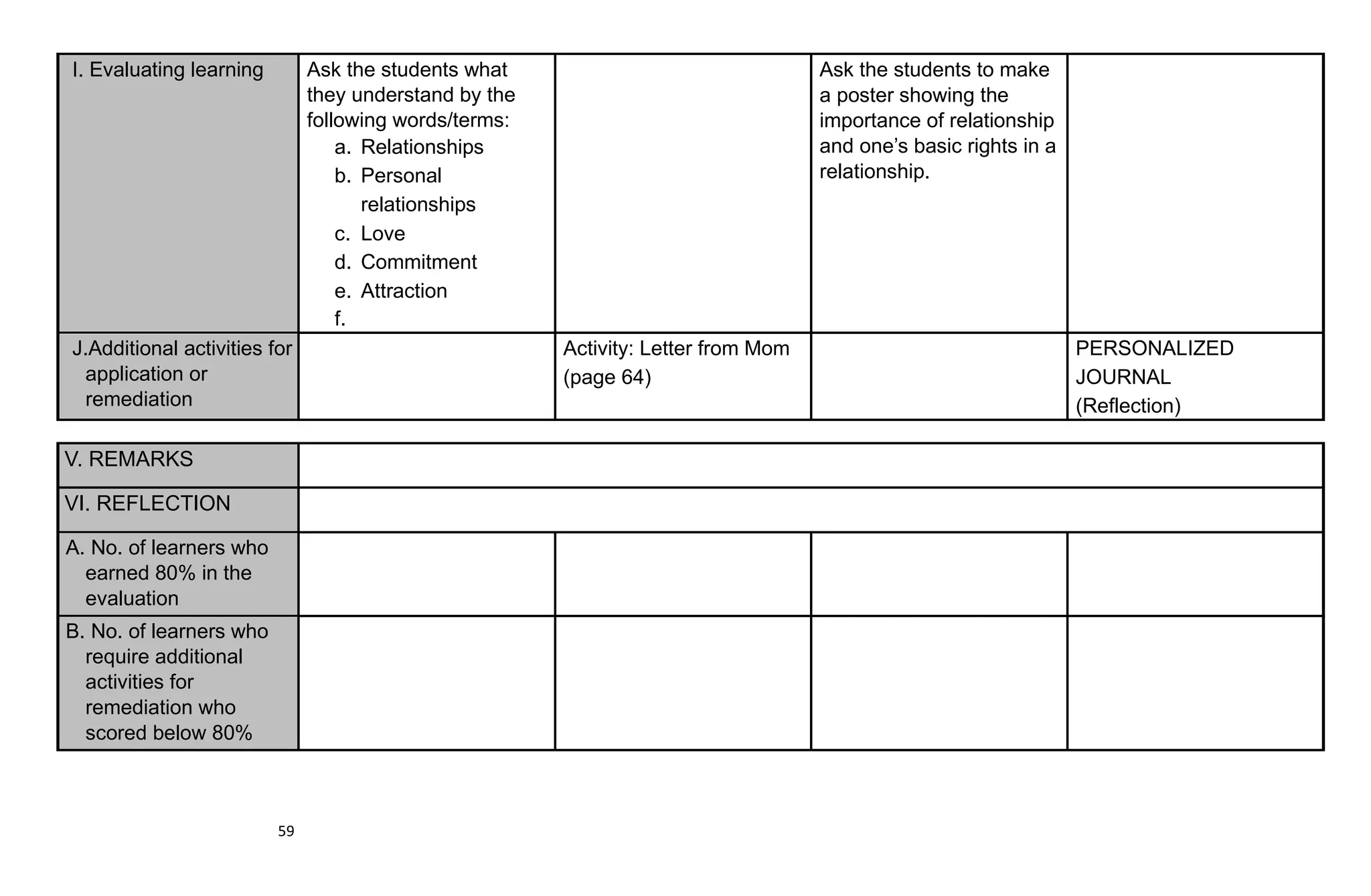
I. Evaluating learning Ask the students what
they understand by the
following words/terms:
a. Relationships
b. Personal
relationships
c. Love
d. Commitment
e. Attraction
f.
Ask the students to make
a poster showing the
importance of relationship
and one’s basic rights in a
relationship.
J.Additional activities for
application or
remediation
Activity: Letter from Mom
(page 64)
PERSONALIZED
JOURNAL
(Reflection)
V. REMARKS
VI. REFLECTION
A. No. of learners who
earned 80% in the
evaluation
B. No. of learners who
require additional
activities for
remediation who
scored below 80%
60
C.Did the remedial
lessons work? No. of
learners who have
caught up with the
lesson
D.No. of learners who
continue to require
remediation
E. Which of my teaching
strategies worked
well?
Why did these work?
F. What difficulties did I
encounter which my
principal or supervisor
can help me solve?
G.What innovation or
localized materials did
I use/discover which I
wish to share with
other teachers?
61
DAY 1 DAY 2 DAY 3 DAY 4
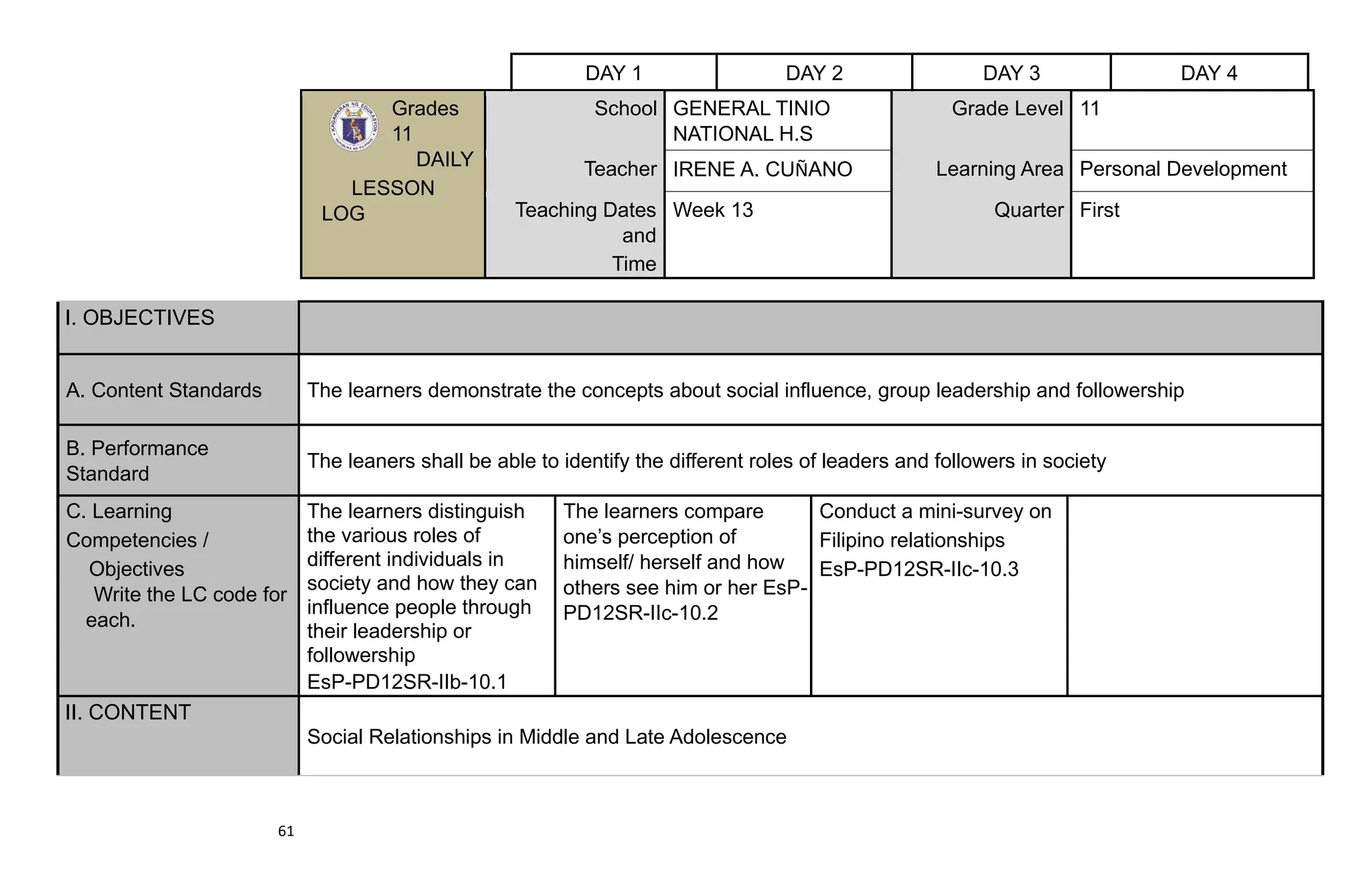
Grades
11
DAILY
LESSON
LOG
School GENERAL TINIO
NATIONAL H.S
Grade Level 11
Teacher IRENE A. CUÑANO Learning Area Personal Development
Teaching Dates
and
Time
Week 13 Quarter First
I. OBJECTIVES
A. Content Standards The learners demonstrate the concepts about social influence, group leadership and followership
B. Performance
Standard
The leaners shall be able to identify the different roles of leaders and followers in society
C. Learning
Competencies /
Objectives
Write the LC code for
each.
The learners distinguish
the various roles of
different individuals in
society and how they can
influence people through
their leadership or
followership
EsP-PD12SR-IIb-10.1
The learners compare
one’s perception of
himself/ herself and how
others see him or her EsP-
PD12SR-IIc-10.2
Conduct a mini-survey on
Filipino relationships
EsP-PD12SR-IIc-10.3
II. CONTENT
Social Relationships in Middle and Late Adolescence
62
III. LEARNING
RESOURCES
A. References
1. Teacher’s Guide
pages
pp. 94 - 102
2. Learner’s Materials
pages
pp. 77 – 83
3. Textbook pages
4. Additional
Materials from
Learning
Resource
(LR)portal
B. Other Learning
Resource
IV. PROCEDURES
A. Reviewing previous
lesson
Ask the students who
among
Start by asking volunteer
or presenting the new
lesson
them are members of a
certain group, organization
or club.
students to read aloud the
fables about leadership
and membership. Ask
them to identify the lesson
each fable is trying to
teach.
63
B. Establishing a
purpose for the lesson
Ask them the following
questions:
1. Why did you choose to
be in that particular
group?
2. What was the biggest
factor that made you
decided to be in that
group?
3. Who decided on your
role in that group?
4. How do you fulfill your
responsibilities in that
group?
5. How do you find the
leader/s of the group?
6.
Ask the students’ insights
regarding on their
knowledge on civic
responsibility.
Ask the students the
following questions:
1. What is a
true leader?
2. How do we know
that a leader is a
true leader?
3. How do we know
that the person we
are following is
worth our trust and
loyalty?
Give the students to the
students to read the
article about Servant
Leadership. Ask them to
share the key points of
the article.
C. Presenting
examples/Instances
of the new lesson
Explain how the society/
community/culture plays a
major role in the life of a
teenager.
Explain to the students
that as a teenager they
can have a big role/
contribution to the
community.
Discuss what the meaning
of leadership and the
different traits of a leader..
Ask them to give their
comments/reactions
regarding on the article.
D. Discussing new
concepts and
practicing new skills #
1
Explain the benefits that
teenagers can get upon
joining a group or
organization
Explain on what they can
get upon involving
themselves in the different
community activities.
Explain to the students
that a leader has his/her
own style in terms of
his/her leadership.
Defend why they agree or
disagree to the article.
64
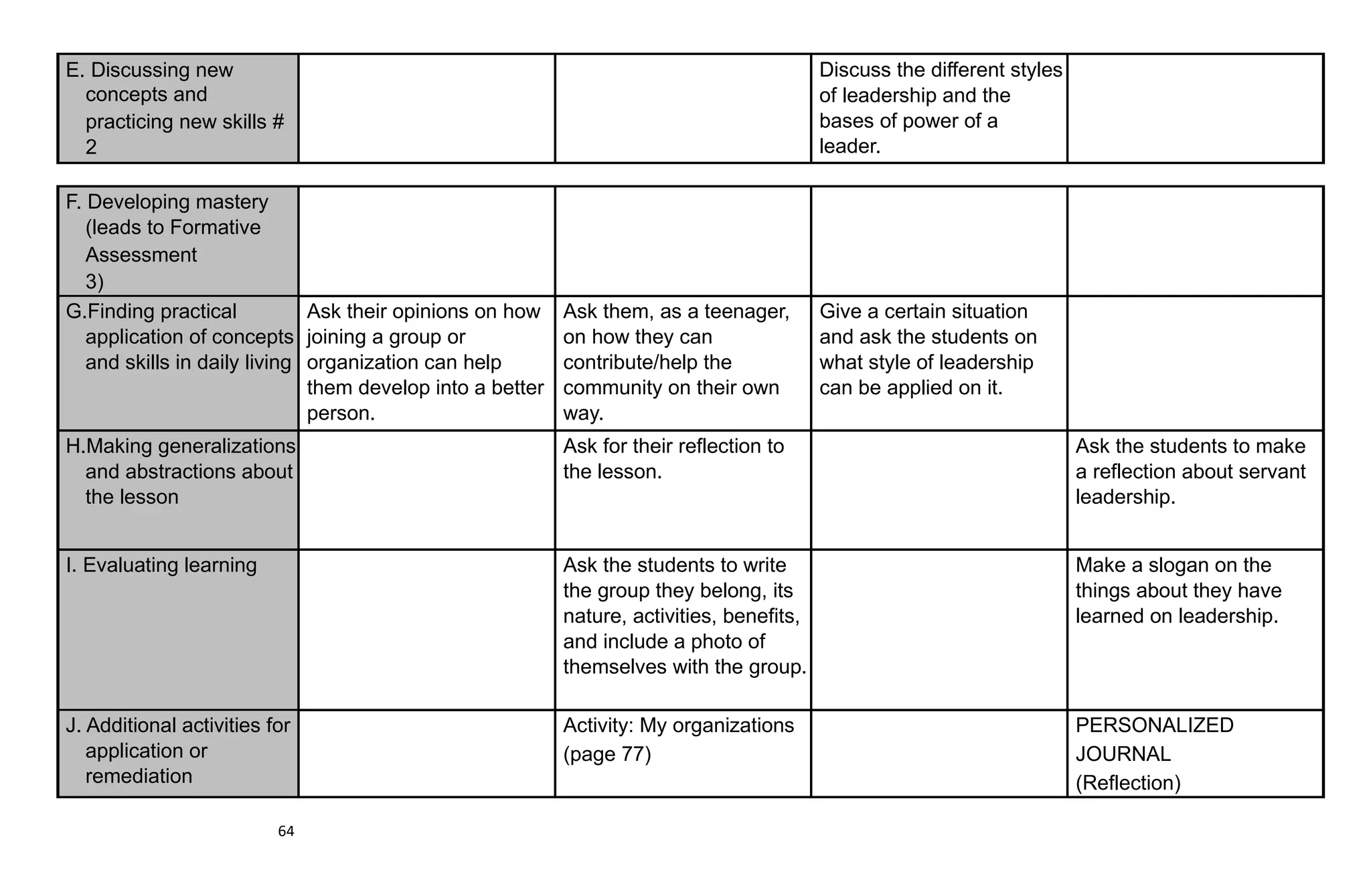
E. Discussing new
concepts and
practicing new skills #
2
Discuss the different styles
of leadership and the
bases of power of a
leader.
F. Developing mastery
(leads to Formative
Assessment
3)
G.Finding practical
application of concepts
and skills in daily living
Ask their opinions on how
joining a group or
organization can help
them develop into a better
person.
Ask them, as a teenager,
on how they can
contribute/help the
community on their own
way.
Give a certain situation
and ask the students on
what style of leadership
can be applied on it.
H.Making generalizations
and abstractions about
the lesson
Ask for their reflection to
the lesson.
Ask the students to make
a reflection about servant
leadership.
I. Evaluating learning Ask the students to write
the group they belong, its
nature, activities, benefits,
and include a photo of
themselves with the group.
Make a slogan on the
things about they have
learned on leadership.
J. Additional activities for
application or
remediation
Activity: My organizations
(page 77)
PERSONALIZED
JOURNAL
(Reflection)
65
V. REMARKS
VI. REFLECTION
A. No. of learners who
earned 80% in the
evaluation
B. No. of learners who
require additional
activities for
remediation who
scored below 80%
C.Did the remedial
lessons work? No. of
learners who have
caught up with the
lesson
D.No. of learners who
continue to require
remediation
E. Which of my teaching
strategies worked
well?
Why did these work?
66
F. What difficulties did I
encounter which my
principal or supervisor
can help me solve?
A. Content Standards The learners demonstrate the concepts about social influence, group leadership and followership
The learners demonstrate the impact of one’s family in his/her personal development during middle and late
adolescence
G.What innovation or
localized materials did
I use/discover which I
wish to share with
other teachers?
Grades 11
DAILY
LESSON
LOG
School GENERAL TINIO NATIONAL
H.S
Grade Level 11
Teacher IRENE A. CUÑANO Learning Area Personal Development
Teaching Dates and
Time
Week 14 Quarter First
DAY 1 DAY 2 DAY 3 DAY 4
I. OBJECTIVES
67
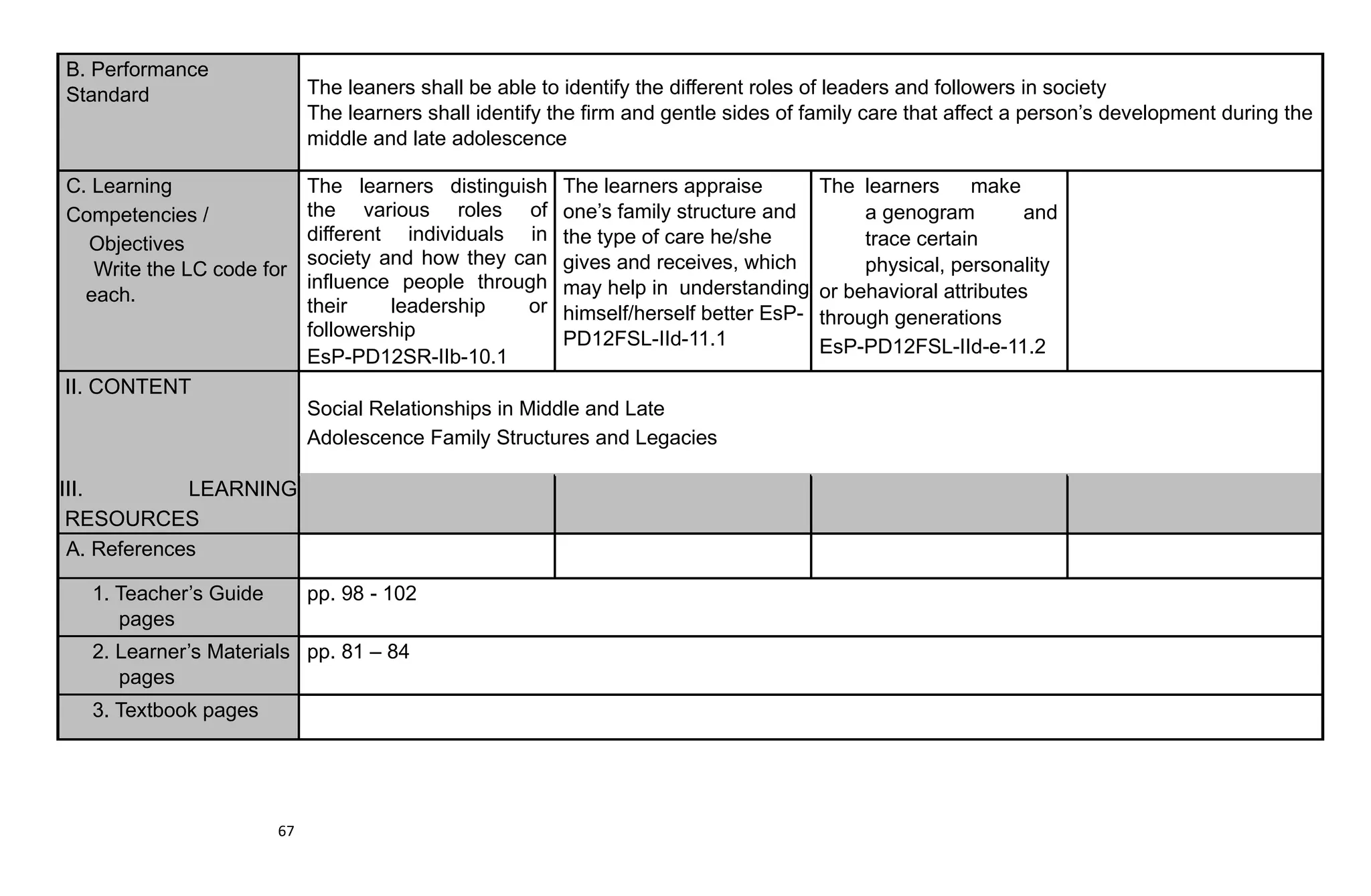
B. Performance
Standard The leaners shall be able to identify the different roles of leaders and followers in society
The learners shall identify the firm and gentle sides of family care that affect a person’s development during the
middle and late adolescence
C. Learning
Competencies /
Objectives
Write the LC code for
each.
The learners distinguish
the various roles of
different individuals in
society and how they can
influence people through
their leadership or
followership
EsP-PD12SR-IIb-10.1
The learners appraise
one’s family structure and
the type of care he/she
gives and receives, which
may help in understanding
himself/herself better EsP-
PD12FSL-IId-11.1
The learners make
a genogram and
trace certain
physical, personality
or behavioral attributes
through generations
EsP-PD12FSL-IId-e-11.2
II. CONTENT
Social Relationships in Middle and Late
Adolescence Family Structures and Legacies
III. LEARNING
RESOURCES
A. References
1. Teacher’s Guide
pages
pp. 98 - 102
2. Learner’s Materials
pages
pp. 81 – 84
3. Textbook pages
68
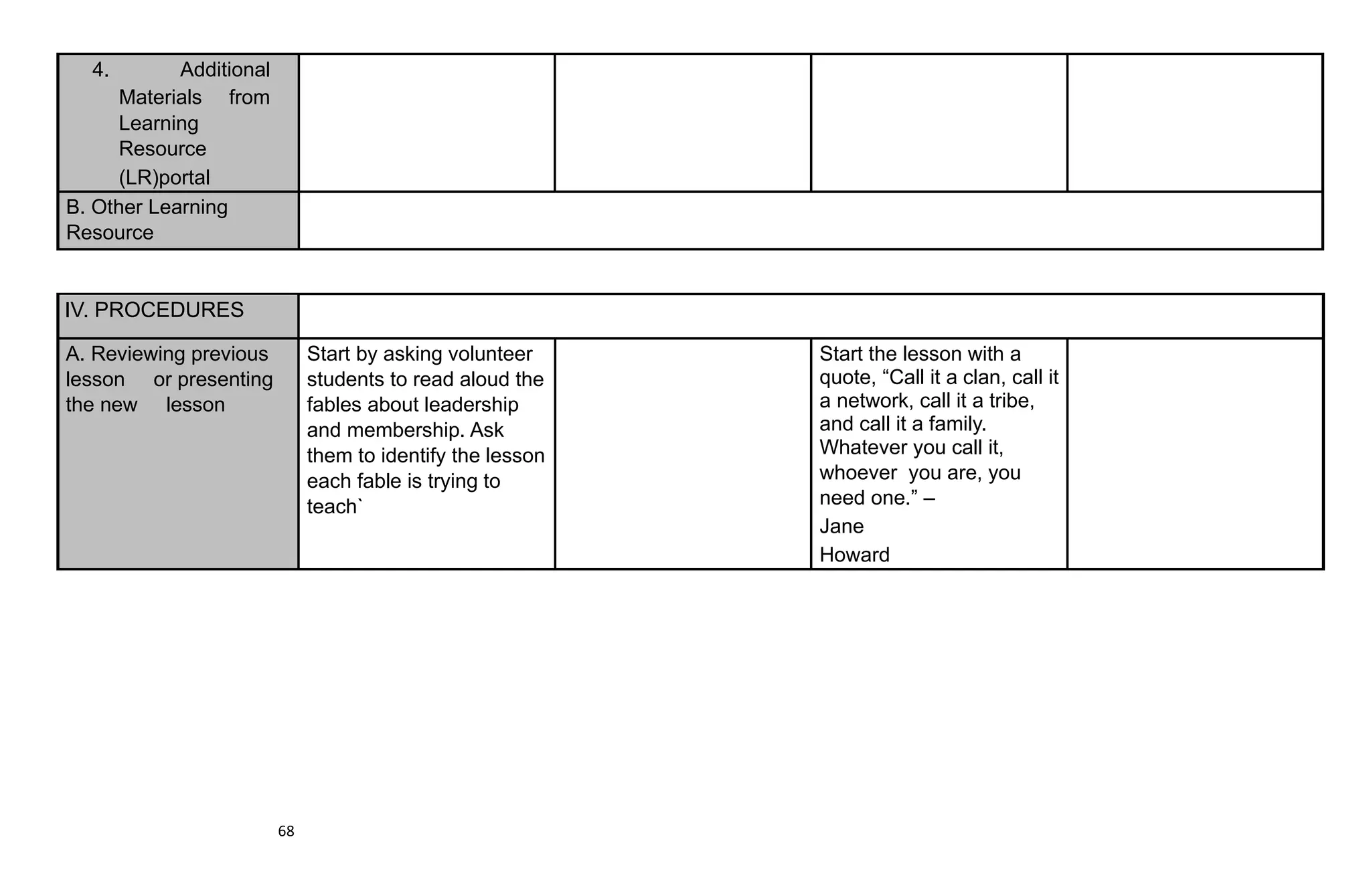
4. Additional
Materials from
Learning
Resource
(LR)portal
B. Other Learning
Resource
IV. PROCEDURES
A. Reviewing previous
lesson or presenting
the new lesson
Start by asking volunteer
students to read aloud the
fables about leadership
and membership. Ask
them to identify the lesson
each fable is trying to
teach`
Start the lesson with a
quote, “Call it a clan, call it
a network, call it a tribe,
and call it a family.
Whatever you call it,
whoever you are, you
need one.” –
Jane
Howard
69
B. Establishing a
purpose for the lesson
Ask the students the
following questions:
1. What is a
true leader?
2. How do we know
that a leader is a
true leader?
3. How do we know
that the person we
are following is
worth our trust and
loyalty?
Let the students read the
article about Servant
Leadership. Ask them to
share the key points of the
article.
Ask the students whether
they agree with Jane
Howard and ask them how
they need their respective
families in their life.
Ask the students if they
have any idea about family
tree and how it is made.
C.Presenting
examples/Instances of
the new lesson
Discuss what the meaning
of leadership and the
different traits of a leader.
Ask them to give their
comments/reactions
regarding on the article.
Ask volunteers to describe
their respective families in
terms of people in their
family, physical set
up/agreement, place of
residence, who
leads/makes decision in
the family.
Show a sample of a family
tree.
D.Discussing new
concepts and
practicing new skills #
1
Explain to the students
that a leader has his/her
own style in terms of
his/her leadership.
Defend why they agree or
disagree to the article.
Discuss the different kinds
of family structures
Explain what is genogram
or family tree making. Ask
them regarding on the
information that they can
gather from a genogram.
70
E. Discussing new
concepts and
practicing new skills #
Discuss the different styles
of leadership and the
bases of
2 power of a leader.
F. Developing mastery
(leads to Formative
Assessment 3)
Instruct the students to
make their own genogram.
G.Finding practical
application of concepts
and skills in daily living
Give a certain situation
and ask the students on
what style of leadership
can be applied on it.
H.Making generalizations
and abstractions about
the lesson
I. Evaluating learning Make a slogan on the
things about what they
have learned on
leadership.
Have the students write a
poem about their
respective families using
the guidelines for the
Based on their genogram,
identify which among the
family structures their
family belongs and explain
why.
activity “POEM WRITING”.
71
J. Additional activities for
application or
remediation
Bring art materials
tomorrow.
PERSONALIZED
JOURNAL
(Reflection)
V. REMARKS
VI. REFLECTION
A. No. of learners who
earned 80% in the
evaluation
B. No. of learners who
require additional
activities for
remediation who
scored below 80%
C.Did the remedial
lessons work? No. of
learners who have
caught up with the
lesson
D.No. of learners who
continue to require
remediation
E. Which of my teaching
strategies worked
well?
72
Why did these work?
F. What difficulties did I
encounter which my
principal or supervisor
can help me solve?
G.What innovation or
localized materials did
I use/discover which I
wish to share with
other teachers?
Grades 11
DAILY
LESSON
LOG
School GENERAL TINIO NATIONAL
H.S
Grade Level 11
Teacher IRENE A. CUÑANO Learning Area Personal Development
Teaching Dates and
Time
Week 15 Quarter First
DAY 1 DAY 2 DAY 3 DAY 4
I. OBJECTIVES
A. Content Standards
The learners demonstrate the impact of one’s family on his/her personal development during middle and late
adolescence
73
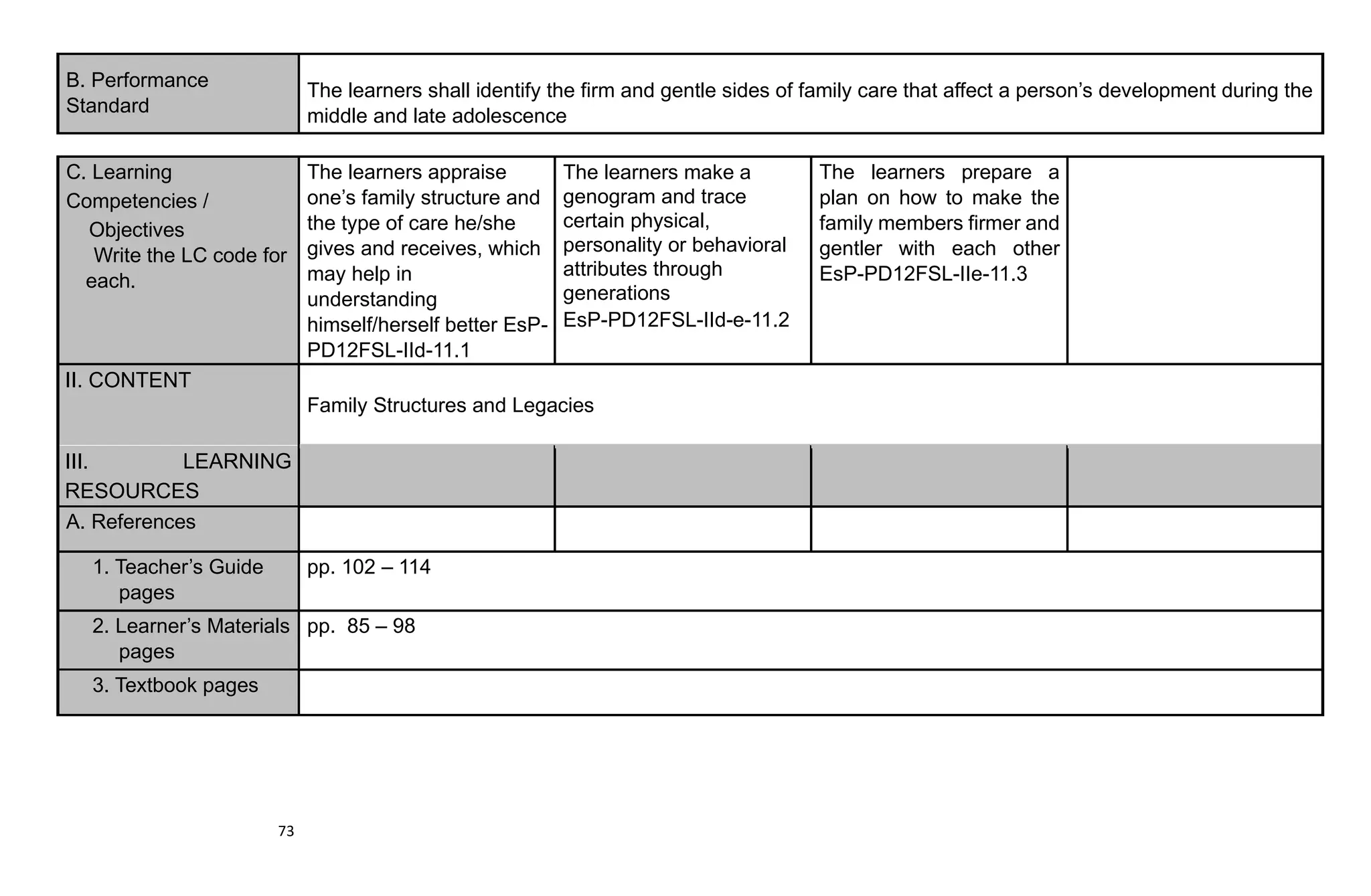
B. Performance
Standard
The learners shall identify the firm and gentle sides of family care that affect a person’s development during the
middle and late adolescence
C. Learning
Competencies /
Objectives
Write the LC code for
each.
The learners appraise
one’s family structure and
the type of care he/she
gives and receives, which
may help in
understanding
himself/herself better EsP-
PD12FSL-IId-11.1
The learners make a
genogram and trace
certain physical,
personality or behavioral
attributes through
generations
EsP-PD12FSL-IId-e-11.2
The learners prepare a
plan on how to make the
family members firmer and
gentler with each other
EsP-PD12FSL-IIe-11.3
II. CONTENT
Family Structures and Legacies
III. LEARNING
RESOURCES
A. References
1. Teacher’s Guide
pages
pp. 102 – 114
2. Learner’s Materials
pages
pp. 85 – 98
3. Textbook pages
74
4. Additional
Materials from
Learning
Resource
(LR)portal
B. Other Learning
Resource
IV. PROCEDURES
A. Reviewing previous
lesson or presenting
the new lesson
Start the lesson with a
quote, “Call it a clan, call it
a network, call it a tribe,
and call it a family.
Start the lesson by letting
the students to answer
the Activity:
EMOTIONAL, SOCIAL
AND
Whatever you call it,
whoever you are, you
need one.” – Jane
Howard
SPIRITUAL LEGACY on
page 91.
B. Establishing a
purpose for the lesson
Ask the students whether
they agree with Jane
Howard and ask them how
they need their respective
families in their life.
Ask the students if they
have any idea about family
tree and how it is made.
Ask the students regarding
on their ideas about the
importance of our families.
Explain to the class the
results of their activity.
Emphasize to them that as
a family, there is a
particular legacy that has
been passed from one
generation to another.
75
C.Presenting
examples/Instances of
the new lesson
Ask volunteers to describe
their respective families in
terms of people in their
family, physical set
up/agreement, place of
residence, who
leads/makes decision in
the family.
Show a sample of a family
tree.
Introduce the reading on
Inspiring Stories of
Families.
Ask the students to share
the attitudes, beliefs or
values, which they have
learned from their family.
D.Discussing new
concepts and
practicing new skills #
1
Discuss the different kinds
of family structures
Explain what is genogram
or family tree making. Ask
them regarding on the
information that they can
gather from a genogram.
Based on the reading,
remind them on the
sacrifices our individual
family does for us.
Discuss the lesson on
Family Legacies.
E. Discussing new
concepts and
practicing new skills #
2
F. Developing mastery
(leads to Formative
Assessment 3)
Instruct the students to
make their own genogram.
G.Finding practical
application of concepts
and
skills in daily living
76
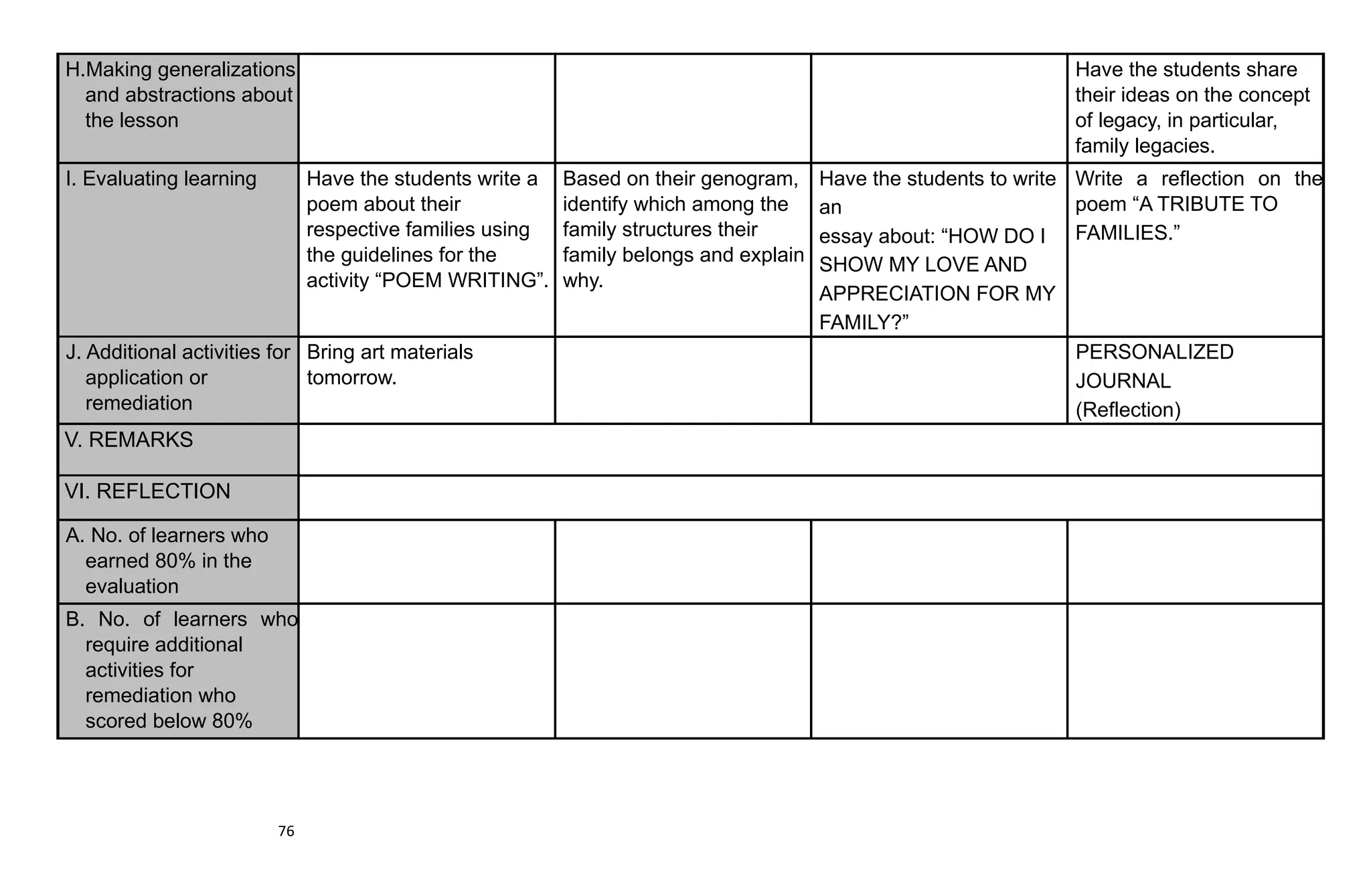
H.Making generalizations
and abstractions about
the lesson
Have the students share
their ideas on the concept
of legacy, in particular,
family legacies.
I. Evaluating learning Have the students write a
poem about their
respective families using
the guidelines for the
activity “POEM WRITING”.
Based on their genogram,
identify which among the
family structures their
family belongs and explain
why.
Have the students to write
an
essay about: “HOW DO I
SHOW MY LOVE AND
APPRECIATION FOR MY
FAMILY?”
Write a reflection on the
poem “A TRIBUTE TO
FAMILIES.”
J. Additional activities for
application or
remediation
Bring art materials
tomorrow.
PERSONALIZED
JOURNAL
(Reflection)
V. REMARKS
VI. REFLECTION
A. No. of learners who
earned 80% in the
evaluation
B. No. of learners who
require additional
activities for
remediation who
scored below 80%
77
C.Did the remedial
lessons work? No. of
learners who have
caught up with the
lesson
D.No. of learners who
continue to require
remediation
E. Which of my teaching
strategies worked
well?
Why did these work?
F. What difficulties did I
encounter which my
principal or supervisor
can help me solve?
G.What innovation or
localized materials did
I use/discover which I
wish to share with
other teachers?
Grades 11
DAILY
LESSON
LOG
School GENERAL TINIO NATIONAL
H.S
Grade Level 11
Teacher IRENE A.CUÑANO Learning Area Personal Development
Teaching Dates and
Time
Week 16 Quarter First
78
DAY 1 DAY 2 DAY 3 DAY 4
I. OBJECTIVES
A. Content Standards
The learners demonstrate concepts of career development, life goals, and personal factors influencing career
choice
B. Performance
Standard
The learners shall identify the external factors influencing career choices
C. Learning
Competencies /
Objectives
Write the LC code for
each.
The learners explain that
through understanding of
the concepts of career
and life goals can help in
planning his/her career
EsP-PD12PC-IIf-12.1
The learners identify
the personal factors
influencing career
choices. to his/her
goals
EsP-PD12PC-IIf-12.2
The learners take
selfassessment tool to
know his/her personality
traits and other personal
factors in relation
EsP-PD12PC-IIg-12.3
II. CONTENT Persons and Careers
III. LEARNING
RESOURCES
A. References
1. Teacher’s Guide
pages
pp. 115 - 124
2. Learner’s Materials
pages
pp. 99 - 118
79
3. Textbook pages
4. Additional
Materials from
Learning
Resource
(LR)portal
B. Other Learning
Resource
IV. PROCEDURES
A. Reviewing previous
lesson or presenting
the new lesson
Ask the class “Para
kanino ka bumabangon
sa umaga?”
Connect this tagline to the
purpose of life.
Before the class begins,
have an illustration of a
career wheel.
B. Establishing a
purpose for the lesson
Do the Motivation: Agree
or Disagree. Explain to
the class
Introduce the activity by
saying “One’s career is
the roadmap
Ask the students
differentiate/define
following
to
the
Explain
concept
time and
its
on how
changes
selfover
that the objective of this
game is about the
common
misconception and facts
about career planning.
that you follow through
your lifetime.” Ask for the
insights of the students on
this statement.
terms
1. Career
2. Job
3. Occupation
importance when planning
your career.
80
C.Presenting
examples/Instances of
the new lesson
Emphasize to the students
that some of the most
important decisions we
make in our lifetime
concern our career.
Tell the students to copy
the career wheel on a
sheet of blank paper.
Elaborate the meaning of
the term “career”.
Differentiate Job from
Occupation.
Introduce Super’s Career
Development Theory.
D.Discussing new
concepts and
practicing new skills #
1
Explain the ten myths
about career planning.
In the labelled circles, ask
them to identify the place
events, situations, needs
and facts that can affect
their decisions when it
comes to choosing their
career in the future.
Ask the students regarding
on the different factors that
can influence career
choice.
Explain the Five Life and
career Development
Stages according to
Super.
E. Discussing new
concepts and
practicing new skills #
2
Explain the different
theories on what influence
your career choice.
Explain the different
developmental task at the
different stages
F. Developing mastery
(leads to Formative
Assessment 3)
Ask them to firm a dyad or
triad so that they can
share what they have
written on their career
wheels.
G.Finding practical
application of concepts
and skills in daily living
Ask the students:
“Looking at these many
facets in your life, which
among do you think are
major considerations when
deciding on future career
options?”
Ask the students on how
they can apply Super’s
Career Development
Theory in choosing their
career.
81
H.Making generalizations
and abstractions about
the lesson
Ask their opinions on what
have been discussed.
Ask them regarding on
their realizations.
Ask the students to
summarize the discussion
I. Evaluating learning Ask them to answer this
question:
“What or who influenced
you in making decision
when it comes to
choosing your course in
college? Explain your
answer”
J. Additional activities for
application or
remediation
PERSONALIZED
JOURNAL
(Reflection)
V. REMARKS
VI. REFLECTION
82
A. No. of learners who
earned 80% in the
evaluation
B. No. of learners who
require additional
activities for
remediation who
scored below 80%
C.Did the remedial
lessons work? No. of
learners who have
caught up with the
lesson
D.No. of learners who
continue to require
remediation
E. Which of my teaching
strategies worked
well?
Why did these work?
F. What difficulties did I
encounter which my
principal or supervisor
can help me solve?
83
G.What innovation or
localized materials did
I use/discover which I
wish to share with
other teachers?
84
DAY 1 DAY 2 DAY 3 DAY 4
Grades
11
DAILY
LESSON
LOG
School GENERAL TINIO
NATIONAL H.S
Grade Level 11
Teacher JENNA DL. SERRANO Learning Area Personal Development
Teaching Dates
and
Time
Week 17 & 18 Quarter First
I. OBJECTIVES
A. Content Standards The learners demonstrate an understanding of the external factors influencing career choices
B. Performance
Standard
The learners shall be able to make a career plan based on his/her personal goal, and external factors
influencing career choices
C. Learning
Competencies /
Objectives
Write the LC code for
each.
The learners discuss the
external factors
influencing career choices
that may help in career
decision making
EsPPD11/12CP-IIg-13.1
The learners identify pros
and cons of various career
options with the guidance
of parent, teacher, or
counselor
EsP-PD11/12CP-IIh-13.2
The learners prepare a
career plan based on
his/her personal goal and
external factors
influencing career choices
EsP-PD11/12CP-IIh-i-13.3
II. CONTENT
Career Pathways
III. LEARNING
RESOURCES
85
A. References
1. Teacher’s Guide
pages
pp.99 - 113
2. Learner’s Materials
pages
pp.138 - 150
3. Textbook pages
4. Additional
Materials from
Learning
Resource
(LR)portal
B. Other Learning
Resource
IV. PROCEDURES
A. Reviewing previous
lesson or presenting
the new lesson
How do personal /internal
factors influence your
career choices?
Discuss ten myths about
career planning busted
B. Establishing a
purpose for
the lesson
C.Presenting
examples/Instances of
the new lesson
Career concepts What influences your
career choice?
86
D.Discussing new
concepts and
practicing new skills #
1
Let the students make
their own career wheel.
E. Discussing new
concepts and
practicing new skills #
2
Portfolio output Skills assessment
worksheet
F. Developing mastery
(leads to Formative
Assessment
3)
Making a Career Bucket
List
Panel Discussion Career Concept
G.Finding practical
application of concepts
and skills in daily living
Students identify the
personal factors
influencing career choices
and self-assessment
Students know their
personality traits and other
personal factors in relation
to their goals
H.Making generalizations
and abstractions about
the lesson
Ask them to make their
generalization or reflection
regarding on what have
been discussed.
I. Evaluating learning Group activity (career
interest)
Individual activity
(personality test)
The quick job-hunting map
J. Additional activities for
application or
remediation
Individual projects PERSONALIZED
JOURNAL
(Reflection)
87
V. REMARKS
VI. REFLECTION
A. No. of learners who
earned 80% in the
evaluation
B. No. of learners who
require
88
additional activities for
remediation who
scored below 80%
C.Did the remedial
lessons work? No. of
learners who have
caught up with the
lesson
D.No. of learners who
continue to require
remediation
E. Which of my teaching
strategies worked
well?
Why did these work?
F. What difficulties did I
encounter which my
principal or supervisor
can help me solve?
G.What innovation or
localized materials did
I use/discover which I
wish to share with
other teachers?
89
DAY 1 DAY 2 DAY 3 DAY 4
Grades
11
DAILY
LESSON
LOG
School GENERAL TINIO
NATIONAL H.S
Grade Level 11
Teacher JENNA DL. SERRANO Learning Area Personal Development
Teaching Dates
and
Time
Week 19 & 20 Quarter First
I. OBJECTIVES
A. Content Standards
The learners demonstrate an understanding of his/her personal development as an important component of
setting career and life goals
B. Performance
Standard The learners shall be able to analyze and synthesize his/her personal development as an important component
of setting career and life goals
C. Learning
Competencies /
Objectives
Write the LC code for
each.
The learners explain the
factors in personal
development that may
guide him/her in making
important career
decisions as adolescents
EsP-PD11/12IOPD-IIi14.1
The learners share
insights that make him/her
realize the importance of
personal development in
making a career decision
as adolescent EsP-
PD11/12IOPD-IIi-h-14.2
The learners construct a
creative visualization of
his/her personal
development through of
the various stages he/she
went through, stressors,
influences, and
decisionmaking points,
and a personal profile
analysis
EsP-PD11/12IOPD-IIj14.3
90
II. CONTENT Insights into One’s Personal Development
III. LEARNING
RESOURCES
A. References
1. Teacher’s Guide
pages
pp. 151 - 156
2. Learner’s Materials
pages
pp. 130 - 131
3. Textbook pages
4. Additional
Materials from
Learning
Resource
(LR)portal
B. Other Learning
Resource
IV. PROCEDURES
A. Reviewing
previous lesson or
presenting the new
lesson
Why is personal
development an important
component of setting
career in life goals?
What is a personal mission
statement?
91
B. Establishing a purpose
for the lesson
Share insights that make
students realize the
importance of personal
development in making a
career decision as
adolescence.
C.Presenting
examples/Instances of
the new lesson
Introduce the last module
by stating: Brazilian author
Paolo Coelho, in his book
“The Alchemist”,
introduced the idea of
one’s Personal Legend as
“what you have always
wanted to accomplished.”
D.Discussing new
concepts and
practicing new skills #
1
Create Personal Mission
Statement
Portfolio output –
Personal development:
Hindsight and Foresight.
E. Discussing new
concepts and
practicing new skills #
2
Career map Making a Career Bucket
List
5-year Career Planning (6
months’ goal plan)
F. Developing mastery
(leads to Formative
Assessment
3)
Futuristic Writing (How do
you see Myself 5 years
from now?)
92
G.Finding practical
application of concepts
and skills in daily living
Students can clarify their
own life goals and
aspirations
H.Making generalizations
and abstractions about
the
Write an essay on your
journey through this course
on Personal
lesson Development.
How have you change
since the beginning of this
semester? What have you
learned about yourself?
I. Evaluating learning
J. Additional activities for
application or
remediation
PERSONALIZED
JOURNAL
(Reflection)
V. REMARKS
VI. REFLECTION
A. No. of learners
who earned 80% in
the evaluation
93
B. No. of learners who
require additional
activities for
remediation who
scored below 80%
C.Did the remedial
lessons work? No. of
learners who have
caught up with the
lesson
D.No. of learners who
continue to require
remediation
E. Which of my teaching
strategies worked
well?
Why did these work?
F. What difficulties did I
encounter which my
principal or supervisor
can
help me solve?
94
G.What innovation or
localized materials did
I use/discover which I
wish to share with
other teachers?

PERSONAL DEVELOPMENT LESSON PLAN COMPLETE.pdf

  • 1.
    1 Grades 11 DAILY LESSON LOG School GENERALTINIO NATIONAL H.S Grade Level 11 Teacher MARY ANN J. ROMERO Learning Area Personal Development Teaching Dates and Time Week 1 Quarter First
  • 2.
  • 3.
    3 B. Other Learning Resource IV.PROCEDURES A. Reviewing previous lesson or presenting the new lesson ORIENTATION 1. Classroom Rules 2. Talk about the Course Personal Development, its content and objectives 3. Discuss the requirements needed for Personal Development. Ask the students to answer the Self-Concept Inventory. Tell the students that the best way to develop oneself is to express their talents and gifts in a way they enjoy. Provide ”My Banner – The Treasure Within Me” activity to the students B. Establishing purpose for lesson a the Group the class into 5-6 groups. Ask them to prepare a talent show to be presented on the third session. Ask the students to give their insight regarding on the previous activity. Emphasize to them that the purpose of the activity is determining on how they see themselves. Ask the students to perform their prepared talent. After the performance, the students need to give their qualitative comments. Explain to the students on how the previous activities help them in determining all the positive things that happened to them or the positive attributes that they have. C.Presenting examples/instances of the new lesson Show some pictures to the class. Let them describe the picture. Discuss what Selfconcept is. Explain to the students that the said performance displays the talents of the students and make use all their personal resources. Explain the importance of knowing what your strengths are and identifying your weaknesses.
  • 4.
    4 D.Discussing new concepts and practicingnew skills # 1 Let the student imagine himself/herself to who and what he/she want to be and the “real” him/her. Discuss Personal Effectiveness. Discuss the SWOT Analysis. E. Discussing new concepts Discuss the difference between Emphasize that as individuals, and practicing new skills # 2 actual self and ideal self. we have our own talents, skills and abilities. Discuss on how to develop these talents, skills and abilities. F. Developing mastery (leads to Formative Assessment 3) Discuss self-image. G.Finding practical application of concepts and skills in daily living Emphasize to the students the importance of knowing who and what you are when it comes to dealing with self and other people. H.Making generalizations and abstractions about the lesson Ask the students to right their insights and realizations in their journals. Ask the students to write their reflections regarding on their banner.
  • 5.
    5 I. Evaluating learningThe students must have at least 3 things that they can do in order for them to improve themselves. Ask the students to identify two (2) skills they already have and two (2) they want to develop. Write three (3) ways for them to improve on each of their identified skills. Let the students to create their Personal SWOT Analysis J. Additional activities for application or remediation Ask the students to bring the following: a. Clear book Remind the students to prepare for their talent show to be presented tomorrow. PERSONALIZED JOURNAL (Reflection) V. REMARKS VI. REFLECTION A. No. of learners who earned 80% in the evaluation B. No. of learners who require additional activities for remediation who scored below 80% C. Did the remedial lessons work? No. of learners who have caught up with the lesson
  • 6.
    6 LOG Teaching Datesand Time Week 2 Quarter First D. No. of learners who continue to require remediation E. Which of my teaching strategies worked well? Why did these work? F. What difficulties did I encounter which my principal or supervisor can help me solve? G. What innovation or localized materials did I use/discover which I wish to share with other teachers? Grades 11 DAILY LESSON School GENERAL TINIO NATIONAL H.S Grade Level 11 Teacher MARY ANN J. ROMERO Learning Area Personal Development
  • 7.
  • 8.
    8 IV. PROCEDURES A. Reviewingprevious lesson or presenting the new lesson Tell the students that the best way to develop oneself is to express their talents and gifts in a way they enjoy. Present an article of Bo Sanchez entitled “You Need to Take Charge of Your Future” to the students. Ask the students to assess their own beliefs about holistic development Present stories to the class and ask them to identify the factors that may lead a person to succeed. B. Establishing a purpose for the lesson Ask the students to perform their prepared talent. After the performance, the students need to give their qualitative comments. Ask them to give their insights regarding on the article. Ask the students to draw a circle on a blank sheet of paper and divide the circle into 8 segments. In each segment, they will write some descriptions of the different aspects of themselves. Ask questions which are related to the stories. Highlights the good qualities by letting the students identify the characteristics, right decisions and perspective these individuals exemplify C.Presenting examples/Instances of the new lesson Explain to the students that the said performance displays the talents of the students and make use all their personal resources. Explain the importance of journal writing Explain the different aspects of development. Show so some emoticons and identify the emotion that is being shown by each emotion. D.Discussing new concepts and practicing new skills # 1 Discuss Personal Effectiveness. Remind students that holistic development is not overnight project but instead I must be seen as a lifelong project a person has to undertake. Discuss what emotion is. Provide examples
  • 9.
    9 E. Discussing new conceptsand practicing new skills # 2 Emphasize that as individuals, we have our own talents, skills and abilities. Discuss on how to develop these talents, skills and abilities. Explain on how selfconcept is connected to the different aspects of development Emphasize to the students the difference between emotion and feeling. F. Developing mastery (leads to Formative Assessment 3) Explain on how feelings and emotions can affect attitude. G.Finding practical application of concepts and skills in daily living Ask the students to have a personal journal and give some guiding questions to answer on writing entries on their journal. Present real life situation on how giving much attention on a certain aspect can affect other aspects of development. Provide real life examples on how emotions, feelings and attitude can affect your mood H.Making generalizations and abstractions about the lesson I. Evaluating learning Ask the students to identify two (2) skills they already have and two (2) they want to develop. Write three (3) ways for them to improve on each of their identified skills. Write about the eight aspects of development. Ask them to name ways in which they can improve the minus areas and enhance the positive aspects.
  • 10.
    10 J. Additional activitiesfor application or remediation PERSONALIZED JOURNAL (Reflection) V. REMARKS VI. REFLECTION A. No. of learners who earned 80% in the evaluation B. No. of learners who require additional activities for remediation who scored below 80% C.Did the remedial lessons work? No. of learners who have caught up with the lesson D.No. of learners who continue to require remediation E. Which of my teaching strategies worked well? Why did these work?
  • 11.
    11 F. What difficultiesdid I encounter which my principal or supervisor can help me solve? G.What innovation or localized materials did I use/discover which I wish to share with other teachers? LOG Teaching Dates and Time Week 3 Quarter First I. OB JE CT IV ES Grades 11 DAILY LESSON School GENERAL TINIO NATIONAL H.S Grade Level 11 Teacher MARY ANN J. ROMERO Learning Area Personal Development DAY 1 DAY 2 DAY 3 DAY 4
  • 12.
    12 A. Co nte nt Sta nd ard s The learners demonstrate an understandingof the various aspects of holistic development: physiological, cognitive, psychological, spiritual, and social development B. Per for ma nc e Sta nd ard The learners shall be able to illustrate the connections between thoughts, feelings, and behaviors in a person’s holistic development
  • 13.
    13 C. Learning Competencies / Objectives Writethe LC code for each. The learners discuss the relationship among physiological, spiritual, and social development to understand his/her thoughts, feelings and behaviors EsPPD11/12DWP-Ib-2.1 The learners evaluate his/her own thoughts, feelings and behaviors EsP-PD11/12DWP-Ib-2.2 The learners show the connections between thoughts, feelings, and behaviors in actual life situation EsP-PD11/12DWP-Ic-2.3 II. CONTENT Developing the Whole Person III. LEARNING RESOURCES A. References 1. Teacher’s Guide pages Personal Development Teacher’s Guide, pp. 9 – 18 2. Learner’s Materials pages Personal Development Learner’s Materials, pp. 10 3. Textbook pages Personal Development Ricardo Rubio Santos, pp. 24 – 33 4. Additional Materials from Learning Resource (LR)portal B. Other Learning Resource
  • 14.
    14 IV. PROCEDURES A. Reviewingprevious lesson or presenting the new lesson Ask the students to assess their own beliefs about holistic development Present stories to the class and ask them to identify the factors that may lead a person to succeed. Ask the students to work as a group and give their own definition of success to the class. Allow them to present their work to the class. B. Establishing a purpose for the lesson Ask the students to draw a circle on a blank sheet of paper and divide the circle into 8 Ask questions which are related to the stories. Highlights the good qualities by letting the Let them read a story and ask them to give their interpretation on what they have read. segments. In each segment, they will write some descriptions of the different aspects of themselves. students identify the characteristics, right decisions and perspective these individuals exemplify. C.Presenting examples/Instances of the new lesson Explain the different aspects of development. Show so some emoticons and identify the emotion Explain on how emotions, feelings and thoughts related to success that is being shown by each emotion.
  • 15.
    15 D.Discussing new concepts and practicingnew skills # 1 Remind students that holistic development is not overnight project but instead I must be seen as a lifelong project a person has to undertake. Discuss what emotion is. Provide examples Present a sample of Personal Recipe of Success. E. Discussing new concepts and practicing new skills # 2 Explain on how selfconcept is connected to the different aspects of development Emphasize to the students the difference between emotion and feeling. F. Developing mastery (leads to Formative Assessment 3) Explain on how feelings and emotions can affect attitude. G.Finding practical application of concepts and skills in daily living Present real life situation on how giving much attention on a certain aspect can affect other aspects of development. Provide real life examples on how emotions, feelings and attitude can affect your mood Ask some questions about the story they have read and relate it to real life. H.Making generalizations and abstractions about the lesson Let the students give their insights on how to be successful. I. Evaluating learning Write about the eight aspects of development. Ask them to name ways in which they can Students will have to make their own recipe for success.
  • 16.
    16 improve the minusareas and enhance the positive aspects. J. Additional activities for application or remediation Ask the students to bring bond paper and coloring materials. PERSONALIZED JOURNAL (Reflection) V. REMARKS VI. REFLECTION A. No. of learners who earned 80% in the evaluation B. No. of learners who require additional activities for remediation who scored below 80% C.Did the remedial lessons work? No. of learners who have caught up with the lesson D.No. of learners who continue to require remediation E. Which of my teaching strategies worked well? Why did these work?
  • 17.
    17 F. What difficultiesdid I encounter which my principal or supervisor can help me solve? G.What innovation or localized materials did I use/discover which I wish to share with other teachers? DAY 1 DAY 2 DAY 3 DAY 4 I. OBJECTIVES A. Content Standards Th e learners demonstrate the skills and tasks appropriate for middle and late adolescence and preparatory Grades 11 DAILY School GENERAL TINIO NATIONAL H.S Grade Level 11 LESSON LOG Teacher MARY ANN J. ROMERO Learning Area Personal Development Teaching Dates and Time Week 4 Quarter First for early adulthood B.Performance Standard The learners shall be able to make a list of ways to become responsible adolescents prepared for adult life C.Learning Competencies / The learners classify various The learners evaluate one’s The learners list ways to Objectives developmental tasks according development in comparison withbecome a responsible Write the LC code for to developmental stage persons of the same group adolescent prepared for adult
  • 18.
    18 each. EsP-PD11/12DS-Ic-3.1 EsP-PD11/12DS-Id-3.2life EsP-PD11/12DS-Id-3.3 II. CONTENT Developmental Stages in Middle and Late Adolescence III. LEARNING RESOURCES A. References 1. Teacher’s Guide pages Personal Development Teacher’s Guide, pp. 19 – 25 2. Learner’s Materials pages Personal Development Learner’s Materials, pp. 17 – 23 3. Textbook pages 4. Additional Materials from Learning Resource (LR)portal B. Other Learning Resource IV. PROCEDURES
  • 19.
    19 A. Reviewing previous lessonor presenting the new lesson Tell the students to line up based on the category that you will used (e.g. age, height, shoe size and so on). After the activity, ask them on how they feel Have the students simulate the actions appropriate to the different stages of physical development. and the process they underwent. B. Establishing a purpose for the lesson Relate the activity on development stages and tasks. The teacher will initiate the activity on Development Tasks of Being in Senior High School. Ask the students’ insights upon doing yesterday’s activity. C.Presenting examples/Instances of the new lesson Explain the development stages. Introduce Robert J. Havighurst’s Developmental Task Theory. Ask the processing questions. Explain what Living mindfully means. D.Discussing new concepts and practicing new skills # Focus on the developmental stages during adolescence and Explain the developmental tasks summary table. Lead students to do the second activity on Mindfulness Explain the different tools needed that will help you to 1 early adulthood. have a fulfilling way of life.
  • 20.
    20 E. Discussing new conceptsand practicing new skills # 2 Ask them to determine the different characteristics for every stage of development. Do activity ‘HOW MINDFUL AM I?” F. Developing mastery (leads to Formative Assessment 3) G.Finding practical application of concepts and skills in daily living Emphasize that understanding the different stages of development can help them in understanding the characteristics of other people. Tell the students on how they can use the Developmental Tasks table in understanding the things that they can do. H.Making generalizations and abstractions about the lesson Ask the students to make a personal timeline, which portrays the influential events and happenings in their lives. After the activity, ask the students on how they feel upon answering the questions. Ask questions to the students regarding on the tools presented and relate it to their lives. I. Evaluating learning Explain the personal timeline that they’ve done. Role-playing the actions expected from infancy to adulthood. J. Additional activities for application or remediation Make a scrapbook of your own images from infancy to adulthood PERSONALIZED JOURNAL (Reflection)
  • 21.
    21 V. REMARKS VI. REFLECTION A.No. of learners who earned 80% in the evaluation B. No. of learners who require additional activities for remediation who scored below 80% C.Did the remedial lessons work? No. of learners who have caught up with the lesson D.No. of learners who continue to require remediation E. Which of my teaching strategies worked well? Why did these work? F. What difficulties did I encounter which my principal or supervisor can help me solve?
  • 22.
    22 G.What innovation or localizedmaterials did I use/discover which I wish to share with other teachers? I. OBJECTIVES DAY 1 DAY 2 DAY 3 DAY 4 Grades 11 School GENERAL TINIO NATIONAL Grade Level 11 DAILY H.S LESSON Teacher DIANA MAE D. REYES Learning Area Personal Development LOG Teaching Dates and Week 5 Quarter First Time A. Content The learners demonstrate the development changes in middle and late adolescence, and expectation of and from adolescents Standards The learners shall be able to clarify and manage the demands of the teen years (middle and late adolescence) B. Performance The learners discuss that facing The learners discuss that facing The learners express his/her The learners Standard make affirmations the challenges during the challenges during feelings on the expectations of that help one become more adolescence may be clarify and adolescence may be clarify and the significant people around C. Learning lovable and capable as an Competencies / manage the demands of teenmanage the demands of teenhim/her adolescent Objectives years years EsP-PD11/12CA-Ie-4.2 EsP-PD11/12CA-Ie-4.3 Write the LC code for each. EsP-PD11/12CA-Id-4.1 EsP-PD11/12CA-Id-4.1
  • 23.
    23 The Challenges ofMiddle and Late Adolescence II. CONTENT
  • 24.
    24 III. LEARNING RESOURCES A. References 1.Teacher’s Guide pages Personal Development Teacher’s Guide, pp. 19 – 25 2. Learner’s Materials pages Personal Development Learner’s Materials, pp. 17 – 23 3. Textbook pages 4. Additional Materials from Learning Resource (LR)portal B. Other Learning Resource IV. PROCEDURES A. Reviewing previous lesson or presenting the new lesson Ask the students to have a roleplay on situations and challenges of middle adolescence. Make a list of their present life challenges that they are experiencing. Make a list of possible solutions of their present challenges.
  • 25.
    25 B. Establishing a purposefor the lesson Let them to express their opinions, feelings or insights regarding on their activity. Ask the students on how they see themselves and their expectations on themselves. Remind the students that even though opinions of other people are important, what they think and how they feel about themselves is more potent. C. Presenting examples/Instances of the new lesson Explain that at their age, they experiences different challenges. Discuss that as an individual we have our own expectations and same as expectations of the people around them. Read with the class “The Power of Personal Declarations and Being Happy”. D.Discussing new concepts and practicing new skills # 1 Discuss the challenges of late adolescence on the different aspects of development. Ask them their feelings regarding on the expectations of others to them. Let them give their opinions on what they have read. E. Discussing new concepts and practicing new skills # Discuss Encouragement 101: The Courage to be Imperfect. 2 F. Developing mastery (leads to Formative Assessment 3)
  • 26.
    26 G.Finding practical application ofconcepts and skills in daily living Give emphasis that challenges are part of life and they must find ways to overcome it. Apply this question to their life: “Whatever I say or do, will it bring me closer or farther apart from a person?” Ask the students to make a slogan or personal declaration on how they can be committed to selfdevelopment. Remind them to always apply it in developing themselves. H.Making generalizations and abstractions about the lesson Tell the students that developing the self may not be an easy journey towards happiness but it is worth pursuing. I. Evaluating learning Ask the students to identify the challenges that they experience and what would they do to overcome them. Let them explain their thoughts or feelings regarding on the slogan or personal declaration and include specific ways in which they will develop themselves. J. Additional activities for application or remediation Poster making about challenges that they encounter during middle adolescence. (optional) PERSONALIZED JOURNAL (Reflection) V. REMARKS VI. REFLECTION
  • 27.
    27 A. No. oflearners who earned 80% in the evaluation B. No. of learners who require additional activities for remediation who scored below 80% C.Did the remedial lessons work? No. of learners who have caught up with the lesson D.No. of learners who continue to require remediation E. Which of my teaching strategies worked well? Why did these work? F. What difficulties did I encounter which my principal or supervisor can help me solve?
  • 28.
  • 29.
    29 Grades 11 DAILY LESSON LOG School GradeLevel 11 Teacher Learning Area Personal Development Teaching Dates and Time Week 6 Quarter First DAY 1 DAY 2 DAY 3 DAY 4 I. OBJECTIVES A. Content Standards The learners demonstrate an understanding of stress and its sources; various stress responses; coping strategies for healthful living in middle and late adolescence B. Performance Standard The learners shall be able to identify personal ways of coping healthy living C. Learning Competencies / Objectives Write the LC code for each. The learners discuss that understanding stress and its sources during adolescence may help in identifying ways to cope and have a healthful life EsP-PD11CS-If-5.1 The learners identify sources of one’s stress and illustrate the effects of stress on one’s system EsP-PD11CS-If-5.2
  • 30.
    30 II. CONTENT Copingwith Stress in Middle and Late Adolescence III. LEARNING RESOURCES A. References 1. Teacher’s Guide pages Personal Development Teacher’s Guide, pp. 33 – 37 2. Learner’s Materials pages Personal Development Learner’s Materials, p. 17 – 23 3. Textbook pages 4. Additional Materials from Learning Resource (LR)portal B. Other Learning Resource IV. PROCEDURES A. Reviewing previous lesson or presenting the Let the students to watch a certain video clip about stress in Make a reflection about the video clip. new lesson middle and late adolescence.
  • 31.
    31 B. Establishing a purposefor the lesson Ask the students to give their insights on the video. Ask them to give what causes them to be stressed. Discuss with the students how stress is a part of everyday life and the difference between good stress and bad stress. Provide students with 15 minutes of quiet time. C.Presenting examples/Instances of the new lesson Ask the students what they understand by “stress” and whether they have experienced stress. Discuss what Stress Management is. Have the students to brainstorm the types of good stress and bad stress. D.Discussing new concepts and practicing new skills # 1 Discuss the meaning of stress. Explain the different causes and effects of stress. Ask them how they commonly feel when they “lose their cool”. E. Discussing new concepts and practicing new skills # 2 Give some situations where in stress is experienced. Discuss Stress response F. Developing mastery (leads to Formative Assessment 3) G.Finding practical application of concepts and skills in daily living Ask the students to identify what causes them to be stressed by answering the activity “What causes you to “lose your control”? Ask the students to determine the signs if they are experiencing stress.
  • 32.
    32 H.Making generalizations and abstractions aboutthe lesson Ask the students to complete Activity: Stress Signals and share their responses. Students may share the experience of how they felt before, during and after the activity and to previous discussions. I. Evaluating learning Ask the students on how they Ask the students to do Portfolio are going to cope with stress. Output by answering the given questions. J. Additional activities for application or remediation Make your own stress bingo card. Create your own stress survival kit. PERSONALIZED JOURNAL (Reflection) V. REMARKS VI. REFLECTION A. No. of learners who earned 80% in the evaluation B. No. of learners who require additional activities for remediation who scored below 80%
  • 33.
    33 C.Did the remedial lessonswork? No. of learners who have caught up with the lesson D.No. of learners who continue to require remediation E. Which of my teaching strategies worked well? Why did these work? F. What difficulties did I encounter which my principal or supervisor can help me solve? G.What innovation or localized materials did I use/discover which I wish to share with other teachers?
  • 34.
    34 brain II. CONTENT Copingwith Stress in Middle and Late Adolescence The Powers of the mind III. LEARNING RESOURCES A. References Grades 11 DAILY LESSON LOG School GENERAL TINIO NATIONAL H.S Grade Level 11 Teacher DIANA MAE D. REYES Learning Area Personal Development Teaching Dates and Time Week 7 Quarter First DAY 1 DAY 2 DAY 3 DAY 4 I. OBJECTIVES A. Content Standards The learners demonstrate an understanding of stress and its es; various stress responses;sourc g strategies for healthful living in copin middle and late adolescence The learners demonstrate tole brain theory, or two hemhe wh ispheres of the brain: artistic (right -dominant) and linear (leftbrain - dominant) B. Performance Standard The learners shall be able to identify personal ways of coping hy living healt The learner shall be able to improve learning using both the l eft and right brain C. Learning Competencie Objectives Write the LC code for each. s / The learners demonstrate personal ways of coping wi stress for healthful living EsP-PD11/12CS-Ig-5.3 th The learners discuss that understanding the left and brain may help in improving one’s learning EsP-PD11/12PM-Ig-6.1 right
  • 35.
    35 1. Teacher’s Guide pages PersonalDevelopment Teacher’s Guide, pp. 38 – 45 2. Learner’s Materials pages Personal Development Learner’s Materials, pp. 3. Textbook pages 4. Additional Materials from Learning Resource (LR)portal B. Other Learning Resource IV. PROCEDURES A. Reviewing previous lesson or presenting the new lesson Start the class by doing the Belly Breathing Exercise as a motivation. Let the students answer Lateral Thinking Puzzles. B. Establishing a purpose for the lesson Discuss on how stress can affect your life and performance. Ask these questions to the class: 1. What is the brain and how does it work? 2. What happens inside your brain when you learn something new? Ask these questions: How did you learn to talk? To read? To ride a bicycle? To shoot a basket?
  • 36.
    36 C.Presenting examples/Instances of the newlesson Provide some examples of stressful situations to the students and ask for their reactions and how to handle them. Give the importance of prioritizing and breaking down tasks into smaller steps and how it can help to manage stress. Introduce the topic in cognitive development. D.Discussing new concepts and practicing new skills # 1 Explain techniques on how to keep stress under control. Discuss the main parts of brain and their functions. Discuss brain development. E. Discussing new concepts and practicing new skills # 2 Discuss the two hemispheres of brain. Discuss some factors that can affect the brain. F. Developing mastery (leads to Formative Assessment 3) G.Finding practical application of concepts and skills in daily living Ask the students on how they handle the situation if they are stress. Ask the students to do the Project To-do List by means of identifying the tasks that they need to accomplish throughout their lives.
  • 37.
    37 H.Making generalizations and abstractionsabout the lesson I. Evaluating learning Quiz on Stress and Stress Management Quiz on brain and brain development. J. Additional activities for application or remediation Do the Lateral Thinking Puzzles on pge 36. Make A Mind Map (optional) PERSONALIZED JOURNAL (Reflection) V. REMARKS VI. REFLECTION A. No. of learners who earned 80% in the evaluation B. No. of learners who require additional activities for remediation who scored below 80% C.Did the remedial lessons work? No. of learners who have caught up with the lesson
  • 38.
    38 D.No. of learnerswho continue to require remediation E. Which of my teaching strategies worked well? Why did these work? F. What difficulties did I encounter which my principal or supervisor can help me solve? G.What innovation or localized materials did I use/discover which I wish to share with other teachers? Grades 11 DAILY LESSON LOG School GENERAL TINIO NATIONAL H.S Grade Level 11 Teacher DIANA MAE D. REYES Learning Area Personal Development Teaching Dates and Time Week 8 Quarter First
  • 39.
  • 40.
    40 3. Textbook pages 4.Additional Materials from Learning Resource (LR)portal B. Other Learning Resource IV. PROCEDURES A. Reviewing previous lesson or presenting the new lesson MOTIVATION: Ask the students to raise their hands if the given statement can be applied to them. Review on the previous lesson. Emphasize to them that there are some learning tools that help you utilize both sides of the brain may help you learn more effectively Use the following questions to introduce the topic to the students. 1. How many of them have been sick last year? 2. Why were they sick? 3. How long? 4. The symptoms 5. Actions that they’d taken Divide the class into groups and instruct them to discuss among themselves the mental health challenge assign to them.
  • 41.
    41 B. Establishing apurpose for the lesson Inform the students that the said activity is a way to determine if what side of the brain is dominant to them. Introduce to the students what mind mapping is. Inform students that not all sickness is physical in nature. Introduce mental illnesses As they discuss their topic, ask them to describe the mental health challenge and make a list regarding on the signs and some positive aspect related to the challenge. C.Presenting examples/Instances of the new lesson Discuss the two sides of the brain. Discuss the steps in creating mind map. Present example to the class Present statements to the students and ask them whether if they are fact or fiction. Ask the group to present their work and take note of what they have presented. D.Discussing new concepts and practicing new skills # 1 Discuss the characteristics or the skills of right-brain dominant and left-brain dominant. Discuss “You Can Grow Your Intelligence” Discuss Changing Your Mind about Mental Health. E. Discussing new concepts and practicing new skills # 2 Discuss the research study on The Brain’s Left and Right Side Introduce the lesson Self- Esteem and Body-Esteem and the factors that influence a person’s esteem. F. Developing mastery (leads to Formative Assessment 3)
  • 42.
    42 G.Finding practical application ofconcepts and skills in daily living Reinforce the students’ minds that people facing mental health challenges are just like everybody else and help them can get better and live normal lives. H.Making generalizations and abstractions about the lesson Generate some questions from students regarding on the research study presented. Ask the students on what they have learned about mental health challenges that they did not know before the class began. I. Evaluating learning Ask the students to do a sample of Mind Map using what they already know about the brain from the previous discussion. Ask the students to make a written research on Anxiety Disorders/Depression. J. Additional activities for application or remediation PERSONALIZED JOURNAL (Reflection) V. REMARKS VI. REFLECTION A. No. of learners who earned 80% in the evaluation
  • 43.
    43 B. No. oflearners who require additional activities for remediation who scored below 80% C.Did the remedial lessons work? No. learners who have caught up with the lesson of D.No. of learners who continue to require remediation E. Which of my teachi strategies worked well? Why did these work ng ? F. What difficulties did encounter which my principal or supervis can help me solve? I or G.What innovation or localized materials I use/discover whic wish to share with other teachers? did h I
  • 44.
    44 School GENERAL TINIONATIONAL HS Grade Level 11 Grades 11 DAILY LESSON LOG Teacher RUBY P. BUSOG Learning Area Personal Development Teaching Dates and Time Week 9 Quarter First DAY 1 DAY 2 DAY 3 DAY 4 I. OBJECTIVES A. Content Standards The learners demonstrate the concepts about mental health and well-being in middle and late adolescence B. Performance Standard The leaners identify his/her own vulnerabilities and make a plan on how to stay mentally healthy C. Learning Competencies / Objectives Write the LC code for each. The learners interpret the concepts of mental health and psychological well- being in everyday observations about mental health problems during adolescence EsP-PD11/12PM-Ig-h-6.2 The learners interpret the concepts of mental health and psychological wellbeing in everyday observations about mental health problems during adolescence EsP-PD11/12MHWB-Ih- 7.1 The learners identify his/own vulnerabilities EsP-PD11/12PM-Ii-7.2 The learners make a mind map on ways of achieving psychological well-being EsP-PD11/12MHWB-Ii- 7.3 create a plan to stay mentally healthy during adolescence EsP- PD11/12MHWB-Ii-7.4 II. CONTENT Mental Health and Well-being in Middle and Late Adolescence
  • 45.
    45 III. LEARNING RESOURCES A. References 1.Teacher’s Guide pages Personal Development Teacher’s Guide pp. 52 -68 2. Learner’s Materials pages Personal Development Learner’s Materials pp. 45 – 53 3. Textbook pages 4. Additional Materials from Learning Resource (LR)portal B. Other Learning Resource IV. PROCEDURES A. Reviewing previous lesson or presenting the new lesson Use the following questions to introduce the topic to the students. 1 How many of them have Review on previous lesson. Divide the class into groups and instruct them to discuss among themselves the mental health Let the students review the previous lesson “Mental health”. The teacher will raise questions regarding the previous lesson
  • 46.
    46 been sick lastyear? 2. Why were they sick? 3. How long? 3. The symptoms 4. Actions that they’d taken challenge assigned to them. B. Establishing a purpose for the Lesson Inform students that not all sickness is physical in nature. Introduce mental illnesses As they discuss their topic, ask them to describe the mental health challenge and make a list regarding on the signs and some positive aspect related to the challenge. For the introduction of the topic, the teacher will show a mirror to the class, the teacher will ask the learners if they have insecurities in life. The learners may share to class their flaws and insecurities. Afterwards, the teacher will discuss the purpose of the mirror. In addition, the teacher will continue by defining terms: the SELF ESTEEM and BODY ESTEEM and answers the question “What influences a person’s self-esteem. To foster mastery, the teacher will administer a Summative Test
  • 47.
    47 C. Presenting examples/Instances of thenew lesson Present statements to the students and ask them whether if they are fact or fiction. Ask the group to present their work and take note of what they have presented. The teacher will collate the opinions, ideas and entertain questions regarding the discussion. D. Discussing new concepts and practicing new skills # 1 Discuss Changing Your Mind about Mental Health. Explain to the students the way on how to have a healthy living and mental health. E. Discussing new concepts and practicing new skills # 2 Introduce the lesson Self- Esteem and Body-Esteem and the factors that influence a person’s esteem. F. Developing mastery (leads to Formative Assessment 3) G.Finding practical application of concepts and skills in daily living Reinforce the students’ minds that people facing mental health challenges are just like everybody else and help them can get better and live normal lives. For more understanding of the lesson, the learners will do the Activity:: I AM A UNIQUE INDIVIDUAL
  • 48.
    48 H.Making generalizations and abstractionsabout the lesson Ask the students on what they have learned about mental health challenges that they did not know before the class began. The teacher will end the lesson by a quotation from Confucius that states “Everyone has beauty, but not everyone sees it”. After the test and checking, the teacher will announce the scores I. Evaluating learning Ask the students to make a research on Anxiety Disorders/Depression. J. Additional activities for application or remediation Provide assignment to the students (assigned per group) regarding on the different mental disorders. Ask them to make a research and they will have their presentation regarding on their assigned disorders. PERSONALIZED JOURNAL (Reflection) V. REMARKS VI. REFLECTION A. No. of learners who earned 80% in the evaluation
  • 49.
    49 B. No. oflearners who require additional activities for remediation who scored below 80% C.Did the remedial lessons work? No. of learners who have caught up with the lesson D.No. of learners who continue to require remediation E. Which of my teaching strategies worked well? Why did these work? F. What difficulties did I encounter which my principal or supervisor can help me solve? G.What innovation or localized materials did I use/discover which I wish to share with other teachers?
  • 50.
    50 Grades 11 DAILY LESSON LOG School GENERALTINIO NATIONAL HS Grade Level 11 Teacher RUBY P. BUSOG Learning Area Personal Development Teaching Dates and Time Week 10 & 11 Quarter First DAY 1 DAY 2 DAY 3 DAY 4 I. OBJECTIVES A. Content Standards The learners demonstrate an understanding of the different types of emotions and how they are expressed B. Performance Standard The learners shall be able to identify ways to communicate and manage emotions in a healthy manner C. Learning Competencies / Objectives Write the LC code for each. The learners discuss that understanding the intensity and differentiation of emotions may help in communicating emotional expressions EsP- PD11/12EI-Ii-j-8.1 The learners explore one’s positive and negative emotions and how one expresses or hides them EsP-PD11/12EI-Ij-8.2 The learners demonstrate and create ways to manage various emotions EsP-PD11/12EI-Ij-8.3 II. CONTENT Emotional Intelligence
  • 51.
    51 III. LEARNING RESOURCES A. References 5.Teacher’s Guide pages pp. 68 – 76 6. Learner’s Materials pages pp. 54 – 59 7. Textbook pages 8. Additional Materials from Learning Resource (LR)portal B. Other Learning Resource IV. PROCEDURES A. Reviewing previous lesson or presenting the new lesson Conduct motivation on Today I feel _______________________. (sentence completion) Discuss the Reading on emotional intelligence B. Establishing a purpose for the Lesson Demonstrate and create ways to manage various emotions
  • 52.
    52 C. Presenting examples/Instances of thenew lesson Activity: Introduction to emotions (page 56) D. Discussing new concepts and practicing new skills # 1 Activity: Exploring emotions (page 56) Activity: I am (page 56) Activity: Am I Assertive? : Get a grip on anger (page 58) E. Discussing new concepts and practicing new skills # 2 I am the BOSS of my feelings! (page 58) F. Developing mastery (leads to Formative Assessment 3) G.Finding practical application of concepts and skills in daily living Demonstrate and create ways to manage various emotions H.Making generalizations and abstractions about the lesson Reflection on Exploring Emotions and I am. Portfolio Output I. Evaluating learning Responsible Action sheet
  • 53.
    53 J. Additional activitiesfor application or remediation PERSONALIZED JOURNAL (Reflection) V. REMARKS VI. REFLECTION A. No. of learners who earned 80% in the evaluation B. No. of learners who require additional activities for remediation who scored below 80% C. Did the remedial lessons work? No. of learners who have caught up with the lesson D.No. of learners who continue to require remediation E. Which of my teaching strategies worked well? Why did these work?
  • 54.
    54 F. What difficultiesdid I encounter which my principal or supervisor can help me solve? G.What innovation or localized materials did I use/discover which I wish to share with other teachers? DAY 1 DAY 2 DAY 3 DAY 4 Grades 1 to DAILY LESSON LOG School GENERAL TINIO NATIONAL HS Grade Level 11 Teacher RUBY P. BUSOG Learning Area Personal Development Teaching Dates and Time Week 12 Quarter First I. OBJECTIVES A. Content Standards The learners demonstrate the dynamics of attraction, love, and commitment
  • 55.
    55 B. Performance Standard The leanersshall be able to appraise one’s present relationship and make plans for building responsible future relationships C. Learning Competencies / Objectives Write the LC code for each. The learners discuss an understanding of teen-age relationships, including the acceptable and unacceptable expressions of attractions EsP-PD12PR-IIa-9.1 The learners express his/her ways of showing attraction, love, and commitment EsPPD12PR- IIa-9.2 The learners identify ways to become responsible in a relationship EsP-PD11/12PR-IIb-9.3 II. CONTENT Personal Relationships III. LEARNING RESOURCES A. References 1. Teacher’s Guide pages pp. 77-86 2. Learner’s Materials pages pp. 60 -77 3. Textbook pages 4. Additional Materials from Learning Resource (LR)portal
  • 56.
    56 B. Other Learning Resource IV.PROCEDURES A. Reviewing previous lesson or presenting the new lesson Ask the students what they understand by the following words/terms: a. Relationships Statements on Relationships (page 60) Make a statement about your own point of view, which is the most important personal relationships that you cherish b. Personal relationships c. Love d. Commitment e. Attraction most.
  • 57.
    57 B. Establishing a purposefor the lesson Clarify the meaning of the given words. Introduce the activity: Statements on Relationships by asking a. What are the basics of a relationship? b. What do we really know about relationships? c. Are our ideas about relationship true or false? Ask the following questions: a. What three words describe your relationship with your family? Parents? Siblings? Friends? Boyfriend/girlfriend? b. Which relationships are important to you? Why? c. Why do some relationships fail? d. How does one prepare for arelationship? Ask the students to answer activity, Healthy Relationship Items Set. Ask questions related to the activity. C.Presenting examples/Instances of the new lesson Explain the meaning of Personal Relationship and the different kinds of personal relationship. Ask the students’ opinions regarding on the answers given by their classmates on the given questions. Discuss the lesson on How to Keep Healthy Relationships. D.Discussing new concepts and practicing new skills # 1 Ask the students: What are the most common problems in relationship? Discuss on how to nurture your relationship and the ten rule for finding love and creating longlasting, authentic relationship. Explain to the students that once you enter in a relationship, you have your responsibility and as the same time rights.
  • 58.
    58 E. Discussing new conceptsand practicing new skills # 2 Explain the basic rights in a relationship. F. Developing mastery (leads to Formative Assessment 3) G.Finding practical application of concepts and skills in daily living Ask the students their own opinion regarding on how to keep healthy relationship and their rights upon having a relationship. H.Making generalizations and abstractions about the lesson Ask the students why personal relationship is important. Ask them to make their generalization or reflection regarding on what have been discussed.
  • 59.
    59 I. Evaluating learningAsk the students what they understand by the following words/terms: a. Relationships b. Personal relationships c. Love d. Commitment e. Attraction f. Ask the students to make a poster showing the importance of relationship and one’s basic rights in a relationship. J.Additional activities for application or remediation Activity: Letter from Mom (page 64) PERSONALIZED JOURNAL (Reflection) V. REMARKS VI. REFLECTION A. No. of learners who earned 80% in the evaluation B. No. of learners who require additional activities for remediation who scored below 80%
  • 60.
    60 C.Did the remedial lessonswork? No. of learners who have caught up with the lesson D.No. of learners who continue to require remediation E. Which of my teaching strategies worked well? Why did these work? F. What difficulties did I encounter which my principal or supervisor can help me solve? G.What innovation or localized materials did I use/discover which I wish to share with other teachers?
  • 61.
    61 DAY 1 DAY2 DAY 3 DAY 4 Grades 11 DAILY LESSON LOG School GENERAL TINIO NATIONAL H.S Grade Level 11 Teacher IRENE A. CUÑANO Learning Area Personal Development Teaching Dates and Time Week 13 Quarter First I. OBJECTIVES A. Content Standards The learners demonstrate the concepts about social influence, group leadership and followership B. Performance Standard The leaners shall be able to identify the different roles of leaders and followers in society C. Learning Competencies / Objectives Write the LC code for each. The learners distinguish the various roles of different individuals in society and how they can influence people through their leadership or followership EsP-PD12SR-IIb-10.1 The learners compare one’s perception of himself/ herself and how others see him or her EsP- PD12SR-IIc-10.2 Conduct a mini-survey on Filipino relationships EsP-PD12SR-IIc-10.3 II. CONTENT Social Relationships in Middle and Late Adolescence
  • 62.
    62 III. LEARNING RESOURCES A. References 1.Teacher’s Guide pages pp. 94 - 102 2. Learner’s Materials pages pp. 77 – 83 3. Textbook pages 4. Additional Materials from Learning Resource (LR)portal B. Other Learning Resource IV. PROCEDURES A. Reviewing previous lesson Ask the students who among Start by asking volunteer or presenting the new lesson them are members of a certain group, organization or club. students to read aloud the fables about leadership and membership. Ask them to identify the lesson each fable is trying to teach.
  • 63.
    63 B. Establishing a purposefor the lesson Ask them the following questions: 1. Why did you choose to be in that particular group? 2. What was the biggest factor that made you decided to be in that group? 3. Who decided on your role in that group? 4. How do you fulfill your responsibilities in that group? 5. How do you find the leader/s of the group? 6. Ask the students’ insights regarding on their knowledge on civic responsibility. Ask the students the following questions: 1. What is a true leader? 2. How do we know that a leader is a true leader? 3. How do we know that the person we are following is worth our trust and loyalty? Give the students to the students to read the article about Servant Leadership. Ask them to share the key points of the article. C. Presenting examples/Instances of the new lesson Explain how the society/ community/culture plays a major role in the life of a teenager. Explain to the students that as a teenager they can have a big role/ contribution to the community. Discuss what the meaning of leadership and the different traits of a leader.. Ask them to give their comments/reactions regarding on the article. D. Discussing new concepts and practicing new skills # 1 Explain the benefits that teenagers can get upon joining a group or organization Explain on what they can get upon involving themselves in the different community activities. Explain to the students that a leader has his/her own style in terms of his/her leadership. Defend why they agree or disagree to the article.
  • 64.
    64 E. Discussing new conceptsand practicing new skills # 2 Discuss the different styles of leadership and the bases of power of a leader. F. Developing mastery (leads to Formative Assessment 3) G.Finding practical application of concepts and skills in daily living Ask their opinions on how joining a group or organization can help them develop into a better person. Ask them, as a teenager, on how they can contribute/help the community on their own way. Give a certain situation and ask the students on what style of leadership can be applied on it. H.Making generalizations and abstractions about the lesson Ask for their reflection to the lesson. Ask the students to make a reflection about servant leadership. I. Evaluating learning Ask the students to write the group they belong, its nature, activities, benefits, and include a photo of themselves with the group. Make a slogan on the things about they have learned on leadership. J. Additional activities for application or remediation Activity: My organizations (page 77) PERSONALIZED JOURNAL (Reflection)
  • 65.
    65 V. REMARKS VI. REFLECTION A.No. of learners who earned 80% in the evaluation B. No. of learners who require additional activities for remediation who scored below 80% C.Did the remedial lessons work? No. of learners who have caught up with the lesson D.No. of learners who continue to require remediation E. Which of my teaching strategies worked well? Why did these work?
  • 66.
    66 F. What difficultiesdid I encounter which my principal or supervisor can help me solve? A. Content Standards The learners demonstrate the concepts about social influence, group leadership and followership The learners demonstrate the impact of one’s family in his/her personal development during middle and late adolescence G.What innovation or localized materials did I use/discover which I wish to share with other teachers? Grades 11 DAILY LESSON LOG School GENERAL TINIO NATIONAL H.S Grade Level 11 Teacher IRENE A. CUÑANO Learning Area Personal Development Teaching Dates and Time Week 14 Quarter First DAY 1 DAY 2 DAY 3 DAY 4 I. OBJECTIVES
  • 67.
    67 B. Performance Standard Theleaners shall be able to identify the different roles of leaders and followers in society The learners shall identify the firm and gentle sides of family care that affect a person’s development during the middle and late adolescence C. Learning Competencies / Objectives Write the LC code for each. The learners distinguish the various roles of different individuals in society and how they can influence people through their leadership or followership EsP-PD12SR-IIb-10.1 The learners appraise one’s family structure and the type of care he/she gives and receives, which may help in understanding himself/herself better EsP- PD12FSL-IId-11.1 The learners make a genogram and trace certain physical, personality or behavioral attributes through generations EsP-PD12FSL-IId-e-11.2 II. CONTENT Social Relationships in Middle and Late Adolescence Family Structures and Legacies III. LEARNING RESOURCES A. References 1. Teacher’s Guide pages pp. 98 - 102 2. Learner’s Materials pages pp. 81 – 84 3. Textbook pages
  • 68.
    68 4. Additional Materials from Learning Resource (LR)portal B.Other Learning Resource IV. PROCEDURES A. Reviewing previous lesson or presenting the new lesson Start by asking volunteer students to read aloud the fables about leadership and membership. Ask them to identify the lesson each fable is trying to teach` Start the lesson with a quote, “Call it a clan, call it a network, call it a tribe, and call it a family. Whatever you call it, whoever you are, you need one.” – Jane Howard
  • 69.
    69 B. Establishing a purposefor the lesson Ask the students the following questions: 1. What is a true leader? 2. How do we know that a leader is a true leader? 3. How do we know that the person we are following is worth our trust and loyalty? Let the students read the article about Servant Leadership. Ask them to share the key points of the article. Ask the students whether they agree with Jane Howard and ask them how they need their respective families in their life. Ask the students if they have any idea about family tree and how it is made. C.Presenting examples/Instances of the new lesson Discuss what the meaning of leadership and the different traits of a leader. Ask them to give their comments/reactions regarding on the article. Ask volunteers to describe their respective families in terms of people in their family, physical set up/agreement, place of residence, who leads/makes decision in the family. Show a sample of a family tree. D.Discussing new concepts and practicing new skills # 1 Explain to the students that a leader has his/her own style in terms of his/her leadership. Defend why they agree or disagree to the article. Discuss the different kinds of family structures Explain what is genogram or family tree making. Ask them regarding on the information that they can gather from a genogram.
  • 70.
    70 E. Discussing new conceptsand practicing new skills # Discuss the different styles of leadership and the bases of 2 power of a leader. F. Developing mastery (leads to Formative Assessment 3) Instruct the students to make their own genogram. G.Finding practical application of concepts and skills in daily living Give a certain situation and ask the students on what style of leadership can be applied on it. H.Making generalizations and abstractions about the lesson I. Evaluating learning Make a slogan on the things about what they have learned on leadership. Have the students write a poem about their respective families using the guidelines for the Based on their genogram, identify which among the family structures their family belongs and explain why. activity “POEM WRITING”.
  • 71.
    71 J. Additional activitiesfor application or remediation Bring art materials tomorrow. PERSONALIZED JOURNAL (Reflection) V. REMARKS VI. REFLECTION A. No. of learners who earned 80% in the evaluation B. No. of learners who require additional activities for remediation who scored below 80% C.Did the remedial lessons work? No. of learners who have caught up with the lesson D.No. of learners who continue to require remediation E. Which of my teaching strategies worked well?
  • 72.
    72 Why did thesework? F. What difficulties did I encounter which my principal or supervisor can help me solve? G.What innovation or localized materials did I use/discover which I wish to share with other teachers? Grades 11 DAILY LESSON LOG School GENERAL TINIO NATIONAL H.S Grade Level 11 Teacher IRENE A. CUÑANO Learning Area Personal Development Teaching Dates and Time Week 15 Quarter First DAY 1 DAY 2 DAY 3 DAY 4 I. OBJECTIVES A. Content Standards The learners demonstrate the impact of one’s family on his/her personal development during middle and late adolescence
  • 73.
    73 B. Performance Standard The learnersshall identify the firm and gentle sides of family care that affect a person’s development during the middle and late adolescence C. Learning Competencies / Objectives Write the LC code for each. The learners appraise one’s family structure and the type of care he/she gives and receives, which may help in understanding himself/herself better EsP- PD12FSL-IId-11.1 The learners make a genogram and trace certain physical, personality or behavioral attributes through generations EsP-PD12FSL-IId-e-11.2 The learners prepare a plan on how to make the family members firmer and gentler with each other EsP-PD12FSL-IIe-11.3 II. CONTENT Family Structures and Legacies III. LEARNING RESOURCES A. References 1. Teacher’s Guide pages pp. 102 – 114 2. Learner’s Materials pages pp. 85 – 98 3. Textbook pages
  • 74.
    74 4. Additional Materials from Learning Resource (LR)portal B.Other Learning Resource IV. PROCEDURES A. Reviewing previous lesson or presenting the new lesson Start the lesson with a quote, “Call it a clan, call it a network, call it a tribe, and call it a family. Start the lesson by letting the students to answer the Activity: EMOTIONAL, SOCIAL AND Whatever you call it, whoever you are, you need one.” – Jane Howard SPIRITUAL LEGACY on page 91. B. Establishing a purpose for the lesson Ask the students whether they agree with Jane Howard and ask them how they need their respective families in their life. Ask the students if they have any idea about family tree and how it is made. Ask the students regarding on their ideas about the importance of our families. Explain to the class the results of their activity. Emphasize to them that as a family, there is a particular legacy that has been passed from one generation to another.
  • 75.
    75 C.Presenting examples/Instances of the newlesson Ask volunteers to describe their respective families in terms of people in their family, physical set up/agreement, place of residence, who leads/makes decision in the family. Show a sample of a family tree. Introduce the reading on Inspiring Stories of Families. Ask the students to share the attitudes, beliefs or values, which they have learned from their family. D.Discussing new concepts and practicing new skills # 1 Discuss the different kinds of family structures Explain what is genogram or family tree making. Ask them regarding on the information that they can gather from a genogram. Based on the reading, remind them on the sacrifices our individual family does for us. Discuss the lesson on Family Legacies. E. Discussing new concepts and practicing new skills # 2 F. Developing mastery (leads to Formative Assessment 3) Instruct the students to make their own genogram. G.Finding practical application of concepts and skills in daily living
  • 76.
    76 H.Making generalizations and abstractionsabout the lesson Have the students share their ideas on the concept of legacy, in particular, family legacies. I. Evaluating learning Have the students write a poem about their respective families using the guidelines for the activity “POEM WRITING”. Based on their genogram, identify which among the family structures their family belongs and explain why. Have the students to write an essay about: “HOW DO I SHOW MY LOVE AND APPRECIATION FOR MY FAMILY?” Write a reflection on the poem “A TRIBUTE TO FAMILIES.” J. Additional activities for application or remediation Bring art materials tomorrow. PERSONALIZED JOURNAL (Reflection) V. REMARKS VI. REFLECTION A. No. of learners who earned 80% in the evaluation B. No. of learners who require additional activities for remediation who scored below 80%
  • 77.
    77 C.Did the remedial lessonswork? No. of learners who have caught up with the lesson D.No. of learners who continue to require remediation E. Which of my teaching strategies worked well? Why did these work? F. What difficulties did I encounter which my principal or supervisor can help me solve? G.What innovation or localized materials did I use/discover which I wish to share with other teachers? Grades 11 DAILY LESSON LOG School GENERAL TINIO NATIONAL H.S Grade Level 11 Teacher IRENE A.CUÑANO Learning Area Personal Development Teaching Dates and Time Week 16 Quarter First
  • 78.
    78 DAY 1 DAY2 DAY 3 DAY 4 I. OBJECTIVES A. Content Standards The learners demonstrate concepts of career development, life goals, and personal factors influencing career choice B. Performance Standard The learners shall identify the external factors influencing career choices C. Learning Competencies / Objectives Write the LC code for each. The learners explain that through understanding of the concepts of career and life goals can help in planning his/her career EsP-PD12PC-IIf-12.1 The learners identify the personal factors influencing career choices. to his/her goals EsP-PD12PC-IIf-12.2 The learners take selfassessment tool to know his/her personality traits and other personal factors in relation EsP-PD12PC-IIg-12.3 II. CONTENT Persons and Careers III. LEARNING RESOURCES A. References 1. Teacher’s Guide pages pp. 115 - 124 2. Learner’s Materials pages pp. 99 - 118
  • 79.
    79 3. Textbook pages 4.Additional Materials from Learning Resource (LR)portal B. Other Learning Resource IV. PROCEDURES A. Reviewing previous lesson or presenting the new lesson Ask the class “Para kanino ka bumabangon sa umaga?” Connect this tagline to the purpose of life. Before the class begins, have an illustration of a career wheel. B. Establishing a purpose for the lesson Do the Motivation: Agree or Disagree. Explain to the class Introduce the activity by saying “One’s career is the roadmap Ask the students differentiate/define following to the Explain concept time and its on how changes selfover that the objective of this game is about the common misconception and facts about career planning. that you follow through your lifetime.” Ask for the insights of the students on this statement. terms 1. Career 2. Job 3. Occupation importance when planning your career.
  • 80.
    80 C.Presenting examples/Instances of the newlesson Emphasize to the students that some of the most important decisions we make in our lifetime concern our career. Tell the students to copy the career wheel on a sheet of blank paper. Elaborate the meaning of the term “career”. Differentiate Job from Occupation. Introduce Super’s Career Development Theory. D.Discussing new concepts and practicing new skills # 1 Explain the ten myths about career planning. In the labelled circles, ask them to identify the place events, situations, needs and facts that can affect their decisions when it comes to choosing their career in the future. Ask the students regarding on the different factors that can influence career choice. Explain the Five Life and career Development Stages according to Super. E. Discussing new concepts and practicing new skills # 2 Explain the different theories on what influence your career choice. Explain the different developmental task at the different stages F. Developing mastery (leads to Formative Assessment 3) Ask them to firm a dyad or triad so that they can share what they have written on their career wheels. G.Finding practical application of concepts and skills in daily living Ask the students: “Looking at these many facets in your life, which among do you think are major considerations when deciding on future career options?” Ask the students on how they can apply Super’s Career Development Theory in choosing their career.
  • 81.
    81 H.Making generalizations and abstractionsabout the lesson Ask their opinions on what have been discussed. Ask them regarding on their realizations. Ask the students to summarize the discussion I. Evaluating learning Ask them to answer this question: “What or who influenced you in making decision when it comes to choosing your course in college? Explain your answer” J. Additional activities for application or remediation PERSONALIZED JOURNAL (Reflection) V. REMARKS VI. REFLECTION
  • 82.
    82 A. No. oflearners who earned 80% in the evaluation B. No. of learners who require additional activities for remediation who scored below 80% C.Did the remedial lessons work? No. of learners who have caught up with the lesson D.No. of learners who continue to require remediation E. Which of my teaching strategies worked well? Why did these work? F. What difficulties did I encounter which my principal or supervisor can help me solve?
  • 83.
    83 G.What innovation or localizedmaterials did I use/discover which I wish to share with other teachers?
  • 84.
    84 DAY 1 DAY2 DAY 3 DAY 4 Grades 11 DAILY LESSON LOG School GENERAL TINIO NATIONAL H.S Grade Level 11 Teacher JENNA DL. SERRANO Learning Area Personal Development Teaching Dates and Time Week 17 & 18 Quarter First I. OBJECTIVES A. Content Standards The learners demonstrate an understanding of the external factors influencing career choices B. Performance Standard The learners shall be able to make a career plan based on his/her personal goal, and external factors influencing career choices C. Learning Competencies / Objectives Write the LC code for each. The learners discuss the external factors influencing career choices that may help in career decision making EsPPD11/12CP-IIg-13.1 The learners identify pros and cons of various career options with the guidance of parent, teacher, or counselor EsP-PD11/12CP-IIh-13.2 The learners prepare a career plan based on his/her personal goal and external factors influencing career choices EsP-PD11/12CP-IIh-i-13.3 II. CONTENT Career Pathways III. LEARNING RESOURCES
  • 85.
    85 A. References 1. Teacher’sGuide pages pp.99 - 113 2. Learner’s Materials pages pp.138 - 150 3. Textbook pages 4. Additional Materials from Learning Resource (LR)portal B. Other Learning Resource IV. PROCEDURES A. Reviewing previous lesson or presenting the new lesson How do personal /internal factors influence your career choices? Discuss ten myths about career planning busted B. Establishing a purpose for the lesson C.Presenting examples/Instances of the new lesson Career concepts What influences your career choice?
  • 86.
    86 D.Discussing new concepts and practicingnew skills # 1 Let the students make their own career wheel. E. Discussing new concepts and practicing new skills # 2 Portfolio output Skills assessment worksheet F. Developing mastery (leads to Formative Assessment 3) Making a Career Bucket List Panel Discussion Career Concept G.Finding practical application of concepts and skills in daily living Students identify the personal factors influencing career choices and self-assessment Students know their personality traits and other personal factors in relation to their goals H.Making generalizations and abstractions about the lesson Ask them to make their generalization or reflection regarding on what have been discussed. I. Evaluating learning Group activity (career interest) Individual activity (personality test) The quick job-hunting map J. Additional activities for application or remediation Individual projects PERSONALIZED JOURNAL (Reflection)
  • 87.
    87 V. REMARKS VI. REFLECTION A.No. of learners who earned 80% in the evaluation B. No. of learners who require
  • 88.
    88 additional activities for remediationwho scored below 80% C.Did the remedial lessons work? No. of learners who have caught up with the lesson D.No. of learners who continue to require remediation E. Which of my teaching strategies worked well? Why did these work? F. What difficulties did I encounter which my principal or supervisor can help me solve? G.What innovation or localized materials did I use/discover which I wish to share with other teachers?
  • 89.
    89 DAY 1 DAY2 DAY 3 DAY 4 Grades 11 DAILY LESSON LOG School GENERAL TINIO NATIONAL H.S Grade Level 11 Teacher JENNA DL. SERRANO Learning Area Personal Development Teaching Dates and Time Week 19 & 20 Quarter First I. OBJECTIVES A. Content Standards The learners demonstrate an understanding of his/her personal development as an important component of setting career and life goals B. Performance Standard The learners shall be able to analyze and synthesize his/her personal development as an important component of setting career and life goals C. Learning Competencies / Objectives Write the LC code for each. The learners explain the factors in personal development that may guide him/her in making important career decisions as adolescents EsP-PD11/12IOPD-IIi14.1 The learners share insights that make him/her realize the importance of personal development in making a career decision as adolescent EsP- PD11/12IOPD-IIi-h-14.2 The learners construct a creative visualization of his/her personal development through of the various stages he/she went through, stressors, influences, and decisionmaking points, and a personal profile analysis EsP-PD11/12IOPD-IIj14.3
  • 90.
    90 II. CONTENT Insightsinto One’s Personal Development III. LEARNING RESOURCES A. References 1. Teacher’s Guide pages pp. 151 - 156 2. Learner’s Materials pages pp. 130 - 131 3. Textbook pages 4. Additional Materials from Learning Resource (LR)portal B. Other Learning Resource IV. PROCEDURES A. Reviewing previous lesson or presenting the new lesson Why is personal development an important component of setting career in life goals? What is a personal mission statement?
  • 91.
    91 B. Establishing apurpose for the lesson Share insights that make students realize the importance of personal development in making a career decision as adolescence. C.Presenting examples/Instances of the new lesson Introduce the last module by stating: Brazilian author Paolo Coelho, in his book “The Alchemist”, introduced the idea of one’s Personal Legend as “what you have always wanted to accomplished.” D.Discussing new concepts and practicing new skills # 1 Create Personal Mission Statement Portfolio output – Personal development: Hindsight and Foresight. E. Discussing new concepts and practicing new skills # 2 Career map Making a Career Bucket List 5-year Career Planning (6 months’ goal plan) F. Developing mastery (leads to Formative Assessment 3) Futuristic Writing (How do you see Myself 5 years from now?)
  • 92.
    92 G.Finding practical application ofconcepts and skills in daily living Students can clarify their own life goals and aspirations H.Making generalizations and abstractions about the Write an essay on your journey through this course on Personal lesson Development. How have you change since the beginning of this semester? What have you learned about yourself? I. Evaluating learning J. Additional activities for application or remediation PERSONALIZED JOURNAL (Reflection) V. REMARKS VI. REFLECTION A. No. of learners who earned 80% in the evaluation
  • 93.
    93 B. No. oflearners who require additional activities for remediation who scored below 80% C.Did the remedial lessons work? No. of learners who have caught up with the lesson D.No. of learners who continue to require remediation E. Which of my teaching strategies worked well? Why did these work? F. What difficulties did I encounter which my principal or supervisor can help me solve?
  • 94.
    94 G.What innovation or localizedmaterials did I use/discover which I wish to share with other teachers?