WHAT I KNOW
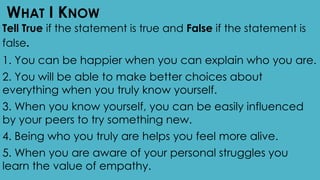
Tell True if the statement is true and False if the statement is
false.
1. You can be happier when you can explain who you are.
2. You will be able to make better choices about
everything when you truly know yourself.
3. When you know yourself, you can be easily influenced
by your peers to try something new.
4. Being who you truly are helps you feel more alive.
5. When you are aware of your personal struggles you
learn the value of empathy.
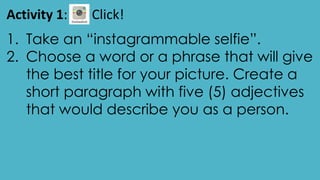
Activity 1: Click!
1. Take an “instagrammable selfie”.
2. Choose a word or a phrase that will give
the best title for your picture. Create a
short paragraph with five (5) adjectives
that would describe you as a person.
Now let us reflect
and answer the
following
questions in your
notebook.
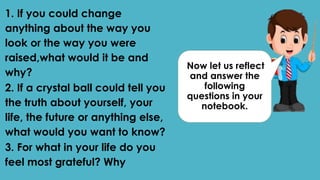
1. If you could change
anything about the way you
look or the way you were
raised,what would it be and
why?
2. If a crystal ball could tell you
the truth about yourself, your
life, the future or anything else,
what would you want to know?
3. For what in your life do you
feel most grateful? Why
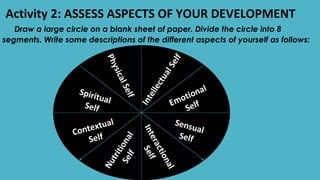
Activity 2: ASSESS ASPECTS OF YOUR DEVELOPMENT
Draw a large circle on a blank sheet of paper. Divide the circle into 8
segments. Write some descriptions of the different aspects of yourself as follows:
1. PHYSICAL SELF. Describe yourself. Try not to censor any thoughts
which come to your mind. Include descriptions of your height, weight,
facial appearance and quality of skin, hair and descriptions of body
areas such as your neck, chest, waist, legs.
2. INTELLECTUAL SELF. Includes here an assessment of how well you
reason and solve problems, your capacity to learn and create your
general amount of knowledge, your specific areas of knowledge,
wisdom you have acquired.
3. EMOTIONAL SELF. Write as many words or phrases about typical
feelings you have, feelings you seldom have, feelings you try to avoid,
feelings you especially enjoy, feelings from your past and present, and
feelings which are associated with each other
4. SENSUAL SELF. Write how you feel as a sensual person. What
sense do you use most – sight, hearing, speaking, smelling,
touching? How do you feel about the different ways you take in
information – through the eyes, ears, mouth, nose, pores and skin?
In what ways do you let information in and out of your body?
5. INTERACTIONAL SELF. Include descriptions of your strengths
and weaknesses in intimate relationships and relationships to
friends, family, co-students and strangers in social settings. Describe
the strength and weaknesses which your friends and family have
notices. Describe what kind of son or daughter, brother or sister you
are.
6. NUTRITIONAL SELF. How do you nourish yourself? What foods
do you like and dislike?
7. CONTEXTUAL SELF. Descriptors could be in the areas of
maintenance of your living environment, reaction to light,
temperature, space, weather, colours, sound and seasons and
your impact on the environment.
8. SPIRITUAL SELF OR LIFE FORCE. Write words or phrases
which tell about how you feel in this area. This could include
your feelings about yourself and organized religion, reactions
about your spiritual connections to others, feelings about your
spiritual development and history, and thoughts about your
metaphysical self. Think about your inner peace and joy. Think
about your spiritual regimen or routine.Try assessing the
different areas of your development in the next activity.
1. Which aspect of your self is considered as
your strongest? Which is the weakest?
2. What are your basis in identifying these self-
descriptions as strengths and weaknesses?
3. How can you enhance the weakest parts of
you self? How do you use your strengths in facing
your everyday challenges? Are these parts
contributing to your development as a growing
person? How?
Determinants of Personality
⮚The word derives from the Latin word “persona”, which
means mask.
Characteristics of Personality
∙ Personality is unique in individual.
∙ It impacts behaviour and action.
∙ Personality refers to persistent qualities of individual.
∙ Personality is the result of social interactions.
∙ Personality is always dynamic.
∙ Personality determines our thinking, reasoning and
actions.
⮚Personality is not determined by a single factor, but by an
accumulation of many factors. Some of those factors are
psychological, while others are physical, biological, and
hereditary.
o Biological Factors
▪ Brain - father and son adopt almost the same type of
brain stimulation
▪ Physical factor - physical factors involves height, colour,
health status and beauty of the person
▪ Heredity factor - factors affect the physical features
intelligence level, attentiveness, gender, temperament,
various inherited diseases and energy level
oSocial Factors also play a vital role in determining
one’s personality.
▪ The society that we live in, the environment, the
community, all are included in this factor.
▪ Socialization starts with the contact between a
mother and infant. After infancy, we build our
social skills with our father, brothers, sisters, relatives,
friends and then the social group
oCultural Factors
▪ The culture largely determines attributes toward
independence, aggression, competition, and
cooperation.
▪ The culture in which one lives in, traditional
practices, norms, customs, procedures, rules and
regulations, values, are determinants of personality.
▪ The creed, religion and believes are also very
important factors of personality determinants.
oSituational Factor
▪ According to Milgram "Situation exerts an
important press on the individual”.
▪ Situational factors do alter a person’s
behaviour and response from time to time.
▪ Situational factors can be commonly
observed when a person behaves
contrastingly and exhibits different traits and
characteristics.
The following are some benefits of self-knowledge:
1. You can be happier when you can explain who
you are
2. Lesser inner conflict – actions are based on what
really feels.
3. Better decision making – able to make better
choices about anything when you truly know
yourself.
4. Self-control – resist bad habits and develop a good
one.
5. Resistance to social pressure – withstand the social
pressure to conform the majority.
6. Tolerance and understanding of others- awareness
of your foibles and struggles can help you empathize
with others.
7. Vitality and pleasure – being who you truly are helps
you feel more alive.
Activity 3 : HOW DO I DEFINE MYSELF?
In the video, Lizzie Velasquez discusses how she suffers
from a rare disorder which prevents her from gaining weight
and has caused blindness in her right eye. Once cyber bullied
and labelled “the world’s ugliest woman,” she decided to
turn things around and create her own definitions of beauty
and happiness.
Lizzie asks the audience to consider what defines them.
Is it their backgrounds? Friends? Families? She reminds us
that if we can find happiness within, and be the drivers of
our own lives, bullies will always lose.
1.Based on the story you have
watched/read, what difficulties did Lizzie
Velasquez encountered in her growing
years? How was she treated in school?
2.What are some of Lizzie’s positive traits that
contributes to her positive self-concept?
3.How does Lizzie demonstrate that “beauty
is on the inside”?
4.Were you moved by her story? What lessons
in life have you learned from her?
ACTIVITY 4: Idol Ko Ikaw
Having a person to look up to, to
learn from and to have as a role
model could be considered as one
of our fundamental needs in order
to stay track in achieving our goal.
1.Interview someone in your family or even in your
community whom you look up to.
You may use other means except face to face
encounter if you choose to interview outside your
family circle. Follow safety standards.
1.Use the following questions as your guide in your
interview.
You may add more questions if you want to.
a.What were your plans prior to your situation right
now?
b. When you were still at my age, do you
have some weaknesses? How did you
overcome these weaknesses and turned
them into your strengths?
c. What are your strategies in eliminating
threats that hindered you from achieving
your goals?
d. What is your guiding principle in life?
ACTIVITY 5: Thank You Letter
Answer the following questions briefly.
1.What have you realized from the
conducted interview?
2.Write a Thank You Letter to your “Idol” and
tell him/her how you appreciate him/her in
sharing his/her story and how he/she inspires
you. Send/Give the letter to the intended
person.
ACTIVITY 6: CELEBRATION OF UNIQUENESS
Choose one (1) of the following activities. Let’s
celebrate your uniqueness and share to the world how
much you appreciate yourself and how loving your self
affects your social, mental, biological and
Psychological aspects.
a.“ME” Commercial: make a 2-3 minute
commercial stating why would they hire
you?
b. Write yourself a letter: only you can see the letter,
but make sure to keep it. After the semester, you
are required to read your letter and check if you
were able to remain loving to yourself.
c. Draw a self-portrait: the portrait has two sides, half
of your face shows how you see yourself, and the
other half shows how others see you. Compose a
‘Self-Pledge’ and sign it.?
Developing the Whole Person.pptx

Developing the Whole Person.pptx

  • 2.
    WHAT I KNOW TellTrue if the statement is true and False if the statement is false. 1. You can be happier when you can explain who you are. 2. You will be able to make better choices about everything when you truly know yourself. 3. When you know yourself, you can be easily influenced by your peers to try something new. 4. Being who you truly are helps you feel more alive. 5. When you are aware of your personal struggles you learn the value of empathy.
  • 3.
    Activity 1: Click! 1.Take an “instagrammable selfie”. 2. Choose a word or a phrase that will give the best title for your picture. Create a short paragraph with five (5) adjectives that would describe you as a person.
  • 4.
    Now let usreflect and answer the following questions in your notebook. 1. If you could change anything about the way you look or the way you were raised,what would it be and why? 2. If a crystal ball could tell you the truth about yourself, your life, the future or anything else, what would you want to know? 3. For what in your life do you feel most grateful? Why
  • 5.
    Activity 2: ASSESSASPECTS OF YOUR DEVELOPMENT Draw a large circle on a blank sheet of paper. Divide the circle into 8 segments. Write some descriptions of the different aspects of yourself as follows:
  • 6.
    1. PHYSICAL SELF.Describe yourself. Try not to censor any thoughts which come to your mind. Include descriptions of your height, weight, facial appearance and quality of skin, hair and descriptions of body areas such as your neck, chest, waist, legs. 2. INTELLECTUAL SELF. Includes here an assessment of how well you reason and solve problems, your capacity to learn and create your general amount of knowledge, your specific areas of knowledge, wisdom you have acquired. 3. EMOTIONAL SELF. Write as many words or phrases about typical feelings you have, feelings you seldom have, feelings you try to avoid, feelings you especially enjoy, feelings from your past and present, and feelings which are associated with each other
  • 7.
    4. SENSUAL SELF.Write how you feel as a sensual person. What sense do you use most – sight, hearing, speaking, smelling, touching? How do you feel about the different ways you take in information – through the eyes, ears, mouth, nose, pores and skin? In what ways do you let information in and out of your body? 5. INTERACTIONAL SELF. Include descriptions of your strengths and weaknesses in intimate relationships and relationships to friends, family, co-students and strangers in social settings. Describe the strength and weaknesses which your friends and family have notices. Describe what kind of son or daughter, brother or sister you are. 6. NUTRITIONAL SELF. How do you nourish yourself? What foods do you like and dislike?
  • 8.
    7. CONTEXTUAL SELF.Descriptors could be in the areas of maintenance of your living environment, reaction to light, temperature, space, weather, colours, sound and seasons and your impact on the environment. 8. SPIRITUAL SELF OR LIFE FORCE. Write words or phrases which tell about how you feel in this area. This could include your feelings about yourself and organized religion, reactions about your spiritual connections to others, feelings about your spiritual development and history, and thoughts about your metaphysical self. Think about your inner peace and joy. Think about your spiritual regimen or routine.Try assessing the different areas of your development in the next activity.
  • 9.
    1. Which aspectof your self is considered as your strongest? Which is the weakest? 2. What are your basis in identifying these self- descriptions as strengths and weaknesses? 3. How can you enhance the weakest parts of you self? How do you use your strengths in facing your everyday challenges? Are these parts contributing to your development as a growing person? How?
  • 10.
    Determinants of Personality ⮚Theword derives from the Latin word “persona”, which means mask. Characteristics of Personality ∙ Personality is unique in individual. ∙ It impacts behaviour and action. ∙ Personality refers to persistent qualities of individual. ∙ Personality is the result of social interactions. ∙ Personality is always dynamic. ∙ Personality determines our thinking, reasoning and actions.
  • 11.
    ⮚Personality is notdetermined by a single factor, but by an accumulation of many factors. Some of those factors are psychological, while others are physical, biological, and hereditary. o Biological Factors ▪ Brain - father and son adopt almost the same type of brain stimulation ▪ Physical factor - physical factors involves height, colour, health status and beauty of the person ▪ Heredity factor - factors affect the physical features intelligence level, attentiveness, gender, temperament, various inherited diseases and energy level
  • 12.
    oSocial Factors alsoplay a vital role in determining one’s personality. ▪ The society that we live in, the environment, the community, all are included in this factor. ▪ Socialization starts with the contact between a mother and infant. After infancy, we build our social skills with our father, brothers, sisters, relatives, friends and then the social group
  • 13.
    oCultural Factors ▪ Theculture largely determines attributes toward independence, aggression, competition, and cooperation. ▪ The culture in which one lives in, traditional practices, norms, customs, procedures, rules and regulations, values, are determinants of personality. ▪ The creed, religion and believes are also very important factors of personality determinants.
  • 14.
    oSituational Factor ▪ Accordingto Milgram "Situation exerts an important press on the individual”. ▪ Situational factors do alter a person’s behaviour and response from time to time. ▪ Situational factors can be commonly observed when a person behaves contrastingly and exhibits different traits and characteristics.
  • 15.
    The following aresome benefits of self-knowledge: 1. You can be happier when you can explain who you are 2. Lesser inner conflict – actions are based on what really feels. 3. Better decision making – able to make better choices about anything when you truly know yourself.
  • 16.
    4. Self-control –resist bad habits and develop a good one. 5. Resistance to social pressure – withstand the social pressure to conform the majority. 6. Tolerance and understanding of others- awareness of your foibles and struggles can help you empathize with others. 7. Vitality and pleasure – being who you truly are helps you feel more alive.
  • 17.
    Activity 3 :HOW DO I DEFINE MYSELF?
  • 18.
    In the video,Lizzie Velasquez discusses how she suffers from a rare disorder which prevents her from gaining weight and has caused blindness in her right eye. Once cyber bullied and labelled “the world’s ugliest woman,” she decided to turn things around and create her own definitions of beauty and happiness. Lizzie asks the audience to consider what defines them. Is it their backgrounds? Friends? Families? She reminds us that if we can find happiness within, and be the drivers of our own lives, bullies will always lose.
  • 19.
    1.Based on thestory you have watched/read, what difficulties did Lizzie Velasquez encountered in her growing years? How was she treated in school? 2.What are some of Lizzie’s positive traits that contributes to her positive self-concept? 3.How does Lizzie demonstrate that “beauty is on the inside”? 4.Were you moved by her story? What lessons in life have you learned from her?
  • 20.
    ACTIVITY 4: IdolKo Ikaw Having a person to look up to, to learn from and to have as a role model could be considered as one of our fundamental needs in order to stay track in achieving our goal.
  • 21.
    1.Interview someone inyour family or even in your community whom you look up to. You may use other means except face to face encounter if you choose to interview outside your family circle. Follow safety standards. 1.Use the following questions as your guide in your interview. You may add more questions if you want to. a.What were your plans prior to your situation right now?
  • 22.
    b. When youwere still at my age, do you have some weaknesses? How did you overcome these weaknesses and turned them into your strengths? c. What are your strategies in eliminating threats that hindered you from achieving your goals? d. What is your guiding principle in life?
  • 23.
    ACTIVITY 5: ThankYou Letter Answer the following questions briefly. 1.What have you realized from the conducted interview? 2.Write a Thank You Letter to your “Idol” and tell him/her how you appreciate him/her in sharing his/her story and how he/she inspires you. Send/Give the letter to the intended person.
  • 24.
    ACTIVITY 6: CELEBRATIONOF UNIQUENESS Choose one (1) of the following activities. Let’s celebrate your uniqueness and share to the world how much you appreciate yourself and how loving your self affects your social, mental, biological and Psychological aspects. a.“ME” Commercial: make a 2-3 minute commercial stating why would they hire you?
  • 25.
    b. Write yourselfa letter: only you can see the letter, but make sure to keep it. After the semester, you are required to read your letter and check if you were able to remain loving to yourself. c. Draw a self-portrait: the portrait has two sides, half of your face shows how you see yourself, and the other half shows how others see you. Compose a ‘Self-Pledge’ and sign it.?