PERSONALITY DEVELOPMENT
MODULE 8 WEEK 8
MODULE 8
EMOTIONAL
INTELLIGENCE
MELC
 • 8.1 discuss that understanding the intensity
and differentiation of emotions may help in
communicating emotional expressions EsP-
PD11/12EI-Ii-j-8.1
 • 8.2 explore one’s positive and negative
emotions and how one expresses or hides
them EsP-PD11/12EI-Ij-8.2
 • 8.3 demonstrate and create ways to
manage various emotions EsP-PD11/12EI-Ij-8.3
Pre Test!
Directions: Read the questions carefully.
Write the letter of your answer on the comment section.
Question 1
Write the letter of your
answer on the comment
section.
1. Emotional intelligence includes the
individual’s ____?
a. Ability to motivate oneself
b. Capacity to control impulses
c. Ability to emphasize with others
d. All of the above
Question 2
Write the letter of your
answer on the comment
section.
2. What do you need to do to be
emotionally intelligent?
a. Identify what you feel
b. Use and manage your emotion
c. Understand why you feel that way
d. All of the above
Question 3
Write the letter of your
answer on the comment
section.
3. What does understanding emotions
means?
a. Talking to someone
b. Releasing what you feel
c. Crying to release tensions
d. Making sense of what you feel
Question 4
Write the letter of your
answer on the comment
section.
4. Controlling impulse is manifested
when you____?
a. Immediately buy what you want
b. Meet friends during examination week
c. Wait for the right time to buy your dream car
d. Insist on your parents that you want a new
cell phone
Question 5
Write the letter of your
answer on the comment
section.
5. What does managing emotions
mean?
a. Controlling emotions
b. Dominating your feelings
c. Suppressing your feelings
d. Being honest on what you feel
LOOKING
BACK/
REVIEW
Label the parts of the human brain as shown in the picture.
FRONTAL LOBE
PARIETAL LOBE
TEMPORAL LOBE
OCCIPITAL LOBE
CEREBELLUM
BRAIN STEM
PARIENTAL
LOBE
FUNCTIONS
FRONTAL
LOBE
FUNCTIONS
OCCIPITAL
LOBE
FUNCTIONS
TEMPORAL
LOBE
HUMAN BRAIN
CEREBELLUM
HUMAN BRAIN
BRAIN
STEM
HUMAN BRAIN
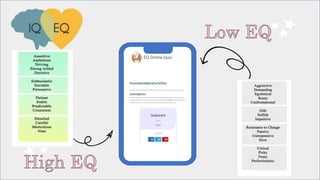
Take this short online quiz:
https://www.ihhp.com/free-eq-
quiz/
EQ Online Quiz
PERSONALITY DEVELOPMENT
Module 8 Emotional Intelligence
Let us first look into the nature of
emotions, how and why they occur,
and what are their effects on us
Break Out Session:
SHOW YOUR FEELING TODAY
THROUGH EMOTICON..
 TODAY IM FEELING….
 What did I do about my
feelings..
Discussion:
https://www.youtube.com/watch?v=7UHoIcZXHb0&t=429s
PERSONALITY DEVELOPMENT WEEK 8
Emotions are an essential part of who
you are, but they can be messy,
complicated, and downright confusing
most especially during this time that
we are experiencing COVID19.
Knowing how to name them and talk
about them — with both yourself and
others — is a key part of developing
emotional health.
Module 8 Emotional Intelligence
PERSONALITY DEVELOPMENT WEEK 8
Anybody can become angry
That is easy
But to be angry with the right person
And the right degree
And at the right time
And for the right purpose
And in the right way
That is not within
Everybody’s power
And is not easy
-Aristotle
Module 8 Emotional Intelligence
PERSONALITY DEVELOPMENT WEEK 8
Emotional
intelligence
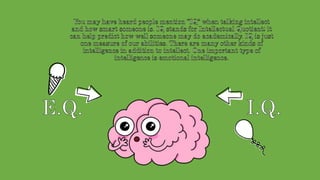
– also called emotional quotient or EQ – might
sound complicated but it is something anyone
can develop. It has nothing to do with how
smart you are – referred to as your
intelligence quotient or IQ – or how many
facts you know. In short, EQ is a person’s
ability to recognize and manage their
emotions.
PERSONALITY DEVELOPMENT WEEK 5
Emotional intelligence is the ability to manage
feelings so that they are expressed
appropriately and effectively, enabling people
to work together smoothly toward common
goals (Goleman, 1998a).
An emotion is an inner realization or feeling
of, for example, joy anger, fear, or sadness. It
can either occur spontaneously (without a
clear reason) or can be caused by a certain
situation. Our emotions often influence our
actions or reactions.
PERSONALITY DEVELOPMENT WEEK 5
Emotions
Emotions are an encouragement to act, and
a tendency to do things. Goleman, in his
book, describes the basic emotions possessed
by all cultures in the world that can be
understood as a characteristic of the
emotions of various individuals. They are
scared, angry, sad, and happy feelings
(Goleman, 2007).
Emotions are attitudes or responses to a
situation or an object, like judgments
(Zemach, 2001).
Robert Plutchik theorized that emotions
are multi-dimensional, or having various
intensities, identified these as: adoration,
ecstasy, anticipation, rage, disgust, grief,
surprise, and fear.
PERSONALITY DEVELOPMENT WEEK 5 Figure 1: Plutchik’s Wheel of Emotions
PERSONALITY DEVELOPMENT WEEK 8
 Goleman also refers to eight main families of
emotions and their corresponding members:
Figure 2: Goleman 8 Familied of Emotions
1. Anger – fury, outrage, resentment, wrath, annoyance,
irritability, hostility, and to extremes, hatred, and violence.
2. Sadness – grief, sorrow, gloom, melancholy, self-pity,
loneliness, despair, and in extreme, depression.
3. Fear – anxiety, nervousness, concern, fright, terror, and ins
extreme, phobia and panic.
4. Enjoyment – happiness, joy, relief, contentment, bliss, pride,
pleasure, satisfaction, euphoria, and to its extreme, mania.
5. Love – acceptance, friendliness, trust, kindness, devotion,
adoration, infatuation, and agape.
6. Surprise – shock, astonishment, amazement, and wonder.
7. Disgust – Contempt, disdain, scorn, aversion, distaste,
revulsion.
8. Shame – guilt, embarrassment, remorse, humiliation, regret,
mortification, and contrition.
PERSONALITY DEVELOPMENT WEEK 5
 What are these emotions?
 What were your thoughts while you were
experiencing the emotions?
 How did you express these emotions?
 How did you handle these emotions?
Sharing: What are the top three feelings that you do not like to have most?
Break Out Session:
Sharing: What are the top three
feelings that you do not like to have
most?
Team Lalaki: https://meet.google.com/fhn-vrvh-nwb
Team babe: https://meet.google.com/pra-njtu-pkp
PERSONALITY DEVELOPMENT WEEK 8
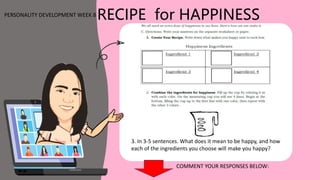
RECIPE for HAPPINESS
PERSONALITY DEVELOPMENT WEEK 8
COMMENT YOUR RESPONSES BELOW:
3. In 3-5 sentences. What does it mean to be happy, and how
each of the ingredients you choose will make you happy?

Personal Development Emotional Intelligence.pptx

  • 1.
    PERSONALITY DEVELOPMENT MODULE 8WEEK 8 MODULE 8 EMOTIONAL INTELLIGENCE
  • 2.
    MELC  • 8.1discuss that understanding the intensity and differentiation of emotions may help in communicating emotional expressions EsP- PD11/12EI-Ii-j-8.1  • 8.2 explore one’s positive and negative emotions and how one expresses or hides them EsP-PD11/12EI-Ij-8.2  • 8.3 demonstrate and create ways to manage various emotions EsP-PD11/12EI-Ij-8.3
  • 3.
    Pre Test! Directions: Readthe questions carefully. Write the letter of your answer on the comment section.
  • 4.
    Question 1 Write theletter of your answer on the comment section. 1. Emotional intelligence includes the individual’s ____? a. Ability to motivate oneself b. Capacity to control impulses c. Ability to emphasize with others d. All of the above
  • 5.
    Question 2 Write theletter of your answer on the comment section. 2. What do you need to do to be emotionally intelligent? a. Identify what you feel b. Use and manage your emotion c. Understand why you feel that way d. All of the above
  • 6.
    Question 3 Write theletter of your answer on the comment section. 3. What does understanding emotions means? a. Talking to someone b. Releasing what you feel c. Crying to release tensions d. Making sense of what you feel
  • 7.
    Question 4 Write theletter of your answer on the comment section. 4. Controlling impulse is manifested when you____? a. Immediately buy what you want b. Meet friends during examination week c. Wait for the right time to buy your dream car d. Insist on your parents that you want a new cell phone
  • 8.
    Question 5 Write theletter of your answer on the comment section. 5. What does managing emotions mean? a. Controlling emotions b. Dominating your feelings c. Suppressing your feelings d. Being honest on what you feel
  • 9.
  • 10.
    Label the partsof the human brain as shown in the picture. FRONTAL LOBE PARIETAL LOBE TEMPORAL LOBE OCCIPITAL LOBE CEREBELLUM BRAIN STEM
  • 11.
  • 13.
    Take this shortonline quiz: https://www.ihhp.com/free-eq- quiz/
  • 14.
  • 15.
    PERSONALITY DEVELOPMENT Module 8Emotional Intelligence Let us first look into the nature of emotions, how and why they occur, and what are their effects on us
  • 16.
    Break Out Session: SHOWYOUR FEELING TODAY THROUGH EMOTICON..  TODAY IM FEELING….  What did I do about my feelings..
  • 17.
  • 18.
    PERSONALITY DEVELOPMENT WEEK8 Emotions are an essential part of who you are, but they can be messy, complicated, and downright confusing most especially during this time that we are experiencing COVID19. Knowing how to name them and talk about them — with both yourself and others — is a key part of developing emotional health. Module 8 Emotional Intelligence
  • 19.
    PERSONALITY DEVELOPMENT WEEK8 Anybody can become angry That is easy But to be angry with the right person And the right degree And at the right time And for the right purpose And in the right way That is not within Everybody’s power And is not easy -Aristotle Module 8 Emotional Intelligence
  • 20.
    PERSONALITY DEVELOPMENT WEEK8 Emotional intelligence – also called emotional quotient or EQ – might sound complicated but it is something anyone can develop. It has nothing to do with how smart you are – referred to as your intelligence quotient or IQ – or how many facts you know. In short, EQ is a person’s ability to recognize and manage their emotions.
  • 21.
    PERSONALITY DEVELOPMENT WEEK5 Emotional intelligence is the ability to manage feelings so that they are expressed appropriately and effectively, enabling people to work together smoothly toward common goals (Goleman, 1998a). An emotion is an inner realization or feeling of, for example, joy anger, fear, or sadness. It can either occur spontaneously (without a clear reason) or can be caused by a certain situation. Our emotions often influence our actions or reactions.
  • 22.
    PERSONALITY DEVELOPMENT WEEK5 Emotions Emotions are an encouragement to act, and a tendency to do things. Goleman, in his book, describes the basic emotions possessed by all cultures in the world that can be understood as a characteristic of the emotions of various individuals. They are scared, angry, sad, and happy feelings (Goleman, 2007). Emotions are attitudes or responses to a situation or an object, like judgments (Zemach, 2001). Robert Plutchik theorized that emotions are multi-dimensional, or having various intensities, identified these as: adoration, ecstasy, anticipation, rage, disgust, grief, surprise, and fear.
  • 23.
    PERSONALITY DEVELOPMENT WEEK5 Figure 1: Plutchik’s Wheel of Emotions
  • 24.
    PERSONALITY DEVELOPMENT WEEK8  Goleman also refers to eight main families of emotions and their corresponding members: Figure 2: Goleman 8 Familied of Emotions
  • 25.
    1. Anger –fury, outrage, resentment, wrath, annoyance, irritability, hostility, and to extremes, hatred, and violence. 2. Sadness – grief, sorrow, gloom, melancholy, self-pity, loneliness, despair, and in extreme, depression. 3. Fear – anxiety, nervousness, concern, fright, terror, and ins extreme, phobia and panic. 4. Enjoyment – happiness, joy, relief, contentment, bliss, pride, pleasure, satisfaction, euphoria, and to its extreme, mania. 5. Love – acceptance, friendliness, trust, kindness, devotion, adoration, infatuation, and agape. 6. Surprise – shock, astonishment, amazement, and wonder. 7. Disgust – Contempt, disdain, scorn, aversion, distaste, revulsion. 8. Shame – guilt, embarrassment, remorse, humiliation, regret, mortification, and contrition.
  • 26.
    PERSONALITY DEVELOPMENT WEEK5  What are these emotions?  What were your thoughts while you were experiencing the emotions?  How did you express these emotions?  How did you handle these emotions?
  • 27.
    Sharing: What arethe top three feelings that you do not like to have most? Break Out Session: Sharing: What are the top three feelings that you do not like to have most? Team Lalaki: https://meet.google.com/fhn-vrvh-nwb Team babe: https://meet.google.com/pra-njtu-pkp
  • 28.
  • 29.
    RECIPE for HAPPINESS PERSONALITYDEVELOPMENT WEEK 8 COMMENT YOUR RESPONSES BELOW: 3. In 3-5 sentences. What does it mean to be happy, and how each of the ingredients you choose will make you happy?

Editor's Notes

  • #2 MAGANDANG BUHAY!!! Good Morning po sa ating lahat! Mula sa pamunuan ng ating paaralan, Sir Pip.. Department Heads and Coordinators, Admin Officer and of course sa inyong lahat mga kapwa ko guro. Mula dito sa Albay, Ako po si Abegail Sargent0-Bayog, your Speaker for today.