MODULE 7
Mental Health and
Well-Being In
Middle and Late
Adolescence
1. Interpret the
concepts of mental
health and
psychological well-
being in everyday
observations about
mental health
problems during
adolescence
OBJECTIVES:
2. Identify your
own
vulnerabilities
3. Create a plan
to stay mentally
healthy during
adolescence
OBJECTIVES:
1.ONE person in
every 100 persons
develops
schizophrenia
or
1.ONE percent of the
general population
develops
schizophrenia
FACT
2. A person who has
one or both parents
with mental illness is
more likely to
develop mental
or
2. Mental illness can be
hereditary.
FACT
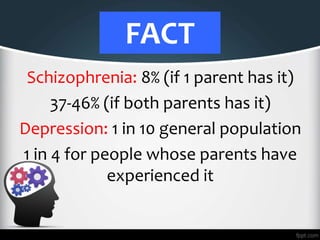
Schizophrenia: 8% (if 1 parent has it)
37-46% (if both parents has it)
Depression: 1 in 10 general population
1 in 4 for people whose parents have
experienced it
FACT
3. Mental illness is
contagious
or
FICTION
3. Mental illness is NOT
contagious, HEREDITY
can play a factor for the
development of the
disease
4. Mental illness
tends to begin
during
adolescence
or
4. First episode often
occurs between the
age of 15 and 30
years.
FACT
4. Early intervention is
currently thought to be
one of the most
important factors
related to recovery
FACT
4. Embarrassment, fear,
peer pressure and
stigma often prevent
young people from
seeking out help
FACT
5. Poor parenting
causes mental
illness
or
FICTION
5. Childhood abuse or
neglect does not cause
mental illness such as
schizophrenia.
FICTION
5. However, stressful or
abusive environments may
seriously impair a person’s
ability to cope with and
later manage the illness
6. Illegal drug use
causes mental
illness
or
6. Alcohol and other drugs
sometimes play a role in the
development of some
symptoms and disorders but
do not usually cause the
illness
&
6. However, long term drug and
alcohol use can lead to the
development of drug-
induced psychosis, which has
many of the same symptoms
of organic mental illness
&
7. Mental illness
can be cured
with willpower.
or
FICTION
7. Mental illness is associated
with chemical imbalances
in the brain and requires a
comprehensive treatment
plan
8. People with
mental illness
never get better
or
FICTION
8. With the right kind of help
many people with a
mental illness do recover
and go on to lead healthy,
productive satisfying lives.
FICTION
8. While the illness may
not go away, the
symptoms associated
with it can be
controlled.
FICTION
8. This allows the person to
regain normal functioning.
Medication, counseling,
and psychosocial
rehabilitation are
treatment options
9. People with
mental illness
tend to be
violent
or
FICTION
9. People who experience a
mental illness acutely
sometimes behave very
differently from people
who do not.
FICTION
9. While some of their
behaviors may seem
bizarre, people with mental
illness are NOT more violent
than the rest of the
population
10. All homeless
people are
mentally ill.
or
FICTION
10. Although studies have shown
that between 17 and 70% of
people who are homeless have
mental illnesses, it is clear that
being homeless doesn’t
automatically indicate a mental
illness
11. Developmental
disabilities are a
form of mental
illness
or
FICTION
11. Mental illness is often
confused with developmental
disabilities, even though the
two conditions are quite
different.
FICTION
11. Mental illness does not affect
the individual’s intellectual
capacity, whereas
developmental disabilities do.
However, people with
developmental disabilities are
more susceptible to developing
12. Poor people are
more likely to have
mental illness than
those who are not.
or
FICTION
12. Income is not a factor in
overall rates of mental health
problems. However, people
with lower incomes
experience slightly higher
rates of depression.
FICTION
12. People who live with major
mental illnesses often end up
in lower social classes because
the illness may interfere with
their ability to hold a job.
Your MIND
MENTAL HEALTH
The way your
thoughts, feelings, and
behaviors affect your
life.
MENTAL HEALTH
GOOD mental health
leads to 1.)POSITIVE
SELF-IMAGE.
MENTAL HEALTH
2.) satisfying
relationships with
friends and
others.
MENTAL HEALTH
3.) It helps you make
good decisions and
deal with life’s
challenges.
MENTAL HEALTH
Teenagers tend
to develop
problems with
their mental
MENTAL HEALTH
Depression
Anxiety
Body esteem
issues
MENTAL HEALTH
Unfortunately most
young people with
mental health problems
don’t GET any
treatment.
MENTAL HEALTH
Often ignore mental
health problems
thinking they will “snap
out of it” or something
to be ashamed of.
MENTAL HEALTH
FIRST TREATMENT:
Understand mental
health, and
CHANGE your MINDSET!.
ACTIVITY 1
MEDIA
MOTIVES
BE A CRITICAL VIEWER
MEDIA’s definition of
BEAUTY and SUCCESS do
not have to define your
SELF-IMAGE nor
POTENTIAL
HOW TO BE WISE
1. ALL MEDIA images and
messages are
CONSTRUCTIONS
NOT REFLECTION of
REALITY
HOW TO BE WISE
2. PURPOSE of
ADVERTISEMENT:
CONVINCE you
to BUY
HOW TO BE WISE
3. EMOTIONAL
EXPERIENCE looks like a
REALITY – you are only
seeing what they want
you to SEE!
HOW TO BE WISE
4. THEY THINK what will work
for you (the best that you
want to see in you)… but
does NOT necessarily mean
it WILL INDEED work for
you.
HOW TO BE WISE
5. Choose a filter that
protects your self-esteem
and body image.
STRENGTHEN YOURSELF
against FALSE BELIEFS
SELF-ESTEEM & BODY
ESTEEM
“I’m too tall”
“I’m too short”
“I’m too skinny”
RELATE MUCH…
“IF only I had straight
hair”
“If only I had smaller
nose”
“I‘d be happy.”
THE TRUTH
It’s not always easy to like
every part of your looks,
but when you get
STUCKED on the negatives
it can really bring down
your SELF-ESTEEM
Why are
self-esteem
and body
image
important?
Because…
Self-esteem is all about
how much you feel you
are worth – and how
much you feel other
people value you
Because…
whether you feel you are
attractive and whether
others like your looks
Body image is how you view
your physical self –
What
influences a
person’s
SELF-
ESTEEM?
1. PUBERTY &
DEVELOPMENT
•BODY goes through
many changes,
•Wanting to feel accepted
•Comparing oneself to
others
1. PUBERTY &
DEVELOPMENT
NOT everyone grows or
develops at the same
time or in the same way.
DO NOT COMPARE!
2. Media images & other
outside influence
•We compare ourselves
to “ideals”
•Superficial, artificial,
airbrushed and fake!
3. Families and School
•Parents/coaches that are
too focused on looking a
certain way or “making
weight” for a sports team
3. Families and School
•Classmates and peers who give
hurtful comments/teasing – you
never know when it hurts
•Do NOT be TOO SENSITIVE
to other people’s comment
Common Eating Disorders
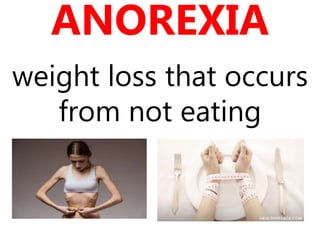
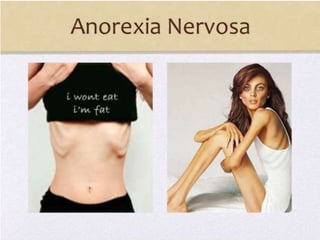
1. ANOREXIA NERVOSA
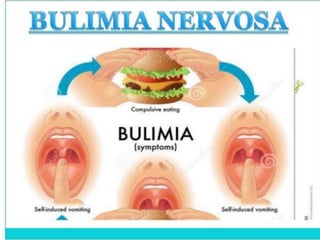
2. BULIMIA NERVOSA
MENTAL HEALTH
CHALLENGE
Mental
Health
Disorder
common to
Adolescents
MENTAL HEALTH
CHALLENGE
What do you
NEED to
know about
mental health
disorders?
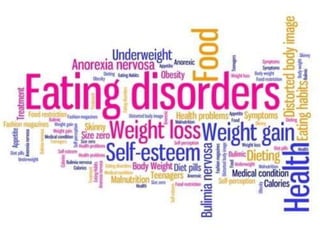
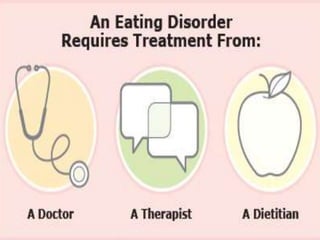
Eating
Disorder
BULIMIA
eating large amount of
food over a short period
time followed by an
attempt to get rid of the
This getting rid of food
is called “purging.”
ANOREXIA
weight loss that occurs
from not eating
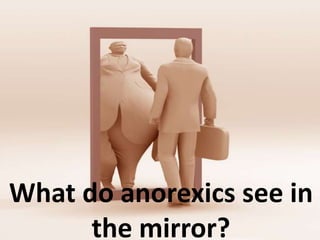
What do anorexics see in
the mirror?
EXTREME
OVEREATING is
marked by eating,
eating, and eating
then having feelings
guilt and shame.
The truth is…
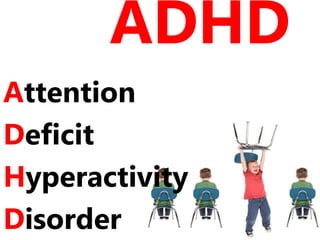
ADHD
Attention
Deficit
Hyperactivity
Disorder
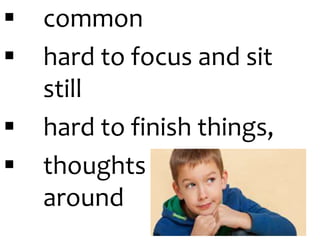
 common
 hard to focus and sit
still
 hard to finish things,
 thoughts jumping
around
1. Can learn to control thoughts
and bodies by figuring out
what helps them focus,
2. Can help talking to a doctor
or mental health professional
3. Some do better in school if
they can do their work in a
quiet room
4. Medicine can help too
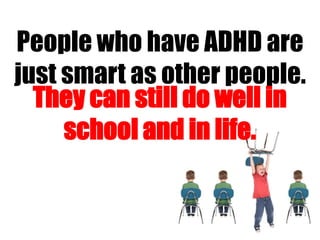
People who have ADHD are
just smart as other people.
They can still do well in
school and in life.
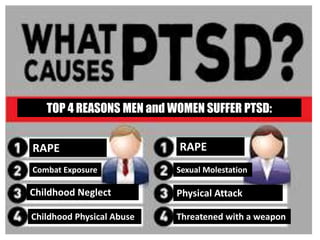
PTSD
(Post-Traumatic
Stress Disorder)
RAPE RAPE
Combat Exposure
Childhood Neglect
Childhood Physical Abuse
Sexual Molestation
Physical Attack
Threatened with a weapon
TOP 4 REASONS MEN and WOMEN SUFFER PTSD:
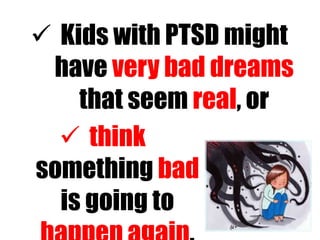
 Kids with PTSD might
have very bad dreams
that seem real, or
 think
something bad
is going to
But kids who are
diagnosed with PTSD can
learn ways to handle
their fears and can live
healthy and happy
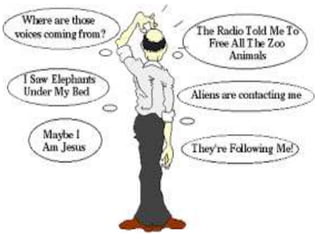
SCHIZOPHRENIA
Schizophrenia makes it hard for
people to know what is real and
what is not real.
It can make the brain think it
sees or hears things that are
NOT really there.
Usually people do not get
this illness until their late
teens or early adulthood
There are ways to make their
lives better, like therapy and
medication.
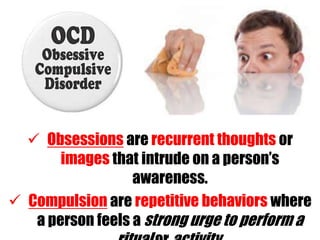
 Obsessions are recurrent thoughts or
images that intrude on a person’s
awareness.
 Compulsion are repetitive behaviors where
a person feels a strong urge to perform a
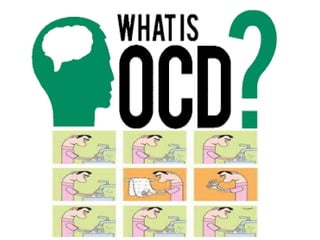
 an anxiety disorder in which a
person experiences recurrent
obsessions or compulsions that
he/she feels cannot be controlled.
 centered on removing dirt or fear of
contamination.
 If the person will not do it, he/she
becomes anxious
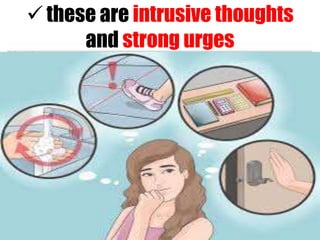
 these are intrusive thoughts
and strong urges
with professional
consultation and therapeutic
treatment necessary
together with support from
family and friends, people
with OCD can live normal lives
wanting to be friend and have
friends just like any human
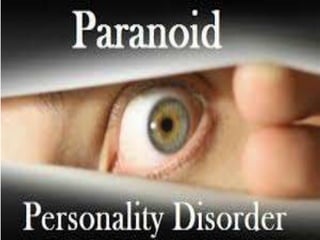
 typically distrustful and
suspicious of others.
 prone to unjustified anger or
aggressive outbursts when
they perceive others as
disloyal or deceitful,
 emotionally “cold” or
excessively serious