Personal Awareness
Session 1:
• Personal Values
• Valuing Personal Identity
Session 2:
• Business Etiquette
• Office Norms
Session Agenda
• Session 2:
• Business Etiquette
• Mindfulness at Work
• Business Etiquette
• Office Norms
• Defining Work Norms
• Practicing Work Norms
Session Objectives
• By the end of the session,
participants will:
1. Understand the basics of business
etiquette
2. Determine acceptable business
norms
3. Apply professional business
practices
Mindfulness at Work
• Developing awareness of thoughts,
emotions, and physiology and how
they interact with one another.
• Being aware of your surroundings
• Helping you better understand the
needs of those around you.
AWARENESS
EMOTIONS
THOUGHTSBODY
Moment
by
Moment
Non-
Judgment
Open
Curiosity
Why Be More Mindful at Work?
Research concludes that mindfulness at
work can:
• Help employees develop positive
strategies for dealing with highly
stressful environments and work
pressures
• Enhance employee self-regulation of
thoughts, emotions and behaviors and
make them more resilient when facing
of challenges
• Improve task performance
Homework #1
Be a Single-Tasker
• What is single-tasking?
• Multi-tasking is trying to do two or more tasks at the
same time or switching back and forth between tasks.
Nobody can actually multi-task.
• In reality, your brain is madly switching from one thing
to the next, often losing data in the process.
Use Mindful Reminders
• Setting an alarm on the phone – even a vibrating alarm
that doesn’t disturb others works well.
• Jotting mindfulness in your calendar – setting an
appointment with yourself!
• Placing a small note or picture on your desk to remind
you to be mindful.
Business Etiquette
• Set the standard of professionalism for your company
• People who deal directly with the public especially need
polished manners and etiquette.
• Prospective clients will form their perception of your
business based on the behavior and professionalism of
your people.
Hoop Activity
Work Norms
DEFINITION:
 Standards of work behavior & practices that
embody the organization
 Specific & observable ways of actualizing or
demonstrating the work values
 Serve as a measure of success in the
implementation of work values
 Translation of work values into concrete
doable plans & programs
 Specific
 Demonstrable
 Observable
 Measurable
 Agreed upon by the team members
 Supported by systems & structures
 A set standard or model of development
Work Norms must be:
Work Norms
Examples:
 Loyalty to the absentRespect
 Monthly round table discussions
to resolve issues & concerns
Communication
 40 hours of training per
employee
Continuous Improvement
 No meetings shall be scheduled
at 6:00pm & onwardsWork-life Harmony
 Intellectual honesty; don’t take
ownership of other people’s
ideas
Trustworthiness
 Answer phone calls within 3
rings
Quality Customer Service
Work Norms
Everyone Has a Role
• Acknowledge each and every colleague accordingly.
• Ensure a firm handshake during introductions.
• Introductions start with acknowledging the more senior,
then introducing the next person.
Respect Others and Their Time
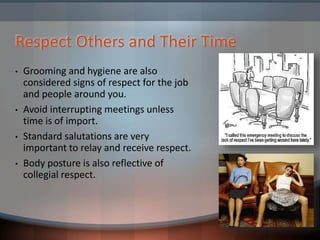
• Grooming and hygiene are also
considered signs of respect for the job
and people around you.
• Avoid interrupting meetings unless
time is of import.
• Standard salutations are very
important to relay and receive respect.
• Body posture is also reflective of
collegial respect.
Dress for Success
• Uniforms are used to identify roles in a community.
• Neatness and orderliness of attire speaks of your rank in
the organization.
• A messy appearance can imply to clients and coworkers
that the situation, company or people involved aren't
worth the effort to present yourself respectably.
Timeliness
• When there is a time factor in anything business related,
from a deadline for a project or a meeting set to begin,
don't be late.
• If you can’t be on time, advise earlier.
• Being on time builds credibility and reliability.
DWYSYWD
Remember the Basics
• "Please"
• “Thank you."
• “You're welcome.“
• Avoid raising your voice and offensive language.
Personal awareness v2

Personal awareness v2

  • 1.
    Personal Awareness Session 1: •Personal Values • Valuing Personal Identity Session 2: • Business Etiquette • Office Norms
  • 2.
    Session Agenda • Session2: • Business Etiquette • Mindfulness at Work • Business Etiquette • Office Norms • Defining Work Norms • Practicing Work Norms
  • 3.
    Session Objectives • Bythe end of the session, participants will: 1. Understand the basics of business etiquette 2. Determine acceptable business norms 3. Apply professional business practices
  • 4.
    Mindfulness at Work •Developing awareness of thoughts, emotions, and physiology and how they interact with one another. • Being aware of your surroundings • Helping you better understand the needs of those around you.
  • 5.
  • 6.
    Why Be MoreMindful at Work? Research concludes that mindfulness at work can: • Help employees develop positive strategies for dealing with highly stressful environments and work pressures • Enhance employee self-regulation of thoughts, emotions and behaviors and make them more resilient when facing of challenges • Improve task performance
  • 7.
  • 8.
    Be a Single-Tasker •What is single-tasking? • Multi-tasking is trying to do two or more tasks at the same time or switching back and forth between tasks. Nobody can actually multi-task. • In reality, your brain is madly switching from one thing to the next, often losing data in the process.
  • 9.
    Use Mindful Reminders •Setting an alarm on the phone – even a vibrating alarm that doesn’t disturb others works well. • Jotting mindfulness in your calendar – setting an appointment with yourself! • Placing a small note or picture on your desk to remind you to be mindful.
  • 10.
    Business Etiquette • Setthe standard of professionalism for your company • People who deal directly with the public especially need polished manners and etiquette. • Prospective clients will form their perception of your business based on the behavior and professionalism of your people.
  • 11.
  • 12.
    Work Norms DEFINITION:  Standardsof work behavior & practices that embody the organization  Specific & observable ways of actualizing or demonstrating the work values  Serve as a measure of success in the implementation of work values  Translation of work values into concrete doable plans & programs
  • 13.
     Specific  Demonstrable Observable  Measurable  Agreed upon by the team members  Supported by systems & structures  A set standard or model of development Work Norms must be: Work Norms
  • 14.
    Examples:  Loyalty tothe absentRespect  Monthly round table discussions to resolve issues & concerns Communication  40 hours of training per employee Continuous Improvement  No meetings shall be scheduled at 6:00pm & onwardsWork-life Harmony  Intellectual honesty; don’t take ownership of other people’s ideas Trustworthiness  Answer phone calls within 3 rings Quality Customer Service Work Norms
  • 15.
    Everyone Has aRole • Acknowledge each and every colleague accordingly. • Ensure a firm handshake during introductions. • Introductions start with acknowledging the more senior, then introducing the next person.
  • 16.
    Respect Others andTheir Time • Grooming and hygiene are also considered signs of respect for the job and people around you. • Avoid interrupting meetings unless time is of import. • Standard salutations are very important to relay and receive respect. • Body posture is also reflective of collegial respect.
  • 17.
    Dress for Success •Uniforms are used to identify roles in a community. • Neatness and orderliness of attire speaks of your rank in the organization. • A messy appearance can imply to clients and coworkers that the situation, company or people involved aren't worth the effort to present yourself respectably.
  • 18.
    Timeliness • When thereis a time factor in anything business related, from a deadline for a project or a meeting set to begin, don't be late. • If you can’t be on time, advise earlier. • Being on time builds credibility and reliability. DWYSYWD
  • 19.
    Remember the Basics •"Please" • “Thank you." • “You're welcome.“ • Avoid raising your voice and offensive language.