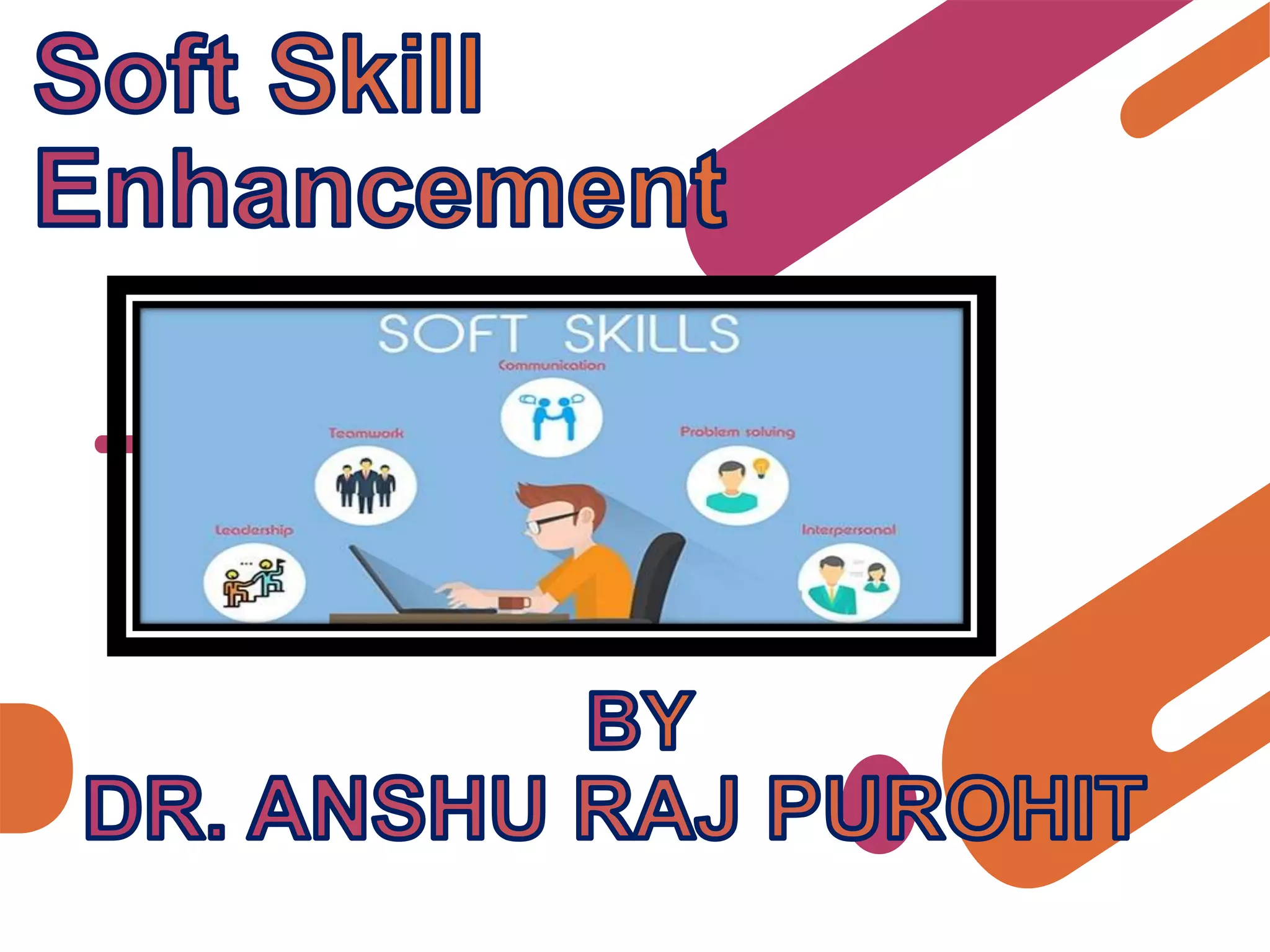
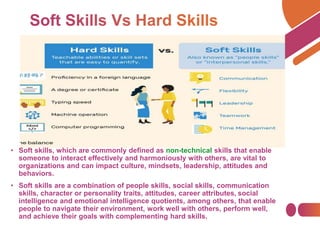
• Soft skills, which are commonly defined as non-technical skills that enable
someone to interact effectively and harmoniously with others, are vital to
organizations and can impact culture, mindsets, leadership, attitudes and
behaviors.
• Soft skills are a combination of people skills, social skills, communication
skills, character or personality traits, attitudes, career attributes, social
intelligence and emotional intelligence quotients, among others, that enable
people to navigate their environment, work well with others, perform well,
and achieve their goals with complementing hard skills.
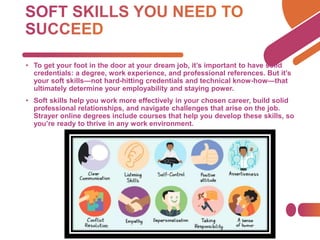
• To get your foot in the door at your dream job, it’s important to have solid
credentials: a degree, work experience, and professional references. But it’s
your soft skills—not hard-hitting credentials and technical know-how—that
ultimately determine your employability and staying power.
• Soft skills help you work more effectively in your chosen career, build solid
professional relationships, and navigate challenges that arise on the job.
Strayer online degrees include courses that help you develop these skills, so
you’re ready to thrive in any work environment.
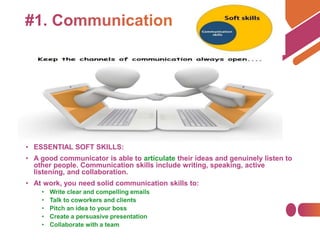
• ESSENTIAL SOFT SKILLS:
• A good communicator is able to articulate their ideas and genuinely listen to
other people. Communication skills include writing, speaking, active
listening, and collaboration.
• At work, you need solid communication skills to:
• Write clear and compelling emails
• Talk to coworkers and clients
• Pitch an idea to your boss
• Create a persuasive presentation
• Collaborate with a team
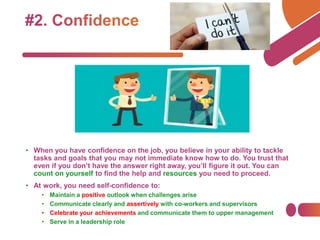
• When you have confidence on the job, you believe in your ability to tackle
tasks and goals that you may not immediate know how to do. You trust that
even if you don’t have the answer right away, you’ll figure it out. You can
count on yourself to find the help and resources you need to proceed.
• At work, you need self-confidence to:
• Maintain a positive outlook when challenges arise
• Communicate clearly and assertively with co-workers and supervisors
• Celebrate your achievements and communicate them to upper management
• Serve in a leadership role
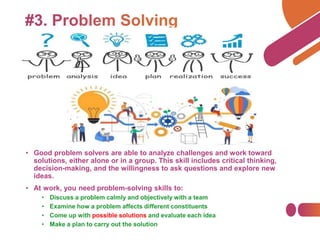
• Good problem solvers are able to analyze challenges and work toward
solutions, either alone or in a group. This skill includes critical thinking,
decision-making, and the willingness to ask questions and explore new
ideas.
• At work, you need problem-solving skills to:
• Discuss a problem calmly and objectively with a team
• Examine how a problem affects different constituents
• Come up with possible solutions and evaluate each idea
• Make a plan to carry out the solution
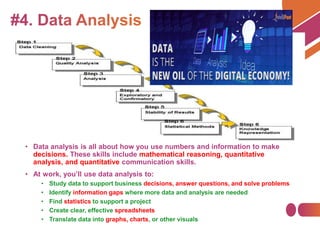
• Data analysis is all about how you use numbers and information to make
decisions. These skills include mathematical reasoning, quantitative
analysis, and quantitative communication skills.
• At work, you’ll use data analysis to:
• Study data to support business decisions, answer questions, and solve problems
• Identify information gaps where more data and analysis are needed
• Find statistics to support a project
• Create clear, effective spreadsheets
• Translate data into graphs, charts, or other visuals
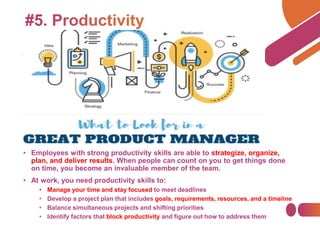
• Employees with strong productivity skills are able to strategize, organize,
plan, and deliver results. When people can count on you to get things done
on time, you become an invaluable member of the team.
• At work, you need productivity skills to:
• Manage your time and stay focused to meet deadlines
• Develop a project plan that includes goals, requirements, resources, and a timeline
• Balance simultaneous projects and shifting priorities
• Identify factors that block productivity and figure out how to address them
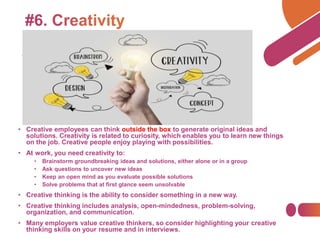
• Creative employees can think outside the box to generate original ideas and
solutions. Creativity is related to curiosity, which enables you to learn new things
on the job. Creative people enjoy playing with possibilities.
• At work, you need creativity to:
• Brainstorm groundbreaking ideas and solutions, either alone or in a group
• Ask questions to uncover new ideas
• Keep an open mind as you evaluate possible solutions
• Solve problems that at first glance seem unsolvable
• Creative thinking is the ability to consider something in a new way.
• Creative thinking includes analysis, open-mindedness, problem-solving,
organization, and communication.
• Many employers value creative thinkers, so consider highlighting your creative
thinking skills on your resume and in interviews.
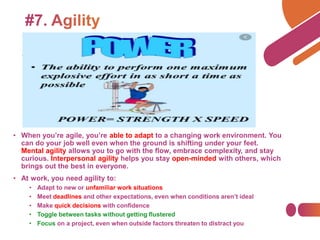
• When you’re agile, you’re able to adapt to a changing work environment. You
can do your job well even when the ground is shifting under your feet.
Mental agility allows you to go with the flow, embrace complexity, and stay
curious. Interpersonal agility helps you stay open-minded with others, which
brings out the best in everyone.
• At work, you need agility to:
• Adapt to new or unfamiliar work situations
• Meet deadlines and other expectations, even when conditions aren’t ideal
• Make quick decisions with confidence
• Toggle between tasks without getting flustered
• Focus on a project, even when outside factors threaten to distract you
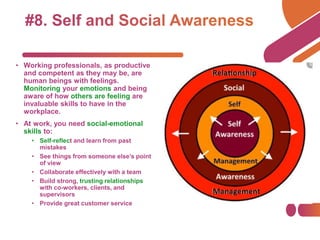
• Working professionals, as productive
and competent as they may be, are
human beings with feelings.
Monitoring your emotions and being
aware of how others are feeling are
invaluable skills to have in the
workplace.
• At work, you need social-emotional
skills to:
• Self-reflect and learn from past
mistakes
• See things from someone else’s point
of view
• Collaborate effectively with a team
• Build strong, trusting relationships
with co-workers, clients, and
supervisors
• Provide great customer service
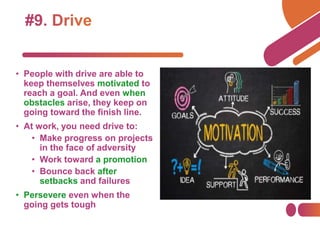
• People with drive are able to
keep themselves motivated to
reach a goal. And even when
obstacles arise, they keep on
going toward the finish line.
• At work, you need drive to:
• Make progress on projects
in the face of adversity
• Work toward a promotion
• Bounce back after
setbacks and failures
• Persevere even when the
going gets tough
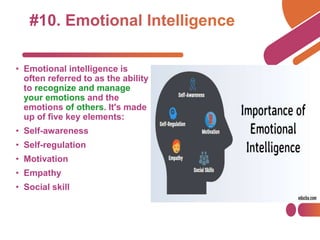
• Emotional intelligence is
often referred to as the ability
to recognize and manage
your emotions and the
emotions of others. It's made
up of five key elements:
• Self-awareness
• Self-regulation
• Motivation
• Empathy
• Social skill
• You can't succeed in a role without being
willing to put in the time, effort, and elbow
grease to hit your goals, and company
leaders and hiring managers are looking for
people who will put in the extra legwork to
succeed without being asked.
• If you want to get a new job or get
promoted, it's essential that you should
have work ethic
• if excelling means learning new skills or
tools, dedicate time to learning those
outside of work hours
• What weaves all of these soft skills together
is a positive attitude. It might sound cheesy,
but believing that there's a positive
outcome in any and all challenging
situations will help you navigate the day-to-
day of your job
• . These soft skills are harder to teach, but
the payoff might be even bigger, so make
sure you're investing time and effort into
auditing and improving your soft skill set.
• 1. Effectively presenting your
thoughts and ideas, verbally and
in writing.
• Teamwork
• Perseverance
• Communication
• Respect
• 2. Non-verbal communication includes
• Smiling
• Hand gestures
• Facial expressions, body language
and posture
• Standing straight
• 3. Which of the following is NOT a
barrier to effective communication?
• Poor listening skills
• Language
• Stereotyping
• Asking questions
• 4. Working without being told, being
self-motivated, and being the first to
begin work shows...
• Motivation
• Initiative
• Leadership
• Persistence
• 5. How can you prove you are a team
player?
• Be respectful of the opinion of others.
• Join in on rumors around work.
• Miss a day of work because you're
hanging out the night before.
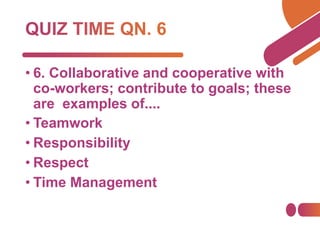
• 6. Collaborative and cooperative with
co-workers; contribute to goals; these
are examples of....
• Teamwork
• Responsibility
• Respect
• Time Management
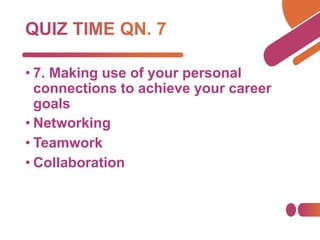
• 7. Making use of your personal
connections to achieve your career
goals
• Networking
• Teamwork
• Collaboration
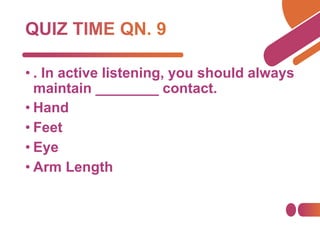
• . In active listening, you should always
maintain ________ contact.
• Hand
• Feet
• Eye
• Arm Length
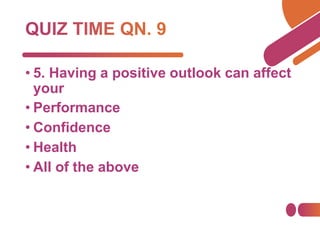
• 5. Having a positive outlook can affect
your
• Performance
• Confidence
• Health
• All of the above
• 1. -3
• 2.-3
• 3. -4
• 4.-2
• 5.-1
• 6.-1
• 7-1
• 8.-1
• 9-3
Soft skill enhancement

Soft skill enhancement

  • 2.
    • Soft skills,which are commonly defined as non-technical skills that enable someone to interact effectively and harmoniously with others, are vital to organizations and can impact culture, mindsets, leadership, attitudes and behaviors. • Soft skills are a combination of people skills, social skills, communication skills, character or personality traits, attitudes, career attributes, social intelligence and emotional intelligence quotients, among others, that enable people to navigate their environment, work well with others, perform well, and achieve their goals with complementing hard skills.
  • 3.
    • To getyour foot in the door at your dream job, it’s important to have solid credentials: a degree, work experience, and professional references. But it’s your soft skills—not hard-hitting credentials and technical know-how—that ultimately determine your employability and staying power. • Soft skills help you work more effectively in your chosen career, build solid professional relationships, and navigate challenges that arise on the job. Strayer online degrees include courses that help you develop these skills, so you’re ready to thrive in any work environment.
  • 4.
    • ESSENTIAL SOFTSKILLS: • A good communicator is able to articulate their ideas and genuinely listen to other people. Communication skills include writing, speaking, active listening, and collaboration. • At work, you need solid communication skills to: • Write clear and compelling emails • Talk to coworkers and clients • Pitch an idea to your boss • Create a persuasive presentation • Collaborate with a team
  • 5.
    • When youhave confidence on the job, you believe in your ability to tackle tasks and goals that you may not immediate know how to do. You trust that even if you don’t have the answer right away, you’ll figure it out. You can count on yourself to find the help and resources you need to proceed. • At work, you need self-confidence to: • Maintain a positive outlook when challenges arise • Communicate clearly and assertively with co-workers and supervisors • Celebrate your achievements and communicate them to upper management • Serve in a leadership role
  • 6.
    • Good problemsolvers are able to analyze challenges and work toward solutions, either alone or in a group. This skill includes critical thinking, decision-making, and the willingness to ask questions and explore new ideas. • At work, you need problem-solving skills to: • Discuss a problem calmly and objectively with a team • Examine how a problem affects different constituents • Come up with possible solutions and evaluate each idea • Make a plan to carry out the solution
  • 7.
    • Data analysisis all about how you use numbers and information to make decisions. These skills include mathematical reasoning, quantitative analysis, and quantitative communication skills. • At work, you’ll use data analysis to: • Study data to support business decisions, answer questions, and solve problems • Identify information gaps where more data and analysis are needed • Find statistics to support a project • Create clear, effective spreadsheets • Translate data into graphs, charts, or other visuals
  • 8.
    • Employees withstrong productivity skills are able to strategize, organize, plan, and deliver results. When people can count on you to get things done on time, you become an invaluable member of the team. • At work, you need productivity skills to: • Manage your time and stay focused to meet deadlines • Develop a project plan that includes goals, requirements, resources, and a timeline • Balance simultaneous projects and shifting priorities • Identify factors that block productivity and figure out how to address them
  • 9.
    • Creative employeescan think outside the box to generate original ideas and solutions. Creativity is related to curiosity, which enables you to learn new things on the job. Creative people enjoy playing with possibilities. • At work, you need creativity to: • Brainstorm groundbreaking ideas and solutions, either alone or in a group • Ask questions to uncover new ideas • Keep an open mind as you evaluate possible solutions • Solve problems that at first glance seem unsolvable • Creative thinking is the ability to consider something in a new way. • Creative thinking includes analysis, open-mindedness, problem-solving, organization, and communication. • Many employers value creative thinkers, so consider highlighting your creative thinking skills on your resume and in interviews.
  • 10.
    • When you’reagile, you’re able to adapt to a changing work environment. You can do your job well even when the ground is shifting under your feet. Mental agility allows you to go with the flow, embrace complexity, and stay curious. Interpersonal agility helps you stay open-minded with others, which brings out the best in everyone. • At work, you need agility to: • Adapt to new or unfamiliar work situations • Meet deadlines and other expectations, even when conditions aren’t ideal • Make quick decisions with confidence • Toggle between tasks without getting flustered • Focus on a project, even when outside factors threaten to distract you
  • 11.
    • Working professionals,as productive and competent as they may be, are human beings with feelings. Monitoring your emotions and being aware of how others are feeling are invaluable skills to have in the workplace. • At work, you need social-emotional skills to: • Self-reflect and learn from past mistakes • See things from someone else’s point of view • Collaborate effectively with a team • Build strong, trusting relationships with co-workers, clients, and supervisors • Provide great customer service
  • 12.
    • People withdrive are able to keep themselves motivated to reach a goal. And even when obstacles arise, they keep on going toward the finish line. • At work, you need drive to: • Make progress on projects in the face of adversity • Work toward a promotion • Bounce back after setbacks and failures • Persevere even when the going gets tough
  • 13.
    • Emotional intelligenceis often referred to as the ability to recognize and manage your emotions and the emotions of others. It's made up of five key elements: • Self-awareness • Self-regulation • Motivation • Empathy • Social skill
  • 14.
    • You can'tsucceed in a role without being willing to put in the time, effort, and elbow grease to hit your goals, and company leaders and hiring managers are looking for people who will put in the extra legwork to succeed without being asked. • If you want to get a new job or get promoted, it's essential that you should have work ethic • if excelling means learning new skills or tools, dedicate time to learning those outside of work hours • What weaves all of these soft skills together is a positive attitude. It might sound cheesy, but believing that there's a positive outcome in any and all challenging situations will help you navigate the day-to- day of your job • . These soft skills are harder to teach, but the payoff might be even bigger, so make sure you're investing time and effort into auditing and improving your soft skill set.
  • 15.
    • 1. Effectivelypresenting your thoughts and ideas, verbally and in writing. • Teamwork • Perseverance • Communication • Respect
  • 16.
    • 2. Non-verbalcommunication includes • Smiling • Hand gestures • Facial expressions, body language and posture • Standing straight
  • 17.
    • 3. Whichof the following is NOT a barrier to effective communication? • Poor listening skills • Language • Stereotyping • Asking questions
  • 18.
    • 4. Workingwithout being told, being self-motivated, and being the first to begin work shows... • Motivation • Initiative • Leadership • Persistence
  • 19.
    • 5. Howcan you prove you are a team player? • Be respectful of the opinion of others. • Join in on rumors around work. • Miss a day of work because you're hanging out the night before.
  • 20.
    • 6. Collaborativeand cooperative with co-workers; contribute to goals; these are examples of.... • Teamwork • Responsibility • Respect • Time Management
  • 21.
    • 7. Makinguse of your personal connections to achieve your career goals • Networking • Teamwork • Collaboration
  • 22.
    • . Inactive listening, you should always maintain ________ contact. • Hand • Feet • Eye • Arm Length
  • 23.
    • 5. Havinga positive outlook can affect your • Performance • Confidence • Health • All of the above
  • 24.
    • 1. -3 •2.-3 • 3. -4 • 4.-2 • 5.-1 • 6.-1 • 7-1 • 8.-1 • 9-3