Discovering Our
    Realities
     Chapter Five
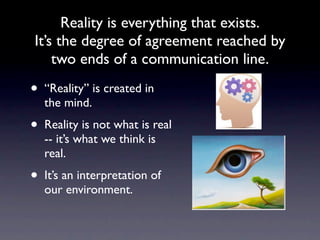
Reality is everything that exists.
It’s the degree of agreement reached by
    two ends of a communication line.

•   “Reality” is created in
    the mind.
•   Reality is not what is real
    -- it’s what we think is
    real.
•   It’s an interpretation of
    our environment.
Perception
                        • Perception is the
                          selecting, sorting, and
                          interpreting of data
                          from an external
                          environment.


• It is an individual
  event.
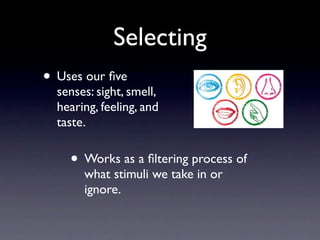
Selecting
• Uses our five
  senses: sight, smell,
  hearing, feeling, and
  taste.


    • Works as a filtering process of
       what stimuli we take in or
       ignore.
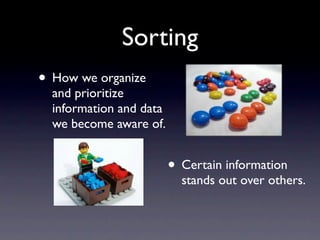
Sorting
• How we organize
  and prioritize
  information and data
  we become aware of.


                         • Certain information
                           stands out over others.
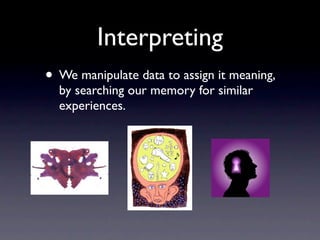
Interpreting
• We manipulate data to assign it meaning,
  by searching our memory for similar
  experiences.
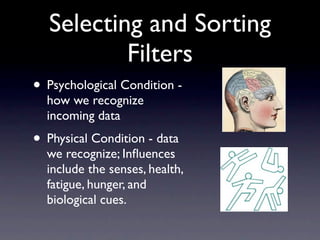
Selecting and Sorting
           Filters
• Psychological Condition -
  how we recognize
  incoming data
• Physical Condition - data
  we recognize; Influences
  include the senses, health,
  fatigue, hunger, and
  biological cues.
Selecting and Sorting
     Filters cont.
• Language - Organizational system that
  allows us to understand messages from
  environment. The more limited our
  vocabulary, the more limited our reality.
• Formal Learning - shapes our socially
  correct view of environment; teaches
  people to be good citizens
Selecting and Sorting
     Filters cont.
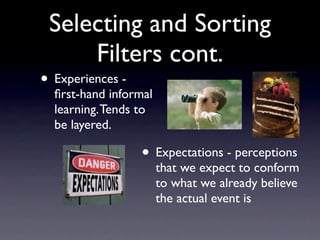
• Experiences -
  first-hand informal
  learning. Tends to
  be layered.

                  • Expectations - perceptions
                       that we expect to conform
                       to what we already believe
                       the actual event is
Factors that influence
how we interpret data
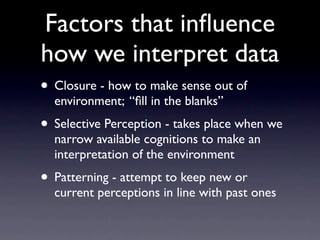
• Closure - how to make sense out of
  environment; “fill in the blanks”
• Selective Perception - takes place when we
  narrow available cognitions to make an
  interpretation of the environment
• Patterning - attempt to keep new or
  current perceptions in line with past ones
Reality Testing
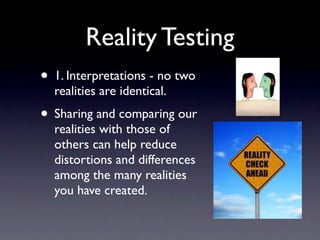
• 1. Interpretations - no two
  realities are identical.
• Sharing and comparing our
  realities with those of
  others can help reduce
  distortions and differences
  among the many realities
  you have created.
Reality Testing
• 2. Listening Skills - psychological process
  controlled by the mind
  • a. Empathic Listening - empathy as the
    basis for understanding the positions of
    others.
  • b. Deliberative Listening - definite,
    deliberate attempt to hear information,
    analyze, draw conclusions, and recall it at
    a later time. Requires little effort or
    energy.
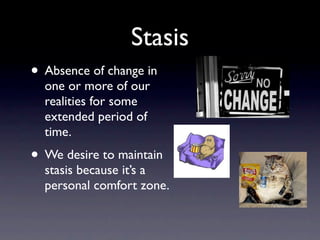
Stasis
• Absence of change in
  one or more of our
  realities for some
  extended period of
  time.
• We desire to maintain
  stasis because it’s a
  personal comfort zone.

Speech 104 Discovering Our Realities

  • 1.
    Discovering Our Realities Chapter Five
  • 2.
    Reality is everythingthat exists. It’s the degree of agreement reached by two ends of a communication line. • “Reality” is created in the mind. • Reality is not what is real -- it’s what we think is real. • It’s an interpretation of our environment.
  • 3.
    Perception • Perception is the selecting, sorting, and interpreting of data from an external environment. • It is an individual event.
  • 4.
    Selecting • Uses ourfive senses: sight, smell, hearing, feeling, and taste. • Works as a filtering process of what stimuli we take in or ignore.
  • 5.
    Sorting • How weorganize and prioritize information and data we become aware of. • Certain information stands out over others.
  • 6.
    Interpreting • We manipulatedata to assign it meaning, by searching our memory for similar experiences.
  • 7.
    Selecting and Sorting Filters • Psychological Condition - how we recognize incoming data • Physical Condition - data we recognize; Influences include the senses, health, fatigue, hunger, and biological cues.
  • 8.
    Selecting and Sorting Filters cont. • Language - Organizational system that allows us to understand messages from environment. The more limited our vocabulary, the more limited our reality. • Formal Learning - shapes our socially correct view of environment; teaches people to be good citizens
  • 9.
    Selecting and Sorting Filters cont. • Experiences - first-hand informal learning. Tends to be layered. • Expectations - perceptions that we expect to conform to what we already believe the actual event is
  • 10.
    Factors that influence howwe interpret data • Closure - how to make sense out of environment; “fill in the blanks” • Selective Perception - takes place when we narrow available cognitions to make an interpretation of the environment • Patterning - attempt to keep new or current perceptions in line with past ones
  • 11.
    Reality Testing • 1.Interpretations - no two realities are identical. • Sharing and comparing our realities with those of others can help reduce distortions and differences among the many realities you have created.
  • 12.
    Reality Testing • 2.Listening Skills - psychological process controlled by the mind • a. Empathic Listening - empathy as the basis for understanding the positions of others. • b. Deliberative Listening - definite, deliberate attempt to hear information, analyze, draw conclusions, and recall it at a later time. Requires little effort or energy.
  • 13.
    Stasis • Absence ofchange in one or more of our realities for some extended period of time. • We desire to maintain stasis because it’s a personal comfort zone.

Editor's Notes