Representing Situations in Assessment –
extracting better value from our investment


           Division of Occupational Psychology
                       Annual Conference 2011
                      Michael Burnett & Almuth McDowall
Overview
 • The Problem with Situations
 • Disentangling Situational Influences:
 • Part 1: Predominance of situational effects in high stakes
 Assessment Centres
 • Part 2: Understanding trait v. situational effects in low stakes
 Situational Judgement Tests
 • Part 3: How cognitive Situational Models address sources of
 situational effects
 • Implications
The Problem with Situations
     •Techniques used today range from ‘context free’ cognitive ability
     and personality measures to simulations (ACs and SJTs) of work
     or organisational situations
     •The first problem is that simulations give significant (ACs .281,
     SJTs .18-.382) but in absolute terms low additional incremental
     validity over ‘context free’ measures
     • The second problem is explaining what simulations actually
     measure – e.g. the methods effect in ACs3, construct validity of
     SJTs4
     • The implication is that applied psychology needs to provide a
     better account of individual differences in dealing with situations
     *
     1AC Criterion Validity –Harmelin et. al. (2007)
     2SJT Criterion Validity - Christian et. al. (2010)
     3Sackett & Dreher (1982)
     4McDaniel & Whetzel (2005)
Multimedia based simulations will happen
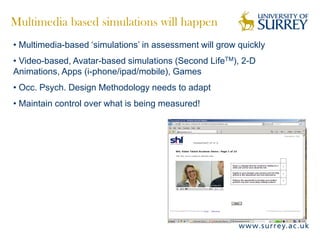
• Multimedia-based ‘simulations’ in assessment will grow quickly
• Video-based, Avatar-based simulations (Second LifeTM), 2-D
Animations, Apps (i-phone/ipad/mobile), Games
• Occ. Psych. Design Methodology needs to adapt
• Maintain control over what is being measured!
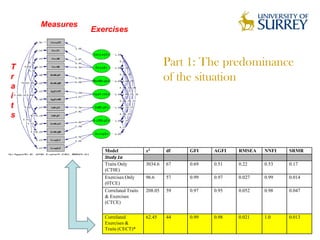
Measures
               Exercises


T                                              Part 1: The predominance
r                                              of the situation
a
i
t
s


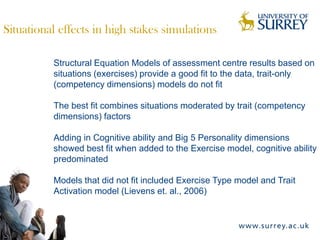
                  Model               x2       df   GFI    AGFI   RMSEA   NNFI   SRMR
                  Study 1a
                  Traits Only         3034.6   67   0.69   0.51   0.22    0.53   0.17
                  (CT0E)
                  Exercises Only      96.6     57   0.99   0.97   0.027   0.99   0.014
                  (0TCE)
                  Correlated Traits   208.05   59   0.97   0.95   0.052   0.98   0.047
                  & Exercises
                  (CTCE)


                  Correlated          62.45    44   0.99   0.98   0.021   1.0    0.013
                  Exercises &
                  Traits (CECT)*
Situational effects in high stakes simulations

          Structural Equation Models of assessment centre results based on
          situations (exercises) provide a good fit to the data, trait-only
          (competency dimensions) models do not fit

          The best fit combines situations moderated by trait (competency
          dimensions) factors

          Adding in Cognitive ability and Big 5 Personality dimensions
          showed best fit when added to the Exercise model, cognitive ability
          predominated

          Models that did not fit included Exercise Type model and Trait
          Activation model (Lievens et. al., 2006)
Part 2: Exploring situational effects


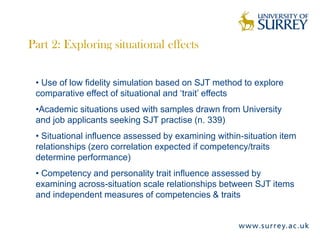
 • Use of low fidelity simulation based on SJT method to explore
 comparative effect of situational and ‘trait’ effects
 •Academic situations used with samples drawn from University
 and job applicants seeking SJT practise (n. 339)
 • Situational influence assessed by examining within-situation item
 relationships (zero correlation expected if competency/traits
 determine performance)
 • Competency and personality trait influence assessed by
 examining across-situation scale relationships between SJT items
 and independent measures of competencies & traits
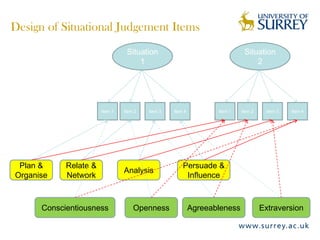
Design of Situational Judgement Items
                                 Situation                                  Situation
                                     1                                          2


                       Item 1   Item 2   Item 3   Item 4          Item 1   Item 2    Item 3   Item 4


 Plan &     Relate &                                  Persuade &
                                Analysis
Organise    Network                                    Influence


      Conscientiousness             Openness               Agreeableness            Extraversion
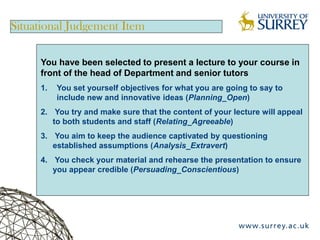
Situational Judgement Item

     You have been selected to present a lecture to your course in
     front of the head of Department and senior tutors
     1.   You set yourself objectives for what you are going to say to
          include new and innovative ideas (Planning_Open)
     2. You try and make sure that the content of your lecture will appeal
        to both students and staff (Relating_Agreeable)
     3. You aim to keep the audience captivated by questioning
        established assumptions (Analysis_Extravert)
     4. You check your material and rehearse the presentation to ensure
        you appear credible (Persuading_Conscientious)
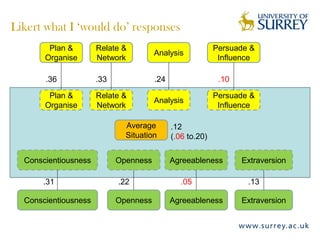
Likert what I ‘would do’ responses
        Plan &        Relate &                             Persuade &
                                       Analysis
       Organise       Network                               Influence

       .36            .33              .24                  .10

        Plan &        Relate &                             Persuade &
                                       Analysis
       Organise       Network                               Influence

                              Average        .12
                              Situation      (.06 to.20)


  Conscientiousness         Openness         Agreeableness        Extraversion

      .31                   .22                 .05                .13

  Conscientiousness         Openness         Agreeableness        Extraversion
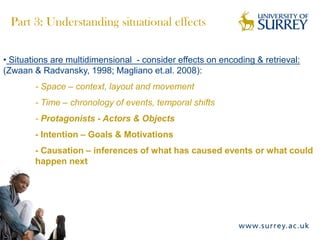
Part 3: Understanding situational effects

• Situations are multidimensional - consider effects on encoding & retrieval:
(Zwaan & Radvansky, 1998; Magliano et.al. 2008):
        - Space – context, layout and movement
        - Time – chronology of events, temporal shifts
        - Protagonists - Actors & Objects
        - Intention – Goals & Motivations
        - Causation – inferences of what has caused events or what could
        happen next
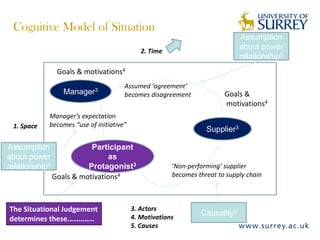
Cognitive Model of Situation
                                                                               Assumption
                                                                               about power
                                             2. Time
                                                                               relationship5
                 Goals & motivations4
                                      Assumed ‘agreement’
                   Manager3           becomes disagreement               Goals &
                                                                         motivations4
            Manager’s expectation
 1. Space   becomes “use of initiative”
                                                Goals              Supplier3

Assumption                 Participant
about power                      as
relationship5             Protagonist3                  ‘Non-performing’ supplier
                Goals & motivations4                    becomes threat to supply chain


The Situational Judgement                 3. Actors
                                          4. Motivations
                                                                 Causality5
determines these…………..
                                          5. Causes
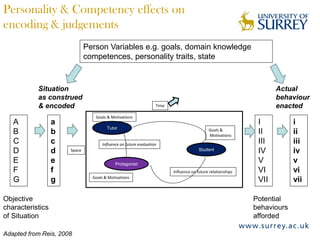
Personality & Competency effects on
encoding & judgements
                              Person Variables e.g. goals, domain knowledge
                              competences, personality traits, state


           Situation                                                                                                     Actual
           as construed                                                                                                  behaviour
           & encoded                                              Time                                                   enacted
                                 Goals & Motivations
   A              a                                                                                                I           i
                                       Tutor                                                     Goals &
   B              b                                                                              Motivations
                                                                                                                   II          ii
   C              c                  Influence on future evaluation                                                III         iii
   D              d   Space                                           Goals                 Student                IV          iv
   E              e                         Protagonist
                                                                                                                   V           v
   F              f                                                           Influence on future relationships    VI          vi
                                Goals & Motivations
   G              g                                                                                                VII         vii

Objective                                                                                                         Potential
characteristics                                                                                                   behaviours
of Situation                                                                                                      afforded

Adapted from Reis, 2008
Implications
  •Performance in Simulation-based assessments is determined by
  both situational and dispositional (trait & competency) factors
      •AC feedback should reflect both aspects
      •SJTs can be structured to return required facets
  •Situational Models hold promise in improving the yield from
  simulations (if we change the paradigm)
      •assessing encoding as well as judgement to widen the range
      of information gathered from assessments
      •providing a systematic way of describing situations to
      understand how these affect behaviour (IRT correlates)
      •enabling greater control over how situations are used in
      simulations including use of multimedia & gaming techniques
      (impact on Occ Psych methodology)

Representing Situations in Assessment - Getting better value from our investment

  • 1.
    Representing Situations inAssessment – extracting better value from our investment Division of Occupational Psychology Annual Conference 2011 Michael Burnett & Almuth McDowall
  • 2.
    Overview • TheProblem with Situations • Disentangling Situational Influences: • Part 1: Predominance of situational effects in high stakes Assessment Centres • Part 2: Understanding trait v. situational effects in low stakes Situational Judgement Tests • Part 3: How cognitive Situational Models address sources of situational effects • Implications
  • 3.
    The Problem withSituations •Techniques used today range from ‘context free’ cognitive ability and personality measures to simulations (ACs and SJTs) of work or organisational situations •The first problem is that simulations give significant (ACs .281, SJTs .18-.382) but in absolute terms low additional incremental validity over ‘context free’ measures • The second problem is explaining what simulations actually measure – e.g. the methods effect in ACs3, construct validity of SJTs4 • The implication is that applied psychology needs to provide a better account of individual differences in dealing with situations * 1AC Criterion Validity –Harmelin et. al. (2007) 2SJT Criterion Validity - Christian et. al. (2010) 3Sackett & Dreher (1982) 4McDaniel & Whetzel (2005)
  • 4.
    Multimedia based simulationswill happen • Multimedia-based ‘simulations’ in assessment will grow quickly • Video-based, Avatar-based simulations (Second LifeTM), 2-D Animations, Apps (i-phone/ipad/mobile), Games • Occ. Psych. Design Methodology needs to adapt • Maintain control over what is being measured!
  • 5.
    Measures Exercises T Part 1: The predominance r of the situation a i t s Model x2 df GFI AGFI RMSEA NNFI SRMR Study 1a Traits Only 3034.6 67 0.69 0.51 0.22 0.53 0.17 (CT0E) Exercises Only 96.6 57 0.99 0.97 0.027 0.99 0.014 (0TCE) Correlated Traits 208.05 59 0.97 0.95 0.052 0.98 0.047 & Exercises (CTCE) Correlated 62.45 44 0.99 0.98 0.021 1.0 0.013 Exercises & Traits (CECT)*
  • 6.
    Situational effects inhigh stakes simulations Structural Equation Models of assessment centre results based on situations (exercises) provide a good fit to the data, trait-only (competency dimensions) models do not fit The best fit combines situations moderated by trait (competency dimensions) factors Adding in Cognitive ability and Big 5 Personality dimensions showed best fit when added to the Exercise model, cognitive ability predominated Models that did not fit included Exercise Type model and Trait Activation model (Lievens et. al., 2006)
  • 7.
    Part 2: Exploringsituational effects • Use of low fidelity simulation based on SJT method to explore comparative effect of situational and ‘trait’ effects •Academic situations used with samples drawn from University and job applicants seeking SJT practise (n. 339) • Situational influence assessed by examining within-situation item relationships (zero correlation expected if competency/traits determine performance) • Competency and personality trait influence assessed by examining across-situation scale relationships between SJT items and independent measures of competencies & traits
  • 8.
    Design of SituationalJudgement Items Situation Situation 1 2 Item 1 Item 2 Item 3 Item 4 Item 1 Item 2 Item 3 Item 4 Plan & Relate & Persuade & Analysis Organise Network Influence Conscientiousness Openness Agreeableness Extraversion
  • 9.
    Situational Judgement Item You have been selected to present a lecture to your course in front of the head of Department and senior tutors 1. You set yourself objectives for what you are going to say to include new and innovative ideas (Planning_Open) 2. You try and make sure that the content of your lecture will appeal to both students and staff (Relating_Agreeable) 3. You aim to keep the audience captivated by questioning established assumptions (Analysis_Extravert) 4. You check your material and rehearse the presentation to ensure you appear credible (Persuading_Conscientious)
  • 10.
    Likert what I‘would do’ responses Plan & Relate & Persuade & Analysis Organise Network Influence .36 .33 .24 .10 Plan & Relate & Persuade & Analysis Organise Network Influence Average .12 Situation (.06 to.20) Conscientiousness Openness Agreeableness Extraversion .31 .22 .05 .13 Conscientiousness Openness Agreeableness Extraversion
  • 11.
    Part 3: Understandingsituational effects • Situations are multidimensional - consider effects on encoding & retrieval: (Zwaan & Radvansky, 1998; Magliano et.al. 2008): - Space – context, layout and movement - Time – chronology of events, temporal shifts - Protagonists - Actors & Objects - Intention – Goals & Motivations - Causation – inferences of what has caused events or what could happen next
  • 12.
    Cognitive Model ofSituation Assumption about power 2. Time relationship5 Goals & motivations4 Assumed ‘agreement’ Manager3 becomes disagreement Goals & motivations4 Manager’s expectation 1. Space becomes “use of initiative” Goals Supplier3 Assumption Participant about power as relationship5 Protagonist3 ‘Non-performing’ supplier Goals & motivations4 becomes threat to supply chain The Situational Judgement 3. Actors 4. Motivations Causality5 determines these………….. 5. Causes
  • 13.
    Personality & Competencyeffects on encoding & judgements Person Variables e.g. goals, domain knowledge competences, personality traits, state Situation Actual as construed behaviour & encoded Time enacted Goals & Motivations A a I i Tutor Goals & B b Motivations II ii C c Influence on future evaluation III iii D d Space Goals Student IV iv E e Protagonist V v F f Influence on future relationships VI vi Goals & Motivations G g VII vii Objective Potential characteristics behaviours of Situation afforded Adapted from Reis, 2008
  • 14.
    Implications •Performancein Simulation-based assessments is determined by both situational and dispositional (trait & competency) factors •AC feedback should reflect both aspects •SJTs can be structured to return required facets •Situational Models hold promise in improving the yield from simulations (if we change the paradigm) •assessing encoding as well as judgement to widen the range of information gathered from assessments •providing a systematic way of describing situations to understand how these affect behaviour (IRT correlates) •enabling greater control over how situations are used in simulations including use of multimedia & gaming techniques (impact on Occ Psych methodology)