FRENCH GARDEN
JARDIN À LA FRANÇAISE
PRESENTATION BY :-
UJJWAL KUMAR SWAIN
ABHIJEET MISHRA
TANYEE KADAMBARI
INTRODUCTION
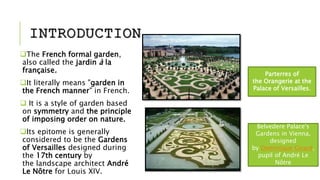
The French formal garden,
also called the jardin à la
française.
It literally means "garden in
the French manner" in French.
 It is a style of garden based
on symmetry and the principle
of imposing order on nature.
Its epitome is generally
considered to be the Gardens
of Versailles designed during
the 17th century by
the landscape architect André
Le Nôtre for Louis XIV.
Parterres of
the Orangerie at the
Palace of Versailles.
Belvedere Palace's
Gardens in Vienna,
designed
by Dominique Girard,
pupil of André Le
Nôtre
PRINCIPLES OF FRENCH
GARDEN
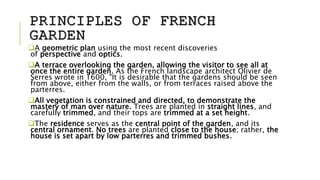
A geometric plan using the most recent discoveries
of perspective and optics.
A terrace overlooking the garden, allowing the visitor to see all at
once the entire garden. As the French landscape architect Olivier de
Serres wrote in 1600, "It is desirable that the gardens should be seen
from above, either from the walls, or from terraces raised above the
parterres.
All vegetation is constrained and directed, to demonstrate the
mastery of man over nature. Trees are planted in straight lines, and
carefully trimmed, and their tops are trimmed at a set height.
The residence serves as the central point of the garden, and its
central ornament. No trees are planted close to the house; rather, the
house is set apart by low parterres and trimmed bushes.
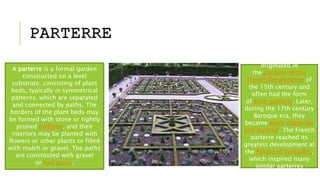
The most elaborate parterres, or planting beds, in the
shape of squares, ovals, circles or scrolls, are placed in a
regular and geometric order close to the house, to
complement the architecture and to be seen from above
from the reception rooms of the house.
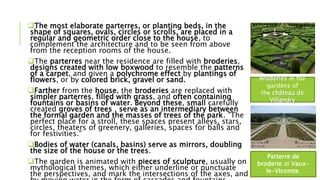
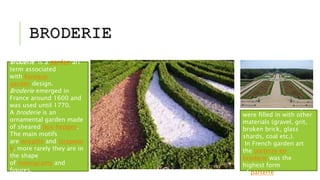
The parterres near the residence are filled with broderies,
designs created with low boxwood to resemble the patterns
of a carpet, and given a polychrome effect by plantings of
flowers, or by colored brick, gravel or sand.
Farther from the house, the broderies are replaced with
simpler parterres, filled with grass, and often containing
fountains or basins of water. Beyond these, small carefully
created groves of trees , serve as an intermediary between
the formal garden and the masses of trees of the park. "The
perfect place for a stroll, these spaces present alleys, stars,
circles, theaters of greenery, galleries, spaces for balls and
for festivities."
Bodies of water (canals, basins) serve as mirrors, doubling
the size of the house or the trees.
The garden is animated with pieces of sculpture, usually on
mythological themes, which either underline or punctuate
the perspectives, and mark the intersections of the axes, and
Broderies in the
gardens of
the château de
Villandry
Parterre de
broderie at Vaux-
le-Vicomte.
PARTERRE
A parterre is a formal garden
constructed on a level
substrate, consisting of plant
beds, typically in symmetrical
patterns, which are separated
and connected by paths. The
borders of the plant beds may
be formed with stone or tightly
pruned hedging, and their
interiors may be planted with
flowers or other plants or filled
with mulch or gravel. The paths
are constituted with gravel
or turf grass.
French parterres
originated in
the gardens of the
French Renaissance of
the 15th century and
often had the form
of knot gardens. Later,
during the 17th century
Baroque era, they
became more elaborate
and stylised. The French
parterre reached its
greatest development at
the Palace of Versailles,
which inspired many
similar parterres
throughout Europe.
BRODERIE
The ornamental shapes
were filled in with other
materials (gravel, grit,
broken brick, glass
shards, coal etc.).
In French garden art
the parterre en
broderie was the
highest form
of parterre.
Broderie is a garden art
term associated
with Baroque
garden design.
Broderie emerged in
France around 1600 and
was used until 1770.
A broderie is an
ornamental garden made
of sheared box hedges.
The main motifs
are wreaths and strapwor
k, more rarely they are in
the shape
of monograms and
figures.
GARDEN OF VERSAILLES :-
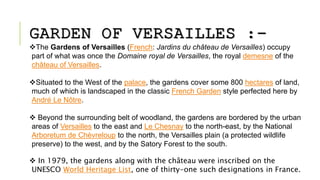
The Gardens of Versailles (French: Jardins du château de Versailles) occupy
part of what was once the Domaine royal de Versailles, the royal demesne of the
château of Versailles.
Situated to the West of the palace, the gardens cover some 800 hectares of land,
much of which is landscaped in the classic French Garden style perfected here by
André Le Nôtre.
 Beyond the surrounding belt of woodland, the gardens are bordered by the urban
areas of Versailles to the east and Le Chesnay to the north-east, by the National
Arboretum de Chèvreloup to the north, the Versailles plain (a protected wildlife
preserve) to the west, and by the Satory Forest to the south.
 In 1979, the gardens along with the château were inscribed on the
UNESCO World Heritage List, one of thirty-one such designations in France.
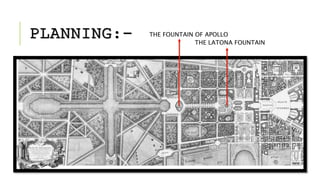
PLANNING:- THE FOUNTAIN OF APOLLO
THE LATONA FOUNTAIN
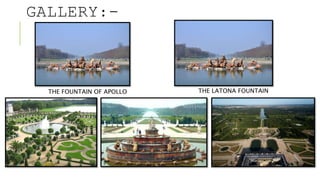
GALLERY:-
THE FOUNTAIN OF APOLLO THE LATONA FOUNTAIN
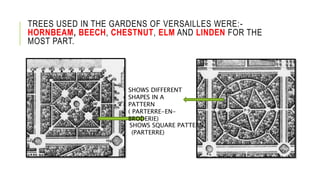
TREES USED IN THE GARDENS OF VERSAILLES WERE:-
HORNBEAM, BEECH, CHESTNUT, ELM AND LINDEN FOR THE
MOST PART.
SHOWS SQUARE PATTERN
(PARTERRE)
SHOWS DIFFERENT
SHAPES IN A
PATTERN
( PARTERRE-EN-
BRODERIE)
PLANTS & TREES TO BE
USED:- Trees are planted in straight lines and clipped to keep a perfect shape and size.
They may be formed into shapes to form topiary.
 Trees used in the Gardens of Versailles were:- Hornbeam, Beech, Chestnut, Elm
and Linden for the most part.
 HEDGES :-
The clipped hedges are usually box, lavender, rosemary and occasionally
santoline. Regular trimming to stop them going leggy and woody is important.
 VEGETABLES :-
Many French Chateax have wonderful vegetable gardens with the vegetables laid
out in patterns and parterres in the style of the ornamental formal gardens.
 PLANTS:-
Bedding plants and bulbs are popular choices for parterres with for example,
parterres filled with bulbs in formal patterns for spring flowering and then replaced
with bedding plants for the late- spring and summer.
KEY FEATURES
/CHARACTERISTICS :-
o The residence -
Should be the number one focal point in the French landscape style. The
home is often the centre point of the design with large paths that provide
axial views.
o Geometric plan -
Virtually everything in the design is geometric and planned with symmetry.
o Water -
Is incorporated as a number one element within the landscape. Referred to as
“reflecting pools” in circular, oval and rectangular shapes.
o Parterres -
The intricate patterns created from hedged shrubs or planting beds are
usually designed in near proximity to the residence. These designs are less
detailed the further away they are from the house.
o Statuary -
Is a key feature as your making your way through the French garden. During
the rise of the French garden design era, Follies were introduced as a type of
statuary in the garden. A folly is a building constructed for decoration, the
point was to create these garden ornaments that were beyond the typical
garden sculpture.
o Terraces -
Are located in the landscape where the entire garden and all of its detail can be
viewed.
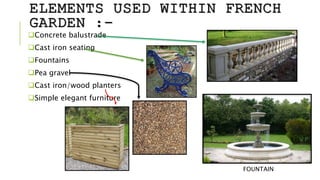
ELEMENTS USED WITHIN FRENCH
GARDEN :-
Concrete balustrade
Cast iron seating
Fountains
Pea gravel
Cast iron/wood planters
Simple elegant furniture
FOUNTAIN
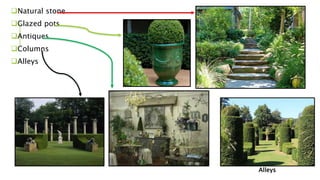
Natural stone
Glazed pots
Antiques
Columns
Alleys
Alleys
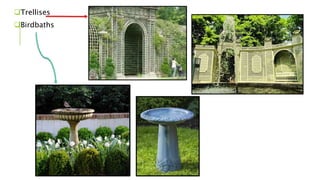
Trellises
Birdbaths

French garden ppt

  • 1.
    FRENCH GARDEN JARDIN ÀLA FRANÇAISE PRESENTATION BY :- UJJWAL KUMAR SWAIN ABHIJEET MISHRA TANYEE KADAMBARI
  • 2.
    INTRODUCTION The French formalgarden, also called the jardin à la française. It literally means "garden in the French manner" in French.  It is a style of garden based on symmetry and the principle of imposing order on nature. Its epitome is generally considered to be the Gardens of Versailles designed during the 17th century by the landscape architect André Le Nôtre for Louis XIV. Parterres of the Orangerie at the Palace of Versailles. Belvedere Palace's Gardens in Vienna, designed by Dominique Girard, pupil of André Le Nôtre
  • 3.
    PRINCIPLES OF FRENCH GARDEN Ageometric plan using the most recent discoveries of perspective and optics. A terrace overlooking the garden, allowing the visitor to see all at once the entire garden. As the French landscape architect Olivier de Serres wrote in 1600, "It is desirable that the gardens should be seen from above, either from the walls, or from terraces raised above the parterres. All vegetation is constrained and directed, to demonstrate the mastery of man over nature. Trees are planted in straight lines, and carefully trimmed, and their tops are trimmed at a set height. The residence serves as the central point of the garden, and its central ornament. No trees are planted close to the house; rather, the house is set apart by low parterres and trimmed bushes.
  • 4.
    The most elaborateparterres, or planting beds, in the shape of squares, ovals, circles or scrolls, are placed in a regular and geometric order close to the house, to complement the architecture and to be seen from above from the reception rooms of the house. The parterres near the residence are filled with broderies, designs created with low boxwood to resemble the patterns of a carpet, and given a polychrome effect by plantings of flowers, or by colored brick, gravel or sand. Farther from the house, the broderies are replaced with simpler parterres, filled with grass, and often containing fountains or basins of water. Beyond these, small carefully created groves of trees , serve as an intermediary between the formal garden and the masses of trees of the park. "The perfect place for a stroll, these spaces present alleys, stars, circles, theaters of greenery, galleries, spaces for balls and for festivities." Bodies of water (canals, basins) serve as mirrors, doubling the size of the house or the trees. The garden is animated with pieces of sculpture, usually on mythological themes, which either underline or punctuate the perspectives, and mark the intersections of the axes, and Broderies in the gardens of the château de Villandry Parterre de broderie at Vaux- le-Vicomte.
  • 5.
    PARTERRE A parterre isa formal garden constructed on a level substrate, consisting of plant beds, typically in symmetrical patterns, which are separated and connected by paths. The borders of the plant beds may be formed with stone or tightly pruned hedging, and their interiors may be planted with flowers or other plants or filled with mulch or gravel. The paths are constituted with gravel or turf grass. French parterres originated in the gardens of the French Renaissance of the 15th century and often had the form of knot gardens. Later, during the 17th century Baroque era, they became more elaborate and stylised. The French parterre reached its greatest development at the Palace of Versailles, which inspired many similar parterres throughout Europe.
  • 6.
    BRODERIE The ornamental shapes werefilled in with other materials (gravel, grit, broken brick, glass shards, coal etc.). In French garden art the parterre en broderie was the highest form of parterre. Broderie is a garden art term associated with Baroque garden design. Broderie emerged in France around 1600 and was used until 1770. A broderie is an ornamental garden made of sheared box hedges. The main motifs are wreaths and strapwor k, more rarely they are in the shape of monograms and figures.
  • 7.
    GARDEN OF VERSAILLES:- The Gardens of Versailles (French: Jardins du château de Versailles) occupy part of what was once the Domaine royal de Versailles, the royal demesne of the château of Versailles. Situated to the West of the palace, the gardens cover some 800 hectares of land, much of which is landscaped in the classic French Garden style perfected here by André Le Nôtre.  Beyond the surrounding belt of woodland, the gardens are bordered by the urban areas of Versailles to the east and Le Chesnay to the north-east, by the National Arboretum de Chèvreloup to the north, the Versailles plain (a protected wildlife preserve) to the west, and by the Satory Forest to the south.  In 1979, the gardens along with the château were inscribed on the UNESCO World Heritage List, one of thirty-one such designations in France.
  • 8.
    PLANNING:- THE FOUNTAINOF APOLLO THE LATONA FOUNTAIN
  • 9.
    GALLERY:- THE FOUNTAIN OFAPOLLO THE LATONA FOUNTAIN
  • 10.
    TREES USED INTHE GARDENS OF VERSAILLES WERE:- HORNBEAM, BEECH, CHESTNUT, ELM AND LINDEN FOR THE MOST PART. SHOWS SQUARE PATTERN (PARTERRE) SHOWS DIFFERENT SHAPES IN A PATTERN ( PARTERRE-EN- BRODERIE)
  • 11.
    PLANTS & TREESTO BE USED:- Trees are planted in straight lines and clipped to keep a perfect shape and size. They may be formed into shapes to form topiary.  Trees used in the Gardens of Versailles were:- Hornbeam, Beech, Chestnut, Elm and Linden for the most part.  HEDGES :- The clipped hedges are usually box, lavender, rosemary and occasionally santoline. Regular trimming to stop them going leggy and woody is important.  VEGETABLES :- Many French Chateax have wonderful vegetable gardens with the vegetables laid out in patterns and parterres in the style of the ornamental formal gardens.  PLANTS:- Bedding plants and bulbs are popular choices for parterres with for example, parterres filled with bulbs in formal patterns for spring flowering and then replaced with bedding plants for the late- spring and summer.
  • 12.
    KEY FEATURES /CHARACTERISTICS :- oThe residence - Should be the number one focal point in the French landscape style. The home is often the centre point of the design with large paths that provide axial views. o Geometric plan - Virtually everything in the design is geometric and planned with symmetry. o Water - Is incorporated as a number one element within the landscape. Referred to as “reflecting pools” in circular, oval and rectangular shapes. o Parterres - The intricate patterns created from hedged shrubs or planting beds are usually designed in near proximity to the residence. These designs are less detailed the further away they are from the house.
  • 13.
    o Statuary - Isa key feature as your making your way through the French garden. During the rise of the French garden design era, Follies were introduced as a type of statuary in the garden. A folly is a building constructed for decoration, the point was to create these garden ornaments that were beyond the typical garden sculpture. o Terraces - Are located in the landscape where the entire garden and all of its detail can be viewed.
  • 14.
    ELEMENTS USED WITHINFRENCH GARDEN :- Concrete balustrade Cast iron seating Fountains Pea gravel Cast iron/wood planters Simple elegant furniture FOUNTAIN
  • 15.
  • 16.