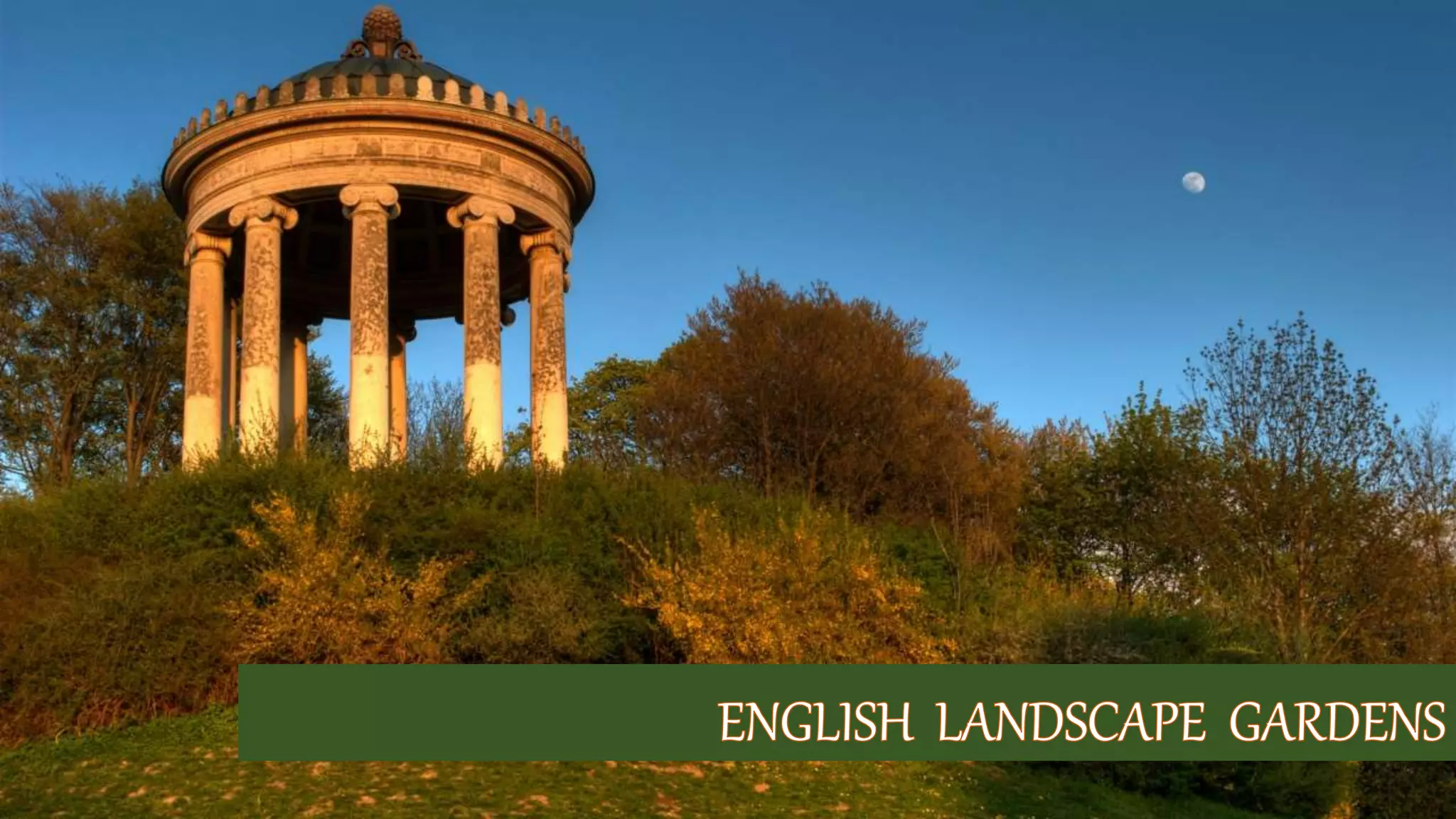
 The English landscape garden, also called English landscape park or simply
the English garden, is a style of “landscape" garden which emerged in England in
the early 18th century, and spread across Europe, replacing the more formal,
symmetrical French gardens (jardin à la française) of the 17th century as the
principal gardening style of Europe.
 The English garden presented an idealized view of nature. It drew inspiration
from paintings of landscapes by Claude Lorraine and Nicolas Poussin, and, in
the Anglo-Chinese garden, from the classic Chinese gardens of the East, which had
recently been described by European travellers.
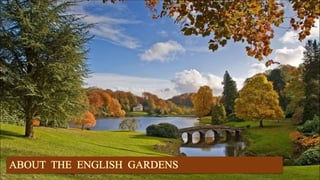
 The English garden usually included a lake, sweeps of gently rolling lawns set
against groves of trees, and recreations of classical temples, Gothic ruins,
bridges, and other picturesque architecture, designed to recreate an idyllic
pastoral landscape.
 By the end of the 18th century the English garden was being imitated by the French
landscape garden.
The shift
 Lines were no longer straight, paths curve and wander, and parterres are
replaced by grass.
 Trees were planted in clusters rather than in straight lines, and rounded
lakes replaced the rectangular ponds of the earlier style.
 The garden became open, a park joining the house to the outside world
rather than a carefully nurtured refuge from it.
 This natural style begun by Kent evolved into the "landscape garden"
under Kent's pupil and son-in-law, Lancelot "Capability" Brown. Brown,
whose curious nickname came from his habit of telling prospective
clients that their gardens showed "great capabilities", had an enormous
effect upon the course of English gardening and architectural style.
 Before the introduction of English landscape, nature was viewed as
dangerous , cranky .
 The English landscape completely changed this view to appreciate and
value the natural world.
Before English garden…..
Before English garden most garden was
arranged in French or Dutch style .
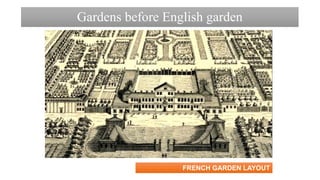
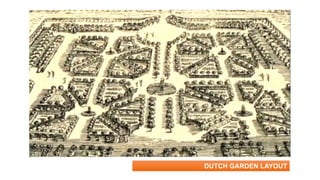
These French and Dutch gardens have
rectangular subdivision.
Straight avenues & paths and water contained
symmetrically shaped basin
Gardens before English garden
FRENCH GARDEN LAYOUT
DUTCH GARDEN LAYOUT
Elements within English gardens
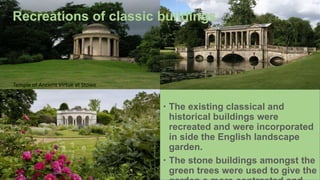
Temple of Ancient Virtue at Stowe
Recreations of classic buildings
 The existing classical and
historical buildings were
recreated and were incorporated
in side the English landscape
garden.
 The stone buildings amongst the
green trees were used to give the
Elements within English gardens:
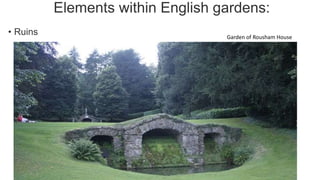
• Ruins Garden of Rousham House
Elements within English gardens:
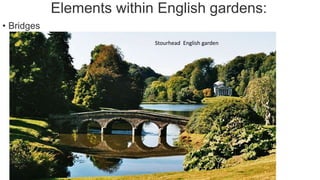
• Bridges
Stourhead English garden
Elements within English gardens
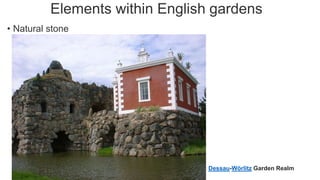
• Natural stone
Dessau-Wörlitz Garden Realm
Elements within English gardens
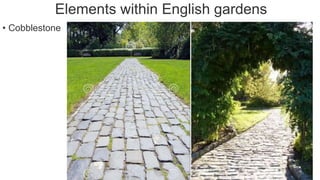
• Cobblestone
Elements within English gardens
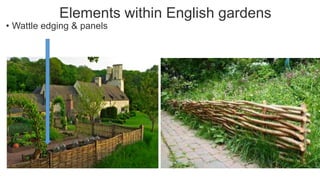
• Wattle edging & panels
Elements within English gardens
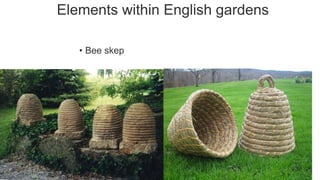
• Bee skep
Common characteristics of an English garden
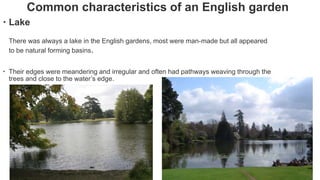
 Lake
There was always a lake in the English gardens, most were man-made but all appeared
to be natural forming basins.
 Their edges were meandering and irregular and often had pathways weaving through the
trees and close to the water’s edge.
Common characteristics of an English garden
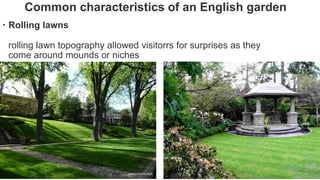
 Rolling lawns
rolling lawn topography allowed visitorrs for surprises as they
come around mounds or niches
Common characteristics of an English garden
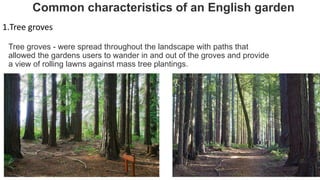
1.Tree groves
Tree groves - were spread throughout the landscape with paths that
allowed the gardens users to wander in and out of the groves and provide
a view of rolling lawns against mass tree plantings.
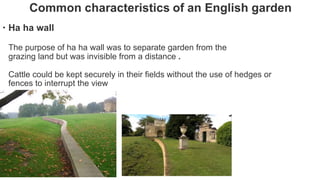
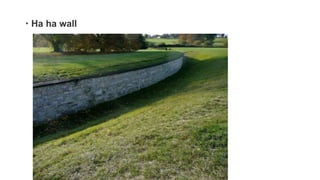
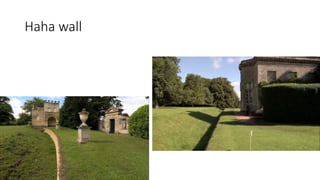
 Ha ha wall
The purpose of ha ha wall was to separate garden from the
grazing land but was invisible from a distance .
Cattle could be kept securely in their fields without the use of hedges or
fences to interrupt the view
 Ha ha wall
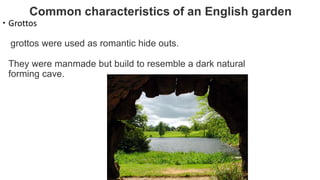
 Grottos
grottos were used as romantic hide outs.
They were manmade but build to resemble a dark natural
forming cave.
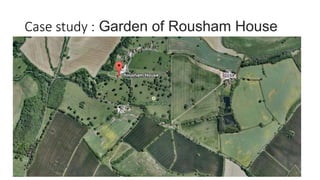
Case study : Garden of Rousham House
Rousham House in Oxfordshire is considered by some as the most
accomplished and significant of William Kent's work.
The patron was General Dormer, who commissioned Bridgeman to begin
the garden in 1727.
But then brought in Kent to recreate it in 1737
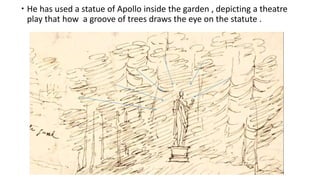
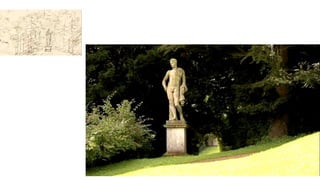
 He has used a statue of Apollo inside the garden , depicting a theatre
play that how a groove of trees draws the eye on the statute .
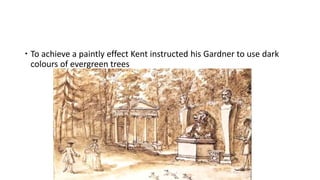
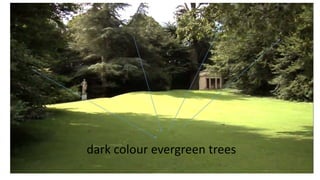
 To achieve a paintly effect Kent instructed his Gardner to use dark
colours of evergreen trees
dark colour evergreen trees
 To create the illusion of unbroken landscape kent has used several
technique at the garden of rousham house.
 One of those technique is ha ha wall
 A wall that separated garden from grazing land , being invisible from a
distance
 Cattle could be kept separated without the use of hedges or fences
Haha wall
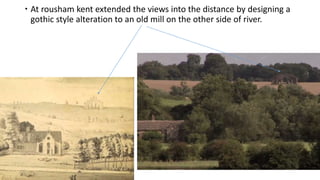
 At rousham kent extended the views into the distance by designing a
gothic style alteration to an old mill on the other side of river.
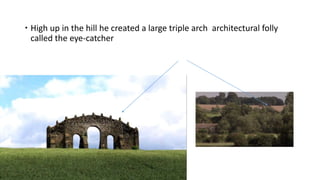
 High up in the hill he created a large triple arch architectural folly
called the eye-catcher
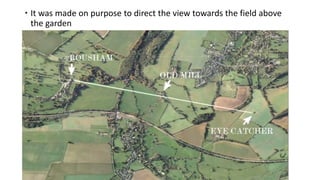
 It was made on purpose to direct the view towards the field above
the garden
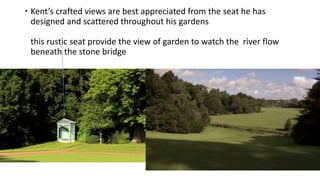
 Kent’s crafted views are best appreciated from the seat he has
designed and scattered throughout his gardens
this rustic seat provide the view of garden to watch the river flow
beneath the stone bridge
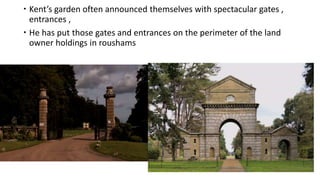
 Kent’s garden often announced themselves with spectacular gates ,
entrances ,
 He has put those gates and entrances on the perimeter of the land
owner holdings in roushams
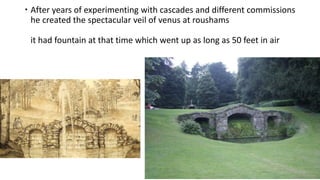
 After years of experimenting with cascades and different commissions
he created the spectacular veil of venus at roushams
it had fountain at that time which went up as long as 50 feet in air

English garden

  • 3.
     The Englishlandscape garden, also called English landscape park or simply the English garden, is a style of “landscape" garden which emerged in England in the early 18th century, and spread across Europe, replacing the more formal, symmetrical French gardens (jardin à la française) of the 17th century as the principal gardening style of Europe.  The English garden presented an idealized view of nature. It drew inspiration from paintings of landscapes by Claude Lorraine and Nicolas Poussin, and, in the Anglo-Chinese garden, from the classic Chinese gardens of the East, which had recently been described by European travellers.  The English garden usually included a lake, sweeps of gently rolling lawns set against groves of trees, and recreations of classical temples, Gothic ruins, bridges, and other picturesque architecture, designed to recreate an idyllic pastoral landscape.  By the end of the 18th century the English garden was being imitated by the French landscape garden.
  • 4.
    The shift  Lineswere no longer straight, paths curve and wander, and parterres are replaced by grass.  Trees were planted in clusters rather than in straight lines, and rounded lakes replaced the rectangular ponds of the earlier style.  The garden became open, a park joining the house to the outside world rather than a carefully nurtured refuge from it.  This natural style begun by Kent evolved into the "landscape garden" under Kent's pupil and son-in-law, Lancelot "Capability" Brown. Brown, whose curious nickname came from his habit of telling prospective clients that their gardens showed "great capabilities", had an enormous effect upon the course of English gardening and architectural style.  Before the introduction of English landscape, nature was viewed as dangerous , cranky .  The English landscape completely changed this view to appreciate and value the natural world.
  • 5.
    Before English garden….. BeforeEnglish garden most garden was arranged in French or Dutch style . These French and Dutch gardens have rectangular subdivision. Straight avenues & paths and water contained symmetrically shaped basin
  • 6.
    Gardens before Englishgarden FRENCH GARDEN LAYOUT
  • 7.
  • 8.
  • 9.
    Temple of AncientVirtue at Stowe Recreations of classic buildings  The existing classical and historical buildings were recreated and were incorporated in side the English landscape garden.  The stone buildings amongst the green trees were used to give the
  • 10.
    Elements within Englishgardens: • Ruins Garden of Rousham House
  • 11.
    Elements within Englishgardens: • Bridges Stourhead English garden
  • 12.
    Elements within Englishgardens • Natural stone Dessau-Wörlitz Garden Realm
  • 13.
    Elements within Englishgardens • Cobblestone
  • 14.
    Elements within Englishgardens • Wattle edging & panels
  • 15.
    Elements within Englishgardens • Bee skep
  • 16.
    Common characteristics ofan English garden  Lake There was always a lake in the English gardens, most were man-made but all appeared to be natural forming basins.  Their edges were meandering and irregular and often had pathways weaving through the trees and close to the water’s edge.
  • 17.
    Common characteristics ofan English garden  Rolling lawns rolling lawn topography allowed visitorrs for surprises as they come around mounds or niches
  • 18.
    Common characteristics ofan English garden 1.Tree groves Tree groves - were spread throughout the landscape with paths that allowed the gardens users to wander in and out of the groves and provide a view of rolling lawns against mass tree plantings.
  • 19.
     Ha hawall The purpose of ha ha wall was to separate garden from the grazing land but was invisible from a distance . Cattle could be kept securely in their fields without the use of hedges or fences to interrupt the view
  • 20.
  • 21.
     Grottos grottos wereused as romantic hide outs. They were manmade but build to resemble a dark natural forming cave.
  • 22.
    Case study :Garden of Rousham House
  • 23.
    Rousham House inOxfordshire is considered by some as the most accomplished and significant of William Kent's work. The patron was General Dormer, who commissioned Bridgeman to begin the garden in 1727. But then brought in Kent to recreate it in 1737
  • 24.
     He hasused a statue of Apollo inside the garden , depicting a theatre play that how a groove of trees draws the eye on the statute .
  • 26.
     To achievea paintly effect Kent instructed his Gardner to use dark colours of evergreen trees
  • 27.
  • 28.
     To createthe illusion of unbroken landscape kent has used several technique at the garden of rousham house.  One of those technique is ha ha wall  A wall that separated garden from grazing land , being invisible from a distance  Cattle could be kept separated without the use of hedges or fences
  • 29.
  • 30.
     At roushamkent extended the views into the distance by designing a gothic style alteration to an old mill on the other side of river.
  • 31.
     High upin the hill he created a large triple arch architectural folly called the eye-catcher
  • 32.
     It wasmade on purpose to direct the view towards the field above the garden
  • 33.
     Kent’s craftedviews are best appreciated from the seat he has designed and scattered throughout his gardens this rustic seat provide the view of garden to watch the river flow beneath the stone bridge
  • 34.
     Kent’s gardenoften announced themselves with spectacular gates , entrances ,  He has put those gates and entrances on the perimeter of the land owner holdings in roushams
  • 35.
     After yearsof experimenting with cascades and different commissions he created the spectacular veil of venus at roushams it had fountain at that time which went up as long as 50 feet in air