Gardens
Mughal and French gardens
AI generated
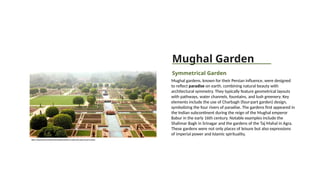
Mughal Garden
Symmetrical Garden
Mughal gardens, known for their Persian influence, were designed
to reflect paradise on earth, combining natural beauty with
architectural symmetry. They typically feature geometrical layouts
with pathways, water channels, fountains, and lush greenery. Key
elements include the use of Charbagh (four-part garden) design,
symbolizing the four rivers of paradise. The gardens first appeared in
the Indian subcontinent during the reign of the Mughal emperor
Babur in the early 16th century. Notable examples include the
Shalimar Bagh in Srinagar and the gardens of the Taj Mahal in Agra.
These gardens were not only places of leisure but also expressions
of imperial power and Islamic spirituality.
https://www.interflora.in/blog/20-beautiful-gardens-in-india-that-nature-lovers-mustsee
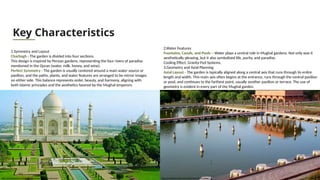
Key Characteristics
1.Symmetry and Layout
Charbagh - The garden is divided into four sections.
This design is inspired by Persian gardens, representing the four rivers of paradise
mentioned in the Quran (water, milk, honey, and wine).
Perfect Symmetry - The garden is usually centered around a main water source or
pavilion, and the paths, plants, and water features are arranged to be mirror images
on either side. This balance represents order, beauty, and harmony, aligning with
both Islamic principles and the aesthetics favored by the Mughal emperors.
2.Water Features
Fountains, Canals, and Pools – Water plays a central role in Mughal gardens. Not only was it
aesthetically pleasing, but it also symbolized life, purity, and paradise.
Cooling Effect, Gravity-Fed Systems.
3.Geometry and Axial Planning
Axial Layout - The garden is typically aligned along a central axis that runs through its entire
length and width. This main axis often begins at the entrance, runs through the central pavilion
or pool, and continues to the farthest point, usually another pavilion or terrace. The use of
geometry is evident in every part of the Mughal garden.
https://xeniumholidays.com/golden-triangle-tour/Golden-triangle-with-ajmer https://travelwithsk.wordpress.com/2020/03/18/shalimar-garden/
Inspiration
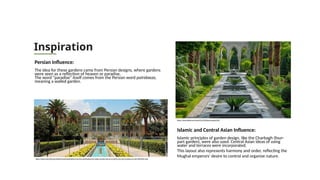
Persian Influence:
The idea for these gardens came from Persian designs, where gardens
were seen as a reflection of heaven or paradise.
The word "paradise" itself comes from the Persian word pairidaeza,
meaning a walled garden.
Islamic and Central Asian Influence:
Islamic principles of garden design, like the Charbagh (four-
part garden), were also used. Central Asian ideas of using
water and terraces were incorporated.
This layout also represents harmony and order, reflecting the
Mughal emperors' desire to control and organize nature.
https://www.cnbctv18.com/photos/travel/destinations/visa-free-destinations-for-indian-tourists-visa-on-arrival-in-iran-top-10-places-to-visit-18995091.htm
https://stock.adobe.com/search?k=%22islamic+garden%22
Elements
•Water Channels and Fountains:
Water was used in every possible way—fountains, small
streams, and large pools. The sound of flowing water created
a peaceful atmosphere.
01
02
03
•Plants and Trees:
Mughal gardens were filled with trees, flowers, and shrubs
that had both aesthetic and symbolic meanings. Some plants
were chosen for their fragrance or fruit.
•Pavilions and Terraces:
These gardens often had shaded areas and small buildings
(pavilions) for resting. Terraces gave the gardens different
levels, making them more visually interesting.
AI generated
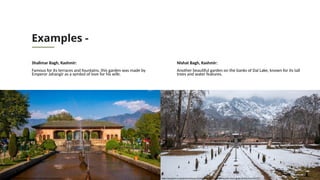
Examples -
Shalimar Bagh, Kashmir:
Famous for its terraces and fountains, this garden was made by
Emperor Jahangir as a symbol of love for his wife.
Nishat Bagh, Kashmir:
Another beautiful garden on the banks of Dal Lake, known for its tall
trees and water features.
https://stock.adobe.com/images/the-landscape-of-nishat-bagh-mughal-garden-during-winter-season-srinagar-kashmir-india/438037729
https://tourism.webindia123.com/tourism/lakes_gardens/Shalimar_Bagh/index.htm
Examples -
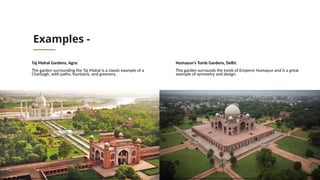
Taj Mahal Gardens, Agra:
The garden surrounding the Taj Mahal is a classic example of a
Charbagh, with paths, fountains, and greenery.
Humayun’s Tomb Gardens, Delhi:
This garden surrounds the tomb of Emperor Humayun and is a great
example of symmetry and design.
https://www.tripadvisor.in/AttractionProductReview-g304551-d27435268-From_Delhi_to_Taj_Mahal_and_Agra_Tour_By_Superfast_Train-New_Delhi_National_Capita.html https://the.akdn/en/resources-media/multimedia/photographs/noble-structure-returned-glory-humayuns-tomb-complex-delhi-india
French Garden
Formalism
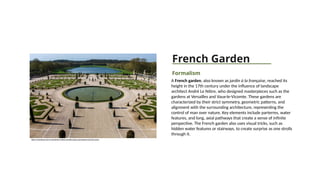
A French garden, also known as jardin à la française, reached its
height in the 17th century under the influence of landscape
architect André Le Nôtre, who designed masterpieces such as the
gardens at Versailles and Vaux-le-Vicomte. These gardens are
characterized by their strict symmetry, geometric patterns, and
alignment with the surrounding architecture, representing the
control of man over nature. Key elements include parterres, water
features, and long, axial pathways that create a sense of infinite
perspective. The French garden also uses visual tricks, such as
hidden water features or stairways, to create surprise as one strolls
through it.
https://www.klook.com/en-IN/activity/114042-versailles-palace-and-gardens-tour-from-paris/
Key Characteristics
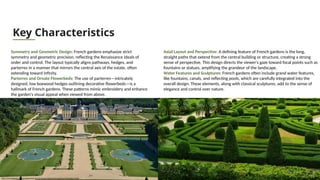
Symmetry and Geometric Design: French gardens emphasize strict
symmetry and geometric precision, reflecting the Renaissance ideals of
order and control. The layout typically aligns pathways, hedges, and
parterres in a manner that mirrors the central axis of the estate, often
extending toward infinity.
Parterres and Ornate Flowerbeds: The use of parterres—intricately
designed, low boxwood hedges outlining decorative flowerbeds—is a
hallmark of French gardens. These patterns mimic embroidery and enhance
the garden's visual appeal when viewed from above.
Axial Layout and Perspective: A defining feature of French gardens is the long,
straight paths that extend from the central building or structure, creating a strong
sense of perspective. This design directs the viewer's gaze toward focal points such as
fountains or statues, amplifying the grandeur of the landscape​
.
Water Features and Sculptures: French gardens often include grand water features,
like fountains, canals, and reflecting pools, which are carefully integrated into the
overall design. These elements, along with classical sculptures, add to the sense of
elegance and control over nature​
.
https://www.myguide-paris.com/experiences/vaux-le-vicomte-chateau-entry-ticket-and-chateaubus-transfe https://hanasblog.beverlyclaire.com/attack-on-titan-fanfiction-bladesmiths-librarians-chapter-4/
Inspiration
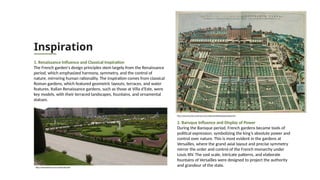
1. Renaissance Influence and Classical Inspiration
The French garden's design principles stem largely from the Renaissance
period, which emphasized harmony, symmetry, and the control of
nature, mirroring human rationality. The inspiration comes from classical
Roman gardens, which featured geometric layouts, terraces, and water
features. Italian Renaissance gardens, such as those at Villa d'Este, were
key models, with their terraced landscapes, fountains, and ornamental
statues.
2. Baroque Influence and Display of Power
During the Baroque period, French gardens became tools of
political expression, symbolizing the king’s absolute power and
control over nature. This is most evident in the gardens at
Versailles, where the grand axial layout and precise symmetry
mirror the order and control of the French monarchy under
Louis XIV. The vast scale, intricate patterns, and elaborate
fountains of Versailles were designed to project the authority
and grandeur of the state.
https://www.bestourism.com/medias/dfp/5090
https://www.art-prints-on-demand.com/a/blaeu/thevilladestepalaceandgar.html
Elements
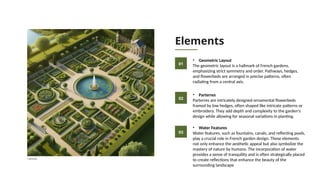
• Geometric Layout
The geometric layout is a hallmark of French gardens,
emphasizing strict symmetry and order. Pathways, hedges,
and flowerbeds are arranged in precise patterns, often
radiating from a central axis.
01
02
03
• Parterres
Parterres are intricately designed ornamental flowerbeds
framed by low hedges, often shaped like intricate patterns or
embroidery. They add depth and complexity to the garden's
design while allowing for seasonal variations in planting.
• Water Features
Water features, such as fountains, canals, and reflecting pools,
play a crucial role in French garden design. These elements
not only enhance the aesthetic appeal but also symbolize the
mastery of nature by humans. The incorporation of water
provides a sense of tranquility and is often strategically placed
to create reflections that enhance the beauty of the
surrounding landscape
AI generated
Examples -
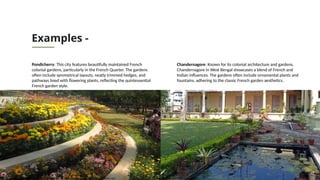
Pondicherry: This city features beautifully maintained French
colonial gardens, particularly in the French Quarter. The gardens
often include symmetrical layouts, neatly trimmed hedges, and
pathways lined with flowering plants, reflecting the quintessential
French garden style.
Chandernagore: Known for its colonial architecture and gardens,
Chandernagore in West Bengal showcases a blend of French and
Indian influences. The gardens often include ornamental plants and
fountains, adhering to the classic French garden aesthetics.
https://www.tripadvisor.in/Attraction_Review-g659792-d568076-Reviews-Pondicherry_Botanical_Gardens-Pondicherry_Union_Territory_of_Pondicherry.html https://www.indiaunveiled.in/location/chandannagar
Examples -
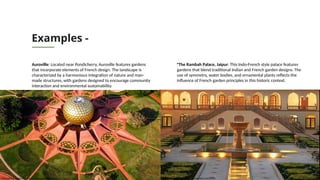
Auroville: Located near Pondicherry, Auroville features gardens
that incorporate elements of French design. The landscape is
characterized by a harmonious integration of nature and man-
made structures, with gardens designed to encourage community
interaction and environmental sustainability.
•The Rambah Palace, Jaipur: This Indo-French style palace features
gardens that blend traditional Indian and French garden designs. The
use of symmetry, water bodies, and ornamental plants reflects the
influence of French garden principles in this historic context.
https://xplro.com/auroville-puducherrys-unique-path-to-universal-harmony/ https://www.momondo.in/hotels/jaipur/Rambagh-Palace.mhd56542.ksp
Comparision -
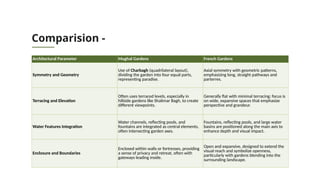
Architectural Parameter Mughal Gardens French Gardens
Symmetry and Geometry
Use of Charbagh (quadrilateral layout),
dividing the garden into four equal parts,
representing paradise​
.
Axial symmetry with geometric patterns,
emphasizing long, straight pathways and
parterres​
.
Terracing and Elevation
Often uses terraced levels, especially in
hillside gardens like Shalimar Bagh, to create
different viewpoints​
.
Generally flat with minimal terracing; focus is
on wide, expansive spaces that emphasize
perspective and grandeur.
Water Features Integration
Water channels, reflecting pools, and
fountains are integrated as central elements,
often intersecting garden axes.
Fountains, reflecting pools, and large water
basins are positioned along the main axis to
enhance depth and visual impact.
Enclosure and Boundaries
Enclosed within walls or fortresses, providing
a sense of privacy and retreat, often with
gateways leading inside​
.
Open and expansive, designed to extend the
visual reach and symbolize openness,
particularly with gardens blending into the
surrounding landscape.
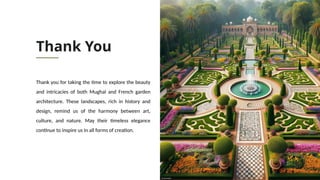
Thank You
Thank you for taking the time to explore the beauty
and intricacies of both Mughal and French garden
architecture. These landscapes, rich in history and
design, remind us of the harmony between art,
culture, and nature. May their timeless elegance
continue to inspire us in all forms of creation.
AI Generated


Landscape assignment for historical garden

  • 1.
    Gardens Mughal and Frenchgardens AI generated
  • 2.
    Mughal Garden Symmetrical Garden Mughalgardens, known for their Persian influence, were designed to reflect paradise on earth, combining natural beauty with architectural symmetry. They typically feature geometrical layouts with pathways, water channels, fountains, and lush greenery. Key elements include the use of Charbagh (four-part garden) design, symbolizing the four rivers of paradise. The gardens first appeared in the Indian subcontinent during the reign of the Mughal emperor Babur in the early 16th century. Notable examples include the Shalimar Bagh in Srinagar and the gardens of the Taj Mahal in Agra. These gardens were not only places of leisure but also expressions of imperial power and Islamic spirituality. https://www.interflora.in/blog/20-beautiful-gardens-in-india-that-nature-lovers-mustsee
  • 3.
    Key Characteristics 1.Symmetry andLayout Charbagh - The garden is divided into four sections. This design is inspired by Persian gardens, representing the four rivers of paradise mentioned in the Quran (water, milk, honey, and wine). Perfect Symmetry - The garden is usually centered around a main water source or pavilion, and the paths, plants, and water features are arranged to be mirror images on either side. This balance represents order, beauty, and harmony, aligning with both Islamic principles and the aesthetics favored by the Mughal emperors. 2.Water Features Fountains, Canals, and Pools – Water plays a central role in Mughal gardens. Not only was it aesthetically pleasing, but it also symbolized life, purity, and paradise. Cooling Effect, Gravity-Fed Systems. 3.Geometry and Axial Planning Axial Layout - The garden is typically aligned along a central axis that runs through its entire length and width. This main axis often begins at the entrance, runs through the central pavilion or pool, and continues to the farthest point, usually another pavilion or terrace. The use of geometry is evident in every part of the Mughal garden. https://xeniumholidays.com/golden-triangle-tour/Golden-triangle-with-ajmer https://travelwithsk.wordpress.com/2020/03/18/shalimar-garden/
  • 4.
    Inspiration Persian Influence: The ideafor these gardens came from Persian designs, where gardens were seen as a reflection of heaven or paradise. The word "paradise" itself comes from the Persian word pairidaeza, meaning a walled garden. Islamic and Central Asian Influence: Islamic principles of garden design, like the Charbagh (four- part garden), were also used. Central Asian ideas of using water and terraces were incorporated. This layout also represents harmony and order, reflecting the Mughal emperors' desire to control and organize nature. https://www.cnbctv18.com/photos/travel/destinations/visa-free-destinations-for-indian-tourists-visa-on-arrival-in-iran-top-10-places-to-visit-18995091.htm https://stock.adobe.com/search?k=%22islamic+garden%22
  • 5.
    Elements •Water Channels andFountains: Water was used in every possible way—fountains, small streams, and large pools. The sound of flowing water created a peaceful atmosphere. 01 02 03 •Plants and Trees: Mughal gardens were filled with trees, flowers, and shrubs that had both aesthetic and symbolic meanings. Some plants were chosen for their fragrance or fruit. •Pavilions and Terraces: These gardens often had shaded areas and small buildings (pavilions) for resting. Terraces gave the gardens different levels, making them more visually interesting. AI generated
  • 6.
    Examples - Shalimar Bagh,Kashmir: Famous for its terraces and fountains, this garden was made by Emperor Jahangir as a symbol of love for his wife. Nishat Bagh, Kashmir: Another beautiful garden on the banks of Dal Lake, known for its tall trees and water features. https://stock.adobe.com/images/the-landscape-of-nishat-bagh-mughal-garden-during-winter-season-srinagar-kashmir-india/438037729 https://tourism.webindia123.com/tourism/lakes_gardens/Shalimar_Bagh/index.htm
  • 7.
    Examples - Taj MahalGardens, Agra: The garden surrounding the Taj Mahal is a classic example of a Charbagh, with paths, fountains, and greenery. Humayun’s Tomb Gardens, Delhi: This garden surrounds the tomb of Emperor Humayun and is a great example of symmetry and design. https://www.tripadvisor.in/AttractionProductReview-g304551-d27435268-From_Delhi_to_Taj_Mahal_and_Agra_Tour_By_Superfast_Train-New_Delhi_National_Capita.html https://the.akdn/en/resources-media/multimedia/photographs/noble-structure-returned-glory-humayuns-tomb-complex-delhi-india
  • 8.
    French Garden Formalism A Frenchgarden, also known as jardin à la française, reached its height in the 17th century under the influence of landscape architect André Le Nôtre, who designed masterpieces such as the gardens at Versailles and Vaux-le-Vicomte. These gardens are characterized by their strict symmetry, geometric patterns, and alignment with the surrounding architecture, representing the control of man over nature. Key elements include parterres, water features, and long, axial pathways that create a sense of infinite perspective. The French garden also uses visual tricks, such as hidden water features or stairways, to create surprise as one strolls through it. https://www.klook.com/en-IN/activity/114042-versailles-palace-and-gardens-tour-from-paris/
  • 9.
    Key Characteristics Symmetry andGeometric Design: French gardens emphasize strict symmetry and geometric precision, reflecting the Renaissance ideals of order and control. The layout typically aligns pathways, hedges, and parterres in a manner that mirrors the central axis of the estate, often extending toward infinity. Parterres and Ornate Flowerbeds: The use of parterres—intricately designed, low boxwood hedges outlining decorative flowerbeds—is a hallmark of French gardens. These patterns mimic embroidery and enhance the garden's visual appeal when viewed from above. Axial Layout and Perspective: A defining feature of French gardens is the long, straight paths that extend from the central building or structure, creating a strong sense of perspective. This design directs the viewer's gaze toward focal points such as fountains or statues, amplifying the grandeur of the landscape​ . Water Features and Sculptures: French gardens often include grand water features, like fountains, canals, and reflecting pools, which are carefully integrated into the overall design. These elements, along with classical sculptures, add to the sense of elegance and control over nature​ . https://www.myguide-paris.com/experiences/vaux-le-vicomte-chateau-entry-ticket-and-chateaubus-transfe https://hanasblog.beverlyclaire.com/attack-on-titan-fanfiction-bladesmiths-librarians-chapter-4/
  • 10.
    Inspiration 1. Renaissance Influenceand Classical Inspiration The French garden's design principles stem largely from the Renaissance period, which emphasized harmony, symmetry, and the control of nature, mirroring human rationality. The inspiration comes from classical Roman gardens, which featured geometric layouts, terraces, and water features. Italian Renaissance gardens, such as those at Villa d'Este, were key models, with their terraced landscapes, fountains, and ornamental statues. 2. Baroque Influence and Display of Power During the Baroque period, French gardens became tools of political expression, symbolizing the king’s absolute power and control over nature. This is most evident in the gardens at Versailles, where the grand axial layout and precise symmetry mirror the order and control of the French monarchy under Louis XIV. The vast scale, intricate patterns, and elaborate fountains of Versailles were designed to project the authority and grandeur of the state. https://www.bestourism.com/medias/dfp/5090 https://www.art-prints-on-demand.com/a/blaeu/thevilladestepalaceandgar.html
  • 11.
    Elements • Geometric Layout Thegeometric layout is a hallmark of French gardens, emphasizing strict symmetry and order. Pathways, hedges, and flowerbeds are arranged in precise patterns, often radiating from a central axis. 01 02 03 • Parterres Parterres are intricately designed ornamental flowerbeds framed by low hedges, often shaped like intricate patterns or embroidery. They add depth and complexity to the garden's design while allowing for seasonal variations in planting. • Water Features Water features, such as fountains, canals, and reflecting pools, play a crucial role in French garden design. These elements not only enhance the aesthetic appeal but also symbolize the mastery of nature by humans. The incorporation of water provides a sense of tranquility and is often strategically placed to create reflections that enhance the beauty of the surrounding landscape AI generated
  • 12.
    Examples - Pondicherry: Thiscity features beautifully maintained French colonial gardens, particularly in the French Quarter. The gardens often include symmetrical layouts, neatly trimmed hedges, and pathways lined with flowering plants, reflecting the quintessential French garden style. Chandernagore: Known for its colonial architecture and gardens, Chandernagore in West Bengal showcases a blend of French and Indian influences. The gardens often include ornamental plants and fountains, adhering to the classic French garden aesthetics. https://www.tripadvisor.in/Attraction_Review-g659792-d568076-Reviews-Pondicherry_Botanical_Gardens-Pondicherry_Union_Territory_of_Pondicherry.html https://www.indiaunveiled.in/location/chandannagar
  • 13.
    Examples - Auroville: Locatednear Pondicherry, Auroville features gardens that incorporate elements of French design. The landscape is characterized by a harmonious integration of nature and man- made structures, with gardens designed to encourage community interaction and environmental sustainability. •The Rambah Palace, Jaipur: This Indo-French style palace features gardens that blend traditional Indian and French garden designs. The use of symmetry, water bodies, and ornamental plants reflects the influence of French garden principles in this historic context. https://xplro.com/auroville-puducherrys-unique-path-to-universal-harmony/ https://www.momondo.in/hotels/jaipur/Rambagh-Palace.mhd56542.ksp
  • 14.
    Comparision - Architectural ParameterMughal Gardens French Gardens Symmetry and Geometry Use of Charbagh (quadrilateral layout), dividing the garden into four equal parts, representing paradise​ . Axial symmetry with geometric patterns, emphasizing long, straight pathways and parterres​ . Terracing and Elevation Often uses terraced levels, especially in hillside gardens like Shalimar Bagh, to create different viewpoints​ . Generally flat with minimal terracing; focus is on wide, expansive spaces that emphasize perspective and grandeur. Water Features Integration Water channels, reflecting pools, and fountains are integrated as central elements, often intersecting garden axes. Fountains, reflecting pools, and large water basins are positioned along the main axis to enhance depth and visual impact. Enclosure and Boundaries Enclosed within walls or fortresses, providing a sense of privacy and retreat, often with gateways leading inside​ . Open and expansive, designed to extend the visual reach and symbolize openness, particularly with gardens blending into the surrounding landscape.
  • 15.
    Thank You Thank youfor taking the time to explore the beauty and intricacies of both Mughal and French garden architecture. These landscapes, rich in history and design, remind us of the harmony between art, culture, and nature. May their timeless elegance continue to inspire us in all forms of creation. AI Generated