LANDSCAPE DESIGN
1
Lorem Ipsum Dolor
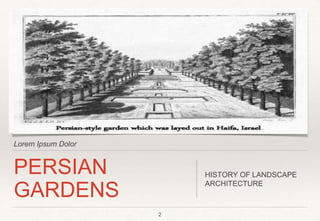
PERSIAN
GARDENS
HISTORY OF LANDSCAPE
ARCHITECTURE
2
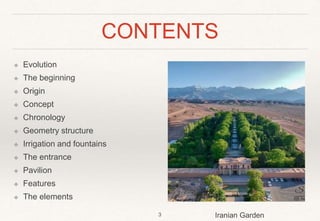
CONTENTS
❖ Evolution
❖ The beginning
❖ Origin
❖ Concept
❖ Chronology
❖ Geometry structure
❖ Irrigation and fountains
❖ The entrance
❖ Pavilion
❖ Features
❖ The elements
3 Iranian Garden
CONTENTS
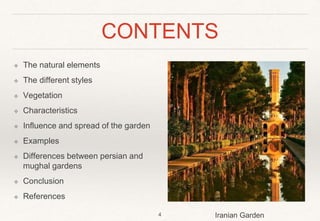
❖ The natural elements
❖ The different styles
❖ Vegetation
❖ Characteristics
❖ Influence and spread of the garden
❖ Examples
❖ Differences between persian and
mughal gardens
❖ Conclusion
❖ References
4 Iranian Garden
EVOLUTION
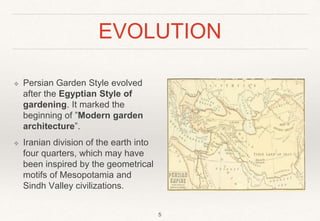
❖ Persian Garden Style evolved
after the Egyptian Style of
gardening. It marked the
beginning of ”Modern garden
architecture”.
❖ Iranian division of the earth into
four quarters, which may have
been inspired by the geometrical
motifs of Mesopotamia and
Sindh Valley civilizations.
5
THE BEGINNING…
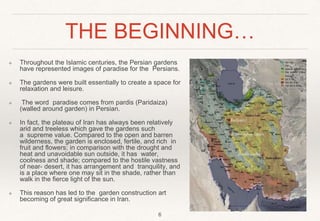
❖ Throughout the Islamic centuries, the Persian gardens
have represented images of paradise for the Persians.
❖ The gardens were built essentially to create a space for
relaxation and leisure.
❖ The word paradise comes from pardis (Paridaiza)
(walled around garden) in Persian.
❖ In fact, the plateau of Iran has always been relatively
arid and treeless which gave the gardens such
a supreme value. Compared to the open and barren
wilderness, the garden is enclosed, fertile, and rich in
fruit and flowers; in comparison with the drought and
heat and unavoidable sun outside, it has water,
coolness and shade; compared to the hostile vastness
of near- desert, it has arrangement and tranquility, and
is a place where one may sit in the shade, rather than
walk in the fierce light of the sun.
❖ This reason has led to the garden construction art
becoming of great significance in Iran.
6
ORIGIN
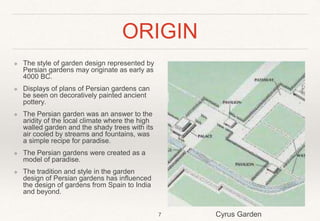
❖ The style of garden design represented by
Persian gardens may originate as early as
4000 BC.
❖ Displays of plans of Persian gardens can
be seen on decoratively painted ancient
pottery.
❖ The Persian garden was an answer to the
aridity of the local climate where the high
walled garden and the shady trees with its
air cooled by streams and fountains, was
a simple recipe for paradise.
❖ The Persian gardens were created as a
model of paradise.
❖ The tradition and style in the garden
design of Persian gardens has influenced
the design of gardens from Spain to India
and beyond.
7 Cyrus Garden
CONCEPT
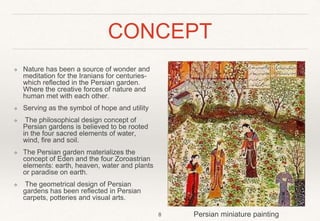
❖ Nature has been a source of wonder and
meditation for the Iranians for centuries-
which reflected in the Persian garden.
Where the creative forces of nature and
human met with each other.
❖ Serving as the symbol of hope and utility
❖ The philosophical design concept of
Persian gardens is believed to be rooted
in the four sacred elements of water,
wind, fire and soil.
❖ The Persian garden materializes the
concept of Eden and the four Zoroastrian
elements: earth, heaven, water and plants
or paradise on earth.
❖ The geometrical design of Persian
gardens has been reflected in Persian
carpets, potteries and visual arts.
8 Persian miniature painting
CHRONOLOGY
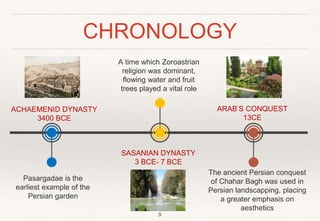
ACHAEMENID DYNASTY
3400 BCE
Pasargadae is the
earliest example of the
Persian garden
A time which Zoroastrian
religion was dominant,
flowing water and fruit
trees played a vital role
SASANIAN DYNASTY
3 BCE- 7 BCE
The ancient Persian conquest
of Chahar Bagh was used in
Persian landscapping, placing
a greater emphasis on
aesthetics
ARAB’S CONQUEST
13CE
9
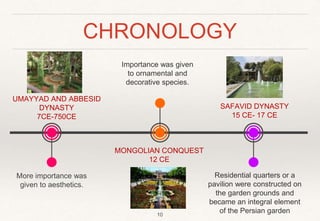
CHRONOLOGY
UMAYYAD AND ABBESID
DYNASTY
7CE-750CE
More importance was
given to aesthetics.
Importance was given
to ornamental and
decorative species.
MONGOLIAN CONQUEST
12 CE
SAFAVID DYNASTY
15 CE- 17 CE
Residential quarters or a
pavilion were constructed on
the garden grounds and
became an integral element
of the Persian garden
10
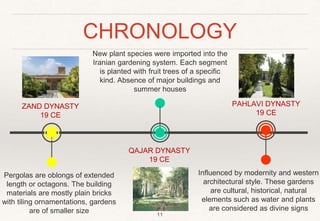
CHRONOLOGY
ZAND DYNASTY
19 CE
Pergolas are oblongs of extended
length or octagons. The building
materials are mostly plain bricks
with tiling ornamentations, gardens
are of smaller size
New plant species were imported into the
Iranian gardening system. Each segment
is planted with fruit trees of a specific
kind. Absence of major buildings and
summer houses
.
QAJAR DYNASTY
19 CE
PAHLAVI DYNASTY
19 CE
Influenced by modernity and western
architectural style. These gardens
are cultural, historical, natural
elements such as water and plants
are considered as divine signs
11
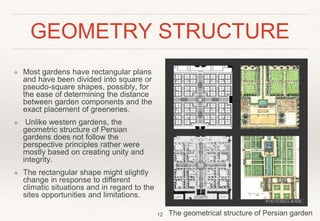
GEOMETRY STRUCTURE
❖ Most gardens have rectangular plans
and have been divided into square or
pseudo-square shapes, possibly, for
the ease of determining the distance
between garden components and the
exact placement of greeneries.
❖ Unlike western gardens, the
geometric structure of Persian
gardens does not follow the
perspective principles rather were
mostly based on creating unity and
integrity.
❖ The rectangular shape might slightly
change in response to different
climatic situations and in regard to the
sites opportunities and limitations.
12 The geometrical structure of Persian garden
GEOMETRY STRUCTURE
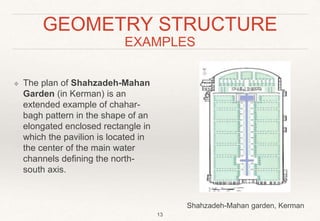
EXAMPLES
❖ The plan of Shahzadeh-Mahan
Garden (in Kerman) is an
extended example of chahar-
bagh pattern in the shape of an
elongated enclosed rectangle in
which the pavilion is located in
the center of the main water
channels defining the north-
south axis.
13
Shahzadeh-Mahan garden, Kerman
GEOMETRY STRUCTURE
EXAMPLES
❖ The structure of Fin Garden (in
Kashan) is also an extended
form of chahar-bagh in a series
of squares and rectangles with a
pavilion and square basin in the
center. The water axes defining
the chahar-bagh include a main
one which leads the user from
the entrance gateway to the
central pavilion and a secondary
one with a turquoise-tiled water
channel.
14
The plan of Fin garden, Kashan
GEOMETRY STRUCTURE
EXAMPLES
❖ The Chehelsotun Garden
design also stretches to a
square shape with a pavilion
located at the intersection of the
primary axis defined by two
large pools and a secondary
asymmetric axis with a smaller
pool on the western side
15
The plan of Chehel sotun garden, Esfahan
IRRIGATION AND FOUNTAINS
❖ The water with its scarcity and limitation have been
a sacred and precious element in the ancient
Persia.
❖ The presence of water in Persian gardens has a
dual application; a functional application of irrigation
besides an ornamental and aesthetic purpose.
❖ Therefore, the pattern of chahar-bagh is usually
defined with the intersected water channels or
streams. The streams usually had a sufficient slope
to enable the irrigation system required for the
garden
❖ The water coming from far distances into the water
channels had a significant impact on the design of
gardens; to the extent of the claim that the structure
of gardens has been shaped according to the
irrigation system .
❖ Other than water channels, the front space of the
pavilion was usually dedicated to a pond or large
pool to reflect the image of the building and sky
connecting the realm of the earthly to the heavenly.
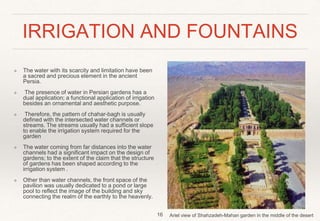
16 Ariel view of Shahzadeh-Mahan garden in the middle of the desert
IRRIGATION AND FOUNTAINS
Examples
FIN GARDEN
❖ The required water for the Fin garden has
been provided by an old Sulaimaniyah
Spring.
❖ The main branch furcates into the pools
and water channelswith several fountains.
❖ The garden contains several streams,
basins and pools which are located on the
axes to circulate water around the garden.
❖ The main pool of the garden is located in
the central main square in front of the
pavilion and there are four other pools
covered by cupolas within the pavilion not
only to be protected from the sun, but also
intensifying the value of the water
17
Water way circulation, fountains and basins
IRRIGATION AND FOUNTAINS
Examples
CHEHEL-SOTUN
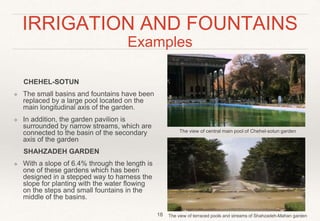
❖ The small basins and fountains have been
replaced by a large pool located on the
main longitudinal axis of the garden.
❖ In addition, the garden pavilion is
surrounded by narrow streams, which are
connected to the basin of the secondary
axis of the garden
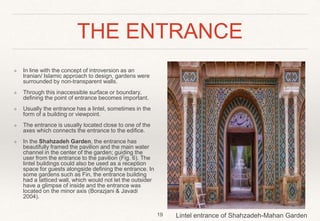
SHAHZADEH GARDEN
❖ With a slope of 6.4% through the length is
one of these gardens which has been
designed in a stepped way to harness the
slope for planting with the water flowing
on the steps and small fountains in the
middle of the basins.
18
The view of central main pool of Chehel-sotun garden
The view of terraced pools and streams of Shahzadeh-Mahan garden
THE ENTRANCE
❖ In line with the concept of introversion as an
Iranian/ Islamic approach to design, gardens were
surrounded by non-transparent walls.
❖ Through this inaccessible surface or boundary,
defining the point of entrance becomes important.
❖ Usually the entrance has a lintel, sometimes in the
form of a building or viewpoint.
❖ The entrance is usually located close to one of the
axes which connects the entrance to the edifice.
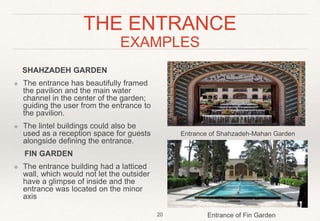
❖ In the Shahzadeh Garden, the entrance has
beautifully framed the pavilion and the main water
channel in the center of the garden; guiding the
user from the entrance to the pavilion (Fig. 6). The
lintel buildings could also be used as a reception
space for guests alongside defining the entrance. In
some gardens such as Fin, the entrance building
had a latticed wall, which would not let the outsider
have a glimpse of inside and the entrance was
located on the minor axis (Borazjani & Javadi
2004).
19 Lintel entrance of Shahzadeh-Mahan Garden
THE ENTRANCE
EXAMPLES
SHAHZADEH GARDEN
❖ The entrance has beautifully framed
the pavilion and the main water
channel in the center of the garden;
guiding the user from the entrance to
the pavilion.
❖ The lintel buildings could also be
used as a reception space for guests
alongside defining the entrance.
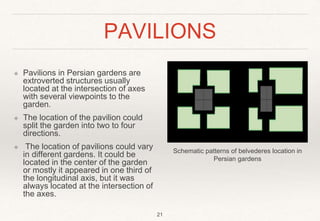
FIN GARDEN
❖ The entrance building had a latticed
wall, which would not let the outsider
have a glimpse of inside and the
entrance was located on the minor
axis
20 Entrance of Fin Garden
Entrance of Shahzadeh-Mahan Garden
PAVILIONS
❖ Pavilions in Persian gardens are
extroverted structures usually
located at the intersection of axes
with several viewpoints to the
garden.
❖ The location of the pavilion could
split the garden into two to four
directions.
❖ The location of pavilions could vary
in different gardens. It could be
located in the center of the garden
or mostly it appeared in one third of
the longitudinal axis, but it was
always located at the intersection of
the axes.
Schematic patterns of belvederes location in
Persian gardens
21
PAVILIONS
EXAMPLES
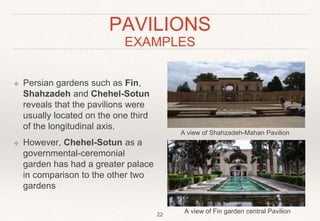
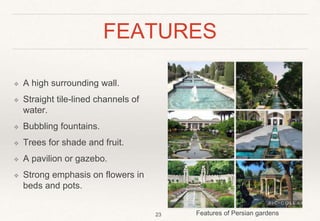
❖ Persian gardens such as Fin,
Shahzadeh and Chehel-Sotun
reveals that the pavilions were
usually located on the one third
of the longitudinal axis.
❖ However, Chehel-Sotun as a
governmental-ceremonial
garden has had a greater palace
in comparison to the other two
gardens
A view of Shahzadeh-Mahan Pavilion
A view of Fin garden central Pavilion
22
FEATURES
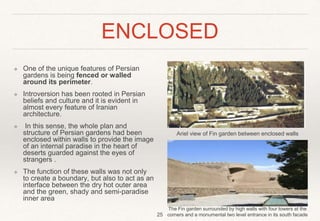
❖ A high surrounding wall.
❖ Straight tile-lined channels of
water.
❖ Bubbling fountains.
❖ Trees for shade and fruit.
❖ A pavilion or gazebo.
❖ Strong emphasis on flowers in
beds and pots.
23 Features of Persian gardens
HISTORY OF LANDSCAPE ARCHITECTURE
THE ELEMENTS PERSIAN GARDENS
24
ENCLOSED
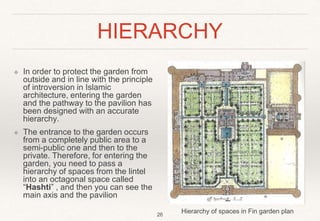
❖ One of the unique features of Persian
gardens is being fenced or walled
around its perimeter.
❖ Introversion has been rooted in Persian
beliefs and culture and it is evident in
almost every feature of Iranian
architecture.
❖ In this sense, the whole plan and
structure of Persian gardens had been
enclosed within walls to provide the image
of an internal paradise in the heart of
deserts guarded against the eyes of
strangers .
❖ The function of these walls was not only
to create a boundary, but also to act as an
interface between the dry hot outer area
and the green, shady and semi-paradise
inner area
The Fin garden surrounded by high walls with four towers at the
corners and a monumental two level entrance in its south facade
Ariel view of Fin garden between enclosed walls
25
HIERARCHY
❖ In order to protect the garden from
outside and in line with the principle
of introversion in Islamic
architecture, entering the garden
and the pathway to the pavilion has
been designed with an accurate
hierarchy.
❖ The entrance to the garden occurs
from a completely public area to a
semi-public one and then to the
private. Therefore, for entering the
garden, you need to pass a
hierarchy of spaces from the lintel
into an octagonal space called
“Hashti” , and then you can see the
main axis and the pavilion
Hierarchy of spaces in Fin garden plan
26
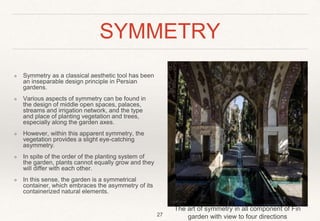
SYMMETRY
❖ Symmetry as a classical aesthetic tool has been
an inseparable design principle in Persian
gardens.
❖ Various aspects of symmetry can be found in
the design of middle open spaces, palaces,
streams and irrigation network, and the type
and place of planting vegetation and trees,
especially along the garden axes.
❖ However, within this apparent symmetry, the
vegetation provides a slight eye-catching
asymmetry.
❖ In spite of the order of the planting system of
the garden, plants cannot equally grow and they
will differ with each other.
❖ In this sense, the garden is a symmetrical
container, which embraces the asymmetry of its
containerized natural elements.
The art of symmetry in all component of Fin
garden with view to four directions
27
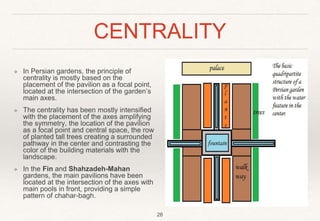
CENTRALITY
❖ In Persian gardens, the principle of
centrality is mostly based on the
placement of the pavilion as a focal point,
located at the intersection of the garden’s
main axes.
❖ The centrality has been mostly intensified
with the placement of the axes amplifying
the symmetry, the location of the pavilion
as a focal point and central space, the row
of planted tall trees creating a surrounded
pathway in the center and contrasting the
color of the building materials with the
landscape.
❖ In the Fin and Shahzadeh-Mahan
gardens, the main pavilions have been
located at the intersection of the axes with
main pools in front, providing a simple
pattern of chahar-bagh.
28
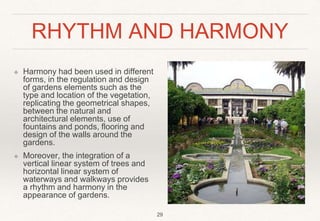
RHYTHM AND HARMONY
❖ Harmony had been used in different
forms, in the regulation and design
of gardens elements such as the
type and location of the vegetation,
replicating the geometrical shapes,
between the natural and
architectural elements, use of
fountains and ponds, flooring and
design of the walls around the
gardens.
❖ Moreover, the integration of a
vertical linear system of trees and
horizontal linear system of
waterways and walkways provides
a rhythm and harmony in the
appearance of gardens.
29
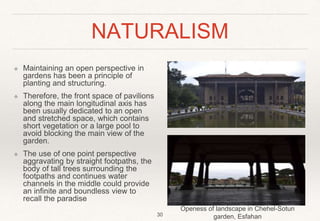
NATURALISM
❖ Maintaining an open perspective in
gardens has been a principle of
planting and structuring.
❖ Therefore, the front space of pavilions
along the main longitudinal axis has
been usually dedicated to an open
and stretched space, which contains
short vegetation or a large pool to
avoid blocking the main view of the
garden.
❖ The use of one point perspective
aggravating by straight footpaths, the
body of tall trees surrounding the
footpaths and continues water
channels in the middle could provide
an infinite and boundless view to
recall the paradise
Openess of landscape in Chehel-Sotun
garden, Esfahan
30
HISTORY OF LANDSCAPE ARCHITECTURE
THE NATURAL
ELEMENTS
PERSIAN GARDENS
31
The Natural Elements
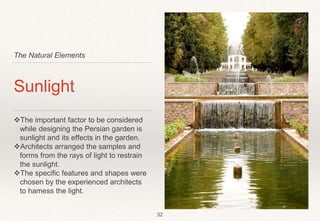
Sunlight
The important factor to be considered
while designing the Persian garden is
sunlight and its effects in the garden.
Architects arranged the samples and
forms from the rays of light to restrain
the sunlight.
The specific features and shapes were
chosen by the experienced architects
to hamess the light.
32
The Natural Elements
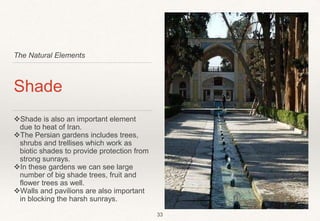
Shade
Shade is also an important element
due to heat of Iran.
The Persian gardens includes trees,
shrubs and trellises which work as
biotic shades to provide protection from
strong sunrays.
In these gardens we can see large
number of big shade trees, fruit and
flower trees as well.
Walls and pavilions are also important
in blocking the harsh sunrays.
33
The Natural Elements
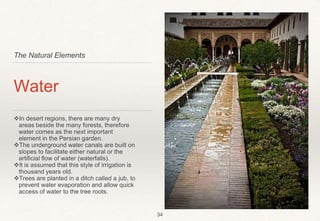
Water
In desert regions, there are many dry
areas beside the many forests, therefore
water comes as the next important
element in the Persian garden.
The underground water canals are built on
slopes to facilitate either natural or the
artificial flow of water (waterfalls).
It is assumed that this style of irrigation is
thousand years old.
Trees are planted in a ditch called a jub, to
prevent water evaporation and allow quick
access of water to the tree roots.
34
The Natural Elements
Buildings
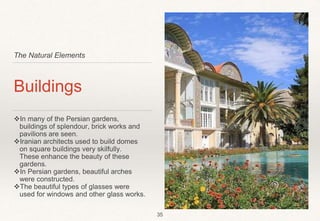
In many of the Persian gardens,
buildings of splendour, brick works and
pavilions are seen.
Iranian architects used to build domes
on square buildings very skilfully.
These enhance the beauty of these
gardens.
In Persian gardens, beautiful arches
were constructed.
The beautiful types of glasses were
used for windows and other glass works.
35
THE DIFFERENT STYLES
36
CLASSICAL FORMAL CASUAL
PUBLIC Hayat Meidan Park
PRIVATE Hayat Chahar Bagh Bagh
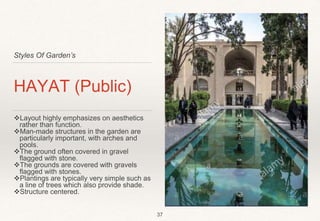
Styles Of Garden’s
HAYAT (Public)
Layout highly emphasizes on aesthetics
rather than function.
Man-made structures in the garden are
particularly important, with arches and
pools.
The ground often covered in gravel
flagged with stone.
The grounds are covered with gravels
flagged with stones.
Plantings are typically very simple such as
a line of trees which also provide shade.
Structure centered.
37
Styles Of Garden’s
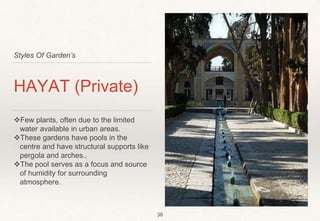
HAYAT (Private)
Few plants, often due to the limited
water available in urban areas.
These gardens have pools in the
centre and have structural supports like
pergola and arches..
The pool serves as a focus and source
of humidity for surrounding
atmosphere.
38
Styles Of Garden’s
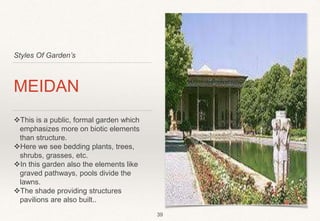
MEIDAN
This is a public, formal garden which
emphasizes more on biotic elements
than structure.
Here we see bedding plants, trees,
shrubs, grasses, etc.
In this garden also the elements like
graved pathways, pools divide the
lawns.
The shade providing structures
pavilions are also built..
39
Styles Of Garden’s
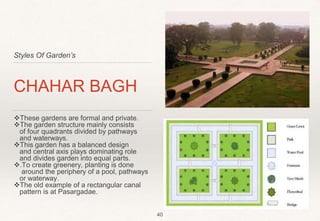
CHAHAR BAGH
These gardens are formal and private.
The garden structure mainly consists
of four quadrants divided by pathways
and waterways.
This garden has a balanced design
and central axis plays dominating role
and divides garden into equal parts.
.To create greenery, planting is done
around the periphery of a pool, pathways
or waterway.
The old example of a rectangular canal
pattern is at Pasargadae.
40
Styles Of Garden’s
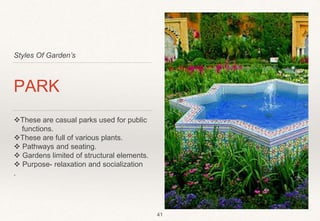
PARK
These are casual parks used for public
functions.
These are full of various plants.
 Pathways and seating.
 Gardens limited of structural elements.
 Purpose- relaxation and socialization
.
41
Styles Of Garden’s
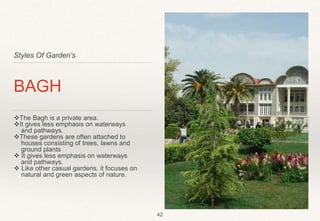
BAGH
The Bagh is a private area.
It gives less emphasis on waterways
and pathways.
These gardens are often attached to
houses consisting of trees, lawns and
ground plants
 It gives less emphasis on waterways
and pathways.
 Like other casual gardens, it focuses on
natural and green aspects of nature.
42
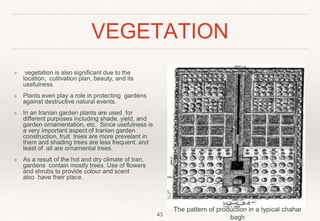
VEGETATION
❖ vegetation is also significant due to the
location, cultivation plan, beauty, and its
usefulness.
❖ Plants even play a role in protecting gardens
against destructive natural events.
❖ In an Iranian garden plants are used for
different purposes including shade, yield, and
garden ornamentation, etc. Since usefulness is
a very important aspect of Iranian garden
construction, fruit trees are more prevelant in
them and shading trees are less frequent, and
least of all are ornamental trees.
❖ As a result of the hot and dry climate of Iran,
gardens contain mostly trees. Use of flowers
and shrubs to provide colour and scent
also have their place.

The pattern of production in a typical chahar
bagh
43
VEGETATION
❖ Along the streams in long streets are planted cedar,
pine and box. Aspen, Tabrizi and rowan have
mostly been planted in clay lands ,Wych elm, bid,
and purple trees, have often been planted around
pools.
❖ Plots at both sides of the routes into a garden,
were covered by fruit seedlings, plots around the
gardens were covered by grapevines, and the
pathways, corners, and shelters were covered by
fig, senjed, and annab trees.
❖ Instead of planting high trees and bushes among
the plot to cover the garden’s building, spest (a kind
of alfalfa) was used.
❖ Also flowers have had important role in gardens.
Seasonal flowers used to be planted in front of
palaces and small aromatic flowers had
been planted beside trees.
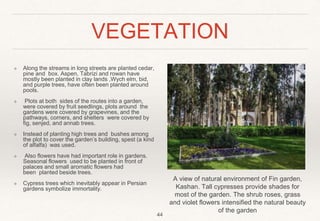
❖ Cypress trees which inevitably appear in Persian
gardens symbolize immortality.
44
A view of natural environment of Fin garden,
Kashan. Tall cypresses provide shades for
most of the garden. The shrub roses, grass
and violet flowers intensified the natural beauty
of the garden
CHARACTERISTICS
❖ The most important factor of Persian gardens is to build shade type structures wherever necessary in
the garden. This helps to cope with hot climates and keep the atmosphere cool.
❖ These gardens are closed and walled and have very little association with the area outside these walls.
❖ The Persian gardens necessarily have a central water feature or ponds as water is the soul of these
gardens. Fountains tend to be more of modern , It is a best way to save water and maintain with the
original design consisting of a water structure.
❖ The gardens have crisp colours and clean alignments, Intricate mosaic tiles are occasionally used in
these gardens.
❖ The garden can be conservative, refined, formal or relaxed and casual. The different garden designs
serve different purposes.
❖ Arches play an important role, it shows typical Persian architectural theme. These arches are made
from stonework or sometimes wooden support which can be made appear as original.
❖ Symmetry is very important in these designs. The matching or mirroring elements can give enjoyment
and pleasure.
45
SPREAD OF PERSIAN GARDEN
❖ The Mongols then carried a
Persian Garden tradition to other
parts of their empire (notably
India).
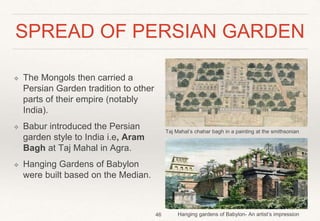
❖ Babur introduced the Persian
garden style to India i.e, Aram
Bagh at Taj Mahal in Agra.
❖ Hanging Gardens of Babylon
were built based on the Median.
46 Hanging gardens of Babylon- An artist’s impression
Taj Mahal’s chahar bagh in a painting at the smithsonian
INFLUENCE
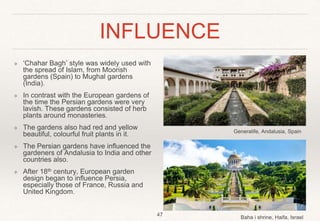
❖ ‘Chahar Bagh’ style was widely used with
the spread of Islam, from Moorish
gardens (Spain) to Mughal gardens
(India).
❖ In contrast with the European gardens of
the time the Persian gardens were very
lavish. These gardens consisted of herb
plants around monasteries.
❖ The gardens also had red and yellow
beautiful, colourful fruit plants in it.
❖ The Persian gardens have influenced the
gardeners of Andalusia to India and other
countries also.
❖ After 18th century, European garden
design began to influence Persia,
especially those of France, Russia and
United Kingdom.
47
Baha i shrine, Haifa, Israel
Generalife, Andalusia, Spain
History Of Persian Landscape
EXAMPLES Across the world
48
SHAHZADEH GARDEN
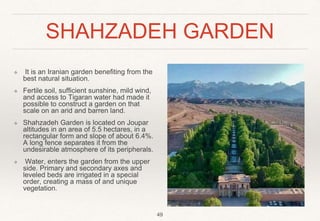
❖ It is an Iranian garden benefiting from the
best natural situation.
❖ Fertile soil, sufficient sunshine, mild wind,
and access to Tigaran water had made it
possible to construct a garden on that
scale on an arid and barren land.
❖ Shahzadeh Garden is located on Joupar
altitudes in an area of 5.5 hectares, in a
rectangular form and slope of about 6.4%.
A long fence separates it from the
undesirable atmosphere of its peripherals.
❖ Water, enters the garden from the upper
side. Primary and secondary axes and
leveled beds are irrigated in a special
order, creating a mass of and unique
vegetation.
49
SHAHZADEH GARDEN
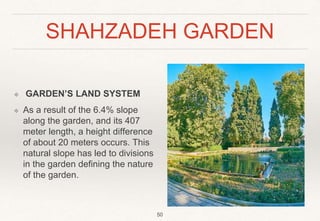
❖ GARDEN’S LAND SYSTEM
❖ As a result of the 6.4% slope
along the garden, and its 407
meter length, a height difference
of about 20 meters occurs. This
natural slope has led to divisions
in the garden defining the nature
of the garden.
50
SHAHZADEH GARDEN
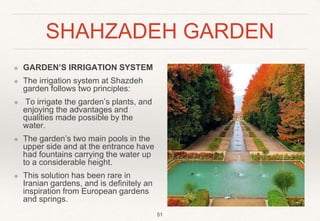
❖ GARDEN’S IRRIGATION SYSTEM
❖ The irrigation system at Shazdeh
garden follows two principles:
❖ To irrigate the garden’s plants, and
enjoying the advantages and
qualities made possible by the
water.
❖ The garden’s two main pools in the
upper side and at the entrance have
had fountains carrying the water up
to a considerable height.
❖ This solution has been rare in
Iranian gardens, and is definitely an
inspiration from European gardens
and springs.
51
SHAHZADEH GARDEN
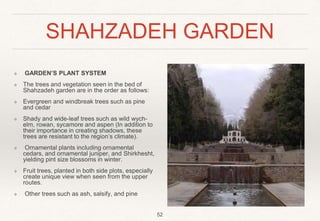
❖ GARDEN’S PLANT SYSTEM
❖ The trees and vegetation seen in the bed of
Shahzadeh garden are in the order as follows:
❖ Evergreen and windbreak trees such as pine
and cedar
❖ Shady and wide-leaf trees such as wild wych-
elm, rowan, sycamore and aspen (In addition to
their importance in creating shadows, these
trees are resistant to the region’s climate).
❖ Ornamental plants including ornamental
cedars, and ornamental juniper, and Shirkhesht,
yielding pint size blossoms in winter.
❖ Fruit trees, planted in both side plots, especially
create unique view when seen from the upper
routes.
❖ Other trees such as ash, salsify, and pine
52
SHAHZADEH GARDEN
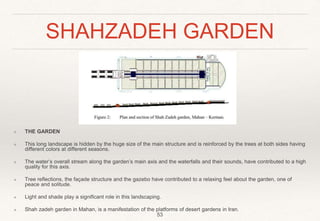
❖ THE GARDEN
❖ This long landscape is hidden by the huge size of the main structure and is reinforced by the trees at both sides having
different colors at different seasons.
❖ The water’s overall stream along the garden’s main axis and the waterfalls and their sounds, have contributed to a high
quality for this axis.
❖ Tree reflections, the façade structure and the gazebo have contributed to a relaxing feel about the garden, one of
peace and solitude.
❖ Light and shade play a significant role in this landscaping.
❖ Shah zadeh garden in Mahan, is a manifestation of the platforms of desert gardens in Iran.
53
FIN GARDEN
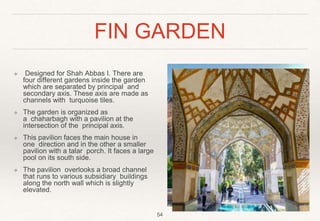
❖ Designed for Shah Abbas I. There are
four different gardens inside the garden
which are separated by principal and
secondary axis. These axis are made as
channels with turquoise tiles.
❖ The garden is organized as
a chaharbagh with a pavilion at the
intersection of the principal axis.
❖ This pavilion faces the main house in
one direction and in the other a smaller
pavilion with a talar porch. It faces a large
pool on its south side.
❖ The pavilion overlooks a broad channel
that runs to various subsidiary buildings
along the north wall which is slightly
elevated.
54
FIN GARDEN
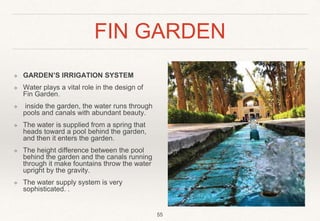
❖ GARDEN’S IRRIGATION SYSTEM
❖ Water plays a vital role in the design of
Fin Garden.
❖ inside the garden, the water runs through
pools and canals with abundant beauty.
❖ The water is supplied from a spring that
heads toward a pool behind the garden,
and then it enters the garden.
❖ The height difference between the pool
behind the garden and the canals running
through it make fountains throw the water
upright by the gravity.
❖ The water supply system is very
sophisticated. .
55
FIN GARDEN
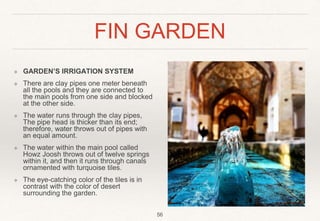
❖ GARDEN’S IRRIGATION SYSTEM
❖ There are clay pipes one meter beneath
all the pools and they are connected to
the main pools from one side and blocked
at the other side.
❖ The water runs through the clay pipes,
The pipe head is thicker than its end;
therefore, water throws out of pipes with
an equal amount.
❖ The water within the main pool called
Howz Joosh throws out of twelve springs
within it, and then it runs through canals
ornamented with turquoise tiles.
❖ The eye-catching color of the tiles is in
contrast with the color of desert
surrounding the garden.
56
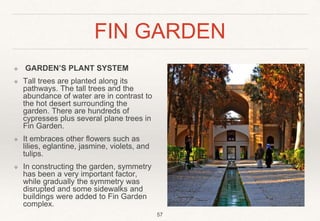
FIN GARDEN
❖ GARDEN’S PLANT SYSTEM
❖ Tall trees are planted along its
pathways. The tall trees and the
abundance of water are in contrast to
the hot desert surrounding the
garden. There are hundreds of
cypresses plus several plane trees in
Fin Garden.
❖ It embraces other flowers such as
lilies, eglantine, jasmine, violets, and
tulips.
❖ In constructing the garden, symmetry
has been a very important factor,
while gradually the symmetry was
disrupted and some sidewalks and
buildings were added to Fin Garden
complex.
57
FIN GARDEN
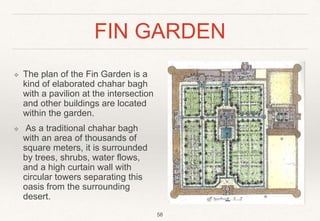
❖ The plan of the Fin Garden is a
kind of elaborated chahar bagh
with a pavilion at the intersection
and other buildings are located
within the garden.
❖ As a traditional chahar bagh
with an area of thousands of
square meters, it is surrounded
by trees, shrubs, water flows,
and a high curtain wall with
circular towers separating this
oasis from the surrounding
desert.
58
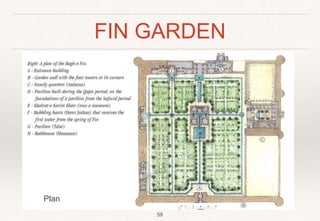
FIN GARDEN
59
Plan
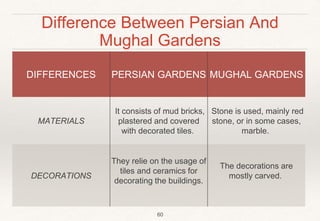
Difference Between Persian And
Mughal Gardens
60
DIFFERENCES PERSIAN GARDENS MUGHAL GARDENS
MATERIALS
It consists of mud bricks,
plastered and covered
with decorated tiles.
Stone is used, mainly red
stone, or in some cases,
marble.
DECORATIONS
They relie on the usage of
tiles and ceramics for
decorating the buildings.
The decorations are
mostly carved.
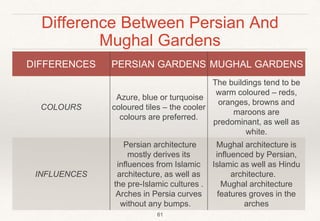
Difference Between Persian And
Mughal Gardens
61
DIFFERENCES PERSIAN GARDENS MUGHAL GARDENS
COLOURS
Azure, blue or turquoise
coloured tiles – the cooler
colours are preferred.
The buildings tend to be
warm coloured – reds,
oranges, browns and
maroons are
predominant, as well as
white.
INFLUENCES
Persian architecture
mostly derives its
influences from Islamic
architecture, as well as
the pre-Islamic cultures .
Arches in Persia curves
without any bumps.
Mughal architecture is
influenced by Persian,
Islamic as well as Hindu
architecture.
Mughal architecture
features groves in the
arches
CONCLUSION
❖ Garden is a depiction of Paradise (Considering Iranians’ view to Paradise
and its role in emergence of the Iranian garden).
❖ Role of land and bed is important so far as topography, fertility, and
position in function and type of the garden is regarded.
❖ Flowing water is the main element in Iranian Garden Construction. It is
important from three aspects: Water supplies, how to irrigate the garden,
and how to use water as an ornamentation (aesthetically).
❖ Construction of a greenbelt and its desirable effects against Iran’s dry and
desert climate have doubled the importance of garden construction.
❖ Focus on the main axis, geometry and application of square and
rectangle shapes in designing gardens presents a specific platform.
62
REFERENCES
❖ https://www.witpress.com/Secure/elibrary/papers/GEO08/GEO08021FU1.pdf
❖ http://ijaup.iust.ac.ir/article-1-436-en.pdf
❖ http://www.architecture-student.com/landscape/evolution-of-persian-gardening-
style-the-paradise-gardens/
❖ https://www.landscape-online.org/index.php/lo/article/download/LO.201646/29/
❖ https://www.wallswithstories.com/gardens/persian-gardens-earth-paradise-which-
dates-back-to-4000-bc.html
❖ https://www.scribd.com/document/459765218/PERSIAN-GARDENS-pdf
❖ https://starsinsymmetry.wordpress.com/2010/09/15/study-the-characteristics-of-
persian-and-mughal-architecture/
63
IV SEMESTER, B.ARCH
THANK YOU
Done by
19011AA008-Deepika
19011AA015-Lakshmi Akshaya
19011AA018-Rakshita
19011AA022-Aravind
19011AA023-Sripriya
19011AA031-Gowrav
64

Landscape 3

  • 1.
  • 2.
    Lorem Ipsum Dolor PERSIAN GARDENS HISTORYOF LANDSCAPE ARCHITECTURE 2
  • 3.
    CONTENTS ❖ Evolution ❖ Thebeginning ❖ Origin ❖ Concept ❖ Chronology ❖ Geometry structure ❖ Irrigation and fountains ❖ The entrance ❖ Pavilion ❖ Features ❖ The elements 3 Iranian Garden
  • 4.
    CONTENTS ❖ The naturalelements ❖ The different styles ❖ Vegetation ❖ Characteristics ❖ Influence and spread of the garden ❖ Examples ❖ Differences between persian and mughal gardens ❖ Conclusion ❖ References 4 Iranian Garden
  • 5.
    EVOLUTION ❖ Persian GardenStyle evolved after the Egyptian Style of gardening. It marked the beginning of ”Modern garden architecture”. ❖ Iranian division of the earth into four quarters, which may have been inspired by the geometrical motifs of Mesopotamia and Sindh Valley civilizations. 5
  • 6.
    THE BEGINNING… ❖ Throughoutthe Islamic centuries, the Persian gardens have represented images of paradise for the Persians. ❖ The gardens were built essentially to create a space for relaxation and leisure. ❖ The word paradise comes from pardis (Paridaiza) (walled around garden) in Persian. ❖ In fact, the plateau of Iran has always been relatively arid and treeless which gave the gardens such a supreme value. Compared to the open and barren wilderness, the garden is enclosed, fertile, and rich in fruit and flowers; in comparison with the drought and heat and unavoidable sun outside, it has water, coolness and shade; compared to the hostile vastness of near- desert, it has arrangement and tranquility, and is a place where one may sit in the shade, rather than walk in the fierce light of the sun. ❖ This reason has led to the garden construction art becoming of great significance in Iran. 6
  • 7.
    ORIGIN ❖ The styleof garden design represented by Persian gardens may originate as early as 4000 BC. ❖ Displays of plans of Persian gardens can be seen on decoratively painted ancient pottery. ❖ The Persian garden was an answer to the aridity of the local climate where the high walled garden and the shady trees with its air cooled by streams and fountains, was a simple recipe for paradise. ❖ The Persian gardens were created as a model of paradise. ❖ The tradition and style in the garden design of Persian gardens has influenced the design of gardens from Spain to India and beyond. 7 Cyrus Garden
  • 8.
    CONCEPT ❖ Nature hasbeen a source of wonder and meditation for the Iranians for centuries- which reflected in the Persian garden. Where the creative forces of nature and human met with each other. ❖ Serving as the symbol of hope and utility ❖ The philosophical design concept of Persian gardens is believed to be rooted in the four sacred elements of water, wind, fire and soil. ❖ The Persian garden materializes the concept of Eden and the four Zoroastrian elements: earth, heaven, water and plants or paradise on earth. ❖ The geometrical design of Persian gardens has been reflected in Persian carpets, potteries and visual arts. 8 Persian miniature painting
  • 9.
    CHRONOLOGY ACHAEMENID DYNASTY 3400 BCE Pasargadaeis the earliest example of the Persian garden A time which Zoroastrian religion was dominant, flowing water and fruit trees played a vital role SASANIAN DYNASTY 3 BCE- 7 BCE The ancient Persian conquest of Chahar Bagh was used in Persian landscapping, placing a greater emphasis on aesthetics ARAB’S CONQUEST 13CE 9
  • 10.
    CHRONOLOGY UMAYYAD AND ABBESID DYNASTY 7CE-750CE Moreimportance was given to aesthetics. Importance was given to ornamental and decorative species. MONGOLIAN CONQUEST 12 CE SAFAVID DYNASTY 15 CE- 17 CE Residential quarters or a pavilion were constructed on the garden grounds and became an integral element of the Persian garden 10
  • 11.
    CHRONOLOGY ZAND DYNASTY 19 CE Pergolasare oblongs of extended length or octagons. The building materials are mostly plain bricks with tiling ornamentations, gardens are of smaller size New plant species were imported into the Iranian gardening system. Each segment is planted with fruit trees of a specific kind. Absence of major buildings and summer houses . QAJAR DYNASTY 19 CE PAHLAVI DYNASTY 19 CE Influenced by modernity and western architectural style. These gardens are cultural, historical, natural elements such as water and plants are considered as divine signs 11
  • 12.
    GEOMETRY STRUCTURE ❖ Mostgardens have rectangular plans and have been divided into square or pseudo-square shapes, possibly, for the ease of determining the distance between garden components and the exact placement of greeneries. ❖ Unlike western gardens, the geometric structure of Persian gardens does not follow the perspective principles rather were mostly based on creating unity and integrity. ❖ The rectangular shape might slightly change in response to different climatic situations and in regard to the sites opportunities and limitations. 12 The geometrical structure of Persian garden
  • 13.
    GEOMETRY STRUCTURE EXAMPLES ❖ Theplan of Shahzadeh-Mahan Garden (in Kerman) is an extended example of chahar- bagh pattern in the shape of an elongated enclosed rectangle in which the pavilion is located in the center of the main water channels defining the north- south axis. 13 Shahzadeh-Mahan garden, Kerman
  • 14.
    GEOMETRY STRUCTURE EXAMPLES ❖ Thestructure of Fin Garden (in Kashan) is also an extended form of chahar-bagh in a series of squares and rectangles with a pavilion and square basin in the center. The water axes defining the chahar-bagh include a main one which leads the user from the entrance gateway to the central pavilion and a secondary one with a turquoise-tiled water channel. 14 The plan of Fin garden, Kashan
  • 15.
    GEOMETRY STRUCTURE EXAMPLES ❖ TheChehelsotun Garden design also stretches to a square shape with a pavilion located at the intersection of the primary axis defined by two large pools and a secondary asymmetric axis with a smaller pool on the western side 15 The plan of Chehel sotun garden, Esfahan
  • 16.
    IRRIGATION AND FOUNTAINS ❖The water with its scarcity and limitation have been a sacred and precious element in the ancient Persia. ❖ The presence of water in Persian gardens has a dual application; a functional application of irrigation besides an ornamental and aesthetic purpose. ❖ Therefore, the pattern of chahar-bagh is usually defined with the intersected water channels or streams. The streams usually had a sufficient slope to enable the irrigation system required for the garden ❖ The water coming from far distances into the water channels had a significant impact on the design of gardens; to the extent of the claim that the structure of gardens has been shaped according to the irrigation system . ❖ Other than water channels, the front space of the pavilion was usually dedicated to a pond or large pool to reflect the image of the building and sky connecting the realm of the earthly to the heavenly. 16 Ariel view of Shahzadeh-Mahan garden in the middle of the desert
  • 17.
    IRRIGATION AND FOUNTAINS Examples FINGARDEN ❖ The required water for the Fin garden has been provided by an old Sulaimaniyah Spring. ❖ The main branch furcates into the pools and water channelswith several fountains. ❖ The garden contains several streams, basins and pools which are located on the axes to circulate water around the garden. ❖ The main pool of the garden is located in the central main square in front of the pavilion and there are four other pools covered by cupolas within the pavilion not only to be protected from the sun, but also intensifying the value of the water 17 Water way circulation, fountains and basins Water way circulation, fountains and basins
  • 18.
    IRRIGATION AND FOUNTAINS Examples CHEHEL-SOTUN ❖The small basins and fountains have been replaced by a large pool located on the main longitudinal axis of the garden. ❖ In addition, the garden pavilion is surrounded by narrow streams, which are connected to the basin of the secondary axis of the garden SHAHZADEH GARDEN ❖ With a slope of 6.4% through the length is one of these gardens which has been designed in a stepped way to harness the slope for planting with the water flowing on the steps and small fountains in the middle of the basins. 18 The view of central main pool of Chehel-sotun garden The view of terraced pools and streams of Shahzadeh-Mahan garden
  • 19.
    THE ENTRANCE ❖ Inline with the concept of introversion as an Iranian/ Islamic approach to design, gardens were surrounded by non-transparent walls. ❖ Through this inaccessible surface or boundary, defining the point of entrance becomes important. ❖ Usually the entrance has a lintel, sometimes in the form of a building or viewpoint. ❖ The entrance is usually located close to one of the axes which connects the entrance to the edifice. ❖ In the Shahzadeh Garden, the entrance has beautifully framed the pavilion and the main water channel in the center of the garden; guiding the user from the entrance to the pavilion (Fig. 6). The lintel buildings could also be used as a reception space for guests alongside defining the entrance. In some gardens such as Fin, the entrance building had a latticed wall, which would not let the outsider have a glimpse of inside and the entrance was located on the minor axis (Borazjani & Javadi 2004). 19 Lintel entrance of Shahzadeh-Mahan Garden
  • 20.
    THE ENTRANCE EXAMPLES SHAHZADEH GARDEN ❖The entrance has beautifully framed the pavilion and the main water channel in the center of the garden; guiding the user from the entrance to the pavilion. ❖ The lintel buildings could also be used as a reception space for guests alongside defining the entrance. FIN GARDEN ❖ The entrance building had a latticed wall, which would not let the outsider have a glimpse of inside and the entrance was located on the minor axis 20 Entrance of Fin Garden Entrance of Shahzadeh-Mahan Garden
  • 21.
    PAVILIONS ❖ Pavilions inPersian gardens are extroverted structures usually located at the intersection of axes with several viewpoints to the garden. ❖ The location of the pavilion could split the garden into two to four directions. ❖ The location of pavilions could vary in different gardens. It could be located in the center of the garden or mostly it appeared in one third of the longitudinal axis, but it was always located at the intersection of the axes. Schematic patterns of belvederes location in Persian gardens 21
  • 22.
    PAVILIONS EXAMPLES ❖ Persian gardenssuch as Fin, Shahzadeh and Chehel-Sotun reveals that the pavilions were usually located on the one third of the longitudinal axis. ❖ However, Chehel-Sotun as a governmental-ceremonial garden has had a greater palace in comparison to the other two gardens A view of Shahzadeh-Mahan Pavilion A view of Fin garden central Pavilion 22
  • 23.
    FEATURES ❖ A highsurrounding wall. ❖ Straight tile-lined channels of water. ❖ Bubbling fountains. ❖ Trees for shade and fruit. ❖ A pavilion or gazebo. ❖ Strong emphasis on flowers in beds and pots. 23 Features of Persian gardens
  • 24.
    HISTORY OF LANDSCAPEARCHITECTURE THE ELEMENTS PERSIAN GARDENS 24
  • 25.
    ENCLOSED ❖ One ofthe unique features of Persian gardens is being fenced or walled around its perimeter. ❖ Introversion has been rooted in Persian beliefs and culture and it is evident in almost every feature of Iranian architecture. ❖ In this sense, the whole plan and structure of Persian gardens had been enclosed within walls to provide the image of an internal paradise in the heart of deserts guarded against the eyes of strangers . ❖ The function of these walls was not only to create a boundary, but also to act as an interface between the dry hot outer area and the green, shady and semi-paradise inner area The Fin garden surrounded by high walls with four towers at the corners and a monumental two level entrance in its south facade Ariel view of Fin garden between enclosed walls 25
  • 26.
    HIERARCHY ❖ In orderto protect the garden from outside and in line with the principle of introversion in Islamic architecture, entering the garden and the pathway to the pavilion has been designed with an accurate hierarchy. ❖ The entrance to the garden occurs from a completely public area to a semi-public one and then to the private. Therefore, for entering the garden, you need to pass a hierarchy of spaces from the lintel into an octagonal space called “Hashti” , and then you can see the main axis and the pavilion Hierarchy of spaces in Fin garden plan 26
  • 27.
    SYMMETRY ❖ Symmetry asa classical aesthetic tool has been an inseparable design principle in Persian gardens. ❖ Various aspects of symmetry can be found in the design of middle open spaces, palaces, streams and irrigation network, and the type and place of planting vegetation and trees, especially along the garden axes. ❖ However, within this apparent symmetry, the vegetation provides a slight eye-catching asymmetry. ❖ In spite of the order of the planting system of the garden, plants cannot equally grow and they will differ with each other. ❖ In this sense, the garden is a symmetrical container, which embraces the asymmetry of its containerized natural elements. The art of symmetry in all component of Fin garden with view to four directions 27
  • 28.
    CENTRALITY ❖ In Persiangardens, the principle of centrality is mostly based on the placement of the pavilion as a focal point, located at the intersection of the garden’s main axes. ❖ The centrality has been mostly intensified with the placement of the axes amplifying the symmetry, the location of the pavilion as a focal point and central space, the row of planted tall trees creating a surrounded pathway in the center and contrasting the color of the building materials with the landscape. ❖ In the Fin and Shahzadeh-Mahan gardens, the main pavilions have been located at the intersection of the axes with main pools in front, providing a simple pattern of chahar-bagh. 28
  • 29.
    RHYTHM AND HARMONY ❖Harmony had been used in different forms, in the regulation and design of gardens elements such as the type and location of the vegetation, replicating the geometrical shapes, between the natural and architectural elements, use of fountains and ponds, flooring and design of the walls around the gardens. ❖ Moreover, the integration of a vertical linear system of trees and horizontal linear system of waterways and walkways provides a rhythm and harmony in the appearance of gardens. 29
  • 30.
    NATURALISM ❖ Maintaining anopen perspective in gardens has been a principle of planting and structuring. ❖ Therefore, the front space of pavilions along the main longitudinal axis has been usually dedicated to an open and stretched space, which contains short vegetation or a large pool to avoid blocking the main view of the garden. ❖ The use of one point perspective aggravating by straight footpaths, the body of tall trees surrounding the footpaths and continues water channels in the middle could provide an infinite and boundless view to recall the paradise Openess of landscape in Chehel-Sotun garden, Esfahan 30
  • 31.
    HISTORY OF LANDSCAPEARCHITECTURE THE NATURAL ELEMENTS PERSIAN GARDENS 31
  • 32.
    The Natural Elements Sunlight Theimportant factor to be considered while designing the Persian garden is sunlight and its effects in the garden. Architects arranged the samples and forms from the rays of light to restrain the sunlight. The specific features and shapes were chosen by the experienced architects to hamess the light. 32
  • 33.
    The Natural Elements Shade Shadeis also an important element due to heat of Iran. The Persian gardens includes trees, shrubs and trellises which work as biotic shades to provide protection from strong sunrays. In these gardens we can see large number of big shade trees, fruit and flower trees as well. Walls and pavilions are also important in blocking the harsh sunrays. 33
  • 34.
    The Natural Elements Water Indesert regions, there are many dry areas beside the many forests, therefore water comes as the next important element in the Persian garden. The underground water canals are built on slopes to facilitate either natural or the artificial flow of water (waterfalls). It is assumed that this style of irrigation is thousand years old. Trees are planted in a ditch called a jub, to prevent water evaporation and allow quick access of water to the tree roots. 34
  • 35.
    The Natural Elements Buildings Inmany of the Persian gardens, buildings of splendour, brick works and pavilions are seen. Iranian architects used to build domes on square buildings very skilfully. These enhance the beauty of these gardens. In Persian gardens, beautiful arches were constructed. The beautiful types of glasses were used for windows and other glass works. 35
  • 36.
    THE DIFFERENT STYLES 36 CLASSICALFORMAL CASUAL PUBLIC Hayat Meidan Park PRIVATE Hayat Chahar Bagh Bagh
  • 37.
    Styles Of Garden’s HAYAT(Public) Layout highly emphasizes on aesthetics rather than function. Man-made structures in the garden are particularly important, with arches and pools. The ground often covered in gravel flagged with stone. The grounds are covered with gravels flagged with stones. Plantings are typically very simple such as a line of trees which also provide shade. Structure centered. 37
  • 38.
    Styles Of Garden’s HAYAT(Private) Few plants, often due to the limited water available in urban areas. These gardens have pools in the centre and have structural supports like pergola and arches.. The pool serves as a focus and source of humidity for surrounding atmosphere. 38
  • 39.
    Styles Of Garden’s MEIDAN Thisis a public, formal garden which emphasizes more on biotic elements than structure. Here we see bedding plants, trees, shrubs, grasses, etc. In this garden also the elements like graved pathways, pools divide the lawns. The shade providing structures pavilions are also built.. 39
  • 40.
    Styles Of Garden’s CHAHARBAGH These gardens are formal and private. The garden structure mainly consists of four quadrants divided by pathways and waterways. This garden has a balanced design and central axis plays dominating role and divides garden into equal parts. .To create greenery, planting is done around the periphery of a pool, pathways or waterway. The old example of a rectangular canal pattern is at Pasargadae. 40
  • 41.
    Styles Of Garden’s PARK Theseare casual parks used for public functions. These are full of various plants.  Pathways and seating.  Gardens limited of structural elements.  Purpose- relaxation and socialization . 41
  • 42.
    Styles Of Garden’s BAGH TheBagh is a private area. It gives less emphasis on waterways and pathways. These gardens are often attached to houses consisting of trees, lawns and ground plants  It gives less emphasis on waterways and pathways.  Like other casual gardens, it focuses on natural and green aspects of nature. 42
  • 43.
    VEGETATION ❖ vegetation isalso significant due to the location, cultivation plan, beauty, and its usefulness. ❖ Plants even play a role in protecting gardens against destructive natural events. ❖ In an Iranian garden plants are used for different purposes including shade, yield, and garden ornamentation, etc. Since usefulness is a very important aspect of Iranian garden construction, fruit trees are more prevelant in them and shading trees are less frequent, and least of all are ornamental trees. ❖ As a result of the hot and dry climate of Iran, gardens contain mostly trees. Use of flowers and shrubs to provide colour and scent also have their place. The pattern of production in a typical chahar bagh 43
  • 44.
    VEGETATION ❖ Along thestreams in long streets are planted cedar, pine and box. Aspen, Tabrizi and rowan have mostly been planted in clay lands ,Wych elm, bid, and purple trees, have often been planted around pools. ❖ Plots at both sides of the routes into a garden, were covered by fruit seedlings, plots around the gardens were covered by grapevines, and the pathways, corners, and shelters were covered by fig, senjed, and annab trees. ❖ Instead of planting high trees and bushes among the plot to cover the garden’s building, spest (a kind of alfalfa) was used. ❖ Also flowers have had important role in gardens. Seasonal flowers used to be planted in front of palaces and small aromatic flowers had been planted beside trees. ❖ Cypress trees which inevitably appear in Persian gardens symbolize immortality. 44 A view of natural environment of Fin garden, Kashan. Tall cypresses provide shades for most of the garden. The shrub roses, grass and violet flowers intensified the natural beauty of the garden
  • 45.
    CHARACTERISTICS ❖ The mostimportant factor of Persian gardens is to build shade type structures wherever necessary in the garden. This helps to cope with hot climates and keep the atmosphere cool. ❖ These gardens are closed and walled and have very little association with the area outside these walls. ❖ The Persian gardens necessarily have a central water feature or ponds as water is the soul of these gardens. Fountains tend to be more of modern , It is a best way to save water and maintain with the original design consisting of a water structure. ❖ The gardens have crisp colours and clean alignments, Intricate mosaic tiles are occasionally used in these gardens. ❖ The garden can be conservative, refined, formal or relaxed and casual. The different garden designs serve different purposes. ❖ Arches play an important role, it shows typical Persian architectural theme. These arches are made from stonework or sometimes wooden support which can be made appear as original. ❖ Symmetry is very important in these designs. The matching or mirroring elements can give enjoyment and pleasure. 45
  • 46.
    SPREAD OF PERSIANGARDEN ❖ The Mongols then carried a Persian Garden tradition to other parts of their empire (notably India). ❖ Babur introduced the Persian garden style to India i.e, Aram Bagh at Taj Mahal in Agra. ❖ Hanging Gardens of Babylon were built based on the Median. 46 Hanging gardens of Babylon- An artist’s impression Taj Mahal’s chahar bagh in a painting at the smithsonian
  • 47.
    INFLUENCE ❖ ‘Chahar Bagh’style was widely used with the spread of Islam, from Moorish gardens (Spain) to Mughal gardens (India). ❖ In contrast with the European gardens of the time the Persian gardens were very lavish. These gardens consisted of herb plants around monasteries. ❖ The gardens also had red and yellow beautiful, colourful fruit plants in it. ❖ The Persian gardens have influenced the gardeners of Andalusia to India and other countries also. ❖ After 18th century, European garden design began to influence Persia, especially those of France, Russia and United Kingdom. 47 Baha i shrine, Haifa, Israel Generalife, Andalusia, Spain
  • 48.
    History Of PersianLandscape EXAMPLES Across the world 48
  • 49.
    SHAHZADEH GARDEN ❖ Itis an Iranian garden benefiting from the best natural situation. ❖ Fertile soil, sufficient sunshine, mild wind, and access to Tigaran water had made it possible to construct a garden on that scale on an arid and barren land. ❖ Shahzadeh Garden is located on Joupar altitudes in an area of 5.5 hectares, in a rectangular form and slope of about 6.4%. A long fence separates it from the undesirable atmosphere of its peripherals. ❖ Water, enters the garden from the upper side. Primary and secondary axes and leveled beds are irrigated in a special order, creating a mass of and unique vegetation. 49
  • 50.
    SHAHZADEH GARDEN ❖ GARDEN’SLAND SYSTEM ❖ As a result of the 6.4% slope along the garden, and its 407 meter length, a height difference of about 20 meters occurs. This natural slope has led to divisions in the garden defining the nature of the garden. 50
  • 51.
    SHAHZADEH GARDEN ❖ GARDEN’SIRRIGATION SYSTEM ❖ The irrigation system at Shazdeh garden follows two principles: ❖ To irrigate the garden’s plants, and enjoying the advantages and qualities made possible by the water. ❖ The garden’s two main pools in the upper side and at the entrance have had fountains carrying the water up to a considerable height. ❖ This solution has been rare in Iranian gardens, and is definitely an inspiration from European gardens and springs. 51
  • 52.
    SHAHZADEH GARDEN ❖ GARDEN’SPLANT SYSTEM ❖ The trees and vegetation seen in the bed of Shahzadeh garden are in the order as follows: ❖ Evergreen and windbreak trees such as pine and cedar ❖ Shady and wide-leaf trees such as wild wych- elm, rowan, sycamore and aspen (In addition to their importance in creating shadows, these trees are resistant to the region’s climate). ❖ Ornamental plants including ornamental cedars, and ornamental juniper, and Shirkhesht, yielding pint size blossoms in winter. ❖ Fruit trees, planted in both side plots, especially create unique view when seen from the upper routes. ❖ Other trees such as ash, salsify, and pine 52
  • 53.
    SHAHZADEH GARDEN ❖ THEGARDEN ❖ This long landscape is hidden by the huge size of the main structure and is reinforced by the trees at both sides having different colors at different seasons. ❖ The water’s overall stream along the garden’s main axis and the waterfalls and their sounds, have contributed to a high quality for this axis. ❖ Tree reflections, the façade structure and the gazebo have contributed to a relaxing feel about the garden, one of peace and solitude. ❖ Light and shade play a significant role in this landscaping. ❖ Shah zadeh garden in Mahan, is a manifestation of the platforms of desert gardens in Iran. 53
  • 54.
    FIN GARDEN ❖ Designedfor Shah Abbas I. There are four different gardens inside the garden which are separated by principal and secondary axis. These axis are made as channels with turquoise tiles. ❖ The garden is organized as a chaharbagh with a pavilion at the intersection of the principal axis. ❖ This pavilion faces the main house in one direction and in the other a smaller pavilion with a talar porch. It faces a large pool on its south side. ❖ The pavilion overlooks a broad channel that runs to various subsidiary buildings along the north wall which is slightly elevated. 54
  • 55.
    FIN GARDEN ❖ GARDEN’SIRRIGATION SYSTEM ❖ Water plays a vital role in the design of Fin Garden. ❖ inside the garden, the water runs through pools and canals with abundant beauty. ❖ The water is supplied from a spring that heads toward a pool behind the garden, and then it enters the garden. ❖ The height difference between the pool behind the garden and the canals running through it make fountains throw the water upright by the gravity. ❖ The water supply system is very sophisticated. . 55
  • 56.
    FIN GARDEN ❖ GARDEN’SIRRIGATION SYSTEM ❖ There are clay pipes one meter beneath all the pools and they are connected to the main pools from one side and blocked at the other side. ❖ The water runs through the clay pipes, The pipe head is thicker than its end; therefore, water throws out of pipes with an equal amount. ❖ The water within the main pool called Howz Joosh throws out of twelve springs within it, and then it runs through canals ornamented with turquoise tiles. ❖ The eye-catching color of the tiles is in contrast with the color of desert surrounding the garden. 56
  • 57.
    FIN GARDEN ❖ GARDEN’SPLANT SYSTEM ❖ Tall trees are planted along its pathways. The tall trees and the abundance of water are in contrast to the hot desert surrounding the garden. There are hundreds of cypresses plus several plane trees in Fin Garden. ❖ It embraces other flowers such as lilies, eglantine, jasmine, violets, and tulips. ❖ In constructing the garden, symmetry has been a very important factor, while gradually the symmetry was disrupted and some sidewalks and buildings were added to Fin Garden complex. 57
  • 58.
    FIN GARDEN ❖ Theplan of the Fin Garden is a kind of elaborated chahar bagh with a pavilion at the intersection and other buildings are located within the garden. ❖ As a traditional chahar bagh with an area of thousands of square meters, it is surrounded by trees, shrubs, water flows, and a high curtain wall with circular towers separating this oasis from the surrounding desert. 58
  • 59.
  • 60.
    Difference Between PersianAnd Mughal Gardens 60 DIFFERENCES PERSIAN GARDENS MUGHAL GARDENS MATERIALS It consists of mud bricks, plastered and covered with decorated tiles. Stone is used, mainly red stone, or in some cases, marble. DECORATIONS They relie on the usage of tiles and ceramics for decorating the buildings. The decorations are mostly carved.
  • 61.
    Difference Between PersianAnd Mughal Gardens 61 DIFFERENCES PERSIAN GARDENS MUGHAL GARDENS COLOURS Azure, blue or turquoise coloured tiles – the cooler colours are preferred. The buildings tend to be warm coloured – reds, oranges, browns and maroons are predominant, as well as white. INFLUENCES Persian architecture mostly derives its influences from Islamic architecture, as well as the pre-Islamic cultures . Arches in Persia curves without any bumps. Mughal architecture is influenced by Persian, Islamic as well as Hindu architecture. Mughal architecture features groves in the arches
  • 62.
    CONCLUSION ❖ Garden isa depiction of Paradise (Considering Iranians’ view to Paradise and its role in emergence of the Iranian garden). ❖ Role of land and bed is important so far as topography, fertility, and position in function and type of the garden is regarded. ❖ Flowing water is the main element in Iranian Garden Construction. It is important from three aspects: Water supplies, how to irrigate the garden, and how to use water as an ornamentation (aesthetically). ❖ Construction of a greenbelt and its desirable effects against Iran’s dry and desert climate have doubled the importance of garden construction. ❖ Focus on the main axis, geometry and application of square and rectangle shapes in designing gardens presents a specific platform. 62
  • 63.
    REFERENCES ❖ https://www.witpress.com/Secure/elibrary/papers/GEO08/GEO08021FU1.pdf ❖ http://ijaup.iust.ac.ir/article-1-436-en.pdf ❖http://www.architecture-student.com/landscape/evolution-of-persian-gardening- style-the-paradise-gardens/ ❖ https://www.landscape-online.org/index.php/lo/article/download/LO.201646/29/ ❖ https://www.wallswithstories.com/gardens/persian-gardens-earth-paradise-which- dates-back-to-4000-bc.html ❖ https://www.scribd.com/document/459765218/PERSIAN-GARDENS-pdf ❖ https://starsinsymmetry.wordpress.com/2010/09/15/study-the-characteristics-of- persian-and-mughal-architecture/ 63
  • 64.
    IV SEMESTER, B.ARCH THANKYOU Done by 19011AA008-Deepika 19011AA015-Lakshmi Akshaya 19011AA018-Rakshita 19011AA022-Aravind 19011AA023-Sripriya 19011AA031-Gowrav 64