CHINESE
GARDENS AND
LANDSCAPE
B.J.NILESH KRISHNAA
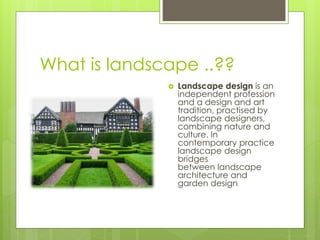
What is landscape ..??
 Landscape design is an
independent profession
and a design and art
tradition, practised by
landscape designers,
combining nature and
culture. In
contemporary practice
landscape design
bridges
between landscape
architecture and
garden design
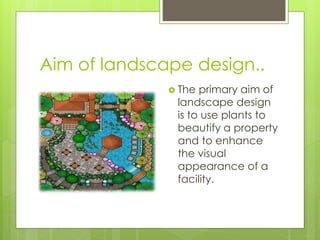
Aim of landscape design..
 The primary aim of
landscape design
is to use plants to
beautify a property
and to enhance
the visual
appearance of a
facility.
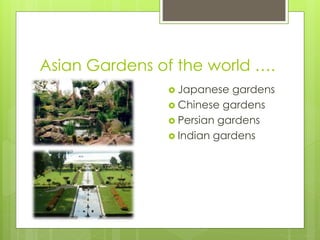
Asian Gardens of the world ….
 Japanese gardens
 Chinese gardens
 Persian gardens
 Indian gardens
Philosophy
 “Even though everything [in the garden] is the work of
man, it must appear to have been created by heaven” -
Ji Cheng
 "Chinese classical gardens are a perfect integration of
nature and work by man” - Zhou Ganzhi ( President of the
Chinese Society of Landscape Architecture )
 The zig-zag bridge in the Humble Administrator's Garden
illustrates the proverb, "By detours, access to secrets."
History …..
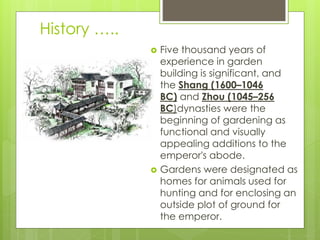
 Five thousand years of
experience in garden
building is significant, and
the Shang (1600–1046
BC) and Zhou (1045–256
BC)dynasties were the
beginning of gardening as
functional and visually
appealing additions to the
emperor's abode.
 Gardens were designated as
homes for animals used for
hunting and for enclosing an
outside plot of ground for
the emperor.
History …..
 After the Han Dynasty (206 BC–220 AD), gardens
were places for the emperor to rest and renew
energy.
 Then, a garden was called a yuan.
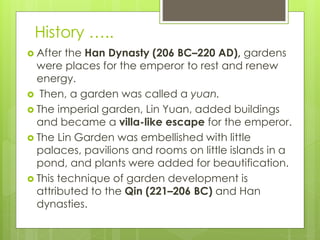
 The imperial garden, Lin Yuan, added buildings
and became a villa-like escape for the emperor.
 The Lin Garden was embellished with little
palaces, pavilions and rooms on little islands in a
pond, and plants were added for beautification.
 This technique of garden development is
attributed to the Qin (221–206 BC) and Han
dynasties.
History …..
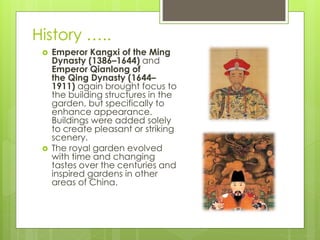
 Emperor Kangxi of the Ming
Dynasty (1386–1644) and
Emperor Qianlong of
the Qing Dynasty (1644–
1911) again brought focus to
the building structures in the
garden, but specifically to
enhance appearance.
Buildings were added solely
to create pleasant or striking
scenery.
 The royal garden evolved
with time and changing
tastes over the centuries and
inspired gardens in other
areas of China.
Chinese Gardens
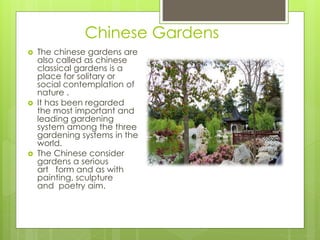
 The chinese gardens are
also called as chinese
classical gardens is a
place for solitary or
social contemplation of
nature .
 It has been regarded
the most important and
leading gardening
system among the three
gardening systems in the
world.
 The Chinese consider
gardens a serious
art form and as with
painting, sculpture
and poetry aim.
Types
 Two Types – The Imperial garden & The private
garden.
 Imperial gardens are mostly found in north
China, with those in Beijing as representatives,
featuring grandness and magnificence.
 Private gardens are mostly found in south China,
especially in cities in south of the Yangtze River,
such as Suzhou, Wuxi, Nanjing and Hangzhou.
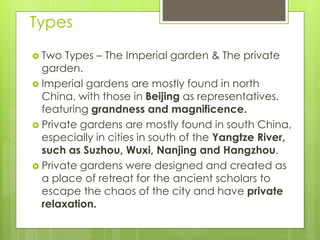
 Private gardens were designed and created as
a place of retreat for the ancient scholars to
escape the chaos of the city and have private
relaxation.
Characteristics
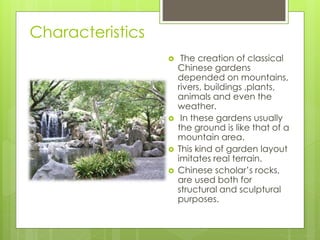
 The creation of classical
Chinese gardens
depended on mountains,
rivers, buildings ,plants,
animals and even the
weather.
 In these gardens usually
the ground is like that of a
mountain area.
 This kind of garden layout
imitates real terrain.
 Chinese scholar’s rocks,
are used both for
structural and sculptural
purposes.
Elements
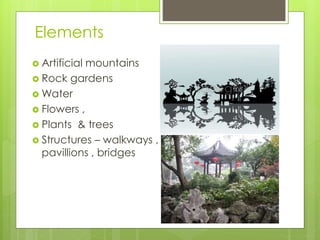
 Artificial mountains
 Rock gardens
 Water
 Flowers ,
 Plants & trees
 Structures – walkways ,
pavillions , bridges
Elements – Rocks
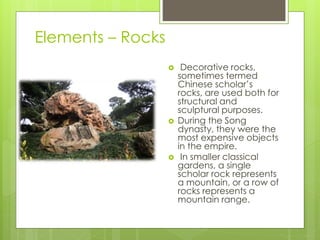
 Decorative rocks,
sometimes termed
Chinese scholar’s
rocks, are used both for
structural and
sculptural purposes.
 During the Song
dynasty, they were the
most expensive objects
in the empire.
 In smaller classical
gardens, a single
scholar rock represents
a mountain, or a row of
rocks represents a
mountain range.
Water
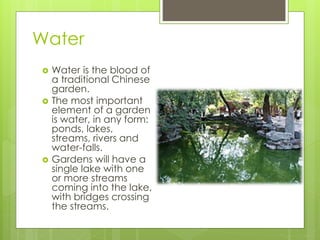
 Water is the blood of
a traditional Chinese
garden.
 The most important
element of a garden
is water, in any form:
ponds, lakes,
streams, rivers and
water-falls.
 Gardens will have a
single lake with one
or more streams
coming into the lake,
with bridges crossing
the streams.
Garden –Plants & Trees
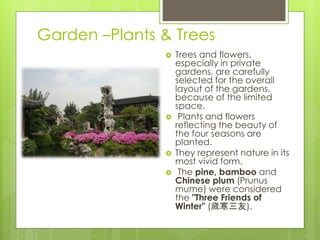
 Trees and flowers,
especially in private
gardens, are carefully
selected for the overall
layout of the gardens,
because of the limited
space.
 Plants and flowers
reflecting the beauty of
the four seasons are
planted.
 They represent nature in its
most vivid form.
 The pine, bamboo and
Chinese plum (Prunus
mume) were considered
the "Three Friends of
Winter" (歲寒三友).
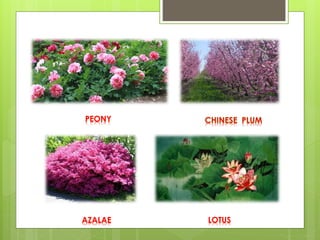
PEONY
AZALAE LOTUS
Structures
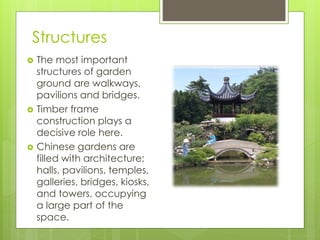
 The most important
structures of garden
ground are walkways,
pavilions and bridges.
 Timber frame
construction plays a
decisive role here.
 Chinese gardens are
filled with architecture;
halls, pavilions, temples,
galleries, bridges, kiosks,
and towers, occupying
a large part of the
space.
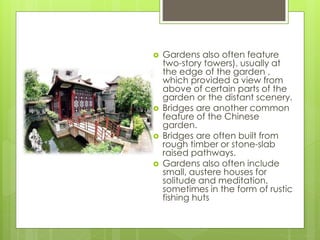
 Gardens also often feature
two-story towers), usually at
the edge of the garden ,
which provided a view from
above of certain parts of the
garden or the distant scenery.
 Bridges are another common
feature of the Chinese
garden.
 Bridges are often built from
rough timber or stone-slab
raised pathways.
 Gardens also often include
small, austere houses for
solitude and meditation,
sometimes in the form of rustic
fishing huts
References
 www.chinahighlights.com/travelguide/arch
itecture/history-garden.htm
 https://en.wikipedia.org/wiki/Chinese_gard
en
 http://www.allchinanet.com/chinese_gard
en/chinese_garden_philosophy.shtml
 http://www.chinahighlights.com/travelguid
e/architecture/chinese-garden.htm
谢谢 – Thank you

Chinese gardens and landscape

  • 1.
  • 2.
    What is landscape..??  Landscape design is an independent profession and a design and art tradition, practised by landscape designers, combining nature and culture. In contemporary practice landscape design bridges between landscape architecture and garden design
  • 3.
    Aim of landscapedesign..  The primary aim of landscape design is to use plants to beautify a property and to enhance the visual appearance of a facility.
  • 4.
    Asian Gardens ofthe world ….  Japanese gardens  Chinese gardens  Persian gardens  Indian gardens
  • 5.
    Philosophy  “Even thougheverything [in the garden] is the work of man, it must appear to have been created by heaven” - Ji Cheng  "Chinese classical gardens are a perfect integration of nature and work by man” - Zhou Ganzhi ( President of the Chinese Society of Landscape Architecture )  The zig-zag bridge in the Humble Administrator's Garden illustrates the proverb, "By detours, access to secrets."
  • 6.
    History …..  Fivethousand years of experience in garden building is significant, and the Shang (1600–1046 BC) and Zhou (1045–256 BC)dynasties were the beginning of gardening as functional and visually appealing additions to the emperor's abode.  Gardens were designated as homes for animals used for hunting and for enclosing an outside plot of ground for the emperor.
  • 7.
    History …..  Afterthe Han Dynasty (206 BC–220 AD), gardens were places for the emperor to rest and renew energy.  Then, a garden was called a yuan.  The imperial garden, Lin Yuan, added buildings and became a villa-like escape for the emperor.  The Lin Garden was embellished with little palaces, pavilions and rooms on little islands in a pond, and plants were added for beautification.  This technique of garden development is attributed to the Qin (221–206 BC) and Han dynasties.
  • 8.
    History …..  EmperorKangxi of the Ming Dynasty (1386–1644) and Emperor Qianlong of the Qing Dynasty (1644– 1911) again brought focus to the building structures in the garden, but specifically to enhance appearance. Buildings were added solely to create pleasant or striking scenery.  The royal garden evolved with time and changing tastes over the centuries and inspired gardens in other areas of China.
  • 9.
    Chinese Gardens  Thechinese gardens are also called as chinese classical gardens is a place for solitary or social contemplation of nature .  It has been regarded the most important and leading gardening system among the three gardening systems in the world.  The Chinese consider gardens a serious art form and as with painting, sculpture and poetry aim.
  • 10.
    Types  Two Types– The Imperial garden & The private garden.  Imperial gardens are mostly found in north China, with those in Beijing as representatives, featuring grandness and magnificence.  Private gardens are mostly found in south China, especially in cities in south of the Yangtze River, such as Suzhou, Wuxi, Nanjing and Hangzhou.  Private gardens were designed and created as a place of retreat for the ancient scholars to escape the chaos of the city and have private relaxation.
  • 11.
    Characteristics  The creationof classical Chinese gardens depended on mountains, rivers, buildings ,plants, animals and even the weather.  In these gardens usually the ground is like that of a mountain area.  This kind of garden layout imitates real terrain.  Chinese scholar’s rocks, are used both for structural and sculptural purposes.
  • 12.
    Elements  Artificial mountains Rock gardens  Water  Flowers ,  Plants & trees  Structures – walkways , pavillions , bridges
  • 13.
    Elements – Rocks Decorative rocks, sometimes termed Chinese scholar’s rocks, are used both for structural and sculptural purposes.  During the Song dynasty, they were the most expensive objects in the empire.  In smaller classical gardens, a single scholar rock represents a mountain, or a row of rocks represents a mountain range.
  • 14.
    Water  Water isthe blood of a traditional Chinese garden.  The most important element of a garden is water, in any form: ponds, lakes, streams, rivers and water-falls.  Gardens will have a single lake with one or more streams coming into the lake, with bridges crossing the streams.
  • 15.
    Garden –Plants &Trees  Trees and flowers, especially in private gardens, are carefully selected for the overall layout of the gardens, because of the limited space.  Plants and flowers reflecting the beauty of the four seasons are planted.  They represent nature in its most vivid form.  The pine, bamboo and Chinese plum (Prunus mume) were considered the "Three Friends of Winter" (歲寒三友).
  • 16.
  • 17.
    Structures  The mostimportant structures of garden ground are walkways, pavilions and bridges.  Timber frame construction plays a decisive role here.  Chinese gardens are filled with architecture; halls, pavilions, temples, galleries, bridges, kiosks, and towers, occupying a large part of the space.
  • 18.
     Gardens alsooften feature two-story towers), usually at the edge of the garden , which provided a view from above of certain parts of the garden or the distant scenery.  Bridges are another common feature of the Chinese garden.  Bridges are often built from rough timber or stone-slab raised pathways.  Gardens also often include small, austere houses for solitude and meditation, sometimes in the form of rustic fishing huts
  • 19.
    References  www.chinahighlights.com/travelguide/arch itecture/history-garden.htm  https://en.wikipedia.org/wiki/Chinese_gard en http://www.allchinanet.com/chinese_gard en/chinese_garden_philosophy.shtml  http://www.chinahighlights.com/travelguid e/architecture/chinese-garden.htm
  • 20.