ORGANISATION AND FUNCTION
OF NURSING SERVICES-
HOSPITAL AND COMMUNITY
By
Sandhya C
M.Sc Nursing Final Year
RAKCON
1
ORIGIN OF WORD HOSPITAL
• The word hospital is derived from the Latin
word hospitalis,which comes from ‘hospes’
meaning a host.
• Today hospital means an institution in
which sick or injured persons are treated
as well as healthy persons are helped to
prevent, promote and maintain an
optimum level of well being.
2
HOSPITAL
• The hospital is an integral part of a social
and medical organization, the function of
which is to provide for the population
complete health care, both curative and
preventive and whose out patient services
reach out to the family and its environment,
the hospital is also a centre for the training
of health workers .
-WHO expert committee
3
Functions of a Hospital
• The primary function of a hospital is the
provision of medical care to a community
• To be a centre for education of all types of
health professionals
• To be a centre for research
4
5
Nursing Service:- Is the part of the total health
care organization which aims to satisfy the
nursing needs of the community ,major
objective of the nursing services is to provide
prevention of disease and promotion of health.
-WHO Expert Committee
6
Organization of patient care in hospital
• Of all services provided in a hospital, the
nursing service closest to the patients.
• Management and supervision of nursing
personnel is therefore a vital factor in
establishing and maintaining an
acceptable standard of nursing care for
patients.
7
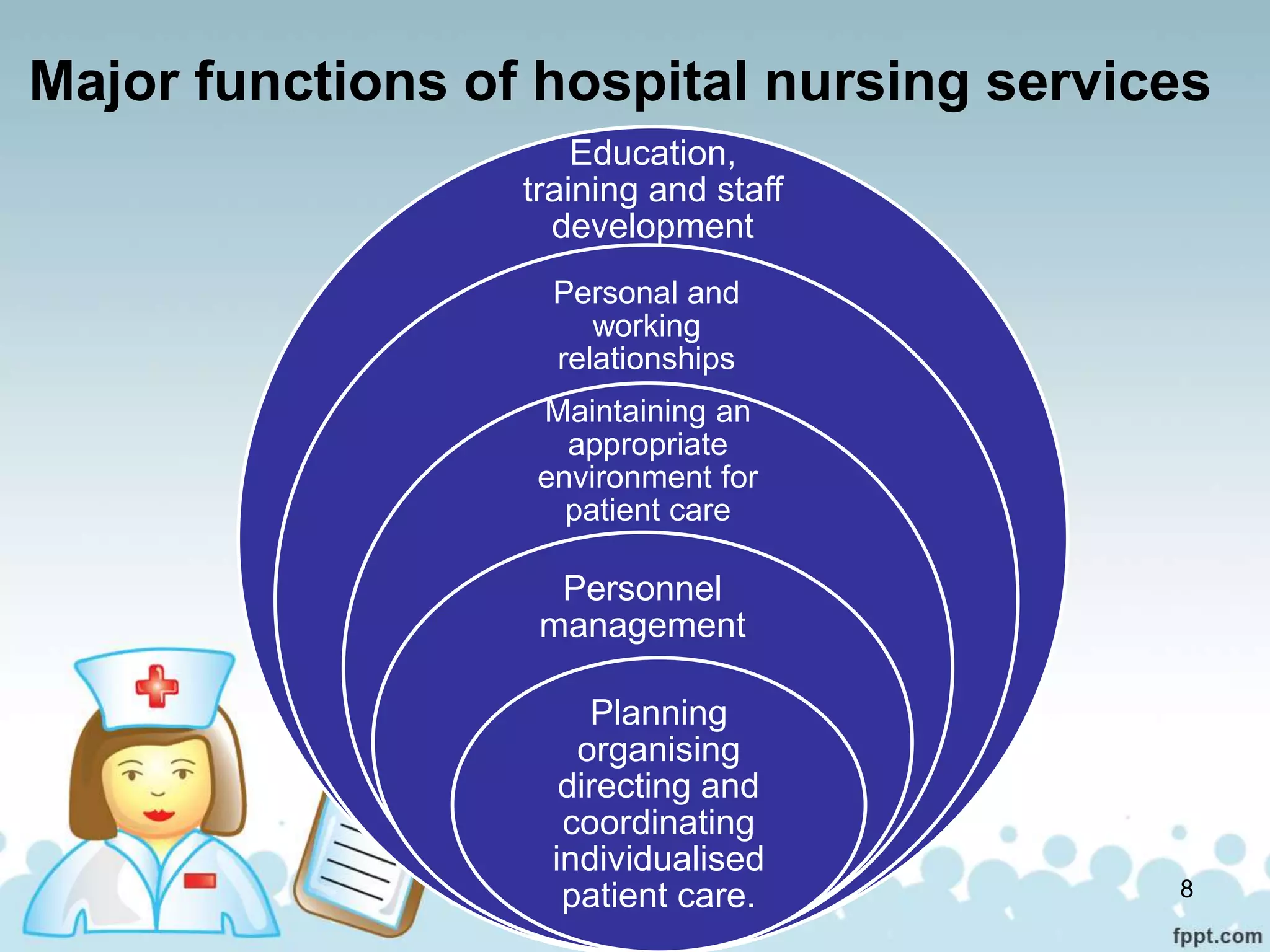
Major functions of hospital nursing services
Education,
training and staff
development
programme
Personal and
working
relationships
Maintaining an
appropriate
environment for
patient care
Personnel
management
Planning
organising
directing and
coordinating
individualised
patient care. 8
Management of nursing care and services
Establish adequate staffing pattern
Develop and implement proper
communication system.
Develop and initiate proper evaluation
and periodic monitoring system.
Proper job description for nursing
personnel.
Assist hospital authorities for effective
personnel management
Share nursing information system with
other discipline
Formulate and interpret nursing service
policies
Assist hospital authorities for preparation
of budget.
Participate in inter departmental programs and
other programs
9
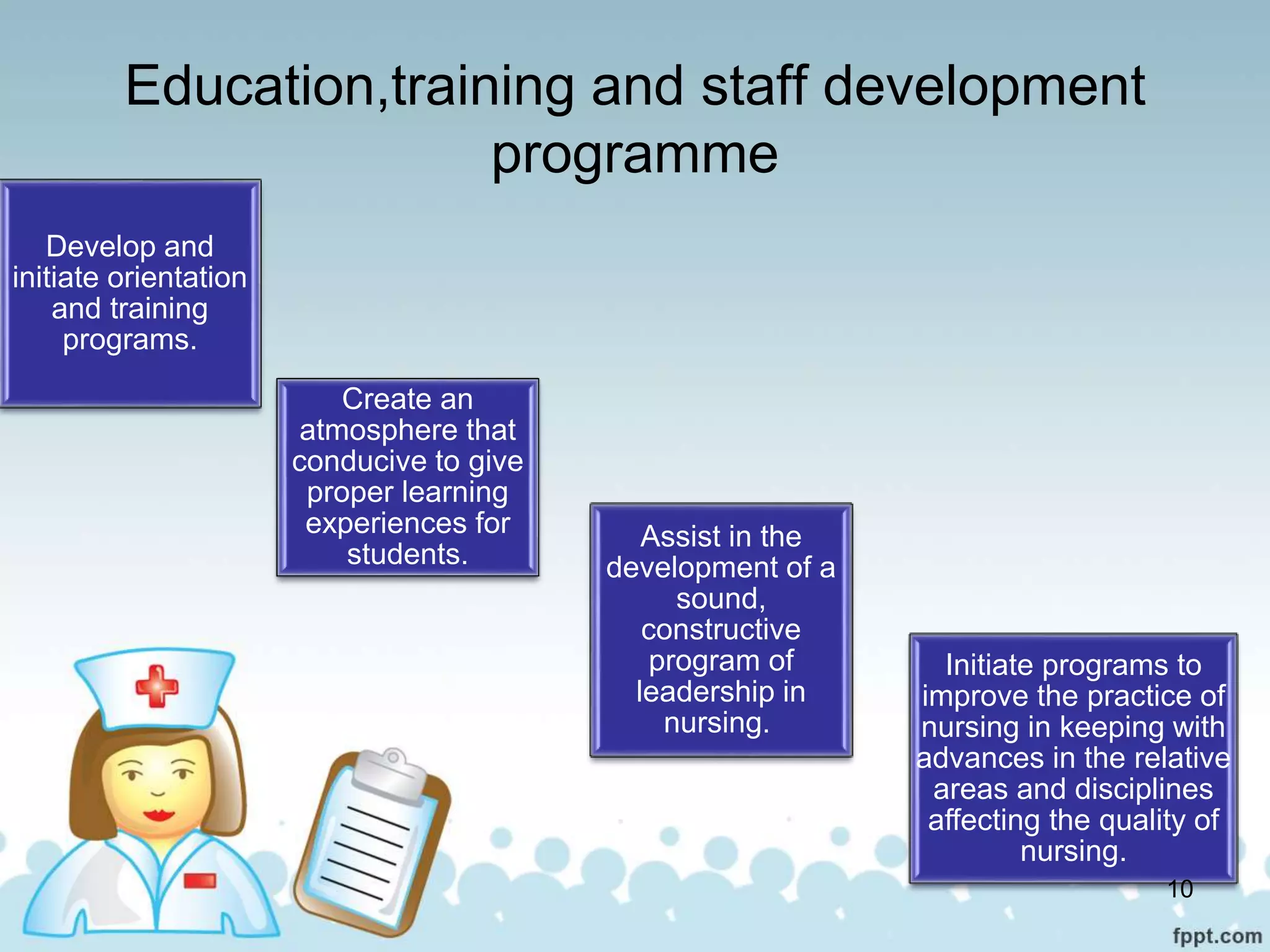
Education,training and staff development
programme
Develop and
initiate orientation
and training
programs.
Create an
atmosphere that
conducive to give
proper learning
experiences for
students.
Assist in the
development of a
sound,
constructive
program of
leadership in
nursing.
Initiate programs to
improve the practice of
nursing in keeping with
advances in the relative
areas and disciplines
affecting the quality of
nursing.
10
Nursing research
Participate in
identifying the
areas of
research
Participate in
the
application
of data and
research.
Produce
conducive
environment
for research.
11
Nursing care
• Nursing care is a direct service which includes
one or both of the following components needed
to maintain or restore an individuals optimum
health
Implementation of the
physicians plan of care
Planning,organising
providing and
evaluating facilities and
care in terms of a
patients need.
12
13
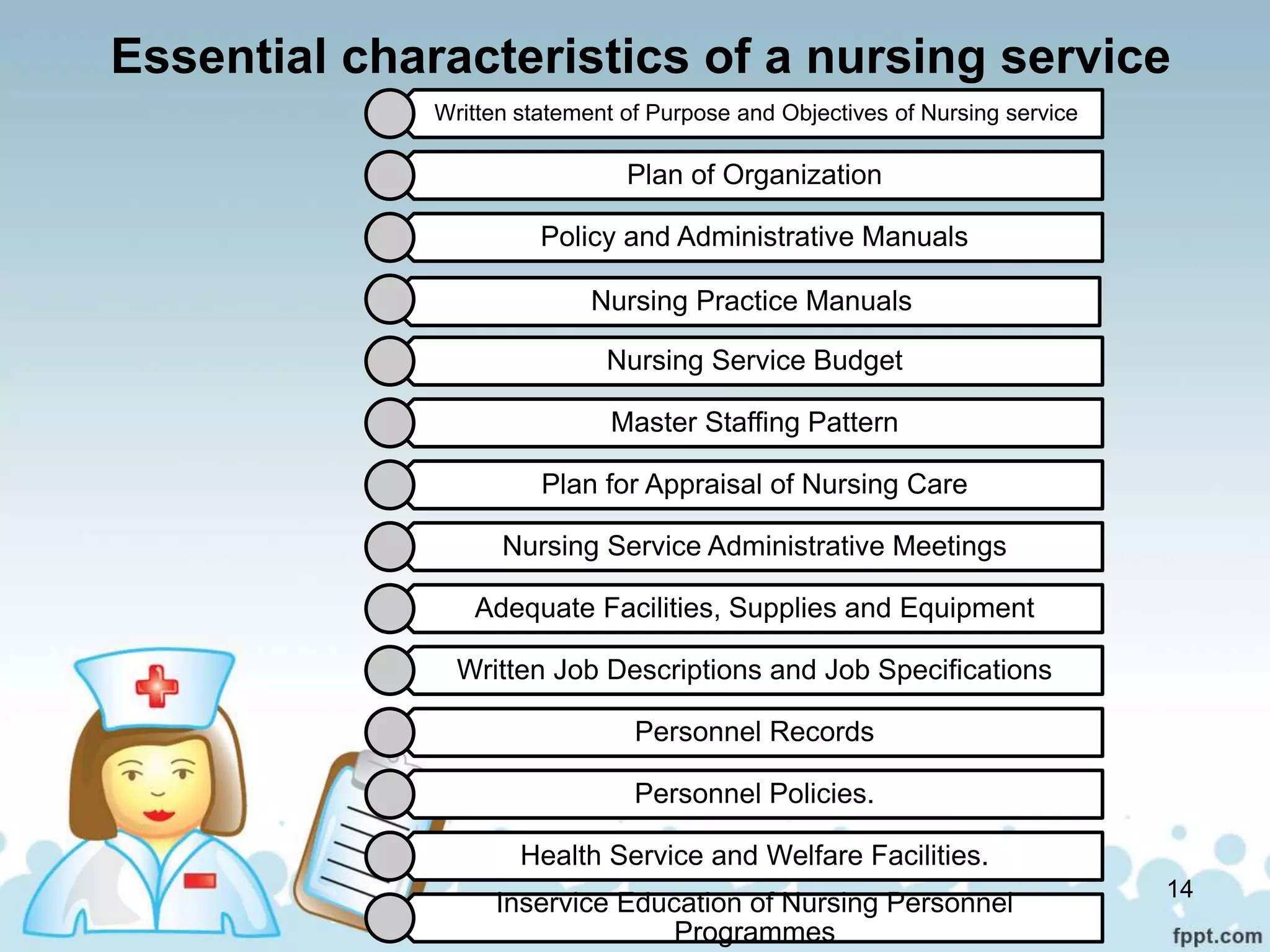
Essential characteristics of a nursing service
Written statement of Purpose and Objectives of Nursing service
Plan of Organization
Policy and Administrative Manuals
Nursing Practice Manuals
Nursing Service Budget
Master Staffing Pattern
Plan for Appraisal of Nursing Care
Nursing Service Administrative Meetings
Adequate Facilities, Supplies and Equipment
Written Job Descriptions and Job Specifications
Personnel Records
Personnel Policies.
Health Service and Welfare Facilities.
Inservice Education of Nursing Personnel
Programmes
14
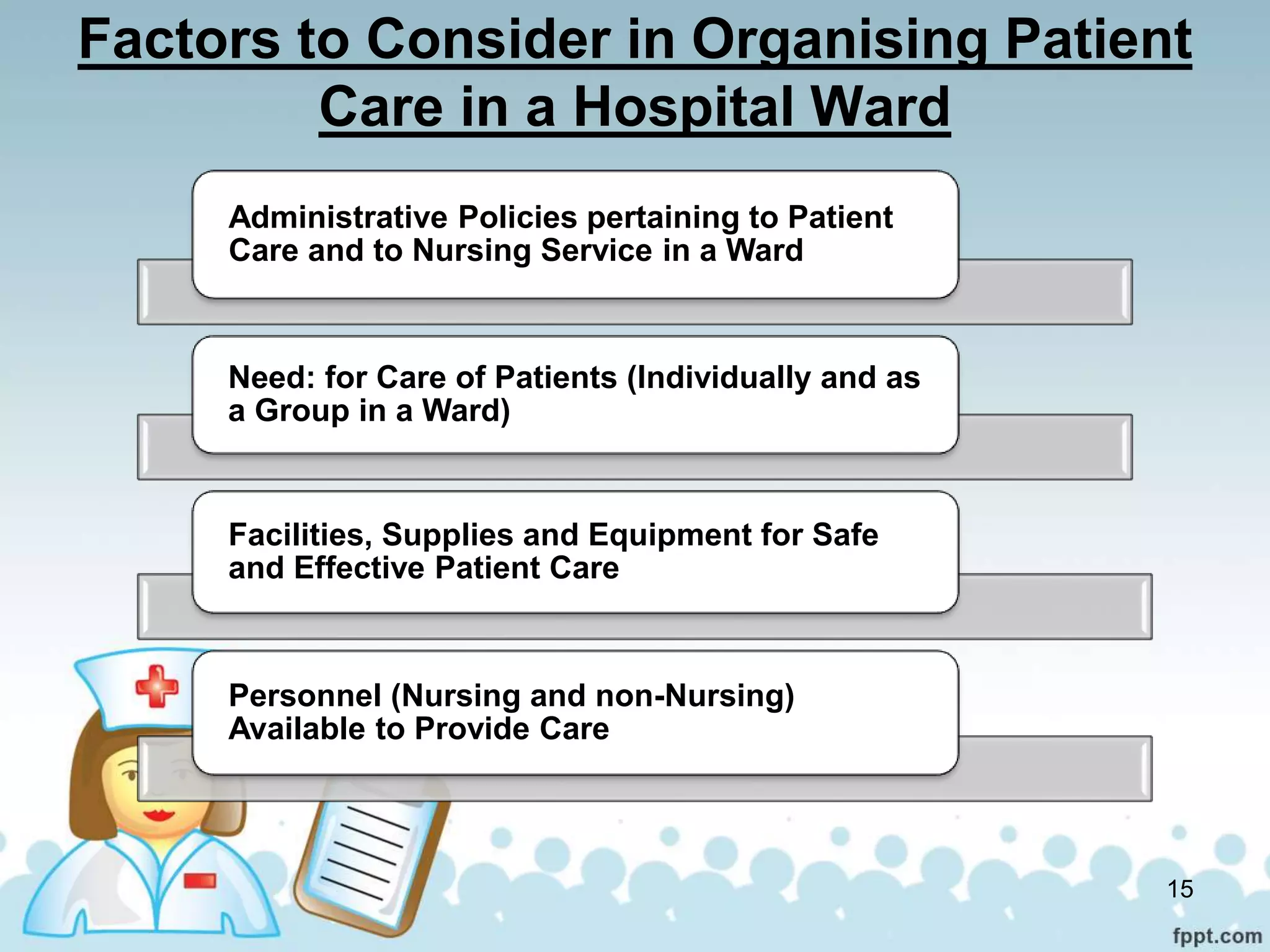
Factors to Consider in Organising Patient
Care in a Hospital Ward
Administrative Policies pertaining to Patient
Care and to Nursing Service in a Ward
Need: for Care of Patients (Individually and as
a Group in a Ward)
Facilities, Supplies and Equipment for Safe
and Effective Patient Care
Personnel (Nursing and non-Nursing)
Available to Provide Care
15
Administrative decisions and policies
which may affect nursing care in a ward
• Is the ward sister financially responsible
for loss of equipment and linen and
breakage in the ward?
• What research is being done in the ward
that may affect the morale of the nursing
staff,indirectly this can affect the nursinh
care?
16
Needs for care of patients
• The Nursing care plan is based upon the
Nurse’s observation of the patient and her
Nursing knowledge and skills.
• Her appraisal of the patient’s needs for
Nursing care is a continuing process and
is accomplished by such methods as
observation, Nursing rounds, ward
conferences, knowledge of patient’s
record and medical orders.
• To the extent possible, Nursing care plans
are patient centred. 17
• Let us take a Male Medical Ward with 60 sanctioned beds and 65
patients (5 are “floor” patients). The 60 beds are assigned to five
physicians. The day staff includes one Ward Sister, one Staff
Nurse, two Student Nurses (one in the first year of Nursing and one
in the second year), one Ayah and one Sweeper. Some of the
patients are seriously ill, some moderately and some are able to
care for themselves, for the most part. The diagnosis include:
diabetes, cardiac insufficiency, hypertension, nephritis, typhoid
fever, pneumonia, fever of unknown origin, gastric ulcer, hepatitis,
general debility, diarrhoea and undiagnosed admitted for
observation.
• To organise Nursing care for these patients takes skill. The need of
the patient’s individually and in relation to the group, as a whole will
have to be assessed and planned for. What about a plan for
progressive patient care within the ward? This would include
grouping the patients according to their self-care abilities.
18
Personnel nursing and non
nursing
• In a hospital ward those involved in providing Nursing
care to patients may include: Ward Sister, Staff Nurse,
Student (Nursing and/or A.N.M.), Ayah, Orderly,
Sweeper, and relatives of patients. The qualified Nurses
can perform the more complex care and make the
professional judgments. The Auxiliary Nurse Midwives,
and these are not many in hospitals, can perform less
complex care. Students should function at the level of
their preparation.
• A sweeper may give bed pan to selected patients, but a
patient with recently fractured pelvis may need the skill
of a nurse to help with elimination.
19
Facilities, Supplies and Equipment for Safe and
Effective Patient Care
• Environmental factors are important in
providing safe and effective patient care.
“Good administration aims at seeing that a
ward is so arranged and equipped that
good Nursing is possible, economy of
effort and maintenance familiated, and the
time and energy of personnel conserved
• Availability of clean water and
sanitation,the adequacy of supplies and
drugs for clinical work,safe storage and
use of drugs and chemicals and supplies
for safe handling of blood and excreta 20
Organogram of Hospital nursing
Chief nursing officer
Nursing superintendent
Deputy Nursing superintendent
Assistant Nursing Superintendent
Ward sister-Clinical Supervisor
Staff Nurse
Student Nurse 21
Job responsibilities
Read out from the handout
22
COMMUNITY
• A social group determined by geographic
boundaries
• A group of individuals with common values
and interests.
• A group of individuals living in the same
place or having a particular characteristic in
common.
• Its members know and interact with one
another. It functions within a particular
social structure and exhibits and creates
norms, values, and social institutions
23
community health :
Community health is a field of public health that focuses
on studying, protecting, or improving health within
a community. It does not focus on a group of people with
the same shared characteristics, like age or diagnosis,
but on all people within a geographical location or
involved in specific activity.
community health nursing :-
According to WHO “Public Health Nursing is a special
field of Nursing that combines the skills of Nursing,
public health and' some phases of social assistance and
functions as part of the total public health programme for
the promotion of health, the improvement of conditions in
the social and physical environment, rehabilitation and
prevention of illnesses and disability ...... ”
24
CONCEPTUAL LEVELS OF ORGANISATION FOR
COMMUNITY HEALTH NURSING ADMINISTRATION IN
INDIA
25
• StaffingPattern
• Community Health Services are delivered
in the rural area through a team of
workers, at the block level Primary Health
Centre,Sub centre and at the village level.
26
At the PHC:
• Staff Nurse (GNM)
• Female & Male Health Worker (FHW 85 MHW)
• Health Assistant Female or LHV Health Assistant Male
Pharmacist
• Block Extension Educator
• Upper Division Clerk
• Lower Division Clerk
• Laboratory Technician Statistician / Computer
• Driver
• Class IV Staff
27
At Sub Centre
• Health Worker Female / AN M
• Health Worker Male
• Voluntary Workers (TD, CHV etc)
28
job responsibilities
TO help the
worker to
develop a clear
understanding of
his / her
expected job
responsibilities.
To avoid
overlapping
activities among
different
categories of
workers.
To provide a
written
document for
legal purposes.
To help as a tool for
supervision v) To
help in
development of
better
understanding
among the different
categories of
workers
29
The Nursing members in the team for health
care delivery in the community consists of:
• Community Health Nurse /PHN
• Health Supervisor-Male &Female
• Health Worker Male & Female
30
COMMUNITY HEALTH NURSE ROLE
PREVIOUS ROLES
Care provider
Counselor
Health educator
Co coordinator
Change agent
trainer
supervisor
PRESENT ROLES
Team leader
manager
supervisor
Evaluator of
programmes
Liaison between
staff
advocate
31
Examples of Public Health Nursing
Activities
Evaluating health trends and risk factors of
population groups and helping to determine
priorities for targeted interventions.
Working with communities or specific
population groups within the community to
develop public policy and targeted health
promotion and disease prevention activities.
Providing essential input to interdisciplinary
programs that monitor, anticipate, and respond
to public health problems in population groups.
32
DPHNO District public health nursing
officer
• The district public health nurse officer is attached o the
district health office. And is directly responsible to the
district health officer (DHO) and has responsibility for all
nursing personnel in the District Public health field (i.e. in
primary health centers and sub centre, family welfare
programme tuberculosis and other programmes). Her
area of work is the entire district. In technical matters,
she is guided by the Deputy/assistant Director of health
services.
33
FUNCTIONS
General
Administrative
Supervisory
functions
Educational:
34
Director nursing services:(state)
• Usually one or two nurses are posted with varying
designations for example in tamilnadu, there is one
Assistant Director, Nursing who is responsible to
director, medical services and director medical education
• In Maharashtra two nurses work one in each in the office
of director medical education is responsible for all
matters of nursing service and nursing education.
• The nurse in the office of the director, health services is
responsible for community health nursing services,
nursing education.
35
Nursing Adviser
• This is the post in the medical division of directorate general of
health services.The nursing adviser is directly responsible to the
deputy director general (medical)
• The nursing adviser is assisted by nursing officer and support staff
for all her/his work.
• Functions:
• Advices the DGHS,the ministry health family welfare as well as other
ministries, departments e.g. railways,labour,delhi
administration/municipal corporation delhi,etc. on all matters of
nursing services, nursing education and research.
36
Deputy nursing adviser
• This post is in the training division of
department of FW.
• Here the nurse deals with training of
ANMs,dais,health supervisor.
• There is no direct linkage between the
nursing adviser and deputy nursing
adviser as both are independent posts.
37
38

Nursing services organisation

  • 1.
    ORGANISATION AND FUNCTION OFNURSING SERVICES- HOSPITAL AND COMMUNITY By Sandhya C M.Sc Nursing Final Year RAKCON 1
  • 2.
    ORIGIN OF WORDHOSPITAL • The word hospital is derived from the Latin word hospitalis,which comes from ‘hospes’ meaning a host. • Today hospital means an institution in which sick or injured persons are treated as well as healthy persons are helped to prevent, promote and maintain an optimum level of well being. 2
  • 3.
    HOSPITAL • The hospitalis an integral part of a social and medical organization, the function of which is to provide for the population complete health care, both curative and preventive and whose out patient services reach out to the family and its environment, the hospital is also a centre for the training of health workers . -WHO expert committee 3
  • 4.
    Functions of aHospital • The primary function of a hospital is the provision of medical care to a community • To be a centre for education of all types of health professionals • To be a centre for research 4
  • 5.
  • 6.
    Nursing Service:- Isthe part of the total health care organization which aims to satisfy the nursing needs of the community ,major objective of the nursing services is to provide prevention of disease and promotion of health. -WHO Expert Committee 6
  • 7.
    Organization of patientcare in hospital • Of all services provided in a hospital, the nursing service closest to the patients. • Management and supervision of nursing personnel is therefore a vital factor in establishing and maintaining an acceptable standard of nursing care for patients. 7
  • 8.
    Major functions ofhospital nursing services Education, training and staff development programme Personal and working relationships Maintaining an appropriate environment for patient care Personnel management Planning organising directing and coordinating individualised patient care. 8
  • 9.
    Management of nursingcare and services Establish adequate staffing pattern Develop and implement proper communication system. Develop and initiate proper evaluation and periodic monitoring system. Proper job description for nursing personnel. Assist hospital authorities for effective personnel management Share nursing information system with other discipline Formulate and interpret nursing service policies Assist hospital authorities for preparation of budget. Participate in inter departmental programs and other programs 9
  • 10.
    Education,training and staffdevelopment programme Develop and initiate orientation and training programs. Create an atmosphere that conducive to give proper learning experiences for students. Assist in the development of a sound, constructive program of leadership in nursing. Initiate programs to improve the practice of nursing in keeping with advances in the relative areas and disciplines affecting the quality of nursing. 10
  • 11.
    Nursing research Participate in identifyingthe areas of research Participate in the application of data and research. Produce conducive environment for research. 11
  • 12.
    Nursing care • Nursingcare is a direct service which includes one or both of the following components needed to maintain or restore an individuals optimum health Implementation of the physicians plan of care Planning,organising providing and evaluating facilities and care in terms of a patients need. 12
  • 13.
  • 14.
    Essential characteristics ofa nursing service Written statement of Purpose and Objectives of Nursing service Plan of Organization Policy and Administrative Manuals Nursing Practice Manuals Nursing Service Budget Master Staffing Pattern Plan for Appraisal of Nursing Care Nursing Service Administrative Meetings Adequate Facilities, Supplies and Equipment Written Job Descriptions and Job Specifications Personnel Records Personnel Policies. Health Service and Welfare Facilities. Inservice Education of Nursing Personnel Programmes 14
  • 15.
    Factors to Considerin Organising Patient Care in a Hospital Ward Administrative Policies pertaining to Patient Care and to Nursing Service in a Ward Need: for Care of Patients (Individually and as a Group in a Ward) Facilities, Supplies and Equipment for Safe and Effective Patient Care Personnel (Nursing and non-Nursing) Available to Provide Care 15
  • 16.
    Administrative decisions andpolicies which may affect nursing care in a ward • Is the ward sister financially responsible for loss of equipment and linen and breakage in the ward? • What research is being done in the ward that may affect the morale of the nursing staff,indirectly this can affect the nursinh care? 16
  • 17.
    Needs for careof patients • The Nursing care plan is based upon the Nurse’s observation of the patient and her Nursing knowledge and skills. • Her appraisal of the patient’s needs for Nursing care is a continuing process and is accomplished by such methods as observation, Nursing rounds, ward conferences, knowledge of patient’s record and medical orders. • To the extent possible, Nursing care plans are patient centred. 17
  • 18.
    • Let ustake a Male Medical Ward with 60 sanctioned beds and 65 patients (5 are “floor” patients). The 60 beds are assigned to five physicians. The day staff includes one Ward Sister, one Staff Nurse, two Student Nurses (one in the first year of Nursing and one in the second year), one Ayah and one Sweeper. Some of the patients are seriously ill, some moderately and some are able to care for themselves, for the most part. The diagnosis include: diabetes, cardiac insufficiency, hypertension, nephritis, typhoid fever, pneumonia, fever of unknown origin, gastric ulcer, hepatitis, general debility, diarrhoea and undiagnosed admitted for observation. • To organise Nursing care for these patients takes skill. The need of the patient’s individually and in relation to the group, as a whole will have to be assessed and planned for. What about a plan for progressive patient care within the ward? This would include grouping the patients according to their self-care abilities. 18
  • 19.
    Personnel nursing andnon nursing • In a hospital ward those involved in providing Nursing care to patients may include: Ward Sister, Staff Nurse, Student (Nursing and/or A.N.M.), Ayah, Orderly, Sweeper, and relatives of patients. The qualified Nurses can perform the more complex care and make the professional judgments. The Auxiliary Nurse Midwives, and these are not many in hospitals, can perform less complex care. Students should function at the level of their preparation. • A sweeper may give bed pan to selected patients, but a patient with recently fractured pelvis may need the skill of a nurse to help with elimination. 19
  • 20.
    Facilities, Supplies andEquipment for Safe and Effective Patient Care • Environmental factors are important in providing safe and effective patient care. “Good administration aims at seeing that a ward is so arranged and equipped that good Nursing is possible, economy of effort and maintenance familiated, and the time and energy of personnel conserved • Availability of clean water and sanitation,the adequacy of supplies and drugs for clinical work,safe storage and use of drugs and chemicals and supplies for safe handling of blood and excreta 20
  • 21.
    Organogram of Hospitalnursing Chief nursing officer Nursing superintendent Deputy Nursing superintendent Assistant Nursing Superintendent Ward sister-Clinical Supervisor Staff Nurse Student Nurse 21
  • 22.
    Job responsibilities Read outfrom the handout 22
  • 23.
    COMMUNITY • A socialgroup determined by geographic boundaries • A group of individuals with common values and interests. • A group of individuals living in the same place or having a particular characteristic in common. • Its members know and interact with one another. It functions within a particular social structure and exhibits and creates norms, values, and social institutions 23
  • 24.
    community health : Communityhealth is a field of public health that focuses on studying, protecting, or improving health within a community. It does not focus on a group of people with the same shared characteristics, like age or diagnosis, but on all people within a geographical location or involved in specific activity. community health nursing :- According to WHO “Public Health Nursing is a special field of Nursing that combines the skills of Nursing, public health and' some phases of social assistance and functions as part of the total public health programme for the promotion of health, the improvement of conditions in the social and physical environment, rehabilitation and prevention of illnesses and disability ...... ” 24
  • 25.
    CONCEPTUAL LEVELS OFORGANISATION FOR COMMUNITY HEALTH NURSING ADMINISTRATION IN INDIA 25
  • 26.
    • StaffingPattern • CommunityHealth Services are delivered in the rural area through a team of workers, at the block level Primary Health Centre,Sub centre and at the village level. 26
  • 27.
    At the PHC: •Staff Nurse (GNM) • Female & Male Health Worker (FHW 85 MHW) • Health Assistant Female or LHV Health Assistant Male Pharmacist • Block Extension Educator • Upper Division Clerk • Lower Division Clerk • Laboratory Technician Statistician / Computer • Driver • Class IV Staff 27
  • 28.
    At Sub Centre •Health Worker Female / AN M • Health Worker Male • Voluntary Workers (TD, CHV etc) 28
  • 29.
    job responsibilities TO helpthe worker to develop a clear understanding of his / her expected job responsibilities. To avoid overlapping activities among different categories of workers. To provide a written document for legal purposes. To help as a tool for supervision v) To help in development of better understanding among the different categories of workers 29
  • 30.
    The Nursing membersin the team for health care delivery in the community consists of: • Community Health Nurse /PHN • Health Supervisor-Male &Female • Health Worker Male & Female 30
  • 31.
    COMMUNITY HEALTH NURSEROLE PREVIOUS ROLES Care provider Counselor Health educator Co coordinator Change agent trainer supervisor PRESENT ROLES Team leader manager supervisor Evaluator of programmes Liaison between staff advocate 31
  • 32.
    Examples of PublicHealth Nursing Activities Evaluating health trends and risk factors of population groups and helping to determine priorities for targeted interventions. Working with communities or specific population groups within the community to develop public policy and targeted health promotion and disease prevention activities. Providing essential input to interdisciplinary programs that monitor, anticipate, and respond to public health problems in population groups. 32
  • 33.
    DPHNO District publichealth nursing officer • The district public health nurse officer is attached o the district health office. And is directly responsible to the district health officer (DHO) and has responsibility for all nursing personnel in the District Public health field (i.e. in primary health centers and sub centre, family welfare programme tuberculosis and other programmes). Her area of work is the entire district. In technical matters, she is guided by the Deputy/assistant Director of health services. 33
  • 34.
  • 35.
    Director nursing services:(state) •Usually one or two nurses are posted with varying designations for example in tamilnadu, there is one Assistant Director, Nursing who is responsible to director, medical services and director medical education • In Maharashtra two nurses work one in each in the office of director medical education is responsible for all matters of nursing service and nursing education. • The nurse in the office of the director, health services is responsible for community health nursing services, nursing education. 35
  • 36.
    Nursing Adviser • Thisis the post in the medical division of directorate general of health services.The nursing adviser is directly responsible to the deputy director general (medical) • The nursing adviser is assisted by nursing officer and support staff for all her/his work. • Functions: • Advices the DGHS,the ministry health family welfare as well as other ministries, departments e.g. railways,labour,delhi administration/municipal corporation delhi,etc. on all matters of nursing services, nursing education and research. 36
  • 37.
    Deputy nursing adviser •This post is in the training division of department of FW. • Here the nurse deals with training of ANMs,dais,health supervisor. • There is no direct linkage between the nursing adviser and deputy nursing adviser as both are independent posts. 37
  • 38.