By:
Seragaldin M. Abdulqader
Clinical pharmacology for nurses
University of Raparin/school of nursing
The lecture for undergraduate students:
2015 -20168 December 2015 1
Cannulation
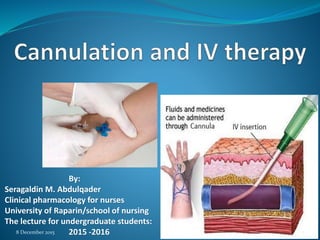
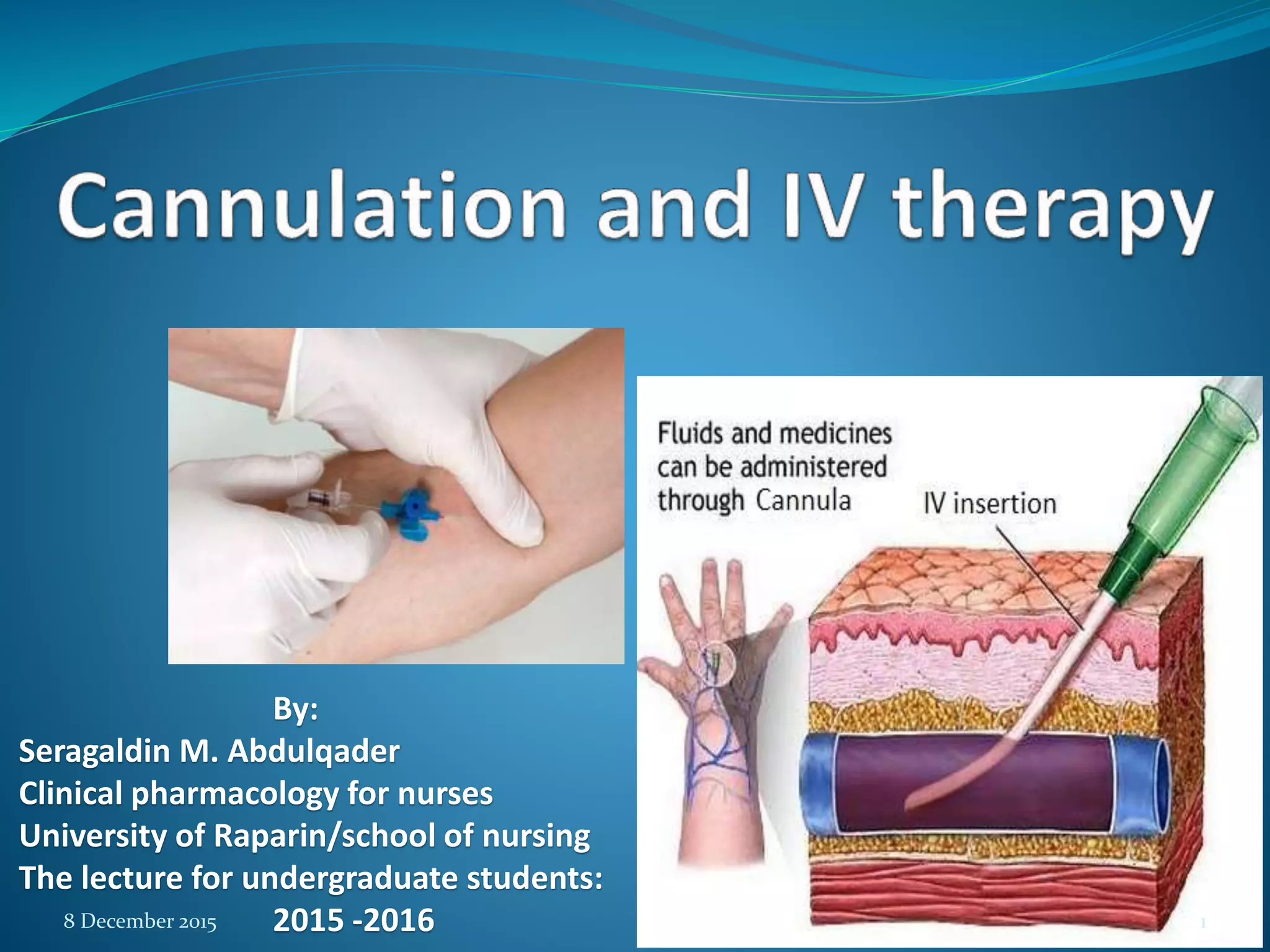
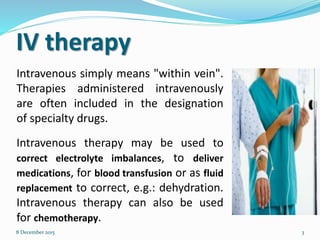
Is an emergency procedure in which
the vein is exposed to specific
insertion and then a cannula is inter
into the vein under direct vision.
It is used to get vascular access
especially in trauma and hypovolemic
shock patients.
8 December 2015 2
IV therapy
Intravenous simply means "within vein".
Therapies administered intravenously
are often included in the designation
of specialty drugs.
8 December 2015 3
Intravenous therapy may be used to
correct electrolyte imbalances, to deliver
medications, for blood transfusion or as fluid
replacement to correct, e.g.: dehydration.
Intravenous therapy can also be used
for chemotherapy.
Advantages
 Immediate effect
 Control over the rate of administration
 Patient cannot tolerate drugs / fluids orally
 Some drugs cannot be absorbed by any other route
 Pain and irritation is avoided compared to some
substances when given SC/IM
8 December 2015 4
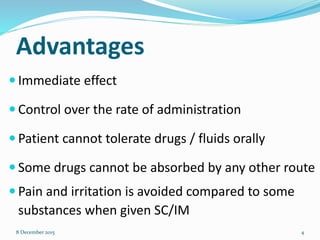
Possible Complications
 Hematoma
8 December 2015 5
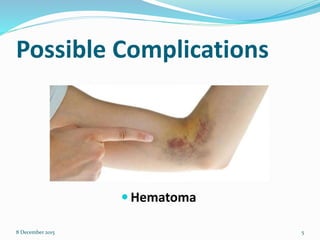
Possible Complications
 Thrombophlebitis
8 December 2015 6
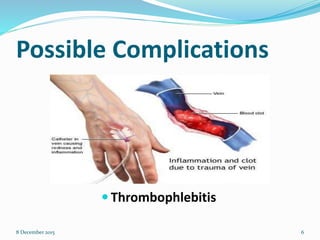
Possible Complications
 Cellulites
8 December 2015 7
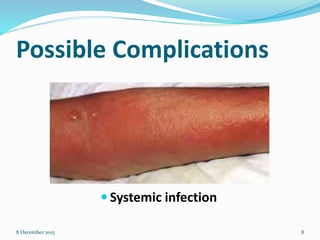
Possible Complications
 Systemic infection
8 December 2015 8
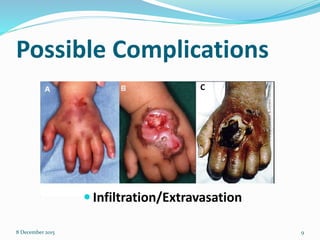
Possible Complications
8 December 2015 9
 Infiltration/Extravasation
C
Sites of chosen vein of
the upper extremities
 Veins of the Hand
1. Digital Dorsal veins
2. Dorsal Metacarpal veins
3. Dorsal venous network
4. Cephalic vein
5. Basilic vein
8 December 2015 10
Sites of chosen vein of
the upper extremities
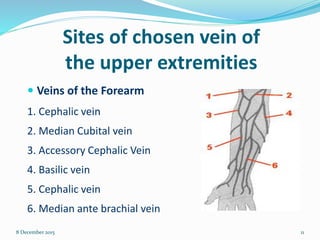
 Veins of the Forearm
1. Cephalic vein
2. Median Cubital vein
3. Accessory Cephalic Vein
4. Basilic vein
5. Cephalic vein
6. Median ante brachial vein
8 December 2015 11
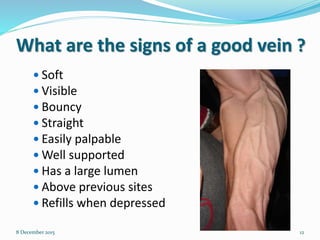
What are the signs of a good vein ?
 Soft
 Visible
 Bouncy
 Straight
 Easily palpable
 Well supported
 Has a large lumen
 Above previous sites
 Refills when depressed
8 December 2015 12
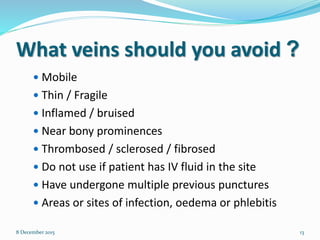
What veins should you avoid ?
 Mobile
 Thin / Fragile
 Inflamed / bruised
 Near bony prominences
 Thrombosed / sclerosed / fibrosed
 Do not use if patient has IV fluid in the site
 Have undergone multiple previous punctures
 Areas or sites of infection, oedema or phlebitis
8 December 2015 13
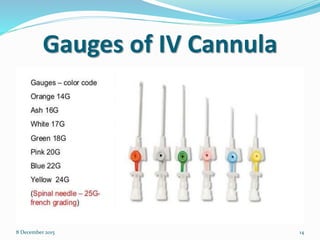
Gauges of IV Cannula
8 December 2015 14
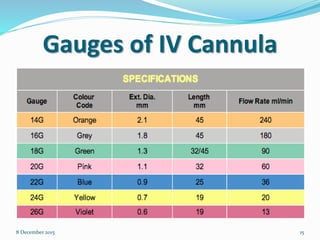
Gauges of IV Cannula
8 December 2015 15
Thank you
8 December 2015 16

Canulation and iv therapy

  • 1.
    By: Seragaldin M. Abdulqader Clinicalpharmacology for nurses University of Raparin/school of nursing The lecture for undergraduate students: 2015 -20168 December 2015 1
  • 2.
    Cannulation Is an emergencyprocedure in which the vein is exposed to specific insertion and then a cannula is inter into the vein under direct vision. It is used to get vascular access especially in trauma and hypovolemic shock patients. 8 December 2015 2
  • 3.
    IV therapy Intravenous simplymeans "within vein". Therapies administered intravenously are often included in the designation of specialty drugs. 8 December 2015 3 Intravenous therapy may be used to correct electrolyte imbalances, to deliver medications, for blood transfusion or as fluid replacement to correct, e.g.: dehydration. Intravenous therapy can also be used for chemotherapy.
  • 4.
    Advantages  Immediate effect Control over the rate of administration  Patient cannot tolerate drugs / fluids orally  Some drugs cannot be absorbed by any other route  Pain and irritation is avoided compared to some substances when given SC/IM 8 December 2015 4
  • 5.
  • 6.
  • 7.
  • 8.
    Possible Complications  Systemicinfection 8 December 2015 8
  • 9.
    Possible Complications 8 December2015 9  Infiltration/Extravasation C
  • 10.
    Sites of chosenvein of the upper extremities  Veins of the Hand 1. Digital Dorsal veins 2. Dorsal Metacarpal veins 3. Dorsal venous network 4. Cephalic vein 5. Basilic vein 8 December 2015 10
  • 11.
    Sites of chosenvein of the upper extremities  Veins of the Forearm 1. Cephalic vein 2. Median Cubital vein 3. Accessory Cephalic Vein 4. Basilic vein 5. Cephalic vein 6. Median ante brachial vein 8 December 2015 11
  • 12.
    What are thesigns of a good vein ?  Soft  Visible  Bouncy  Straight  Easily palpable  Well supported  Has a large lumen  Above previous sites  Refills when depressed 8 December 2015 12
  • 13.
    What veins shouldyou avoid ?  Mobile  Thin / Fragile  Inflamed / bruised  Near bony prominences  Thrombosed / sclerosed / fibrosed  Do not use if patient has IV fluid in the site  Have undergone multiple previous punctures  Areas or sites of infection, oedema or phlebitis 8 December 2015 13
  • 14.
    Gauges of IVCannula 8 December 2015 14
  • 15.
    Gauges of IVCannula 8 December 2015 15
  • 16.