Periodicals
What is a periodical?
Information published at regular intervals:
– Daily Newspaper
– Monthly Magazine
– Bi-Monthly (two months)
– Quarterly (every three months)
– Semi-Annual (every six months)
Why use periodicals?
Periodicals are the second most current published
information after the Internet.
Periodicals are edited and vetted.
They reflect the opinion of their times.
– Articles are written about events at the time those events
happen where books are usually written after the event has
passed.
They reflect evolving information and point of view.
It is often the only information available when
book publishers are not interested.
– Local Issues
Types of Periodicals
Two types of periodicals:
– Popular & Scholarly
Types of Periodicals
Popular
– General Magazines & Newspapers
• Examples: Newsweek, L.A. Times, Entertainment Weekly
– Designed to appeal to a broad population
– Short articles in non-technical language
– Aimed at reading the level of an average person
• In a 1993 study, the average adult grade-reading level
was 8th
to 9th
grade.
– Usually written by staff writers
– Primarily information about current events
Types of Periodicals
Scholarly
– Journals
• Examples: New England Journal of Medicine, International Journal of
Pharmaceuticals, Library Journal
– Aimed at a limited, professional readership
– Written by experts in the field
– Very technical vocabulary aimed at people educated and
experienced in that field
– Articles are usually the result of research in the field
– Usually contain extensive bibliographies
– Will often have the word “journal” in the title
• The Wall Street Journal is an exception. It is a newspaper.
Development of Periodical Holdings
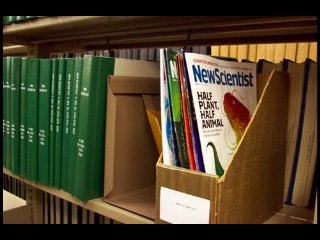
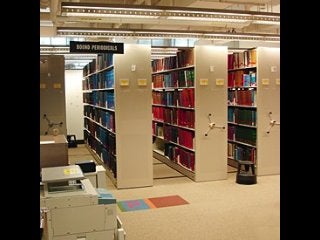
Paper
– Loose & Bound
Development of Periodical Holdings
Paper
– Loose & Bound
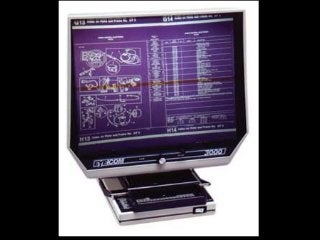
Microforms
– Microfilm & Microfiche
Periodicals
Periodicals
Periodicals
Periodicals

Periodicals

  • 1.
  • 2.
    What is aperiodical? Information published at regular intervals: – Daily Newspaper – Monthly Magazine – Bi-Monthly (two months) – Quarterly (every three months) – Semi-Annual (every six months)
  • 3.
    Why use periodicals? Periodicalsare the second most current published information after the Internet. Periodicals are edited and vetted. They reflect the opinion of their times. – Articles are written about events at the time those events happen where books are usually written after the event has passed. They reflect evolving information and point of view. It is often the only information available when book publishers are not interested. – Local Issues
  • 4.
    Types of Periodicals Twotypes of periodicals: – Popular & Scholarly
  • 5.
    Types of Periodicals Popular –General Magazines & Newspapers • Examples: Newsweek, L.A. Times, Entertainment Weekly – Designed to appeal to a broad population – Short articles in non-technical language – Aimed at reading the level of an average person • In a 1993 study, the average adult grade-reading level was 8th to 9th grade. – Usually written by staff writers – Primarily information about current events
  • 6.
    Types of Periodicals Scholarly –Journals • Examples: New England Journal of Medicine, International Journal of Pharmaceuticals, Library Journal – Aimed at a limited, professional readership – Written by experts in the field – Very technical vocabulary aimed at people educated and experienced in that field – Articles are usually the result of research in the field – Usually contain extensive bibliographies – Will often have the word “journal” in the title • The Wall Street Journal is an exception. It is a newspaper.
  • 7.
    Development of PeriodicalHoldings Paper – Loose & Bound
  • 12.
    Development of PeriodicalHoldings Paper – Loose & Bound Microforms – Microfilm & Microfiche

Editor's Notes

  • #9 Green Library at STanford
  • #10 Green Library at Stanford
  • #11 Hartwick College
  • #12 UC Berkeley