Perfusion Culture System
By
Bandhan Daripa
Content-
• Introduction
• Perfusion Bioreactors
• Perfusion Technology
• Advantage & Disadvantage of perfusion
technology
• Application
• Conclusion
• References
Introduction
• Perfusion, or upstream continuous bioprocessing, has been
practiced since the 1980s towards maximizing facility
utilization, expanding process flexibility and minimizing
costs. Innovative technologies, sophisticated control logic
systems, cell culture supplements and single-use assemblies
have tremendously simplified implementation, establishing
perfusion as the cornerstone of intensification and continuous
processing.
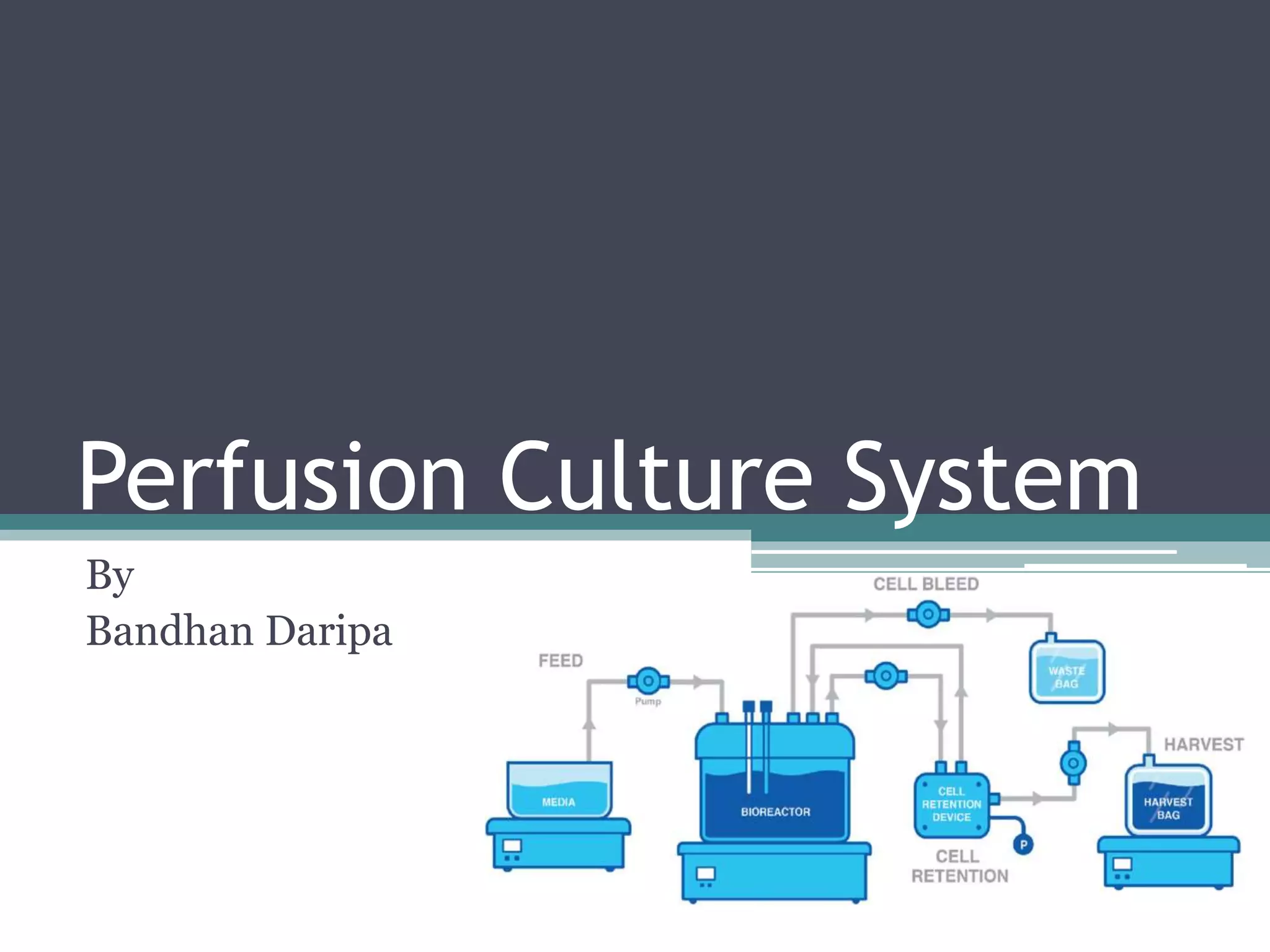
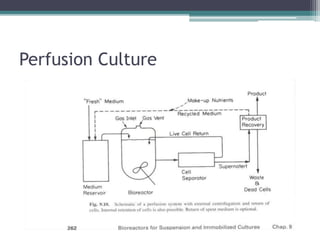
• A perfusion culture is one in which waste medium is
continuously removed from the culture and the displaced
medium is replenished with fresh medium.
What is Perfusion Cell Culture?
• A perfusion cell culture process involves the constant
feeding of fresh media and removal of spent media and
product while retaining high numbers of viable cells.
Removing spent media while keeping cells in culture can
be done using alternating tangential-flow(ATF) and
standard tangential-flow filtration(TFF). Another option
is to retain the cells by binding them to a substrate in
bioreactor. Other method include use of centrifuges.
Lately, a revival of methods using acoustic waves has
been seen.
Perfusion Bioreactors
 Perfusion technology for biopharmaceutical production
▫ Leading focus of R&D of any Biopharma.
▫ It involves addition of media or key media constituents at regular
intervals along with retention of cells in the reactor.
▫ Many manufacturing company involved in perfusion-based systems
especially for hybridoma-based monoclonal antibodies.
▫ In perfusion-based process product yield increased significantly in
comparison to conventional fed-based processes.
▫ Factor VIII (ReFacto) and IgG are two of the leading products being
produced commercially using perfusion technology.
Cont…
 Why perfusion technology?
▫ Its offers the ease of continuous culturing of cells without nuisance of
filter clogging or low throughput.
▫ Less possibilities of waste accumulation and, hence, minimized
chances of any product inhibition, especially while dealing with
proteins prone to instability.
▫ The availability of key media constituents is maintained consistently
by providing host cells a stable environment leading to a high cell
density and higher productivity with respect to desired compound.
▫ Continuous perfusion was calculated and found to be the most
productive technology giving product at the rate of 265kg/year as
compared to 130kg/yr in fed-batch mode.
▫ Perfusion technology offers a lucrative mode of production especially
as it beats the conventional fed-batch system in terms of productivity,
efficiency, and capital investments.
Cont…
 Cell retention in Perfusion
• Ability to yield a high cell mass due to the presence of cell retention
devices.
• Cell can be retained by making them grow inside bioreactor on hollow
capillary fibers, flat plates, sponge-like materials, microcarrier particles,
or other membranes.
• Also cell can be retained by use of various cell separation devices like
gravity-based cell settlers, spin filters, centrifuges, cross-flow filters,
alternating tangential-flow filters, vortex-flow filters, acoustic settlers,
and hydrocyclones.
• Spin filter was one of the earliest available devices for cell retention
which used a two-dimensional screen to retain the cells.
• Alternating tangential-flow filters(TFFs) have emerged as the most
effective and practical means of high-density cell retention in a perfusion
bioreactor.
Cont…
 Perfusion and bioreactors
• Perfusion further minimizes the losses associated with batch failure due
to contamination. Even if contamination occurs earlier in the process,
lesser media and other consumables would be wasted.
• In a recent report, a novel microfluidic cell retention device based on
inertial sorting was tested positively for retention of IgG1 producing
chinese hamster ovary(CHO) cell line.
• Parameters tested were cell retention efficiency, biocompatibility, and
scalability.
• There was also the flexibility of configuring the device to separate
different-sized cells with a specific input flow rate, this gave an added
advantage of flushing out non viable cells.
• Perfusion microfluidic systems can also be used for growth and
expression of proteins from bacterial cells.
Procedure for the design of perfusion
bioreactors
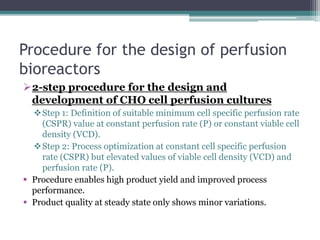
2-step procedure for the design and
development of CHO cell perfusion cultures
Step 1: Definition of suitable minimum cell specific perfusion rate
(CSPR) value at constant perfusion rate (P) or constant viable cell
density (VCD).
Step 2: Process optimization at constant cell specific perfusion
rate (CSPR) but elevated values of viable cell density (VCD) and
perfusion rate (P).
 Procedure enables high product yield and improved process
performance.
 Product quality at steady state only shows minor variations.
Perfusion Culture
Perfusion technology
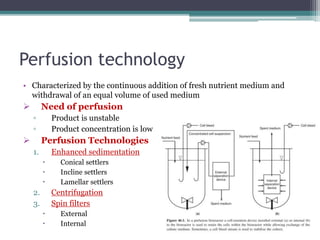
• Characterized by the continuous addition of fresh nutrient medium and
withdrawal of an equal volume of used medium
 Need of perfusion
▫ Product is unstable
▫ Product concentration is low
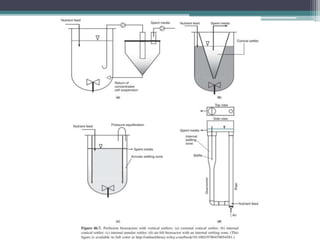
 Perfusion Technologies
1. Enhanced sedimentation
 Conical settlers
 Incline settlers
 Lamellar settlers
2. Centrifugation
3. Spin filters
 External
 Internal
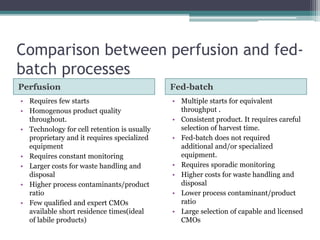
Comparison between perfusion and fed-
batch processes
Perfusion Fed-batch
• Requires few starts
• Homogenous product quality
throughout.
• Technology for cell retention is usually
proprietary and it requires specialized
equipment
• Requires constant monitoring
• Larger costs for waste handling and
disposal
• Higher process contaminants/product
ratio
• Few qualified and expert CMOs
available short residence times(ideal
of labile products)
• Multiple starts for equivalent
throughput .
• Consistent product. It requires careful
selection of harvest time.
• Fed-batch does not required
additional and/or specialized
equipment.
• Requires sporadic monitoring
• Higher costs for waste handling and
disposal
• Lower process contaminant/product
ratio
• Large selection of capable and licensed
CMOs
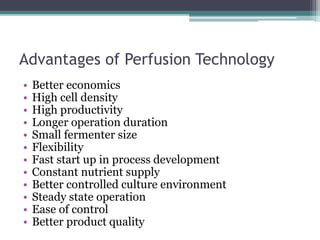
Advantages of Perfusion Technology
• Better economics
• High cell density
• High productivity
• Longer operation duration
• Small fermenter size
• Flexibility
• Fast start up in process development
• Constant nutrient supply
• Better controlled culture environment
• Steady state operation
• Ease of control
• Better product quality
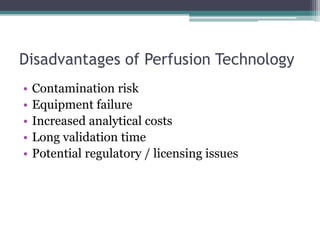
Disadvantages of Perfusion Technology
• Contamination risk
• Equipment failure
• Increased analytical costs
• Long validation time
• Potential regulatory / licensing issues
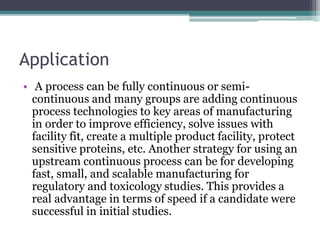
Application
• A process can be fully continuous or semi-
continuous and many groups are adding continuous
process technologies to key areas of manufacturing
in order to improve efficiency, solve issues with
facility fit, create a multiple product facility, protect
sensitive proteins, etc. Another strategy for using an
upstream continuous process can be for developing
fast, small, and scalable manufacturing for
regulatory and toxicology studies. This provides a
real advantage in terms of speed if a candidate were
successful in initial studies.
Conclusion
In conclusion perfusion culture can offer several benefits
that may help those in process development and
manufacturing address key issues. The decision whether
this technology is beneficial to specific products or
manufacturing platforms is application dependent.
While the benefits may be clear in some areas, there are
still some questions that need to be address by
companies’ looking to adopt this technology. Issues like
what constitutes a batch, operation validation, in-
process testing and how continuous upstream connects
to the rest of the manufacturing platform needs to be
carefully considered.
REFERENCES
• Michael_C._Flickinger-_Upstream_Industrial_Biotec(b-
ok.org).pdf
• Perfusion Cell Culture :: Repligen
• Perfusion Medium Development for Continuous Bioprocessing of
Animal Cell Cultures | American Pharmaceutical Review - The
Review of American Pharmaceutical Business & Technology
• Microbioreactors and Perfusion Bioreactors for Microbial and
Mammalian Cell Culture | IntechOpen
Perfusion Culture System

Perfusion Culture System

  • 1.
  • 2.
    Content- • Introduction • PerfusionBioreactors • Perfusion Technology • Advantage & Disadvantage of perfusion technology • Application • Conclusion • References
  • 3.
    Introduction • Perfusion, orupstream continuous bioprocessing, has been practiced since the 1980s towards maximizing facility utilization, expanding process flexibility and minimizing costs. Innovative technologies, sophisticated control logic systems, cell culture supplements and single-use assemblies have tremendously simplified implementation, establishing perfusion as the cornerstone of intensification and continuous processing. • A perfusion culture is one in which waste medium is continuously removed from the culture and the displaced medium is replenished with fresh medium.
  • 4.
    What is PerfusionCell Culture? • A perfusion cell culture process involves the constant feeding of fresh media and removal of spent media and product while retaining high numbers of viable cells. Removing spent media while keeping cells in culture can be done using alternating tangential-flow(ATF) and standard tangential-flow filtration(TFF). Another option is to retain the cells by binding them to a substrate in bioreactor. Other method include use of centrifuges. Lately, a revival of methods using acoustic waves has been seen.
  • 5.
    Perfusion Bioreactors  Perfusiontechnology for biopharmaceutical production ▫ Leading focus of R&D of any Biopharma. ▫ It involves addition of media or key media constituents at regular intervals along with retention of cells in the reactor. ▫ Many manufacturing company involved in perfusion-based systems especially for hybridoma-based monoclonal antibodies. ▫ In perfusion-based process product yield increased significantly in comparison to conventional fed-based processes. ▫ Factor VIII (ReFacto) and IgG are two of the leading products being produced commercially using perfusion technology.
  • 6.
    Cont…  Why perfusiontechnology? ▫ Its offers the ease of continuous culturing of cells without nuisance of filter clogging or low throughput. ▫ Less possibilities of waste accumulation and, hence, minimized chances of any product inhibition, especially while dealing with proteins prone to instability. ▫ The availability of key media constituents is maintained consistently by providing host cells a stable environment leading to a high cell density and higher productivity with respect to desired compound. ▫ Continuous perfusion was calculated and found to be the most productive technology giving product at the rate of 265kg/year as compared to 130kg/yr in fed-batch mode. ▫ Perfusion technology offers a lucrative mode of production especially as it beats the conventional fed-batch system in terms of productivity, efficiency, and capital investments.
  • 7.
    Cont…  Cell retentionin Perfusion • Ability to yield a high cell mass due to the presence of cell retention devices. • Cell can be retained by making them grow inside bioreactor on hollow capillary fibers, flat plates, sponge-like materials, microcarrier particles, or other membranes. • Also cell can be retained by use of various cell separation devices like gravity-based cell settlers, spin filters, centrifuges, cross-flow filters, alternating tangential-flow filters, vortex-flow filters, acoustic settlers, and hydrocyclones. • Spin filter was one of the earliest available devices for cell retention which used a two-dimensional screen to retain the cells. • Alternating tangential-flow filters(TFFs) have emerged as the most effective and practical means of high-density cell retention in a perfusion bioreactor.
  • 8.
    Cont…  Perfusion andbioreactors • Perfusion further minimizes the losses associated with batch failure due to contamination. Even if contamination occurs earlier in the process, lesser media and other consumables would be wasted. • In a recent report, a novel microfluidic cell retention device based on inertial sorting was tested positively for retention of IgG1 producing chinese hamster ovary(CHO) cell line. • Parameters tested were cell retention efficiency, biocompatibility, and scalability. • There was also the flexibility of configuring the device to separate different-sized cells with a specific input flow rate, this gave an added advantage of flushing out non viable cells. • Perfusion microfluidic systems can also be used for growth and expression of proteins from bacterial cells.
  • 9.
    Procedure for thedesign of perfusion bioreactors 2-step procedure for the design and development of CHO cell perfusion cultures Step 1: Definition of suitable minimum cell specific perfusion rate (CSPR) value at constant perfusion rate (P) or constant viable cell density (VCD). Step 2: Process optimization at constant cell specific perfusion rate (CSPR) but elevated values of viable cell density (VCD) and perfusion rate (P).  Procedure enables high product yield and improved process performance.  Product quality at steady state only shows minor variations.
  • 10.
  • 11.
    Perfusion technology • Characterizedby the continuous addition of fresh nutrient medium and withdrawal of an equal volume of used medium  Need of perfusion ▫ Product is unstable ▫ Product concentration is low  Perfusion Technologies 1. Enhanced sedimentation  Conical settlers  Incline settlers  Lamellar settlers 2. Centrifugation 3. Spin filters  External  Internal
  • 13.
    Comparison between perfusionand fed- batch processes Perfusion Fed-batch • Requires few starts • Homogenous product quality throughout. • Technology for cell retention is usually proprietary and it requires specialized equipment • Requires constant monitoring • Larger costs for waste handling and disposal • Higher process contaminants/product ratio • Few qualified and expert CMOs available short residence times(ideal of labile products) • Multiple starts for equivalent throughput . • Consistent product. It requires careful selection of harvest time. • Fed-batch does not required additional and/or specialized equipment. • Requires sporadic monitoring • Higher costs for waste handling and disposal • Lower process contaminant/product ratio • Large selection of capable and licensed CMOs
  • 14.
    Advantages of PerfusionTechnology • Better economics • High cell density • High productivity • Longer operation duration • Small fermenter size • Flexibility • Fast start up in process development • Constant nutrient supply • Better controlled culture environment • Steady state operation • Ease of control • Better product quality
  • 15.
    Disadvantages of PerfusionTechnology • Contamination risk • Equipment failure • Increased analytical costs • Long validation time • Potential regulatory / licensing issues
  • 16.
    Application • A processcan be fully continuous or semi- continuous and many groups are adding continuous process technologies to key areas of manufacturing in order to improve efficiency, solve issues with facility fit, create a multiple product facility, protect sensitive proteins, etc. Another strategy for using an upstream continuous process can be for developing fast, small, and scalable manufacturing for regulatory and toxicology studies. This provides a real advantage in terms of speed if a candidate were successful in initial studies.
  • 17.
    Conclusion In conclusion perfusionculture can offer several benefits that may help those in process development and manufacturing address key issues. The decision whether this technology is beneficial to specific products or manufacturing platforms is application dependent. While the benefits may be clear in some areas, there are still some questions that need to be address by companies’ looking to adopt this technology. Issues like what constitutes a batch, operation validation, in- process testing and how continuous upstream connects to the rest of the manufacturing platform needs to be carefully considered.
  • 18.
    REFERENCES • Michael_C._Flickinger-_Upstream_Industrial_Biotec(b- ok.org).pdf • PerfusionCell Culture :: Repligen • Perfusion Medium Development for Continuous Bioprocessing of Animal Cell Cultures | American Pharmaceutical Review - The Review of American Pharmaceutical Business & Technology • Microbioreactors and Perfusion Bioreactors for Microbial and Mammalian Cell Culture | IntechOpen