CASE STUDY 
EVALUATING 
PERFUSION 
TECHNOLOGIES 
To evaluate the potential benefits and risks associated with 
moving to Perfusion fermentation technologies. 
• A risk-based model was built to evaluate the benefits of fermentation 
perfusion and how this would integrate with an existing plant 
• Risk-based approach used backup perfusion vessels to minimize the 
effect of disruption to downstream purification processing 
• Excess capacity from the production train was used to create a small-scale 
‘plant-within-a-plant’ for clinical and small-scale production 
• The completed design showed a positive NPV of $40MM over 5 years. 
GOAL 
Perfusion technologies have shown potential to radically improve cell densities 
in fermentation over batch-based technologies, with titers an order of magnitude 
higher than those achieved in existing facilities. Such high titers enable much 
smaller fermentation vessels to be used, minimizing plant clean-space requirements 
and maximizing often limited downstream purification train resources. 
One of the big issues with fermentation perfusion remains the radically different 
operating characteristics of perfusion technologies. Since the transient time 
for perfusion is months longer than a batch-based system, contamination risk 
increases considerably. Bioproduction Group’s brief was to create a feasible 
perfusion platform that would fit into an existing plant. The goal was to enable 
the manufacturer to use both perfusion technologies for new products as well as 
the traditional batch-based process for legacy products. 
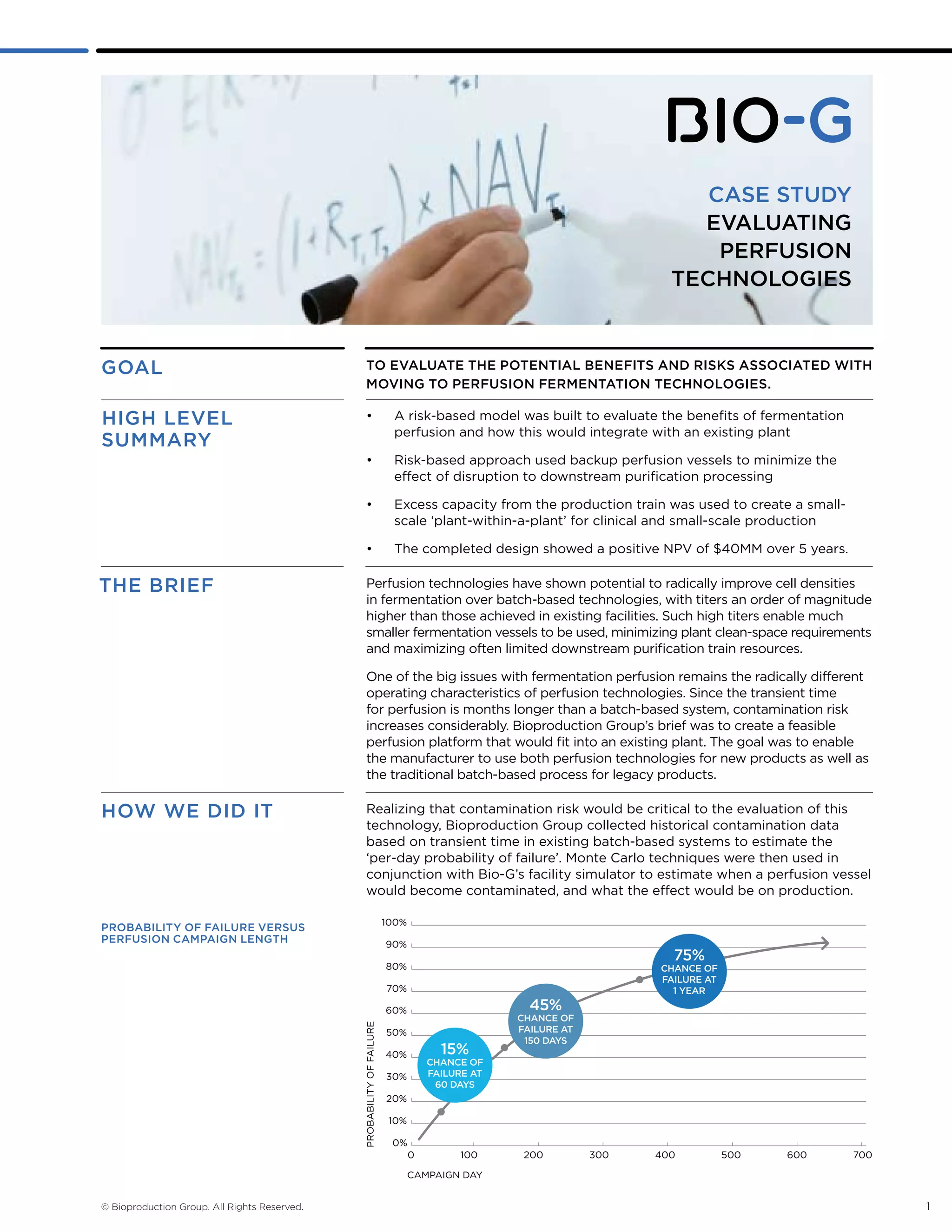
Realizing that contamination risk would be critical to the evaluation of this 
technology, Bioproduction Group collected historical contamination data 
based on transient time in existing batch-based systems to estimate the 
‘per-day probability of failure’. Monte Carlo techniques were then used in 
conjunction with Bio-G’s facility simulator to estimate when a perfusion vessel 
would become contaminated, and what the effect would be on production. 
PROBABILITY OF FAILURE 
0% 
15% 
CHANCE OF 
FAILURE AT 
60 DAYS 
45% 
CHANCE OF 
FAILURE AT 
150 DAYS 
75% 
CHANCE OF 
FAILURE AT 
1 YEAR 
0 100 200 300 400 500 600 700 
CAMPAIGN DAY 
100% 
90% 
80% 
70% 
60% 
50% 
40% 
30% 
20% 
10% 
high level 
summary 
THE BRIEF 
How We Did It 
PROBABILITY OF FAILURE VERSUS 
PERFUSION CAMPAIGN LENGTH 
© Bioproduction Group. All Rights Reserved. 1
“Making perfusion work is all about mitigating the effect of contamination”, 
comments Principal Rick Johnston. “Making sure that backup perfusion 
vessels, innoculum at the correct scale, and even media is available at 
all times is critical to success.” After extensive consultation with the 
manufacturer, redundant capacity was added to the perfusion train to 
allow operations to continue even if a vessel was contaminated. 
Bioproduction Group then produced a comprehensive simulation model 
of fermentation perfusion technologies to show how they could be used 
in ‘semi-batch’ mode with existing (batch-based) purification equipment. 
Unused scale-up tanks were re-tasked to produce clinical and small-scale 
production, allowing the plant to produce multiple products at very 
different scales at the same time. 
“Making perfusion work is all 
about mitigating the effect of 
contamination” 
Rick Johnston, Principal 
Results Bio-G’s recommendations were to segregate production into a small-scale 
batch-based production train and a large-scale perfusion fermentation train, 
retaining the ability to operate the plant in large-scale batch mode. The 
resulting design increased the plant’s capacity to simultaneously operate 
as a launch platform for new products, as well as perform technology 
transfer and optimally utilize workers in the plant. 
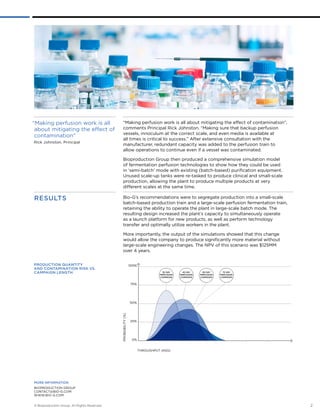
More importantly, the output of the simulations showed that this change 
would allow the company to produce significantly more material without 
large-scale engineering changes. The NPV of this scenario was $125MM 
over 4 years. 
production quantity 
and contamination risk vs. 
campaign length 
MORE INFORMATION 
BIOPRODUCTION GROUP 
CONTACT@BIO-G.COM 
www.bio-g.com 
100% 
75% 
PROBABILITY (%) 
30 DAY 
PERFUSION 
CAMPAIGN 
THROUGHPUT (KGS) 
50% 
25% 
0% 
45 DAY 
PERFUSION 
CAMPAIGN 
60 DAY 
PERFUSION 
CAMPAIGN 
75 DAY 
PERFUSION 
CAMPAIGN 
© Bioproduction Group. All Rights Reserved. 2

Evaluating perfusion technologies

  • 1.
    CASE STUDY EVALUATING PERFUSION TECHNOLOGIES To evaluate the potential benefits and risks associated with moving to Perfusion fermentation technologies. • A risk-based model was built to evaluate the benefits of fermentation perfusion and how this would integrate with an existing plant • Risk-based approach used backup perfusion vessels to minimize the effect of disruption to downstream purification processing • Excess capacity from the production train was used to create a small-scale ‘plant-within-a-plant’ for clinical and small-scale production • The completed design showed a positive NPV of $40MM over 5 years. GOAL Perfusion technologies have shown potential to radically improve cell densities in fermentation over batch-based technologies, with titers an order of magnitude higher than those achieved in existing facilities. Such high titers enable much smaller fermentation vessels to be used, minimizing plant clean-space requirements and maximizing often limited downstream purification train resources. One of the big issues with fermentation perfusion remains the radically different operating characteristics of perfusion technologies. Since the transient time for perfusion is months longer than a batch-based system, contamination risk increases considerably. Bioproduction Group’s brief was to create a feasible perfusion platform that would fit into an existing plant. The goal was to enable the manufacturer to use both perfusion technologies for new products as well as the traditional batch-based process for legacy products. Realizing that contamination risk would be critical to the evaluation of this technology, Bioproduction Group collected historical contamination data based on transient time in existing batch-based systems to estimate the ‘per-day probability of failure’. Monte Carlo techniques were then used in conjunction with Bio-G’s facility simulator to estimate when a perfusion vessel would become contaminated, and what the effect would be on production. PROBABILITY OF FAILURE 0% 15% CHANCE OF FAILURE AT 60 DAYS 45% CHANCE OF FAILURE AT 150 DAYS 75% CHANCE OF FAILURE AT 1 YEAR 0 100 200 300 400 500 600 700 CAMPAIGN DAY 100% 90% 80% 70% 60% 50% 40% 30% 20% 10% high level summary THE BRIEF How We Did It PROBABILITY OF FAILURE VERSUS PERFUSION CAMPAIGN LENGTH © Bioproduction Group. All Rights Reserved. 1
  • 2.
    “Making perfusion workis all about mitigating the effect of contamination”, comments Principal Rick Johnston. “Making sure that backup perfusion vessels, innoculum at the correct scale, and even media is available at all times is critical to success.” After extensive consultation with the manufacturer, redundant capacity was added to the perfusion train to allow operations to continue even if a vessel was contaminated. Bioproduction Group then produced a comprehensive simulation model of fermentation perfusion technologies to show how they could be used in ‘semi-batch’ mode with existing (batch-based) purification equipment. Unused scale-up tanks were re-tasked to produce clinical and small-scale production, allowing the plant to produce multiple products at very different scales at the same time. “Making perfusion work is all about mitigating the effect of contamination” Rick Johnston, Principal Results Bio-G’s recommendations were to segregate production into a small-scale batch-based production train and a large-scale perfusion fermentation train, retaining the ability to operate the plant in large-scale batch mode. The resulting design increased the plant’s capacity to simultaneously operate as a launch platform for new products, as well as perform technology transfer and optimally utilize workers in the plant. More importantly, the output of the simulations showed that this change would allow the company to produce significantly more material without large-scale engineering changes. The NPV of this scenario was $125MM over 4 years. production quantity and contamination risk vs. campaign length MORE INFORMATION BIOPRODUCTION GROUP CONTACT@BIO-G.COM www.bio-g.com 100% 75% PROBABILITY (%) 30 DAY PERFUSION CAMPAIGN THROUGHPUT (KGS) 50% 25% 0% 45 DAY PERFUSION CAMPAIGN 60 DAY PERFUSION CAMPAIGN 75 DAY PERFUSION CAMPAIGN © Bioproduction Group. All Rights Reserved. 2