Towards a Framework for Multidirectional Model
Transformations
Nuno Macedo Alcino Cunha Hugo Pacheco
BX 2014
March 28, Athens, Greece
Introduction MX Dependencies Conclusion
MDE
• In MDE models are the primary development artifact;
• Multiple models must coexist in a consistent manner;
• Keeping two of those models consistent has been a main focus
of research in BX;
• However, not all consistency relations can be decomposed into
the BX scenario.
Nuno Macedo, Alcino Cunha, Hugo Pacheco 2 / 15
Introduction MX Dependencies Conclusion
QVT-R
• QVT-R is able to specify consistency between any number of
models;
• The standard semantics has known issues;
• Extensive work has been done on the bidirectional scenario;
• However, the multidirectional scenario has been disregarded.
Nuno Macedo, Alcino Cunha, Hugo Pacheco 3 / 15
Introduction MX Dependencies Conclusion
Multidirectional Scenario
name : String
Feature
name : String
mandatory: bool
Feature
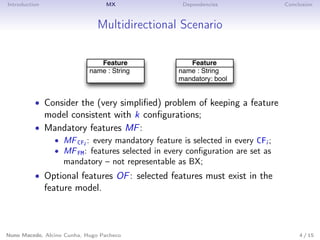
• Consider the (very simplified) problem of keeping a feature
model consistent with k configurations;
• Mandatory features MF:
• MFCFi
: every mandatory feature is selected in every CFi ;
• MFFM: features selected in every configuration are set as
mandatory – not representable as BX;
• Optional features OF: selected features must exist in the
feature model.
Nuno Macedo, Alcino Cunha, Hugo Pacheco 4 / 15
Introduction MX Dependencies Conclusion
Multidirectional QVT-R Checking
• Extension of the bidirectional forall-there-exists quantifier
patterns with a single target;
• One predicate for every model: for all elements in all source
models, there exists at least one element in the target model.
Nuno Macedo, Alcino Cunha, Hugo Pacheco 5 / 15
Introduction MX Dependencies Conclusion
Multidirectional QVT-R Checking
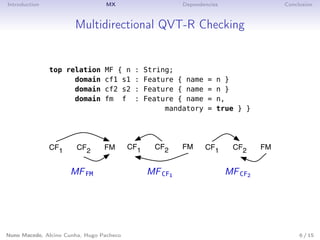
top relation MF { n : String;
domain cf1 s1 : Feature { name = n }
domain cf2 s2 : Feature { name = n }
domain fm f : Feature { name = n,
mandatory = true } }
CF1 CF2 FM CF1 CF2 FM CF1 CF2 FM
MFFM MFCF1 MFCF2
Nuno Macedo, Alcino Cunha, Hugo Pacheco 6 / 15
Introduction MX Dependencies Conclusion
Multidirectional QVT-R Checking
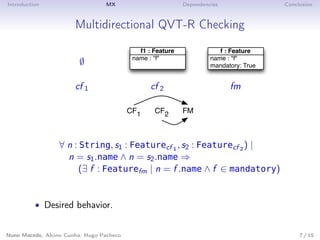
∅ name : "f"
f1 : Feature
name : "f"
mandatory: True
f : Feature
cf 1 cf 2 fm
CF1 CF2 FM
∀ n : String, s1 : Featurecf 1
, s2 : Featurecf 2
) |
n = s1.name ∧ n = s2.name ⇒
(∃ f : Featurefm | n = f .name ∧ f ∈ mandatory)
• Desired behavior.
Nuno Macedo, Alcino Cunha, Hugo Pacheco 7 / 15
Introduction MX Dependencies Conclusion
Multidirectional QVT-R Checking
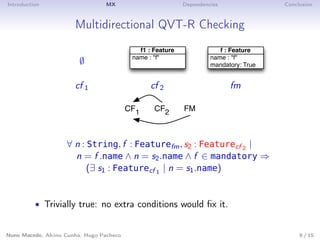
∅ name : "f"
f1 : Feature
name : "f"
mandatory: True
f : Feature
cf 1 cf 2 fm
CF1 CF2 FM
∀ n : String, f : Featurefm, s2 : Featurecf 2
|
n = f .name ∧ n = s2.name ∧ f ∈ mandatory ⇒
(∃ s1 : Featurecf 1
| n = s1.name)
• Trivially true: no extra conditions would fix it.
Nuno Macedo, Alcino Cunha, Hugo Pacheco 8 / 15
Introduction MX Dependencies Conclusion
Relation Dependencies
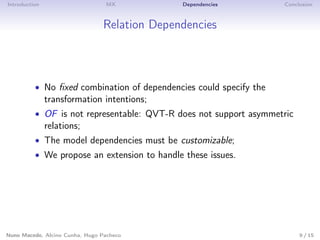
• No fixed combination of dependencies could specify the
transformation intentions;
• OF is not representable: QVT-R does not support asymmetric
relations;
• The model dependencies must be customizable;
• We propose an extension to handle these issues.
Nuno Macedo, Alcino Cunha, Hugo Pacheco 9 / 15
Introduction MX Dependencies Conclusion
Relation Dependencies
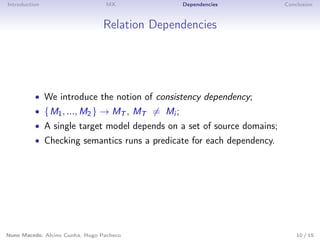
• We introduce the notion of consistency dependency;
• {M1, ..., M2 } → MT , MT = Mi ;
• A single target model depends on a set of source domains;
• Checking semantics runs a predicate for each dependency.
Nuno Macedo, Alcino Cunha, Hugo Pacheco 10 / 15
Introduction MX Dependencies Conclusion
Example Revisited
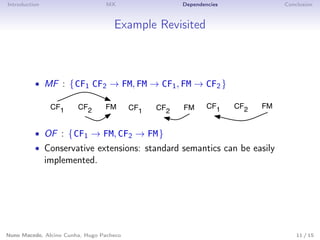
• MF : {CF1 CF2 → FM, FM → CF1, FM → CF2 }
CF1 CF2 FM CF1 CF2 FM CF1 CF2 FM
• OF : {CF1 → FM, CF2 → FM}
• Conservative extensions: standard semantics can be easily
implemented.
Nuno Macedo, Alcino Cunha, Hugo Pacheco 11 / 15
Introduction MX Dependencies Conclusion
Relation Invocations
• The direction of invocations should follow the direction of the
current check;
• Each dependency predicate should invoke relations under the
same dependency;
• May not exist: a relation R can be called by another S if the
dependencies of R entail those of S.
Nuno Macedo, Alcino Cunha, Hugo Pacheco 12 / 15
Introduction MX Dependencies Conclusion
Multidirectional QVT-R Enforcement
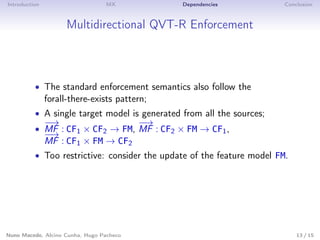
• The standard enforcement semantics also follow the
forall-there-exists pattern;
• A single target model is generated from all the sources;
•
−−→
MF : CF1 × CF2 → FM,
−−→
MF : CF2 × FM → CF1,
−−→
MF : CF1 × FM → CF2
• Too restrictive: consider the update of the feature model FM.
Nuno Macedo, Alcino Cunha, Hugo Pacheco 13 / 15
Introduction MX Dependencies Conclusion
Enforcement Semantics
• In previous work we proposed enforcement semantics based on
the principle of least change;
• Given a consistency relation and a model distance ∆, calculate
the closest consistent model;
• This can be trivially adapted to the multidirectional scenario
considering ∆ is generalized;
• The transformation shapes are specified by different ∆;
• E.g., ∆CF1×CF2 gives rise to
−−→
MF : FM → CF1 × CF2
Nuno Macedo, Alcino Cunha, Hugo Pacheco 14 / 15
Introduction MX Dependencies Conclusion
Conclusions
• We have explored multidirectional transformations under
QVT-R and shown that the language is too restrictive;
• We proposed an initial extension that allows the specification
of interesting examples;
• Also improves expressiveness in the bidirectional scenario:
allows the definition of asymmetric relations;
• Further work is required to test the expressiveness of the
dependency language.
Nuno Macedo, Alcino Cunha, Hugo Pacheco 15 / 15

Towards a Framework for Multidirectional Model Transformations

  • 1.
    Towards a Frameworkfor Multidirectional Model Transformations Nuno Macedo Alcino Cunha Hugo Pacheco BX 2014 March 28, Athens, Greece
  • 2.
    Introduction MX DependenciesConclusion MDE • In MDE models are the primary development artifact; • Multiple models must coexist in a consistent manner; • Keeping two of those models consistent has been a main focus of research in BX; • However, not all consistency relations can be decomposed into the BX scenario. Nuno Macedo, Alcino Cunha, Hugo Pacheco 2 / 15
  • 3.
    Introduction MX DependenciesConclusion QVT-R • QVT-R is able to specify consistency between any number of models; • The standard semantics has known issues; • Extensive work has been done on the bidirectional scenario; • However, the multidirectional scenario has been disregarded. Nuno Macedo, Alcino Cunha, Hugo Pacheco 3 / 15
  • 4.
    Introduction MX DependenciesConclusion Multidirectional Scenario name : String Feature name : String mandatory: bool Feature • Consider the (very simplified) problem of keeping a feature model consistent with k configurations; • Mandatory features MF: • MFCFi : every mandatory feature is selected in every CFi ; • MFFM: features selected in every configuration are set as mandatory – not representable as BX; • Optional features OF: selected features must exist in the feature model. Nuno Macedo, Alcino Cunha, Hugo Pacheco 4 / 15
  • 5.
    Introduction MX DependenciesConclusion Multidirectional QVT-R Checking • Extension of the bidirectional forall-there-exists quantifier patterns with a single target; • One predicate for every model: for all elements in all source models, there exists at least one element in the target model. Nuno Macedo, Alcino Cunha, Hugo Pacheco 5 / 15
  • 6.
    Introduction MX DependenciesConclusion Multidirectional QVT-R Checking top relation MF { n : String; domain cf1 s1 : Feature { name = n } domain cf2 s2 : Feature { name = n } domain fm f : Feature { name = n, mandatory = true } } CF1 CF2 FM CF1 CF2 FM CF1 CF2 FM MFFM MFCF1 MFCF2 Nuno Macedo, Alcino Cunha, Hugo Pacheco 6 / 15
  • 7.
    Introduction MX DependenciesConclusion Multidirectional QVT-R Checking ∅ name : "f" f1 : Feature name : "f" mandatory: True f : Feature cf 1 cf 2 fm CF1 CF2 FM ∀ n : String, s1 : Featurecf 1 , s2 : Featurecf 2 ) | n = s1.name ∧ n = s2.name ⇒ (∃ f : Featurefm | n = f .name ∧ f ∈ mandatory) • Desired behavior. Nuno Macedo, Alcino Cunha, Hugo Pacheco 7 / 15
  • 8.
    Introduction MX DependenciesConclusion Multidirectional QVT-R Checking ∅ name : "f" f1 : Feature name : "f" mandatory: True f : Feature cf 1 cf 2 fm CF1 CF2 FM ∀ n : String, f : Featurefm, s2 : Featurecf 2 | n = f .name ∧ n = s2.name ∧ f ∈ mandatory ⇒ (∃ s1 : Featurecf 1 | n = s1.name) • Trivially true: no extra conditions would fix it. Nuno Macedo, Alcino Cunha, Hugo Pacheco 8 / 15
  • 9.
    Introduction MX DependenciesConclusion Relation Dependencies • No fixed combination of dependencies could specify the transformation intentions; • OF is not representable: QVT-R does not support asymmetric relations; • The model dependencies must be customizable; • We propose an extension to handle these issues. Nuno Macedo, Alcino Cunha, Hugo Pacheco 9 / 15
  • 10.
    Introduction MX DependenciesConclusion Relation Dependencies • We introduce the notion of consistency dependency; • {M1, ..., M2 } → MT , MT = Mi ; • A single target model depends on a set of source domains; • Checking semantics runs a predicate for each dependency. Nuno Macedo, Alcino Cunha, Hugo Pacheco 10 / 15
  • 11.
    Introduction MX DependenciesConclusion Example Revisited • MF : {CF1 CF2 → FM, FM → CF1, FM → CF2 } CF1 CF2 FM CF1 CF2 FM CF1 CF2 FM • OF : {CF1 → FM, CF2 → FM} • Conservative extensions: standard semantics can be easily implemented. Nuno Macedo, Alcino Cunha, Hugo Pacheco 11 / 15
  • 12.
    Introduction MX DependenciesConclusion Relation Invocations • The direction of invocations should follow the direction of the current check; • Each dependency predicate should invoke relations under the same dependency; • May not exist: a relation R can be called by another S if the dependencies of R entail those of S. Nuno Macedo, Alcino Cunha, Hugo Pacheco 12 / 15
  • 13.
    Introduction MX DependenciesConclusion Multidirectional QVT-R Enforcement • The standard enforcement semantics also follow the forall-there-exists pattern; • A single target model is generated from all the sources; • −−→ MF : CF1 × CF2 → FM, −−→ MF : CF2 × FM → CF1, −−→ MF : CF1 × FM → CF2 • Too restrictive: consider the update of the feature model FM. Nuno Macedo, Alcino Cunha, Hugo Pacheco 13 / 15
  • 14.
    Introduction MX DependenciesConclusion Enforcement Semantics • In previous work we proposed enforcement semantics based on the principle of least change; • Given a consistency relation and a model distance ∆, calculate the closest consistent model; • This can be trivially adapted to the multidirectional scenario considering ∆ is generalized; • The transformation shapes are specified by different ∆; • E.g., ∆CF1×CF2 gives rise to −−→ MF : FM → CF1 × CF2 Nuno Macedo, Alcino Cunha, Hugo Pacheco 14 / 15
  • 15.
    Introduction MX DependenciesConclusion Conclusions • We have explored multidirectional transformations under QVT-R and shown that the language is too restrictive; • We proposed an initial extension that allows the specification of interesting examples; • Also improves expressiveness in the bidirectional scenario: allows the definition of asymmetric relations; • Further work is required to test the expressiveness of the dependency language. Nuno Macedo, Alcino Cunha, Hugo Pacheco 15 / 15