An Efficient Blackhole Attack Securing
Mechanism in Ad hoc On-demand Distance
Vector (AODV) Routing Protocol
Guide - Prasanta Baruah
(Asst. Professor)
Department of CSE, CIT Kokrajhar
DEPARTMENT OF COMPUTER SCIENCE AND ENGINEERING
Prepared by - Ninmoy Debnath (Gau-c-13/044)
Mintukan Rabha (Gau-c-13/l-195)
Ajoy Swargiary (Gau-c-13/051)
Outline
 Objective
 Introduction
 AODV Routing Protocol
 Blackhole Attack
 Solution to Blackhole Attack
 Result
 Conclusion
 References
Objective
 To prevent Ad Hoc On-Demand Distance Vector
Routing Protocol from Blackhole attack.
Outline
 Objective
 Introduction
 AODV Routing Protocol
 Blackhole Attack
 Solution to Blackhole Attack
 Result
 Conclusion
 References
Mobile Ad-Hoc Network(MANET)
 Collection of mobile nodes forming ad-hoc network.
 Self-configuring network.
 Each node participates in routing.
 Topology changes frequently.
Applications of MANET
 Personal area networking
 cell phone, laptop, ear phone
 Military environments
 soldiers, tanks, planes
Challenges and Issues in MANET
 Limited wireless range.
 Packet losses.
 Routes changes.
 Devices heterogeneity.
 Battery power constraints.
 Security threats .
Outline
 Objective
 Introduction
 AODV Routing Protocol
 Blackhole Attack
 Solution to Blackhole Attack
 Result
 Conclusion
 References
AODV Routing Protocol
 Reactive Routing Protocol.
 AODV maintains all the route informations in the form of
tables.
 AODV has three control packets
 RREQ(Route Request Packet) broadcasting to find a
route.
 RREP(Route Reply Packet) is to set up forward path.
 RERR(Route Error Packet) to find any broken links.
[5]
AODV Routing Protocol Cont...
• Every node maintain two counters
 Sequence number
 Broadcast_id: it increments whenever the source
issues a new RREQ
• Packet format for RREQ
<source_addr, source_seq#, broadcast_id, dest_addr, dest_seq#, hop_count>
• Packet format for RREP
<source_addr, dest_addr, dest_seq#, hop_count, lifetime>
How AODV Works?
A
F
E
D
C
B
G
Objective: Node A wants to send data to F
How AODV Works?
A
F
E
D
C
B
G
<A, 2, 1, F, , 0>
RREQ
How AODV Works?
A
F
E
D
C
B
G
<A, 2, 1, F, , 0>
RREQ
How AODV Works?
A
F
E
D
C
B
G
<A, 2, 1, F, , 0>
<A, 2, 1, F, , 0>
RREQ
RREQ
How AODV Works?
A
F
E
D
C
B
G
<A, 2, 1, F, , 1>
<A, 2, 1, F, , 1>
Dest Next Hop Seq
A A 1 2
Dest Next Hop Seq
A A 1 2
RREQ
RREQ
How AODV Works?
A
F
E
D
C
B
G
<A, 2, 1, F, , 1>
<A, 2, 1, F, , 1>
Dest Next Hop Seq
A A 1 2
Dest Next Hop Seq
A A 1 2
RREQ
RREQ
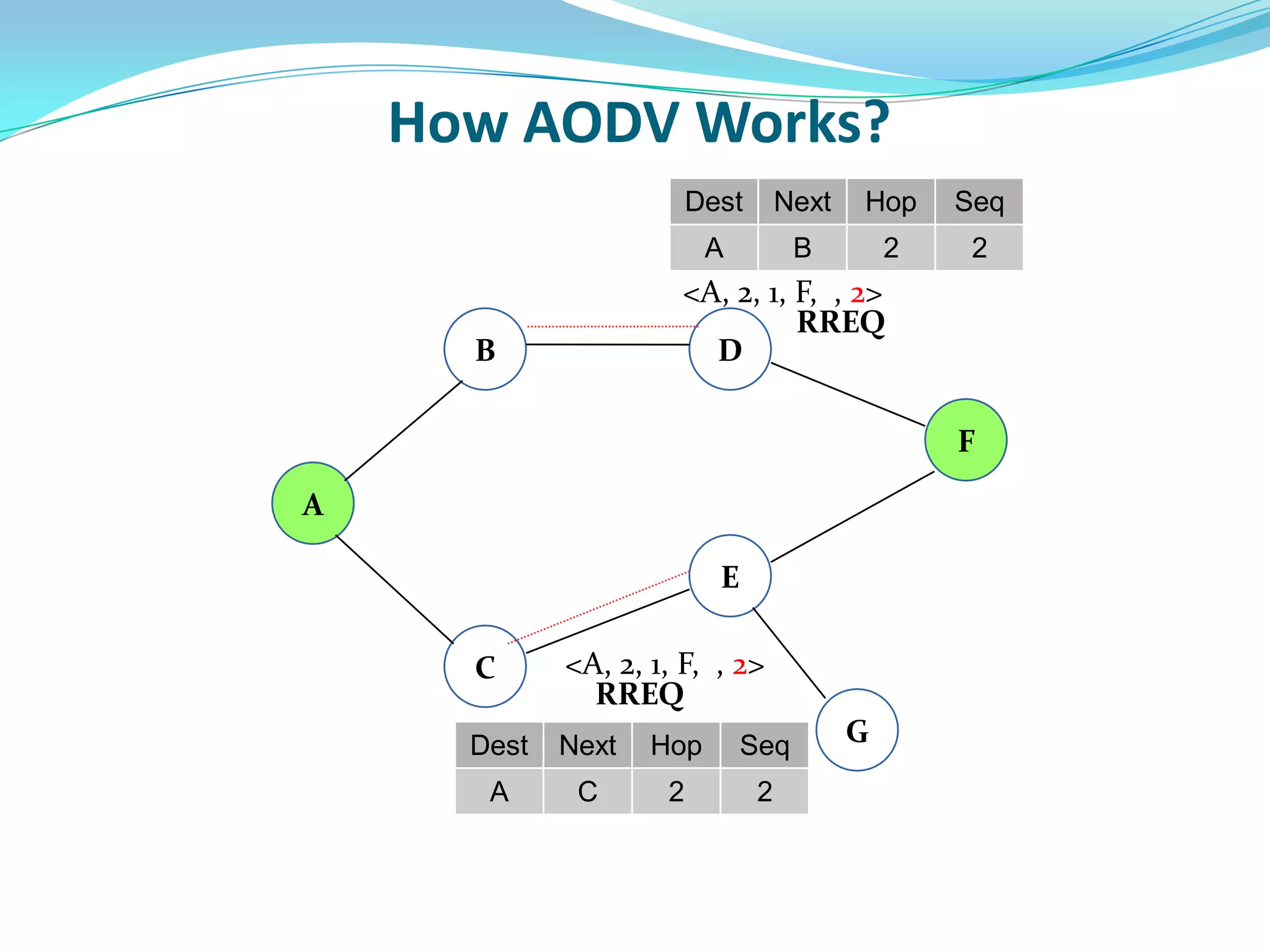
How AODV Works?
A
F
E
D
C
B
G
<A, 2, 1, F, , 2>
<A, 2, 1, F, , 2>
Dest Next Hop Seq
A B 2 2
Dest Next Hop Seq
A C 2 2
RREQ
RREQ
How AODV Works?
A
F
E
D
C
B
G
<A, 2, 1, F, , 2>
<A, 2, 1, F, , 2>
Dest Next Hop Seq
A B 2 2
Dest Next Hop Seq
A A 2 2
RREQ
RREQ
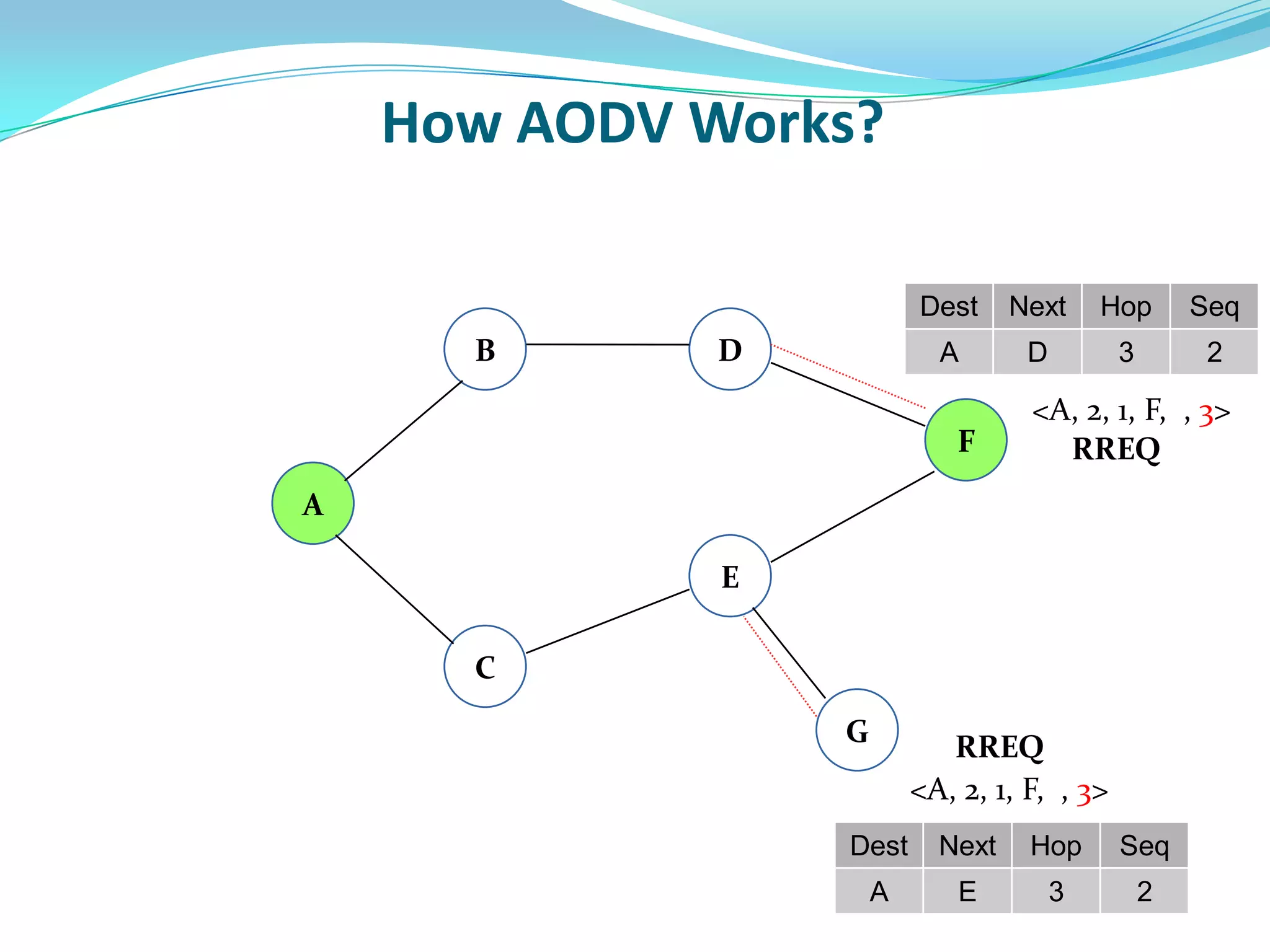
How AODV Works?
A
F
E
D
C
B
G
<A, 2, 1, F, , 3>
<A, 2, 1, F, , 3>
Dest Next Hop Seq
A D 3 2
Dest Next Hop Seq
A E 3 2
RREQ
RREQ
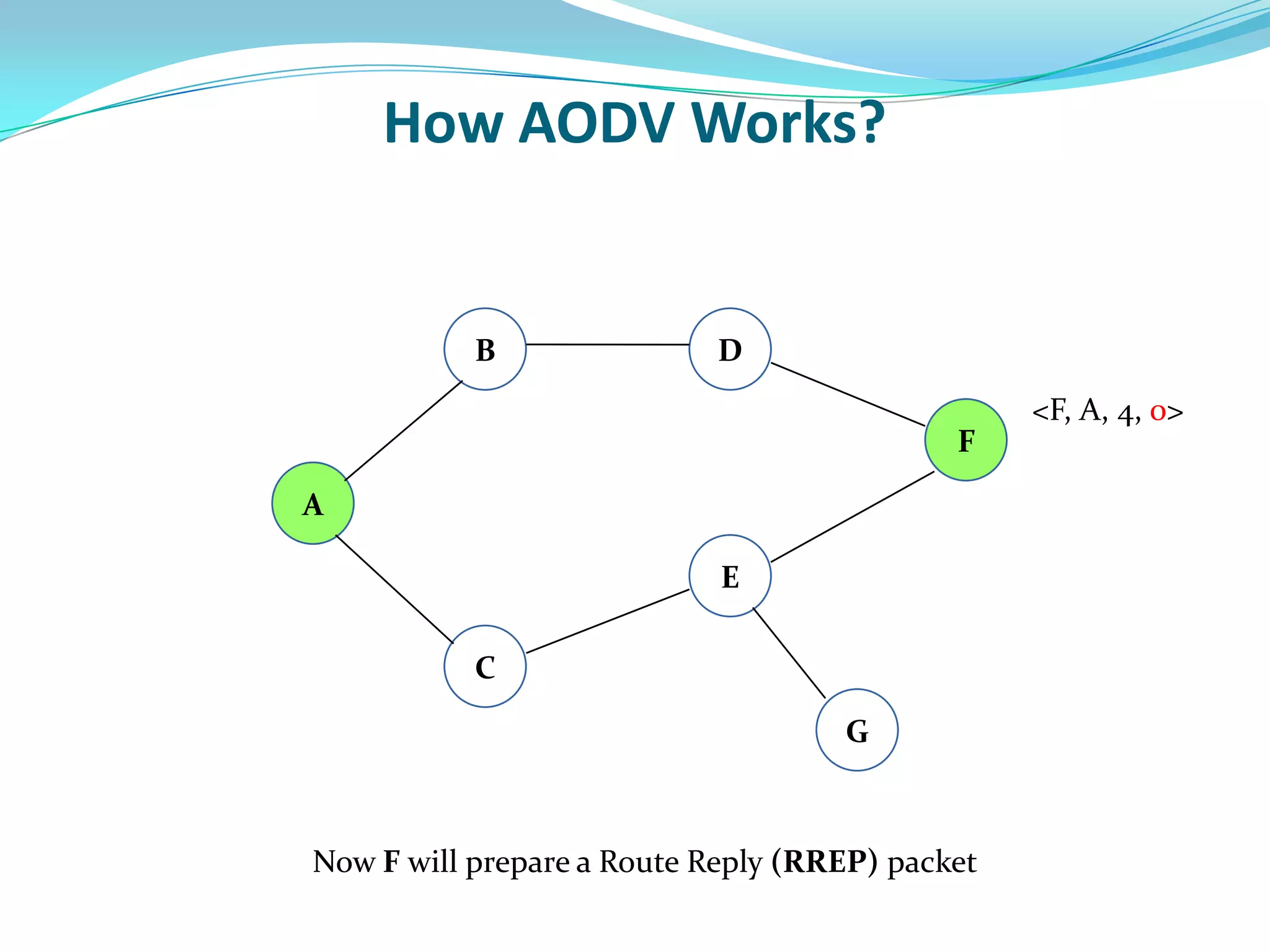
How AODV Works?
A
F
E
D
C
B
G
<F, A, 4, 0>
Now F will prepare a Route Reply (RREP) packet
How AODV Works?
A
F
E
D
C
B
G
<F, A, 4, 1>
Dest Next Hop Seq
A D 3 2
F F 1 4
RREP
How AODV Works?
A
F
E
D
C
B
G
<F, A, 4, 2>
Dest Next Hop Seq
A D 3 2
F D 2 4
RREP
How AODV Works?
A
F
E
D
C
B
G
<F, A, 4, 3>
Dest Next Hop Seq
A D 3 2
F B 3 4
RREP
How AODV Works?
A
F
E
D
C
B
G
DATA
DATA
DATA
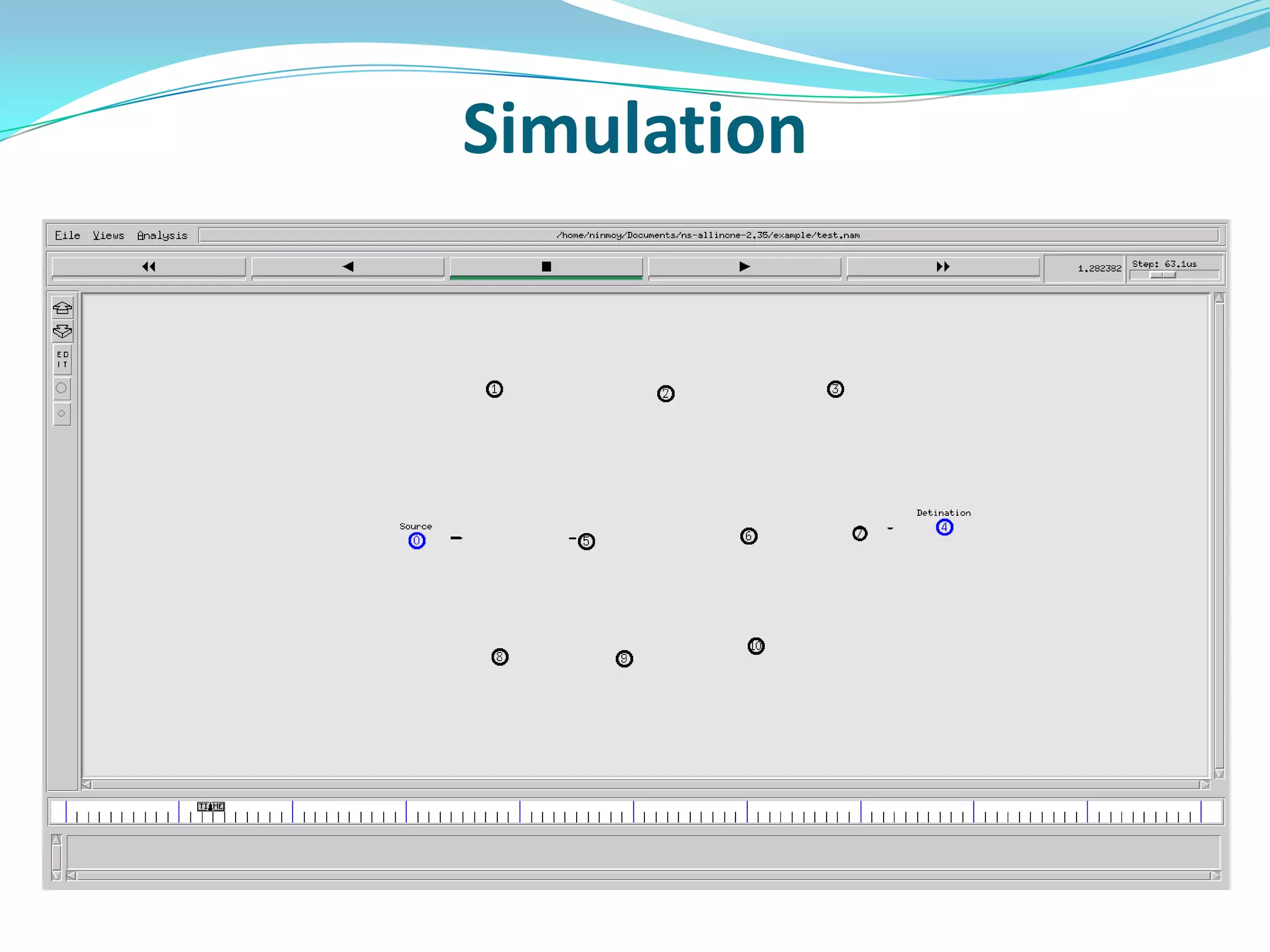
Simulation
Outline
 Objective
 Introduction
 AODV Routing Protocol
 Blackhole Attack
 Solution to Blackhole Attack
 Result
 Conclusion
 References
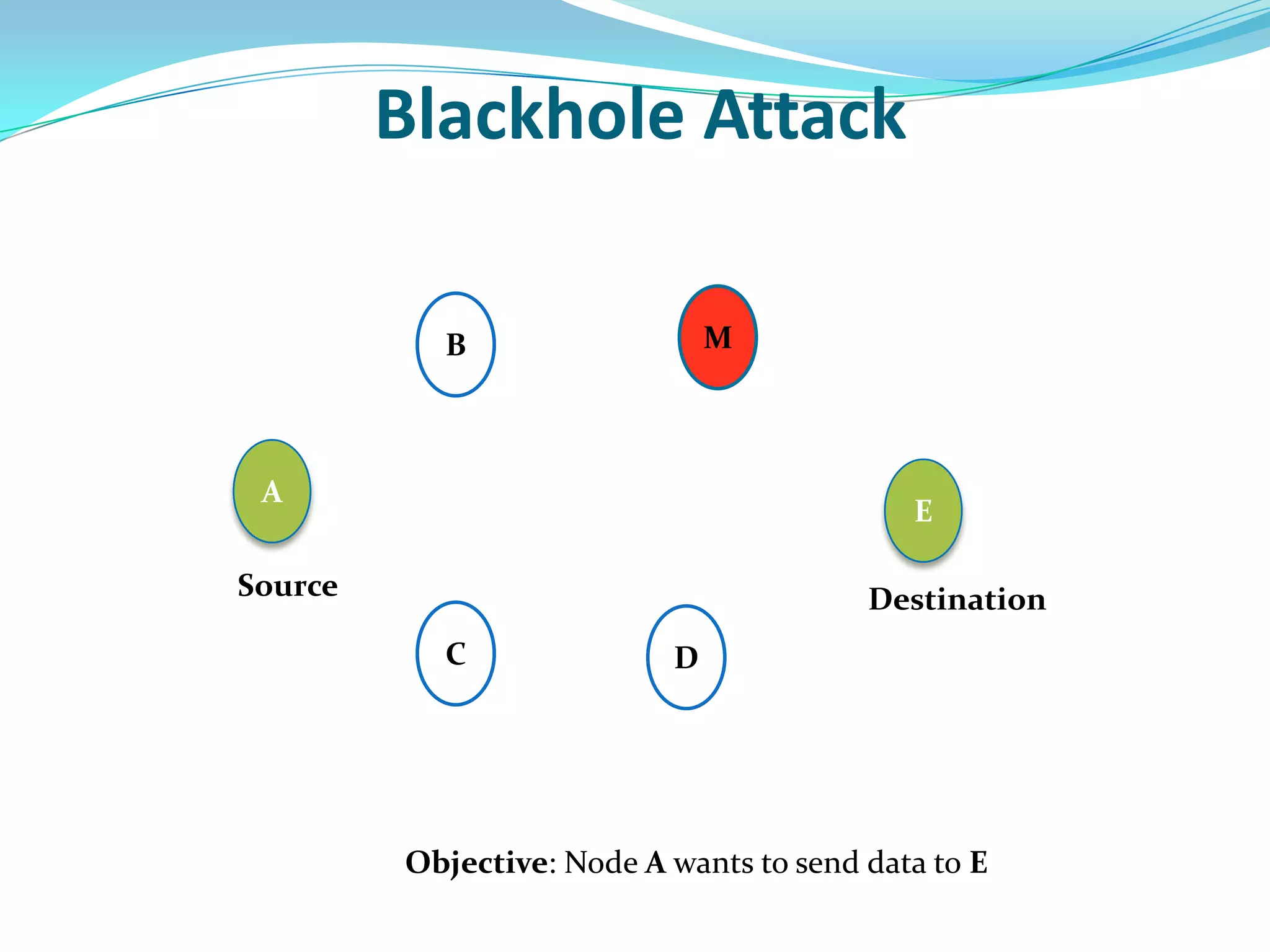
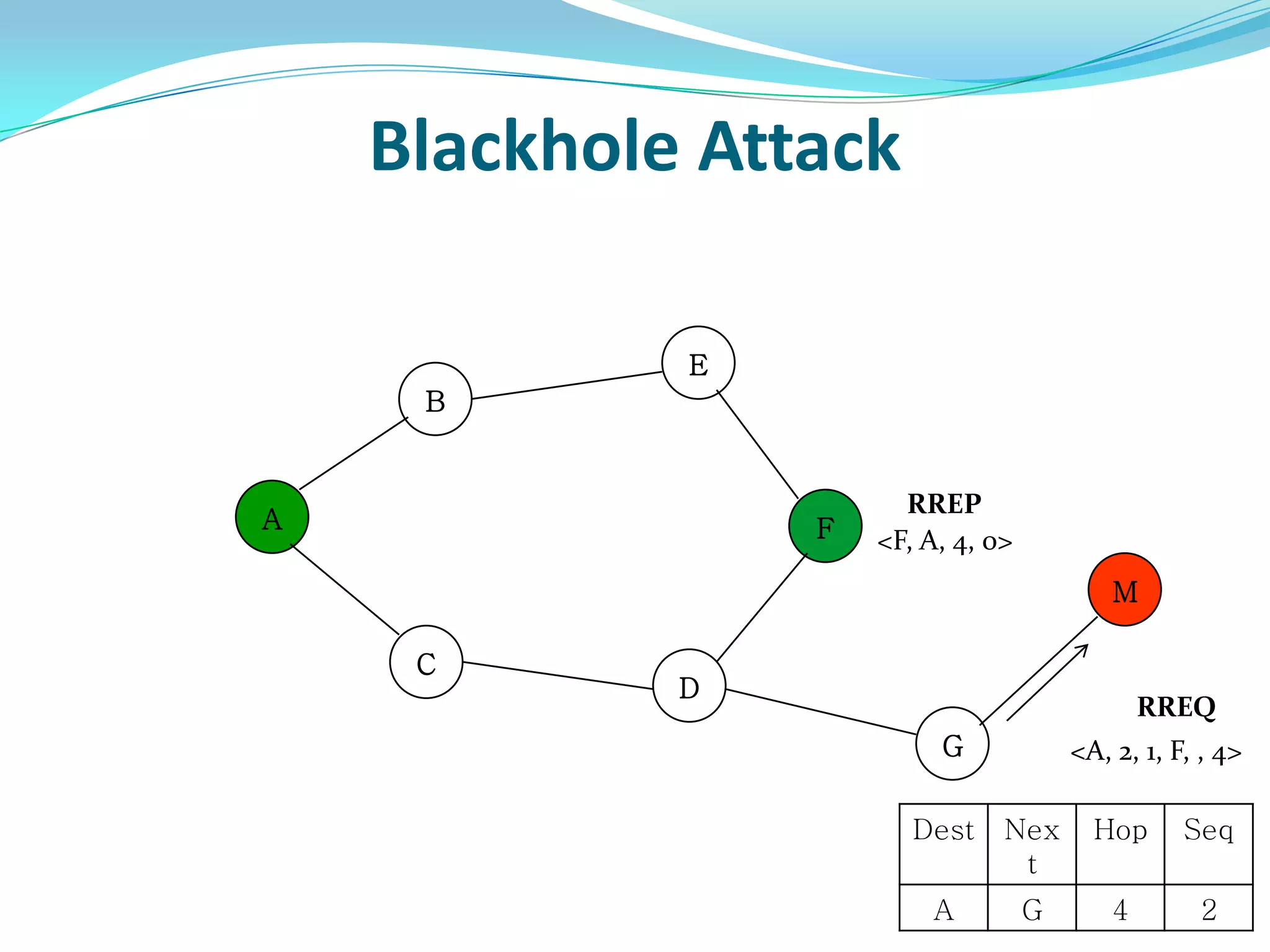
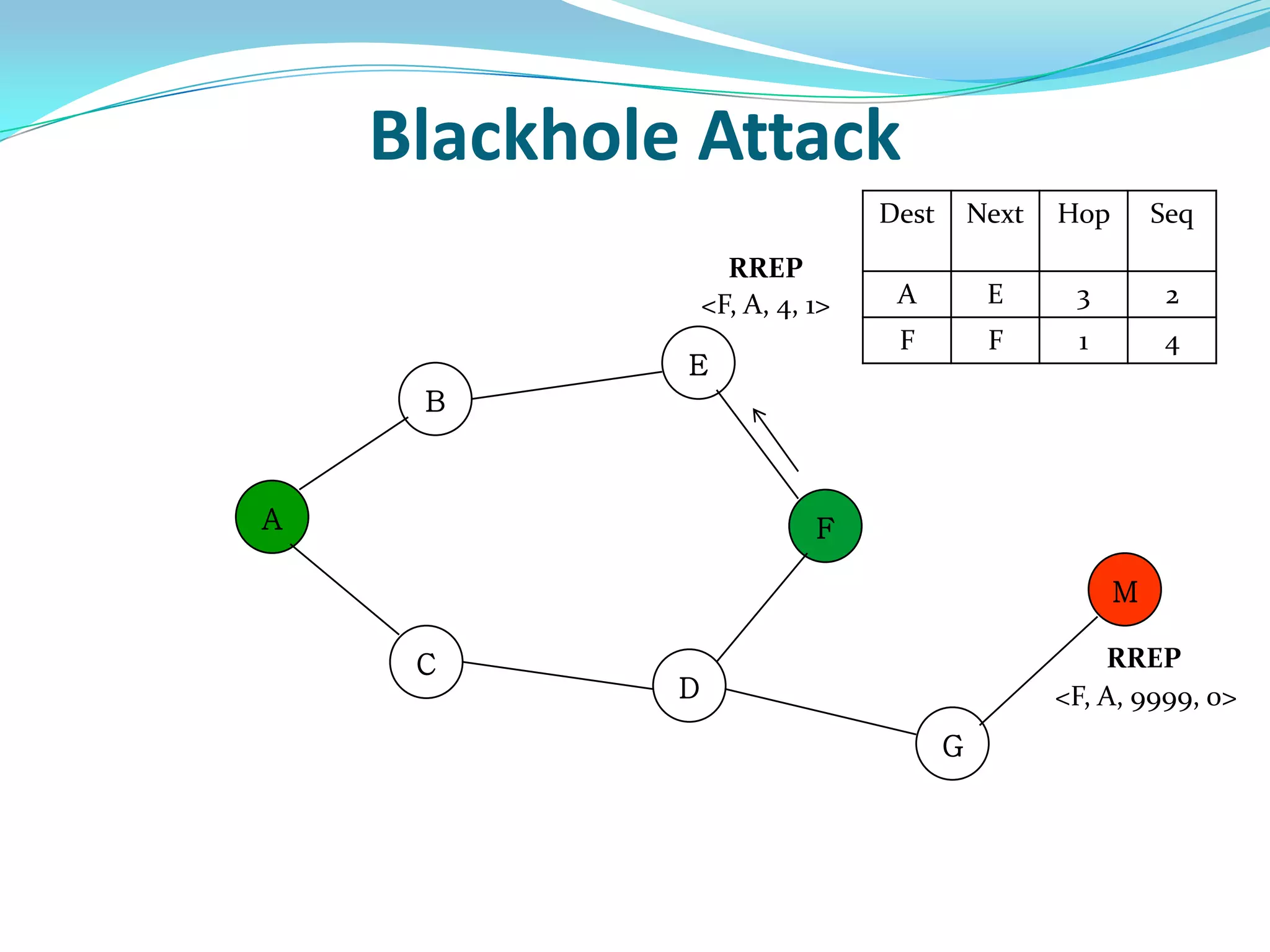
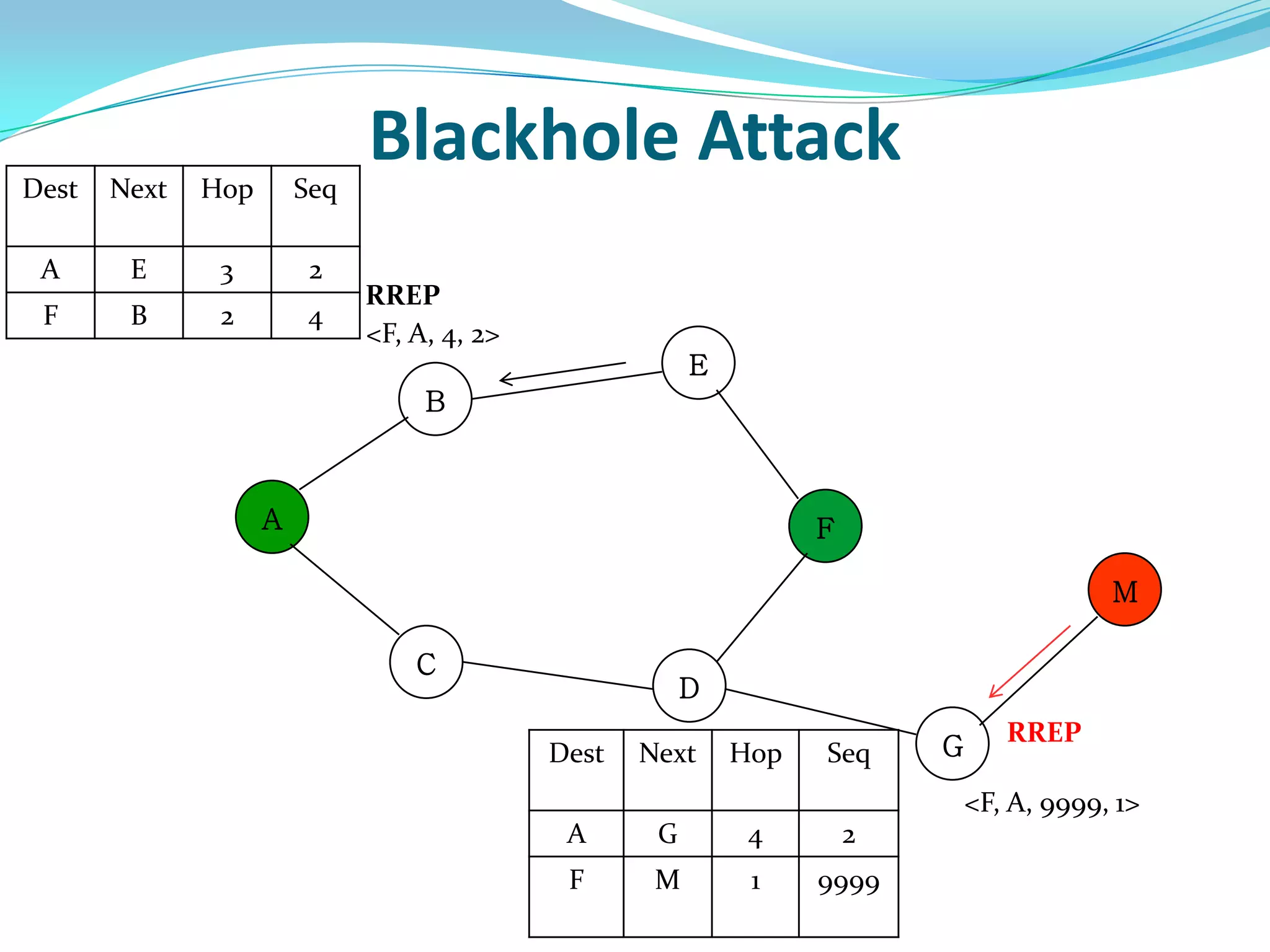
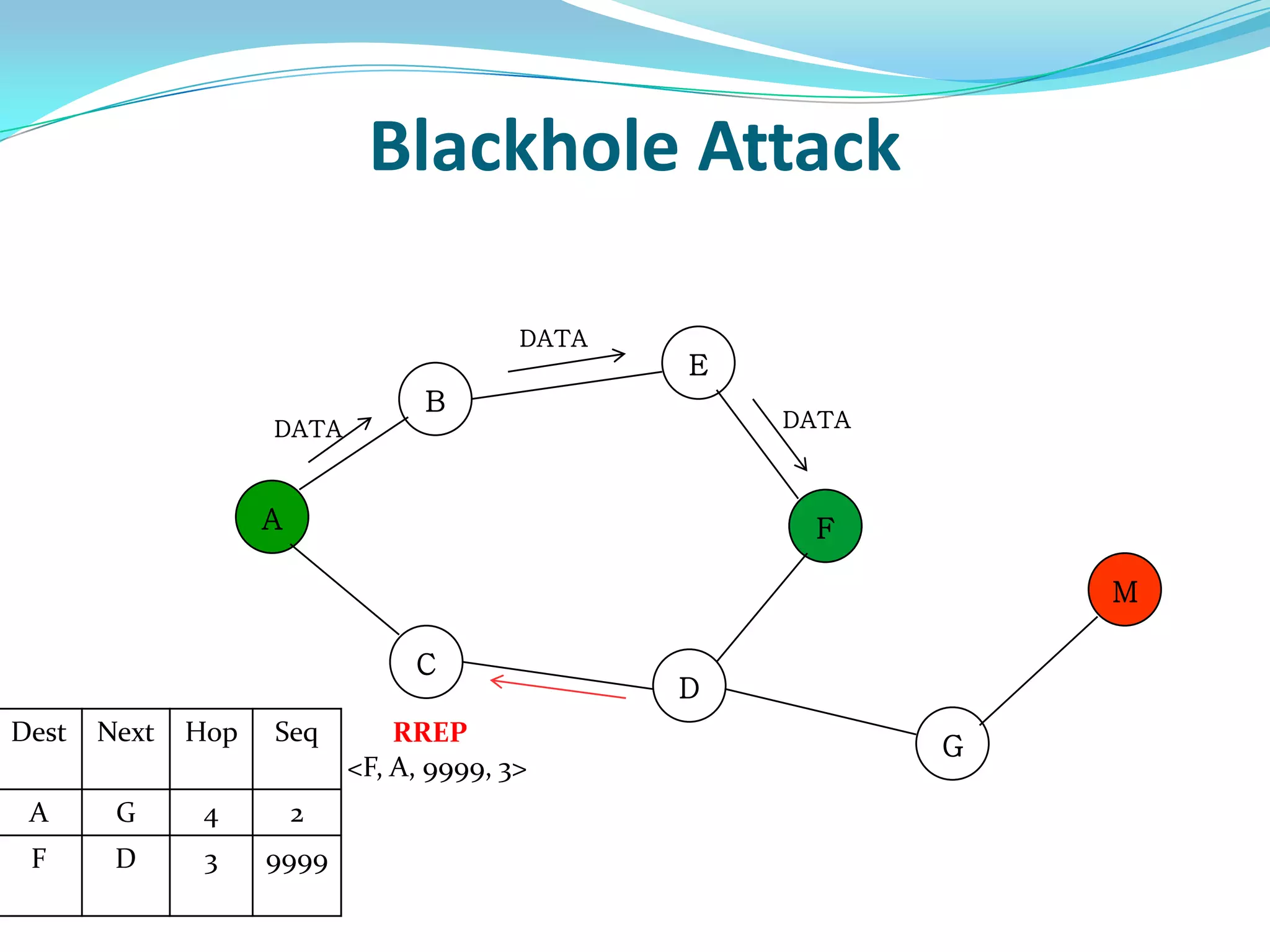
What is Blackhole Attack?
● Malicious node utilizes the routing protocol to attack.
● Claim itself having shortest path to the destination node.
● Does not forward packets to its neighbors.
[4]
Type of Blackhole Attack
● Ordinary( single ) Blackhole Attack
– One Malicious node utilizes the routing protocol to
claim itself of being the shortest path to the destination
node.
– After receiving the packet malicious node simply drop
the packet.
● Collaborative Blackhole Attack
– More than one Malicious node collaborate together to
attack.
Blackhole Attack
A
E
C D
MB
Objective: Node A wants to send data to E
Source Destination
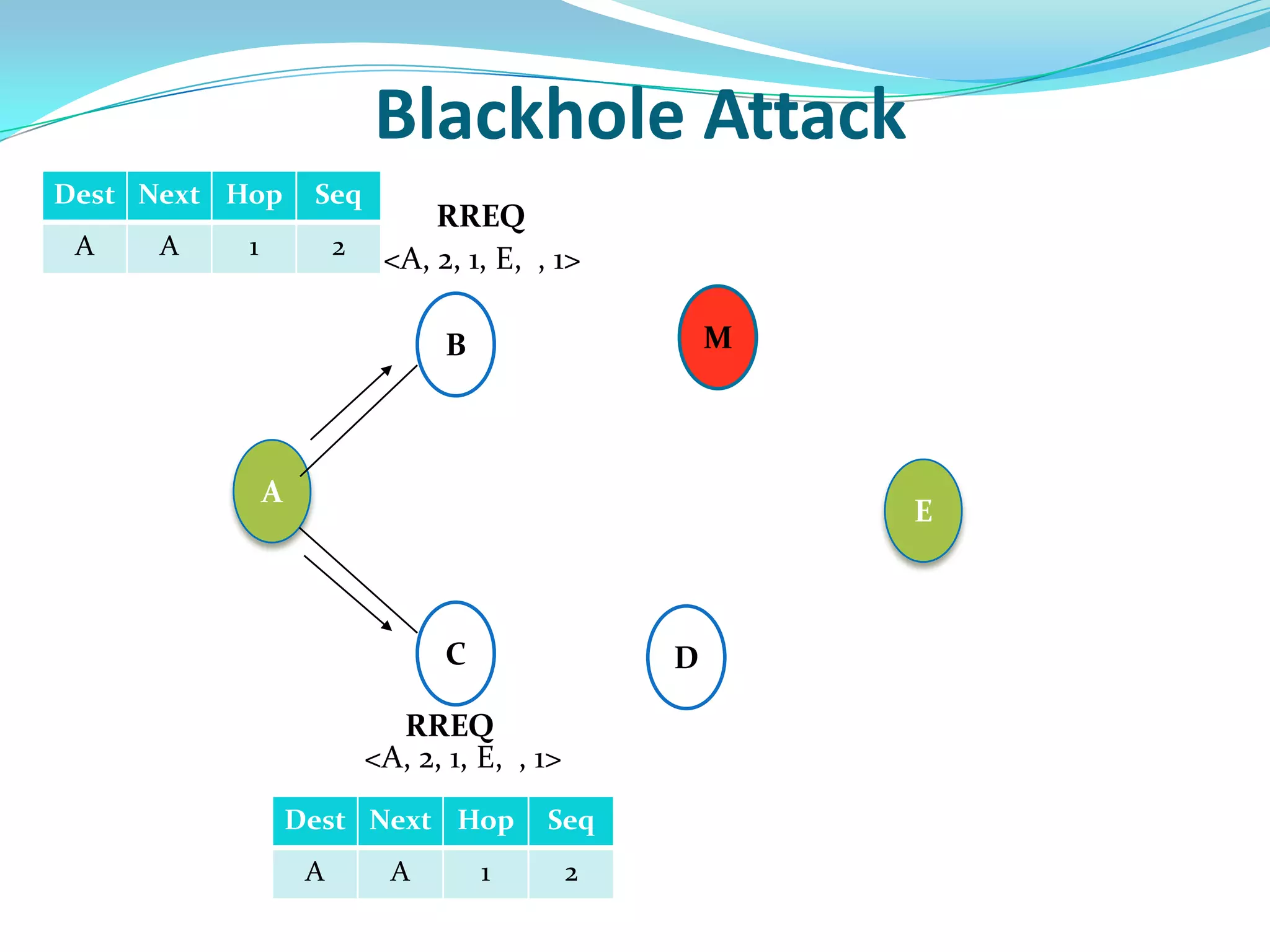
Blackhole Attack
A
E
C D
MB
<A, 2, 1, E, , 0>
RREQ
Blackhole Attack
A
E
C D
MB
<A, 2, 1, E, , 0>
RREQ
Blackhole Attack
A
E
C D
MB
<A, 2, 1, E, , 1>
<A, 2, 1, E, , 1>
RREQ
RREQ
Dest Next Hop Seq
A A 1 2
Dest Next Hop Seq
A A 1 2
Blackhole Attack
A
E
C D
MB
<A, 2, 1, E, , 2>
<A, 2, 1, E, , 2>
RREQ
RREQ Dest Next Hop Seq
A B 2 2
Dest Next Hop Seq
A C 2 2
Blackhole Attack
A
E
C D
MB
<A, 2, 1, E, , 3>
<E, A, 9999, 1>
RREQ
RREP Dest Next Hop Seq
E M 1 9999
Dest Next Hop Seq
A D 3 2
Blackhole Attack
A
E
C D
MB
<E, A, 9999, 2>
RREPDest Next Hop Seq
E M 2 9999
Dest Next Hop Seq
E E 1 4
<E, A, 4, 1>
RREP
Blackhole Attack
A
E
C D
MB
<E, A, 9999, 3>
RREP
Dest Next Hop Seq
E B 3 9999
Dest Next Hop Seq
E D 2 4
<E, A, 4, 2>
RREP
Blackhole Attack
A
E
C D
MB
DATA
DATA
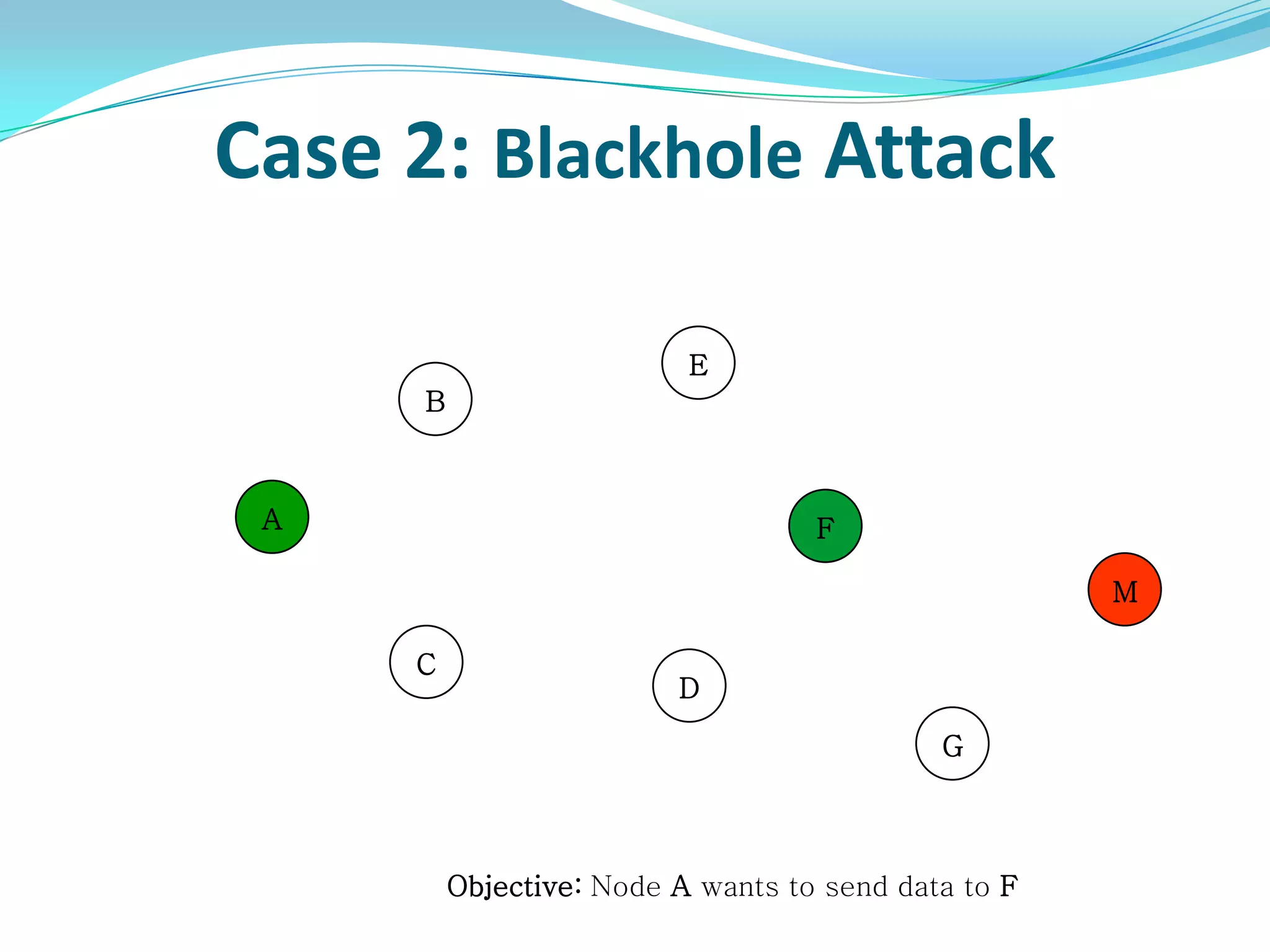
Case 2: Blackhole Attack
A
G
M
D
E
C
B
F
Objective: Node A wants to send data to F
Blackhole Attack
A
D
E
C
B
F
<A, 2, 1, F, , 0>
RREQ
G
M
Blackhole Attack
A
D
E
C
B
F
<A, 2, 1, F, , 0>
RREQ
G
M
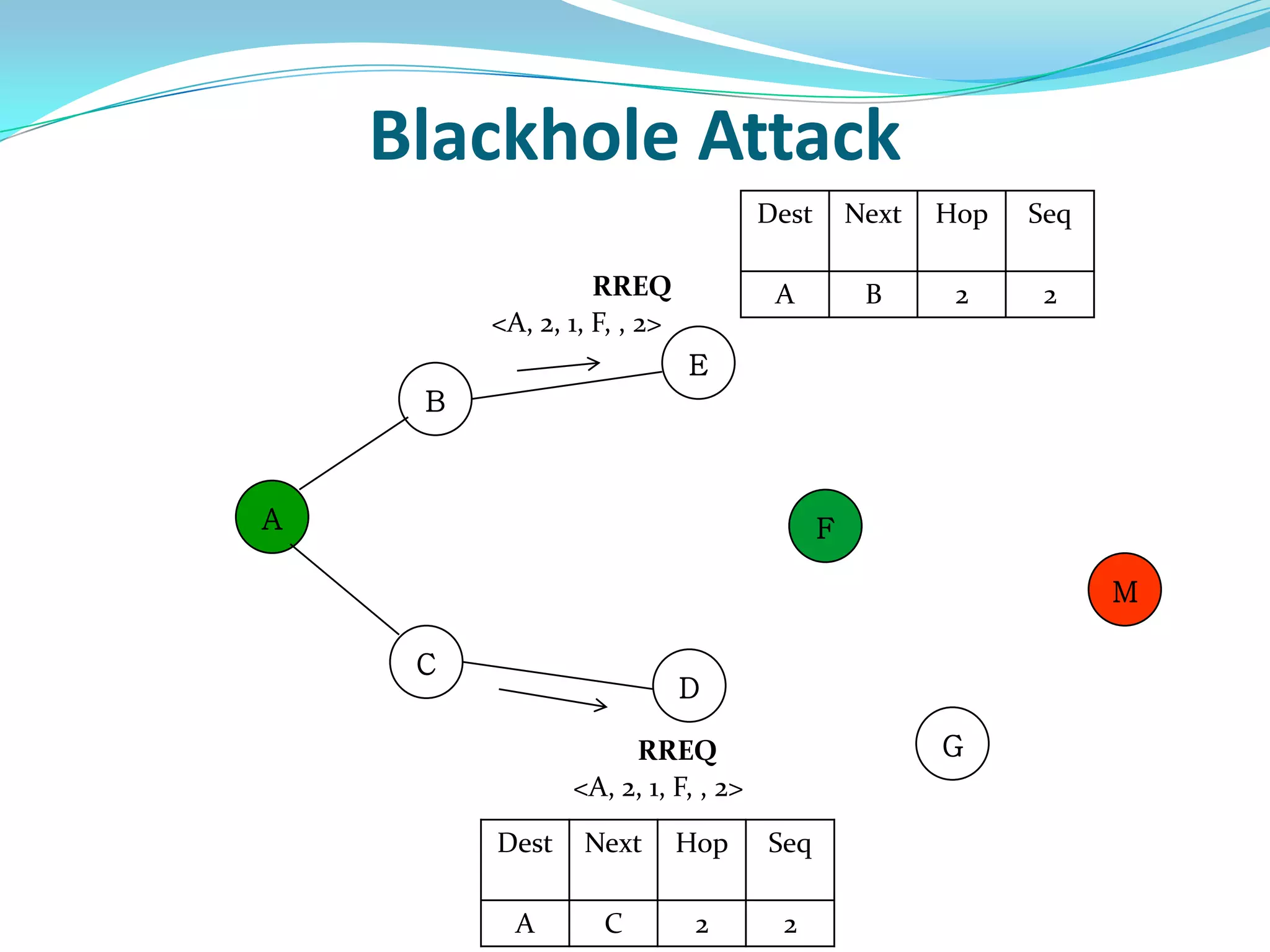
Blackhole Attack
A
D
E
C
B
F
<A, 2, 1, F, , 1>
RREQ
RREQ
<A, 2, 1, F, , 1>
Dest Next Hop Seq
A A 1 2
Dest Next Hop Seq
A A 1 2
G
M
Blackhole Attack
A
D
E
C
B
F
<A, 2, 1, F, , 2>
RREQ
RREQ
<A, 2, 1, F, , 2>
Dest Next Hop Seq
A B 2 2
Dest Next Hop Seq
A C 2 2
G
M
Blackhole Attack
A
D
E
C
B
F
<A, 2, 1, F, , 3>
RREQ
Dest Next Hop Seq
A E 3 2
G
RREQ
<A, 2, 1, F, , 3>
Dest Next Hop Seq
A D 3 2
M
Blackhole Attack
A
D
E
C
B
F <F, A, 4, 0>
RREP
G
M
RREQ
<A, 2, 1, F, , 4>
Dest Nex
t
Hop Seq
A G 4 2
Blackhole Attack
A
D
E
C
B
F
<F, A, 4, 1>
RREP
G
M
RREP
<F, A, 9999, 0>
Dest Next Hop Seq
A E 3 2
F F 1 4
Blackhole Attack
A
D
E
C
B
F
<F, A, 4, 2>
RREP
G
M
RREP
<F, A, 9999, 1>
Dest Next Hop Seq
A E 3 2
F B 2 4
Dest Next Hop Seq
A G 4 2
F M 1 9999
Blackhole Attack
A
D
E
C
B
F
<F, A, 4, 2>
RREP
G
M
RREP
<F, A, 9999, 2>
Dest Next Hop Seq
A E 3 2
F E 2 4
Dest Next Hop Seq
A G 4 2
F G 2 9999
Blackhole Attack
A
D
E
C
B
F
G
M
RREP
<F, A, 9999, 3>
Dest Next Hop Seq
A G 4 2
F D 3 9999
DATA
DATA
DATA
Blackhole Attack
A
D
E
C
B
F
G
MRREP
<F, A, 9999, 4>
Dest Next Hop Seq
A G 4 2
F C 4 9999
DATA
DATA
DATA
Blackhole Attack
A
D
E
C
B
F
G
M
DATA
DATA
DATA
DATA
Simulation
Outline
 Objective
 Introduction
 AODV Routing Protocol
 Blackhole Attack
 Solution to Blackhole Attack
 Result
 Conclusion
 References
Algorithm
 Define table for storing the Route Replies.
 Save all the Route Replies in the table for at least two Route
Replies.
 Take the average of sequence number of Route Replies store
in the table
 Select the Route Reply whose sequence number is smaller or
equal to average of sequence number.
 Send the packet through whose sequence number is smaller
or equal to average of sequence number.
 Delete the entries in the table.
Modified AODV Under Blackhole
Attack
S
3
4
M
1
2
5
D
S
3
4
M
1
2
5
D
2 <Seq. No>
2 <Seq. No>
2 <Seq. No>
S
3
4
M
1
2
5
D
2 <Seq. No>
2 <Seq. No>
2 <Seq. No>
S
3
4
M
1
2
5
D
9999<dest_seq>
2 <Seq. No>
2 <Seq. No>
S
3
4
M
1
2
5
D
Seq.No
9999
9999<dest_seq>
2 <Seq. No>
4 <Seq. No>
Node
1
S
3
4
M
1
2
5
D
Seq.No
9999
Node
1
4<dest_seq>
S
3
4
M
1
2
5
D
Average of 9999 and 4 is 5001
Seq.No
9999
Node
1
4<dest_seq>
4 2
S
3
4
M
1
2
5
D
Seq_no.<=5001
i.e., 4
Send the packet via. node 2
S
3
4
M
1
2
5
D
Data
S
3
4
M
1
2
5
D
Data
S
3
4
M
1
2
5
D
Data
Simulation
Outline
 Objective
 Introduction
 AODV Routing Protocol
 Blackhole Attack
 Solution to Blackhole Attack
 Result
 Conclusion
 References
End to End Delay
End to End delay=packet_receive_time – packet_sent_time
Packet Drop
Packet Drop occurs when one or more packets of data
travelling across a computer network fail to reach their
destination.
Packet Delivery Ratio(PDR)
PDR = (Packet_Receive/Packet_Sent) *100 %
Throughput
Throughput=total_packet_recvdSize/unitTime
where unitTime=(packet_sending_stop_time –
packet_sending_ start_time)
Conclusion
 Justified the algorithm of securing the blackhole attack in the
AODV routing protocols in MANET.
 The proposed solution achieves a very good rise in Packet Delivery
Ratio with acceptable rise in End-to-End Delay and Throughput.
 The algorithm does not have any hidden overhead on either the
intermediate nodes or the destination nodes.
 Algorithm is simple and efficient in implementation.
References
1. Latha Tamilselvan, V Sankaranarayanan. “Prevention of Blackhole Attacks in
MANET.” In Proceedings of the 2nd International Conference on Wireless
Broadband and Ultra Wideban Communications (AusWireless 2007), pp. 21-
21, Aug. 2007.
2. Payal N. Raj, Prashant B. Swadas. “DPRAODV: A Dyanamic Learning System
Against Blackhole Attack In Aodv Based Manet.” In: International Journal of
Computer Science Issues, Vol.2, pp 54-59, 2009.
3. Hongmei Deng, Wei Li, Dharma P. Agrawal,“Routing security in wireless ad
hoc networks” IEEE Communications Magazine (Volume: 40, Issue: 10, Oct
2002 ).
4. Al-Shurman M, Yoo S-M, Park S, “Blackhole Attack in Mobile Ad Hoc
Networks” ACM-SE 42 Proceedings of the 42nd annual Southeast regional
conference (Pages:96-97, date:2004-04-02) .
5. C. Perkins, E. Belding-Royer, and S. Das, “Ad hoc on-demand distance vector
(AODV) routing” RFC 3561, Experimental, July 2003.
6. Ns2 Manual , http://www.isi.edu/nsnam/ns/tutorial/.
Thank You

An Efficient Black Hole Attack Securing Mechanism in Ad Hoc On Demand Distance Vector Routing Protocol