PROFESSOR JAYASHANKAR TELANGANA STATE AGRICULTURAL
UNIVERSITY
COLLEGE OF AGRICULTURAL ENGINEERING
KANDI, SANGAREDDY-502285
PERFORMANCE EVALUATION OF POWER WEEDER IN
SUGARCANE CROP
Presented by
S.SAI MOHAN
2018-18-016
Introduction
Sugarcane is the main sugar-producing crop that contributes
nearly 78.2% to the total sugarcane at the global level.
 It is the prime source of sugar in India.
India is the second largest sugarcane producer on the globe next
to brazil.
 It is estimated that India produces 341.2 million metric tonnes
of sugarcane.
Weeds in sugarcane field competes for moisture and light also
remove about 4 times N and P and 2.5 times of K during the first
50 days of crop period.
The initial 90-120 days period of crop growth is considered as
most critical period of weed competition.
In sugarcane crop, weeds have been estimated to cause 12 to 72
% reduction in cane yield.
In manual weed control, where, labours pulls weeds out of the
soil using different types of hand tools like khurpi, wheel hoe,
hand hoe, etc.
These practices are expensive, time consuming and difficult to
organize labour.
Today the agricultural sector requires non-chemical weed
control that safeguards consumers demand for high quality food
products .
 The technical development of mechanisms for physical weed
control, such as precise inter and intra-row weeders to control
weeds.
Objectives
To Evaluate The Performance Of Power Weeder In Sugarcane.
To Estimate Cost Economics Of Power Weeder Against
Traditional Method Of Weeding In Sugarcane.
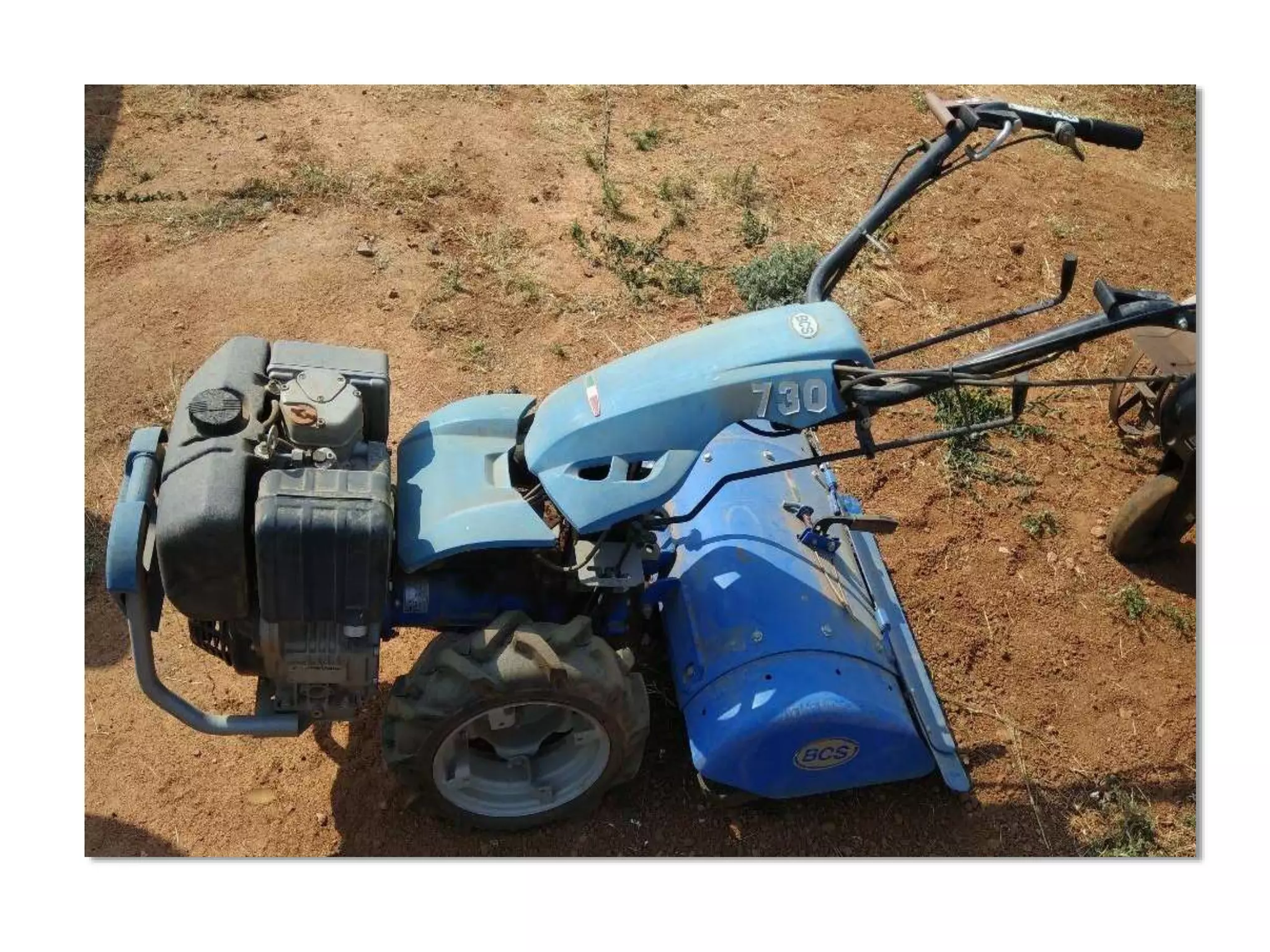
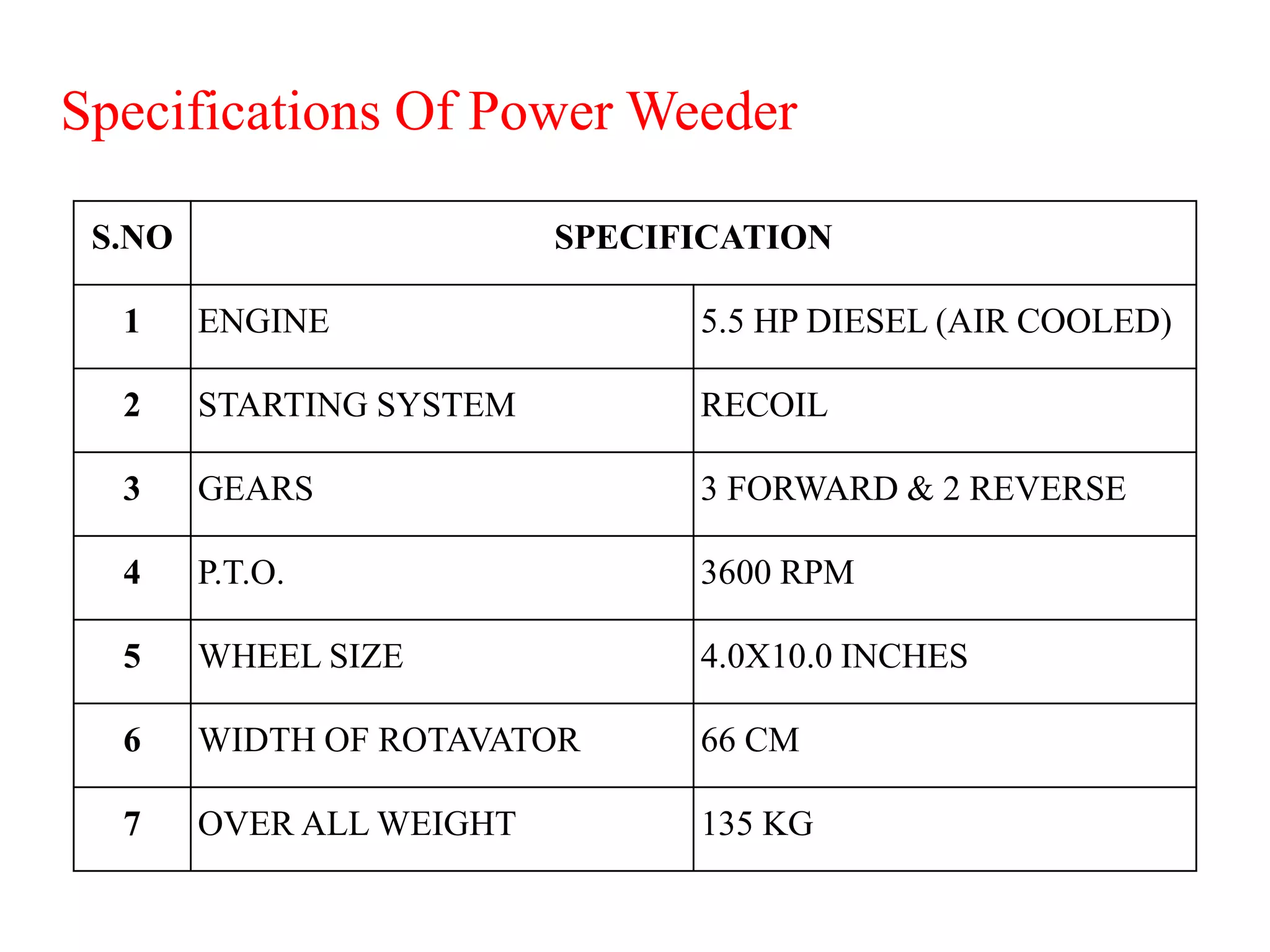
Specifications Of Power Weeder
S.NO SPECIFICATION
1 ENGINE 5.5 HP DIESEL (AIR COOLED)
2 STARTING SYSTEM RECOIL
3 GEARS 3 FORWARD & 2 REVERSE
4 P.T.O. 3600 RPM
5 WHEEL SIZE 4.0X10.0 INCHES
6 WIDTH OF ROTAVATOR 66 CM
7 OVER ALL WEIGHT 135 KG
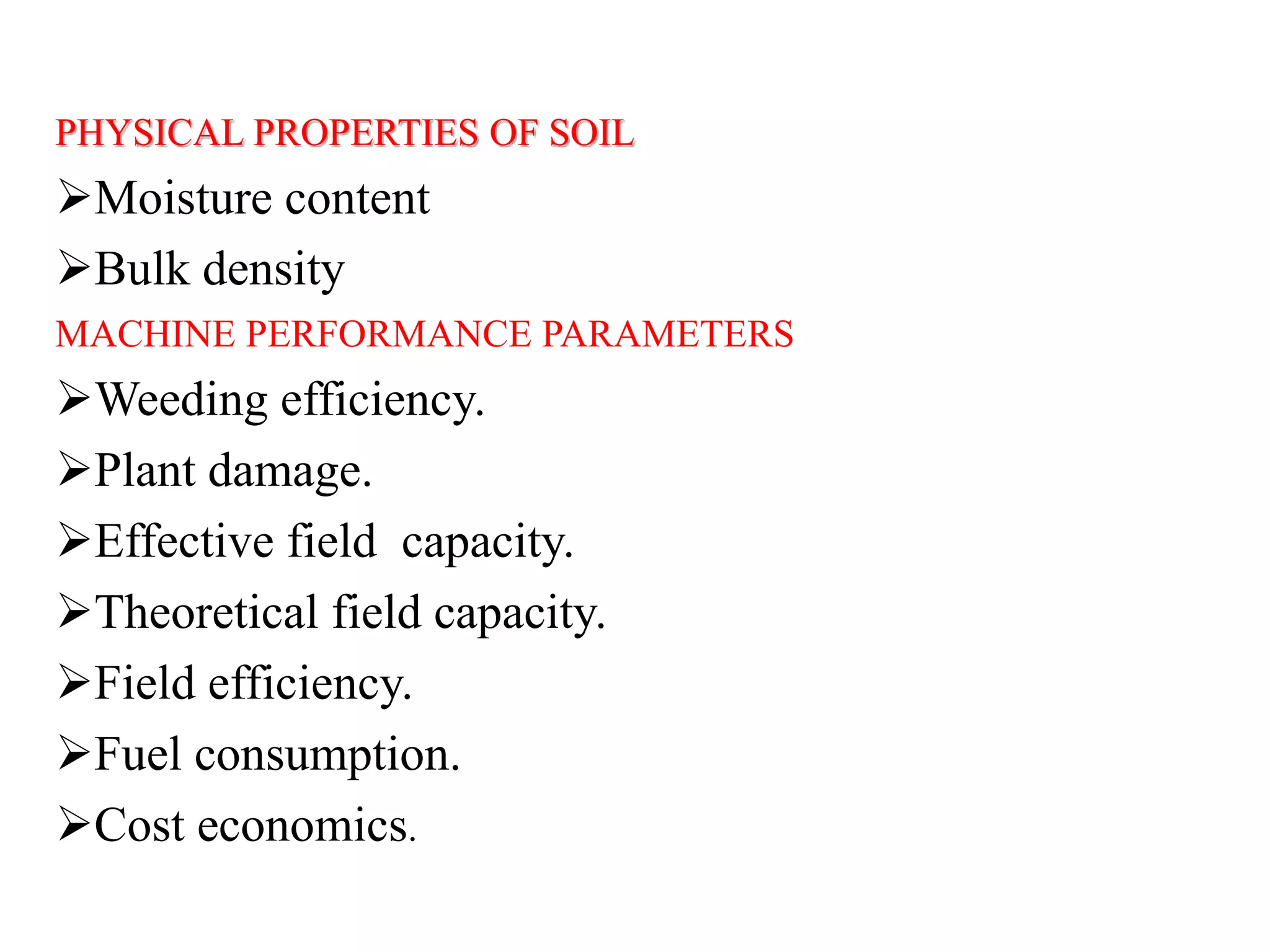
PHYSICAL PROPERTIES OF SOIL
Moisture content
Bulk density
MACHINE PERFORMANCE PARAMETERS
Weeding efficiency.
Plant damage.
Effective field capacity.
Theoretical field capacity.
Field efficiency.
Fuel consumption.
Cost economics.
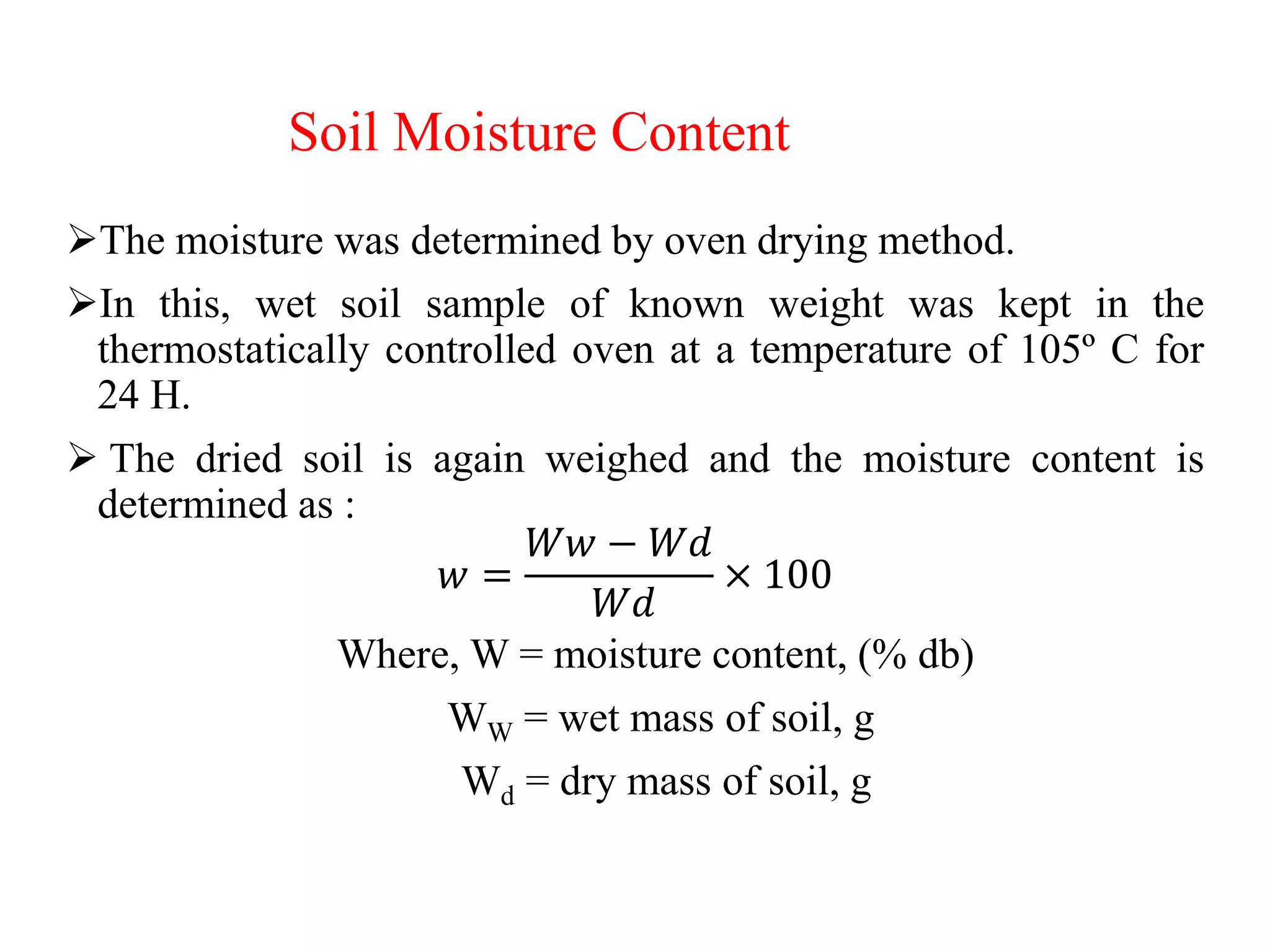
Soil Moisture Content
The moisture was determined by oven drying method.
In this, wet soil sample of known weight was kept in the
thermostatically controlled oven at a temperature of 105º C for
24 H.
 The dried soil is again weighed and the moisture content is
determined as :
𝑤 =
𝑊𝑤 − 𝑊𝑑
𝑊𝑑
× 100
Where, W = moisture content, (% db)
WW = wet mass of soil, g
Wd = dry mass of soil, g
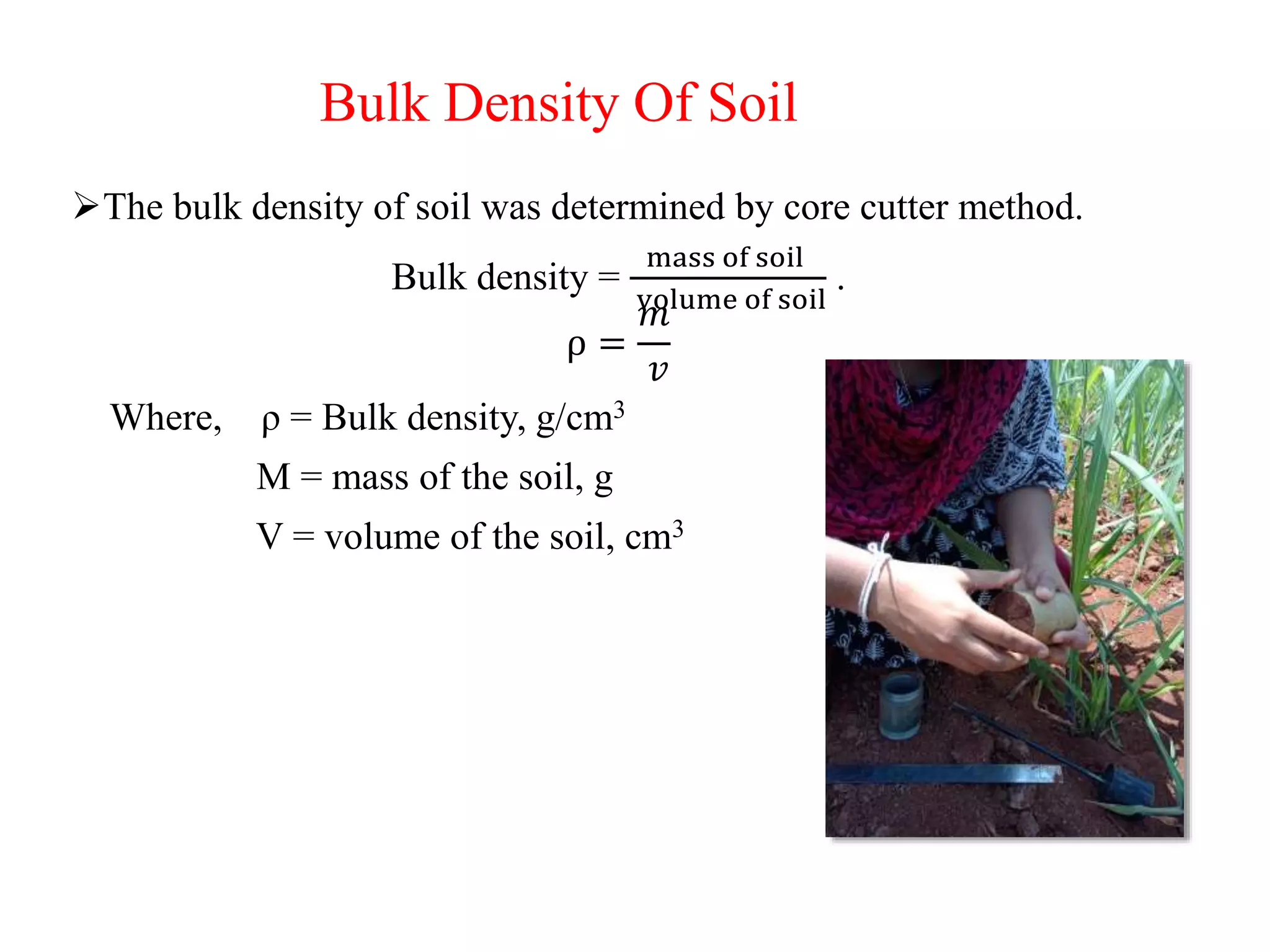
Bulk Density Of Soil
The bulk density of soil was determined by core cutter method.
Bulk density =
mass of soil
volume of soil
.
ρ =
𝑚
𝑣
Where, ρ = Bulk density, g/cm3
M = mass of the soil, g
V = volume of the soil, cm3
Weeding Efficiency
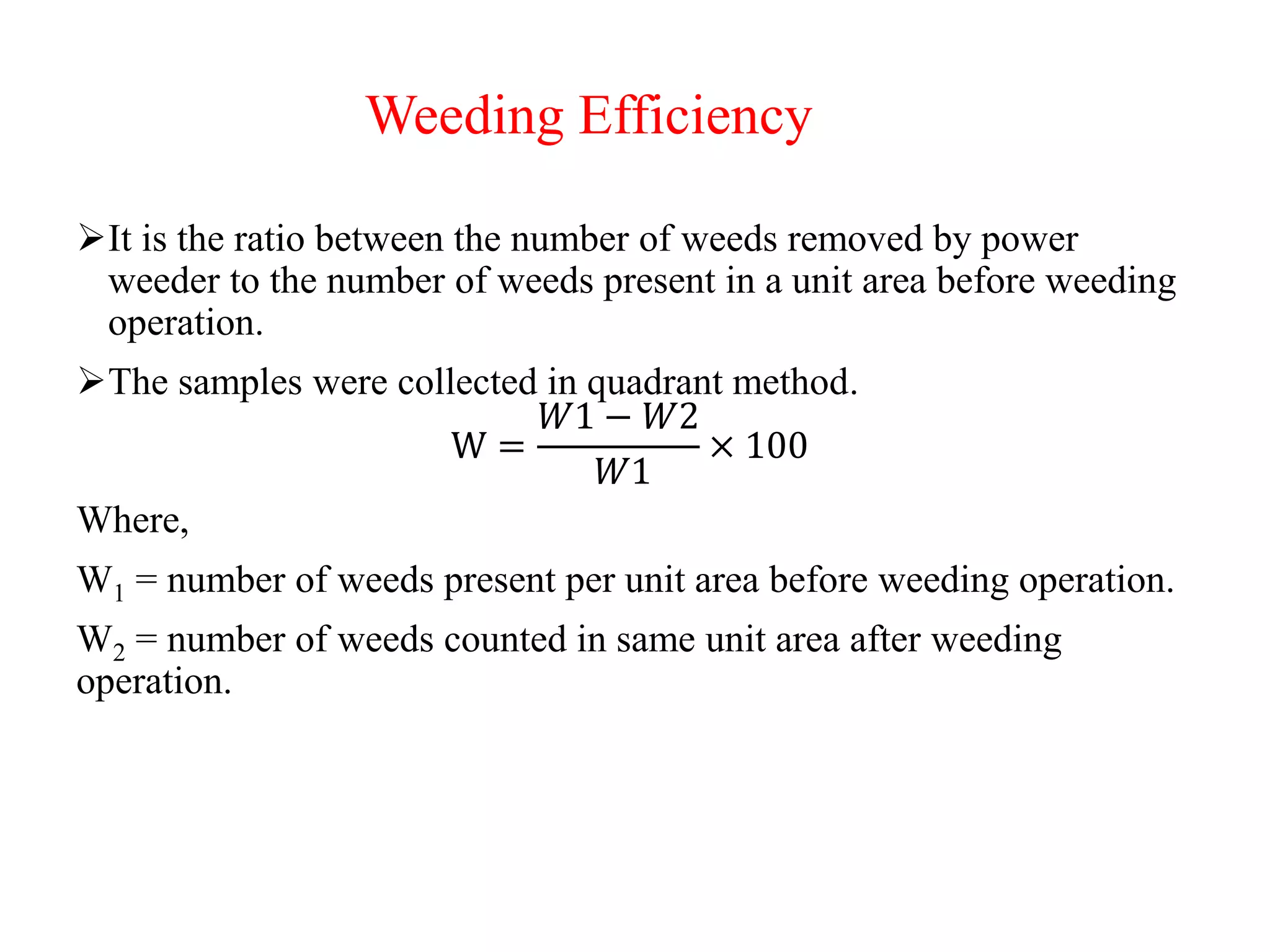
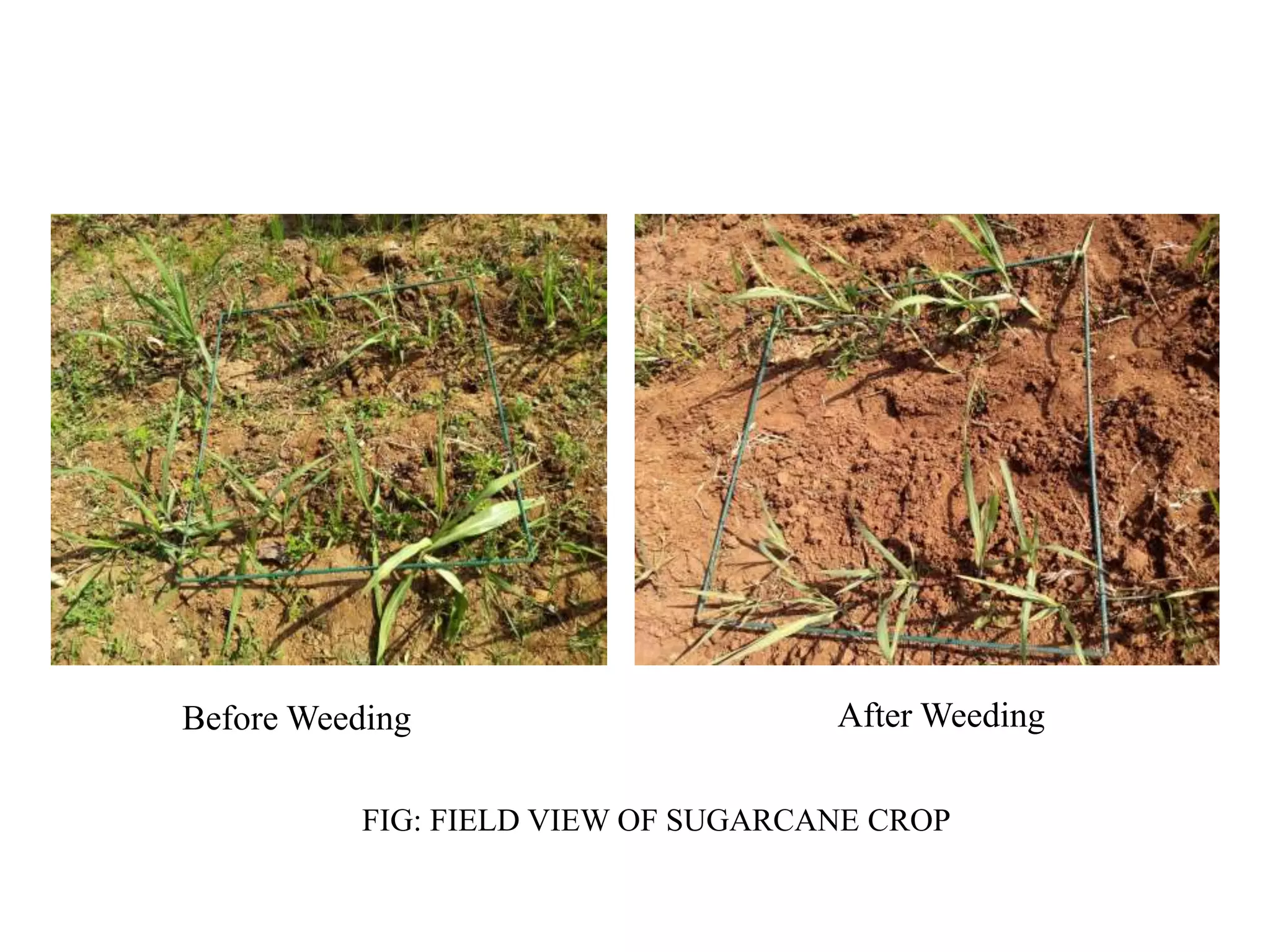
It is the ratio between the number of weeds removed by power
weeder to the number of weeds present in a unit area before weeding
operation.
The samples were collected in quadrant method.
W =
𝑊1 − 𝑊2
𝑊1
× 100
Where,
W1 = number of weeds present per unit area before weeding operation.
W2 = number of weeds counted in same unit area after weeding
operation.
Before Weeding After Weeding
FIG: FIELD VIEW OF SUGARCANE CROP
Plant Damage
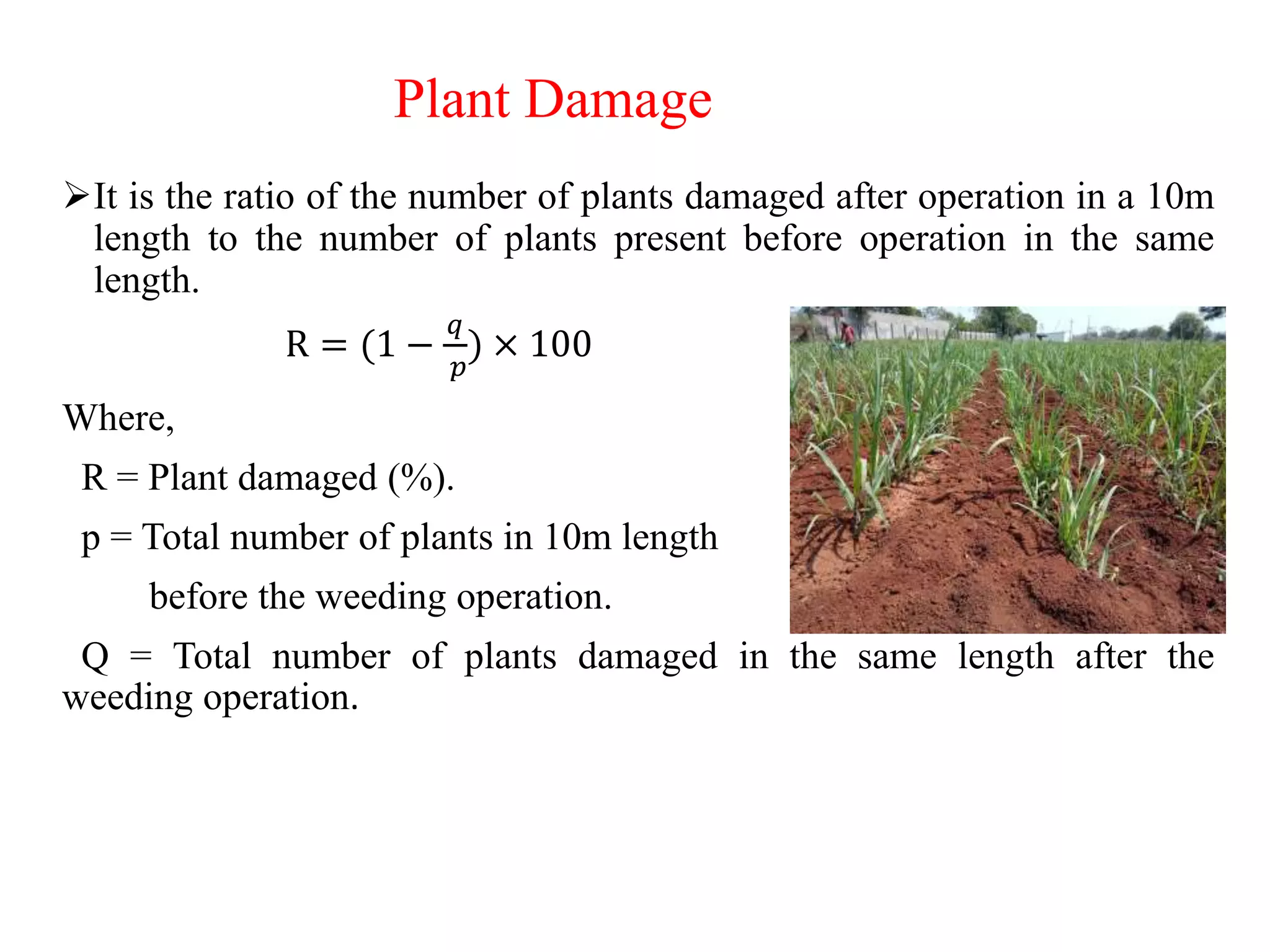
It is the ratio of the number of plants damaged after operation in a 10m
length to the number of plants present before operation in the same
length.
R = (1 −
𝑞
𝑝
) × 100
Where,
R = Plant damaged (%).
p = Total number of plants in 10m length
before the weeding operation.
Q = Total number of plants damaged in the same length after the
weeding operation.
Effective Field Capacity
Effective field capacity is the actual area covered by the implement,
based on its total time consumed and its width.
Theoritical Field Capacity
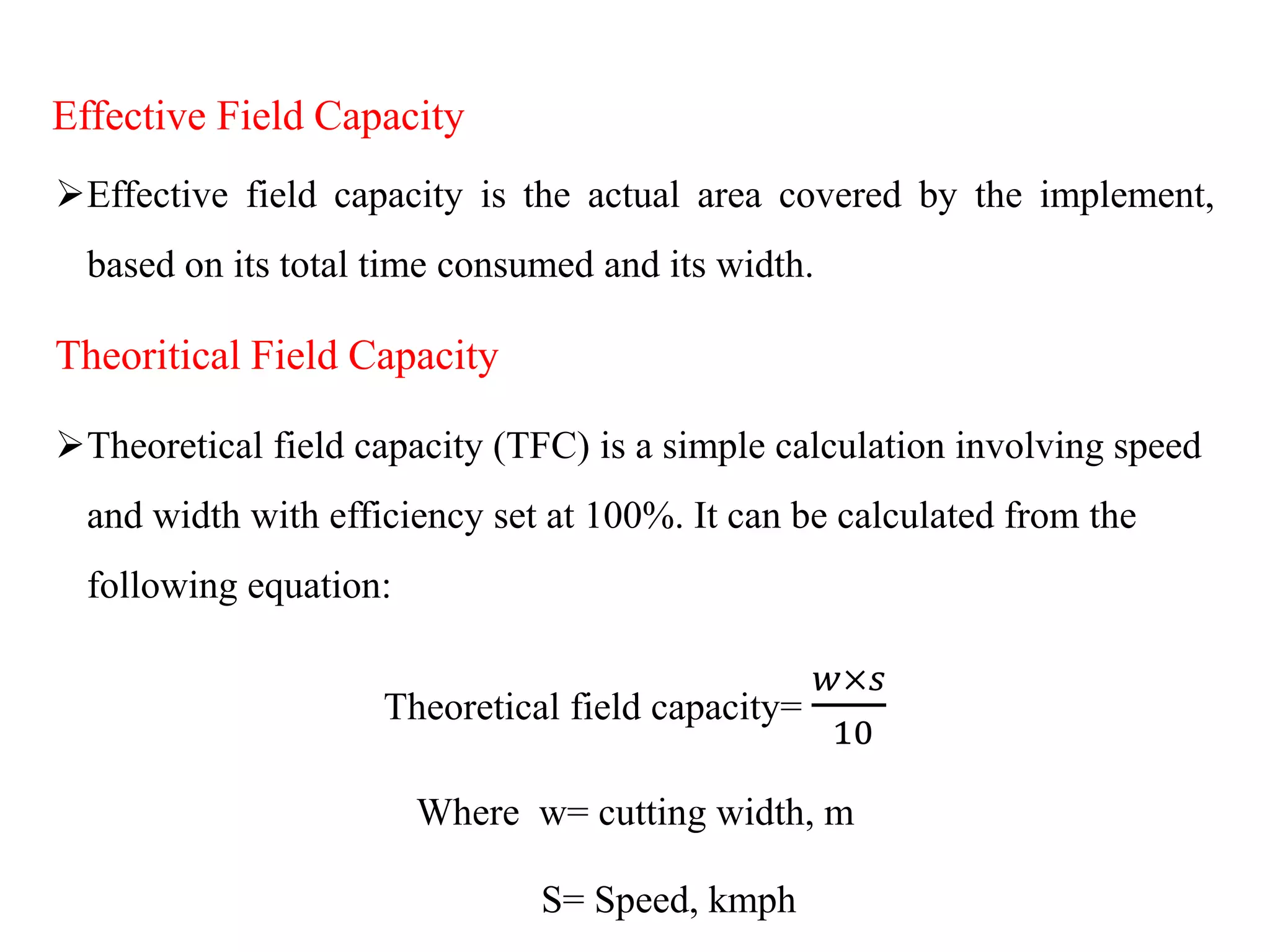
Theoretical field capacity (TFC) is a simple calculation involving speed
and width with efficiency set at 100%. It can be calculated from the
following equation:
Theoretical field capacity=
𝑤×𝑠
10
Where w= cutting width, m
S= Speed, kmph
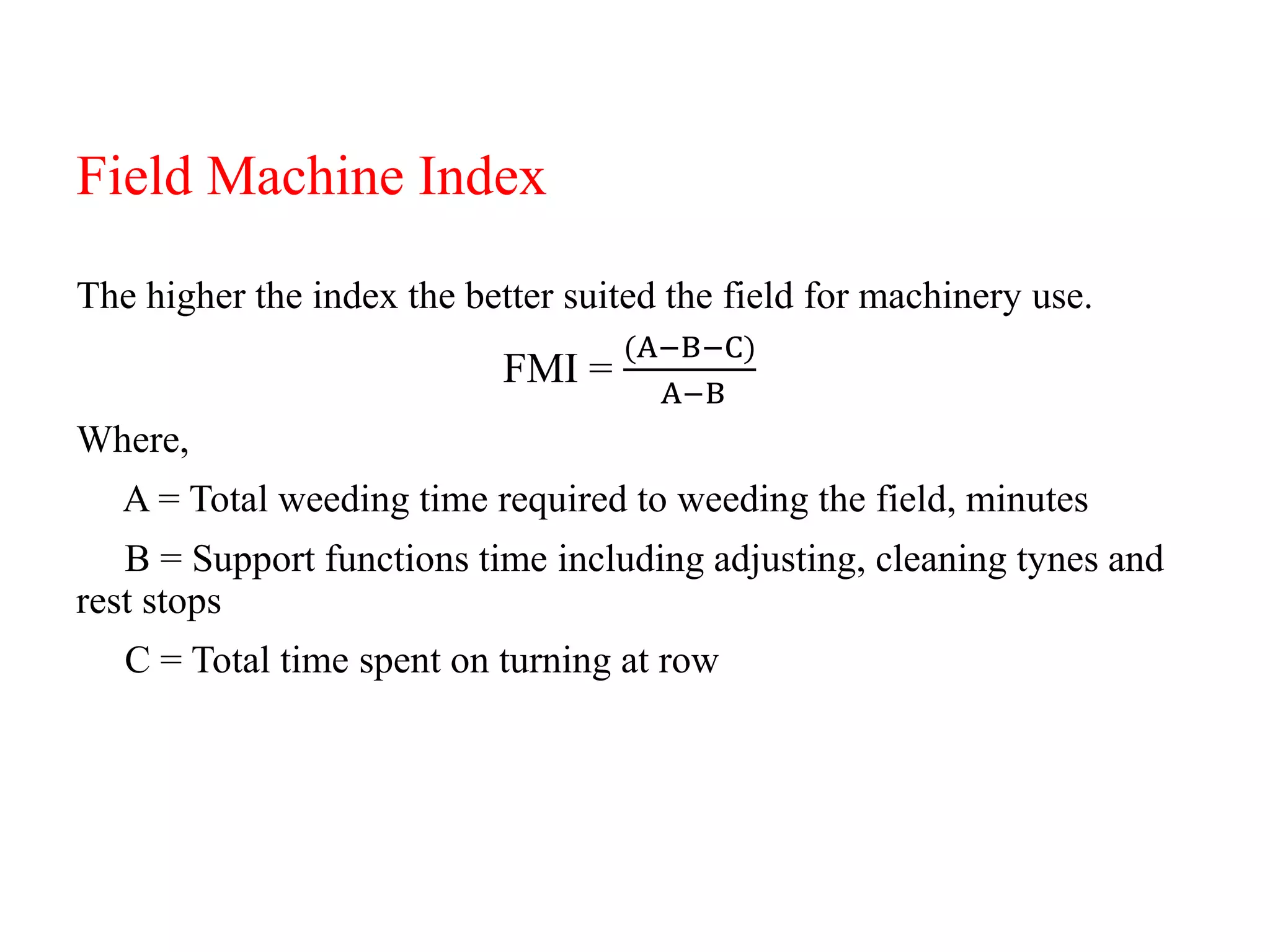
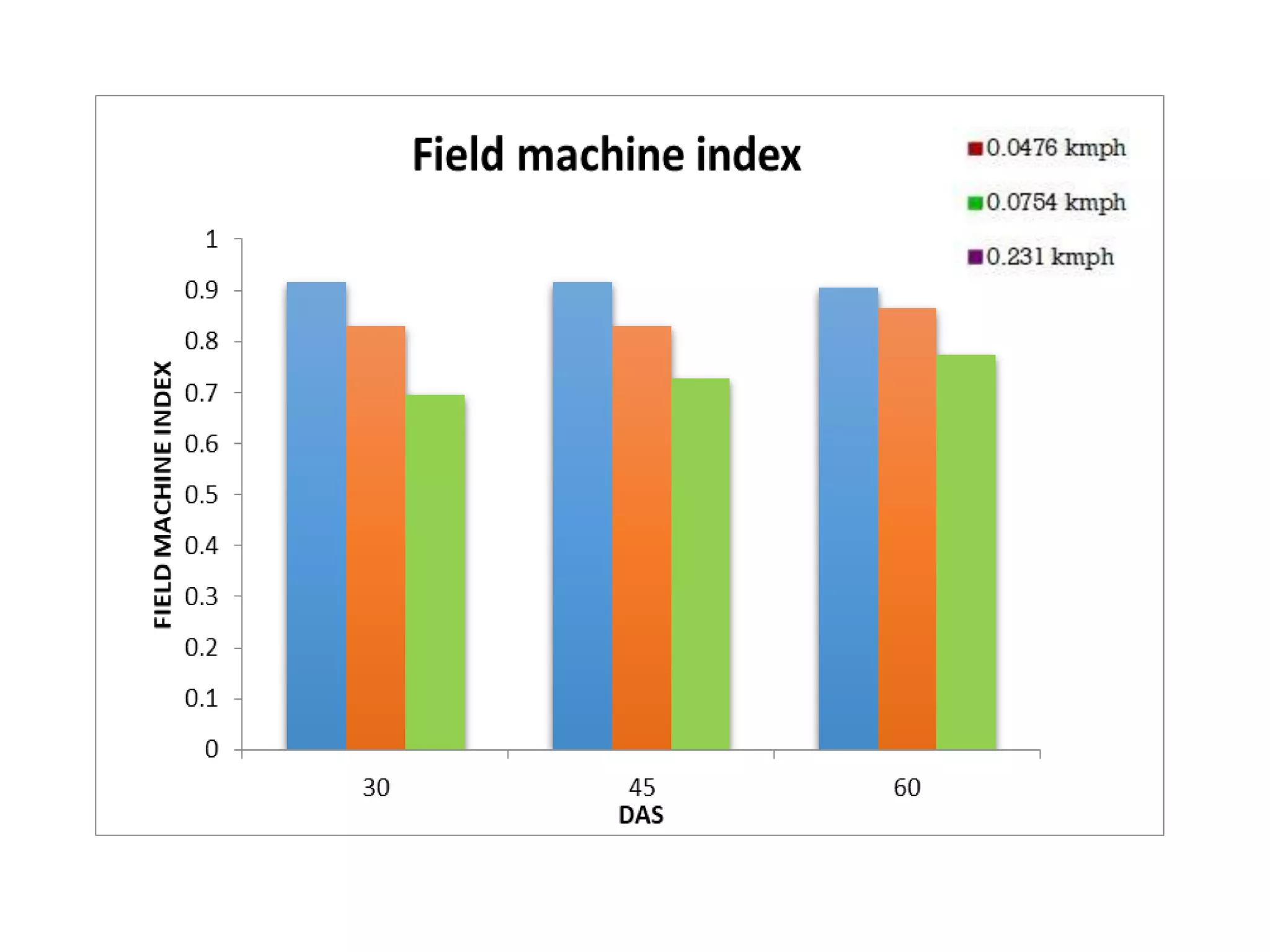
Field Machine Index
The higher the index the better suited the field for machinery use.
FMI =
(A−B−C)
A−B
Where,
A = Total weeding time required to weeding the field, minutes
B = Support functions time including adjusting, cleaning tynes and
rest stops
C = Total time spent on turning at row
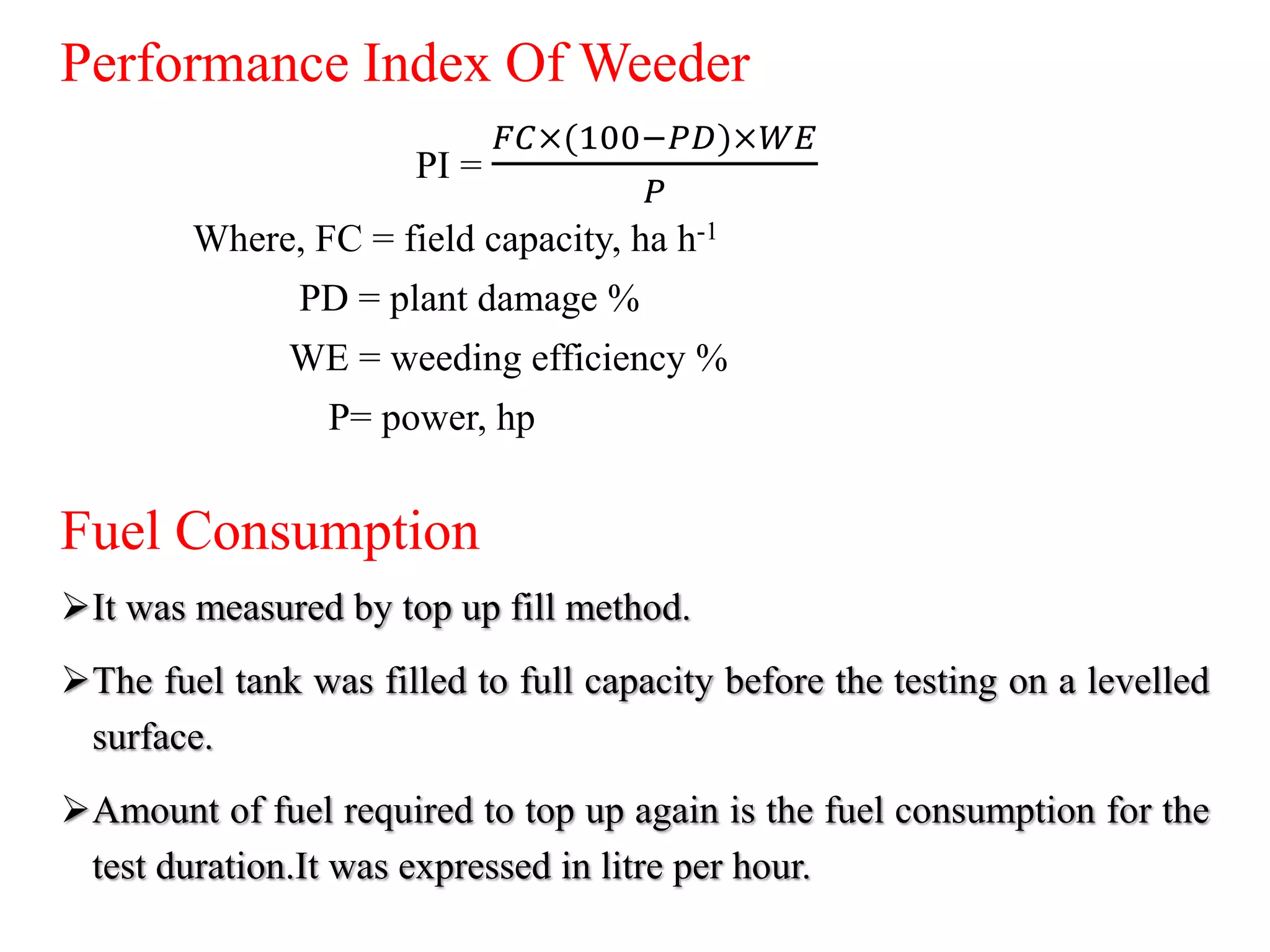
Performance Index Of Weeder
PI =
𝐹𝐶×(100−𝑃𝐷)×𝑊𝐸
𝑃
Where, FC = field capacity, ha h-1
PD = plant damage %
WE = weeding efficiency %
P= power, hp
Fuel Consumption
It was measured by top up fill method.
The fuel tank was filled to full capacity before the testing on a levelled
surface.
Amount of fuel required to top up again is the fuel consumption for the
test duration.It was expressed in litre per hour.
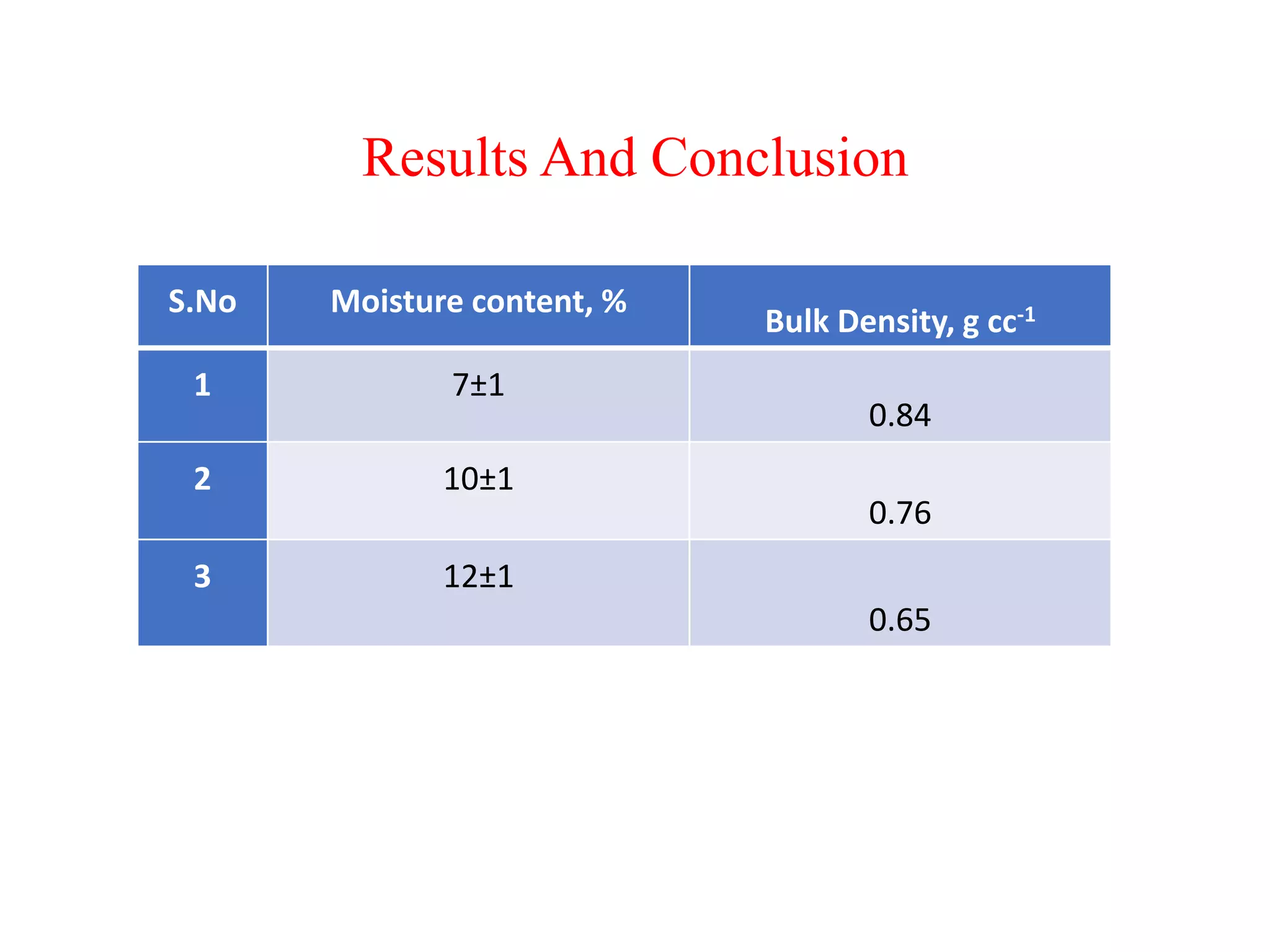
Results And Conclusion
S.No Moisture content, %
Bulk Density, g cc-1
1 7±1
0.84
2 10±1
0.76
3 12±1
0.65
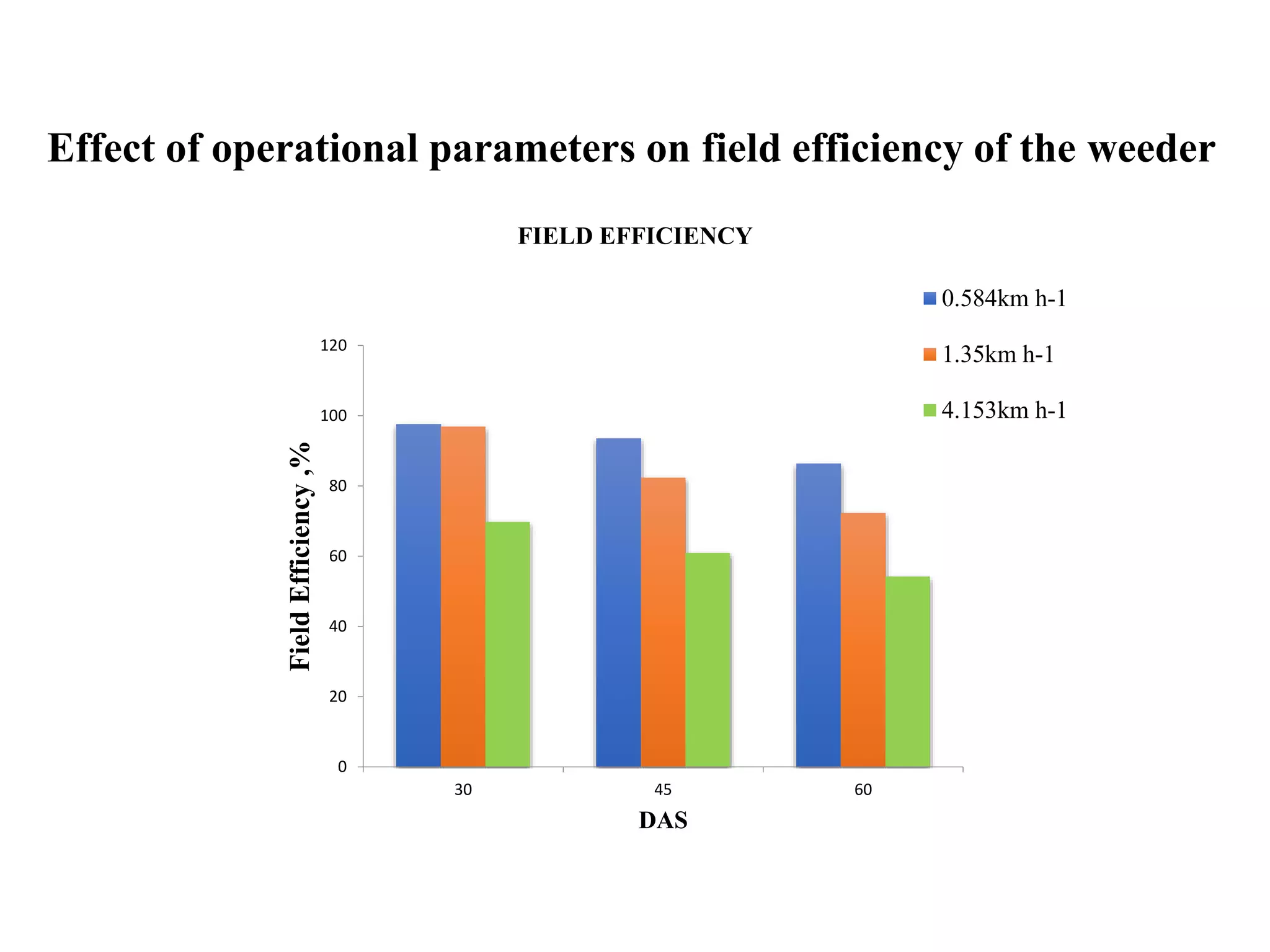
0
20
40
60
80
100
120
30 45 60
FieldEfficiency,%
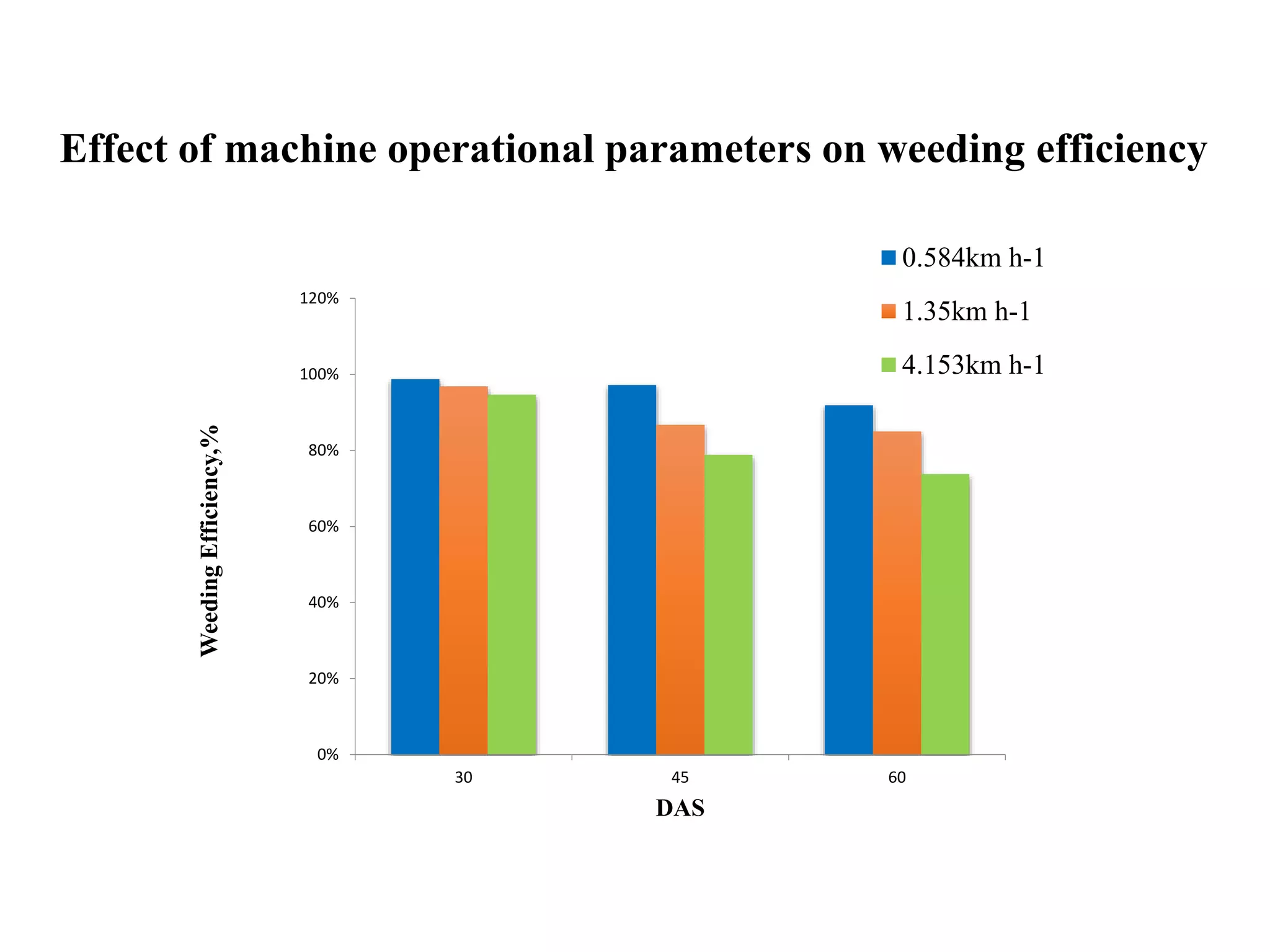
DAS
FIELD EFFICIENCY
0.584km h-1
1.35km h-1
4.153km h-1
Effect of operational parameters on field efficiency of the weeder
0%
20%
40%
60%
80%
100%
120%
30 45 60
WeedingEfficiency,%
DAS
0.584km h-1
1.35km h-1
4.153km h-1
Effect of machine operational parameters on weeding efficiency
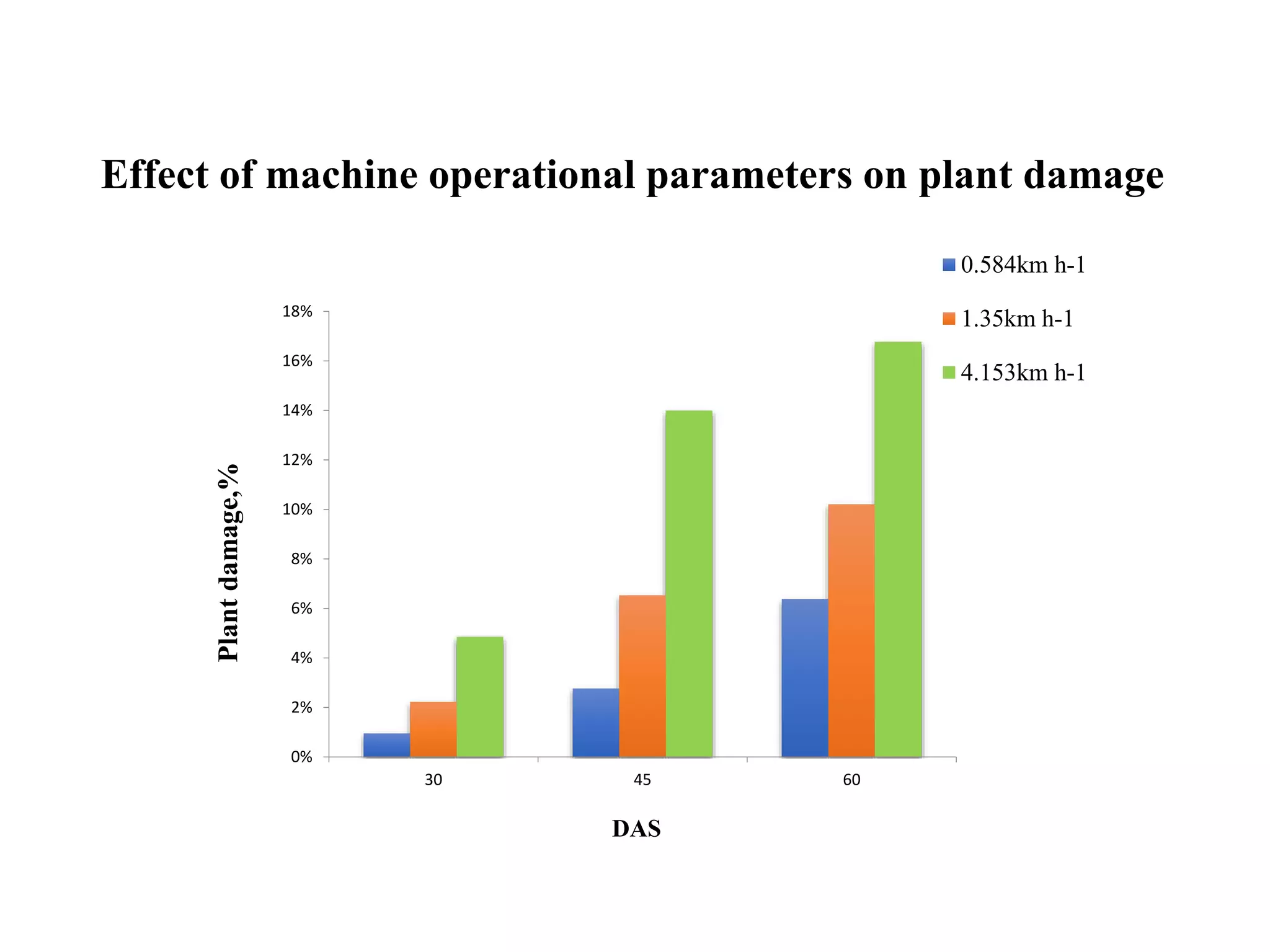
0%
2%
4%
6%
8%
10%
12%
14%
16%
18%
30 45 60
Plantdamage,%
DAS
0.584km h-1
1.35km h-1
4.153km h-1
Effect of machine operational parameters on plant damage
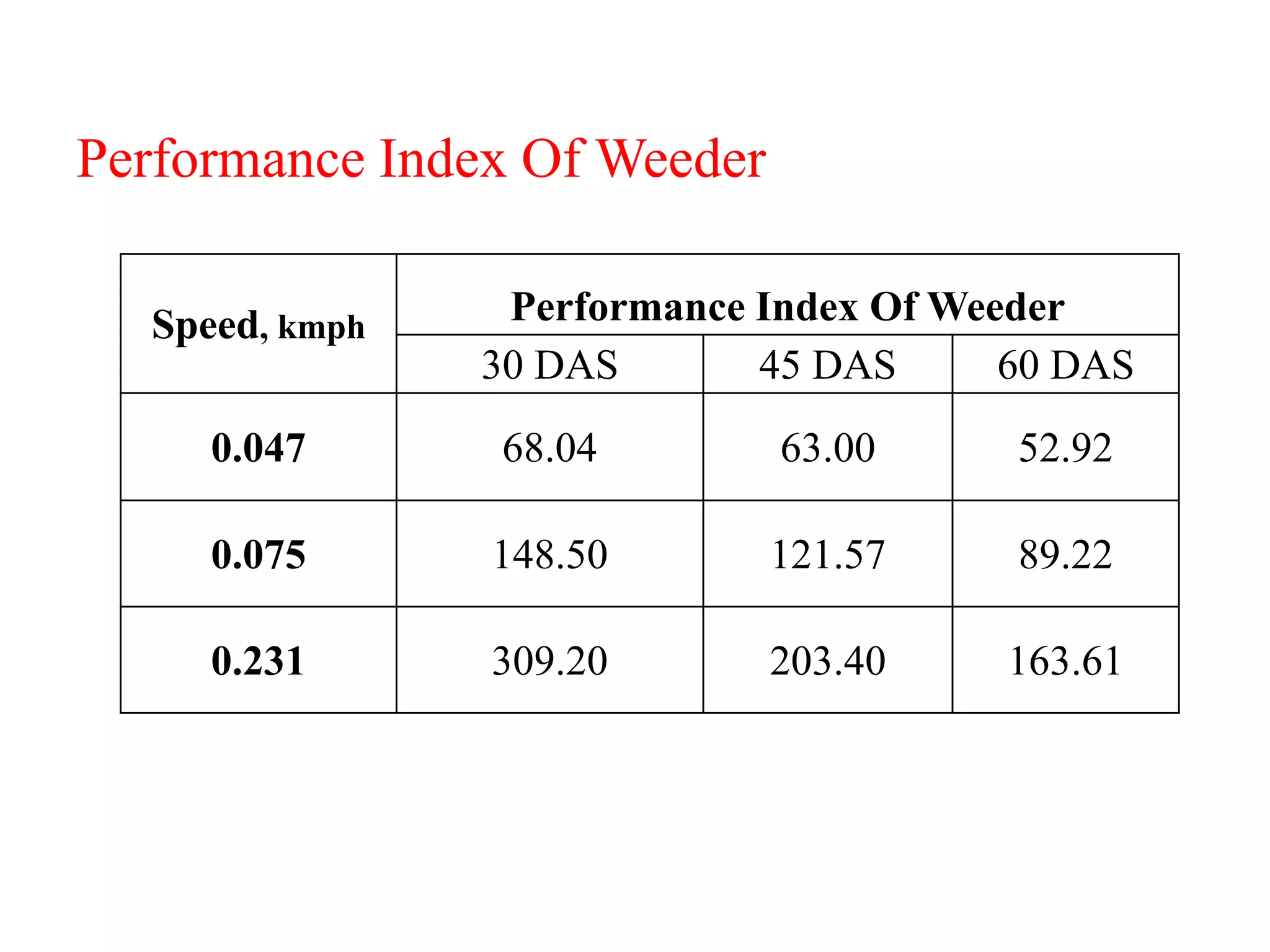
Performance Index Of Weeder
Speed, kmph
Performance Index Of Weeder
30 DAS 45 DAS 60 DAS
0.047 68.04 63.00 52.92
0.075 148.50 121.57 89.22
0.231 309.20 203.40 163.61
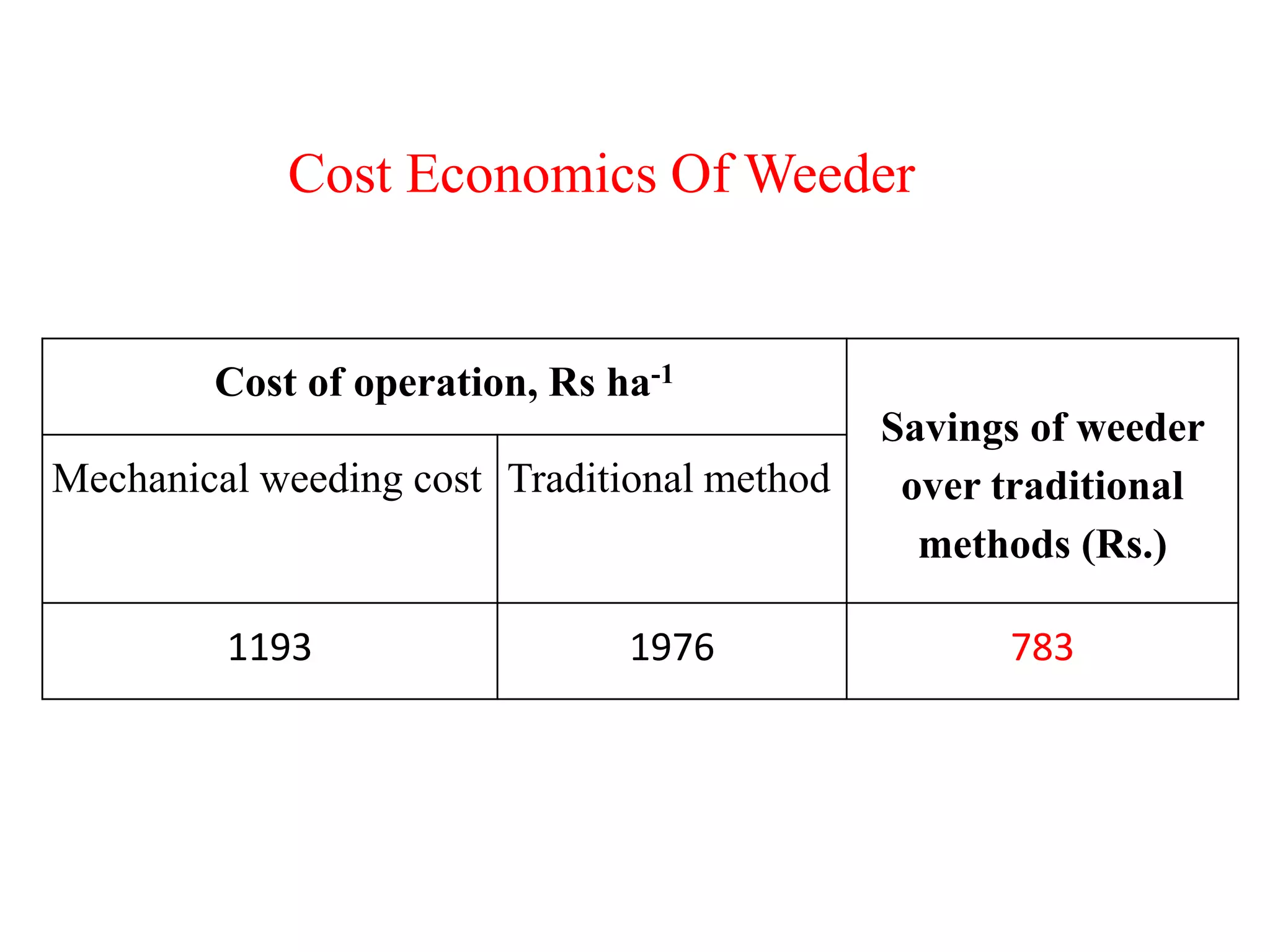
Cost Economics Of Weeder
Cost of operation, Rs ha-1
Savings of weeder
over traditional
methods (Rs.)
Mechanical weeding cost Traditional method
1193 1976 783
References
Olaoye, J. O. and Adekanye, T. A. 2011. Development and
Evaluation of a rotary power weeder. Proc. Nige. Soc. Agric.
Engg. 3:189-199
Padole, Y. B. 2007. Performance evaluation of rotary power
weeder. Agricultural Engineering Today. 31 (3&4): 30-33.
Lotz, L., Van D.W.R.Y., Horeman, G.H and Joosten, L.T.A. 2002.
Weed management and policies: from prevention and precision
technology to certifying individual farms. In: Proceedings 2002
12th EWRS (European Weed Research Society) Symposium,
Wageningen, 2–3.
Nagesh Kumar, T., Sujay Kumar, A., Madhusudan, N and Ramya,
V. 2014. Performance Evaluation of Weeders. International
Journal of Science and Technology. 3(6): 2160 – 2165.
THANK YOU

Performance evaluation of power weeder

  • 1.
    PROFESSOR JAYASHANKAR TELANGANASTATE AGRICULTURAL UNIVERSITY COLLEGE OF AGRICULTURAL ENGINEERING KANDI, SANGAREDDY-502285 PERFORMANCE EVALUATION OF POWER WEEDER IN SUGARCANE CROP Presented by S.SAI MOHAN 2018-18-016
  • 2.
    Introduction Sugarcane is themain sugar-producing crop that contributes nearly 78.2% to the total sugarcane at the global level.  It is the prime source of sugar in India. India is the second largest sugarcane producer on the globe next to brazil.  It is estimated that India produces 341.2 million metric tonnes of sugarcane. Weeds in sugarcane field competes for moisture and light also remove about 4 times N and P and 2.5 times of K during the first 50 days of crop period. The initial 90-120 days period of crop growth is considered as most critical period of weed competition.
  • 3.
    In sugarcane crop,weeds have been estimated to cause 12 to 72 % reduction in cane yield. In manual weed control, where, labours pulls weeds out of the soil using different types of hand tools like khurpi, wheel hoe, hand hoe, etc. These practices are expensive, time consuming and difficult to organize labour. Today the agricultural sector requires non-chemical weed control that safeguards consumers demand for high quality food products .  The technical development of mechanisms for physical weed control, such as precise inter and intra-row weeders to control weeds.
  • 4.
    Objectives To Evaluate ThePerformance Of Power Weeder In Sugarcane. To Estimate Cost Economics Of Power Weeder Against Traditional Method Of Weeding In Sugarcane.
  • 6.
    Specifications Of PowerWeeder S.NO SPECIFICATION 1 ENGINE 5.5 HP DIESEL (AIR COOLED) 2 STARTING SYSTEM RECOIL 3 GEARS 3 FORWARD & 2 REVERSE 4 P.T.O. 3600 RPM 5 WHEEL SIZE 4.0X10.0 INCHES 6 WIDTH OF ROTAVATOR 66 CM 7 OVER ALL WEIGHT 135 KG
  • 7.
    PHYSICAL PROPERTIES OFSOIL Moisture content Bulk density MACHINE PERFORMANCE PARAMETERS Weeding efficiency. Plant damage. Effective field capacity. Theoretical field capacity. Field efficiency. Fuel consumption. Cost economics.
  • 8.
    Soil Moisture Content Themoisture was determined by oven drying method. In this, wet soil sample of known weight was kept in the thermostatically controlled oven at a temperature of 105º C for 24 H.  The dried soil is again weighed and the moisture content is determined as : 𝑤 = 𝑊𝑤 − 𝑊𝑑 𝑊𝑑 × 100 Where, W = moisture content, (% db) WW = wet mass of soil, g Wd = dry mass of soil, g
  • 9.
    Bulk Density OfSoil The bulk density of soil was determined by core cutter method. Bulk density = mass of soil volume of soil . ρ = 𝑚 𝑣 Where, ρ = Bulk density, g/cm3 M = mass of the soil, g V = volume of the soil, cm3
  • 10.
    Weeding Efficiency It isthe ratio between the number of weeds removed by power weeder to the number of weeds present in a unit area before weeding operation. The samples were collected in quadrant method. W = 𝑊1 − 𝑊2 𝑊1 × 100 Where, W1 = number of weeds present per unit area before weeding operation. W2 = number of weeds counted in same unit area after weeding operation.
  • 11.
    Before Weeding AfterWeeding FIG: FIELD VIEW OF SUGARCANE CROP
  • 12.
    Plant Damage It isthe ratio of the number of plants damaged after operation in a 10m length to the number of plants present before operation in the same length. R = (1 − 𝑞 𝑝 ) × 100 Where, R = Plant damaged (%). p = Total number of plants in 10m length before the weeding operation. Q = Total number of plants damaged in the same length after the weeding operation.
  • 13.
    Effective Field Capacity Effectivefield capacity is the actual area covered by the implement, based on its total time consumed and its width. Theoritical Field Capacity Theoretical field capacity (TFC) is a simple calculation involving speed and width with efficiency set at 100%. It can be calculated from the following equation: Theoretical field capacity= 𝑤×𝑠 10 Where w= cutting width, m S= Speed, kmph
  • 14.
    Field Machine Index Thehigher the index the better suited the field for machinery use. FMI = (A−B−C) A−B Where, A = Total weeding time required to weeding the field, minutes B = Support functions time including adjusting, cleaning tynes and rest stops C = Total time spent on turning at row
  • 15.
    Performance Index OfWeeder PI = 𝐹𝐶×(100−𝑃𝐷)×𝑊𝐸 𝑃 Where, FC = field capacity, ha h-1 PD = plant damage % WE = weeding efficiency % P= power, hp Fuel Consumption It was measured by top up fill method. The fuel tank was filled to full capacity before the testing on a levelled surface. Amount of fuel required to top up again is the fuel consumption for the test duration.It was expressed in litre per hour.
  • 16.
    Results And Conclusion S.NoMoisture content, % Bulk Density, g cc-1 1 7±1 0.84 2 10±1 0.76 3 12±1 0.65
  • 17.
    0 20 40 60 80 100 120 30 45 60 FieldEfficiency,% DAS FIELDEFFICIENCY 0.584km h-1 1.35km h-1 4.153km h-1 Effect of operational parameters on field efficiency of the weeder
  • 18.
    0% 20% 40% 60% 80% 100% 120% 30 45 60 WeedingEfficiency,% DAS 0.584kmh-1 1.35km h-1 4.153km h-1 Effect of machine operational parameters on weeding efficiency
  • 19.
    0% 2% 4% 6% 8% 10% 12% 14% 16% 18% 30 45 60 Plantdamage,% DAS 0.584kmh-1 1.35km h-1 4.153km h-1 Effect of machine operational parameters on plant damage
  • 21.
    Performance Index OfWeeder Speed, kmph Performance Index Of Weeder 30 DAS 45 DAS 60 DAS 0.047 68.04 63.00 52.92 0.075 148.50 121.57 89.22 0.231 309.20 203.40 163.61
  • 22.
    Cost Economics OfWeeder Cost of operation, Rs ha-1 Savings of weeder over traditional methods (Rs.) Mechanical weeding cost Traditional method 1193 1976 783
  • 23.
    References Olaoye, J. O.and Adekanye, T. A. 2011. Development and Evaluation of a rotary power weeder. Proc. Nige. Soc. Agric. Engg. 3:189-199 Padole, Y. B. 2007. Performance evaluation of rotary power weeder. Agricultural Engineering Today. 31 (3&4): 30-33. Lotz, L., Van D.W.R.Y., Horeman, G.H and Joosten, L.T.A. 2002. Weed management and policies: from prevention and precision technology to certifying individual farms. In: Proceedings 2002 12th EWRS (European Weed Research Society) Symposium, Wageningen, 2–3. Nagesh Kumar, T., Sujay Kumar, A., Madhusudan, N and Ramya, V. 2014. Performance Evaluation of Weeders. International Journal of Science and Technology. 3(6): 2160 – 2165.
  • 24.