




WELCOME
Project Title
PERFORMANCE STUDY OF MANUAL REAPER COMPARED TO
MANUAL AND COMBINE HARVESTING FOR RICE AND WHEAT
Supervisor
Prof. Md. Ruhul Amin
Hon’ble Vice-chancellor, HSTU,
Dinajpur.
Co-Supervisor
Prof. Dr. Md. Kamal Uddin Sarker
Dept. of Agricultural and Industrial
Engineering
Presenters
RAMANI KANTA BARMAN
Student ID. 1107049
Session: 2011
MD. ABU AYUB SIDDIQUE
Student ID. 1107064
Session: 2011
MD. MAKSUDUR RAHMAN
Student ID. 1107076
Session: 2011
INTRODUCTION
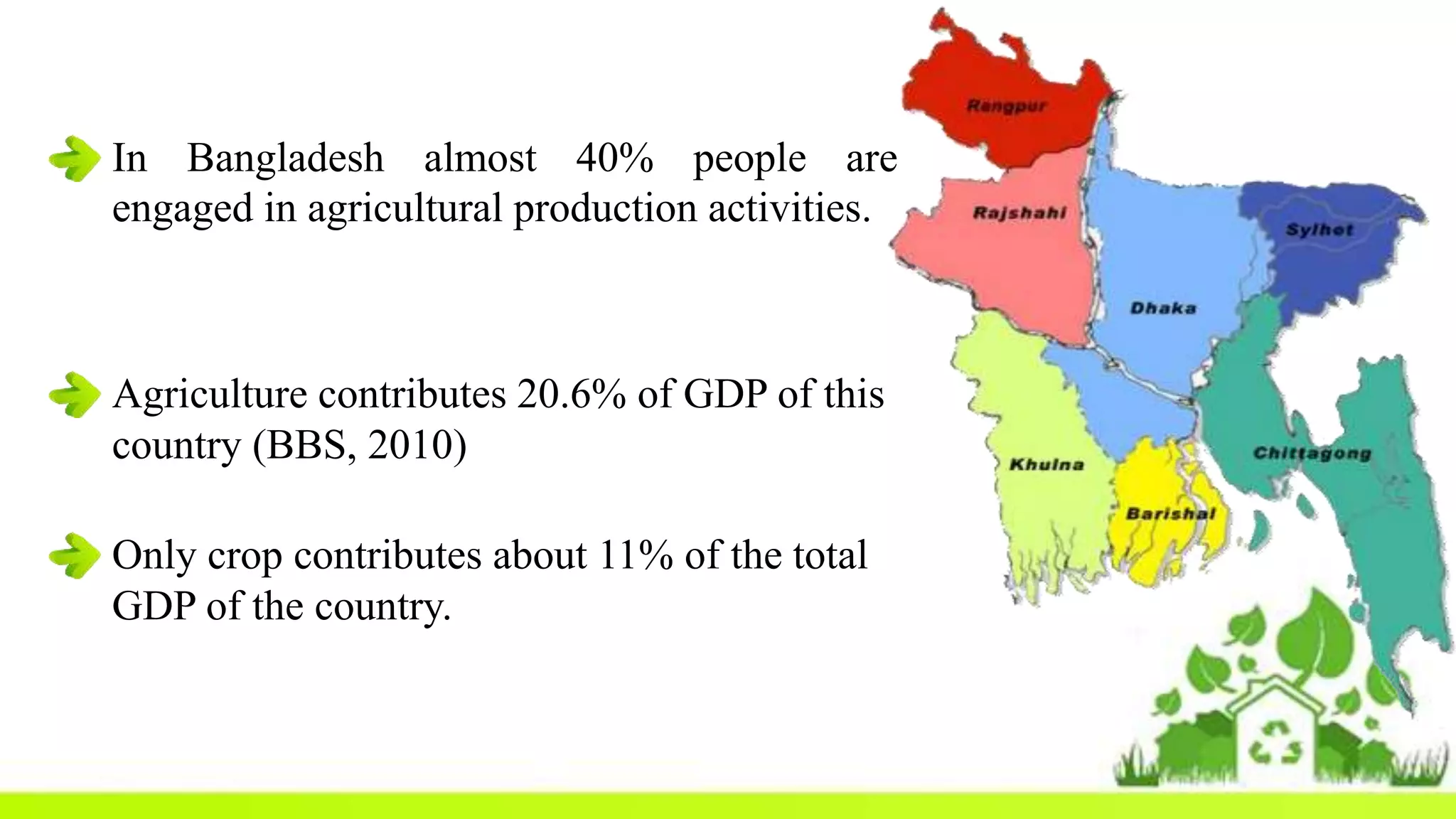
In Bangladesh almost 40% people are
engaged in agricultural production activities.
Agriculture contributes 20.6% of GDP of this
country (BBS, 2010)
Only crop contributes about 11% of the total
GDP of the country.
Rice is one of the leading cereal crops in the world
About 12.25 million hectares were under the cultivation of rice in
Bangladesh that was 88% of the gross cropped land of the country (BBS,
2014)
Annual production of rice was 749.1 million tones with 154 million
hectares of cultivable lands under the 113 countries in the world (FAO,
2015)
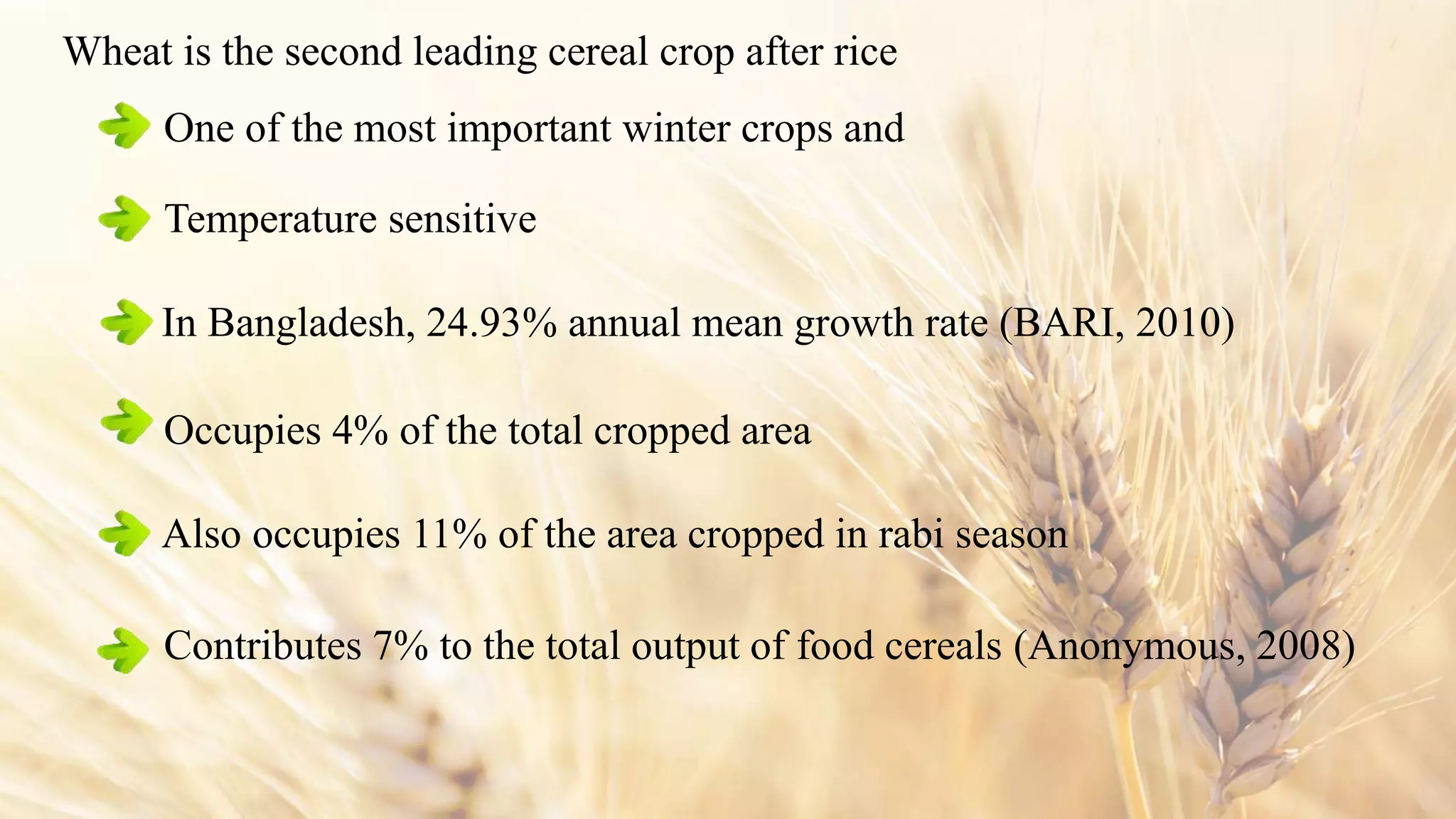
Wheat is the second leading cereal crop after rice
Temperature sensitive
One of the most important winter crops and
Occupies 4% of the total cropped area
Also occupies 11% of the area cropped in rabi season
Contributes 7% to the total output of food cereals (Anonymous, 2008)
In Bangladesh, 24.93% annual mean growth rate (BARI, 2010)
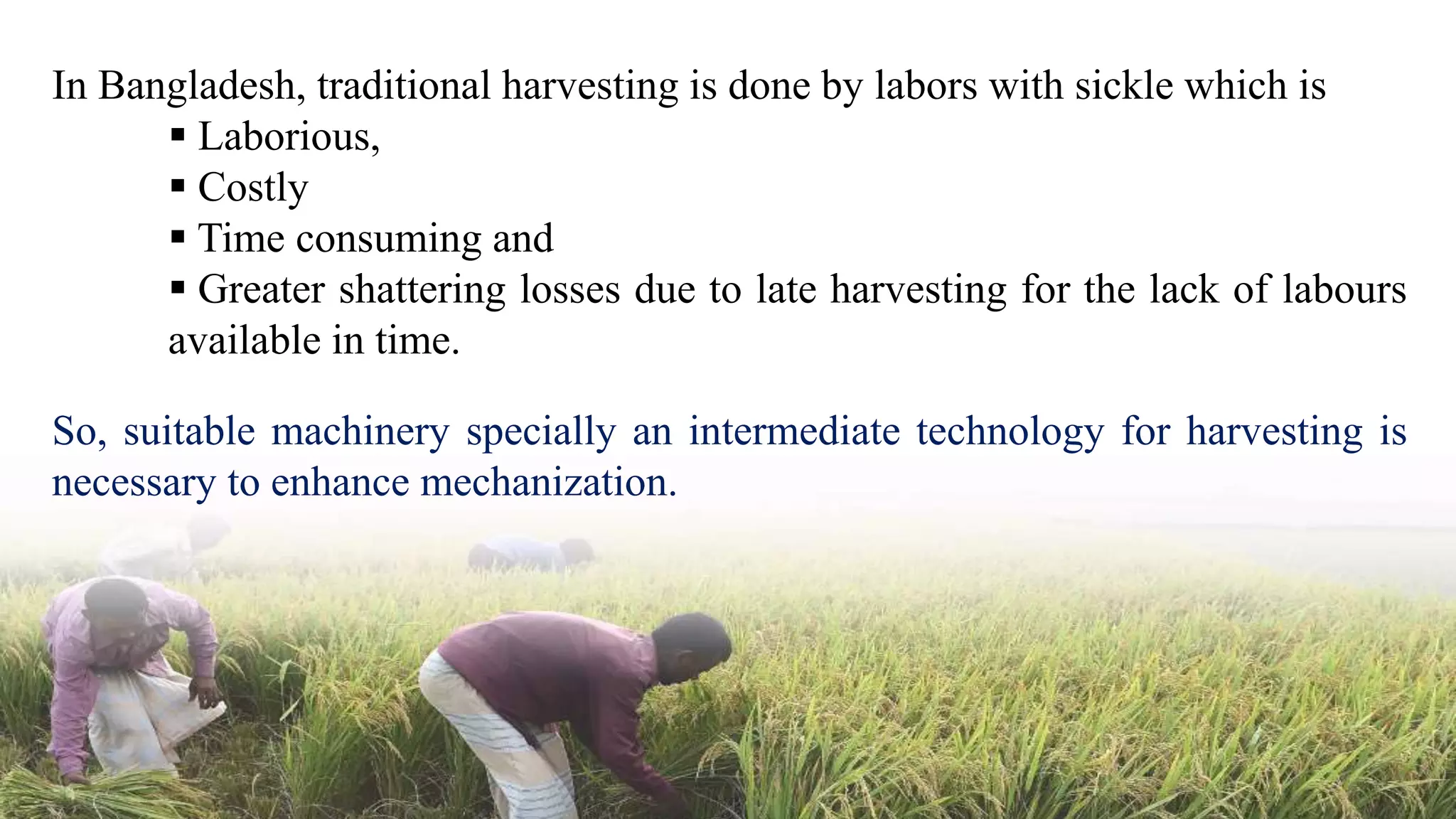
In Bangladesh, traditional harvesting is done by labors with sickle which is
 Laborious,
 Costly
 Time consuming and
 Greater shattering losses due to late harvesting for the lack of labours
available in time.
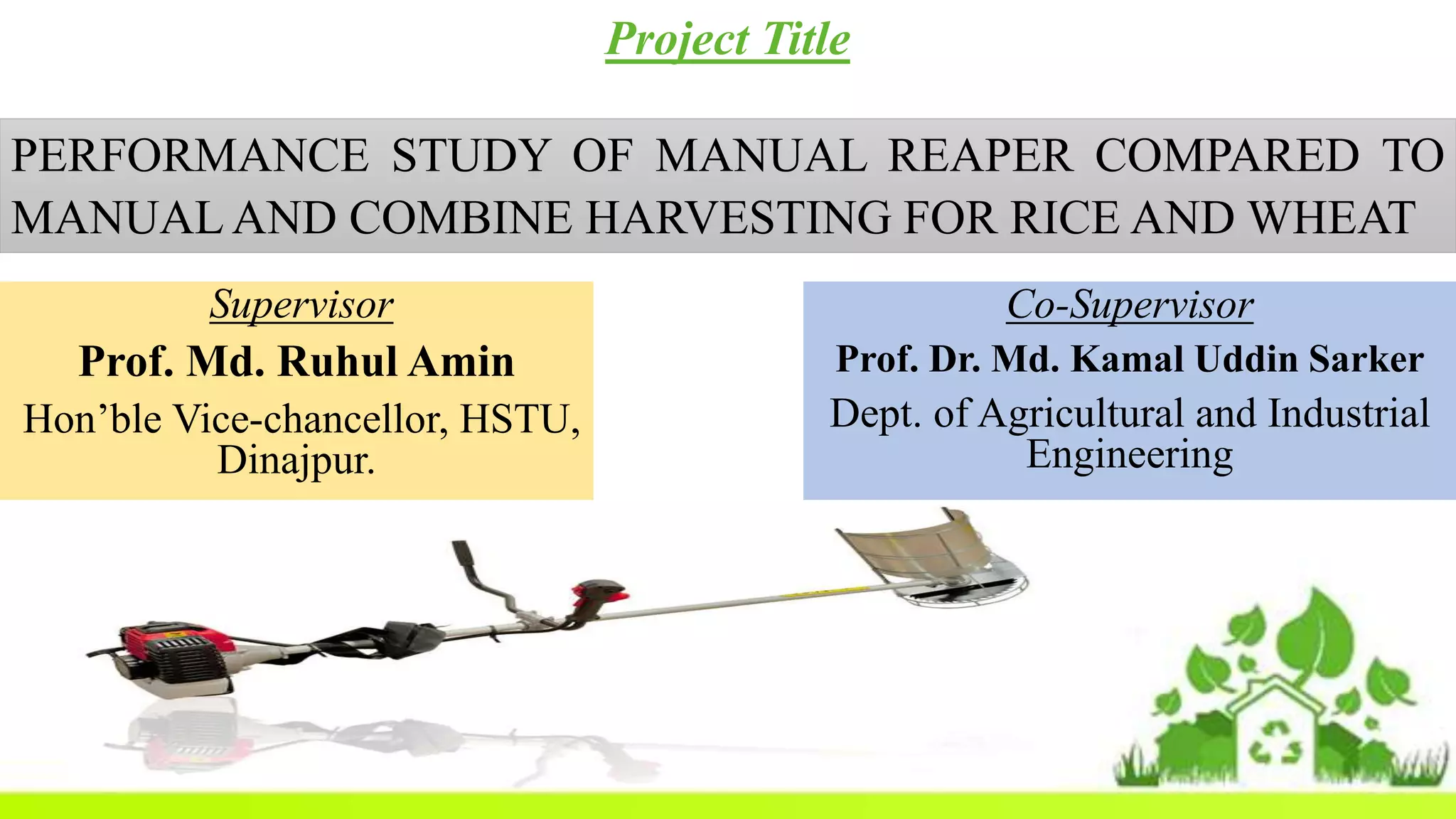
So, suitable machinery specially an intermediate technology for harvesting is
necessary to enhance mechanization.
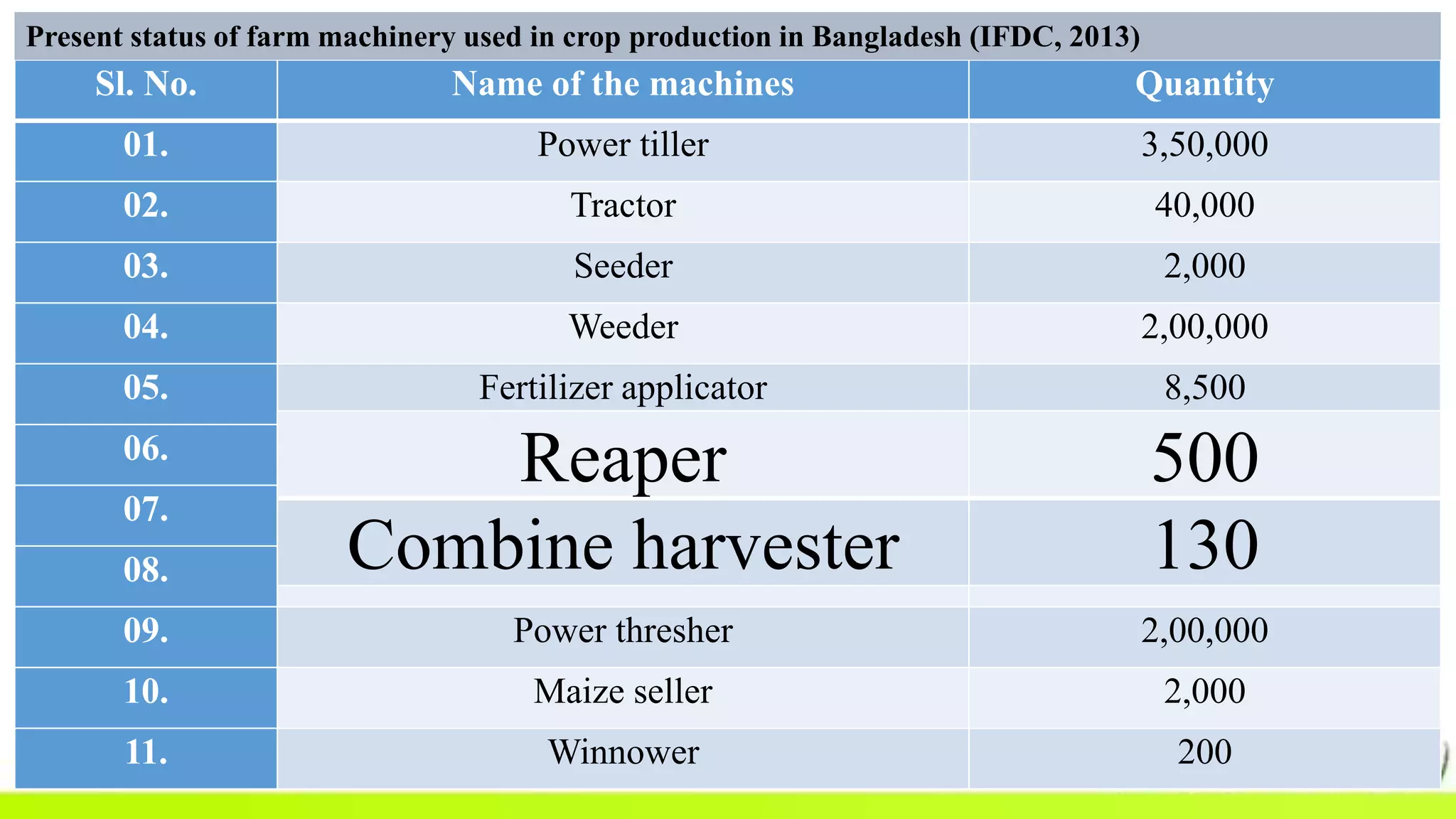
Sl. No. Name of the machines Quantity
01. Power tiller 3,50,000
02. Tractor 40,000
03. Seeder 2,000
04. Weeder 2,00,000
05. Fertilizer applicator 8,500
06. Sprayer 12,50,000
07. Reaper 500
08. Combine harvester 130
09. Power thresher 2,00,000
10. Maize seller 2,000
11. Winnower 200
Present status of farm machinery used in crop production in Bangladesh (IFDC, 2013)
Reaper 500
Combine harvester 130
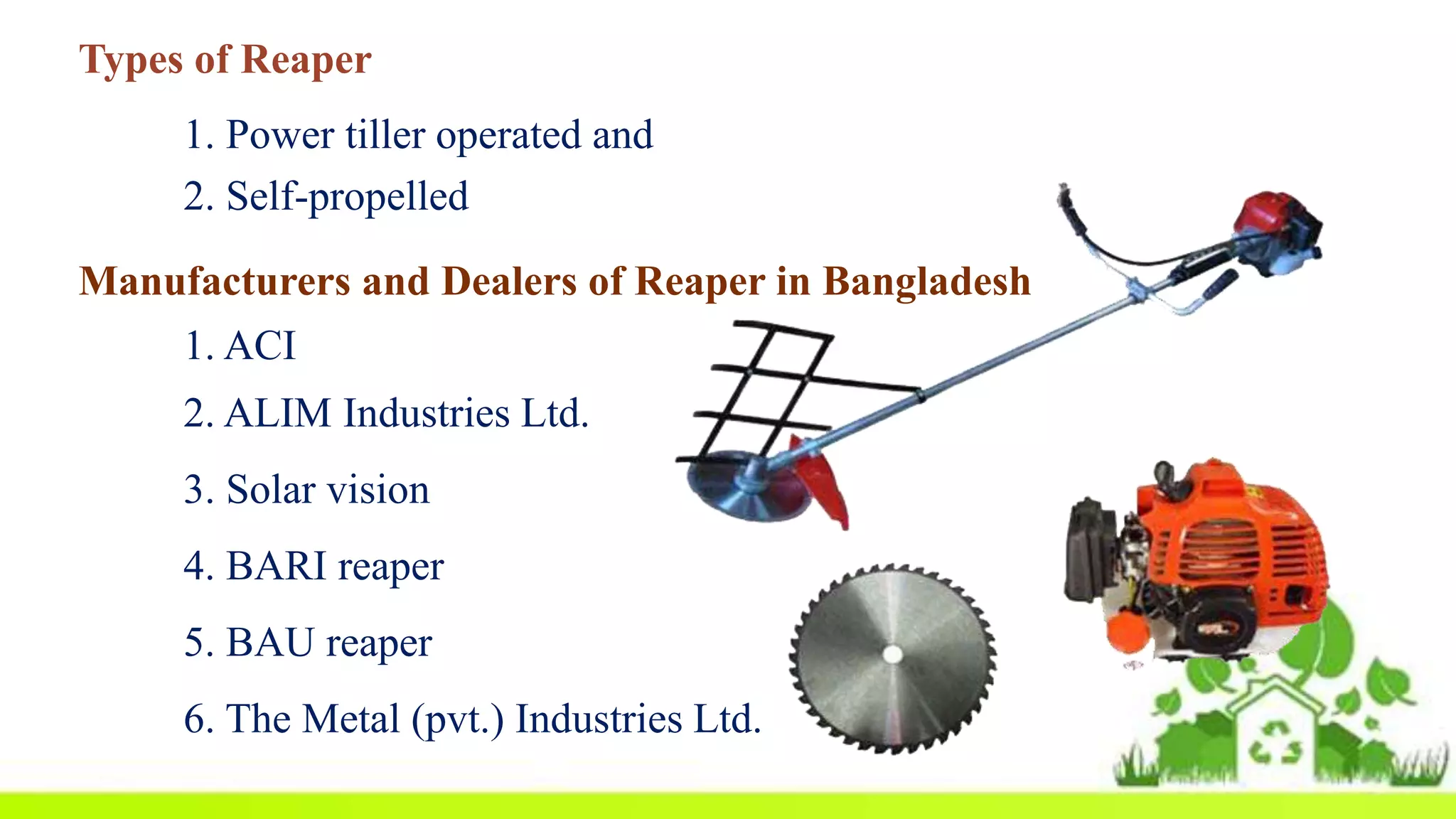
1. Power tiller operated and
2. Self-propelled
Manufacturers and Dealers of Reaper in Bangladesh
1. ACI
2. ALIM Industries Ltd.
3. Solar vision
4. BARI reaper
5. BAU reaper
6. The Metal (pvt.) Industries Ltd.
Types of Reaper
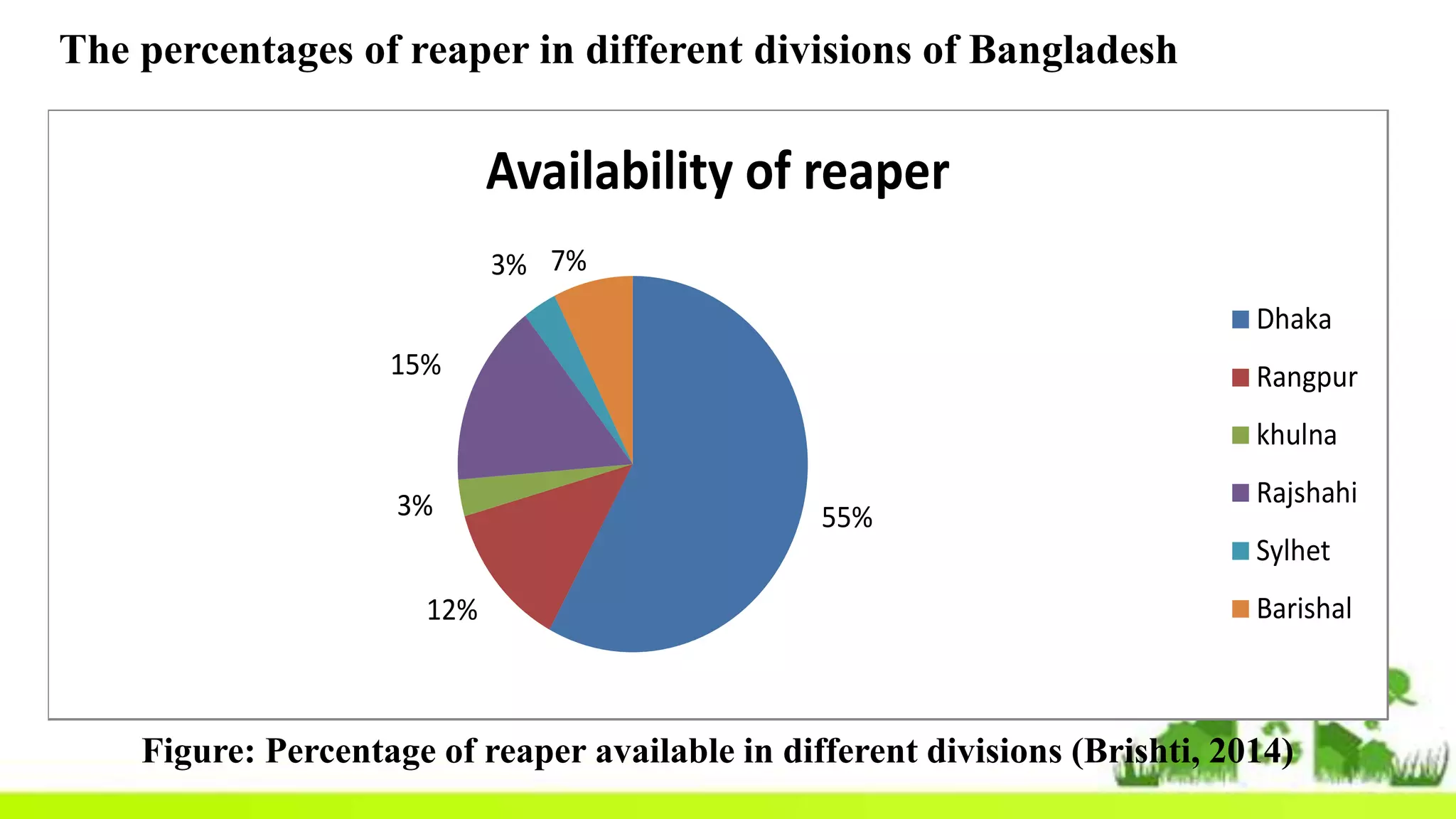
The percentages of reaper in different divisions of Bangladesh
55%
12%
3%
15%
3% 7%
Availability of reaper
Dhaka
Rangpur
khulna
Rajshahi
Sylhet
Barishal
Figure: Percentage of reaper available in different divisions (Brishti, 2014)
Objectives of the Study
The main objective of the study was to compare the performance of a
manual reaper to that of manual and combine harvesting for paddy and
wheat.
Specific Objectives
To study the performance of a manual reaper
To identify the problems and prospects of reaper in harvesting
To compare mechanical harvesting with manual harvesting for selected crops
To suggest an economically feasible harvesting method for selected crops.
MATERIALS AND METHODS
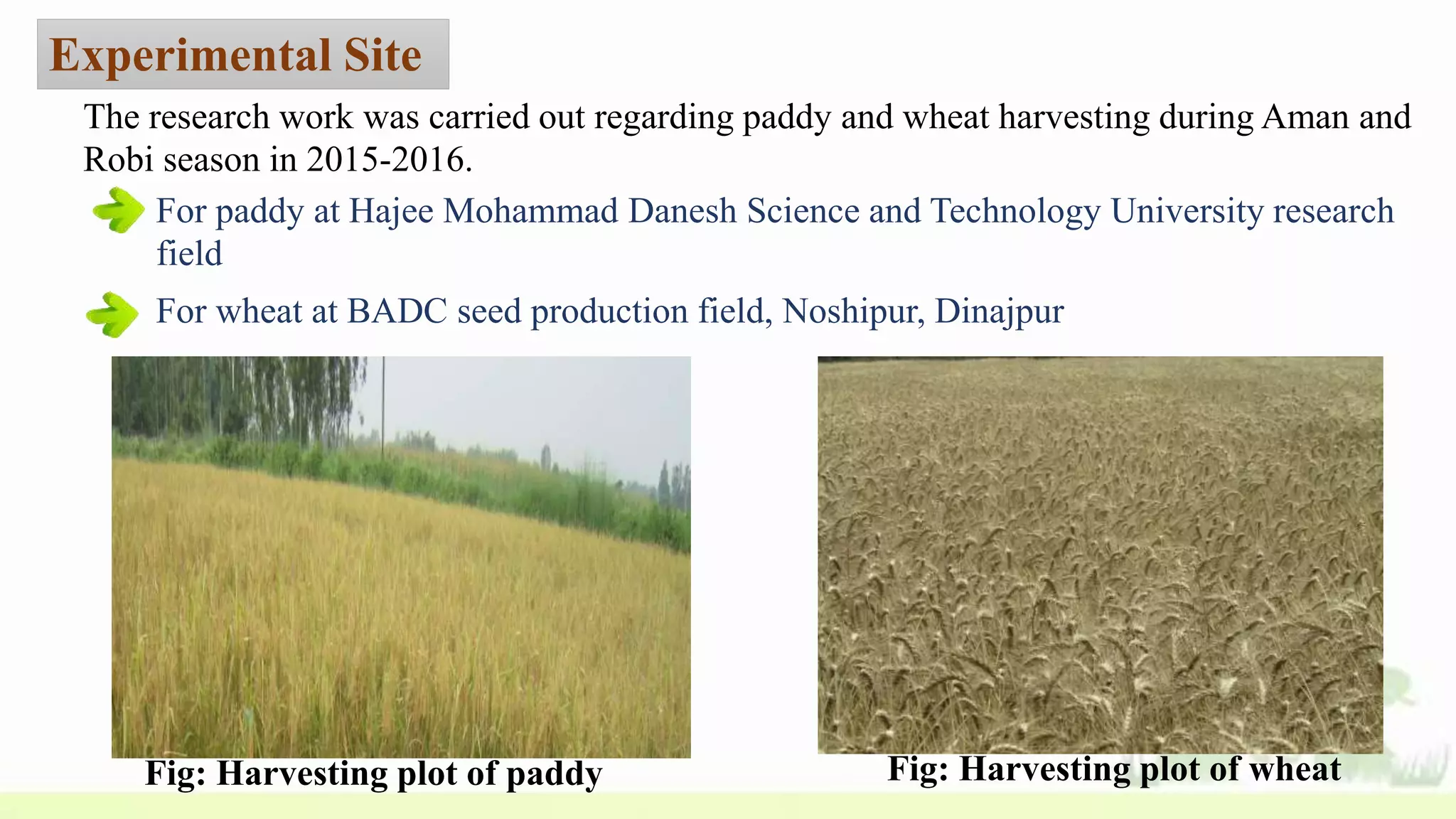
Experimental Site
The research work was carried out regarding paddy and wheat harvesting during Aman and
Robi season in 2015-2016.
For wheat at BADC seed production field, Noshipur, Dinajpur
For paddy at Hajee Mohammad Danesh Science and Technology University research
field
Fig: Harvesting plot of paddy Fig: Harvesting plot of wheat
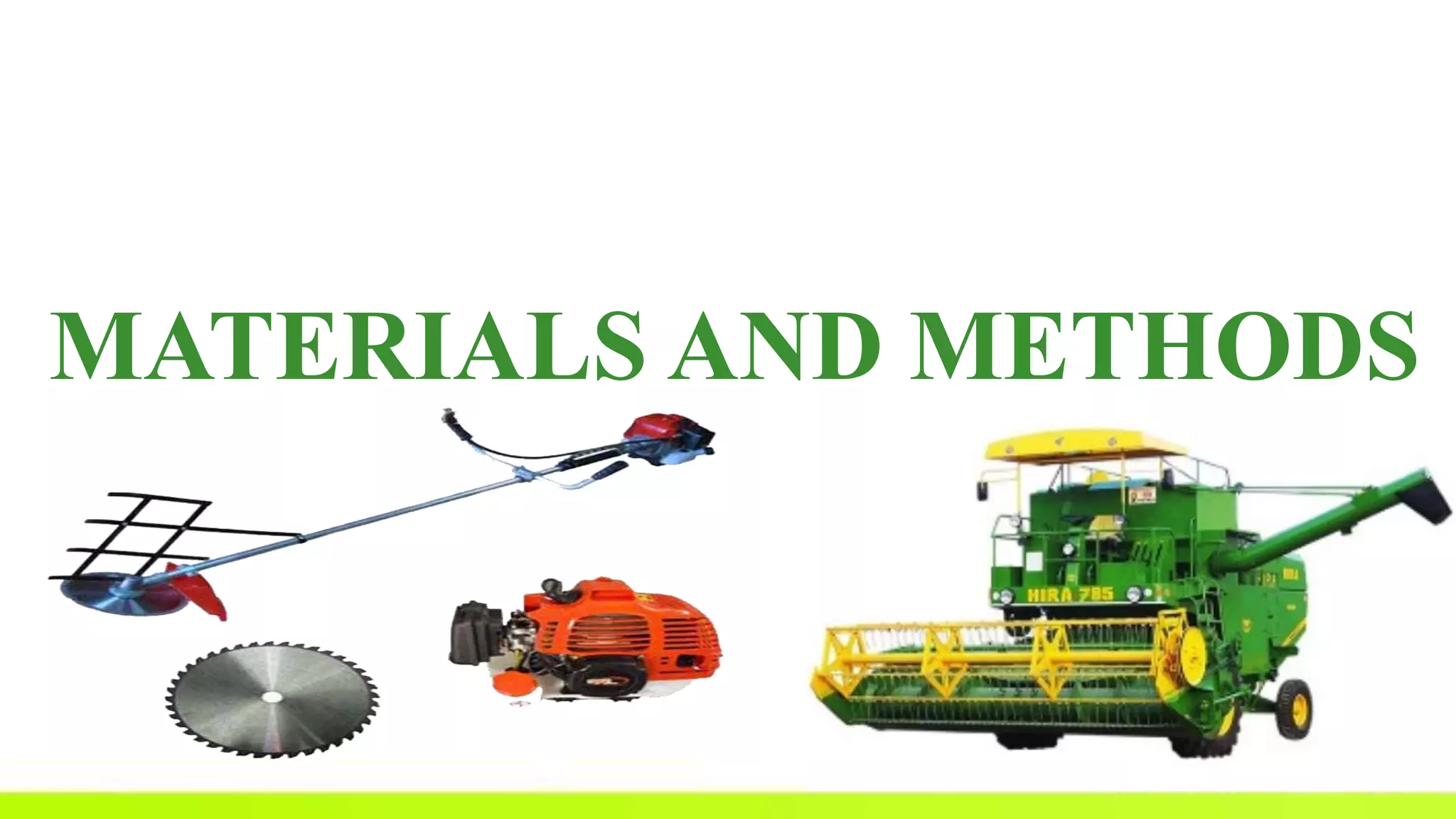
Equipment used
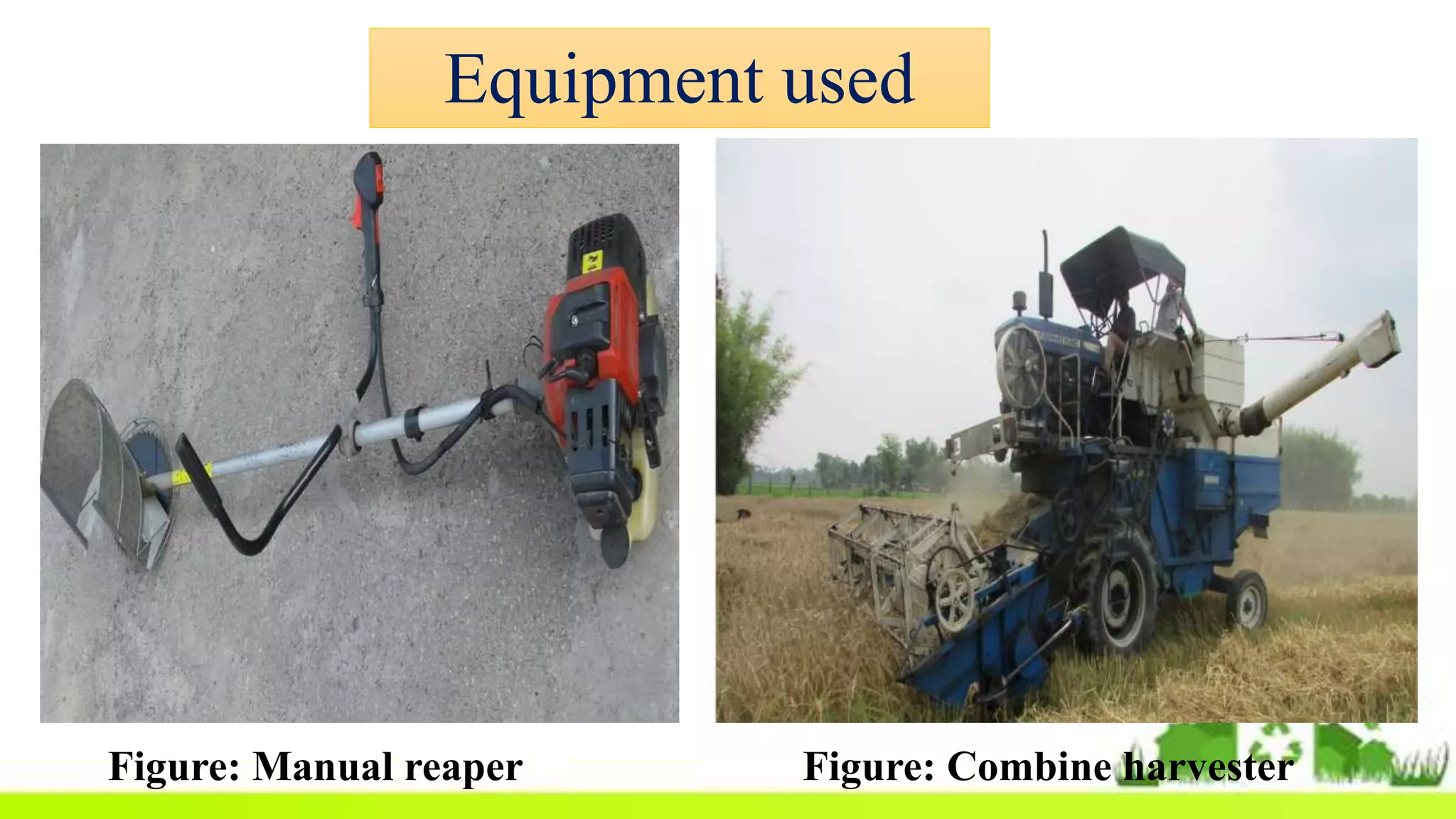
Figure: Manual reaper Figure: Combine harvester
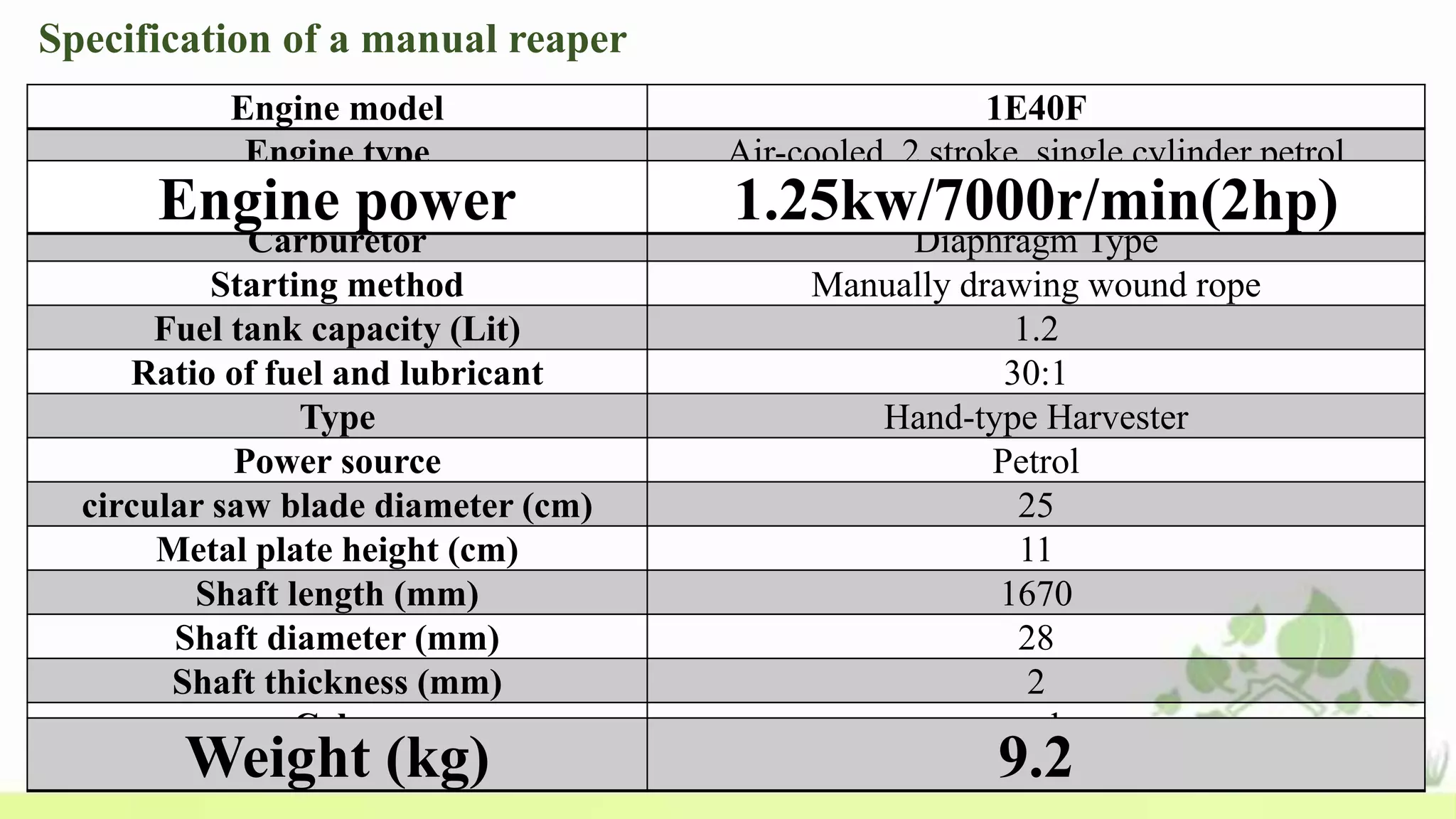
Specification of a manual reaper
Engine model 1E40F
Engine type Air-cooled, 2 stroke, single cylinder petrol
Engine power 1.25kw/7000r/min(2hp)
Carburetor Diaphragm Type
Starting method Manually drawing wound rope
Fuel tank capacity (Lit) 1.2
Ratio of fuel and lubricant 30:1
Type Hand-type Harvester
Power source Petrol
circular saw blade diameter (cm) 25
Metal plate height (cm) 11
Shaft length (mm) 1670
Shaft diameter (mm) 28
Shaft thickness (mm) 2
Color red
Weight (kg) 9.2
Engine power 1.25kw/7000r/min(2hp)
Weight (kg) 9.2
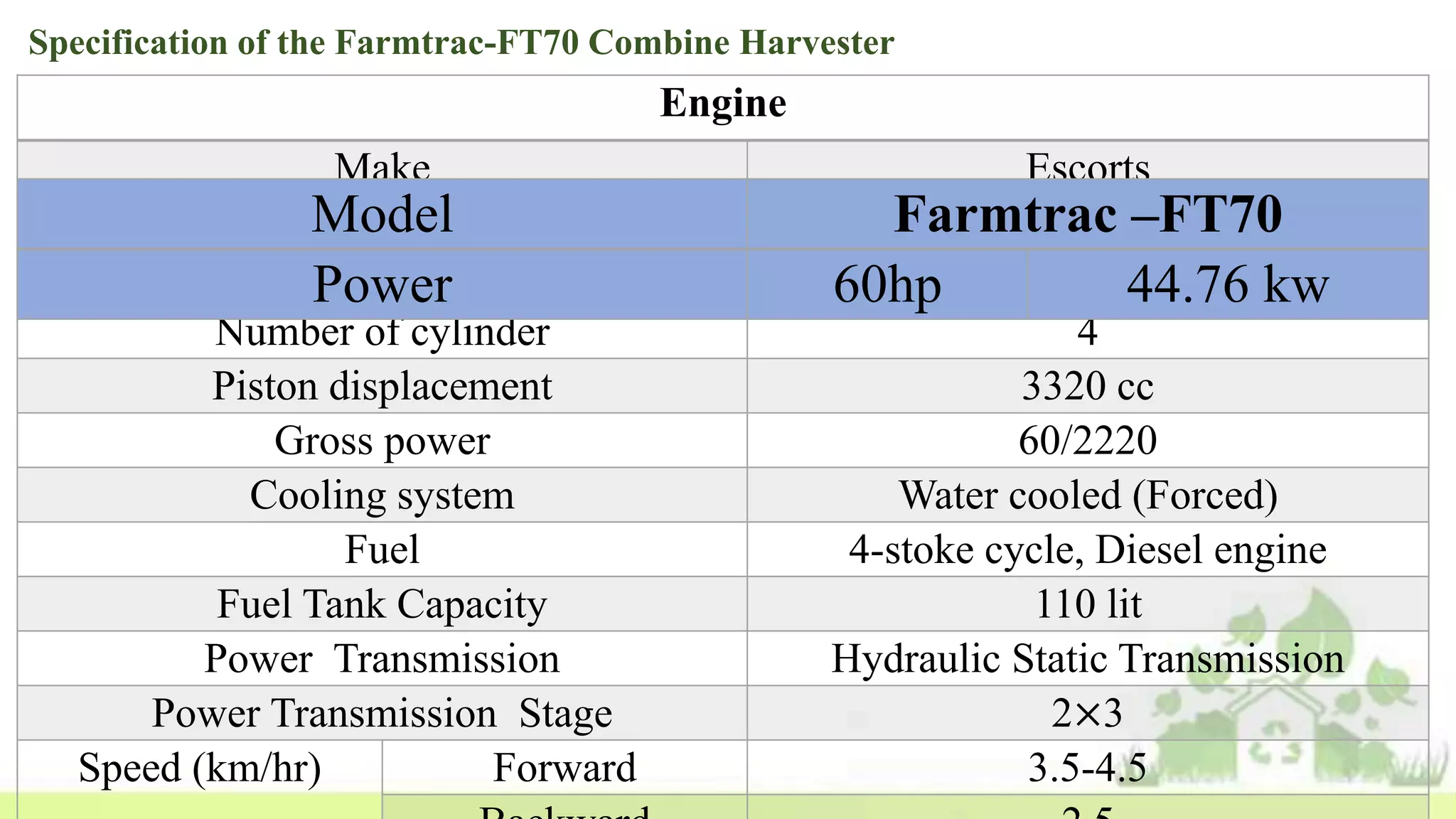
Specification of the Farmtrac-FT70 Combine Harvester
Engine
Make Escorts
Model Farmtrac –FT70
Power 60hp 44.76 kw
Number of cylinder 4
Piston displacement 3320 cc
Gross power 60/2220
Cooling system Water cooled (Forced)
Fuel 4-stoke cycle, Diesel engine
Fuel Tank Capacity 110 lit
Power Transmission Hydraulic Static Transmission
Power Transmission Stage 2×3
Speed (km/hr) Forward 3.5-4.5
Model Farmtrac –FT70
Power 60hp 44.76 kw
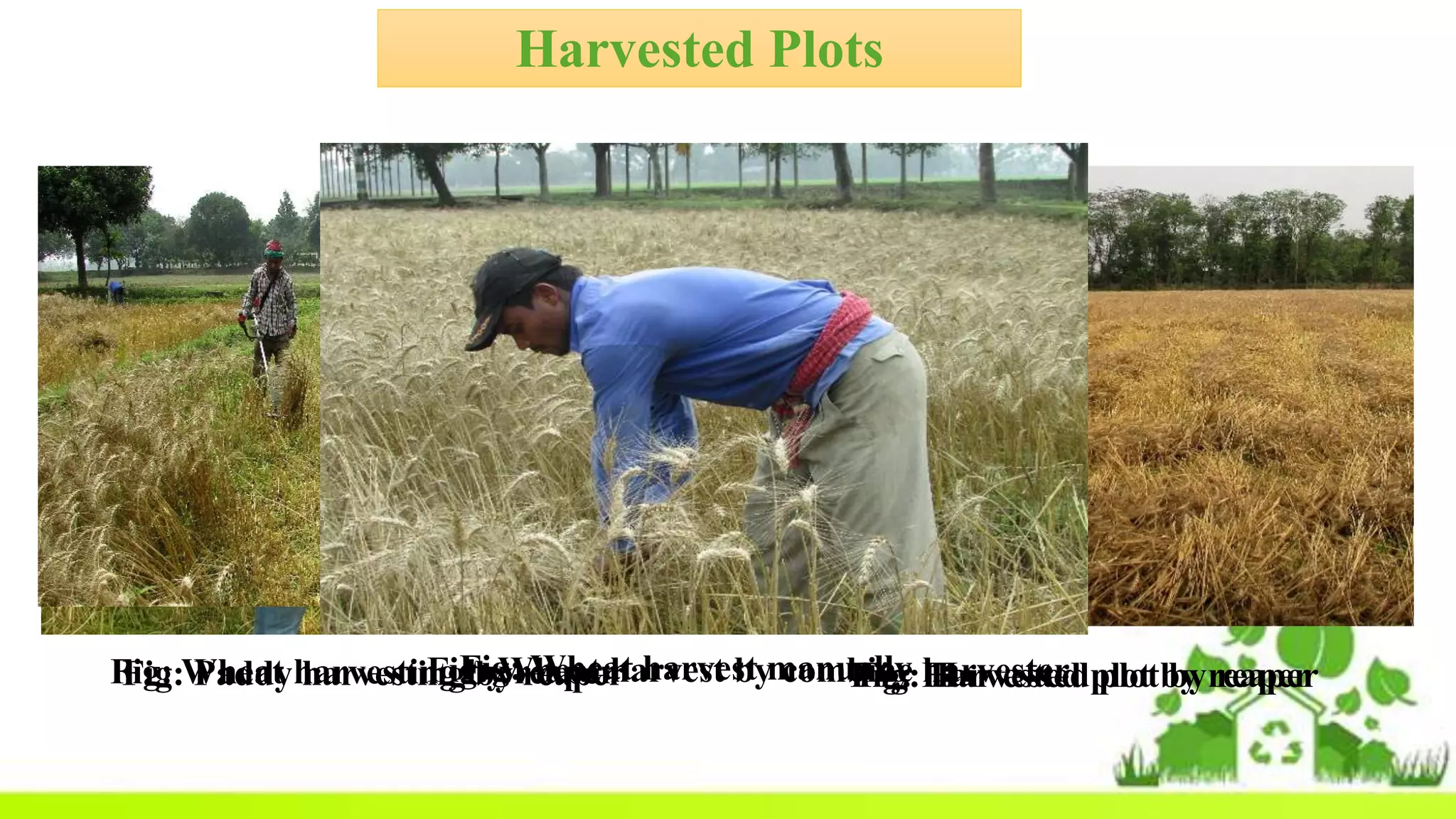
Harvested Plots
Fig: Paddy harvesting by reaper Fig: Harvested plot by reaperFig: Wheat harvesting by reaper Fig: Harvested plot by reaperFig: Wheat harvest by combine harvesterFig: Wheat harvest manually
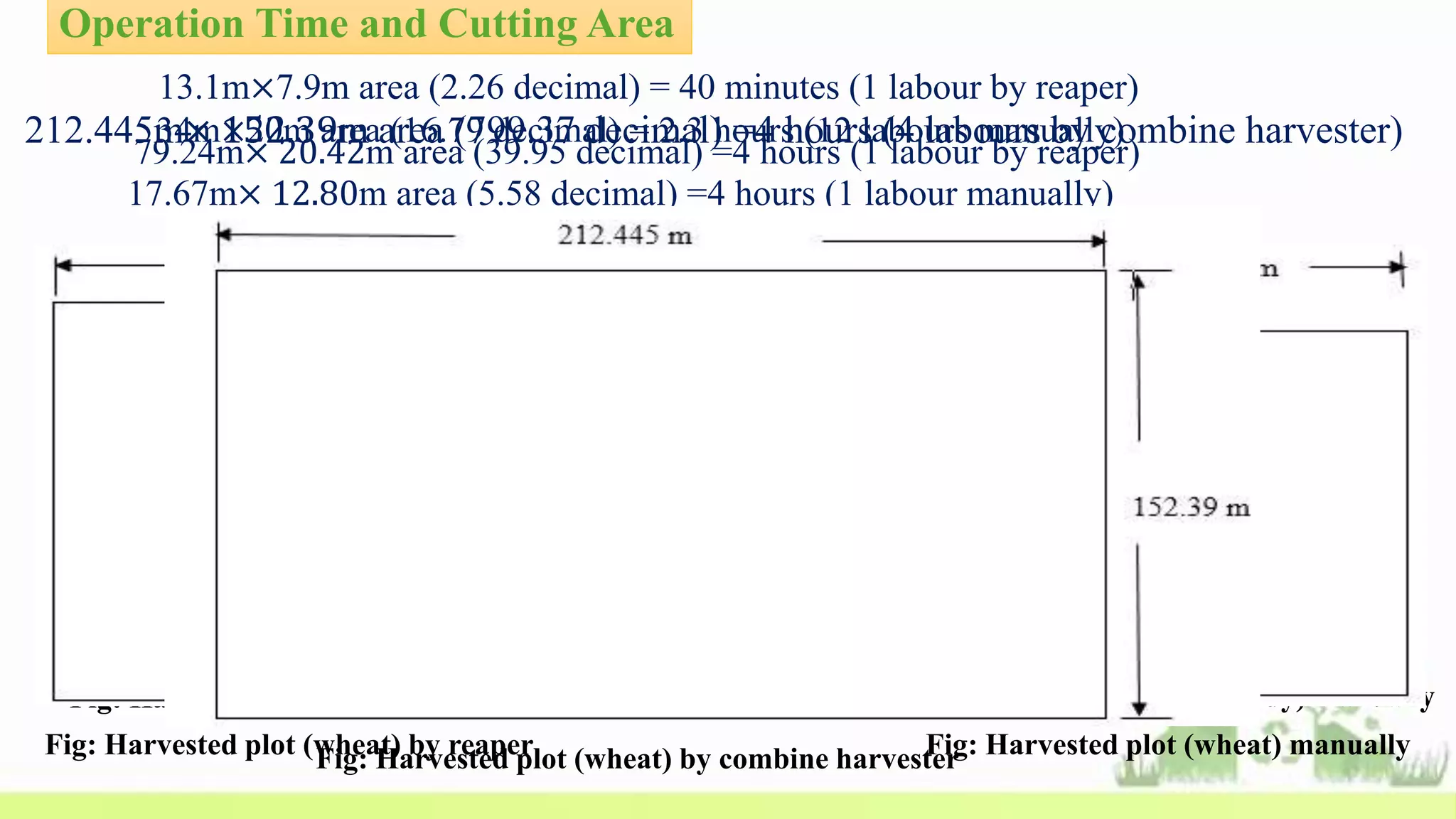
Operation Time and Cutting Area
Fig: Harvested plot (paddy) by reaper Fig: Harvested plot (paddy) manuallyFig: Harvested plot (paddy) by reaper Fig: Harvested plot (paddy) manually
13.1m×7.9m area (2.26 decimal) = 40 minutes (1 labour by reaper)
34m×20m area (16.79 decimal) = 2.3 hours (12 labours manually)
Fig: Harvested plot (wheat) by reaper Fig: Harvested plot (wheat) manually
79.24m× 20.42m area (39.95 decimal) =4 hours (1 labour by reaper)
17.67m× 12.80m area (5.58 decimal) =4 hours (1 labour manually)
Fig: Harvested plot (wheat) by combine harvester
212.445m× 152.39m area (799.37 decimal) =4 hours (4 labours by combine harvester)
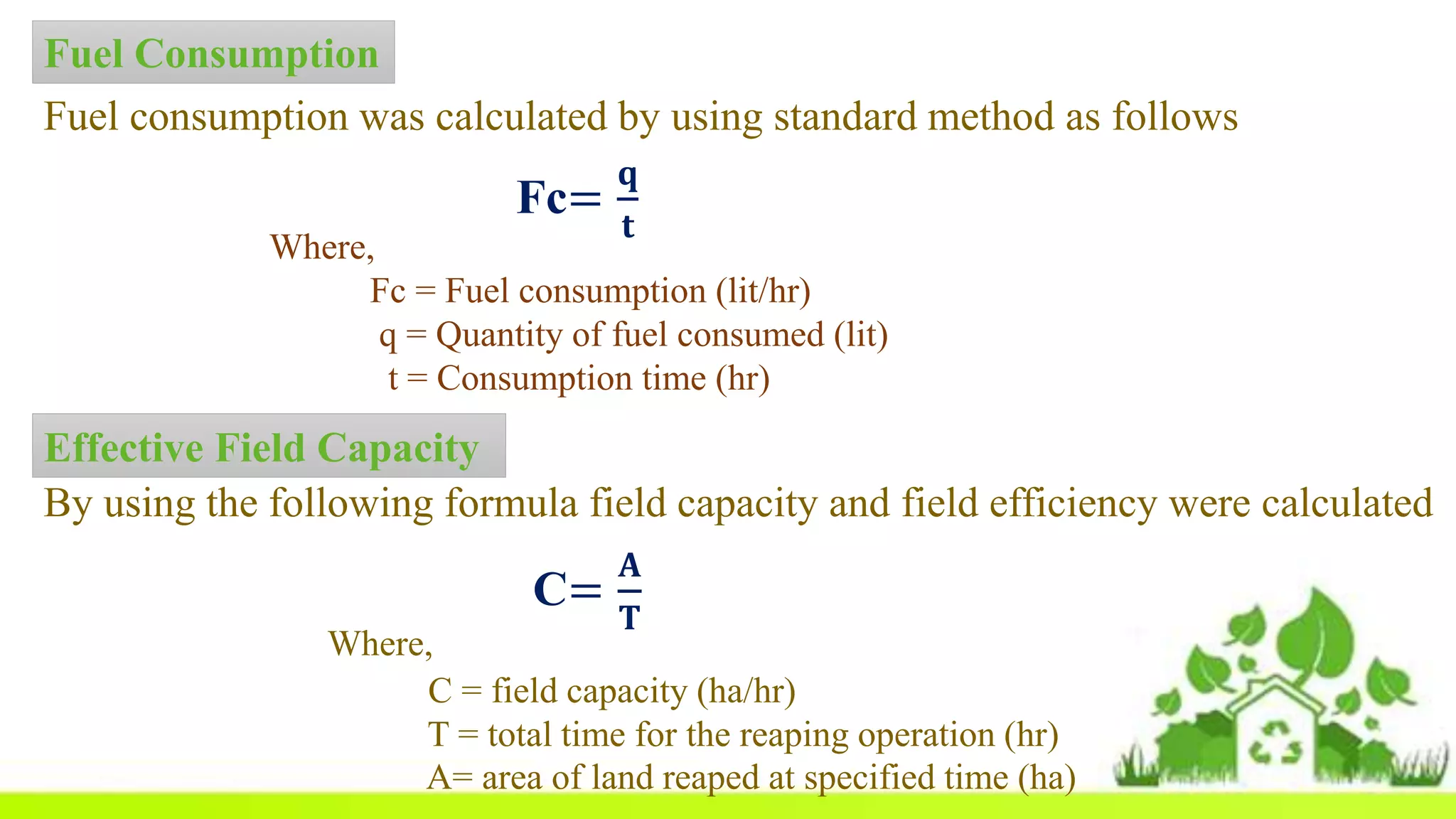
Fuel Consumption
Fuel consumption was calculated by using standard method as follows
Fc=
𝐪
𝐭
Where,
Fc = Fuel consumption (lit/hr)
q = Quantity of fuel consumed (lit)
t = Consumption time (hr)
Effective Field Capacity
By using the following formula field capacity and field efficiency were calculated
C=
𝐀
𝐓
Where,
C = field capacity (ha/hr)
T = total time for the reaping operation (hr)
A= area of land reaped at specified time (ha)
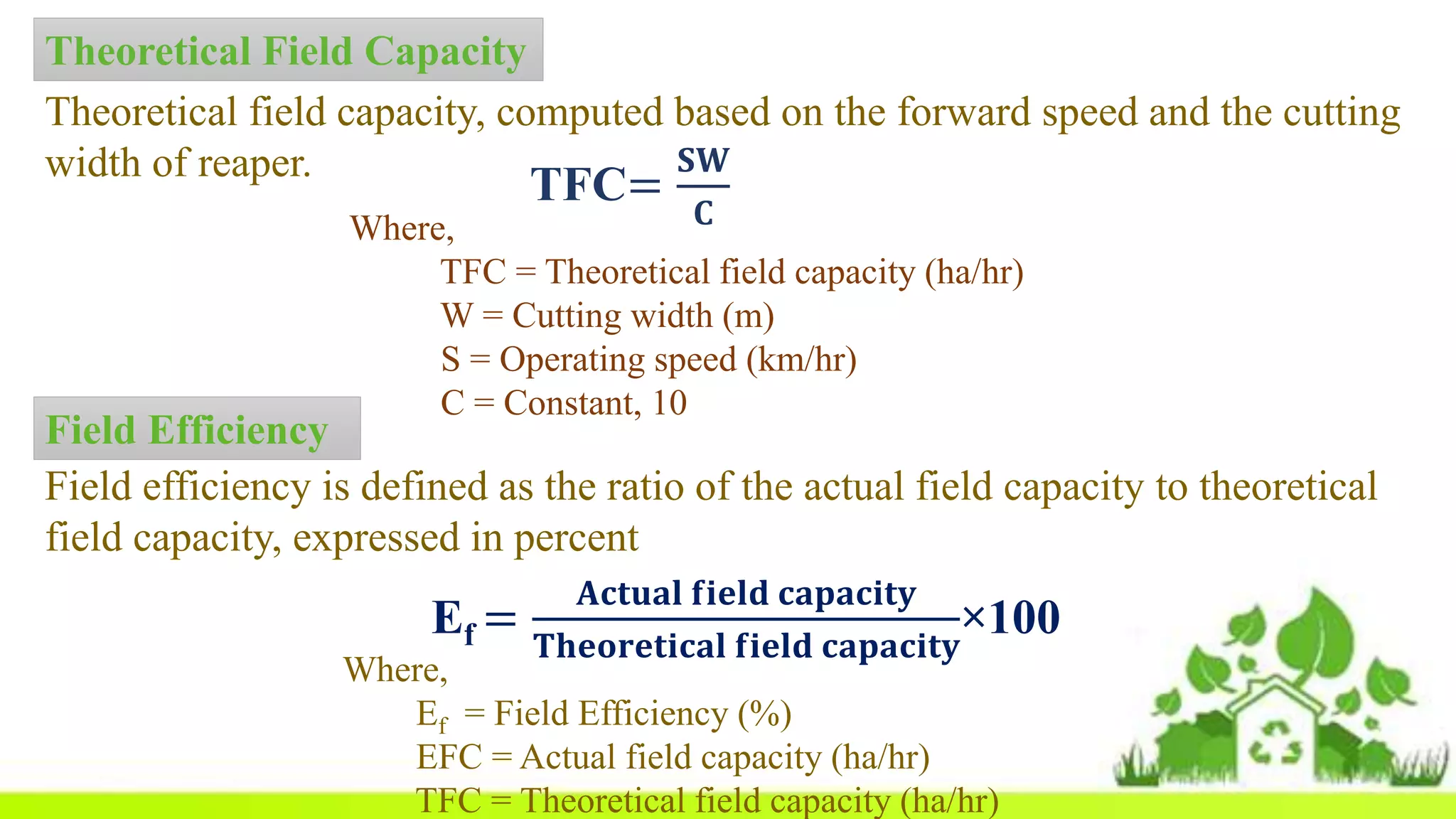
Theoretical Field Capacity
Theoretical field capacity, computed based on the forward speed and the cutting
width of reaper.
TFC=
𝐒𝐖
𝐂Where,
TFC = Theoretical field capacity (ha/hr)
W = Cutting width (m)
S = Operating speed (km/hr)
C = Constant, 10
Field Efficiency
Field efficiency is defined as the ratio of the actual field capacity to theoretical
field capacity, expressed in percent
Ef =
𝐀𝐜𝐭𝐮𝐚𝐥 𝐟𝐢𝐞𝐥𝐝 𝐜𝐚𝐩𝐚𝐜𝐢𝐭𝐲
𝐓𝐡𝐞𝐨𝐫𝐞𝐭𝐢𝐜𝐚𝐥 𝐟𝐢𝐞𝐥𝐝 𝐜𝐚𝐩𝐚𝐜𝐢𝐭𝐲
×100
Where,
Ef = Field Efficiency (%)
EFC = Actual field capacity (ha/hr)
TFC = Theoretical field capacity (ha/hr)
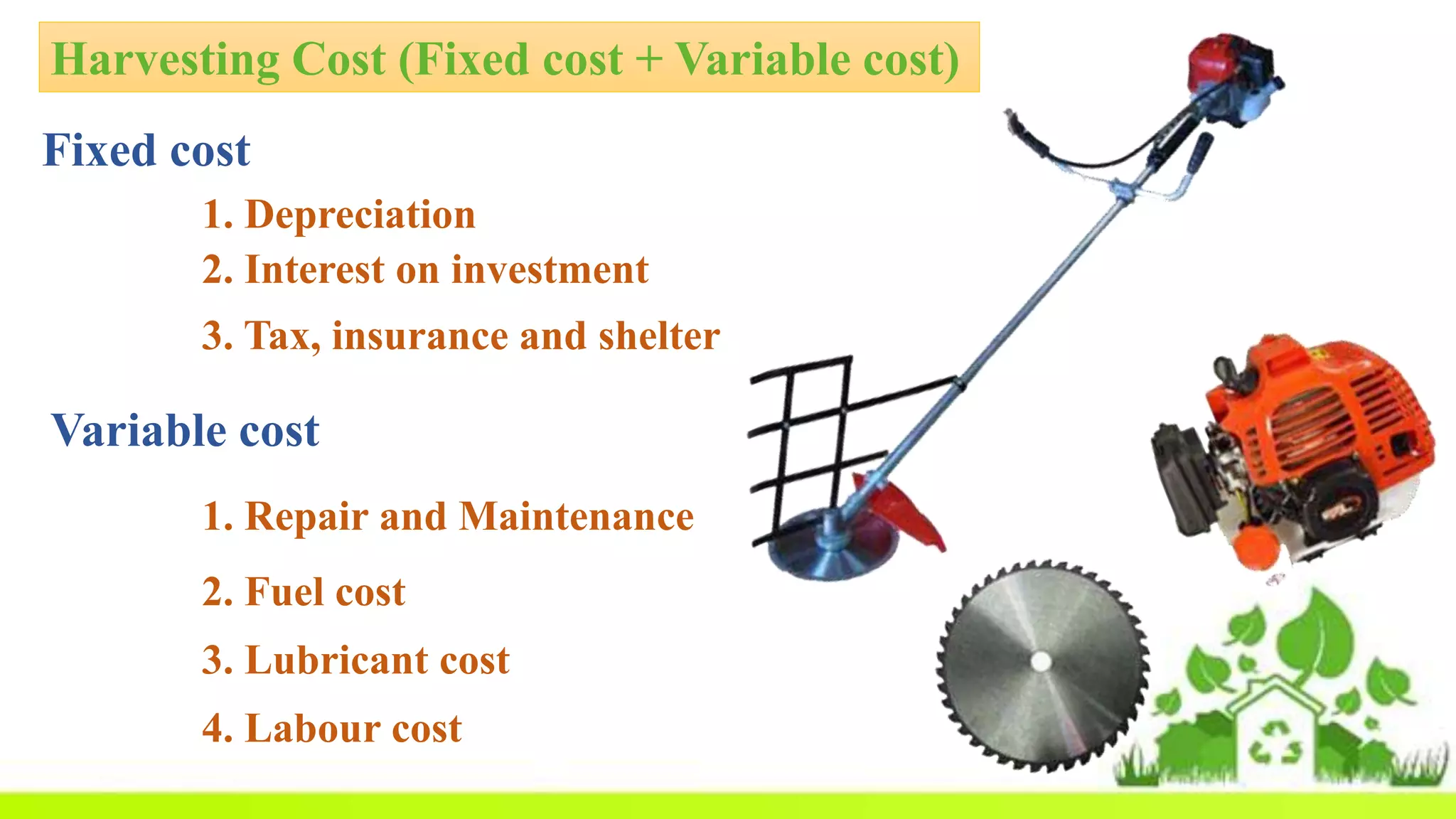
Harvesting Cost (Fixed cost + Variable cost)
Fixed cost
1. Depreciation
2. Interest on investment
3. Tax, insurance and shelter
Variable cost
1. Repair and Maintenance
2. Fuel cost
3. Lubricant cost
4. Labour cost
Fixed cost
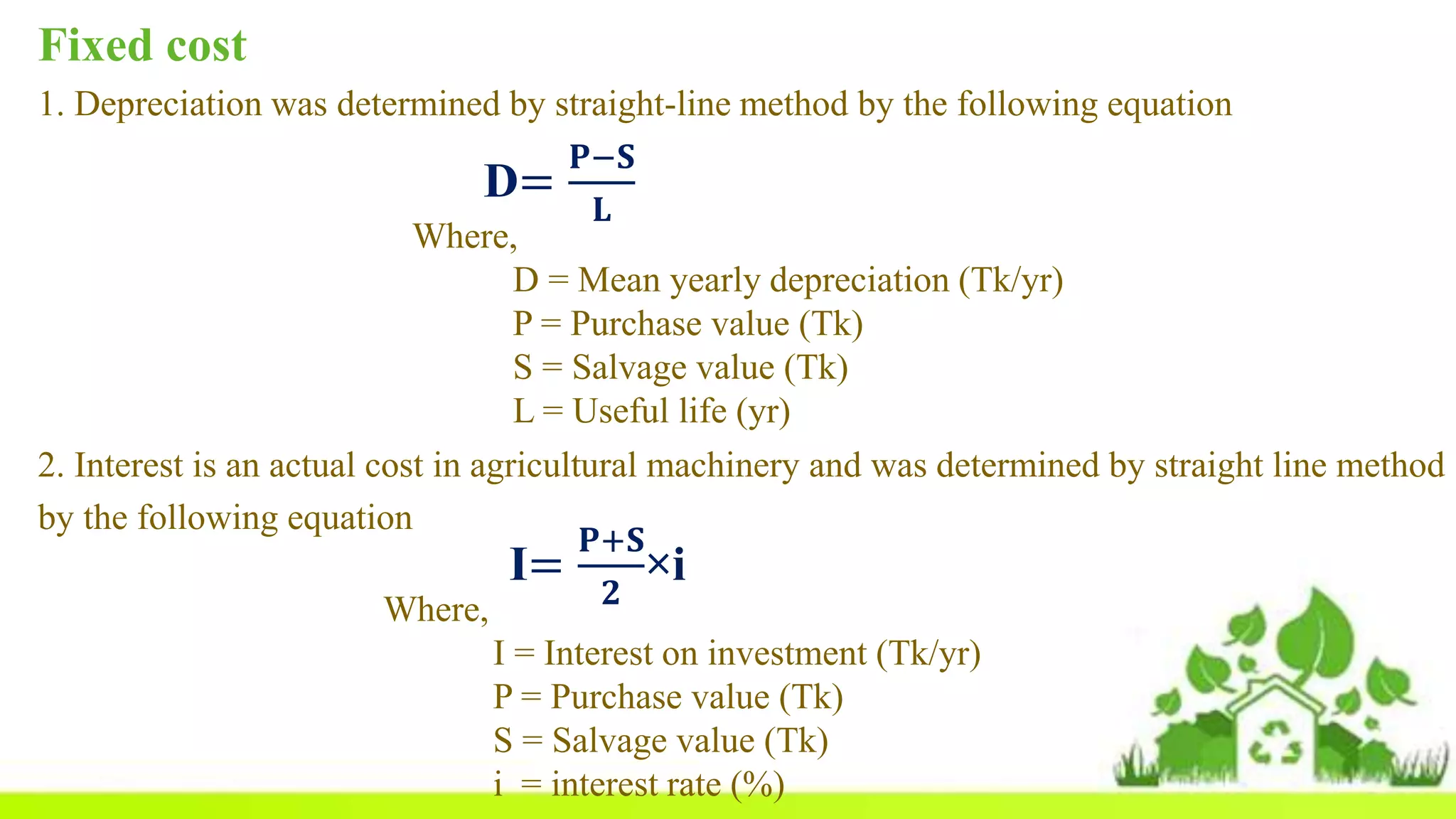
1. Depreciation was determined by straight-line method by the following equation
D=
𝐏−𝐒
𝐋
Where,
D = Mean yearly depreciation (Tk/yr)
P = Purchase value (Tk)
S = Salvage value (Tk)
L = Useful life (yr)
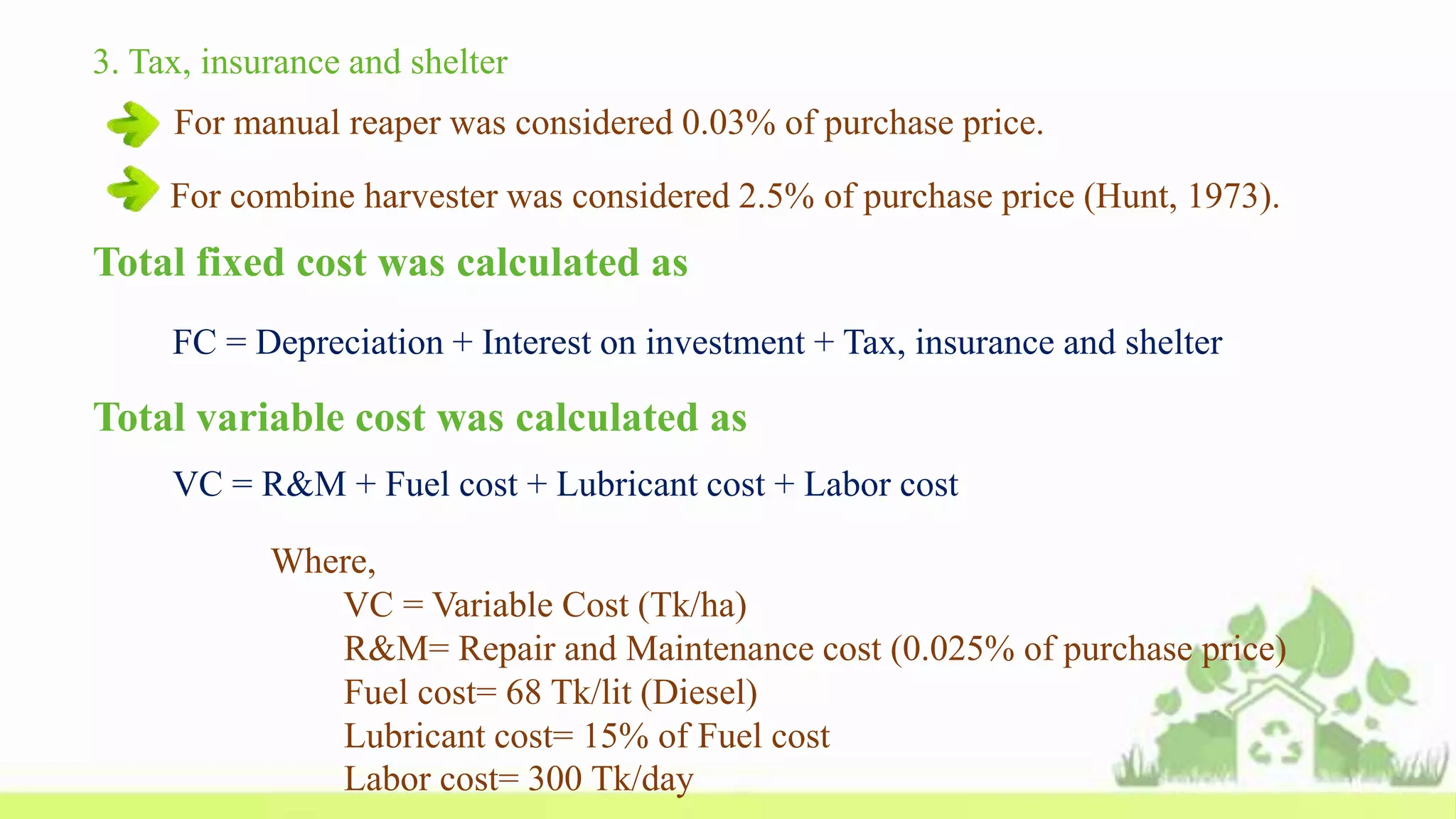
2. Interest is an actual cost in agricultural machinery and was determined by straight line method
by the following equation
I=
𝐏+𝐒
𝟐
×i
Where,
I = Interest on investment (Tk/yr)
P = Purchase value (Tk)
S = Salvage value (Tk)
i = interest rate (%)
Total fixed cost was calculated as
FC = Depreciation + Interest on investment + Tax, insurance and shelter
3. Tax, insurance and shelter
For manual reaper was considered 0.03% of purchase price.
For combine harvester was considered 2.5% of purchase price (Hunt, 1973).
Total variable cost was calculated as
VC = R&M + Fuel cost + Lubricant cost + Labor cost
Where,
VC = Variable Cost (Tk/ha)
R&M= Repair and Maintenance cost (0.025% of purchase price)
Fuel cost= 68 Tk/lit (Diesel)
Lubricant cost= 15% of Fuel cost
Labor cost= 300 Tk/day
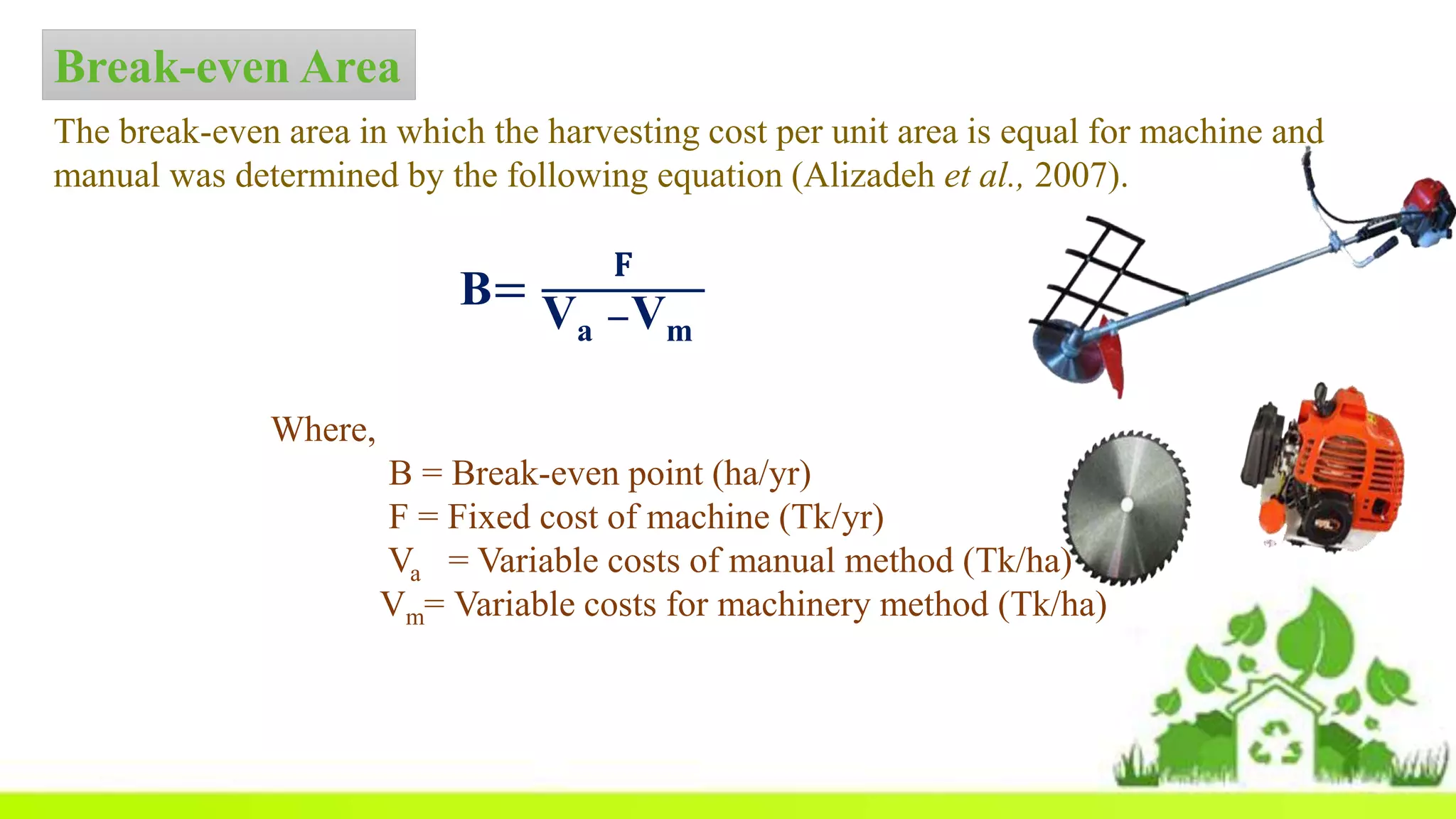
Break-even Area
The break-even area in which the harvesting cost per unit area is equal for machine and
manual was determined by the following equation (Alizadeh et al., 2007).
Where,
B = Break-even point (ha/yr)
F = Fixed cost of machine (Tk/yr)
Va = Variable costs of manual method (Tk/ha)
Vm= Variable costs for machinery method (Tk/ha)
B=
𝐅
Va −Vm
RESULTS AND DISCUSSION
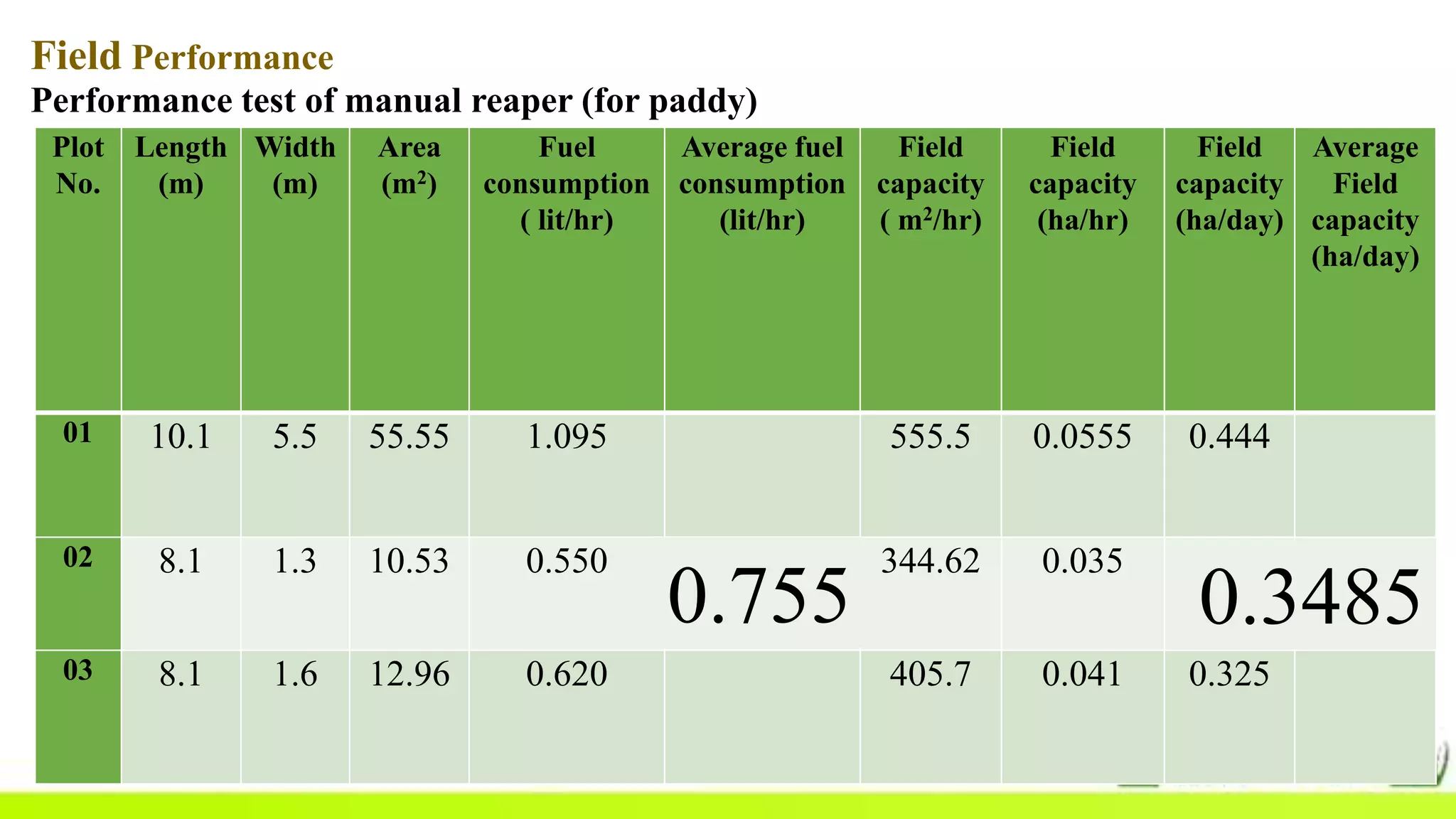
Field Performance
Performance test of manual reaper (for paddy)
Plot
No.
Length
(m)
Width
(m)
Area
(m2)
Fuel
consumption
( lit/hr)
Average fuel
consumption
(lit/hr)
Field
capacity
( m2/hr)
Field
capacity
(ha/hr)
Field
capacity
(ha/day)
Average
Field
capacity
(ha/day)
01 10.1 5.5 55.55 1.095 555.5 0.0555 0.444
02 8.1 1.3 10.53 0.550 0.755 344.62 0.035 0.276 0.3485
03 8.1 1.6 12.96 0.620 405.7 0.041 0.325
0.755 0.3485
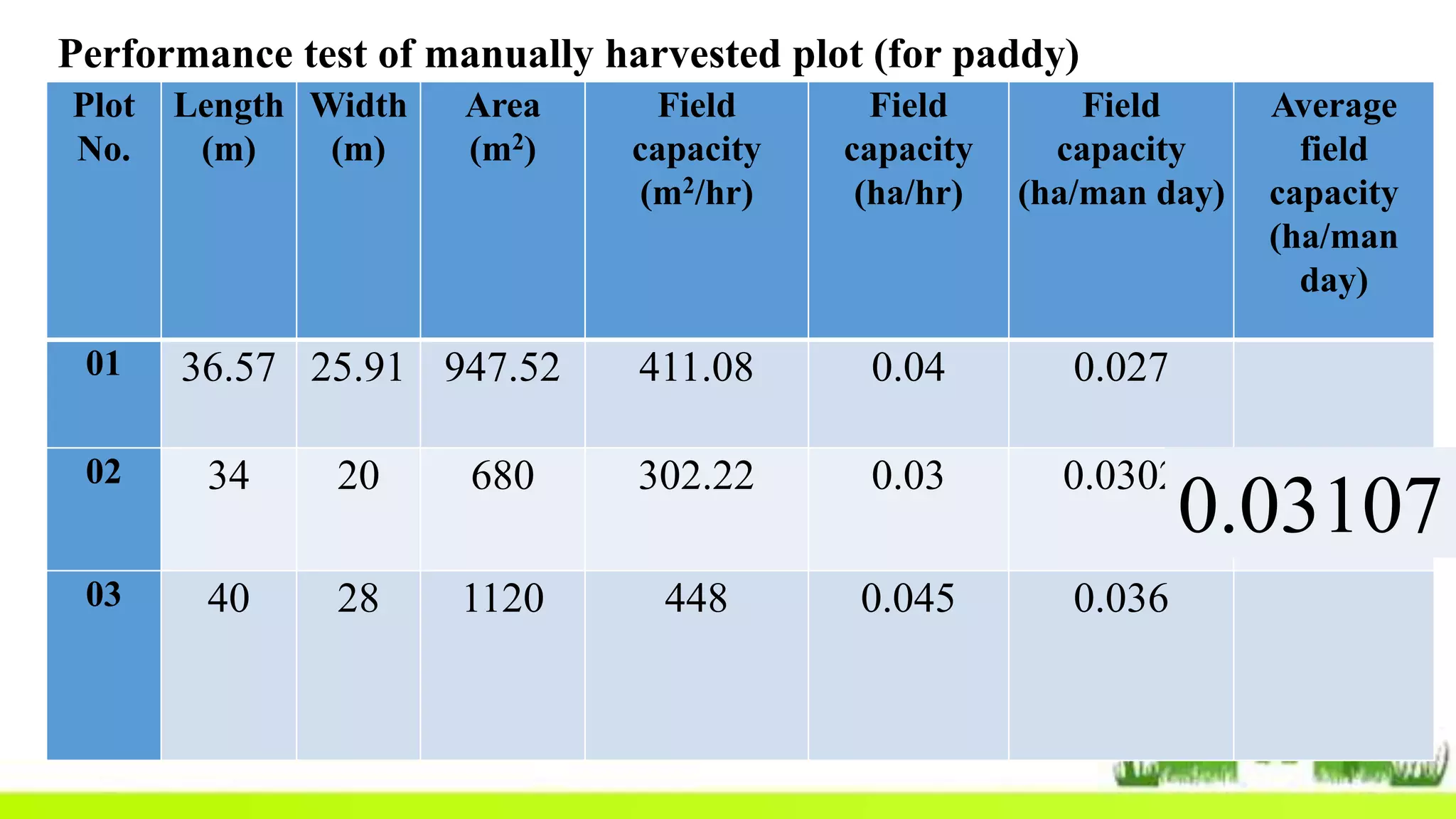
Performance test of manually harvested plot (for paddy)
Plot
No.
Length
(m)
Width
(m)
Area
(m2)
Field
capacity
(m2/hr)
Field
capacity
(ha/hr)
Field
capacity
(ha/man day)
Average
field
capacity
(ha/man
day)
01 36.57 25.91 947.52 411.08 0.04 0.027
02 34 20 680 302.22 0.03 0.0302 0.03107
03 40 28 1120 448 0.045 0.036
0.03107
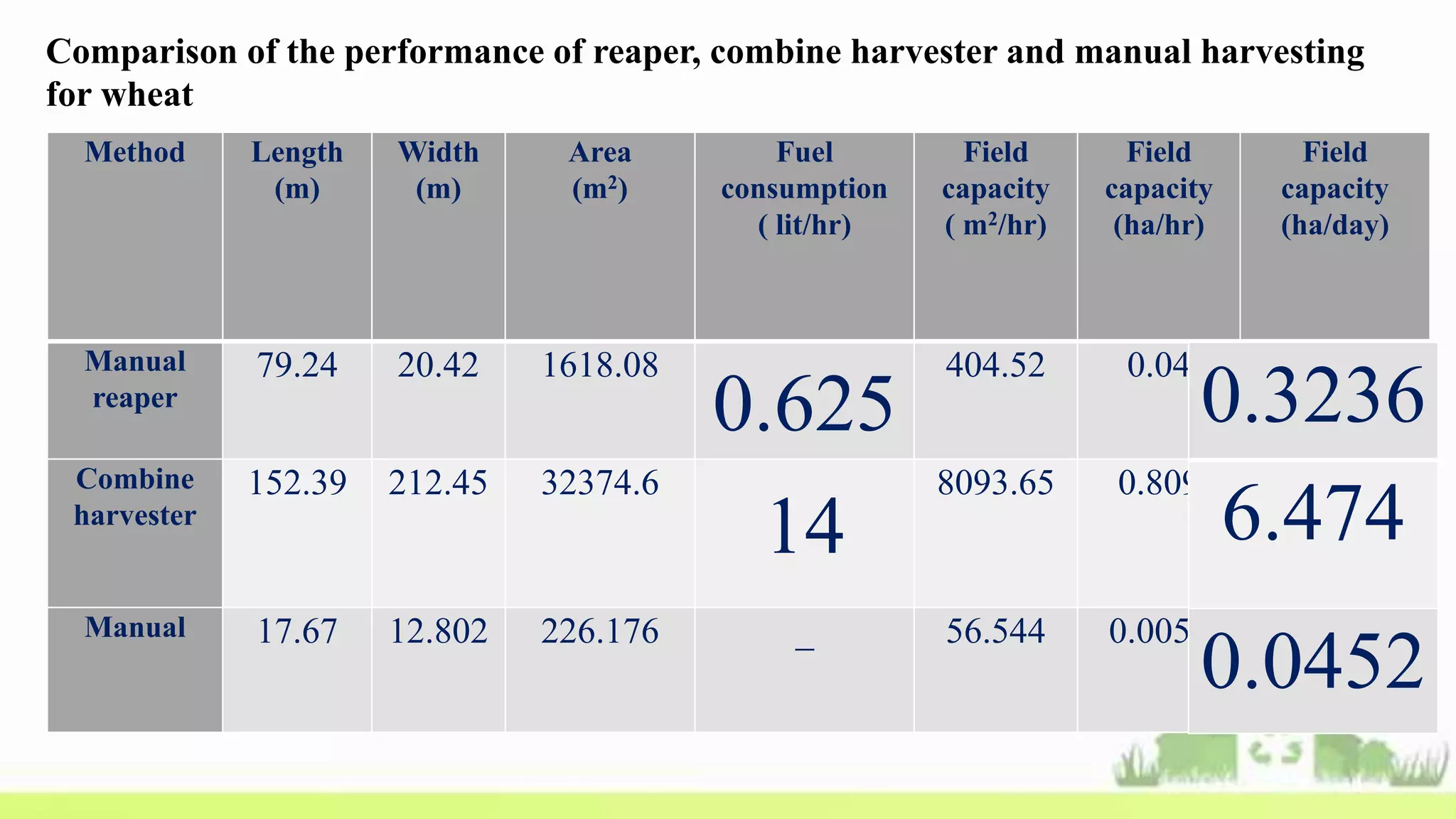
Comparison of the performance of reaper, combine harvester and manual harvesting
for wheat
Method Length
(m)
Width
(m)
Area
(m2)
Fuel
consumption
( lit/hr)
Field
capacity
( m2/hr)
Field
capacity
(ha/hr)
Field
capacity
(ha/day)
Manual
reaper
79.24 20.42 1618.08 0.625 404.52 0.04 0.3236
Combine
harvester
152.39 212.45 32374.6 14 8093.65 0.809 6.474
Manual 17.67 12.802 226.176 _ 56.544 0.0056 0.0452
0.625
14
0.3236
6.474
0.0452
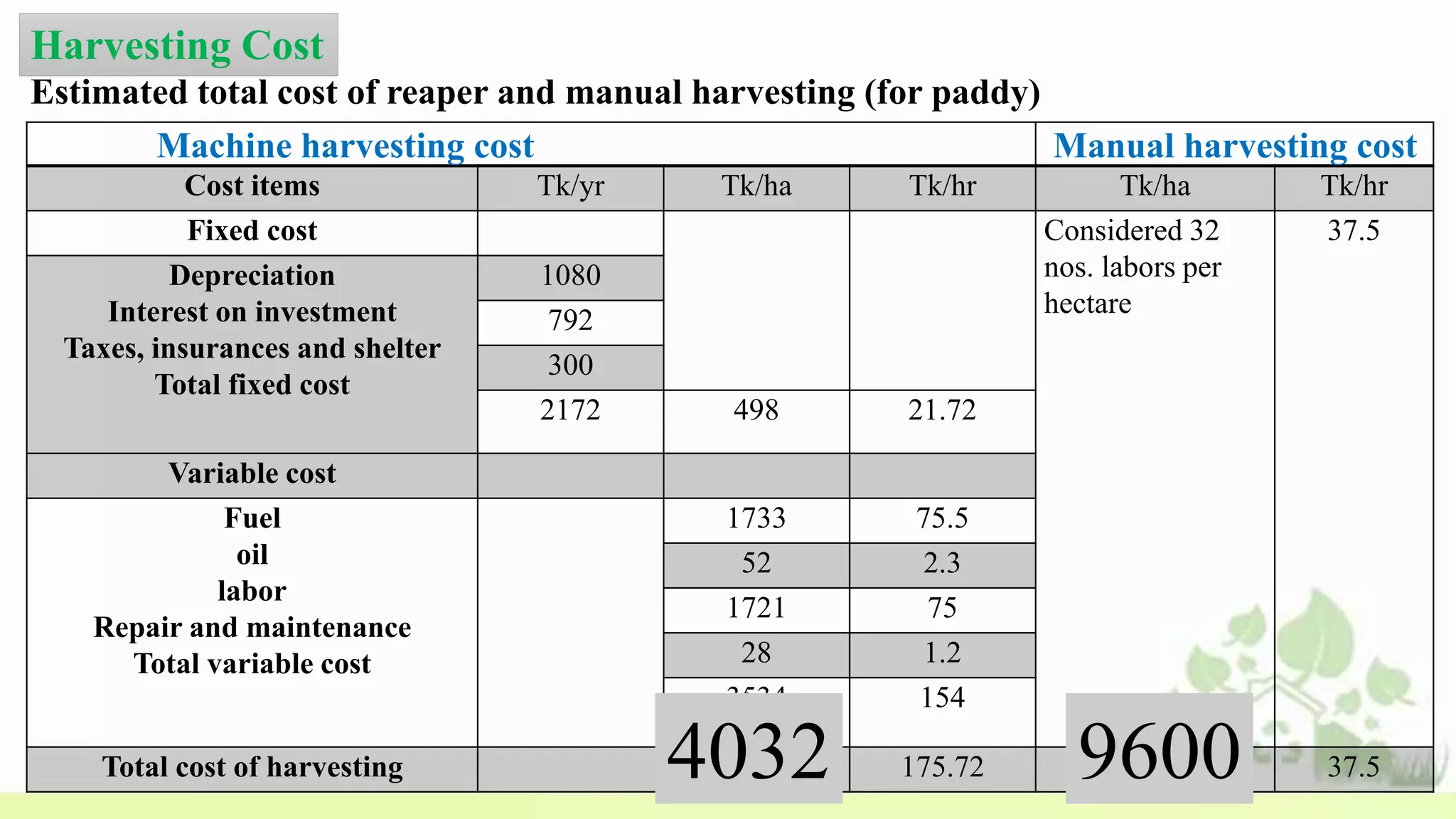
Harvesting Cost
Estimated total cost of reaper and manual harvesting (for paddy)
Machine harvesting cost Manual harvesting cost
Cost items Tk/yr Tk/ha Tk/hr Tk/ha Tk/hr
Fixed cost Considered 32
nos. labors per
hectare
37.5
Depreciation
Interest on investment
Taxes, insurances and shelter
Total fixed cost
1080
792
300
2172 498 21.72
Variable cost
Fuel
oil
labor
Repair and maintenance
Total variable cost
1733 75.5
52 2.3
1721 75
28 1.2
3534 154
Total cost of harvesting 4032 175.72 9600 37.54032 9600
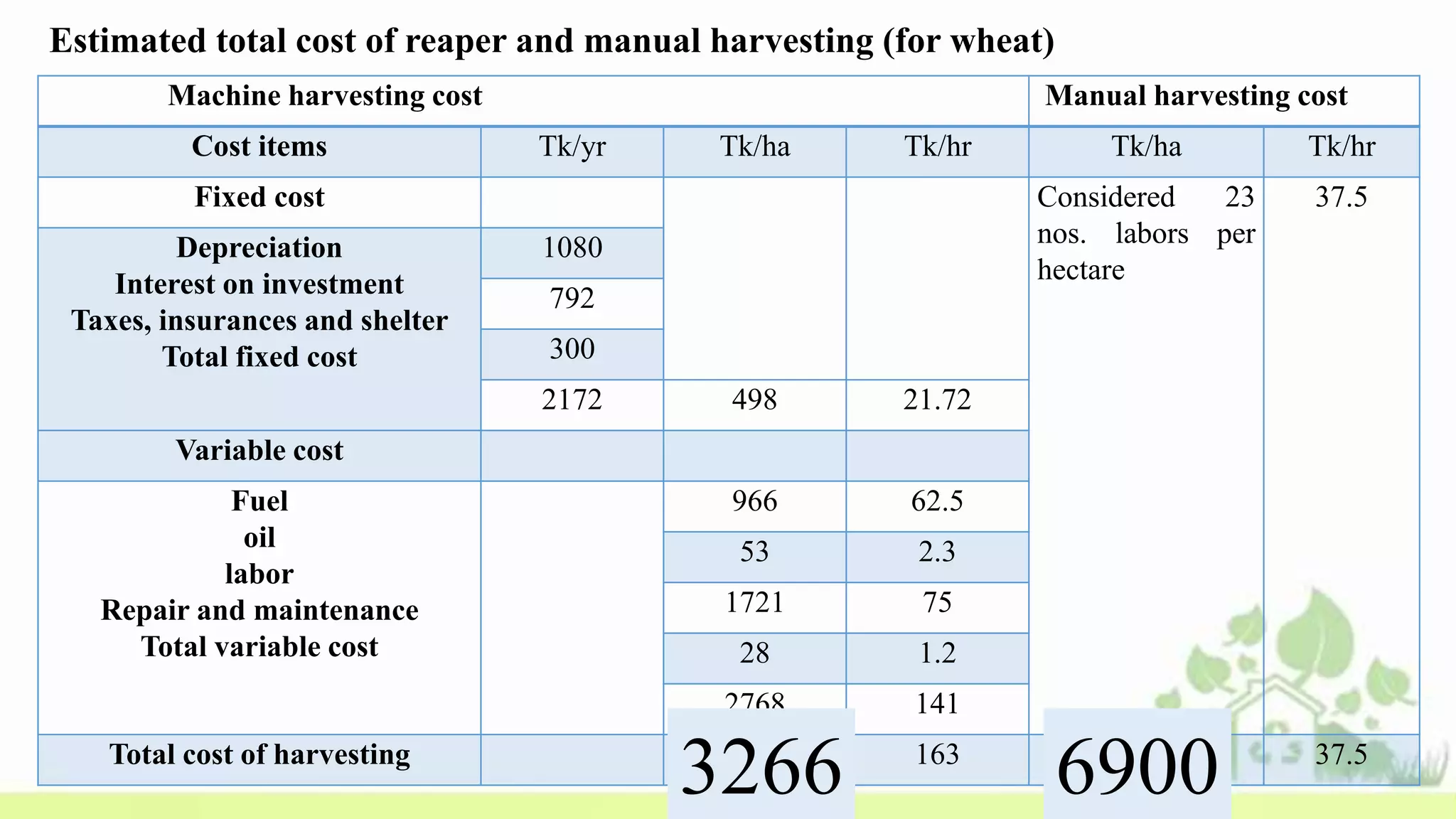
Estimated total cost of reaper and manual harvesting (for wheat)
Machine harvesting cost Manual harvesting cost
Cost items Tk/yr Tk/ha Tk/hr Tk/ha Tk/hr
Fixed cost Considered 23
nos. labors per
hectare
37.5
Depreciation
Interest on investment
Taxes, insurances and shelter
Total fixed cost
1080
792
300
2172 498 21.72
Variable cost
Fuel
oil
labor
Repair and maintenance
Total variable cost
966 62.5
53 2.3
1721 75
28 1.2
2768 141
Total cost of harvesting 3266 163 6900 37.5
3266 6900
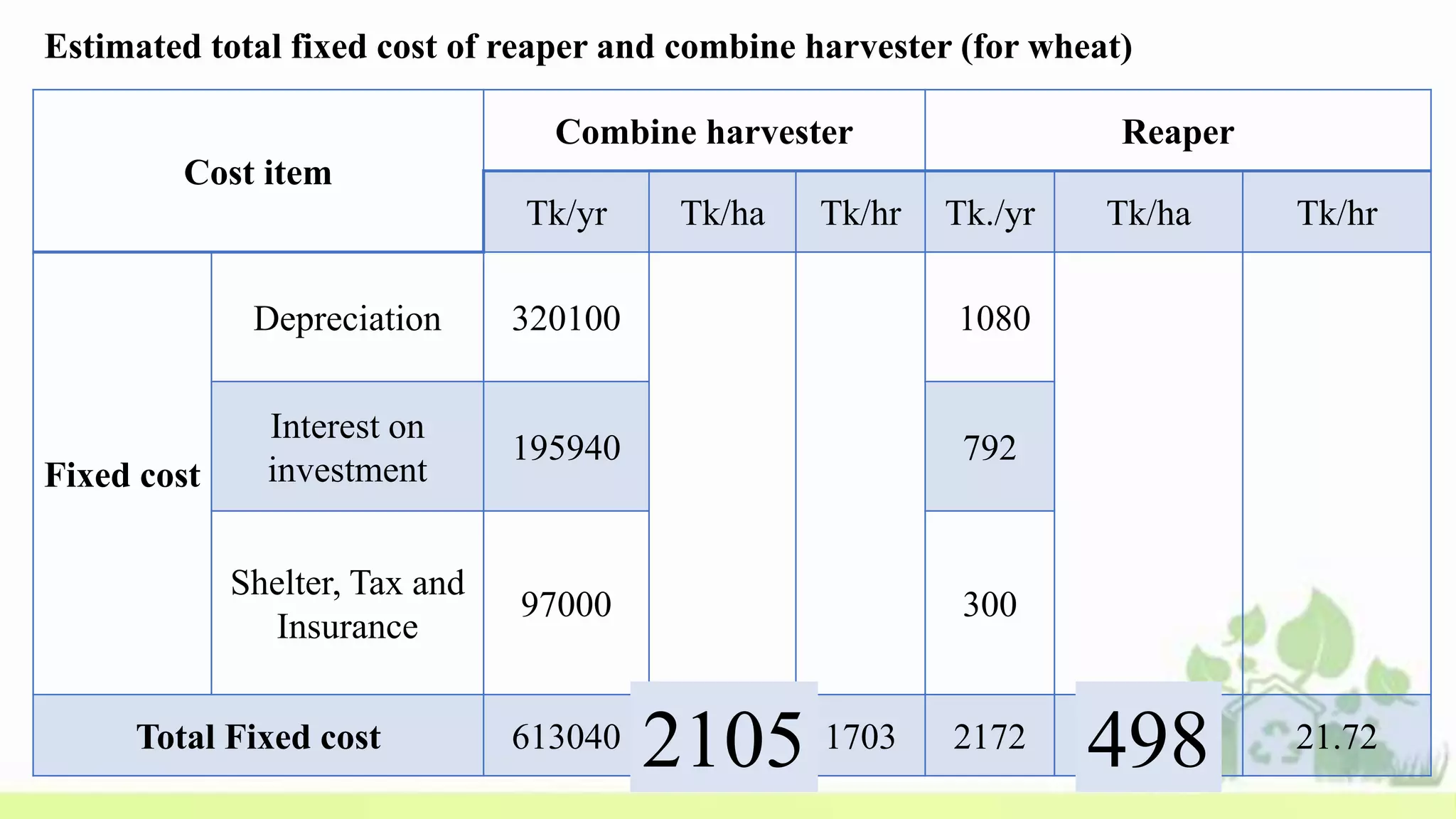
Estimated total fixed cost of reaper and combine harvester (for wheat)
Cost item
Combine harvester Reaper
Tk/yr Tk/ha Tk/hr Tk./yr Tk/ha Tk/hr
Fixed cost
Depreciation 320100 1080
Interest on
investment
195940 792
Shelter, Tax and
Insurance
97000 300
Total Fixed cost 613040 2105 1703 2172 498 21.722105 498
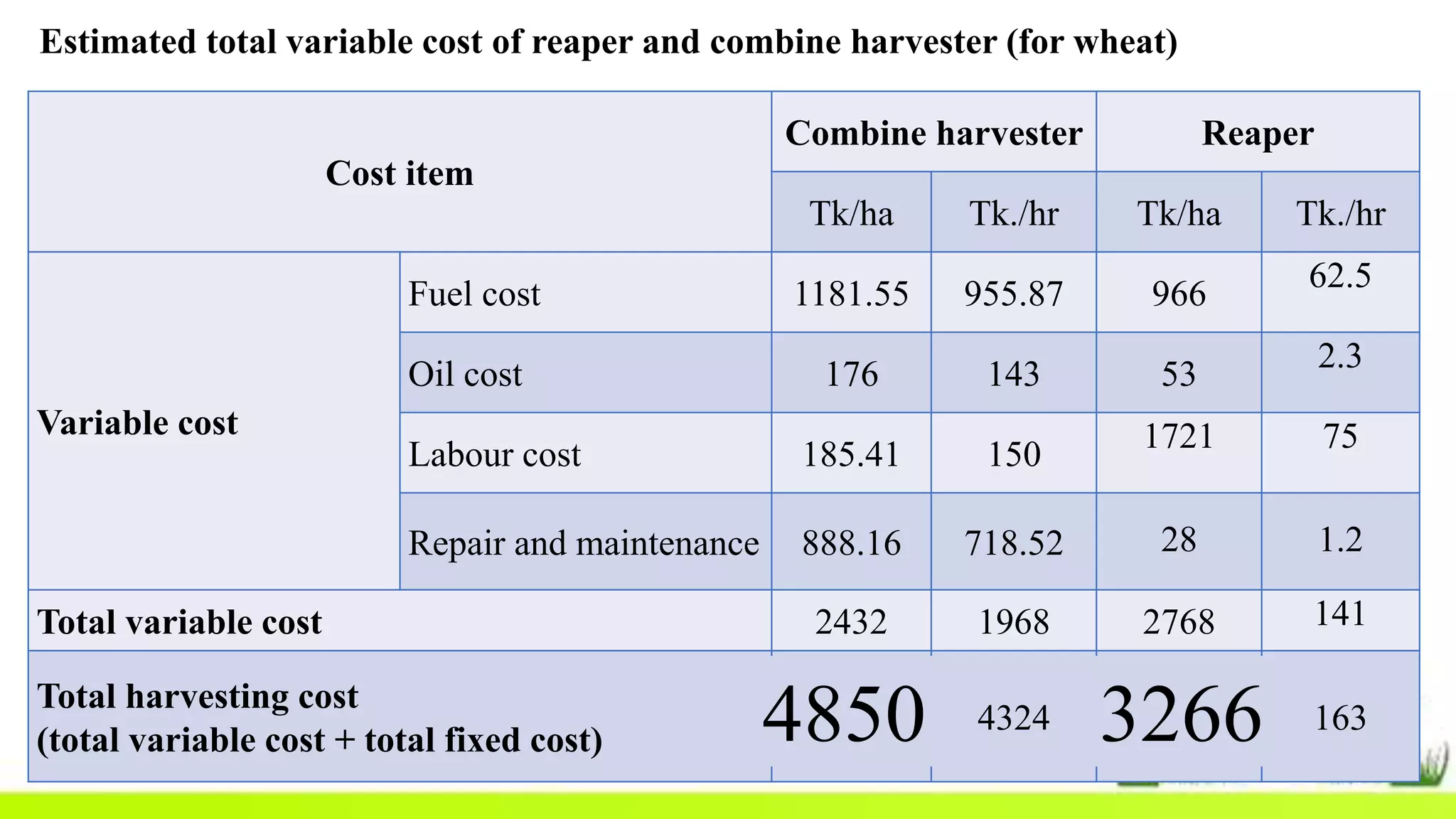
Estimated total variable cost of reaper and combine harvester (for wheat)
Cost item
Combine harvester Reaper
Tk/ha Tk./hr Tk/ha Tk./hr
Variable cost
Fuel cost 1181.55 955.87 966
62.5
Oil cost 176 143 53
2.3
Labour cost 185.41 150
1721 75
Repair and maintenance 888.16 718.52 28 1.2
Total variable cost 2432 1968 2768 141
Total harvesting cost
(total variable cost + total fixed cost)
4850 4324 3266 1634850 3266
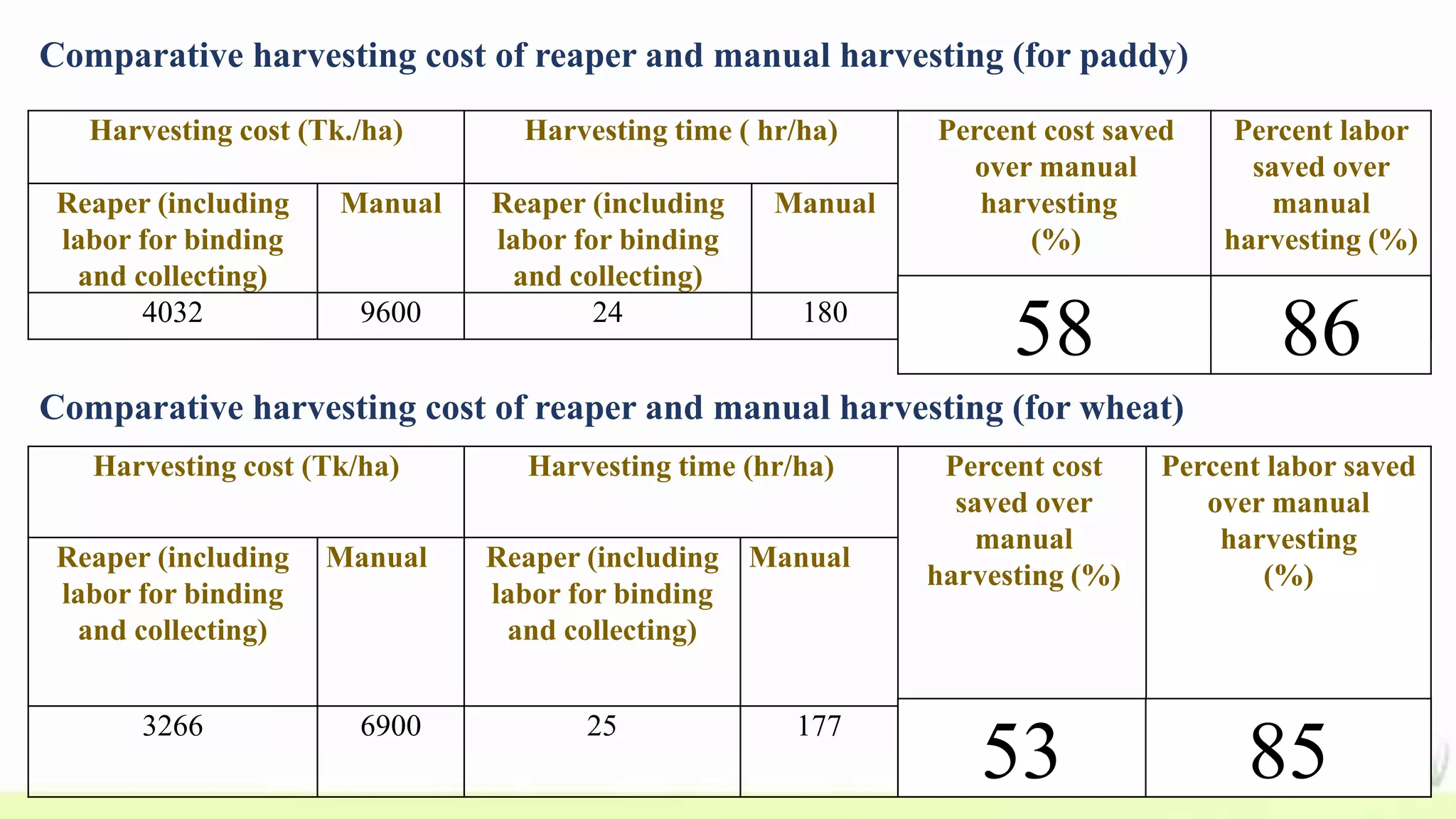
Comparative harvesting cost of reaper and manual harvesting (for paddy)
Harvesting cost (Tk./ha) Harvesting time ( hr/ha) Percent cost saved
over manual
harvesting
(%)
Percent labor
saved over
manual
harvesting (%)
Reaper (including
labor for binding
and collecting)
Manual Reaper (including
labor for binding
and collecting)
Manual
4032 9600 24 180 58 86
Comparative harvesting cost of reaper and manual harvesting (for wheat)
Harvesting cost (Tk/ha) Harvesting time (hr/ha) Percent cost
saved over
manual
harvesting (%)
Percent labor saved
over manual
harvesting
(%)
Reaper (including
labor for binding
and collecting)
Manual Reaper (including
labor for binding
and collecting)
Manual
3266 6900 25 177 53 85
58 86
53 85
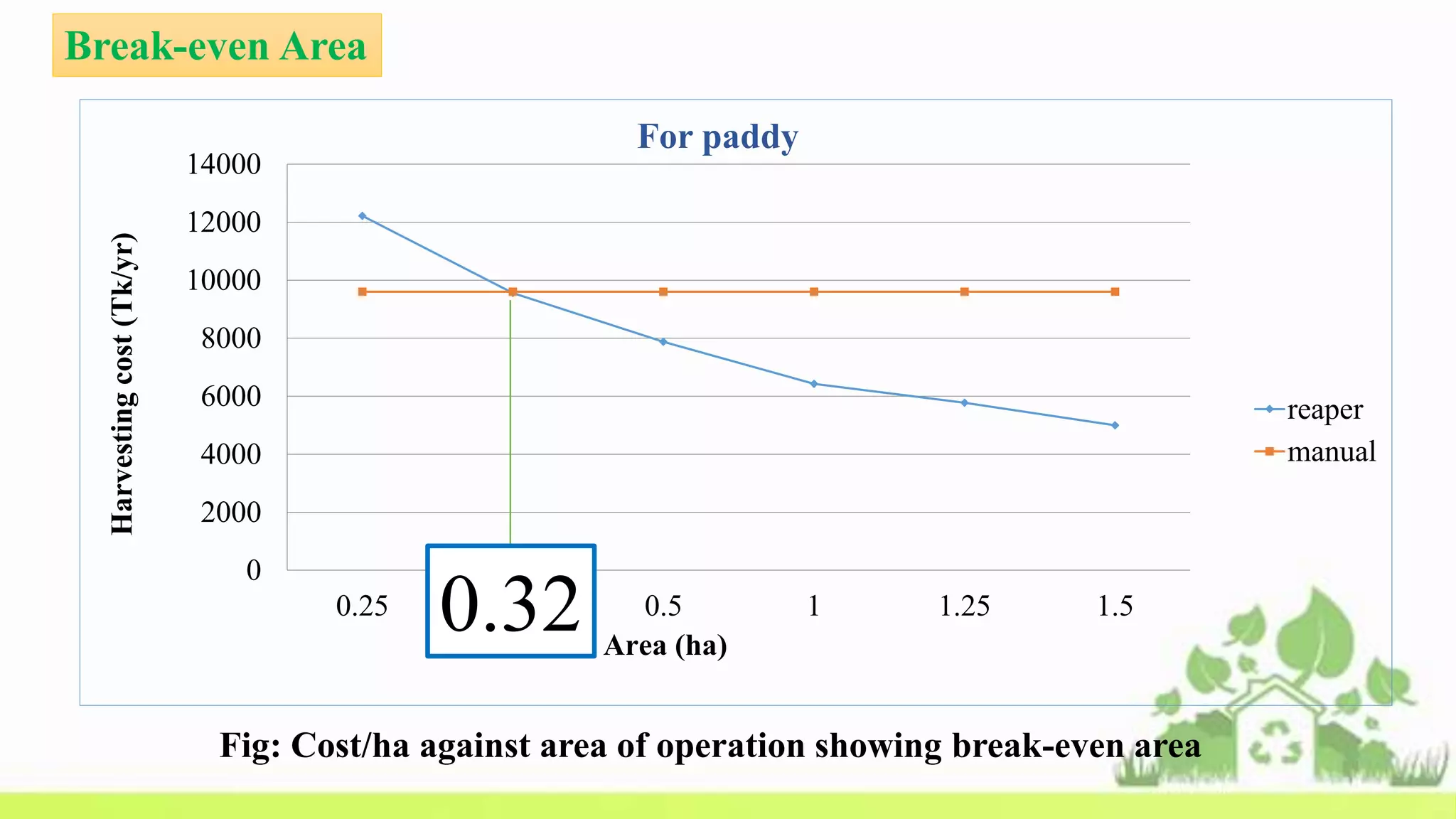
Break-even Area
0
2000
4000
6000
8000
10000
12000
14000
0.25 0.32 0.5 1 1.25 1.5
Harvestingcost(Tk/yr)
For paddy
reaper
manual
Area (ha)
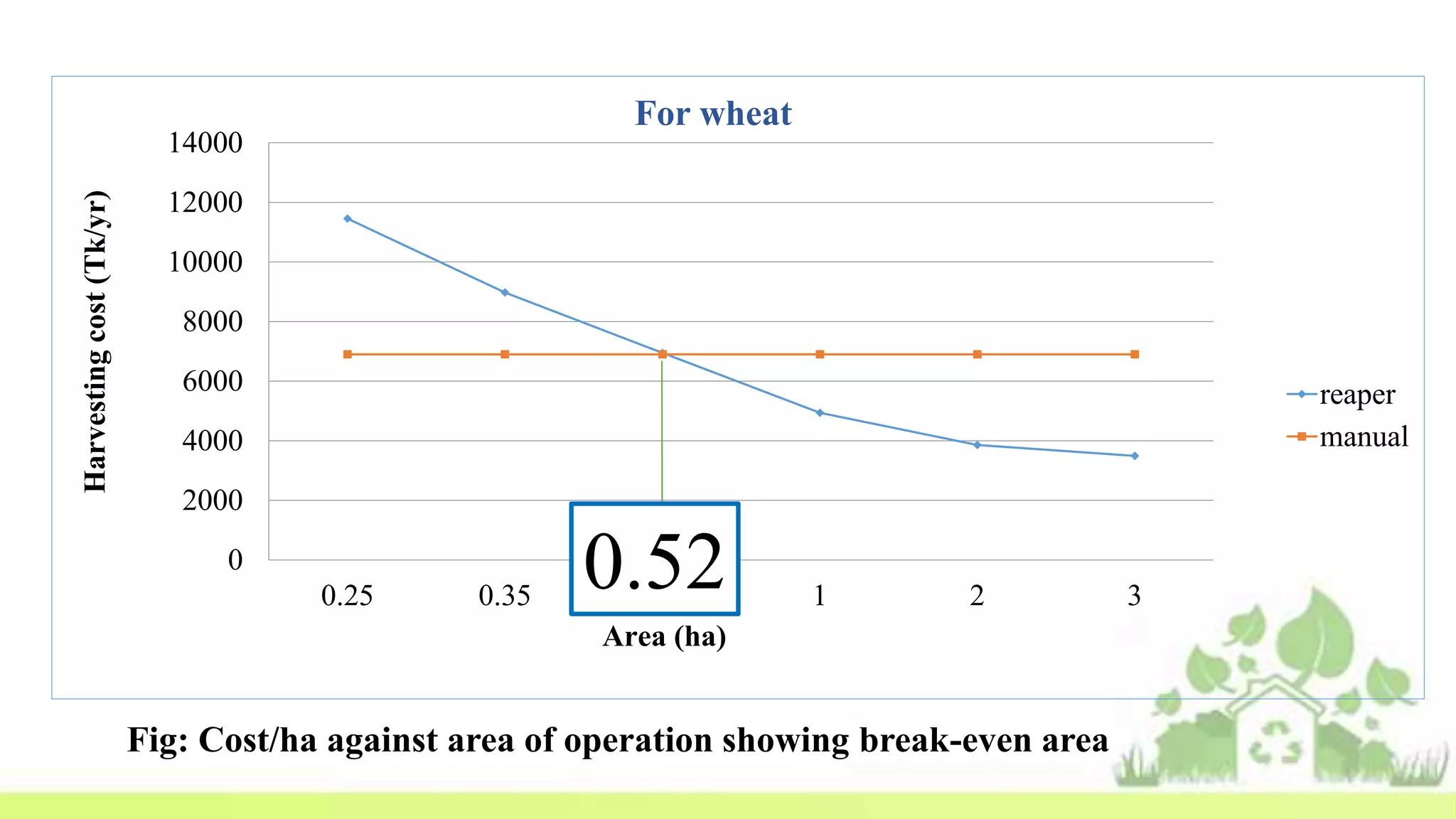
Fig: Cost/ha against area of operation showing break-even area
0.32
0
2000
4000
6000
8000
10000
12000
14000
0.25 0.35 0.52 1 2 3
Harvestingcost(Tk/yr)
For wheat
reaper
manual
Area (ha)
Fig: Cost/ha against area of operation showing break-even area
0.52
SUMMARY AND CONCLUSION
The experimental results shows that
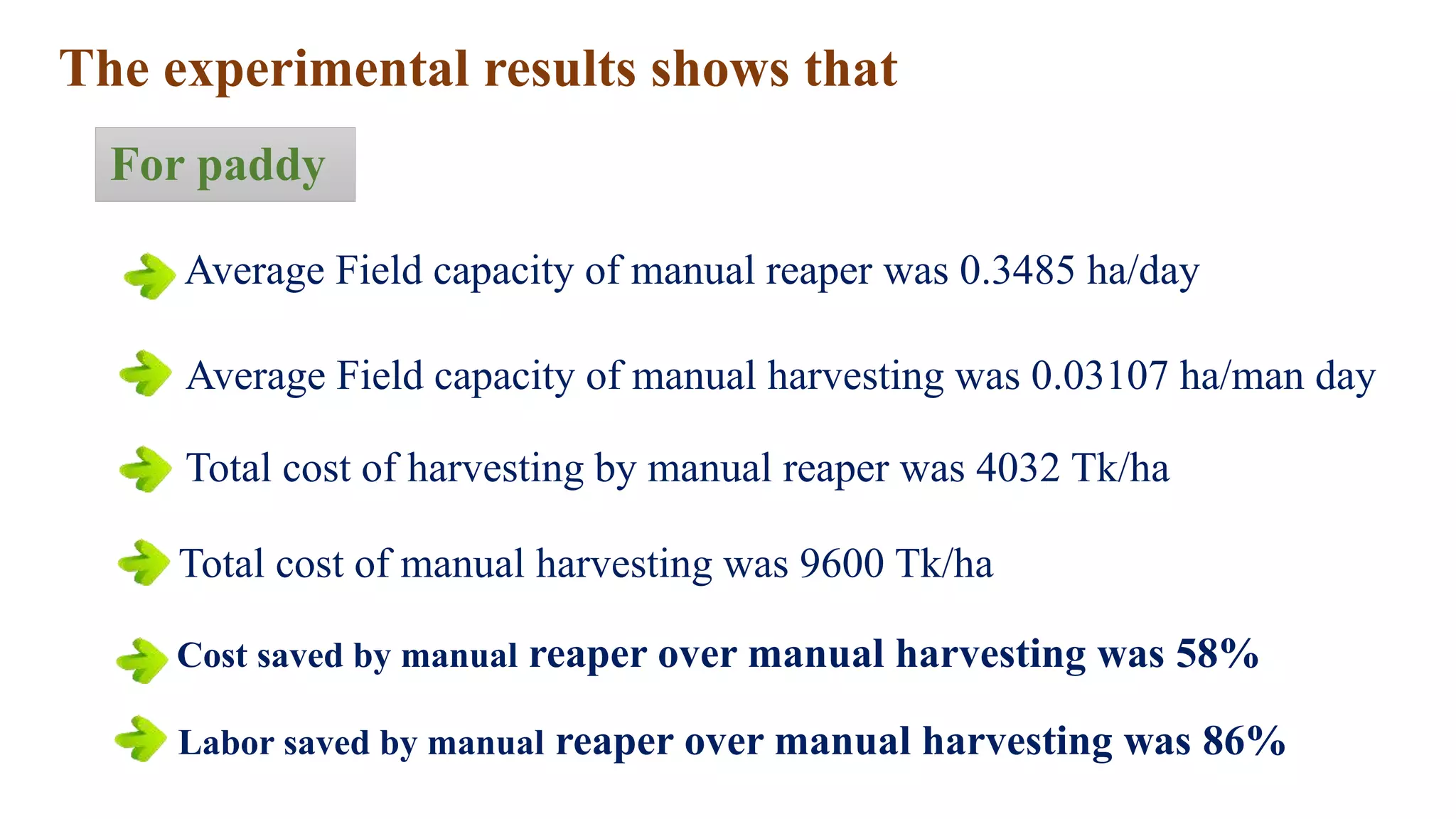
For paddy
Labor saved by manual reaper over manual harvesting was 86%
Cost saved by manual reaper over manual harvesting was 58%
Average Field capacity of manual reaper was 0.3485 ha/day
Average Field capacity of manual harvesting was 0.03107 ha/man day
Total cost of harvesting by manual reaper was 4032 Tk/ha
Total cost of manual harvesting was 9600 Tk/ha
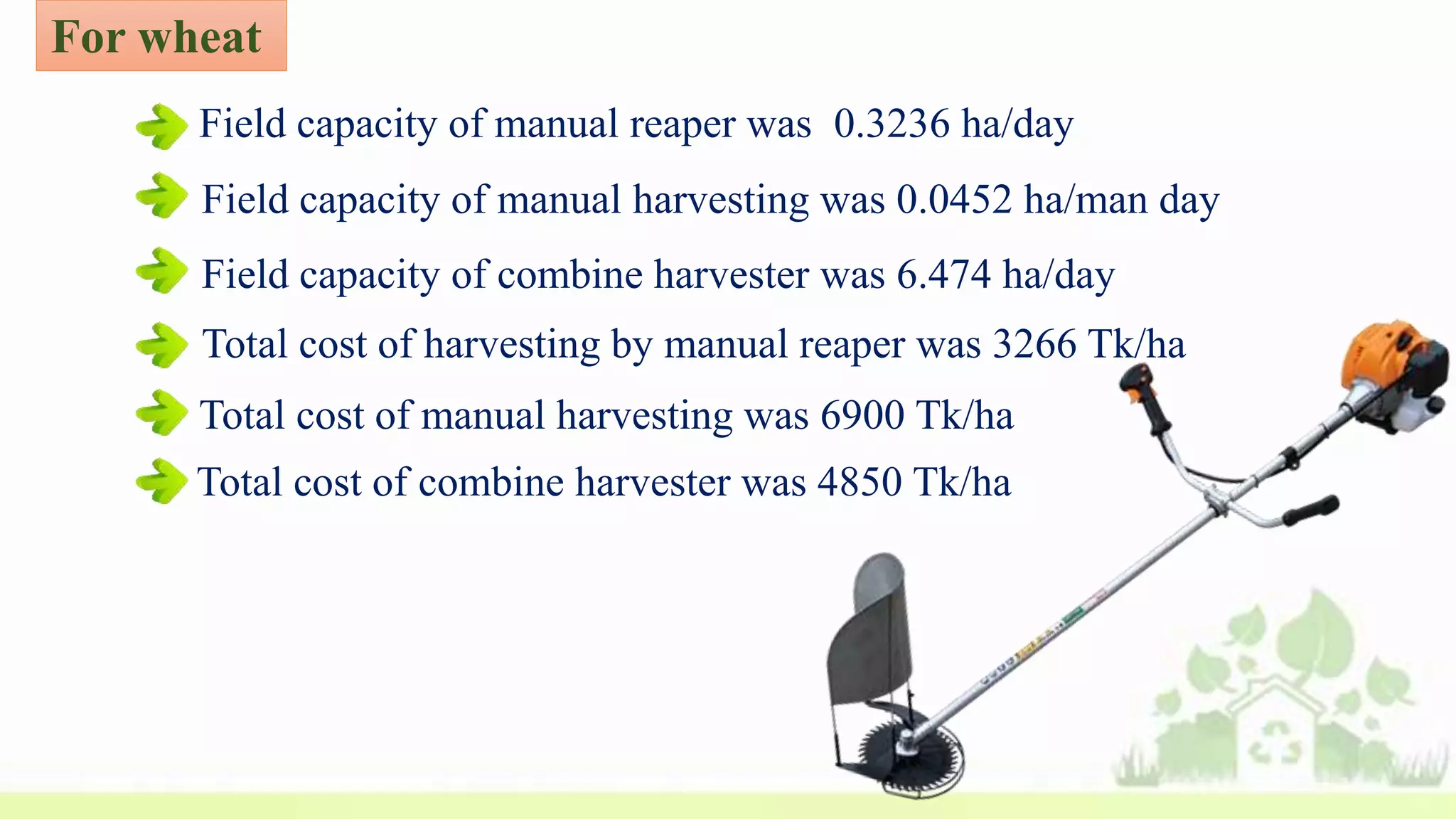
For wheat
Field capacity of manual reaper was 0.3236 ha/day
Field capacity of manual harvesting was 0.0452 ha/man day
Field capacity of combine harvester was 6.474 ha/day
Total cost of harvesting by manual reaper was 3266 Tk/ha
Total cost of manual harvesting was 6900 Tk/ha
Total cost of combine harvester was 4850 Tk/ha
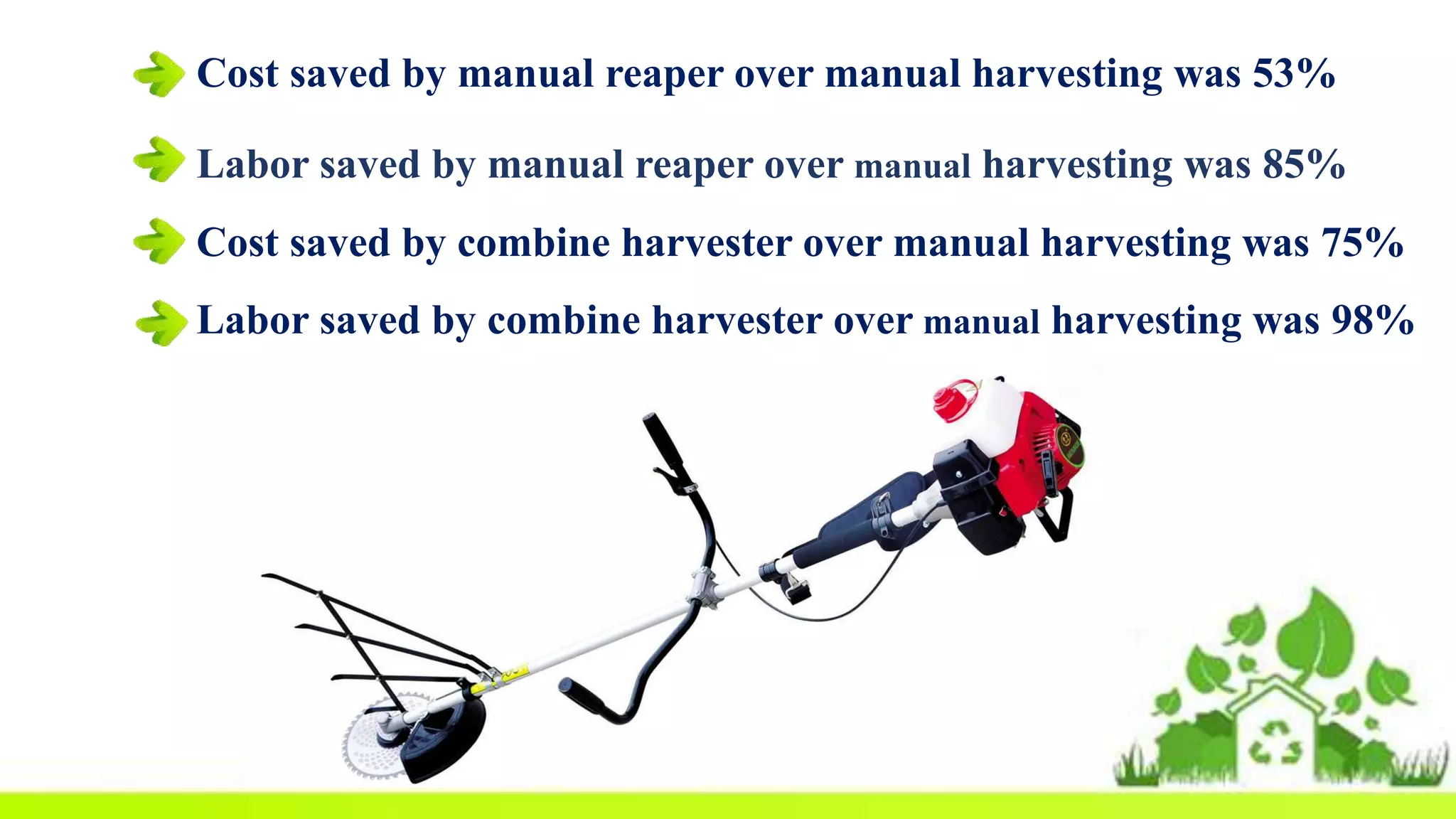
Cost saved by manual reaper over manual harvesting was 53%
Labor saved by manual reaper over manual harvesting was 85%
Labor saved by combine harvester over manual harvesting was 98%
Cost saved by combine harvester over manual harvesting was 75%
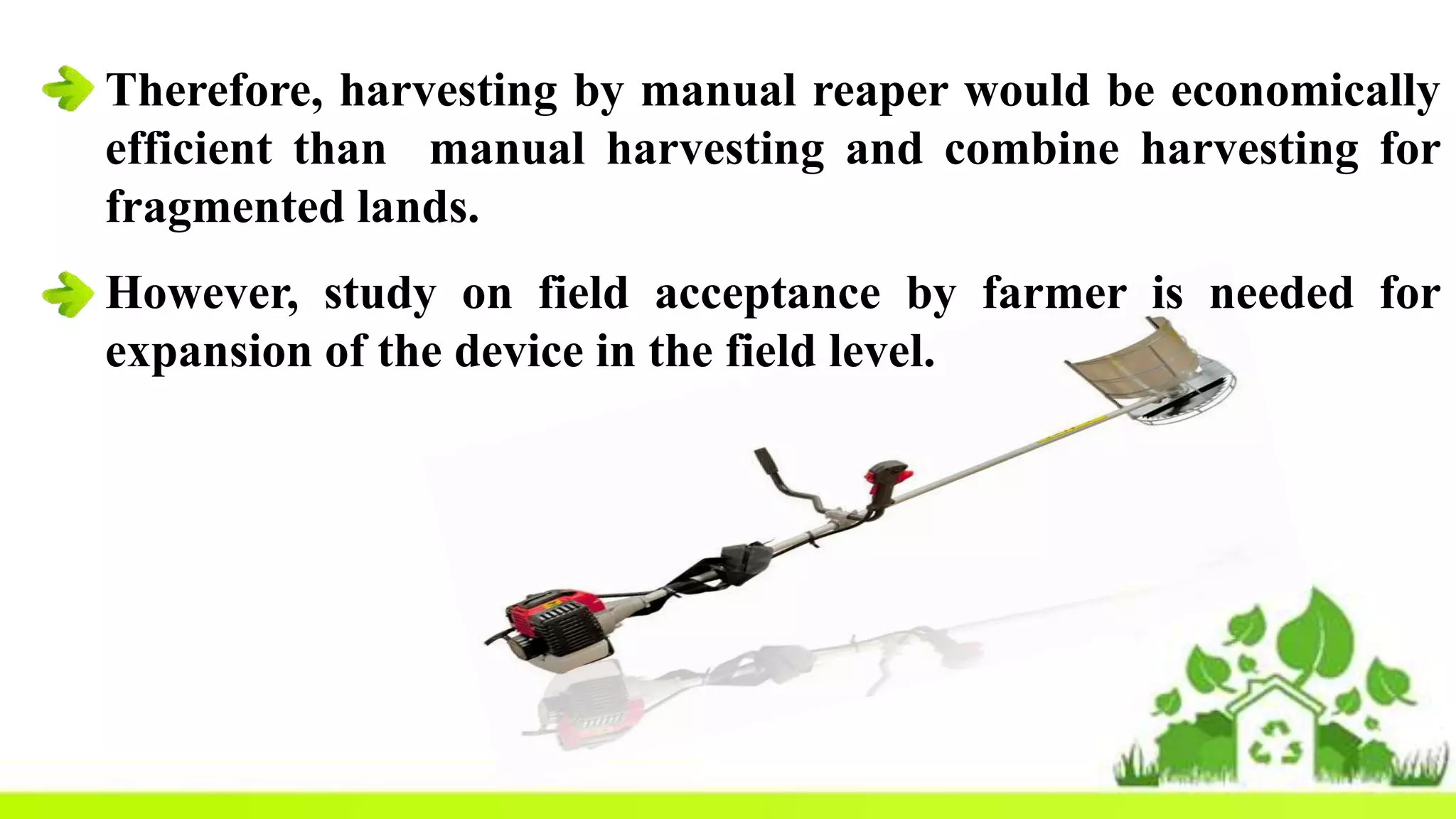
Therefore, harvesting by manual reaper would be economically
efficient than manual harvesting and combine harvesting for
fragmented lands.
However, study on field acceptance by farmer is needed for
expansion of the device in the field level.
PERFORMANCE STUDY OF MANUAL REAPER COMPARED TO MANUAL AND COMBINE HARVESTING FOR RICE AND WHEAT

PERFORMANCE STUDY OF MANUAL REAPER COMPARED TO MANUAL AND COMBINE HARVESTING FOR RICE AND WHEAT

  • 1.
  • 2.
    Project Title PERFORMANCE STUDYOF MANUAL REAPER COMPARED TO MANUAL AND COMBINE HARVESTING FOR RICE AND WHEAT Supervisor Prof. Md. Ruhul Amin Hon’ble Vice-chancellor, HSTU, Dinajpur. Co-Supervisor Prof. Dr. Md. Kamal Uddin Sarker Dept. of Agricultural and Industrial Engineering
  • 3.
    Presenters RAMANI KANTA BARMAN StudentID. 1107049 Session: 2011 MD. ABU AYUB SIDDIQUE Student ID. 1107064 Session: 2011 MD. MAKSUDUR RAHMAN Student ID. 1107076 Session: 2011
  • 4.
  • 5.
    In Bangladesh almost40% people are engaged in agricultural production activities. Agriculture contributes 20.6% of GDP of this country (BBS, 2010) Only crop contributes about 11% of the total GDP of the country.
  • 6.
    Rice is oneof the leading cereal crops in the world About 12.25 million hectares were under the cultivation of rice in Bangladesh that was 88% of the gross cropped land of the country (BBS, 2014) Annual production of rice was 749.1 million tones with 154 million hectares of cultivable lands under the 113 countries in the world (FAO, 2015)
  • 7.
    Wheat is thesecond leading cereal crop after rice Temperature sensitive One of the most important winter crops and Occupies 4% of the total cropped area Also occupies 11% of the area cropped in rabi season Contributes 7% to the total output of food cereals (Anonymous, 2008) In Bangladesh, 24.93% annual mean growth rate (BARI, 2010)
  • 8.
    In Bangladesh, traditionalharvesting is done by labors with sickle which is  Laborious,  Costly  Time consuming and  Greater shattering losses due to late harvesting for the lack of labours available in time. So, suitable machinery specially an intermediate technology for harvesting is necessary to enhance mechanization.
  • 9.
    Sl. No. Nameof the machines Quantity 01. Power tiller 3,50,000 02. Tractor 40,000 03. Seeder 2,000 04. Weeder 2,00,000 05. Fertilizer applicator 8,500 06. Sprayer 12,50,000 07. Reaper 500 08. Combine harvester 130 09. Power thresher 2,00,000 10. Maize seller 2,000 11. Winnower 200 Present status of farm machinery used in crop production in Bangladesh (IFDC, 2013) Reaper 500 Combine harvester 130
  • 10.
    1. Power tilleroperated and 2. Self-propelled Manufacturers and Dealers of Reaper in Bangladesh 1. ACI 2. ALIM Industries Ltd. 3. Solar vision 4. BARI reaper 5. BAU reaper 6. The Metal (pvt.) Industries Ltd. Types of Reaper
  • 11.
    The percentages ofreaper in different divisions of Bangladesh 55% 12% 3% 15% 3% 7% Availability of reaper Dhaka Rangpur khulna Rajshahi Sylhet Barishal Figure: Percentage of reaper available in different divisions (Brishti, 2014)
  • 12.
    Objectives of theStudy The main objective of the study was to compare the performance of a manual reaper to that of manual and combine harvesting for paddy and wheat. Specific Objectives To study the performance of a manual reaper To identify the problems and prospects of reaper in harvesting To compare mechanical harvesting with manual harvesting for selected crops To suggest an economically feasible harvesting method for selected crops.
  • 13.
  • 14.
    Experimental Site The researchwork was carried out regarding paddy and wheat harvesting during Aman and Robi season in 2015-2016. For wheat at BADC seed production field, Noshipur, Dinajpur For paddy at Hajee Mohammad Danesh Science and Technology University research field Fig: Harvesting plot of paddy Fig: Harvesting plot of wheat
  • 15.
    Equipment used Figure: Manualreaper Figure: Combine harvester
  • 16.
    Specification of amanual reaper Engine model 1E40F Engine type Air-cooled, 2 stroke, single cylinder petrol Engine power 1.25kw/7000r/min(2hp) Carburetor Diaphragm Type Starting method Manually drawing wound rope Fuel tank capacity (Lit) 1.2 Ratio of fuel and lubricant 30:1 Type Hand-type Harvester Power source Petrol circular saw blade diameter (cm) 25 Metal plate height (cm) 11 Shaft length (mm) 1670 Shaft diameter (mm) 28 Shaft thickness (mm) 2 Color red Weight (kg) 9.2 Engine power 1.25kw/7000r/min(2hp) Weight (kg) 9.2
  • 17.
    Specification of theFarmtrac-FT70 Combine Harvester Engine Make Escorts Model Farmtrac –FT70 Power 60hp 44.76 kw Number of cylinder 4 Piston displacement 3320 cc Gross power 60/2220 Cooling system Water cooled (Forced) Fuel 4-stoke cycle, Diesel engine Fuel Tank Capacity 110 lit Power Transmission Hydraulic Static Transmission Power Transmission Stage 2×3 Speed (km/hr) Forward 3.5-4.5 Model Farmtrac –FT70 Power 60hp 44.76 kw
  • 18.
    Harvested Plots Fig: Paddyharvesting by reaper Fig: Harvested plot by reaperFig: Wheat harvesting by reaper Fig: Harvested plot by reaperFig: Wheat harvest by combine harvesterFig: Wheat harvest manually
  • 19.
    Operation Time andCutting Area Fig: Harvested plot (paddy) by reaper Fig: Harvested plot (paddy) manuallyFig: Harvested plot (paddy) by reaper Fig: Harvested plot (paddy) manually 13.1m×7.9m area (2.26 decimal) = 40 minutes (1 labour by reaper) 34m×20m area (16.79 decimal) = 2.3 hours (12 labours manually) Fig: Harvested plot (wheat) by reaper Fig: Harvested plot (wheat) manually 79.24m× 20.42m area (39.95 decimal) =4 hours (1 labour by reaper) 17.67m× 12.80m area (5.58 decimal) =4 hours (1 labour manually) Fig: Harvested plot (wheat) by combine harvester 212.445m× 152.39m area (799.37 decimal) =4 hours (4 labours by combine harvester)
  • 20.
    Fuel Consumption Fuel consumptionwas calculated by using standard method as follows Fc= 𝐪 𝐭 Where, Fc = Fuel consumption (lit/hr) q = Quantity of fuel consumed (lit) t = Consumption time (hr) Effective Field Capacity By using the following formula field capacity and field efficiency were calculated C= 𝐀 𝐓 Where, C = field capacity (ha/hr) T = total time for the reaping operation (hr) A= area of land reaped at specified time (ha)
  • 21.
    Theoretical Field Capacity Theoreticalfield capacity, computed based on the forward speed and the cutting width of reaper. TFC= 𝐒𝐖 𝐂Where, TFC = Theoretical field capacity (ha/hr) W = Cutting width (m) S = Operating speed (km/hr) C = Constant, 10 Field Efficiency Field efficiency is defined as the ratio of the actual field capacity to theoretical field capacity, expressed in percent Ef = 𝐀𝐜𝐭𝐮𝐚𝐥 𝐟𝐢𝐞𝐥𝐝 𝐜𝐚𝐩𝐚𝐜𝐢𝐭𝐲 𝐓𝐡𝐞𝐨𝐫𝐞𝐭𝐢𝐜𝐚𝐥 𝐟𝐢𝐞𝐥𝐝 𝐜𝐚𝐩𝐚𝐜𝐢𝐭𝐲 ×100 Where, Ef = Field Efficiency (%) EFC = Actual field capacity (ha/hr) TFC = Theoretical field capacity (ha/hr)
  • 22.
    Harvesting Cost (Fixedcost + Variable cost) Fixed cost 1. Depreciation 2. Interest on investment 3. Tax, insurance and shelter Variable cost 1. Repair and Maintenance 2. Fuel cost 3. Lubricant cost 4. Labour cost
  • 23.
    Fixed cost 1. Depreciationwas determined by straight-line method by the following equation D= 𝐏−𝐒 𝐋 Where, D = Mean yearly depreciation (Tk/yr) P = Purchase value (Tk) S = Salvage value (Tk) L = Useful life (yr) 2. Interest is an actual cost in agricultural machinery and was determined by straight line method by the following equation I= 𝐏+𝐒 𝟐 ×i Where, I = Interest on investment (Tk/yr) P = Purchase value (Tk) S = Salvage value (Tk) i = interest rate (%)
  • 24.
    Total fixed costwas calculated as FC = Depreciation + Interest on investment + Tax, insurance and shelter 3. Tax, insurance and shelter For manual reaper was considered 0.03% of purchase price. For combine harvester was considered 2.5% of purchase price (Hunt, 1973). Total variable cost was calculated as VC = R&M + Fuel cost + Lubricant cost + Labor cost Where, VC = Variable Cost (Tk/ha) R&M= Repair and Maintenance cost (0.025% of purchase price) Fuel cost= 68 Tk/lit (Diesel) Lubricant cost= 15% of Fuel cost Labor cost= 300 Tk/day
  • 25.
    Break-even Area The break-evenarea in which the harvesting cost per unit area is equal for machine and manual was determined by the following equation (Alizadeh et al., 2007). Where, B = Break-even point (ha/yr) F = Fixed cost of machine (Tk/yr) Va = Variable costs of manual method (Tk/ha) Vm= Variable costs for machinery method (Tk/ha) B= 𝐅 Va −Vm
  • 26.
  • 27.
    Field Performance Performance testof manual reaper (for paddy) Plot No. Length (m) Width (m) Area (m2) Fuel consumption ( lit/hr) Average fuel consumption (lit/hr) Field capacity ( m2/hr) Field capacity (ha/hr) Field capacity (ha/day) Average Field capacity (ha/day) 01 10.1 5.5 55.55 1.095 555.5 0.0555 0.444 02 8.1 1.3 10.53 0.550 0.755 344.62 0.035 0.276 0.3485 03 8.1 1.6 12.96 0.620 405.7 0.041 0.325 0.755 0.3485
  • 28.
    Performance test ofmanually harvested plot (for paddy) Plot No. Length (m) Width (m) Area (m2) Field capacity (m2/hr) Field capacity (ha/hr) Field capacity (ha/man day) Average field capacity (ha/man day) 01 36.57 25.91 947.52 411.08 0.04 0.027 02 34 20 680 302.22 0.03 0.0302 0.03107 03 40 28 1120 448 0.045 0.036 0.03107
  • 29.
    Comparison of theperformance of reaper, combine harvester and manual harvesting for wheat Method Length (m) Width (m) Area (m2) Fuel consumption ( lit/hr) Field capacity ( m2/hr) Field capacity (ha/hr) Field capacity (ha/day) Manual reaper 79.24 20.42 1618.08 0.625 404.52 0.04 0.3236 Combine harvester 152.39 212.45 32374.6 14 8093.65 0.809 6.474 Manual 17.67 12.802 226.176 _ 56.544 0.0056 0.0452 0.625 14 0.3236 6.474 0.0452
  • 30.
    Harvesting Cost Estimated totalcost of reaper and manual harvesting (for paddy) Machine harvesting cost Manual harvesting cost Cost items Tk/yr Tk/ha Tk/hr Tk/ha Tk/hr Fixed cost Considered 32 nos. labors per hectare 37.5 Depreciation Interest on investment Taxes, insurances and shelter Total fixed cost 1080 792 300 2172 498 21.72 Variable cost Fuel oil labor Repair and maintenance Total variable cost 1733 75.5 52 2.3 1721 75 28 1.2 3534 154 Total cost of harvesting 4032 175.72 9600 37.54032 9600
  • 31.
    Estimated total costof reaper and manual harvesting (for wheat) Machine harvesting cost Manual harvesting cost Cost items Tk/yr Tk/ha Tk/hr Tk/ha Tk/hr Fixed cost Considered 23 nos. labors per hectare 37.5 Depreciation Interest on investment Taxes, insurances and shelter Total fixed cost 1080 792 300 2172 498 21.72 Variable cost Fuel oil labor Repair and maintenance Total variable cost 966 62.5 53 2.3 1721 75 28 1.2 2768 141 Total cost of harvesting 3266 163 6900 37.5 3266 6900
  • 32.
    Estimated total fixedcost of reaper and combine harvester (for wheat) Cost item Combine harvester Reaper Tk/yr Tk/ha Tk/hr Tk./yr Tk/ha Tk/hr Fixed cost Depreciation 320100 1080 Interest on investment 195940 792 Shelter, Tax and Insurance 97000 300 Total Fixed cost 613040 2105 1703 2172 498 21.722105 498
  • 33.
    Estimated total variablecost of reaper and combine harvester (for wheat) Cost item Combine harvester Reaper Tk/ha Tk./hr Tk/ha Tk./hr Variable cost Fuel cost 1181.55 955.87 966 62.5 Oil cost 176 143 53 2.3 Labour cost 185.41 150 1721 75 Repair and maintenance 888.16 718.52 28 1.2 Total variable cost 2432 1968 2768 141 Total harvesting cost (total variable cost + total fixed cost) 4850 4324 3266 1634850 3266
  • 34.
    Comparative harvesting costof reaper and manual harvesting (for paddy) Harvesting cost (Tk./ha) Harvesting time ( hr/ha) Percent cost saved over manual harvesting (%) Percent labor saved over manual harvesting (%) Reaper (including labor for binding and collecting) Manual Reaper (including labor for binding and collecting) Manual 4032 9600 24 180 58 86 Comparative harvesting cost of reaper and manual harvesting (for wheat) Harvesting cost (Tk/ha) Harvesting time (hr/ha) Percent cost saved over manual harvesting (%) Percent labor saved over manual harvesting (%) Reaper (including labor for binding and collecting) Manual Reaper (including labor for binding and collecting) Manual 3266 6900 25 177 53 85 58 86 53 85
  • 35.
    Break-even Area 0 2000 4000 6000 8000 10000 12000 14000 0.25 0.320.5 1 1.25 1.5 Harvestingcost(Tk/yr) For paddy reaper manual Area (ha) Fig: Cost/ha against area of operation showing break-even area 0.32
  • 36.
    0 2000 4000 6000 8000 10000 12000 14000 0.25 0.35 0.521 2 3 Harvestingcost(Tk/yr) For wheat reaper manual Area (ha) Fig: Cost/ha against area of operation showing break-even area 0.52
  • 37.
  • 38.
    The experimental resultsshows that For paddy Labor saved by manual reaper over manual harvesting was 86% Cost saved by manual reaper over manual harvesting was 58% Average Field capacity of manual reaper was 0.3485 ha/day Average Field capacity of manual harvesting was 0.03107 ha/man day Total cost of harvesting by manual reaper was 4032 Tk/ha Total cost of manual harvesting was 9600 Tk/ha
  • 39.
    For wheat Field capacityof manual reaper was 0.3236 ha/day Field capacity of manual harvesting was 0.0452 ha/man day Field capacity of combine harvester was 6.474 ha/day Total cost of harvesting by manual reaper was 3266 Tk/ha Total cost of manual harvesting was 6900 Tk/ha Total cost of combine harvester was 4850 Tk/ha
  • 40.
    Cost saved bymanual reaper over manual harvesting was 53% Labor saved by manual reaper over manual harvesting was 85% Labor saved by combine harvester over manual harvesting was 98% Cost saved by combine harvester over manual harvesting was 75%
  • 41.
    Therefore, harvesting bymanual reaper would be economically efficient than manual harvesting and combine harvesting for fragmented lands. However, study on field acceptance by farmer is needed for expansion of the device in the field level.

Editor's Notes

  • #6 Bangladesh is an agro-based and the most densely populated country in the world and The fundamental activity of the people of Bangladesh is agriculture Agriculture contributes 20.6% of GDP of this country (BBS, 2010) 3. Crop sub sector alone contributes about 11% of the total GDP of the country and about 75% of the agricultural GDP (GOB, 2011).