PERFORMANCE
APPRAISAL
INTRODUCTION
Despite the multiplicity and complex nature
of many training and educational programs
most development occurs on the job. But such
development is slowed and less effective if the
employee is not systematically appraised and
fed back information concerning her or his
quality of performance. All employees are
appraised on their job performance is some
manner or another . Once the employee has
been selected ,trained and motivated , he is
then appraised for his/her performance .
DEFINITION
ACCORDING TO EDWIN B. FLIPPO
“Performance appraisal is a systematic,
periodic and so far as humanly possible ,
an impartial rating of an employee’s
excellence in matters pertaining to his
present job and to his potentialities for a
better job’’.
PURPOSES OF
PERFORMANCE
APPRAISAL
 Performance appraisal has been
considered as a most significant and
crucial tool for an organization.
 The information it provides is highly
useful in making decisions regarding
various personal aspects such as
promotions, wages etc.
OTHER OBJECTIVE
 IT UNIFIES THE APPRAISAL PROUDEURE so that all employees are rated in the same
manner utilizing the same approach so that the rating obtained of separate personnel are
comparable.
 IT PROVIDES INFORMATION WHICH IS USEFUL IN MAKING AND ENFORCING
IMPORTANT DECISIONS about selection, training, promotions, pay increases, transfer, lay
off, discharges, salary adjustments etc.
 IT PROVIDES INFORMATION IN THE FORM OF RECORDS ABOUT RATING which
may be produced as evidence when decisions on rating are challenged in court of law even
arbitrators accept these in the course of grievance handling procedure as authentic records
.
 IT SERVES TO ENCOVRAGE AND GUIDE EMPLOYEE DEVELOPMENT Appraisal
programmer provide information an the weaknesses of employees and enable them to
estimate their own value and accomplishment and to know what they are doing the
weaknesses provide the basis for an individual development programmes . .
 IT GIVES SUPERVISORS A MORE EFFECTIVE TOOL FOR RATING THEIR PERSONNEL
enables them to make a careful analysis of their men and gives them a better knowledge
and understanding of them.
 IT MAKES FOR BETTER EMPLOYER - EMPLOYEE RELATION through mutual
confidence, which comes as a result of frank discussion between a supervisor and his man.
ADVANTAGES
Provide a record of
performance over a
period of time
Can be motivational
with the support of a
good reward and
compensation
Provide an
opportunity for a
manager to meet
discuss performance
Provides an
opportunity for an
employee to discuss
issues and to clarify
expectation
Provide the
employee with
feedback about their
performance
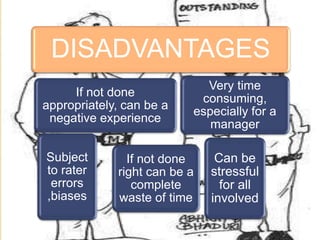
DISADVANTAGES
If not done
appropriately, can be a
negative experience
Subject
to rater
errors
,biases
If not done
right can be a
complete
waste of time
Very time
consuming,
especially for a
manager
Can be
stressful
for all
involved
METHODS TECHNIQUES OR
TOOLS FOR APPRAISING
PERFORMANCE
 Several methods and techniques of
appraisal are available for measuring the
performance of an employee.
 The widely used categorisation is that
given by strauss and sayless. They have
classified performance appraisal methods
into traditional, and newer of the or
modern methods.
PERFORMANCE OF
APPRAISAL
Traditional
methods
 Ranking method .
 Man to man
comparison method.
 Grading method .
 Graphic scales
method.
 Checklist method.
 Forced choice method.
 Free essay method.
 Critical incidence
method.
Modern methods
 Appraisal by result or
management by
objectives.
 Assessment Centre
method.
 Human asset
accounting method.
METHODS
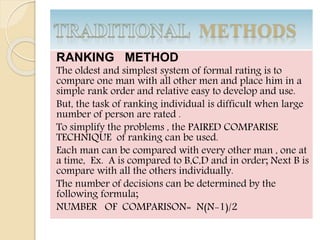
RANKING METHOD
The oldest and simplest system of formal rating is to
compare one man with all other men and place him in a
simple rank order and relative easy to develop and use.
But, the task of ranking individual is difficult when large
number of person are rated .
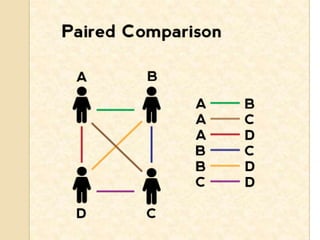
To simplify the problems , the PAIRED COMPARISE
TECHNIQUE of ranking can be used.
Each man can be compared with every other man , one at
a time, Ex. A is compared to B,C,D and in order; Next B is
compare with all the others individually.
The number of decisions can be determined by the
following formula;
NUMBER OF COMPARISON= N(N-1)/2
MAN TO MAN
COMPARISON
METHOD
 This technique was used by the USA army
during the first world war by this method
, certain factors are selected for the
purpose of analysis (such as leadership,
dependability and initiative) and a scale
is designed by the rater for each factor
.The each man to be rated is compared
with the man in the scale and certain
scores for each factors are awarded to
him.
GRADING METHOD
In the grading system certain categories of
worth are established in advance and
carefully defined .In the federal civil services.
For example , there are three categories of
personnel ; outstanding , satisfactory and
unsatisfactory.
Allocated to the grade that best describe his or
her performance.
The selected features may be , cooperativeness
dependability, self-expression ,job-
knowledge, judgment, leadership and
organizing ability etc.
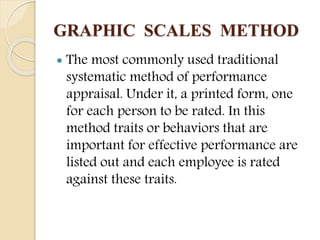
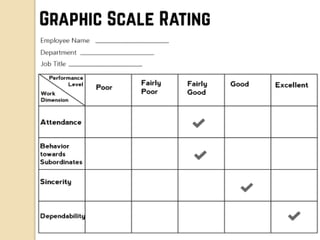
GRAPHIC SCALES METHOD
 The most commonly used traditional
systematic method of performance
appraisal. Under it, a printed form, one
for each person to be rated. In this
method traits or behaviors that are
important for effective performance are
listed out and each employee is rated
against these traits.
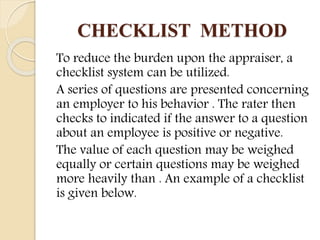
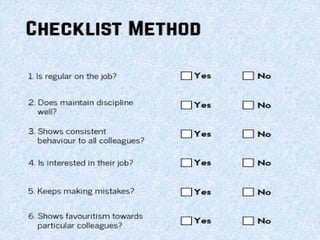
CHECKLIST METHOD
To reduce the burden upon the appraiser, a
checklist system can be utilized.
A series of questions are presented concerning
an employer to his behavior . The rater then
checks to indicated if the answer to a question
about an employee is positive or negative.
The value of each question may be weighed
equally or certain questions may be weighed
more heavily than . An example of a checklist
is given below.
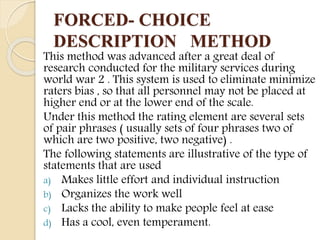
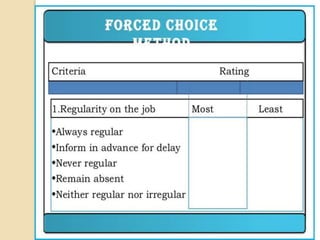
FORCED- CHOICE
DESCRIPTION METHOD
This method was advanced after a great deal of
research conducted for the military services during
world war 2 . This system is used to eliminate minimize
raters bias , so that all personnel may not be placed at
higher end or at the lower end of the scale.
Under this method the rating element are several sets
of pair phrases ( usually sets of four phrases two of
which are two positive, two negative) .
The following statements are illustrative of the type of
statements that are used
a) Makes little effort and individual instruction
b) Organizes the work well
c) Lacks the ability to make people feel at ease
d) Has a cool, even temperament.
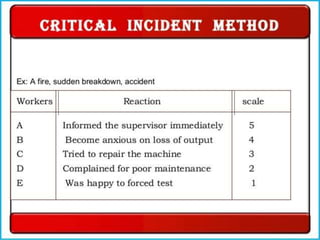
CRITICAL INCIDENT
METHOD
Under this method the supervisor keeps a written
record of the events (either good or bad) that can
easily be recalled and used in the course of a
periodical or formal appraisal.
For example , the supervisor may be trained to look
for and recognize such critical incident as;
1. Became upset or angry over work.
2. Refused to help a fellow worker.
3. Suggested an improvement in the work method.
4. Refused a chance to take further training .
5. Tried to get a fellow worker to accept a
management decision.
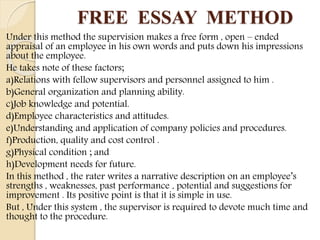
FREE ESSAY METHOD
Under this method the supervision makes a free form , open – ended
appraisal of an employee in his own words and puts down his impressions
about the employee.
He takes note of these factors;
a)Relations with fellow supervisors and personnel assigned to him .
b)General organization and planning ability.
c)Job knowledge and potential.
d)Employee characteristics and attitudes.
e)Understanding and application of company policies and procedures.
f)Production, quality and cost control .
g)Physical condition ; and
h)Development needs for future.
In this method , the rater writes a narrative description on an employee’s
strengths , weaknesses, past performance , potential and suggestions for
improvement . Its positive point is that it is simple in use.
But , Under this system , the supervisor is required to devote much time and
thought to the procedure.
GROUPAPPRAISAL METHOD
Under this method employees are rated by
appraisal group , consisting of their
supervisor and three or four other
supervisor who have some knowledge of
their performance . The group then
discusses the standards of performance for
the job ,the actual performance of the job –
holder, and the causes of their particular
level of performance, and offers
suggestions for future improvement if any.
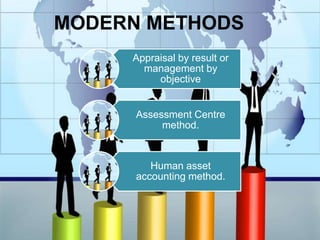
NEW METHODMODERN METHODS
Appraisal by result or
management by
objective
Assessment Centre
method.
Human asset
accounting method.
APPRAISAL BY RESULTS OR
MANAGEMENT BY OBJECTIVE
This method has been evolved by PETER
DRUCKER it seeks to minimize external
controls and maximize internal motivation
through joint goal setting between the
manager and the subordinate and increasing
the subordinate’s own control of his work .
“MBO(Management by objective) is a
comprehensive managerial system that
integrates many managerial activity
consciocesly directed towards effective and
efficient achievement of organizational
objectives.”
ASSESSMENT CENTRE METHOD
Under this method many evaluators join together to judge employee
performance in several situation with the use of a variety of criteria .
It is used mostly to help select employees for the first level (the lowest
) supervisory positions .
Some Key Features Of This System Are :
1)The use of situational exercise such as an in – basket exercise
business games, a role – playing incident.
2)They evaluate all employees both individually and collectively and
each candidate is given one of the four categories; more than
acceptable, less than acceptable and unacceptable.
3)A summary report is prepared by the members and a feedback on a
face to face basis is administered to all the candidate who ask for it.
HUMAN ASSET ACCOUNTING
METHOD
Human resource are a valuable assets for any
organization and it can be valued in monitory
terms. This method evaluate the performance
of an employee in terms of cost and
contribution HR cost include expenses
incurred on HR planning recruitment
selection and training. The difference between
this cost and the contribution by an employee
reflect the performance of that employee. This
method is not yet very popular.
Performance appraisal

Performance appraisal

  • 2.
    PERFORMANCE APPRAISAL INTRODUCTION Despite the multiplicityand complex nature of many training and educational programs most development occurs on the job. But such development is slowed and less effective if the employee is not systematically appraised and fed back information concerning her or his quality of performance. All employees are appraised on their job performance is some manner or another . Once the employee has been selected ,trained and motivated , he is then appraised for his/her performance .
  • 3.
    DEFINITION ACCORDING TO EDWINB. FLIPPO “Performance appraisal is a systematic, periodic and so far as humanly possible , an impartial rating of an employee’s excellence in matters pertaining to his present job and to his potentialities for a better job’’.
  • 4.
    PURPOSES OF PERFORMANCE APPRAISAL  Performanceappraisal has been considered as a most significant and crucial tool for an organization.  The information it provides is highly useful in making decisions regarding various personal aspects such as promotions, wages etc.
  • 5.
    OTHER OBJECTIVE  ITUNIFIES THE APPRAISAL PROUDEURE so that all employees are rated in the same manner utilizing the same approach so that the rating obtained of separate personnel are comparable.  IT PROVIDES INFORMATION WHICH IS USEFUL IN MAKING AND ENFORCING IMPORTANT DECISIONS about selection, training, promotions, pay increases, transfer, lay off, discharges, salary adjustments etc.  IT PROVIDES INFORMATION IN THE FORM OF RECORDS ABOUT RATING which may be produced as evidence when decisions on rating are challenged in court of law even arbitrators accept these in the course of grievance handling procedure as authentic records .  IT SERVES TO ENCOVRAGE AND GUIDE EMPLOYEE DEVELOPMENT Appraisal programmer provide information an the weaknesses of employees and enable them to estimate their own value and accomplishment and to know what they are doing the weaknesses provide the basis for an individual development programmes . .  IT GIVES SUPERVISORS A MORE EFFECTIVE TOOL FOR RATING THEIR PERSONNEL enables them to make a careful analysis of their men and gives them a better knowledge and understanding of them.  IT MAKES FOR BETTER EMPLOYER - EMPLOYEE RELATION through mutual confidence, which comes as a result of frank discussion between a supervisor and his man.
  • 6.
    ADVANTAGES Provide a recordof performance over a period of time Can be motivational with the support of a good reward and compensation Provide an opportunity for a manager to meet discuss performance Provides an opportunity for an employee to discuss issues and to clarify expectation Provide the employee with feedback about their performance
  • 7.
    DISADVANTAGES If not done appropriately,can be a negative experience Subject to rater errors ,biases If not done right can be a complete waste of time Very time consuming, especially for a manager Can be stressful for all involved
  • 8.
    METHODS TECHNIQUES OR TOOLSFOR APPRAISING PERFORMANCE  Several methods and techniques of appraisal are available for measuring the performance of an employee.  The widely used categorisation is that given by strauss and sayless. They have classified performance appraisal methods into traditional, and newer of the or modern methods.
  • 9.
    PERFORMANCE OF APPRAISAL Traditional methods  Rankingmethod .  Man to man comparison method.  Grading method .  Graphic scales method.  Checklist method.  Forced choice method.  Free essay method.  Critical incidence method. Modern methods  Appraisal by result or management by objectives.  Assessment Centre method.  Human asset accounting method.
  • 10.
    METHODS RANKING METHOD The oldestand simplest system of formal rating is to compare one man with all other men and place him in a simple rank order and relative easy to develop and use. But, the task of ranking individual is difficult when large number of person are rated . To simplify the problems , the PAIRED COMPARISE TECHNIQUE of ranking can be used. Each man can be compared with every other man , one at a time, Ex. A is compared to B,C,D and in order; Next B is compare with all the others individually. The number of decisions can be determined by the following formula; NUMBER OF COMPARISON= N(N-1)/2
  • 12.
    MAN TO MAN COMPARISON METHOD This technique was used by the USA army during the first world war by this method , certain factors are selected for the purpose of analysis (such as leadership, dependability and initiative) and a scale is designed by the rater for each factor .The each man to be rated is compared with the man in the scale and certain scores for each factors are awarded to him.
  • 13.
    GRADING METHOD In thegrading system certain categories of worth are established in advance and carefully defined .In the federal civil services. For example , there are three categories of personnel ; outstanding , satisfactory and unsatisfactory. Allocated to the grade that best describe his or her performance. The selected features may be , cooperativeness dependability, self-expression ,job- knowledge, judgment, leadership and organizing ability etc.
  • 14.
    GRAPHIC SCALES METHOD The most commonly used traditional systematic method of performance appraisal. Under it, a printed form, one for each person to be rated. In this method traits or behaviors that are important for effective performance are listed out and each employee is rated against these traits.
  • 16.
    CHECKLIST METHOD To reducethe burden upon the appraiser, a checklist system can be utilized. A series of questions are presented concerning an employer to his behavior . The rater then checks to indicated if the answer to a question about an employee is positive or negative. The value of each question may be weighed equally or certain questions may be weighed more heavily than . An example of a checklist is given below.
  • 18.
    FORCED- CHOICE DESCRIPTION METHOD Thismethod was advanced after a great deal of research conducted for the military services during world war 2 . This system is used to eliminate minimize raters bias , so that all personnel may not be placed at higher end or at the lower end of the scale. Under this method the rating element are several sets of pair phrases ( usually sets of four phrases two of which are two positive, two negative) . The following statements are illustrative of the type of statements that are used a) Makes little effort and individual instruction b) Organizes the work well c) Lacks the ability to make people feel at ease d) Has a cool, even temperament.
  • 20.
    CRITICAL INCIDENT METHOD Under thismethod the supervisor keeps a written record of the events (either good or bad) that can easily be recalled and used in the course of a periodical or formal appraisal. For example , the supervisor may be trained to look for and recognize such critical incident as; 1. Became upset or angry over work. 2. Refused to help a fellow worker. 3. Suggested an improvement in the work method. 4. Refused a chance to take further training . 5. Tried to get a fellow worker to accept a management decision.
  • 22.
    FREE ESSAY METHOD Underthis method the supervision makes a free form , open – ended appraisal of an employee in his own words and puts down his impressions about the employee. He takes note of these factors; a)Relations with fellow supervisors and personnel assigned to him . b)General organization and planning ability. c)Job knowledge and potential. d)Employee characteristics and attitudes. e)Understanding and application of company policies and procedures. f)Production, quality and cost control . g)Physical condition ; and h)Development needs for future. In this method , the rater writes a narrative description on an employee’s strengths , weaknesses, past performance , potential and suggestions for improvement . Its positive point is that it is simple in use. But , Under this system , the supervisor is required to devote much time and thought to the procedure.
  • 23.
    GROUPAPPRAISAL METHOD Under thismethod employees are rated by appraisal group , consisting of their supervisor and three or four other supervisor who have some knowledge of their performance . The group then discusses the standards of performance for the job ,the actual performance of the job – holder, and the causes of their particular level of performance, and offers suggestions for future improvement if any.
  • 24.
    NEW METHODMODERN METHODS Appraisalby result or management by objective Assessment Centre method. Human asset accounting method.
  • 25.
    APPRAISAL BY RESULTSOR MANAGEMENT BY OBJECTIVE This method has been evolved by PETER DRUCKER it seeks to minimize external controls and maximize internal motivation through joint goal setting between the manager and the subordinate and increasing the subordinate’s own control of his work . “MBO(Management by objective) is a comprehensive managerial system that integrates many managerial activity consciocesly directed towards effective and efficient achievement of organizational objectives.”
  • 26.
    ASSESSMENT CENTRE METHOD Underthis method many evaluators join together to judge employee performance in several situation with the use of a variety of criteria . It is used mostly to help select employees for the first level (the lowest ) supervisory positions . Some Key Features Of This System Are : 1)The use of situational exercise such as an in – basket exercise business games, a role – playing incident. 2)They evaluate all employees both individually and collectively and each candidate is given one of the four categories; more than acceptable, less than acceptable and unacceptable. 3)A summary report is prepared by the members and a feedback on a face to face basis is administered to all the candidate who ask for it.
  • 27.
    HUMAN ASSET ACCOUNTING METHOD Humanresource are a valuable assets for any organization and it can be valued in monitory terms. This method evaluate the performance of an employee in terms of cost and contribution HR cost include expenses incurred on HR planning recruitment selection and training. The difference between this cost and the contribution by an employee reflect the performance of that employee. This method is not yet very popular.