VARICOSE DISEASE
HRISTO RAHMAN
DEPARTMENT OF CARDIAC AND VASCULAR SURGERY
MEDICAL UNIVERSITY PLOVDIV
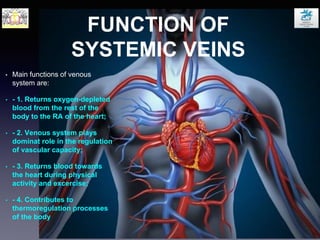
FUNCTION OF
SYSTEMIC VEINS
• Main functions of venous
system are:
• - 1. Returns oxygen-depleted
blood from the rest of the
body to the RA of the heart;
• - 2. Venous system plays
dominat role in the regulation
of vascular capacity;
• - 3. Returns blood towards
the heart during physical
activity and excercise;
• - 4. Contributes to
thermoregulation processes
of the body
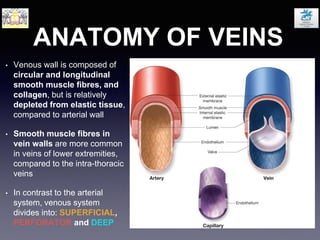
ANATOMY OF VEINS
• Venous wall is composed of
circular and longitudinal
smooth muscle fibres, and
collagen, but is relatively
depleted from elastic tissue,
compared to arterial wall
• Smooth muscle fibres in
vein walls are more common
in veins of lower extremities,
compared to the intra-thoracic
veins
• In contrast to the arterial
system, venous system
divides into: SUPERFICIAL,
PERFORATOR and DEEP
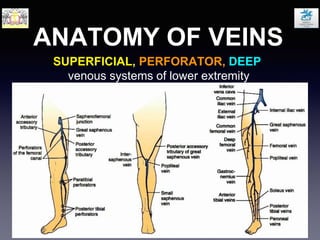
ANATOMY OF VEINS
SUPERFICIAL, PERFORATOR, DEEP
venous systems of lower extremity
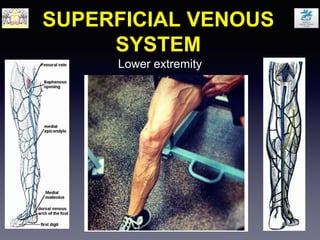
SUPERFICIAL VENOUS
SYSTEM
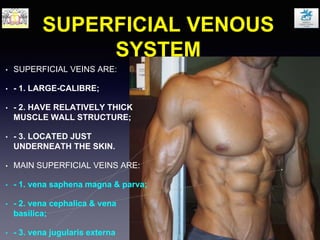
• SUPERFICIAL VEINS ARE:
• - 1. LARGE-CALIBRE;
• - 2. HAVE RELATIVELY THICK
MUSCLE WALL STRUCTURE;
• - 3. LOCATED JUST
UNDERNEATH THE SKIN.
• MAIN SUPERFICIAL VEINS ARE:
• - 1. vena saphena magna & parva;
• - 2. vena cephalica & vena
basilica;
• - 3. vena jugularis externa
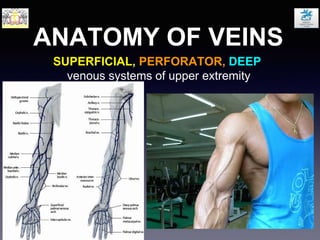
ANATOMY OF VEINS
SUPERFICIAL, PERFORATOR, DEEP
venous systems of upper extremity
SUPERFICIAL VENOUS
SYSTEM
Lower extremity
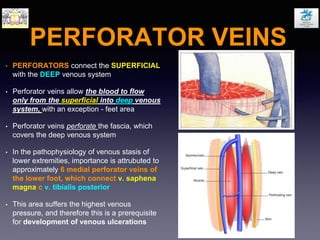
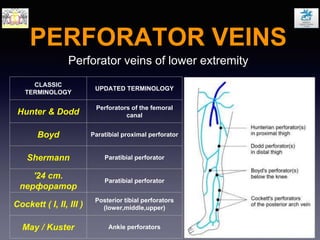
PERFORATOR VEINS
• PERFORATORS connect the SUPERFICIAL
with the DEEP venous system
• Perforator veins allow the blood to flow
only from the superficial into deep venous
system, with an exception - feet area
• Perforator veins perforate the fascia, which
covers the deep venous system
• In the pathophysiology of venous stasis of
lower extremities, importance is attrubuted to
approximately 6 medial perforator veins of
the lower foot, which connect v. saphena
magna с v. tibialis posterior
• This area suffers the highest venous
pressure, and therefore this is a prerequisite
for development of venous ulcerations
PERFORATOR VEINS
CLASSIC
TERMINOLOGY
UPDATED TERMINOLOGY
Hunter & Dodd
Perforators of the femoral
canal
Boyd Paratibial proximal perforator
Shermann Paratibial perforator
'24 cm.
перфоратор
Paratibial perforator
Cockett ( I, II, III )
Posterior tibial perforators
(lower,middle,upper)
May / Kuster Ankle perforators
Perforator veins of lower extremity
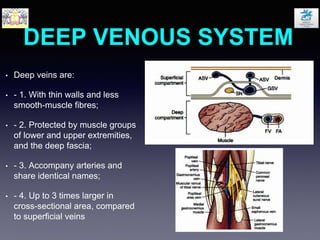
DEEP VENOUS SYSTEM
• Deep veins are:
• - 1. With thin walls and less
smooth-muscle fibres;
• - 2. Protected by muscle groups
of lower and upper extremities,
and the deep fascia;
• - 3. Accompany arteries and
share identical names;
• - 4. Up to 3 times larger in
cross-sectional area, compared
to superficial veins
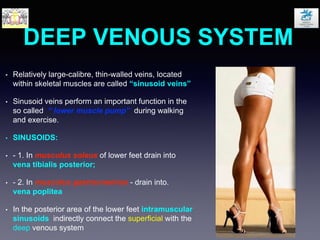
DEEP VENOUS SYSTEM
• Relatively large-calibre, thin-walled veins, located
within skeletal muscles are called “sinusoid veins”
• Sinusoid veins perform an important function in the
so called “ lower muscle pump” during walking
and exercise.
• SINUSOIDS:
• - 1. In musculus soleus of lower feet drain into
vena tibialis posterior;
• - 2. In musculus gastrocnemius - drain into.
vena poplitea
• In the posterior area of the lower feet intramuscular
sinusoids indirectly connect the superficial with the
deep venous system
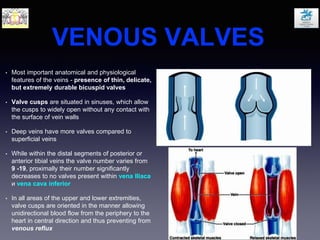
VENOUS VALVES
• Most important anatomical and physiological
features of the veins - presence of thin, delicate,
but extremely durable bicuspid valves
• Valve cusps are situated in sinuses, which allow
the cusps to widely open without any contact with
the surface of vein walls
• Deep veins have more valves compared to
superficial veins
• While within the distal segments of posterior or
anterior tibial veins the valve number varies from
9 -19, proximally their number significantly
decreases to no valves present within vena Iliaca
и vena cava inferior
• In all areas of the upper and lower extremities,
valve cusps are oriented in the manner allowing
unidirectional blood flow from the periphery to the
heart in central direction and thus preventing from
venous reflux
VENOUS PUMP
FUNCTION
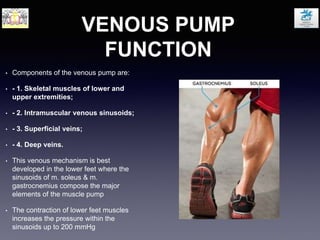
• Components of the venous pump are:
• - 1. Skeletal muscles of lower and
upper extremities;
• - 2. Intramuscular venous sinusoids;
• - 3. Superficial veins;
• - 4. Deep veins.
• This venous mechanism is best
developed in the lower feet where the
sinusoids of m. soleus & m.
gastrocnemius compose the major
elements of the muscle pump
• The contraction of lower feet muscles
increases the pressure within the
sinusoids up to 200 mmHg
VENOUS PUMP
FUNCTION
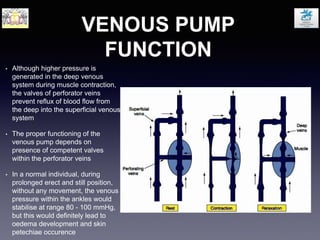
• Although higher pressure is
generated in the deep venous
system during muscle contraction,
the valves of perforator veins
prevent reflux of blood flow from
the deep into the superficial venous
system
• The proper functioning of the
venous pump depends on
presence of competent valves
within the perforator veins
• In a normal individual, during
prolonged erect and still position,
without any movement, the venous
pressure within the ankles would
stabilise at range 80 - 100 mmHg,
but this would definitely lead to
oedema development and skin
petechiae occurence
VENOUS PUMP
FUNCTION
• The competent venous
valves prevent from
venous reflux and the
venous pressure is
decreased as a result of
emptying by the muscle
contractions
• The venous pressure then
increases again after the
collapsed veins fill in from
the blood inflow coming
from the capillaries and
perforator veins
VENOUS PUMP
FUNCTION
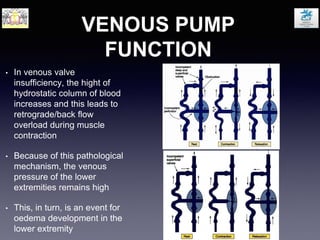
• In venous valve
insufficiency, the hight of
hydrostatic column of blood
increases and this leads to
retrograde/back flow
overload during muscle
contraction
• Because of this pathological
mechanism, the venous
pressure of the lower
extremities remains high
• This, in turn, is an event for
oedema development in the
lower extremity
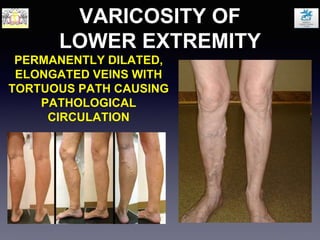
VARICOSITY OF
LOWER EXTREMITY
PERMANENTLY DILATED,
ELONGATED VEINS WITH
TORTUOUS PATH CAUSING
PATHOLOGICAL
CIRCULATION
VARICOSE VEINS
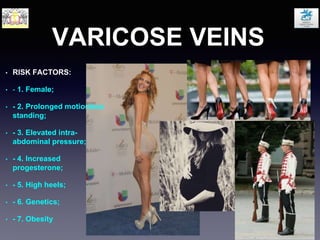
• RISK FACTORS:
• - 1. Female;
• - 2. Prolonged motionless
standing;
• - 3. Elevated intra-
abdominal pressure;
• - 4. Increased
progesterone;
• - 5. High heels;
• - 6. Genetics;
• - 7. Obesity
VARICOSE VEINS
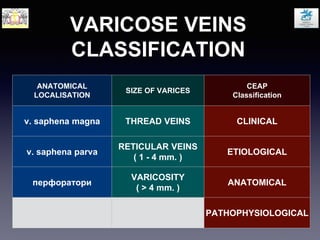
CLASSIFICATION
ANATOMICAL
LOCALISATION
SIZE OF VARICES
CEAP
Classification
v. saphena magna THREAD VEINS CLINICAL
v. saphena parva
RETICULAR VEINS
( 1 - 4 mm. )
ETIOLOGICAL
перфоратори
VARICOSITY
( > 4 mm. )
ANATOMICAL
PATHOPHYSIOLOGICAL
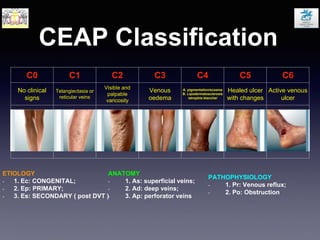
CEAP Classification
C0 C1 C2 C3 C4 C5 C6
No clinical
signs
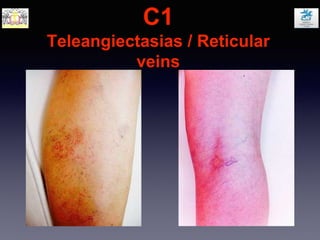
Telangiectasia or
reticular veins
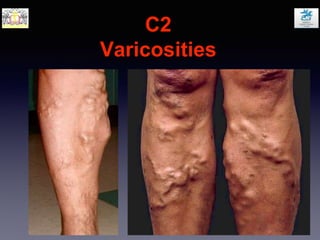
Visible and
palpable
varicosity
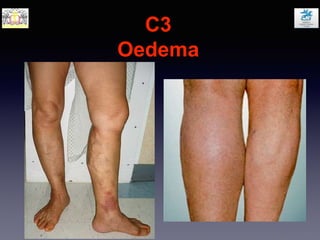
Venous
oedema
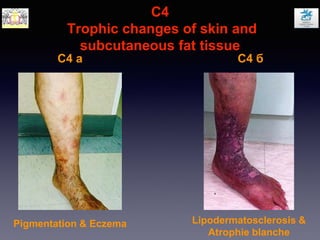
A. pigmentation/ecsema
B. Lipodermatosclerosis
/atrophie blanche/
Healed ulcer
with changes
Active venous
ulcer
ETIOLOGY
- 1. Еc: CONGENITAL;
- 2. Ep: PRIMARY;
- 3. Es: SECONDARY ( post DVT )
ANATOMY
- 1. Аs: superficial veins;
- 2. Ad: deep veins;
- 3. Ap: perforator veins
PATHOPHYSIOLOGY
- 1. Pr: Venous reflux;
- 2. Po: Obstruction
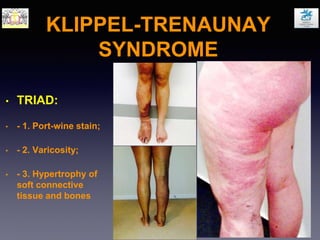
KLIPPEL-TRENAUNAY
SYNDROME
• TRIAD:
• - 1. Port-wine stain;
• - 2. Varicosity;
• - 3. Hypertrophy of
soft connective
tissue and bones
C1
Teleangiectasias / Reticular
veins
C2
Varicosities
C3
Oedema
C4
Trophic changes of skin and
subcutaneous fat tissue
C4 a C4 б
Lipodermatosclerosis &
Atrophie blanche
Pigmentation & Eczema
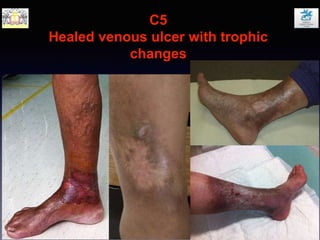
C5
Healed venous ulcer with trophic
changes
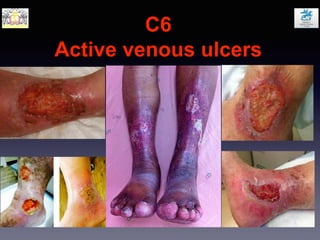
C6
Active venous ulcers
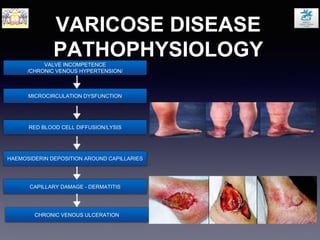
VARICOSE DISEASE
PATHOPHYSIOLOGYVALVE INCOMPETENCE
/CHRONIC VENOUS HYPERTENSION/
MICROCIRCULATION DYSFUNCTION
RED BLOOD CELL DIFFUSION/LYSIS
HAEMOSIDERIN DEPOSITION AROUND CAPILLARIES
CAPILLARY DAMAGE - DERMATITIS
CHRONIC VENOUS ULCERATION
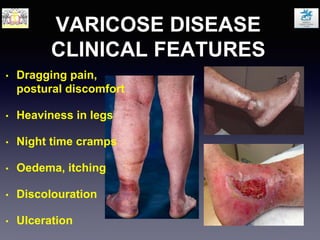
VARICOSE DISEASE
CLINICAL FEATURES
• Dragging pain,
postural discomfort
• Heaviness in legs
• Night time cramps
• Oedema, itching
• Discolouration
• Ulceration
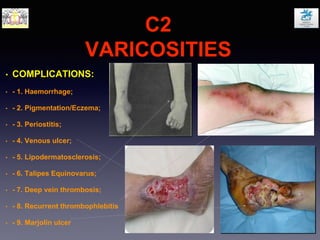
C2
VARICOSITIES
• COMPLICATIONS:
• - 1. Haemorrhage;
• - 2. Pigmentation/Eczema;
• - 3. Periostitis;
• - 4. Venous ulcer;
• - 5. Lipodermatosclerosis;
• - 6. Talipes Equinovarus;
• - 7. Deep vein thrombosis;
• - 8. Recurrent thrombophlebitis
• - 9. Marjolin ulcer
VARICOSITY
TREATMENT
• PURPOSE:
• - CORRECTION OF PATHOLOGICAL VENOUS CIRCULATION
• - COSMETIC/ESTHETIC PRECAUTION
• - ALLEVIATING SYMPTOMS
• - PREVENTION OF COMPLICATIONS
• PRE-OPERATIVE ASSESSMENT OF FUNCTION:
• - 1. DEEP VENOUS SYSTEM;
• - 2. ILIO-FEMORAL VEINS;
• - 3. PERFORATOR VEINS
VARICOSITY
TREATMENY
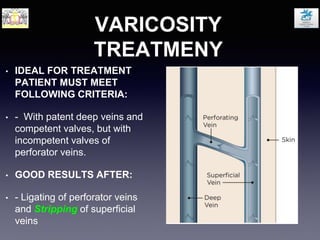
• IDEAL FOR TREATMENT
PATIENT MUST MEET
FOLLOWING CRITERIA:
• - With patent deep veins and
competent valves, but with
incompetent valves of
perforator veins.
• GOOD RESULTS AFTER:
• - Ligating of perforator veins
and Stripping of superficial
veins
VARICOSITY
TREATMENT
• In patients with incompetence of all or most of deep
vein or perforator vein valves, STRIPPING of superficial
veins will be sub-optimal, because of possible
recurrence of newly-developed varicosities
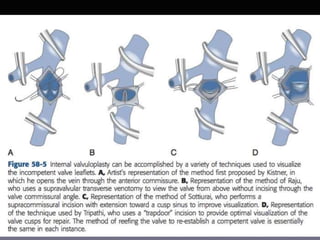
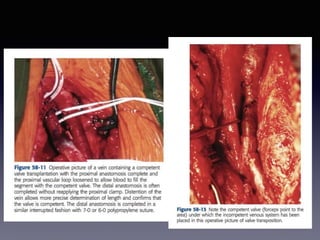
• Venous valve reconstruction ( Valvuloplasty ) or
Transplantation are methods of choice in these
patients
• Purpose: to restore valve competency of deep veins
VARICOSITY
TREATMENT
• Patients with obstructions of blood flow along the deep
venous system, despite of the condition of their valves (
competent or incompetent ) are contraindicated for
Ligating of superficial veins and Stripping
• This will cause:
• - 1. Removal of major patent collateral veins;
• - 2. Compromise of venous drainage
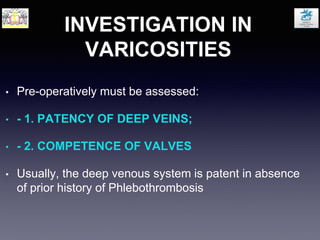
INVESTIGATION IN
VARICOSITIES
• Pre-operatively must be assessed:
• - 1. PATENCY OF DEEP VEINS;
• - 2. COMPETENCE OF VALVES
• Usually, the deep venous system is patent in absence
of prior history of Phlebothrombosis
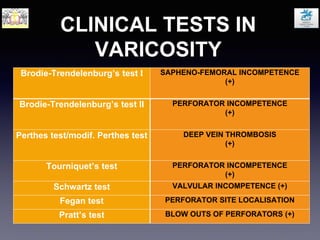
CLINICAL TESTS IN
VARICOSITY
Brodie-Trendelenburg’s test I SAPHENO-FEMORAL INCOMPETENCE
(+)
Brodie-Trendelenburg’s test II PERFORATOR INCOMPETENCE
(+)
Perthes test/modif. Perthes test DEEP VEIN THROMBOSIS
(+)
Tourniquet’s test PERFORATOR INCOMPETENCE
(+)
Schwartz test VALVULAR INCOMPETENCE (+)
Fegan test PERFORATOR SITE LOCALISATION
Pratt’s test BLOW OUTS OF PERFORATORS (+)
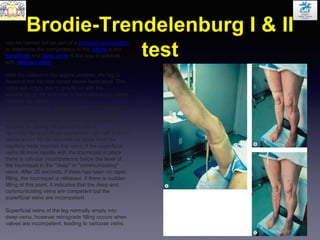
Brodie-Trendelenburg I & II
test
can be carried out as part of a physical examination
to determine the competency of the valves in the
superficial and deep veins of the legs in patients
with varicose veins.
With the patient in the supine position, the leg is
flexed at the hip and raised above heart level. The
veins will empty due to gravity or with the
assistance of the examiner's hand squeezing blood
towards the heart.
A tourniquet is then applied around the upper thigh
to compress the superficial veins but not too tight
as to occlude the deeper veins. The leg is then
lowered by asking the patient to stand.
Normally the superficial saphenous vein will fill from
below within 30–35 seconds as blood from the
capillary beds reaches the veins; if the superficial
veins fill more rapidly with the tourniquet in place
there is valvular incompetence below the level of
the tourniquet in the "deep" or "communicating"
veins. After 20 seconds, if there has been no rapid
filling, the tourniquet is released. If there is sudden
filling at this point, it indicates that the deep and
communicating veins are competent but the
superficial veins are incompetent
Superficial veins of the leg normally empty into
deep veins, however retrograde filling occurs when
valves are incompetent, leading to varicose veins.
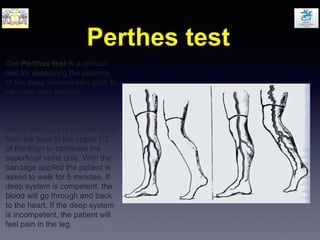
Perthes test
The Perthes test is a clinical
test for assessing the patency
of the deep femoral vein prior to
varicose vein surgery.
The limb is elevated and an
elastic bandage is applied firmly
from the toes to the upper 1/3
of the thigh to obliterate the
superficial veins only. With the
bandage applied the patient is
asked to walk for 5 minutes. If
deep system is competent, the
blood will go through and back
to the heart. If the deep system
is incompetent, the patient will
feel pain in the leg.
Pratt test
Pratt’s sign
The Pratt Test is a simple test to check for deep vein thrombosis in the
leg
It involves having the patient lie supine with the leg bent at the knee,
grasping the calf with both hands and pressing on the popliteal vein in
the proximal calf. If the patient feels pain, it is a sign that a deep vein
thrombosis exists.
Pratt's sign is an indication of femoral deep vein thrombosis. It is seen
as the presence of dilated pretibial veins in the affected leg, which
remain dilated on raising the leg.
INVESTIGATION OF
VARICOSE VEINS
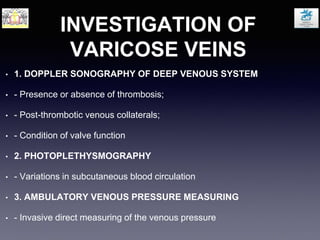
• 1. DOPPLER SONOGRAPHY OF DEEP VENOUS SYSTEM
• - Presence or absence of thrombosis;
• - Post-thrombotic venous collaterals;
• - Condition of valve function
• 2. PHOTOPLETHYSMOGRAPHY
• - Variations in subcutaneous blood circulation
• 3. AMBULATORY VENOUS PRESSURE MEASURING
• - Invasive direct measuring of the venous pressure
VARICOSITY
TREATMENT
• SURGERY:
• - 1. Definitive treatment;
• - 2. More satisfying and long-lasting results.
• NON-SURGICAL METHODS:
• - 1. In patients with contraindications for surgical treatment;
• - 2. In patients with Deep Vein Thrombosis (DVT);
• -3. In patients with mild varicosity disease
VARICOSITY
TREATMENT
• NON-SURGICAL
METHODS/CONSERVATIVE:
• - 1. SCLEROTHERAPY;
• - 2. ELASTIC BANDAGE, STOCKINGS,
GRADED COMPRESSION
STOCKINGS;
• - 3.PERIODIC LOWER LIMB
ELEVATION;
• - 4. WORK-OUT FOR LOW
EXTREMITY MUSCLES
• МEDICAL THERAPY:
• - 1. Venotonics;
• - 2. Flavonoids
VARICOSITY
SURGICAL TREATMENT
• INDICATIONS:
• - 1. Pain;
• - 2. Heaviness discomfort;
• - 3. Cramps;
• - 4. Venosis stasis complications ( pigmentation, dermatitis, induration,
superficial induration and varicosity clotting );
• - 5. Post-traumatic varicosity;
• - 6. Esthetic concerns;
• - 7. Prophylaxis in young patients
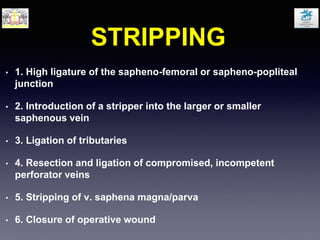
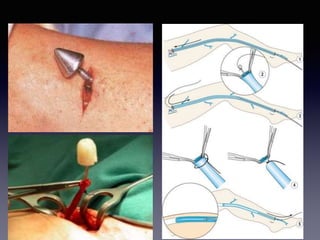
STRIPPING
• 1. High ligature of the sapheno-femoral or sapheno-popliteal
junction
• 2. Introduction of a stripper into the larger or smaller
saphenous vein
• 3. Ligation of tributaries
• 4. Resection and ligation of compromised, incompetent
perforator veins
• 5. Stripping of v. saphena magna/parva
• 6. Closure of operative wound
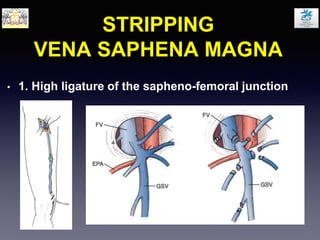
STRIPPING
VENA SAPHENA MAGNA
• 1. High ligature of the sapheno-femoral junction
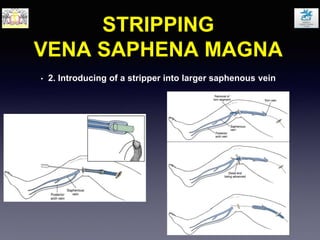
STRIPPING
VENA SAPHENA MAGNA
• 2. Introducing of a stripper into larger saphenous vein
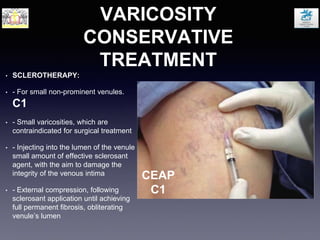
VARICOSITY
CONSERVATIVE
TREATMENT
• SCLEROTHERAPY:
• - For small non-prominent venules.
C1
• - Small varicosities, which are
contraindicated for surgical treatment
• - Injecting into the lumen of the venule
small amount of effective sclerosant
agent, with the aim to damage the
integrity of the venous intima
• - External compression, following
sclerosant application until achieving
full permanent fibrosis, obliterating
venule’s lumen
CEAP
C1
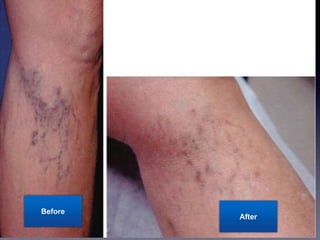
Before
After

Varicose disease varicosity

  • 1.
    VARICOSE DISEASE HRISTO RAHMAN DEPARTMENTOF CARDIAC AND VASCULAR SURGERY MEDICAL UNIVERSITY PLOVDIV
  • 2.
    FUNCTION OF SYSTEMIC VEINS •Main functions of venous system are: • - 1. Returns oxygen-depleted blood from the rest of the body to the RA of the heart; • - 2. Venous system plays dominat role in the regulation of vascular capacity; • - 3. Returns blood towards the heart during physical activity and excercise; • - 4. Contributes to thermoregulation processes of the body
  • 3.
    ANATOMY OF VEINS •Venous wall is composed of circular and longitudinal smooth muscle fibres, and collagen, but is relatively depleted from elastic tissue, compared to arterial wall • Smooth muscle fibres in vein walls are more common in veins of lower extremities, compared to the intra-thoracic veins • In contrast to the arterial system, venous system divides into: SUPERFICIAL, PERFORATOR and DEEP
  • 4.
    ANATOMY OF VEINS SUPERFICIAL,PERFORATOR, DEEP venous systems of lower extremity
  • 5.
    SUPERFICIAL VENOUS SYSTEM • SUPERFICIALVEINS ARE: • - 1. LARGE-CALIBRE; • - 2. HAVE RELATIVELY THICK MUSCLE WALL STRUCTURE; • - 3. LOCATED JUST UNDERNEATH THE SKIN. • MAIN SUPERFICIAL VEINS ARE: • - 1. vena saphena magna & parva; • - 2. vena cephalica & vena basilica; • - 3. vena jugularis externa
  • 6.
    ANATOMY OF VEINS SUPERFICIAL,PERFORATOR, DEEP venous systems of upper extremity
  • 7.
  • 8.
    PERFORATOR VEINS • PERFORATORSconnect the SUPERFICIAL with the DEEP venous system • Perforator veins allow the blood to flow only from the superficial into deep venous system, with an exception - feet area • Perforator veins perforate the fascia, which covers the deep venous system • In the pathophysiology of venous stasis of lower extremities, importance is attrubuted to approximately 6 medial perforator veins of the lower foot, which connect v. saphena magna с v. tibialis posterior • This area suffers the highest venous pressure, and therefore this is a prerequisite for development of venous ulcerations
  • 9.
    PERFORATOR VEINS CLASSIC TERMINOLOGY UPDATED TERMINOLOGY Hunter& Dodd Perforators of the femoral canal Boyd Paratibial proximal perforator Shermann Paratibial perforator '24 cm. перфоратор Paratibial perforator Cockett ( I, II, III ) Posterior tibial perforators (lower,middle,upper) May / Kuster Ankle perforators Perforator veins of lower extremity
  • 10.
    DEEP VENOUS SYSTEM •Deep veins are: • - 1. With thin walls and less smooth-muscle fibres; • - 2. Protected by muscle groups of lower and upper extremities, and the deep fascia; • - 3. Accompany arteries and share identical names; • - 4. Up to 3 times larger in cross-sectional area, compared to superficial veins
  • 11.
    DEEP VENOUS SYSTEM •Relatively large-calibre, thin-walled veins, located within skeletal muscles are called “sinusoid veins” • Sinusoid veins perform an important function in the so called “ lower muscle pump” during walking and exercise. • SINUSOIDS: • - 1. In musculus soleus of lower feet drain into vena tibialis posterior; • - 2. In musculus gastrocnemius - drain into. vena poplitea • In the posterior area of the lower feet intramuscular sinusoids indirectly connect the superficial with the deep venous system
  • 12.
    VENOUS VALVES • Mostimportant anatomical and physiological features of the veins - presence of thin, delicate, but extremely durable bicuspid valves • Valve cusps are situated in sinuses, which allow the cusps to widely open without any contact with the surface of vein walls • Deep veins have more valves compared to superficial veins • While within the distal segments of posterior or anterior tibial veins the valve number varies from 9 -19, proximally their number significantly decreases to no valves present within vena Iliaca и vena cava inferior • In all areas of the upper and lower extremities, valve cusps are oriented in the manner allowing unidirectional blood flow from the periphery to the heart in central direction and thus preventing from venous reflux
  • 13.
    VENOUS PUMP FUNCTION • Componentsof the venous pump are: • - 1. Skeletal muscles of lower and upper extremities; • - 2. Intramuscular venous sinusoids; • - 3. Superficial veins; • - 4. Deep veins. • This venous mechanism is best developed in the lower feet where the sinusoids of m. soleus & m. gastrocnemius compose the major elements of the muscle pump • The contraction of lower feet muscles increases the pressure within the sinusoids up to 200 mmHg
  • 14.
    VENOUS PUMP FUNCTION • Althoughhigher pressure is generated in the deep venous system during muscle contraction, the valves of perforator veins prevent reflux of blood flow from the deep into the superficial venous system • The proper functioning of the venous pump depends on presence of competent valves within the perforator veins • In a normal individual, during prolonged erect and still position, without any movement, the venous pressure within the ankles would stabilise at range 80 - 100 mmHg, but this would definitely lead to oedema development and skin petechiae occurence
  • 15.
    VENOUS PUMP FUNCTION • Thecompetent venous valves prevent from venous reflux and the venous pressure is decreased as a result of emptying by the muscle contractions • The venous pressure then increases again after the collapsed veins fill in from the blood inflow coming from the capillaries and perforator veins
  • 16.
    VENOUS PUMP FUNCTION • Invenous valve insufficiency, the hight of hydrostatic column of blood increases and this leads to retrograde/back flow overload during muscle contraction • Because of this pathological mechanism, the venous pressure of the lower extremities remains high • This, in turn, is an event for oedema development in the lower extremity
  • 17.
    VARICOSITY OF LOWER EXTREMITY PERMANENTLYDILATED, ELONGATED VEINS WITH TORTUOUS PATH CAUSING PATHOLOGICAL CIRCULATION
  • 18.
    VARICOSE VEINS • RISKFACTORS: • - 1. Female; • - 2. Prolonged motionless standing; • - 3. Elevated intra- abdominal pressure; • - 4. Increased progesterone; • - 5. High heels; • - 6. Genetics; • - 7. Obesity
  • 19.
    VARICOSE VEINS CLASSIFICATION ANATOMICAL LOCALISATION SIZE OFVARICES CEAP Classification v. saphena magna THREAD VEINS CLINICAL v. saphena parva RETICULAR VEINS ( 1 - 4 mm. ) ETIOLOGICAL перфоратори VARICOSITY ( > 4 mm. ) ANATOMICAL PATHOPHYSIOLOGICAL
  • 20.
    CEAP Classification C0 C1C2 C3 C4 C5 C6 No clinical signs Telangiectasia or reticular veins Visible and palpable varicosity Venous oedema A. pigmentation/ecsema B. Lipodermatosclerosis /atrophie blanche/ Healed ulcer with changes Active venous ulcer ETIOLOGY - 1. Еc: CONGENITAL; - 2. Ep: PRIMARY; - 3. Es: SECONDARY ( post DVT ) ANATOMY - 1. Аs: superficial veins; - 2. Ad: deep veins; - 3. Ap: perforator veins PATHOPHYSIOLOGY - 1. Pr: Venous reflux; - 2. Po: Obstruction
  • 21.
    KLIPPEL-TRENAUNAY SYNDROME • TRIAD: • -1. Port-wine stain; • - 2. Varicosity; • - 3. Hypertrophy of soft connective tissue and bones
  • 22.
  • 23.
  • 24.
  • 25.
    C4 Trophic changes ofskin and subcutaneous fat tissue C4 a C4 б Lipodermatosclerosis & Atrophie blanche Pigmentation & Eczema
  • 26.
    C5 Healed venous ulcerwith trophic changes
  • 27.
  • 28.
    VARICOSE DISEASE PATHOPHYSIOLOGYVALVE INCOMPETENCE /CHRONICVENOUS HYPERTENSION/ MICROCIRCULATION DYSFUNCTION RED BLOOD CELL DIFFUSION/LYSIS HAEMOSIDERIN DEPOSITION AROUND CAPILLARIES CAPILLARY DAMAGE - DERMATITIS CHRONIC VENOUS ULCERATION
  • 29.
    VARICOSE DISEASE CLINICAL FEATURES •Dragging pain, postural discomfort • Heaviness in legs • Night time cramps • Oedema, itching • Discolouration • Ulceration
  • 30.
    C2 VARICOSITIES • COMPLICATIONS: • -1. Haemorrhage; • - 2. Pigmentation/Eczema; • - 3. Periostitis; • - 4. Venous ulcer; • - 5. Lipodermatosclerosis; • - 6. Talipes Equinovarus; • - 7. Deep vein thrombosis; • - 8. Recurrent thrombophlebitis • - 9. Marjolin ulcer
  • 31.
    VARICOSITY TREATMENT • PURPOSE: • -CORRECTION OF PATHOLOGICAL VENOUS CIRCULATION • - COSMETIC/ESTHETIC PRECAUTION • - ALLEVIATING SYMPTOMS • - PREVENTION OF COMPLICATIONS • PRE-OPERATIVE ASSESSMENT OF FUNCTION: • - 1. DEEP VENOUS SYSTEM; • - 2. ILIO-FEMORAL VEINS; • - 3. PERFORATOR VEINS
  • 32.
    VARICOSITY TREATMENY • IDEAL FORTREATMENT PATIENT MUST MEET FOLLOWING CRITERIA: • - With patent deep veins and competent valves, but with incompetent valves of perforator veins. • GOOD RESULTS AFTER: • - Ligating of perforator veins and Stripping of superficial veins
  • 33.
    VARICOSITY TREATMENT • In patientswith incompetence of all or most of deep vein or perforator vein valves, STRIPPING of superficial veins will be sub-optimal, because of possible recurrence of newly-developed varicosities • Venous valve reconstruction ( Valvuloplasty ) or Transplantation are methods of choice in these patients • Purpose: to restore valve competency of deep veins
  • 37.
    VARICOSITY TREATMENT • Patients withobstructions of blood flow along the deep venous system, despite of the condition of their valves ( competent or incompetent ) are contraindicated for Ligating of superficial veins and Stripping • This will cause: • - 1. Removal of major patent collateral veins; • - 2. Compromise of venous drainage
  • 38.
    INVESTIGATION IN VARICOSITIES • Pre-operativelymust be assessed: • - 1. PATENCY OF DEEP VEINS; • - 2. COMPETENCE OF VALVES • Usually, the deep venous system is patent in absence of prior history of Phlebothrombosis
  • 39.
    CLINICAL TESTS IN VARICOSITY Brodie-Trendelenburg’stest I SAPHENO-FEMORAL INCOMPETENCE (+) Brodie-Trendelenburg’s test II PERFORATOR INCOMPETENCE (+) Perthes test/modif. Perthes test DEEP VEIN THROMBOSIS (+) Tourniquet’s test PERFORATOR INCOMPETENCE (+) Schwartz test VALVULAR INCOMPETENCE (+) Fegan test PERFORATOR SITE LOCALISATION Pratt’s test BLOW OUTS OF PERFORATORS (+)
  • 40.
    Brodie-Trendelenburg I &II test can be carried out as part of a physical examination to determine the competency of the valves in the superficial and deep veins of the legs in patients with varicose veins. With the patient in the supine position, the leg is flexed at the hip and raised above heart level. The veins will empty due to gravity or with the assistance of the examiner's hand squeezing blood towards the heart. A tourniquet is then applied around the upper thigh to compress the superficial veins but not too tight as to occlude the deeper veins. The leg is then lowered by asking the patient to stand. Normally the superficial saphenous vein will fill from below within 30–35 seconds as blood from the capillary beds reaches the veins; if the superficial veins fill more rapidly with the tourniquet in place there is valvular incompetence below the level of the tourniquet in the "deep" or "communicating" veins. After 20 seconds, if there has been no rapid filling, the tourniquet is released. If there is sudden filling at this point, it indicates that the deep and communicating veins are competent but the superficial veins are incompetent Superficial veins of the leg normally empty into deep veins, however retrograde filling occurs when valves are incompetent, leading to varicose veins.
  • 41.
    Perthes test The Perthestest is a clinical test for assessing the patency of the deep femoral vein prior to varicose vein surgery. The limb is elevated and an elastic bandage is applied firmly from the toes to the upper 1/3 of the thigh to obliterate the superficial veins only. With the bandage applied the patient is asked to walk for 5 minutes. If deep system is competent, the blood will go through and back to the heart. If the deep system is incompetent, the patient will feel pain in the leg.
  • 42.
    Pratt test Pratt’s sign ThePratt Test is a simple test to check for deep vein thrombosis in the leg It involves having the patient lie supine with the leg bent at the knee, grasping the calf with both hands and pressing on the popliteal vein in the proximal calf. If the patient feels pain, it is a sign that a deep vein thrombosis exists. Pratt's sign is an indication of femoral deep vein thrombosis. It is seen as the presence of dilated pretibial veins in the affected leg, which remain dilated on raising the leg.
  • 43.
    INVESTIGATION OF VARICOSE VEINS •1. DOPPLER SONOGRAPHY OF DEEP VENOUS SYSTEM • - Presence or absence of thrombosis; • - Post-thrombotic venous collaterals; • - Condition of valve function • 2. PHOTOPLETHYSMOGRAPHY • - Variations in subcutaneous blood circulation • 3. AMBULATORY VENOUS PRESSURE MEASURING • - Invasive direct measuring of the venous pressure
  • 44.
    VARICOSITY TREATMENT • SURGERY: • -1. Definitive treatment; • - 2. More satisfying and long-lasting results. • NON-SURGICAL METHODS: • - 1. In patients with contraindications for surgical treatment; • - 2. In patients with Deep Vein Thrombosis (DVT); • -3. In patients with mild varicosity disease
  • 45.
    VARICOSITY TREATMENT • NON-SURGICAL METHODS/CONSERVATIVE: • -1. SCLEROTHERAPY; • - 2. ELASTIC BANDAGE, STOCKINGS, GRADED COMPRESSION STOCKINGS; • - 3.PERIODIC LOWER LIMB ELEVATION; • - 4. WORK-OUT FOR LOW EXTREMITY MUSCLES • МEDICAL THERAPY: • - 1. Venotonics; • - 2. Flavonoids
  • 46.
    VARICOSITY SURGICAL TREATMENT • INDICATIONS: •- 1. Pain; • - 2. Heaviness discomfort; • - 3. Cramps; • - 4. Venosis stasis complications ( pigmentation, dermatitis, induration, superficial induration and varicosity clotting ); • - 5. Post-traumatic varicosity; • - 6. Esthetic concerns; • - 7. Prophylaxis in young patients
  • 47.
    STRIPPING • 1. Highligature of the sapheno-femoral or sapheno-popliteal junction • 2. Introduction of a stripper into the larger or smaller saphenous vein • 3. Ligation of tributaries • 4. Resection and ligation of compromised, incompetent perforator veins • 5. Stripping of v. saphena magna/parva • 6. Closure of operative wound
  • 48.
    STRIPPING VENA SAPHENA MAGNA •1. High ligature of the sapheno-femoral junction
  • 49.
    STRIPPING VENA SAPHENA MAGNA •2. Introducing of a stripper into larger saphenous vein
  • 53.
    VARICOSITY CONSERVATIVE TREATMENT • SCLEROTHERAPY: • -For small non-prominent venules. C1 • - Small varicosities, which are contraindicated for surgical treatment • - Injecting into the lumen of the venule small amount of effective sclerosant agent, with the aim to damage the integrity of the venous intima • - External compression, following sclerosant application until achieving full permanent fibrosis, obliterating venule’s lumen CEAP C1
  • 54.