Unit - 3 Price & Output
Determination
BasicConcepts
What is Market?
Elements of Market:
Buyers & Sellers
Goods & Service
Price for a product or service at a time
Knowledge about market condition
Bargaining for a price
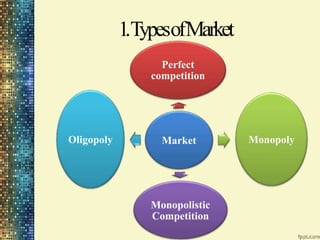
1.TypesofMarket
Perfect
competition
Oligopoly Monopoly
Market
Monopolistic
Competition
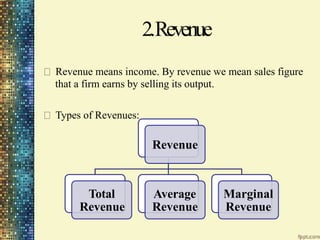
2.Revenue
Revenue means income. By revenue we mean sales figure
that a firm earns by selling its output.
Types of Revenues:
Revenue
Total
Revenue
Average
Revenue
Marginal
Revenue
Total Revenue refers to the amount of money which a
firm realize by selling certain units of commodity.
Average Revenue is the revenue earned per unit of
output.
Marginal Revenue is the change in the Total revenue
resulting from the sake of an additional unit of a
commodity.
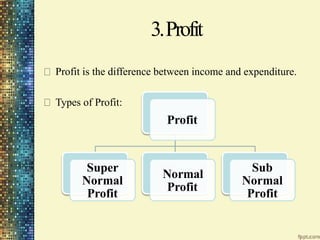
3.Profit
Profit is the difference between income and expenditure.
Types of Profit:
Profit
Super
Normal
Profit
Sub
Normal
Profit
Normal
Profit
Super Normal Profit is an excess profit which is earned
over and above the minimum profit.
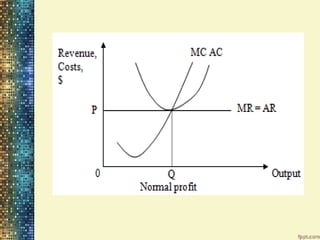
Normal Profit is minimum profit which is earned by the
firm. In this case revenue is equal to the cost.
As per accounting definition normal profit should be zero but
economically the cost includes rent for land, wages to labor,
interest on capital, some minimum profit to entrepreneur ; which
is required to run the business.
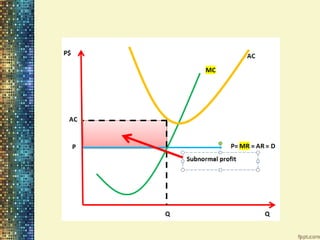
Subnormal profit is called when the revenue is less than
its cost.
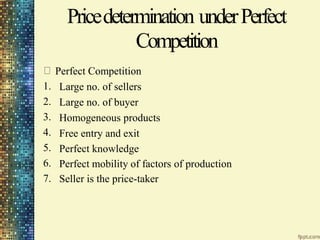
Pricedetermination under
Competition
Perfect Competition
Large no. of sellers
Large no. of buyer
Homogeneous products
Free entry and exit
Perfect knowledge
Perfect
1.
2.
3.
4.
5.
6.
7.
Perfect mobility of factors
Seller is the price-taker
of production
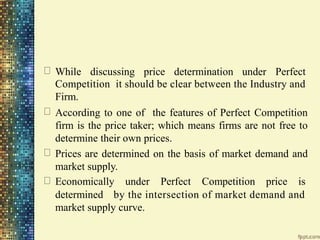
While discussing price determination under Perfect
Competition it should be clear between the Industry and
Firm.
According to one of the features of Perfect Competition
firm is the price taker; which means firms are not free to
determine their own prices.
Prices are determined on the basis of market demand and
market supply.
Economically under Perfect Competition price is
determined by the intersection of market demand and
market supply curve.
Cont.
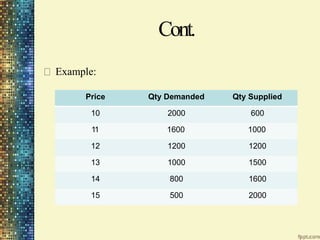
Example:
Price Qty Demanded Qty Supplied
10 2000 600
11 1600 1000
12 1200 1200
13 1000 1500
14 800 1600
15 500 2000
Market Demand Curve represents the summation of
demand curve of all the customers.
Market Supply curve represents the summation of supply
curve of all the firms of the industry.
In Perfect Competition alone demand or only supply can
not fix the price.
Both are required to fix the price.
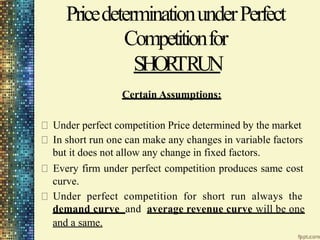
Pricedeterminationunder
Competitionfor
SHOR
TRUN
Perfect
Certain Assumptions:
Under perfect competition Price determined by the market
In short run one can make any changes in variable factors
but it does not allow any change in fixed factors.
Every firm under perfect competition produces same cost
curve.
Under perfect competition for short run always the
demand curve and average revenue curve will be one
and a same.
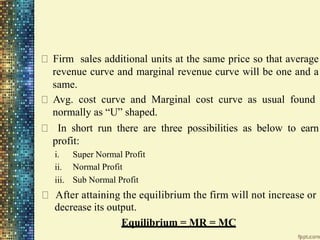
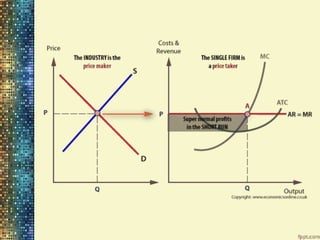
Firm sales additional units at the same price so that average
revenue curve and marginal revenue curve will be one and a
same.
Avg. cost curve and Marginal cost curve as usual found
normally as “U” shaped.
In short run there are three possibilities as below to earn
profit:
i.
ii.
iii.
Super Normal Profit
Normal Profit
Sub Normal Profit
After attaining the equilibrium the firm will not increase or
decrease its output.
Equilibrium = MR = MC
PricedeterminationunderPerfect
Competitionfor
LONGRUN
Long run is that period which allows change in each and
every factor.
Firm can adjust supply according to the change in
demand.
The firm may change the size or scale of operation to
reduce the cost.
It can be possible that some firms may leave the market.
As a result supply becomes perfectly elastic and therefore
supply will change with the change in price.
In long run firm will earn only NORMAL PROFIT.
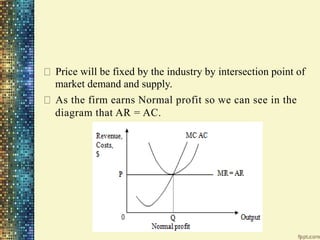
Price will be fixed by the industry by intersection point of
market demand and supply.
As the firm earns Normal profit so we can see in the
diagram that AR = AC.
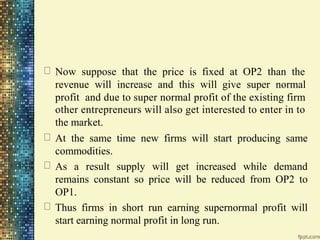
Now suppose that the price is fixed at OP2 than the
revenue will increase and this will give super normal
profit and due to super normal profit of the existing firm
other entrepreneurs will also get interested to enter in to
the market.
At the same time new firms will start producing same
commodities.
As a result supply will get increased while demand
remains constant so price will be reduced from OP2 to
OP1.
Thus firms in short run earning supernormal profit will
start earning normal profit in long run.
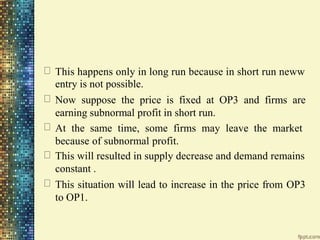
This happens only in long run because in short run neww
entry is not possible.
Now suppose the price is fixed at OP3 and firms are
earning subnormal profit in short run.
At the same time, some firms may leave the market
because of subnormal profit.
This will resulted in supply decrease and demand remains
constant .
This situation will lead to increase in the price from OP3
to OP1.
Pricedeterminationunder
Monopolyfor
SHOR
TRUN
Only one firm producing..
No other seller can enter in to the market
Firm and Industry will be one and a same.
Monopolist is a price maker.
E.g Indian Railway
Features of Monopoly :
1.
2.
3.
4.
5.
6.
Only one seller
Large no. of buyer
No close substitute
No new entry
Monopolist is price maker
Downward slopping demand curve
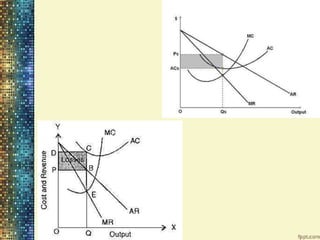
Short run period allows change in variable factors only.
In Monopoly the firm will achieve its equilibrium where
MR = MC
In short run there are three possibilities as below to earn
profit:
i.
ii.
iii.
But
Super Normal Profit
Normal Profit
Sub Normal Profit
generally the firm will earn supernormal profit
because there is no direct competition.
MonopolisticCompetition
Monopolistic competition refers to market structure where
there is keen competition, but not perfect among a group
of large no. of small sellers having some degree of
monopoly power because of their differentiated products.
Thus M.C is a mixture of competition and a certain degree
of monopoly power.
M.C is a market situation in which there is a large no. of
competing monopoly, each one selling a differentiated
product and very close substitute for each other.
Cont.
Features of Monopolistic Market:
Large no. of sellers
Large no. of buyers
Production differentiation
Free entry and exit
Price and Non-price competition [variation, advts.,
promotion]
The group
Two dimensional competition [price and non-price]
MonopolisticCompetitionunderShortRun
Under M.C there is a large no. of sellers, each taking
independent action and having some Monopoly power due
to product differentiation.
Short run is that period which allows change in variable
factors.
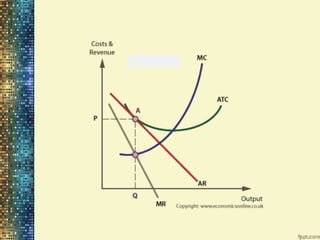
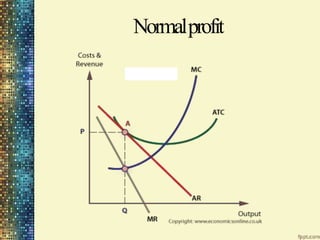
The equilibrium point can be determined where
MR = MC.
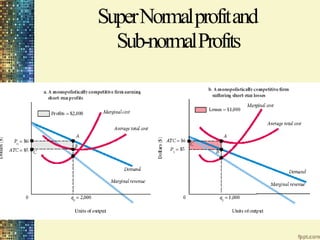
In short run there are three possibilities as below to earn
profit:
i.
ii.
iii.
Super Normal Profit
Normal Profit
Sub Normal Profit
SuperNormalprofitand
Sub-normalProfits
Normalprofit
MonopolisticCompetitionunderLongRun
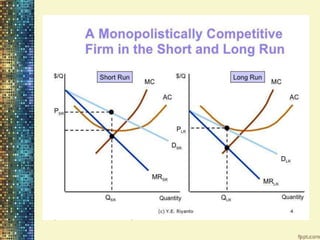
Long run is that period which allows the firm to change ll
the factors of production that is fixed and variable.
If the existing firms are earning super normal profit then
there will be new entry in the market this will be resuled
in the firm will only earn Normal profit.
Thus, total supply of the group will increase.
But compared to supply demand not increased so that the
firm will start selling at a lower price.
Same would be done by the other firms to maintain their
sales.
Thus, he price will increase and super normal profit will
disappear.
On the other hand the firms earning subnormal profit will
exit from the market.
Thus total supply will decrease.
Demand is still the same and there is a decrees in supply
and this will resulted in increase in the prices of the
product.
The result will be normal profit to the existing firms.
Oligopoly
Oligopoly is a situation where a few large firms compete
with each other and there is an element of interdependence
in decision making of those firms.
Any decision the firm makes regarding product, price or
promotion will affect the sales of competitors and so the
result will be counter moves (reactions) from the
competitors.
Features:
Small no. of large sellers
Interdependence
Price Rigidity [reducing or increasing price]
Presence of monopoly element
Advertising

Price and Output Determination.pptx

  • 1.
    Unit - 3Price & Output Determination
  • 2.
    BasicConcepts What is Market? Elementsof Market: Buyers & Sellers Goods & Service Price for a product or service at a time Knowledge about market condition Bargaining for a price
  • 3.
  • 4.
    2.Revenue Revenue means income.By revenue we mean sales figure that a firm earns by selling its output. Types of Revenues: Revenue Total Revenue Average Revenue Marginal Revenue
  • 5.
    Total Revenue refersto the amount of money which a firm realize by selling certain units of commodity. Average Revenue is the revenue earned per unit of output. Marginal Revenue is the change in the Total revenue resulting from the sake of an additional unit of a commodity.
  • 6.
    3.Profit Profit is thedifference between income and expenditure. Types of Profit: Profit Super Normal Profit Sub Normal Profit Normal Profit
  • 7.
    Super Normal Profitis an excess profit which is earned over and above the minimum profit. Normal Profit is minimum profit which is earned by the firm. In this case revenue is equal to the cost. As per accounting definition normal profit should be zero but economically the cost includes rent for land, wages to labor, interest on capital, some minimum profit to entrepreneur ; which is required to run the business. Subnormal profit is called when the revenue is less than its cost.
  • 8.
    Pricedetermination under Competition Perfect Competition Largeno. of sellers Large no. of buyer Homogeneous products Free entry and exit Perfect knowledge Perfect 1. 2. 3. 4. 5. 6. 7. Perfect mobility of factors Seller is the price-taker of production
  • 9.
    While discussing pricedetermination under Perfect Competition it should be clear between the Industry and Firm. According to one of the features of Perfect Competition firm is the price taker; which means firms are not free to determine their own prices. Prices are determined on the basis of market demand and market supply. Economically under Perfect Competition price is determined by the intersection of market demand and market supply curve.
  • 10.
    Cont. Example: Price Qty DemandedQty Supplied 10 2000 600 11 1600 1000 12 1200 1200 13 1000 1500 14 800 1600 15 500 2000
  • 11.
    Market Demand Curverepresents the summation of demand curve of all the customers. Market Supply curve represents the summation of supply curve of all the firms of the industry. In Perfect Competition alone demand or only supply can not fix the price. Both are required to fix the price.
  • 12.
    Pricedeterminationunder Competitionfor SHOR TRUN Perfect Certain Assumptions: Under perfectcompetition Price determined by the market In short run one can make any changes in variable factors but it does not allow any change in fixed factors. Every firm under perfect competition produces same cost curve. Under perfect competition for short run always the demand curve and average revenue curve will be one and a same.
  • 13.
    Firm sales additionalunits at the same price so that average revenue curve and marginal revenue curve will be one and a same. Avg. cost curve and Marginal cost curve as usual found normally as “U” shaped. In short run there are three possibilities as below to earn profit: i. ii. iii. Super Normal Profit Normal Profit Sub Normal Profit After attaining the equilibrium the firm will not increase or decrease its output. Equilibrium = MR = MC
  • 17.
    PricedeterminationunderPerfect Competitionfor LONGRUN Long run isthat period which allows change in each and every factor. Firm can adjust supply according to the change in demand. The firm may change the size or scale of operation to reduce the cost. It can be possible that some firms may leave the market. As a result supply becomes perfectly elastic and therefore supply will change with the change in price. In long run firm will earn only NORMAL PROFIT.
  • 18.
    Price will befixed by the industry by intersection point of market demand and supply. As the firm earns Normal profit so we can see in the diagram that AR = AC.
  • 19.
    Now suppose thatthe price is fixed at OP2 than the revenue will increase and this will give super normal profit and due to super normal profit of the existing firm other entrepreneurs will also get interested to enter in to the market. At the same time new firms will start producing same commodities. As a result supply will get increased while demand remains constant so price will be reduced from OP2 to OP1. Thus firms in short run earning supernormal profit will start earning normal profit in long run.
  • 20.
    This happens onlyin long run because in short run neww entry is not possible. Now suppose the price is fixed at OP3 and firms are earning subnormal profit in short run. At the same time, some firms may leave the market because of subnormal profit. This will resulted in supply decrease and demand remains constant . This situation will lead to increase in the price from OP3 to OP1.
  • 21.
    Pricedeterminationunder Monopolyfor SHOR TRUN Only one firmproducing.. No other seller can enter in to the market Firm and Industry will be one and a same. Monopolist is a price maker. E.g Indian Railway
  • 22.
    Features of Monopoly: 1. 2. 3. 4. 5. 6. Only one seller Large no. of buyer No close substitute No new entry Monopolist is price maker Downward slopping demand curve
  • 23.
    Short run periodallows change in variable factors only. In Monopoly the firm will achieve its equilibrium where MR = MC In short run there are three possibilities as below to earn profit: i. ii. iii. But Super Normal Profit Normal Profit Sub Normal Profit generally the firm will earn supernormal profit because there is no direct competition.
  • 26.
    MonopolisticCompetition Monopolistic competition refersto market structure where there is keen competition, but not perfect among a group of large no. of small sellers having some degree of monopoly power because of their differentiated products. Thus M.C is a mixture of competition and a certain degree of monopoly power. M.C is a market situation in which there is a large no. of competing monopoly, each one selling a differentiated product and very close substitute for each other.
  • 27.
    Cont. Features of MonopolisticMarket: Large no. of sellers Large no. of buyers Production differentiation Free entry and exit Price and Non-price competition [variation, advts., promotion] The group Two dimensional competition [price and non-price]
  • 28.
    MonopolisticCompetitionunderShortRun Under M.C thereis a large no. of sellers, each taking independent action and having some Monopoly power due to product differentiation. Short run is that period which allows change in variable factors. The equilibrium point can be determined where MR = MC. In short run there are three possibilities as below to earn profit: i. ii. iii. Super Normal Profit Normal Profit Sub Normal Profit
  • 29.
  • 30.
  • 31.
    MonopolisticCompetitionunderLongRun Long run isthat period which allows the firm to change ll the factors of production that is fixed and variable. If the existing firms are earning super normal profit then there will be new entry in the market this will be resuled in the firm will only earn Normal profit. Thus, total supply of the group will increase. But compared to supply demand not increased so that the firm will start selling at a lower price. Same would be done by the other firms to maintain their sales. Thus, he price will increase and super normal profit will disappear.
  • 33.
    On the otherhand the firms earning subnormal profit will exit from the market. Thus total supply will decrease. Demand is still the same and there is a decrees in supply and this will resulted in increase in the prices of the product. The result will be normal profit to the existing firms.
  • 34.
    Oligopoly Oligopoly is asituation where a few large firms compete with each other and there is an element of interdependence in decision making of those firms. Any decision the firm makes regarding product, price or promotion will affect the sales of competitors and so the result will be counter moves (reactions) from the competitors.
  • 35.
    Features: Small no. oflarge sellers Interdependence Price Rigidity [reducing or increasing price] Presence of monopoly element Advertising