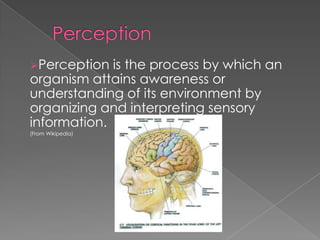

Perception is the process by which an
organism attains awareness or
understanding of its environment by
organizing and interpreting sensory
information.
(From Wikipedia)
In living our lives and communicating with
each other our perception of reality is less
important than reality itself.
Our perceptions are influence by:
› Physical elements - what information your
eye or ear can actually take in, how your
brain processes it.
› Environmental elements - what information is
out there to receive, its context.
› Learned elements - culture, personality,
habit: what filters we use to select what we
take in and how we react to it.
 Everyone will not perceive "red" the way
as others do. All may physically see "red"
similarly, but will interpret it culturally:
 Red means "stop" or "anger" or
"excitement" or "in debt" (US).
 Red means "good fortune" (China).
THANK YOU

Perception & the influencing factors

  • 2.
    Perception is theprocess by which an organism attains awareness or understanding of its environment by organizing and interpreting sensory information. (From Wikipedia)
  • 3.
    In living ourlives and communicating with each other our perception of reality is less important than reality itself. Our perceptions are influence by: › Physical elements - what information your eye or ear can actually take in, how your brain processes it. › Environmental elements - what information is out there to receive, its context. › Learned elements - culture, personality, habit: what filters we use to select what we take in and how we react to it.
  • 4.
     Everyone willnot perceive "red" the way as others do. All may physically see "red" similarly, but will interpret it culturally:  Red means "stop" or "anger" or "excitement" or "in debt" (US).  Red means "good fortune" (China).
  • 6.