Group 2
(FERRERO FACTION)
MBA - FC 1st Sem. (2016)
 Environmental stimuli
 Observation
 Perceptual selection
 Perceptual organization
 Interpretation
 response
ExtErnal
EnvironmEnt
Physical
EnvironmEnt
sociocultural
EnvironmEnt
confrontation rEgistration intErPrEtation
fEEdback
bEhaviorconsEquEncEs
 Figure-ground
 Perceptual Grouping
 Closure
 Continuity
 Proximity
 Similarity
 Perceptual Constancy
 Perceptual Context
 Perceptual Defense
 figurE-ground:
In perceiving stimuli or phenomena, the
tendency is to keep certain phenomena
in focus and other phenomena in
background.
 An individual tends to group several
stimuli together into a recognizable
pattern.
various forms :
 Closure
 Continuity
 Proximity
 Similarity
The perception of elements like size, shape,
color, brightness and location of an object
remains constant and does not change from
individual to individual.
 Example: Photograph
PErcEPtual contExt
It provides meaning and value to objects,
events, situation and other people in the
environment.
 It refers to the screening of those
elements which create conflict and
threatening situation in people.
attitudE
Evaluative statements or judgments
concerning objects, people or value.
reflect how we feel about
something.
It reflects stimuli that cause to
perform particular action.
states goals, purpose perceived by
perceiver from event, situation, etc.
 State that anticipation of a particular
behavior from a person .
 Affects what a person perceives.
 Experience and knowledge serve as basis
for perception. While one’s successful
experience enhance his/her perceptive
ability, failure erodes his/her self
confidence. Successful experience also
helps perceiver understand stimuli with
more accuracy.
Time
Time perception is a construction of the
brain that can also be manipulated and
studied through a variety of
experiments.
What are the factors that affect your
perception of how time passes?
Level of fatigue
Level of Concentration
Depression & Happiness
 “Social perception is that part of perception
that allows people to understand the other
people in their social world.”
 Social perceptions can obviously be flawed -
even skilled observers can misperceive,
misjudge, and reach the wrong conclusions.
Once we form wrong impressions, they are
likely to persist.
 Try this exercise. Look at each umbrella
image. Is the message of each image
different? If so, what makes the message
different?
 People gives more attention to moving
objects than the stationery objects.
 Example:
 Moving object Stationery
object
 Sound level or noise level is a physical
quantity measured with measuring
instruments.
Loudness is a psycho-physical sensation
perceived by the human auditory perception
or the human ear/brain mechanism. That is
not the same.
 Furthermore, for speech, music, and many
other sounds, the physical characteristics
of the sound produce hearing sensations in
the listener. TV advertisement, Radio
advertisement.
Larger object is more likely to be
noticed than a smaller Object.
Example:
 Which you can read fast?
God is great God is great
 Proximity or geographical proximity is
an important factor for formation of
groups. For the same reason an
individual behavior may be perceived to
be group behavior.
 how items that are similar in some
way tend to be grouped together. On
similarities and differences in
cultural perceptions of the
environment.
SelecTive percepTion
People selectively interpret what they see
on the basis of their interests, background,
experience and attitudes. As the people can
sense only limited amount of information in
the environment, they are
characteristically selective.
 When people read a newspaper, they don’t
read the entire newspaper but only those
news which interest them.
(similar things happen in other cases too.)
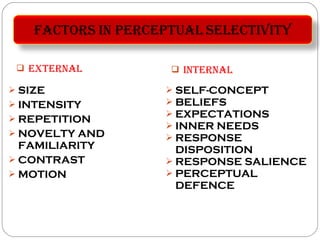
 This is known as perceptual selectivity.
This is caused by a variety of factors which
may be grouped into two categories;-
 External and
 Internal.
 ExtErnal  IntErnal
 SIZE
 INTENSITY
 REPETITION
 NOVELTY AND
FAMILIARITY
 CONTRAST
 MOTION
 SELF-CONCEPT
 BELIEFS
 EXPECTATIONS
 INNER NEEDS
 RESPONSE
DISPOSITION
 RESPONSE SALIENCE
 PERCEPTUAL
DEFENCE
 Figure-Ground
 Grouping
 Proximity
 Similarity
 Simplification
 closure
 The managers must recognize that facts people
do not perceive as meaningful usually will not
influence their behavior, whereas the things
they believe to be real, even though factually
incorrect or non-existent, will influence it.
 Three major areas which require special
attention so far as the perceptual accuracy
is concerned-
 Interpersonal working relationship
 Selection of employees
 Performance appraisal.
 Perceiving oneself
accurately
 Enhancing self-concept
 Having positive attitudes
 Being Empathic
 Communicating more openly
 Avoiding common perceptual
Distortions
 It is directly concerned with how one
individual perceives other individuals;
how we get to know others.
Attribution refers to how people
explain the cause of another’s or
their own behavior.
 The determination depends on
three factors:
 Distinctiveness
 Consensus
 Consistency
Judging someone on the basis of
one’s perception of The group to
which that person belongs.
 The Italians are quick-tempered
 Chinese are inscrutable
 Japanese are industrious
 Americans are materialistic and ambitious
 Blacks are musical and athletes
 Fat men are jolly
Tendency to draw a general impression
about an individual on the basis of a
single characteristic.
 Halo effect is just like 1st impression is Last
impression
 Like people having good quality and dislike
those who have bad qualities. People may be
judged by their work not by their dress
 People may be judged by their result not by
their attendance
Evaluation of a person’s characteristic
that is affected by comparisons with other
people recently encountered who rank
higher or lower on the same
characteristic.
Attributing’ one’s own
characteristic to other people
Chapter-541
Chapter-5
Chapter-543
Chapter-544
Chapter-549
Chapter-550
Chapter-5
Chapter-5
Perception
Perception

Perception

  • 1.
    Group 2 (FERRERO FACTION) MBA- FC 1st Sem. (2016)
  • 3.
     Environmental stimuli Observation  Perceptual selection  Perceptual organization  Interpretation  response
  • 4.
  • 5.
     Figure-ground  PerceptualGrouping  Closure  Continuity  Proximity  Similarity  Perceptual Constancy  Perceptual Context  Perceptual Defense
  • 6.
     figurE-ground: In perceivingstimuli or phenomena, the tendency is to keep certain phenomena in focus and other phenomena in background.
  • 7.
     An individualtends to group several stimuli together into a recognizable pattern. various forms :  Closure  Continuity  Proximity  Similarity
  • 8.
    The perception ofelements like size, shape, color, brightness and location of an object remains constant and does not change from individual to individual.  Example: Photograph PErcEPtual contExt It provides meaning and value to objects, events, situation and other people in the environment.
  • 9.
     It refersto the screening of those elements which create conflict and threatening situation in people.
  • 11.
    attitudE Evaluative statements orjudgments concerning objects, people or value. reflect how we feel about something.
  • 12.
    It reflects stimulithat cause to perform particular action. states goals, purpose perceived by perceiver from event, situation, etc.
  • 14.
     State thatanticipation of a particular behavior from a person .  Affects what a person perceives.
  • 15.
     Experience andknowledge serve as basis for perception. While one’s successful experience enhance his/her perceptive ability, failure erodes his/her self confidence. Successful experience also helps perceiver understand stimuli with more accuracy.
  • 16.
    Time Time perception isa construction of the brain that can also be manipulated and studied through a variety of experiments. What are the factors that affect your perception of how time passes? Level of fatigue Level of Concentration Depression & Happiness
  • 18.
     “Social perceptionis that part of perception that allows people to understand the other people in their social world.”  Social perceptions can obviously be flawed - even skilled observers can misperceive, misjudge, and reach the wrong conclusions. Once we form wrong impressions, they are likely to persist.
  • 19.
     Try thisexercise. Look at each umbrella image. Is the message of each image different? If so, what makes the message different?
  • 21.
     People givesmore attention to moving objects than the stationery objects.  Example:  Moving object Stationery object
  • 22.
     Sound levelor noise level is a physical quantity measured with measuring instruments. Loudness is a psycho-physical sensation perceived by the human auditory perception or the human ear/brain mechanism. That is not the same.  Furthermore, for speech, music, and many other sounds, the physical characteristics of the sound produce hearing sensations in the listener. TV advertisement, Radio advertisement.
  • 23.
    Larger object ismore likely to be noticed than a smaller Object. Example:  Which you can read fast? God is great God is great
  • 25.
     Proximity orgeographical proximity is an important factor for formation of groups. For the same reason an individual behavior may be perceived to be group behavior.
  • 27.
     how itemsthat are similar in some way tend to be grouped together. On similarities and differences in cultural perceptions of the environment.
  • 28.
    SelecTive percepTion People selectivelyinterpret what they see on the basis of their interests, background, experience and attitudes. As the people can sense only limited amount of information in the environment, they are characteristically selective.
  • 29.
     When peopleread a newspaper, they don’t read the entire newspaper but only those news which interest them. (similar things happen in other cases too.)  This is known as perceptual selectivity. This is caused by a variety of factors which may be grouped into two categories;-  External and  Internal.
  • 30.
     ExtErnal IntErnal  SIZE  INTENSITY  REPETITION  NOVELTY AND FAMILIARITY  CONTRAST  MOTION  SELF-CONCEPT  BELIEFS  EXPECTATIONS  INNER NEEDS  RESPONSE DISPOSITION  RESPONSE SALIENCE  PERCEPTUAL DEFENCE
  • 31.
     Figure-Ground  Grouping Proximity  Similarity  Simplification  closure
  • 32.
     The managersmust recognize that facts people do not perceive as meaningful usually will not influence their behavior, whereas the things they believe to be real, even though factually incorrect or non-existent, will influence it.  Three major areas which require special attention so far as the perceptual accuracy is concerned-  Interpersonal working relationship  Selection of employees  Performance appraisal.
  • 33.
     Perceiving oneself accurately Enhancing self-concept  Having positive attitudes  Being Empathic  Communicating more openly  Avoiding common perceptual Distortions
  • 34.
     It isdirectly concerned with how one individual perceives other individuals; how we get to know others.
  • 35.
    Attribution refers tohow people explain the cause of another’s or their own behavior.  The determination depends on three factors:  Distinctiveness  Consensus  Consistency
  • 36.
    Judging someone onthe basis of one’s perception of The group to which that person belongs.
  • 37.
     The Italiansare quick-tempered  Chinese are inscrutable  Japanese are industrious  Americans are materialistic and ambitious  Blacks are musical and athletes  Fat men are jolly
  • 38.
    Tendency to drawa general impression about an individual on the basis of a single characteristic.  Halo effect is just like 1st impression is Last impression  Like people having good quality and dislike those who have bad qualities. People may be judged by their work not by their dress  People may be judged by their result not by their attendance
  • 39.
    Evaluation of aperson’s characteristic that is affected by comparisons with other people recently encountered who rank higher or lower on the same characteristic.
  • 40.
  • 41.
  • 42.
  • 43.
  • 44.
  • 49.
  • 50.
  • 51.
  • 54.