INTRODUCTION
• The origins of Pepsi date back to the late 19th century when a
young pharmacist Caleb Bradham started selling a refreshing drink
called ‘Brad’s Drink’ in his pharmacy.
• The drink was later renamed Pepsi-Cola after the digestive enzyme
pepsin used in the recipe
• The sales of Pepsi soon started to increase.
• This convinced Bradham to form a company called the Pepsi-Cola
Company
• Bradham got an official patent for the drink in 1903 and then started
to sell it in bottles
• Pepsi Cola Company was declared bankrupt for a second time in
the year 1931 as the Great Depression affected its sales.
• Pepsi’s fortunes changed when its assets were purchased by a
successful candy manufacturer Charles G. Guth (Guth).
• Guth had been thinking of selling his own soft drink at his stores
after Coca Cola declined to give him a discount on its drinks.
• He reformulated the Pepsi formula and started to sell it in 12-
ounce bottles at a cheaper price than its competitors.
•
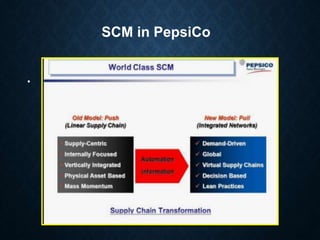
SCM in PepsiCo
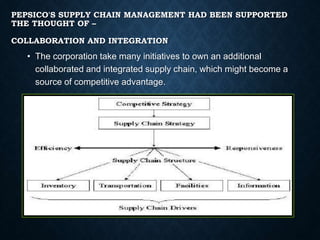
PEPSICO'S SUPPLY CHAIN MANAGEMENT HAD BEEN SUPPORTED
THE THOUGHT OF –
COLLABORATION AND INTEGRATION
• The corporation take many initiatives to own an additional
collaborated and integrated supply chain, which might become a
source of competitive advantage.
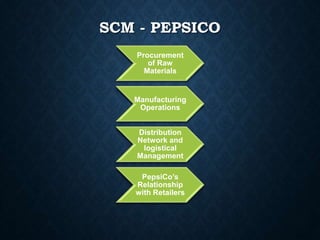
SCM - PEPSICO
Procurement
of Raw
Materials
Manufacturing
Operations
Distribution
Network and
logistical
Management
PepsiCo’s
Relationship
with Retailers
Road Ahead
• As of 2011, PepsiCo was continued with its efforts within the direction of getting a
well managed supply chain and of strengthening its relationship with all its supply
chain partners.
• In January 2011, PepsiCo modified the distribution system of its Gatorade products
from warehouse delivery to “Direct to store” at convenience stores through each
company- owned freelance bottler within the United States and Canada.
IMPROVEMENT WITH USING JUST-IN-TIME (JIT)
The Pepsi brand and different Pepsi-Cola product accounted for nearly one-third of the
entire soft drink sales within the US.
So as to confirm that PepsiCo’s concentrates reaches bottlers as needed in throughout
manufacturing had to achieve them JIT, they partnered with 3PL provider Penske
Logistics to manage its transportation.
Penske additionally provides warehouse management for two Pepsi distribution centres
in North America.
DIRECT TO STORE DELIVERY
MODEL - DEFINITION
Direct to Store Delivery (DSD) is a form of distribution where the
distributor/supplier delivers directly to the retail store.
DSD is a business process that manufacturers use to both sell and
distribute goods directly to point of sales (PoS) or point of
consumption (PoC) including additional product and market related
services such as merchandising, information gathering, or equipment
service and bypassing any retailer or wholesaler logistics.
A company that performs DSD does not send goods to any locations
using any independent third party actor – neither an independent
wholesaler, nor the retailer‘s own warehouses.
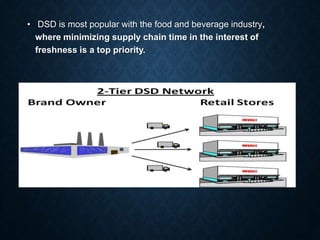
• DSD is most popular with the food and beverage industry,
where minimizing supply chain time in the interest of
freshness is a top priority.
DIRECT TO STORE DELIVERY
MODEL
• DSD allows retailers to reduce operating costs by sidestepping
the retailer’s distribution center.
• Instead, goods travel directly from the the supplier to the retail
store, saving time and money off of the retailer’s bottom line.
• Additionally, bypassing the distribution center and communicating
directly with the supplier gives retailers greater control over their
inventory, which in turn can drive sales growth.
• From the supplier’s perspective, DSD represents a commitment
to remain flexible and responsive, adjusting deliveries to meet
the changing wants and needs of the end customer.
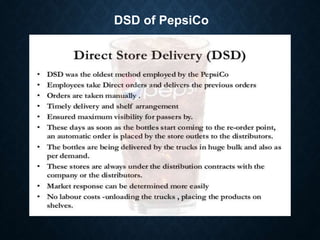
DSD of PepsiCo
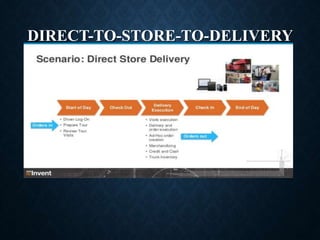
DIRECT-TO-STORE-TO-DELIVERY
MODEL:
BENEFITS OF THE “DIRECT TO STORE
DELIVERY MODEL:
• Direct store delivery (or DSD). Under the DSD system, the
company, its bottlers, and distributors deliver products
directly to retail stores, DSD offers PepsiCo the most
visibility. This channel is also more suitable for products
that are restocked often and sensitive to in-store
promotions.
• PepsiCo uses direct store delivery (DSD) for its supply
chain and distribution network, which ensures that
independent bottlers and distributors deliver beverages,
snacks, and foods directly to retails stores. DSD ensures
faster restock better in-store promotion and maximum
visibility.
EXPLAIN THE PEPSICO’S COLLABORATIVE
SUPPLIER RELATIONSHIP
• PepsiCo’s supply chain management and product flow has three main
components; direct to store delivery model, and the idea of collaboration and
integration
• Disregarding the direct to store delivery model, taking initiative to have a more
collaborated and integrated supply chain becomes a source of competitive
advantage.
• PepsiCo employed many technologies. Distribution strategies are used to bring
products to the market depending on the product characteristic, local trade
practices and customers’ needs.
• Fragile and perishable products are delivered from its manufacturing plant and
warehouses to customer warehouses and retail stores
• Third parties and food services and vending distributors are used to distribute its
snacks, foods, and beverage to restaurants, schools, stadiums, businesses and other
locations.
• All of these technologies are controlled by integrated systems that keep all information
such as; delivery dates, products types and product amounts.
• Taking initiative to have a collaborated supply chain, PepsiCo establish a relationship
with their retailers and customers by proposing them better product lines.
• Products of PepsiCo are dependable on raw agricultural materials to meet our
demands and consumers' expectations in which they are inexpensive and premium
quality.
• With new opportunities always rising, the company has to stay on top of greenhouse
gas management and worldwide food supplies.
• These include an international supply chain which includes independent farmers,
intermediaries and also farms which are company owned.
• The company has their own code of conduct for suppliers called The
PepsiCo Global Procurement Supplier Social Capability Management
Program. It is to make sure all their suppliers understand and abide by
the terms of the conduct.
• There are four dimensions PepsiCo has for supplier standards:
• 1. Accountability for Supplier Code of Conduct (SCoC)
• 2. Engaging through code training
• 3. Reviewing of CSR risks
• 4. Improvement through third party audit/corrective management
• To meet the code of conducts, all suppliers are given the Supplier Code of
Conduct (SCoC) in the initial contracts to guarantee accountability.
• The company also engages each supplier in proper training so there is no
confusion with the SCoC and suppliers manage to do business properly.
• This is done through meetings face-to-face, videos or online. Assessment is also
done to make sure suppliers and their sites need more training. The goal of the
company is to keep the PepsiCo brand safe and highly reputable. PepsiCo has
translated the SCoC into more than 25 languages to make it globally accessible
for all suppliers.
• In its business, diversity and inclusion provide a competitive advantage that
drives business results.
• Its brands appeal to an extraordinarily diverse array of customers and they
are sold by an equally diverse group of retailers.
• It understands the needs of our consumers and customers
• Uses diversity in our supplier base and in everything we do.
• Commitment to purchase from a supplier base representative of our
employees, consumers, retail customers and communities.
• Developing partnerships with minority-owned and women-owned suppliers
helps us build the world-class supplier base we need.
• Creates mutually beneficial relationships that expand PepsiCo's sphere of
activity. It helps build community infrastructure by providing employment,
training, role models, buying from other minority and women-owned
business and supporting community organizations.
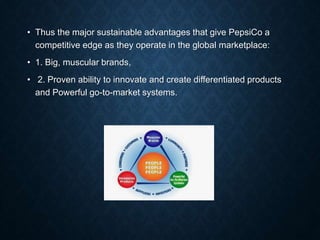
• Thus the major sustainable advantages that give PepsiCo a
competitive edge as they operate in the global marketplace:
• 1. Big, muscular brands,
• 2. Proven ability to innovate and create differentiated products
and Powerful go-to-market systems.
• Pepsi Bottling
• The challenge
• The plant uses a variety of sensors to monitor bottles as they travel through
the sequence of steps and to manage the flow to the individual stations.
• Line sensors match the speed of the conveyor. The company’s inventory of
sensors swelled over the years to include more than 120 different varieties.
• Many of these included multiple styles of the same product stocked under
different brands. A similar problem was developing with its drives inventory,
which had grown to over 50 different part numbers.
• The Solution -
• The first task undertaken by Rockwell Automation was to conduct an
Installed Base Evaluation – a plant-wide inventory assessment to
determine the exact number of sensors and drives the plant
currently had in stock.
• Next it needed to figure out what products were actually needed and
which ones could be eliminated.
• To streamline its operation, Rockwell Automation recommended that
Pepsi standardize its entire sensors inventory on Allen - Bradley
products.
• The results -
• Leveraging Rockwell Automation Services & Support has proved to
be a smart decision for Pepsi Bottling Group. The improved
inventory and parts management capabilities helped reduce
downtime and inventory costs
• LIMITATIONS OF PEPSICO SUPPLY CHAIN OVER COKE
• 1. PepsiCo has duplicate distribution systems for its beverages. Coca-Cola
has for the most part maintained distribution of its entire beverage line-up
through its bottlers.
• 2. Pepsi bottling system is more fragmented than Coca-Cola's.
• 3. In a consolidated system negotiations involve fewer players and therefore
take less time to gain agreement, which may be why the Pepsi system has
lagged in system efficiency efforts.
• PepsiCo and its bottlers have established a purchasing cooperative to gain
purchasing power in buying raw materials.
• 4. While PepsiCo has been pursuing international beverage acquisitions,
those investments will take time to produce significant operating income
• 5. PepsiCo consolidation puts pressure on the independent system bottlers
to more readily consider agreements for warehouse distribution.
THANKYOU

Pepsico

  • 2.
    INTRODUCTION • The originsof Pepsi date back to the late 19th century when a young pharmacist Caleb Bradham started selling a refreshing drink called ‘Brad’s Drink’ in his pharmacy. • The drink was later renamed Pepsi-Cola after the digestive enzyme pepsin used in the recipe • The sales of Pepsi soon started to increase. • This convinced Bradham to form a company called the Pepsi-Cola Company • Bradham got an official patent for the drink in 1903 and then started to sell it in bottles
  • 3.
    • Pepsi ColaCompany was declared bankrupt for a second time in the year 1931 as the Great Depression affected its sales. • Pepsi’s fortunes changed when its assets were purchased by a successful candy manufacturer Charles G. Guth (Guth). • Guth had been thinking of selling his own soft drink at his stores after Coca Cola declined to give him a discount on its drinks. • He reformulated the Pepsi formula and started to sell it in 12- ounce bottles at a cheaper price than its competitors.
  • 4.
  • 5.
    PEPSICO'S SUPPLY CHAINMANAGEMENT HAD BEEN SUPPORTED THE THOUGHT OF – COLLABORATION AND INTEGRATION • The corporation take many initiatives to own an additional collaborated and integrated supply chain, which might become a source of competitive advantage.
  • 6.
    SCM - PEPSICO Procurement ofRaw Materials Manufacturing Operations Distribution Network and logistical Management PepsiCo’s Relationship with Retailers
  • 7.
    Road Ahead • Asof 2011, PepsiCo was continued with its efforts within the direction of getting a well managed supply chain and of strengthening its relationship with all its supply chain partners. • In January 2011, PepsiCo modified the distribution system of its Gatorade products from warehouse delivery to “Direct to store” at convenience stores through each company- owned freelance bottler within the United States and Canada. IMPROVEMENT WITH USING JUST-IN-TIME (JIT) The Pepsi brand and different Pepsi-Cola product accounted for nearly one-third of the entire soft drink sales within the US. So as to confirm that PepsiCo’s concentrates reaches bottlers as needed in throughout manufacturing had to achieve them JIT, they partnered with 3PL provider Penske Logistics to manage its transportation. Penske additionally provides warehouse management for two Pepsi distribution centres in North America.
  • 8.
    DIRECT TO STOREDELIVERY MODEL - DEFINITION Direct to Store Delivery (DSD) is a form of distribution where the distributor/supplier delivers directly to the retail store. DSD is a business process that manufacturers use to both sell and distribute goods directly to point of sales (PoS) or point of consumption (PoC) including additional product and market related services such as merchandising, information gathering, or equipment service and bypassing any retailer or wholesaler logistics. A company that performs DSD does not send goods to any locations using any independent third party actor – neither an independent wholesaler, nor the retailer‘s own warehouses.
  • 9.
    • DSD ismost popular with the food and beverage industry, where minimizing supply chain time in the interest of freshness is a top priority.
  • 10.
    DIRECT TO STOREDELIVERY MODEL • DSD allows retailers to reduce operating costs by sidestepping the retailer’s distribution center. • Instead, goods travel directly from the the supplier to the retail store, saving time and money off of the retailer’s bottom line. • Additionally, bypassing the distribution center and communicating directly with the supplier gives retailers greater control over their inventory, which in turn can drive sales growth. • From the supplier’s perspective, DSD represents a commitment to remain flexible and responsive, adjusting deliveries to meet the changing wants and needs of the end customer.
  • 11.
  • 12.
  • 13.
    BENEFITS OF THE“DIRECT TO STORE DELIVERY MODEL: • Direct store delivery (or DSD). Under the DSD system, the company, its bottlers, and distributors deliver products directly to retail stores, DSD offers PepsiCo the most visibility. This channel is also more suitable for products that are restocked often and sensitive to in-store promotions. • PepsiCo uses direct store delivery (DSD) for its supply chain and distribution network, which ensures that independent bottlers and distributors deliver beverages, snacks, and foods directly to retails stores. DSD ensures faster restock better in-store promotion and maximum visibility.
  • 14.
    EXPLAIN THE PEPSICO’SCOLLABORATIVE SUPPLIER RELATIONSHIP • PepsiCo’s supply chain management and product flow has three main components; direct to store delivery model, and the idea of collaboration and integration • Disregarding the direct to store delivery model, taking initiative to have a more collaborated and integrated supply chain becomes a source of competitive advantage. • PepsiCo employed many technologies. Distribution strategies are used to bring products to the market depending on the product characteristic, local trade practices and customers’ needs. • Fragile and perishable products are delivered from its manufacturing plant and warehouses to customer warehouses and retail stores
  • 15.
    • Third partiesand food services and vending distributors are used to distribute its snacks, foods, and beverage to restaurants, schools, stadiums, businesses and other locations. • All of these technologies are controlled by integrated systems that keep all information such as; delivery dates, products types and product amounts. • Taking initiative to have a collaborated supply chain, PepsiCo establish a relationship with their retailers and customers by proposing them better product lines. • Products of PepsiCo are dependable on raw agricultural materials to meet our demands and consumers' expectations in which they are inexpensive and premium quality. • With new opportunities always rising, the company has to stay on top of greenhouse gas management and worldwide food supplies. • These include an international supply chain which includes independent farmers, intermediaries and also farms which are company owned.
  • 16.
    • The companyhas their own code of conduct for suppliers called The PepsiCo Global Procurement Supplier Social Capability Management Program. It is to make sure all their suppliers understand and abide by the terms of the conduct. • There are four dimensions PepsiCo has for supplier standards: • 1. Accountability for Supplier Code of Conduct (SCoC) • 2. Engaging through code training • 3. Reviewing of CSR risks • 4. Improvement through third party audit/corrective management • To meet the code of conducts, all suppliers are given the Supplier Code of Conduct (SCoC) in the initial contracts to guarantee accountability. • The company also engages each supplier in proper training so there is no confusion with the SCoC and suppliers manage to do business properly. • This is done through meetings face-to-face, videos or online. Assessment is also done to make sure suppliers and their sites need more training. The goal of the company is to keep the PepsiCo brand safe and highly reputable. PepsiCo has translated the SCoC into more than 25 languages to make it globally accessible for all suppliers.
  • 17.
    • In itsbusiness, diversity and inclusion provide a competitive advantage that drives business results. • Its brands appeal to an extraordinarily diverse array of customers and they are sold by an equally diverse group of retailers. • It understands the needs of our consumers and customers • Uses diversity in our supplier base and in everything we do. • Commitment to purchase from a supplier base representative of our employees, consumers, retail customers and communities. • Developing partnerships with minority-owned and women-owned suppliers helps us build the world-class supplier base we need. • Creates mutually beneficial relationships that expand PepsiCo's sphere of activity. It helps build community infrastructure by providing employment, training, role models, buying from other minority and women-owned business and supporting community organizations.
  • 18.
    • Thus themajor sustainable advantages that give PepsiCo a competitive edge as they operate in the global marketplace: • 1. Big, muscular brands, • 2. Proven ability to innovate and create differentiated products and Powerful go-to-market systems.
  • 19.
    • Pepsi Bottling •The challenge • The plant uses a variety of sensors to monitor bottles as they travel through the sequence of steps and to manage the flow to the individual stations. • Line sensors match the speed of the conveyor. The company’s inventory of sensors swelled over the years to include more than 120 different varieties. • Many of these included multiple styles of the same product stocked under different brands. A similar problem was developing with its drives inventory, which had grown to over 50 different part numbers.
  • 20.
    • The Solution- • The first task undertaken by Rockwell Automation was to conduct an Installed Base Evaluation – a plant-wide inventory assessment to determine the exact number of sensors and drives the plant currently had in stock. • Next it needed to figure out what products were actually needed and which ones could be eliminated. • To streamline its operation, Rockwell Automation recommended that Pepsi standardize its entire sensors inventory on Allen - Bradley products. • The results - • Leveraging Rockwell Automation Services & Support has proved to be a smart decision for Pepsi Bottling Group. The improved inventory and parts management capabilities helped reduce downtime and inventory costs
  • 21.
    • LIMITATIONS OFPEPSICO SUPPLY CHAIN OVER COKE • 1. PepsiCo has duplicate distribution systems for its beverages. Coca-Cola has for the most part maintained distribution of its entire beverage line-up through its bottlers. • 2. Pepsi bottling system is more fragmented than Coca-Cola's. • 3. In a consolidated system negotiations involve fewer players and therefore take less time to gain agreement, which may be why the Pepsi system has lagged in system efficiency efforts. • PepsiCo and its bottlers have established a purchasing cooperative to gain purchasing power in buying raw materials. • 4. While PepsiCo has been pursuing international beverage acquisitions, those investments will take time to produce significant operating income • 5. PepsiCo consolidation puts pressure on the independent system bottlers to more readily consider agreements for warehouse distribution.
  • 22.