
P-CMM
   (People Capability Maturity Model)

Presented By:- Sarthak Gupta   People Capability Maturity Model
People Capability Maturity Model


Outline
• CMM

• Why P-CMM ?

• Introduction

• Difference between P-CMM and CMM

• Architecture of P-CMM

• Process area and maturity levels
People Capability Maturity Model


CMM
• A development model created by Software
 Engineering Institute.
• It is applied to an existing organization's Software -
 Development Processes to improve productivity and
 quality, reduce costs and time to market, and
 increase customer satisfaction.
People Capability Maturity Model


Why P-CMM???

• People is one of the main aspects of any
  organization.

• Too much focus on technology and less on
  people.

• Consideration on not only “hygiene factors” but
  whole person.
People Capability Maturity Model


Introduction

• A framework that focuses on improving management
  and development of human assets of an organization.

• Provides an improvement path

• Integrate workforce development with process
  improvement


• Characterize the maturity of their workforce practices
People Capability Maturity Model


Introduction

• It is used world-wide by organizations, small and
 large, such as IBM, Boeing, BAE Systems, Tata
 Consultancy Services, Ericsson, Lockheed Martin
 and QAI (India) Ltd.
People Capability Maturity Model


Difference between CMM and P-CMM

• CMM is more generic and focused on
  organization process.

• P-CMM is more focused on the organization
  workforce.

• P-CMM has a staged architecture then just
  maturity levels as in CMM.
People Capability Maturity Model


 P-CMM levels
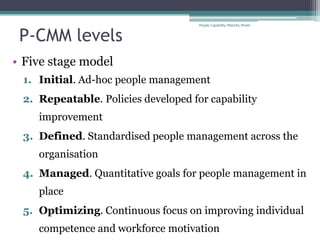
• Five stage model
 1. Initial. Ad-hoc people management
 2. Repeatable. Policies developed for capability
    improvement
 3. Defined. Standardised people management across the
    organisation
 4. Managed. Quantitative goals for people management in
    place
 5. Optimizing. Continuous focus on improving individual
    competence and workforce motivation
People Capability Maturity Model


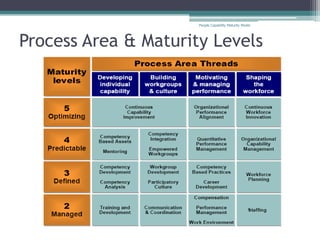
Process Area & Maturity Levels
People Capability Maturity Model


Summary

• Why P-CMM ?

• Introduction

• Difference between CMM and P-CMM

• Architecture

• Process area and maturity levels
People Capability Maturity Model

People Capability Maturity Model

  • 1.
    P-CMM (People Capability Maturity Model) Presented By:- Sarthak Gupta People Capability Maturity Model
  • 2.
    People Capability MaturityModel Outline • CMM • Why P-CMM ? • Introduction • Difference between P-CMM and CMM • Architecture of P-CMM • Process area and maturity levels
  • 3.
    People Capability MaturityModel CMM • A development model created by Software Engineering Institute. • It is applied to an existing organization's Software - Development Processes to improve productivity and quality, reduce costs and time to market, and increase customer satisfaction.
  • 4.
    People Capability MaturityModel Why P-CMM??? • People is one of the main aspects of any organization. • Too much focus on technology and less on people. • Consideration on not only “hygiene factors” but whole person.
  • 5.
    People Capability MaturityModel Introduction • A framework that focuses on improving management and development of human assets of an organization. • Provides an improvement path • Integrate workforce development with process improvement • Characterize the maturity of their workforce practices
  • 6.
    People Capability MaturityModel Introduction • It is used world-wide by organizations, small and large, such as IBM, Boeing, BAE Systems, Tata Consultancy Services, Ericsson, Lockheed Martin and QAI (India) Ltd.
  • 7.
    People Capability MaturityModel Difference between CMM and P-CMM • CMM is more generic and focused on organization process. • P-CMM is more focused on the organization workforce. • P-CMM has a staged architecture then just maturity levels as in CMM.
  • 8.
    People Capability MaturityModel P-CMM levels • Five stage model 1. Initial. Ad-hoc people management 2. Repeatable. Policies developed for capability improvement 3. Defined. Standardised people management across the organisation 4. Managed. Quantitative goals for people management in place 5. Optimizing. Continuous focus on improving individual competence and workforce motivation
  • 9.
    People Capability MaturityModel Process Area & Maturity Levels
  • 10.
    People Capability MaturityModel Summary • Why P-CMM ? • Introduction • Difference between CMM and P-CMM • Architecture • Process area and maturity levels
  • 11.