Customer - Centered
Brand Management
               Presented By:-
                Ishant Mahajan
                   Sunil Goyal
                Sarthak Gupta
                   Rishi Bhatia
              Sarvesh Malhotra
                Abhinav Juneja
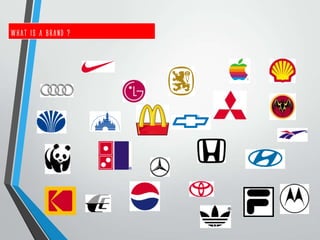
WHAT DO THESE THINGS HAVE
      IN COMMON?


The golden arches, the Nike
swoosh, and an apple icon?
What is a brand ?
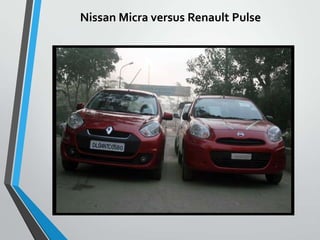
Nissan Micra versus Renault Pulse
WHAT IS A BRAND ?
Brand is a consumer’s perception about the product that
gives a unique identity to the company’s products and
create emotional associations with consumers.


Al and Laura rise in “The 22 immutable laws of branding”
says:
“Branding “presells” the product or service to the user it is
simply more efficient way to sell things”.
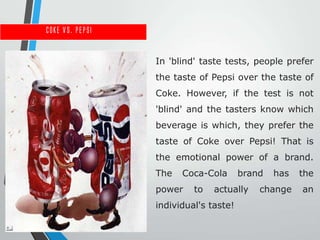
Coke vs. Pepsi


                 In 'blind' taste tests, people prefer
                 the taste of Pepsi over the taste of
                 Coke. However, if the test is not
                 'blind' and the tasters know which
                 beverage is which, they prefer the
                 taste of Coke over Pepsi! That is
                 the emotional power of a brand.
                 The   Coca-Cola       brand   has   the
                 power    to   actually    change    an
                 individual's taste!
WHAT A BRAND MEANS TO
       COMMON PERSON ?
A set of product perceptions by the consumer.
It is a personality developed over time.
A brand signifies a relationship with the customer.
It is the company’s most valuable asset. It’s also the main
  differentiator, the best defense against price
  competition, and the key to customer loyalty.

Competitors can copy your features and benefits, but
  they can’t steal your brand.

It’s a promise.
Oldsmobile
• American car brand launched earlier than any other in
  existence today
• 1988 ad campaign featuring the slogan, "This is not your
  father's Oidsmobile.“
• 1990, ad campaign a new generation of olds.
• 2000, Oldsmobile's market share had sputtered to
  1.6%, from 6.9% in 1985. And in December
  2000, General Motors announced that the Oldsmobile
  brand would be phased out.
IT'S OK, I'M WITH THE BRAND
• Courtesy of songwriter and performer George Clinton.
   •   Clinton in the 1970s sought the attention of two different
       segments of record buyers-mainstream listeners, who liked vocal
       soul music with horns, and progressive listeners, who liked
       harder-edged funk.
• He made 2 different band names:
   •   Parliament, when the music was aimed at popular tastes.
   •   Funkadelic, when it was edgier.
• Both bands were very successful, even though some
  Parliament fans would never listen to Funkadelic and vice
  versa
ECONOMIES OF SCALE
• Shift to narrower and more numerous brands is difficult for
  even the most astute marketers to accept.
• Unilever, for example, fought against market
  fragmentation by instituting a brand consolidation
  program in 1999. Its management eliminated hundreds of
  brands in search of economies of scale.
• Among the discarded were such successful brands as
  Elizabeth Arden cosmetics and the Diversey cleaning and
  hygiene business.
• Five years later, Unilever's sales have stagnated, while
  primary competitor Procter & Gamble, with its niche
  branding strategy, has enjoyed healthy gains.
CUSTOMER EQUITY IS THE
       POINT
       • Companies geared today to
         aggrandising their brand assuming
         Sales will follow.
          •   Firms to be successful over time, should
              maximize Customer Lifetime Value
       • Companies must focus on Customer
         Equity rather than Brand Equity.
       • Our Attitude should be that Brands
         come & go but Customers must
         remain.
THE VALUE OF A BRAND
  DEPENDS ON THE CUSTOMER
• Brand Value of a Brand is highly individualized.
• Most Marketing Managers measure Brand Equity with a
  summary metric of brand strength.
   •   A perfect example of “Flaw of Averages”.
• Assigning an Average value to Brand Equity is Dangerous.
• Managers believe that Brand Value is Intrinsic.
PUT YOUR BRANDS IN THEIR PLACE

 “IF U ACCEPT THAT THE GOAL OF
    MANAGEMENT IS TO GROW
 CUSTOMER EQUITY, NOT BRAND
 VALUE, THEN YOU WILL LIKELY T
   MANAGE YOUR BRANDS IN A
         DIFFERENT WAY.”

       There are seven directives that go against
          the grain of current practice, They are:
1.   Make brand decisions subservient to decisions
     about customer relationship.
    Strengthening the role of customer segment manager.
    Assigning managers to specific customers.


2.   Build brands around customer segments, not
     the other way around.
    Focus on the needs and requirements of a particular
     customer segment.
3. Make your brand as narrow as possible.

   The purpose of a brand here is to satisfy a small customer
    segment as it is economically feasible.


4. Plan brand extensions based on customer
    needs, not component similarities.
   It works well when customers are similar.
5. Develop the capability and the mind-set to hand off
   customers to other brands in the company.
   Future profits are driven not by repeat purchases of particular
    product but by customer’s purchases across all brands.


6. Take no heroic measures.
   If brand managers control the resources they will persist too
    long with a brand that has lost its punch.
   Retiring ineffective brands is easier to do if the marketing
    resources of the firm are controlled by customer segment
    managers.
7. Change how you measure brand equity.

   Brand Equity is defined as the overall strength of the
    brand in the market place and its value to the company
    that owns it.
   Brand equity varies from customer to customer.
   The focus should be on :

       Brand awareness (advertisement in terms of
        recognition & recall)
       Attitude towards the brand
       Brand ethics
BRAND EQUITY IN SCHEME OF THINGS
 Brand managers have long struggled to find the right
  formula for measuring brand equity.
To measure brand equity, First, we must put it in the context
  of customer equity. Second, we must recognize that it varies
  by individual.
Let's start with the bottom line, which is customer equity, the
  sum of the lifetime values of the firm's customers.
 As we know, a customer's lifetime value is driven by
  choices, and those choices are driven by three considerations
  i.e.
I. Quality,
II. Price,
III. Convenience
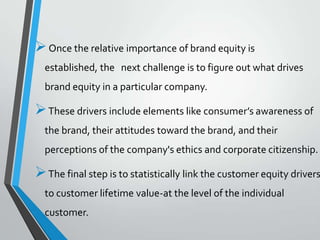
 Once the relative importance of brand equity is
  established, the next challenge is to figure out what drives
  brand equity in a particular company.

 These drivers include elements like consumer’s awareness of
  the brand, their attitudes toward the brand, and their
  perceptions of the company's ethics and corporate citizenship.

 The final step is to statistically link the customer equity drivers
  to customer lifetime value-at the level of the individual
  customer.
How Big
  to
Brand?
When the company's mindsets change to consumers
Then the question arises


HOW BIG SHOULD THE BRAND BE?
• Customers taste and preferences changes from time to
  time

• Customers as a individual has unique taste and desires
• Customers    loot at brands to provide safety. Buying a
  popular brands not only increases the customer’s trust
  that the offering will perform but also contributes to the
  customer social needs

• Like in the magazine industry ,first there was only general
  magazines but nowadays there is a separate magazine for
  each thing like life, health and fitness.
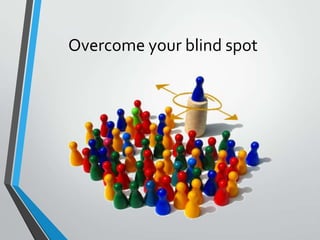
Overcome your blind spot
• People learning to drive quickly realize that they have a
  vulnerable area where there vision is hindered
• In same way for many organizations, brand is one
  those blind spots
• Marketing Executives must begin looking at the
  problem of brand management more deliberately and
  from customer from point of view.
• In customer centered organization, brands are
  important, but its not all
• Therefore companies cant be structured, staffed and
  motivated to grow brand.
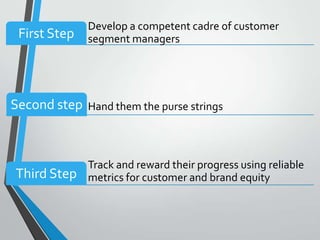
Develop a competent cadre of customer
 First Step   segment managers


Second step Hand them the purse strings


              Track and reward their progress using reliable
Third Step    metrics for customer and brand equity
Customer Centered Brand Management Case