UNIT III
Drugs Affecting the Gastrointestinal System
By: Muhammad Aurangzeb
Lecturer-INS/KMU
Objectives
In this unit, learners will be able to:
• Discuss common symptoms/disorders for which
gastrointestinal drugs are used
• Explain drugs affecting gastrointestinal system, their
mechanism of action, indications
• Identify the expected and adverse reactions of
gastrointestinal drugs
• Discuss the nursing responsibility related to
gastrointestinal drugs
• Calculate the drugs dosage accurately.
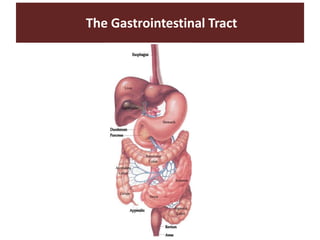
The Gastrointestinal Tract
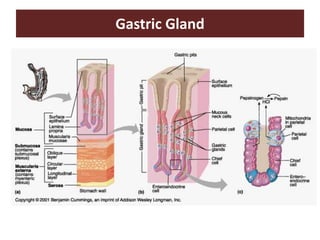
Glands of the Stomach
• Cardiac: they primarily secrete mucus
• Pyloric: They secrete gastrin produced by their G
cells, also secrete mucus
• Gastric*gland secrete hydrochloric acid (HCl)
and intrinsic factor
* The cells of the gastric gland are the largest in
number and of primary importance when discussing
acid control
Cells of the Gastric Gland
• Parietal cells
– Produce and secrete HCl
– Primary site of action for many acid-controller
drugs
Hydrochloric Acid (HCl)
• Secreted by the parietal cells when stimulated by
food
• Maintains stomach at pH of 1 to 4
• Secretion also stimulated by:
– Large fatty meals
– Excessive amounts of alcohol
– Emotional stress
Cells of the Gastric Gland (cont'd)
• Chief cells
– Secrete pepsinogen, a proenzyme
– Pepsinogen becomes pepsin when activated by
exposure to acid
– Pepsin breaks down proteins (proteolytic)
Cells of the Gastric Gland (cont'd)
• Mucoid cells
– Mucus-secreting cells (surface epithelial cells)
– Provide a protective mucous coat
– Protect against self-digestion by HCl
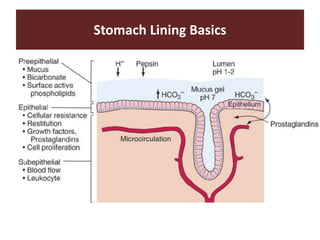
Stomach Lining Basics
Gastric Gland
Gastric Mucosal Barrier
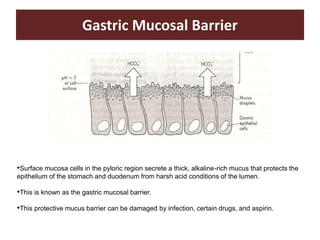
•Surface mucosa cells in the pyloric region secrete a thick, alkaline-rich mucus that protects the
epithelium of the stomach and duodenum from harsh acid conditions of the lumen.
•This is known as the gastric mucosal barrier.
•This protective mucus barrier can be damaged by infection, certain drugs, and aspirin.
Gastric Acid Secretion
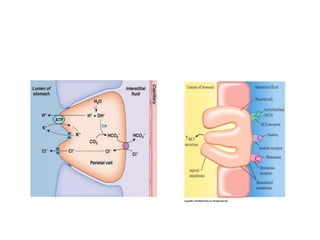
• Parietal cells in the stomach secrete hydrochloric acid. Acid in the
stomach functions to kill bacteria, and to aid digestion by
solubilizing food. The acid is also important to establish the
optimal pH (between 1-4) for the function of the digestive
enzyme pepsin.
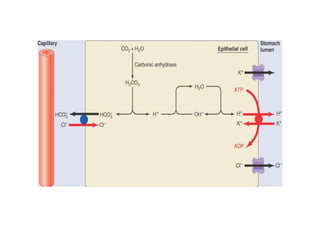
• A key protein for acid secretion is the H+/K+-ATPase (or proton
pump). This protein, which is present on membrane of parietal
cells, uses the energy derived from ATP hydrolysis to pump
hydrogen ions into the lumen in exchange for potassium ions.
• Acetylcholine is a neurotransmitter that is released by enteric
neurons. Histamine is a paracrine that is released from
ECL (enterochromaffin-like) cells. Gastrin is a hormone that is
released by G cells located in the gastric
epithelium. Somatostatin is also secreted by endocrine cells of the
gastric epithelium; it can act as either a paracrine or a hormone.
Cont…
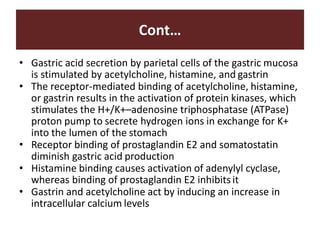
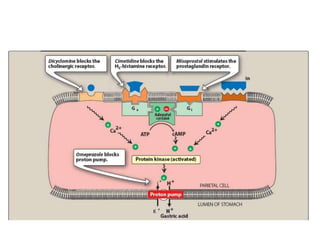
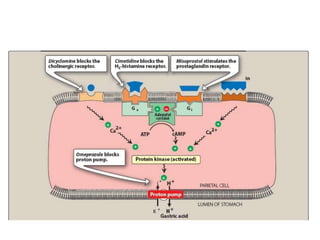
• Gastric acid secretion by parietal cells of the gastric mucosa
is stimulated by acetylcholine, histamine, and gastrin
• The receptor-mediated binding of acetylcholine, histamine,
or gastrin results in the activation of protein kinases, which
stimulates the H+/K+–adenosine triphosphatase (ATPase)
proton pump to secrete hydrogen ions in exchange for K+
into the lumen of the stomach
• Receptor binding of prostaglandin E2 and somatostatin
diminish gastric acid production
• Histamine binding causes activation of adenylyl cyclase,
whereas binding of prostaglandin E2 inhibits it
• Gastrin and acetylcholine act by inducing an increase in
intracellular calcium levels
Acid-Related Diseases
• Most common: hyperacidity
• Clients report symptoms of overproduction of HCl by
the parietal cells as indigestion, sour stomach,
heartburn, acid stomach
Acid-Related Diseases (cont'd)
• PUD: peptic ulcer disease
• GERD: gastroesophageal reflux disease
• Helicobacter pylori (H. pylori)
– Bacterium found in GI tract of 90% of patients
with duodenal ulcers, and 70% of those with
gastric ulcers
– Combination therapy is used most often to
eradicate H. pylori
Gastrointestinal Disorders
• Gastroesophageal Reflux Disease (GERD)
• Peptic Ulcer Disease (PUD)
• Nausea
• Emesis/ vomiting
• Diarrhea
• Constipation
Gastro Intestinal Drugs
• Drugs used for:
1)Peptic ulcers and gastro-esophageal reflux
disease (GERD)
2) Nausea/vomiting especially Chemotherapy-
induced emesis
3) Diarrhea
4) Constipation
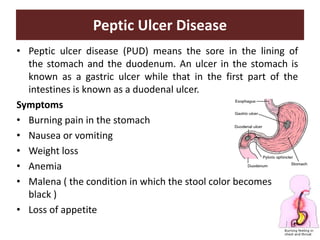
Peptic Ulcer Disease
• Peptic ulcer disease (PUD) means the sore in the lining of
the stomach and the duodenum. An ulcer in the stomach is
known as a gastric ulcer while that in the first part of the
intestines is known as a duodenal ulcer.
Symptoms
• Burning pain in the stomach
• Nausea or vomiting
• Weight loss
• Anemia
• Malena ( the condition in which the stool color becomes
black )
• Loss of appetite
Peptic Ulcer
• Causes of peptic ulcer:
– Infection with gram-negative Helicobacter pylori
– Regular use of non-steroidal anti-inflammatory drugs
(NSAIDs) (aspirin, diclofenac etc.)
– Severe physiologic stress: Stressful conditions that may
cause PUD include burns, central nervous system (CNS)
trauma, surgery, and severe medical illness.
This results in:
• Increased hydrochloric acid secretion
• Inadequate mucosal defense against gastric acid
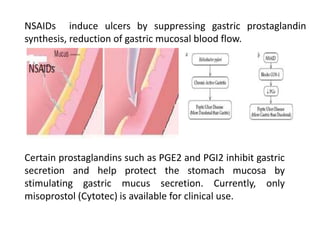
NSAIDs induce ulcers by suppressing gastric prostaglandin
synthesis, reduction of gastric mucosal blood flow.
Certain prostaglandins such as PGE2 and PGI2 inhibit gastric
secretion and help protect the stomach mucosa by
stimulating gastric mucus secretion. Currently, only
misoprostol (Cytotec) is available for clinical use.
Treatment of peptic ulcer
1. Eradicating the H. pylori infection
2. Reducing secretion of gastric acid with the use of
proton pump inhibitors or H2-receptor antagonists
3. Providing agents that protect the gastric mucosa
from damage such as misoprostol and sucralfate
4. Neutralizing gastric acid with non-absorbable
antacids
• Antacids
• Mucosal protective agents
• Proton pump inhibitors
• H2-receptor antagonists
• Prostaglandins
• Antimicrobials
Drugs which neutralize acid(Antacids):
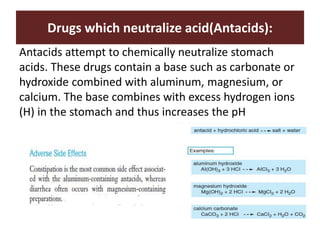
Antacids attempt to chemically neutralize stomach
acids. These drugs contain a base such as carbonate or
hydroxide combined with aluminum, magnesium, or
calcium. The base combines with excess hydrogen ions
(H) in the stomach and thus increases the pH
Mechanism of action of Antacids
• They achieve their effects by neutralizing gastric
acid, inhibiting gastric acid secretion or protect
gastric mucosa.
Indications / Uses of antacids
• Indigestion.
• Reflux esophagitis,
• Pain and burning with peptic ulcer.
• Peptic ulcer.
Drug which provide a physical barrier
Sucralfate (Ulsanic®)
Bismuth subsalicylate
Cytoprotective compounds
• Enhance mucosal protection mechanisms, preventing
mucosal injury, reducing inflammation, and healing
existing ulcers.
• Sucralfate (Carafate, Sulcrate). Sucralfate is a
disaccharide that exerts a cytoprotective effect on
the stomach mucosa. Sucralfate may form a
protective gel that adheres to ulcers and shields
them from the contents of the stomach.
Bismuth subsalicylate
• Effectively heals peptic ulcers
• Has antimicrobial actions
• Inhibits the activity of pepsin
• Increases secretion of mucus, and interact with necrotic
mucosal tissue to coat and protect the ulcer crater
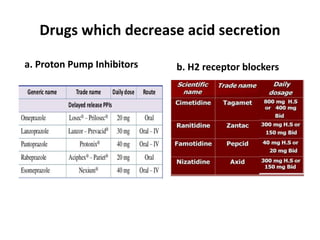
Drugs which decrease acid secretion
a. Proton Pump Inhibitors b. H2 receptor blockers
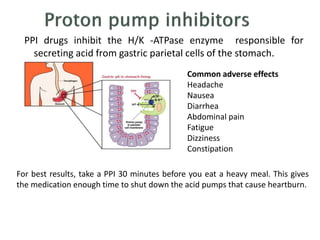
PPI drugs inhibit the H/K -ATPase enzyme responsible for
secreting acid from gastric parietal cells of the stomach.
Common adverse effects
Headache
Nausea
Diarrhea
Abdominal pain
Fatigue
Dizziness
Constipation
For best results, take a PPI 30 minutes before you eat a heavy meal. This gives
the medication enough time to shut down the acid pumps that cause heartburn.
• Bind to the H+/K+-ATPase enzyme system (proton
pump) of the parietal cell and suppress the secretion
of hydrogen ions into the gastric lumen, inhibiting
gastric acid secretion
• The membrane-bound proton pump is the final step in
the secretion of gastric acid
• More effective than H2 antagonists in suppressing
gastric acid production and healing peptic ulcers
 PPIs are prodrugs with an acid-resistant enteric coating
to protect them from premature degradation by gastric
acid
 The coating is removed in the duodenum, and the
prodrug is absorbed and transported to parietal cells
 There, it is converted to the active form, which forms a
stable covalent bond with H+/K+-ATPase
 It takes about 18 hours for the enzyme to be
resynthesized
 At standard doses, all PPIs inhibit gastric acid
secretion by ~90%
 The superiority of the PPIs over the H2 antagonists
for suppressing acid production and healing peptic
ulcers has made them the preferred drugs for
◦ Stress ulcer treatment and prophylaxis
◦ Treating erosive esophagitis and active duodenal ulcer
◦ Long-term treatment of pathologic hypersecretory
conditions (e.g. Zollinger-Ellison syndrome)
 Approved for the treatment of GERD and have
gained favor over H2 antagonists
 PPIs reduce the risk of bleeding from an ulcer
caused by aspirin and other NSAIDs
 Used with antimicrobial regimens to eradicate H.
pylori
Mechanism of action of H2 blockers
Histamine stimulates specific receptors on stomach parietal cells
to increase gastric acid secretion. These histamine receptors are
classified as H2 receptors. H2 antagonists, or blockers, prevent
the histamine activated release of gastric acid.
Side effects:
• headache
• nausea
• diarrhea
• abdominal pain
• dizziness,
• Constipation
• Cimetidine has been associated with gynaecomastia (breast
enlargement in men)and anti androgenic properties.
 Peptic ulcer
 Acute stress ulcers
 Gastroesophageal reflux disease (GERD)
 Prostaglandin E, produced by the gastric mucosa,
inhibits secretion of HCl and stimulates secretion
of mucus and bicarbonate (cytoprotective effect)
 A deficiency of prostaglandins is involved in the
pathogenesis of peptic ulcers
 Misoprostol (Cytotec®)
◦ A stable analog of prostaglandin approved for the
prevention of gastric ulcers induced by NSAIDs
◦ Less effective than H2 antagonists and the PPIs for acute
treatment of peptic ulcers
◦ Has cytoprotective actions, but is clinically effective only
at higher doses that diminish gastric acid secretion
 Misoprostol
◦ Like other prostaglandins, misoprostol produces uterine
contractions, dislodging of the fetus, and is
contraindicated during pregnancy
◦ Adverse effects: diarrhea and nausea
Antimicrobial agents (For H. pylori)
• GERD is not associated with H. pylori infection and does not
respond to treatment with antibiotics
• Triple therapy consisting of a PPI combined with either
metronidazole or amoxicillin plus clarithromycin for 2 weeks
◦ (Amoxicillin, omeprazole, clarithromycin)
• Quadruple therapy of bismuth subsalicylate and
metronidazole, tetracycline plus a PPI, administered for a 2-
week course
• Treatment with a single antimicrobial drug is less effective,
results in antimicrobial resistance, and is absolutely not
recommended
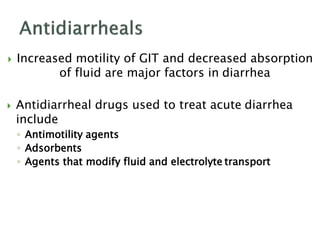
 Increased motility of GIT and decreased absorption
of fluid are major factors in diarrhea
 Antidiarrheal drugs used to treat acute diarrhea
include
◦ Antimotility agents
◦ Adsorbents
◦ Agents that modify fluid and electrolyte transport
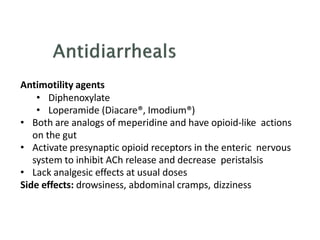
Antimotility agents
• Diphenoxylate
• Loperamide (Diacare®, Imodium®)
• Both are analogs of meperidine and have opioid-like actions
on the gut
• Activate presynaptic opioid receptors in the enteric nervous
system to inhibit ACh release and decrease peristalsis
• Lack analgesic effects at usual doses
Side effects: drowsiness, abdominal cramps, dizziness
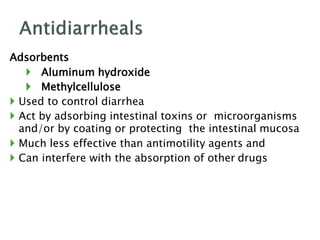
Adsorbents
 Aluminum hydroxide
 Methylcellulose
 Used to control diarrhea
 Act by adsorbing intestinal toxins or microorganisms
and/or by coating or protecting the intestinal mucosa
 Much less effective than antimotility agents and
 Can interfere with the absorption of other drugs
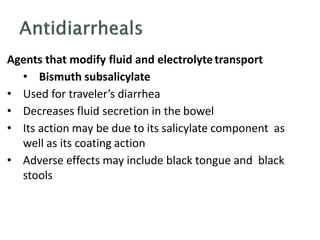
Agents that modify fluid and electrolytetransport
• Bismuth subsalicylate
• Used for traveler’s diarrhea
• Decreases fluid secretion in the bowel
• Its action may be due to its salicylate component as
well as its coating action
• Adverse effects may include black tongue and black
stools
Constipation
Common condition caused by
• Diminished fluid intake
• Slow motility of waste material through large
intestine
• Certain foods, medications, diseases
Constipation
•Usually effectively treated with dietary modification.
•Only if this fails should laxatives be used.
Therapy:
1. Bulking agents
2. Osmotic laxatives
3. Stimulant drugs
4. Stool softners
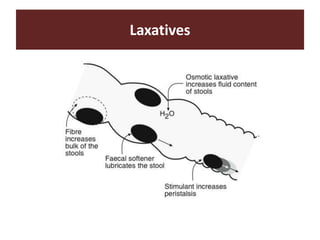
Laxatives
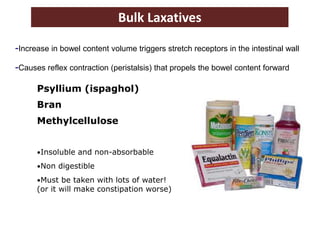
Bulk Laxatives
Psyllium (ispaghol)
Bran
Methylcellulose
•Insoluble and non-absorbable
•Non digestible
•Must be taken with lots of water!
(or it will make constipation worse)
-Increase in bowel content volume triggers stretch receptors in the intestinal wall
-Causes reflex contraction (peristalsis) that propels the bowel content forward
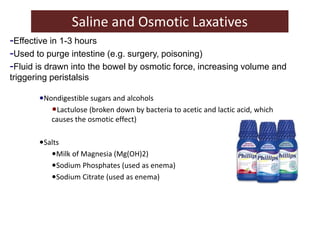
Saline and Osmotic Laxatives
•Nondigestible sugars and alcohols
•Lactulose (broken down by bacteria to acetic and lactic acid, which
causes the osmotic effect)
•Salts
•Milk of Magnesia (Mg(OH)2)
•Sodium Phosphates (used as enema)
•Sodium Citrate (used as enema)
-Effective in 1-3 hours
-Used to purge intestine (e.g. surgery, poisoning)
-Fluid is drawn into the bowel by osmotic force, increasing volume and
triggering peristalsis
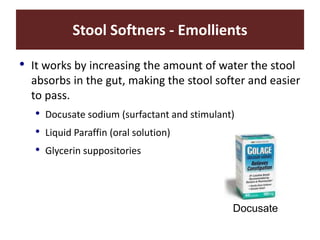
Stool Softners - Emollients
• It works by increasing the amount of water the stool
absorbs in the gut, making the stool softer and easier
to pass.
• Docusate sodium (surfactant and stimulant)
• Liquid Paraffin (oral solution)
• Glycerin suppositories
Docusate
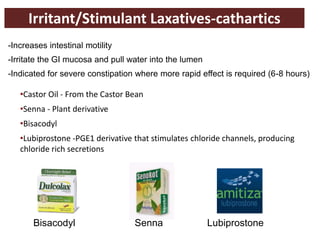
Irritant/Stimulant Laxatives-cathartics
•Castor Oil - From the Castor Bean
•Senna - Plant derivative
•Bisacodyl
•Lubiprostone -PGE1 derivative that stimulates chloride channels, producing
chloride rich secretions
-Increases intestinal motility
-Irritate the GI mucosa and pull water into the lumen
-Indicated for severe constipation where more rapid effect is required (6-8 hours)
Bisacodyl Senna Lubiprostone
Antiemetics
• Antiemetics are the Drugs which prevent or control
the Vomiting/Nausea.
Antieme
tics event or
control the
• Antiemetic are the drugs
which pr
vomiting/nausea.
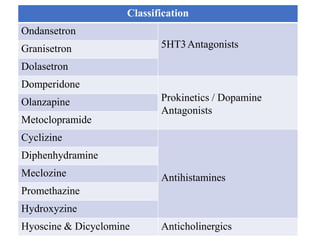
Classification
Ondansetron
5HT3Antagonists
Granisetron
Dolasetron
Domperidone
Prokinetics / Dopamine
Antagonists
Olanzapine
Metoclopramide
Cyclizine
Antihistamines
Diphenhydramine
Meclozine
Promethazine
Hydroxyzine
Hyoscine & Dicyclomine Anticholinergics
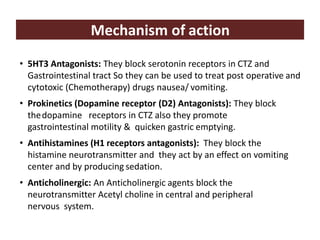
Mechanism of action
• 5HT3 Antagonists: They block serotonin receptors in CTZ and
Gastrointestinal tract So they can be used to treat post operative and
cytotoxic (Chemotherapy) drugs nausea/ vomiting.
• Prokinetics (Dopamine receptor (D2) Antagonists): They block
thedopamine receptors in CTZ also they promote
gastrointestinal motility & quicken gastric emptying.
• Antihistamines (H1 receptors antagonists): They block the
histamine neurotransmitter and they act by an effect on vomiting
center and by producing sedation.
• Anticholinergic: An Anticholinergic agents block the
neurotransmitter Acetyl choline in central and peripheral
nervous system.
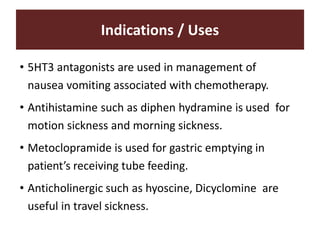
Indications / Uses
• 5HT3 antagonists are used in management of
nausea vomiting associated with chemotherapy.
• Antihistamine such as diphen hydramine is used for
motion sickness and morning sickness.
• Metoclopramide is used for gastric emptying in
patient’s receiving tube feeding.
• Anticholinergic such as hyoscine, Dicyclomine are
useful in travel sickness.
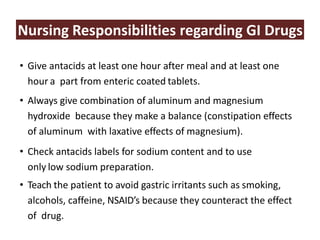
Nursing Responsibilities regarding GI Drugs
• Give antacids at least one hour after meal and at least one
hour a part from enteric coated tablets.
• Always give combination of aluminum and magnesium
hydroxide because they make a balance (constipation effects
of aluminum with laxative effects of magnesium).
• Check antacids labels for sodium content and to use
only low sodium preparation.
• Teach the patient to avoid gastric irritants such as smoking,
alcohols, caffeine, NSAID’s because they counteract the effect
of drug.
References
• Lippincott Illustrated Reviews: Pharmacology
Sixth Edition

Drugs Affecting the Gastrointestinal System.pptx

  • 1.
    UNIT III Drugs Affectingthe Gastrointestinal System By: Muhammad Aurangzeb Lecturer-INS/KMU
  • 2.
    Objectives In this unit,learners will be able to: • Discuss common symptoms/disorders for which gastrointestinal drugs are used • Explain drugs affecting gastrointestinal system, their mechanism of action, indications • Identify the expected and adverse reactions of gastrointestinal drugs • Discuss the nursing responsibility related to gastrointestinal drugs • Calculate the drugs dosage accurately.
  • 3.
  • 4.
    Glands of theStomach • Cardiac: they primarily secrete mucus • Pyloric: They secrete gastrin produced by their G cells, also secrete mucus • Gastric*gland secrete hydrochloric acid (HCl) and intrinsic factor * The cells of the gastric gland are the largest in number and of primary importance when discussing acid control
  • 5.
    Cells of theGastric Gland • Parietal cells – Produce and secrete HCl – Primary site of action for many acid-controller drugs
  • 6.
    Hydrochloric Acid (HCl) •Secreted by the parietal cells when stimulated by food • Maintains stomach at pH of 1 to 4 • Secretion also stimulated by: – Large fatty meals – Excessive amounts of alcohol – Emotional stress
  • 7.
    Cells of theGastric Gland (cont'd) • Chief cells – Secrete pepsinogen, a proenzyme – Pepsinogen becomes pepsin when activated by exposure to acid – Pepsin breaks down proteins (proteolytic)
  • 8.
    Cells of theGastric Gland (cont'd) • Mucoid cells – Mucus-secreting cells (surface epithelial cells) – Provide a protective mucous coat – Protect against self-digestion by HCl
  • 9.
  • 10.
  • 11.
    Gastric Mucosal Barrier •Surfacemucosa cells in the pyloric region secrete a thick, alkaline-rich mucus that protects the epithelium of the stomach and duodenum from harsh acid conditions of the lumen. •This is known as the gastric mucosal barrier. •This protective mucus barrier can be damaged by infection, certain drugs, and aspirin.
  • 12.
    Gastric Acid Secretion •Parietal cells in the stomach secrete hydrochloric acid. Acid in the stomach functions to kill bacteria, and to aid digestion by solubilizing food. The acid is also important to establish the optimal pH (between 1-4) for the function of the digestive enzyme pepsin. • A key protein for acid secretion is the H+/K+-ATPase (or proton pump). This protein, which is present on membrane of parietal cells, uses the energy derived from ATP hydrolysis to pump hydrogen ions into the lumen in exchange for potassium ions. • Acetylcholine is a neurotransmitter that is released by enteric neurons. Histamine is a paracrine that is released from ECL (enterochromaffin-like) cells. Gastrin is a hormone that is released by G cells located in the gastric epithelium. Somatostatin is also secreted by endocrine cells of the gastric epithelium; it can act as either a paracrine or a hormone.
  • 13.
    Cont… • Gastric acidsecretion by parietal cells of the gastric mucosa is stimulated by acetylcholine, histamine, and gastrin • The receptor-mediated binding of acetylcholine, histamine, or gastrin results in the activation of protein kinases, which stimulates the H+/K+–adenosine triphosphatase (ATPase) proton pump to secrete hydrogen ions in exchange for K+ into the lumen of the stomach • Receptor binding of prostaglandin E2 and somatostatin diminish gastric acid production • Histamine binding causes activation of adenylyl cyclase, whereas binding of prostaglandin E2 inhibits it • Gastrin and acetylcholine act by inducing an increase in intracellular calcium levels
  • 16.
    Acid-Related Diseases • Mostcommon: hyperacidity • Clients report symptoms of overproduction of HCl by the parietal cells as indigestion, sour stomach, heartburn, acid stomach
  • 17.
    Acid-Related Diseases (cont'd) •PUD: peptic ulcer disease • GERD: gastroesophageal reflux disease • Helicobacter pylori (H. pylori) – Bacterium found in GI tract of 90% of patients with duodenal ulcers, and 70% of those with gastric ulcers – Combination therapy is used most often to eradicate H. pylori
  • 18.
    Gastrointestinal Disorders • GastroesophagealReflux Disease (GERD) • Peptic Ulcer Disease (PUD) • Nausea • Emesis/ vomiting • Diarrhea • Constipation
  • 19.
    Gastro Intestinal Drugs •Drugs used for: 1)Peptic ulcers and gastro-esophageal reflux disease (GERD) 2) Nausea/vomiting especially Chemotherapy- induced emesis 3) Diarrhea 4) Constipation
  • 20.
    Peptic Ulcer Disease •Peptic ulcer disease (PUD) means the sore in the lining of the stomach and the duodenum. An ulcer in the stomach is known as a gastric ulcer while that in the first part of the intestines is known as a duodenal ulcer. Symptoms • Burning pain in the stomach • Nausea or vomiting • Weight loss • Anemia • Malena ( the condition in which the stool color becomes black ) • Loss of appetite
  • 21.
    Peptic Ulcer • Causesof peptic ulcer: – Infection with gram-negative Helicobacter pylori – Regular use of non-steroidal anti-inflammatory drugs (NSAIDs) (aspirin, diclofenac etc.) – Severe physiologic stress: Stressful conditions that may cause PUD include burns, central nervous system (CNS) trauma, surgery, and severe medical illness. This results in: • Increased hydrochloric acid secretion • Inadequate mucosal defense against gastric acid
  • 22.
    NSAIDs induce ulcersby suppressing gastric prostaglandin synthesis, reduction of gastric mucosal blood flow. Certain prostaglandins such as PGE2 and PGI2 inhibit gastric secretion and help protect the stomach mucosa by stimulating gastric mucus secretion. Currently, only misoprostol (Cytotec) is available for clinical use.
  • 23.
    Treatment of pepticulcer 1. Eradicating the H. pylori infection 2. Reducing secretion of gastric acid with the use of proton pump inhibitors or H2-receptor antagonists 3. Providing agents that protect the gastric mucosa from damage such as misoprostol and sucralfate 4. Neutralizing gastric acid with non-absorbable antacids
  • 24.
    • Antacids • Mucosalprotective agents • Proton pump inhibitors • H2-receptor antagonists • Prostaglandins • Antimicrobials
  • 25.
    Drugs which neutralizeacid(Antacids): Antacids attempt to chemically neutralize stomach acids. These drugs contain a base such as carbonate or hydroxide combined with aluminum, magnesium, or calcium. The base combines with excess hydrogen ions (H) in the stomach and thus increases the pH
  • 26.
    Mechanism of actionof Antacids • They achieve their effects by neutralizing gastric acid, inhibiting gastric acid secretion or protect gastric mucosa.
  • 27.
    Indications / Usesof antacids • Indigestion. • Reflux esophagitis, • Pain and burning with peptic ulcer. • Peptic ulcer.
  • 28.
    Drug which providea physical barrier Sucralfate (Ulsanic®) Bismuth subsalicylate Cytoprotective compounds • Enhance mucosal protection mechanisms, preventing mucosal injury, reducing inflammation, and healing existing ulcers. • Sucralfate (Carafate, Sulcrate). Sucralfate is a disaccharide that exerts a cytoprotective effect on the stomach mucosa. Sucralfate may form a protective gel that adheres to ulcers and shields them from the contents of the stomach.
  • 29.
    Bismuth subsalicylate • Effectivelyheals peptic ulcers • Has antimicrobial actions • Inhibits the activity of pepsin • Increases secretion of mucus, and interact with necrotic mucosal tissue to coat and protect the ulcer crater
  • 30.
    Drugs which decreaseacid secretion a. Proton Pump Inhibitors b. H2 receptor blockers
  • 31.
    PPI drugs inhibitthe H/K -ATPase enzyme responsible for secreting acid from gastric parietal cells of the stomach. Common adverse effects Headache Nausea Diarrhea Abdominal pain Fatigue Dizziness Constipation For best results, take a PPI 30 minutes before you eat a heavy meal. This gives the medication enough time to shut down the acid pumps that cause heartburn.
  • 33.
    • Bind tothe H+/K+-ATPase enzyme system (proton pump) of the parietal cell and suppress the secretion of hydrogen ions into the gastric lumen, inhibiting gastric acid secretion • The membrane-bound proton pump is the final step in the secretion of gastric acid • More effective than H2 antagonists in suppressing gastric acid production and healing peptic ulcers
  • 34.
     PPIs areprodrugs with an acid-resistant enteric coating to protect them from premature degradation by gastric acid  The coating is removed in the duodenum, and the prodrug is absorbed and transported to parietal cells  There, it is converted to the active form, which forms a stable covalent bond with H+/K+-ATPase  It takes about 18 hours for the enzyme to be resynthesized  At standard doses, all PPIs inhibit gastric acid secretion by ~90%
  • 35.
     The superiorityof the PPIs over the H2 antagonists for suppressing acid production and healing peptic ulcers has made them the preferred drugs for ◦ Stress ulcer treatment and prophylaxis ◦ Treating erosive esophagitis and active duodenal ulcer ◦ Long-term treatment of pathologic hypersecretory conditions (e.g. Zollinger-Ellison syndrome)
  • 36.
     Approved forthe treatment of GERD and have gained favor over H2 antagonists  PPIs reduce the risk of bleeding from an ulcer caused by aspirin and other NSAIDs  Used with antimicrobial regimens to eradicate H. pylori
  • 37.
    Mechanism of actionof H2 blockers Histamine stimulates specific receptors on stomach parietal cells to increase gastric acid secretion. These histamine receptors are classified as H2 receptors. H2 antagonists, or blockers, prevent the histamine activated release of gastric acid. Side effects: • headache • nausea • diarrhea • abdominal pain • dizziness, • Constipation • Cimetidine has been associated with gynaecomastia (breast enlargement in men)and anti androgenic properties.
  • 39.
     Peptic ulcer Acute stress ulcers  Gastroesophageal reflux disease (GERD)
  • 40.
     Prostaglandin E,produced by the gastric mucosa, inhibits secretion of HCl and stimulates secretion of mucus and bicarbonate (cytoprotective effect)  A deficiency of prostaglandins is involved in the pathogenesis of peptic ulcers
  • 41.
     Misoprostol (Cytotec®) ◦A stable analog of prostaglandin approved for the prevention of gastric ulcers induced by NSAIDs ◦ Less effective than H2 antagonists and the PPIs for acute treatment of peptic ulcers ◦ Has cytoprotective actions, but is clinically effective only at higher doses that diminish gastric acid secretion
  • 42.
     Misoprostol ◦ Likeother prostaglandins, misoprostol produces uterine contractions, dislodging of the fetus, and is contraindicated during pregnancy ◦ Adverse effects: diarrhea and nausea
  • 43.
    Antimicrobial agents (ForH. pylori) • GERD is not associated with H. pylori infection and does not respond to treatment with antibiotics • Triple therapy consisting of a PPI combined with either metronidazole or amoxicillin plus clarithromycin for 2 weeks ◦ (Amoxicillin, omeprazole, clarithromycin) • Quadruple therapy of bismuth subsalicylate and metronidazole, tetracycline plus a PPI, administered for a 2- week course • Treatment with a single antimicrobial drug is less effective, results in antimicrobial resistance, and is absolutely not recommended
  • 44.
     Increased motilityof GIT and decreased absorption of fluid are major factors in diarrhea  Antidiarrheal drugs used to treat acute diarrhea include ◦ Antimotility agents ◦ Adsorbents ◦ Agents that modify fluid and electrolyte transport
  • 45.
    Antimotility agents • Diphenoxylate •Loperamide (Diacare®, Imodium®) • Both are analogs of meperidine and have opioid-like actions on the gut • Activate presynaptic opioid receptors in the enteric nervous system to inhibit ACh release and decrease peristalsis • Lack analgesic effects at usual doses Side effects: drowsiness, abdominal cramps, dizziness
  • 46.
    Adsorbents  Aluminum hydroxide Methylcellulose  Used to control diarrhea  Act by adsorbing intestinal toxins or microorganisms and/or by coating or protecting the intestinal mucosa  Much less effective than antimotility agents and  Can interfere with the absorption of other drugs
  • 47.
    Agents that modifyfluid and electrolytetransport • Bismuth subsalicylate • Used for traveler’s diarrhea • Decreases fluid secretion in the bowel • Its action may be due to its salicylate component as well as its coating action • Adverse effects may include black tongue and black stools
  • 48.
    Constipation Common condition causedby • Diminished fluid intake • Slow motility of waste material through large intestine • Certain foods, medications, diseases
  • 49.
    Constipation •Usually effectively treatedwith dietary modification. •Only if this fails should laxatives be used. Therapy: 1. Bulking agents 2. Osmotic laxatives 3. Stimulant drugs 4. Stool softners
  • 50.
  • 51.
    Bulk Laxatives Psyllium (ispaghol) Bran Methylcellulose •Insolubleand non-absorbable •Non digestible •Must be taken with lots of water! (or it will make constipation worse) -Increase in bowel content volume triggers stretch receptors in the intestinal wall -Causes reflex contraction (peristalsis) that propels the bowel content forward
  • 52.
    Saline and OsmoticLaxatives •Nondigestible sugars and alcohols •Lactulose (broken down by bacteria to acetic and lactic acid, which causes the osmotic effect) •Salts •Milk of Magnesia (Mg(OH)2) •Sodium Phosphates (used as enema) •Sodium Citrate (used as enema) -Effective in 1-3 hours -Used to purge intestine (e.g. surgery, poisoning) -Fluid is drawn into the bowel by osmotic force, increasing volume and triggering peristalsis
  • 53.
    Stool Softners -Emollients • It works by increasing the amount of water the stool absorbs in the gut, making the stool softer and easier to pass. • Docusate sodium (surfactant and stimulant) • Liquid Paraffin (oral solution) • Glycerin suppositories Docusate
  • 54.
    Irritant/Stimulant Laxatives-cathartics •Castor Oil- From the Castor Bean •Senna - Plant derivative •Bisacodyl •Lubiprostone -PGE1 derivative that stimulates chloride channels, producing chloride rich secretions -Increases intestinal motility -Irritate the GI mucosa and pull water into the lumen -Indicated for severe constipation where more rapid effect is required (6-8 hours) Bisacodyl Senna Lubiprostone
  • 55.
    Antiemetics • Antiemetics arethe Drugs which prevent or control the Vomiting/Nausea.
  • 56.
    Antieme tics event or controlthe • Antiemetic are the drugs which pr vomiting/nausea. Classification Ondansetron 5HT3Antagonists Granisetron Dolasetron Domperidone Prokinetics / Dopamine Antagonists Olanzapine Metoclopramide Cyclizine Antihistamines Diphenhydramine Meclozine Promethazine Hydroxyzine Hyoscine & Dicyclomine Anticholinergics
  • 57.
    Mechanism of action •5HT3 Antagonists: They block serotonin receptors in CTZ and Gastrointestinal tract So they can be used to treat post operative and cytotoxic (Chemotherapy) drugs nausea/ vomiting. • Prokinetics (Dopamine receptor (D2) Antagonists): They block thedopamine receptors in CTZ also they promote gastrointestinal motility & quicken gastric emptying. • Antihistamines (H1 receptors antagonists): They block the histamine neurotransmitter and they act by an effect on vomiting center and by producing sedation. • Anticholinergic: An Anticholinergic agents block the neurotransmitter Acetyl choline in central and peripheral nervous system.
  • 58.
    Indications / Uses •5HT3 antagonists are used in management of nausea vomiting associated with chemotherapy. • Antihistamine such as diphen hydramine is used for motion sickness and morning sickness. • Metoclopramide is used for gastric emptying in patient’s receiving tube feeding. • Anticholinergic such as hyoscine, Dicyclomine are useful in travel sickness.
  • 59.
    Nursing Responsibilities regardingGI Drugs • Give antacids at least one hour after meal and at least one hour a part from enteric coated tablets. • Always give combination of aluminum and magnesium hydroxide because they make a balance (constipation effects of aluminum with laxative effects of magnesium). • Check antacids labels for sodium content and to use only low sodium preparation. • Teach the patient to avoid gastric irritants such as smoking, alcohols, caffeine, NSAID’s because they counteract the effect of drug.
  • 60.
    References • Lippincott IllustratedReviews: Pharmacology Sixth Edition