Humoral control of
blood flow
By -Rukhsar Jabbar
 Humoral control of circulation means control by substances
secreted or absorbed into bodyfluids-such as hormones and
ions.
 Some of these substances are formed by special glands and
transported in blood throughout the entire body and others
are formed in local tissue areas and cause only local
circulatory effects.
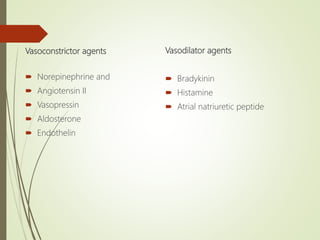
Vasoconstrictor agents
 Norepinephrine and
 Angiotensin II
 Vasopressin
 Aldosterone
 Endothelin
Vasodilator agents
 Bradykinin
 Histamine
 Atrial natriuretic peptide
Norepinephrine and
epinephrine
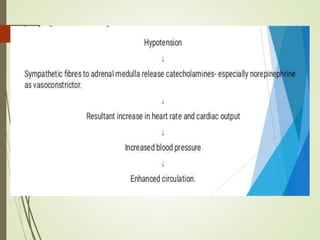
 Norepinephrine is an especially powerful Vasoconstrictor
Hormone.
 When the sympathetic nervous is stimulated in most or all
parts of the body during stress or exercise, the sympathetic
nerve endings in the individual tissues release norepinephrine,
which excites the heart and contracts the veins and arterioles.
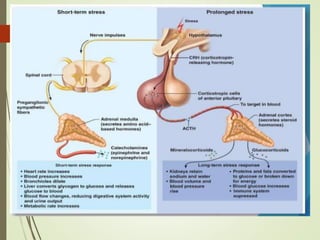
 The sympathetic nerves to the adrenal medullae cause these
glands to secrete both norepinephrine and epinephrine into
blood.
These hormones then circulate to all the areas of the
body and cause almost the same effects on the
circulation as direct sympathetic stimulation, thus
providing a dual system of control
- direct nerve stimulation
- indirect effects of norepinephrine and epinephrine
in circulating blood.
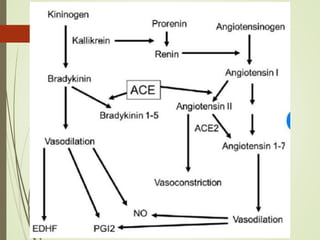
Angiotensin II
 The effect of angiotensin ii is to constrict powerfully the
small arterioles.
 The importance of angiotensin II is that it normally acts on
many of the arterioles of the body at the same time to
increase the total peripheral resistance, thereby increasing
the arterial pressure.
Aldosterone
 It is secreted from adrenal cortex.
 Aldosterone causes retention of sodium and water (from
DCT and collecting duct) and excretion of potassium and
thereby increases the ECF volume and blood volume,
leading to increase in blood pressure.
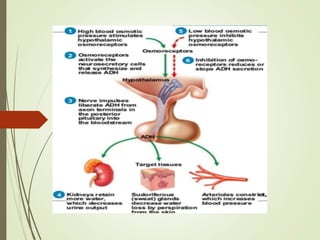
Vasopressin (ADH)
 It is more powerful than angiotensin II as a Vasoconstrictor,
formed in hypothalamus of brain transported to pituitary
gland, where it is finally secreted into blood.
 Vasopressin has a major role to increase greatly water
reabsorption from the renal tubule back into the blood and
therefore to help control body fluid volume that is why this
hormone is called antidiuretic hormone.
Endothelin
 Vasoconstrictor substance that ranks along with angiotensin
and Vasopressin in its Vasoconstrictive capability called
Endothelin.
 This substance present in all Endothelial cells of all or most
blood vessels.
 The stimulus for release is damage to endothelium such that as
caused by crushing the tissues or injecting a traumatizing
chemical into blood vessel.
 After damage, release of local Endothelin and subsequent
vasoconstriction helps to prevent excessive bleeding from
arteries.
Vasodilator agents
Bradykinin
 The kinins are small polypeptides that are split away
by proteolytic enzymes from alpha 2-globulins in the
plasma or tissue fluids.
 A progressive enzyme of particular importance for
this purpose is kallikrein, which is present in blood
and tissue fluids in inactive form.
 This inactive kallikrein is activated by maceration of
blood, by tissue inflammation, or by other similar
chemical or physical on blood or tissues.
 As kallikrein becomes activated, it acts immediately on
alpha2-globulin to release a kinin called kallidin that then is
converted by tissue enzymes into bradykinin.
 Bradykinin causes both powerful arterioles dilation and
increased capillary permeability.
Histamine
 It is released essentially every tissue of body If the tissue becomes
damaged or inflamed or is the subject of an allergic reaction.
 It is a powerful Vasodilator effect on the arterioles and, like bradykinin
has the ability to Increase greatly capillary porosity allowing leakage of
both fluid and plasma protein into tissues.
Atrial natriuretic hormone
 Natriuretic peptides- Atrial, Brain, Vasoactive intestinal
and C-type natriuretic peptides.
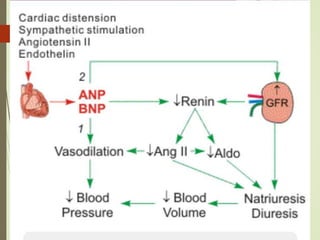
 ANP and BNP are secreted from the atrial myocytes in
response to stretch (increased atrial filling) while CNP is
also released in the vascular endothelium.
 The resultant effect of ANP is a decrease in blood
volume by natriuresis and diuresis.
 ANP also causes vasodilation decreasing the blood
pressure.
 VNP, secreted in the stomach and small intestine and in
small amounts in the large intestine, is a vasodilator and
thus reduces the blood pressure.
It Reduces blood pressure by inhibiting -
Sodium and water Retention
 Inhibits angiotensin II
 Inhibit renin and Aldosterone secretion.
 Inhibits ADH And action of ADH on
kidneys.
Vascular control by ions and
other factors.
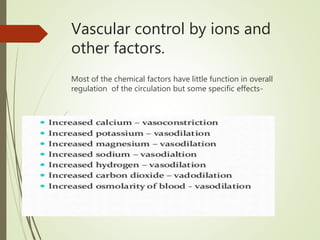
Most of the chemical factors have little function in overall
regulation of the circulation but some specific effects-
Vasopressin–aquaporin-2 pathway: recent advances in
understanding water balance disorders [version 1; referees: 3
approved] Marianna Ranieri , Annarita Di Mise , Grazia Tamma ,
1-3
Department of Biosciences, Biotechnologies and Biopharmaceutics, University o
Bari, Bari, Italy, 70125, Italy 2019
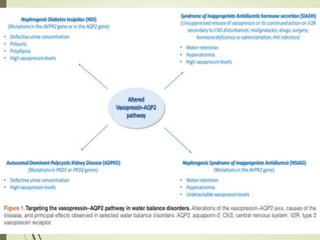
 The alteration of water balance and related disorders has emerged as being
strictly linked to the state of activation of the vasopressin–aquaporin-2 (vasopressin–
AQP2) pathway.
 In the kidney, vasopressin binds to the type 2 vasopressin receptor (V2R) and increases
osmotic water transport through the regulation of the aquaporin-2 (AQP2) water
channel localized in the kidney connecting tubules and collecting ducts.
 recent advances in therapeutic intervention targeting the dysfunctions in the vasopressin–
AQP2 pathway causing diseases
characterized by water balance disorders such as congenital nephrogenic
diabetes insipidus,syndrome of inappropriate antidiuretic hormone secretion,nephrogenic
syndrome of inappropriate antidiuresis, and autosomal dominant
polycystic kidney disease.
 The recent clinical data suggest that targeting the vasopressin–
AQP2 axis can provide therapeutic benefits in patients with water balance disorders.
 Plasma co-peptin as a surrogate marker of vasopressin secretion in renal
disorders. It is secreted along with Vasopressin in equilibrium amounts,
representing a goodmaker for Vasopressin.
 Vasopressin levels are also increased in diabetic nephropathy characterized
by dysregulation of water balance displaying water depletion as a
consequence of osmotic diuresis due to glycosuria.
 The role of Vasopressin is particularly central In pathogenesis of another
severe disease, ADPKD - autosomal dominant polycystic kidney (expansion
of renal cysts eventually leading to loss of renal function)
 Co-peptin can represent a novel marker to predict renal prognosis in ADPKD.
 Summarizing Vasopressin AQP-2 pathway system has a critical role in various
stages of CKD making this pathway very promising from a therapeutic
perspective.
 With regard to NDI( nephrogenic diabetic insipidus )many target
molecules for the treatment of congenital NDI have been proposed;
however, no specific pharmacological drugs have yet reached
clinical application.
 In the development of drugs for the treatment of congenital NDI, it
is important to identify/design drugs that directly activate AQP2
without toxic effects and to pay attention to preserving the
medullary osmotic gradient, representing the driving force for
water reabsorption.
 SIADH which is characterized by hyperactivation of Vasopressin
pathway, the use of vaptans to block Vasopressin receptors
represent the main avenue for the direct treatment of
hyponatremia.
Humoral control

Humoral control

  • 1.
    Humoral control of bloodflow By -Rukhsar Jabbar
  • 2.
     Humoral controlof circulation means control by substances secreted or absorbed into bodyfluids-such as hormones and ions.  Some of these substances are formed by special glands and transported in blood throughout the entire body and others are formed in local tissue areas and cause only local circulatory effects.
  • 3.
    Vasoconstrictor agents  Norepinephrineand  Angiotensin II  Vasopressin  Aldosterone  Endothelin Vasodilator agents  Bradykinin  Histamine  Atrial natriuretic peptide
  • 4.
    Norepinephrine and epinephrine  Norepinephrineis an especially powerful Vasoconstrictor Hormone.  When the sympathetic nervous is stimulated in most or all parts of the body during stress or exercise, the sympathetic nerve endings in the individual tissues release norepinephrine, which excites the heart and contracts the veins and arterioles.  The sympathetic nerves to the adrenal medullae cause these glands to secrete both norepinephrine and epinephrine into blood.
  • 5.
    These hormones thencirculate to all the areas of the body and cause almost the same effects on the circulation as direct sympathetic stimulation, thus providing a dual system of control - direct nerve stimulation - indirect effects of norepinephrine and epinephrine in circulating blood.
  • 8.
    Angiotensin II  Theeffect of angiotensin ii is to constrict powerfully the small arterioles.  The importance of angiotensin II is that it normally acts on many of the arterioles of the body at the same time to increase the total peripheral resistance, thereby increasing the arterial pressure.
  • 10.
    Aldosterone  It issecreted from adrenal cortex.  Aldosterone causes retention of sodium and water (from DCT and collecting duct) and excretion of potassium and thereby increases the ECF volume and blood volume, leading to increase in blood pressure.
  • 12.
    Vasopressin (ADH)  Itis more powerful than angiotensin II as a Vasoconstrictor, formed in hypothalamus of brain transported to pituitary gland, where it is finally secreted into blood.  Vasopressin has a major role to increase greatly water reabsorption from the renal tubule back into the blood and therefore to help control body fluid volume that is why this hormone is called antidiuretic hormone.
  • 14.
    Endothelin  Vasoconstrictor substancethat ranks along with angiotensin and Vasopressin in its Vasoconstrictive capability called Endothelin.  This substance present in all Endothelial cells of all or most blood vessels.  The stimulus for release is damage to endothelium such that as caused by crushing the tissues or injecting a traumatizing chemical into blood vessel.  After damage, release of local Endothelin and subsequent vasoconstriction helps to prevent excessive bleeding from arteries.
  • 15.
    Vasodilator agents Bradykinin  Thekinins are small polypeptides that are split away by proteolytic enzymes from alpha 2-globulins in the plasma or tissue fluids.  A progressive enzyme of particular importance for this purpose is kallikrein, which is present in blood and tissue fluids in inactive form.  This inactive kallikrein is activated by maceration of blood, by tissue inflammation, or by other similar chemical or physical on blood or tissues.
  • 16.
     As kallikreinbecomes activated, it acts immediately on alpha2-globulin to release a kinin called kallidin that then is converted by tissue enzymes into bradykinin.  Bradykinin causes both powerful arterioles dilation and increased capillary permeability.
  • 18.
    Histamine  It isreleased essentially every tissue of body If the tissue becomes damaged or inflamed or is the subject of an allergic reaction.  It is a powerful Vasodilator effect on the arterioles and, like bradykinin has the ability to Increase greatly capillary porosity allowing leakage of both fluid and plasma protein into tissues.
  • 19.
    Atrial natriuretic hormone Natriuretic peptides- Atrial, Brain, Vasoactive intestinal and C-type natriuretic peptides.  ANP and BNP are secreted from the atrial myocytes in response to stretch (increased atrial filling) while CNP is also released in the vascular endothelium.  The resultant effect of ANP is a decrease in blood volume by natriuresis and diuresis.  ANP also causes vasodilation decreasing the blood pressure.  VNP, secreted in the stomach and small intestine and in small amounts in the large intestine, is a vasodilator and thus reduces the blood pressure.
  • 20.
    It Reduces bloodpressure by inhibiting - Sodium and water Retention  Inhibits angiotensin II  Inhibit renin and Aldosterone secretion.  Inhibits ADH And action of ADH on kidneys.
  • 22.
    Vascular control byions and other factors. Most of the chemical factors have little function in overall regulation of the circulation but some specific effects-
  • 23.
    Vasopressin–aquaporin-2 pathway: recentadvances in understanding water balance disorders [version 1; referees: 3 approved] Marianna Ranieri , Annarita Di Mise , Grazia Tamma , 1-3 Department of Biosciences, Biotechnologies and Biopharmaceutics, University o Bari, Bari, Italy, 70125, Italy 2019  The alteration of water balance and related disorders has emerged as being strictly linked to the state of activation of the vasopressin–aquaporin-2 (vasopressin– AQP2) pathway.  In the kidney, vasopressin binds to the type 2 vasopressin receptor (V2R) and increases osmotic water transport through the regulation of the aquaporin-2 (AQP2) water channel localized in the kidney connecting tubules and collecting ducts.  recent advances in therapeutic intervention targeting the dysfunctions in the vasopressin– AQP2 pathway causing diseases characterized by water balance disorders such as congenital nephrogenic diabetes insipidus,syndrome of inappropriate antidiuretic hormone secretion,nephrogenic syndrome of inappropriate antidiuresis, and autosomal dominant polycystic kidney disease.  The recent clinical data suggest that targeting the vasopressin– AQP2 axis can provide therapeutic benefits in patients with water balance disorders.
  • 24.
     Plasma co-peptinas a surrogate marker of vasopressin secretion in renal disorders. It is secreted along with Vasopressin in equilibrium amounts, representing a goodmaker for Vasopressin.  Vasopressin levels are also increased in diabetic nephropathy characterized by dysregulation of water balance displaying water depletion as a consequence of osmotic diuresis due to glycosuria.  The role of Vasopressin is particularly central In pathogenesis of another severe disease, ADPKD - autosomal dominant polycystic kidney (expansion of renal cysts eventually leading to loss of renal function)  Co-peptin can represent a novel marker to predict renal prognosis in ADPKD.  Summarizing Vasopressin AQP-2 pathway system has a critical role in various stages of CKD making this pathway very promising from a therapeutic perspective.
  • 25.
     With regardto NDI( nephrogenic diabetic insipidus )many target molecules for the treatment of congenital NDI have been proposed; however, no specific pharmacological drugs have yet reached clinical application.  In the development of drugs for the treatment of congenital NDI, it is important to identify/design drugs that directly activate AQP2 without toxic effects and to pay attention to preserving the medullary osmotic gradient, representing the driving force for water reabsorption.  SIADH which is characterized by hyperactivation of Vasopressin pathway, the use of vaptans to block Vasopressin receptors represent the main avenue for the direct treatment of hyponatremia.