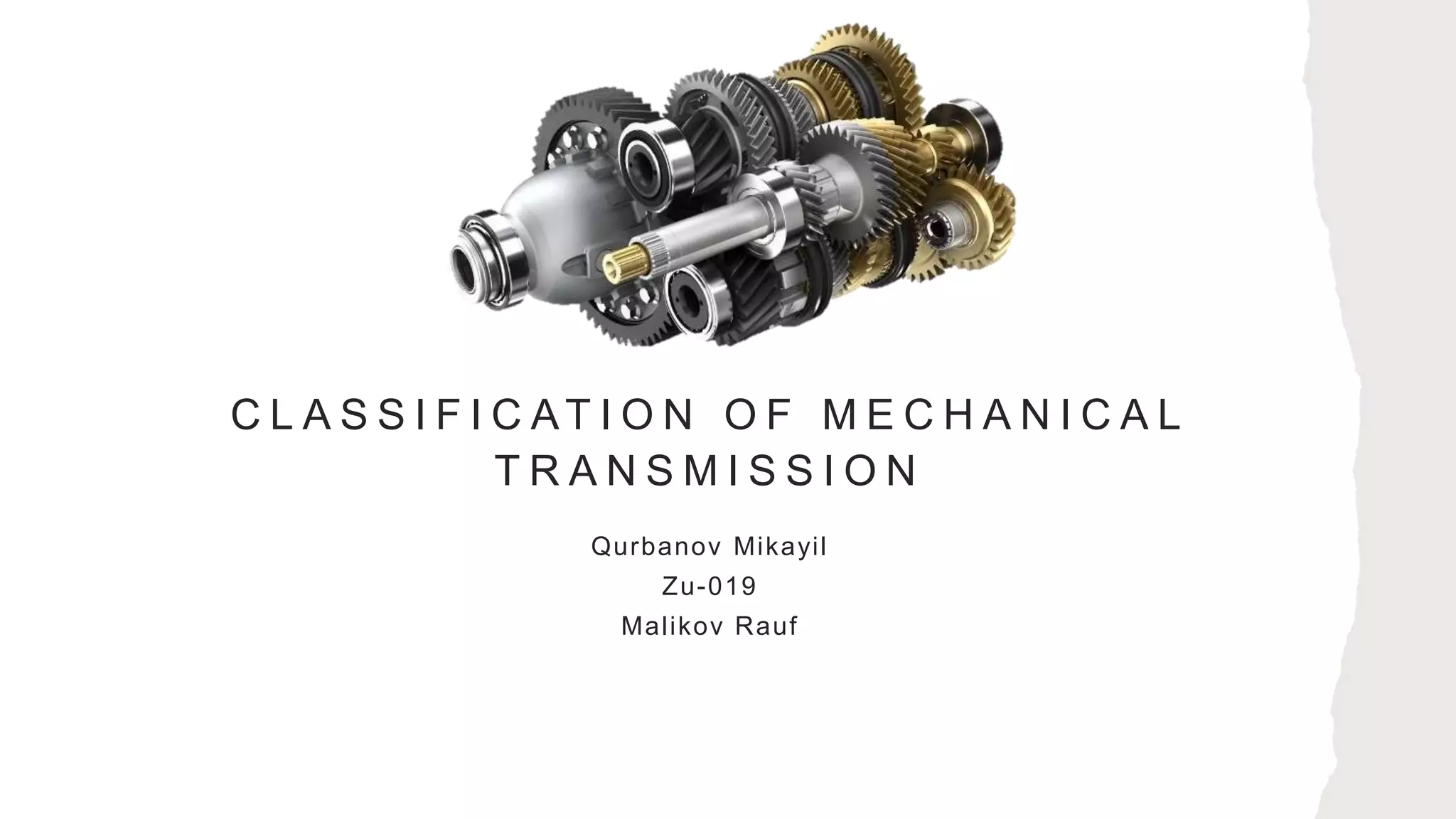
C L A S S I F I C AT I O N O F M E C H A N I C A L
T R A N S M I S S I O N
Qurbanov Mikayil
Zu-019
Malikov Rauf
W H AT I S T R A N S M I S S I O N ?
• A transmission is a machine in a power transmission system, which provides
controlled application of power. Often the term 5-speed transmission refers
simply to the gearbox, that uses gears and gear trains to
provide speed and torque conversions from a rotating power source to another
device.
W H AT I S M E C H A N I C A L P O W E R
T R A N S M I S S I O N ?
• Mechanical power transmission is the transfer of energy from where it’s
generated to a place where it is used to perform work using simple machines,
linkages and mechanical transmission element.
W H Y D O W E N E E D M E C H A N I C A L P O W E R
T R A N S M I S S I O N ?
• There are many ways to generate power but sometimes its impossible to
generate power where it’s needed or in the right form or direction or
magnitude. Hence electrical & mechanical power transmissions are vital for
any engineering product design. This article is solely about mechanical power
transmission and its elements excluding electrical power transmission.
M E C H A N I C A L P O W E R T R A N S M I S S I O N A N D
I T S E L E M E N T S A R E U S E D F O R T H E
F O L L O W I N G R E A S O N S ;
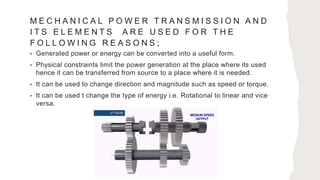
• Generated power or energy can be converted into a useful form.
• Physical constraints limit the power generation at the place where its used
hence it can be transferred from source to a place where it is needed.
• It can be used to change direction and magnitude such as speed or torque.
• It can be used t change the type of energy i.e. Rotational to linear and vice
versa.
T Y P E S O F P O W E R T R A N S M I S S I O N
• The transmission method is an engineering method that matches the power
machine and the working part of the machine in terms of energy configuration,
movement speed and motion form.
• Of the four major types of transmissions(mechanical, electrical, hydraulic and
pneumatic that are currently in use, none of the power transmission are
perfect.
G E A R D R I V E
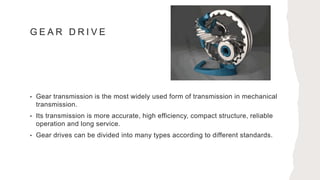
• Gear transmission is the most widely used form of transmission in mechanical
transmission.
• Its transmission is more accurate, high efficiency, compact structure, reliable
operation and long service.
• Gear drives can be divided into many types according to different standards.
G E A R D R I V E
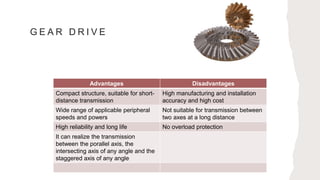
Advantages Disadvantages
Compact structure, suitable for short-
distance transmission
High manufacturing and installation
accuracy and high cost
Wide range of applicable peripheral
speeds and powers
Not suitable for transmission between
two axes at a long distance
High reliability and long life No overload protection
It can realize the transmission
between the porallel axis, the
intersecting axis of any angle and the
staggered axis of any angle
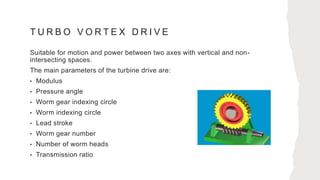
T U R B O V O R T E X D R I V E
Suitable for motion and power between two axes with vertical and non-
intersecting spaces.
The main parameters of the turbine drive are:
• Modulus
• Pressure angle
• Worm gear indexing circle
• Worm indexing circle
• Lead stroke
• Worm gear number
• Number of worm heads
• Transmission ratio
T U R B O V O R T E X D R I V E
Advantages Disadvantages
LargeTransmission ratio Large axial force
The structure is compact Easy to heat
Low efficiency
only-way transmission
B E LT D R I V E
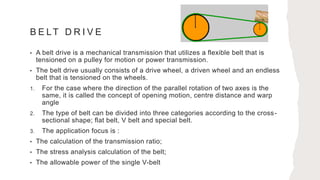
• A belt drive is a mechanical transmission that utilizes a flexible belt that is
tensioned on a pulley for motion or power transmission.
• The belt drive usually consists of a drive wheel, a driven wheel and an endless
belt that is tensioned on the wheels.
1. For the case where the direction of the parallel rotation of two axes is the
same, it is called the concept of opening motion, centre distance and warp
angle
2. The type of belt can be divided into three categories according to the cross-
sectional shape; flat belt, V belt and special belt.
3. The application focus is :
• The calculation of the transmission ratio;
• The stress analysis calculation of the belt;
• The allowable power of the single V-belt
B E LT D R I V E
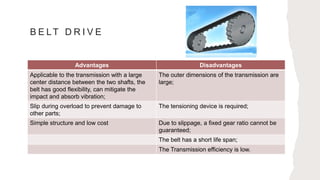
Advantages Disadvantages
Applicable to the transmission with a large
center distance between the two shafts, the
belt has good flexibility, can mitigate the
impact and absorb vibration;
The outer dimensions of the transmission are
large;
Slip during overload to prevent damage to
other parts;
The tensioning device is required;
Simple structure and low cost Due to slippage, a fixed gear ratio cannot be
guaranteed;
The belt has a short life span;
The Transmission efficiency is low.
C H A I N D R I V E
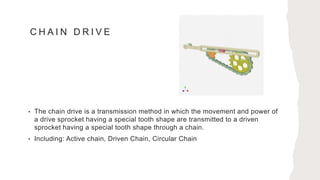
• The chain drive is a transmission method in which the movement and power of
a drive sprocket having a special tooth shape are transmitted to a driven
sprocket having a special tooth shape through a chain.
• Including: Active chain, Driven Chain, Circular Chain
A D VA N TA GES
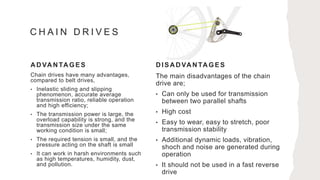
Chain drives have many advantages,
compared to belt drives,
• Inelastic sliding and slipping
phenomenon, accurate average
transmission ratio, reliable operation
and high efficiency;
• The transmission power is large, the
overload capability is strong, and the
transmission size under the same
working condition is small;
• The required tension is small, and the
pressure acting on the shaft is small
• It can work in harsh environments such
as high temperatures, humidity, dust,
and pollution.
D ISA D VA N TA GES
The main disadvantages of the chain
drive are;
• Can only be used for transmission
between two parallel shafts
• High cost
• Easy to wear, easy to stretch, poor
transmission stability
• Additional dynamic loads, vibration,
shoch and noise are generated during
operation
• It should not be used in a fast reverse
drive
C H A I N D R I V E S
W H E E L T R A I N
• A transmission consisting of more than two gears is called wheel train.
• According to whether there is axis movement in the wheel train, the gear
transmission can be divided into ordinary gear transmission and planetary gear
transmission
• A gear that has an axis motion in a wheel train is called a planetary gear.
1. The wheel train is divided into two types: Fixed axle train and epicyclic train.
2. The ratio of the angular velocity of the input shaft to the output shaft in the train
is called the gear ratio of the train. It is equal to the ratio of the product of the
number of teeth of all the follower gears in each pair of meshing gears to the
number of teeth of all the driving gears.
3. In the epicyclic gear train, the gear whose axis position changes, that is, the
gear that is both rotated and revolved, is called a planetary gear, and the gear
with a fixed axial position is called a center wheel or a sun gear.
4. The gear ratio of the epicyclic gear train cannot be directly calculated by the
method of solving the fixed axle train ratio. The relative motion method must be
used to convert the epicyclic gear train into a hypothetical fixed axle train using
the principle of relative motion.
T H A N K S A L O T
mikayil.qurbanov.2000@mail.ru
mikayilqurbanov9@gmail.com

Classification of mechanical transmission

  • 1.
    C L AS S I F I C AT I O N O F M E C H A N I C A L T R A N S M I S S I O N Qurbanov Mikayil Zu-019 Malikov Rauf
  • 2.
    W H ATI S T R A N S M I S S I O N ? • A transmission is a machine in a power transmission system, which provides controlled application of power. Often the term 5-speed transmission refers simply to the gearbox, that uses gears and gear trains to provide speed and torque conversions from a rotating power source to another device.
  • 3.
    W H ATI S M E C H A N I C A L P O W E R T R A N S M I S S I O N ? • Mechanical power transmission is the transfer of energy from where it’s generated to a place where it is used to perform work using simple machines, linkages and mechanical transmission element. W H Y D O W E N E E D M E C H A N I C A L P O W E R T R A N S M I S S I O N ? • There are many ways to generate power but sometimes its impossible to generate power where it’s needed or in the right form or direction or magnitude. Hence electrical & mechanical power transmissions are vital for any engineering product design. This article is solely about mechanical power transmission and its elements excluding electrical power transmission.
  • 4.
    M E CH A N I C A L P O W E R T R A N S M I S S I O N A N D I T S E L E M E N T S A R E U S E D F O R T H E F O L L O W I N G R E A S O N S ; • Generated power or energy can be converted into a useful form. • Physical constraints limit the power generation at the place where its used hence it can be transferred from source to a place where it is needed. • It can be used to change direction and magnitude such as speed or torque. • It can be used t change the type of energy i.e. Rotational to linear and vice versa.
  • 5.
    T Y PE S O F P O W E R T R A N S M I S S I O N • The transmission method is an engineering method that matches the power machine and the working part of the machine in terms of energy configuration, movement speed and motion form. • Of the four major types of transmissions(mechanical, electrical, hydraulic and pneumatic that are currently in use, none of the power transmission are perfect.
  • 6.
    G E AR D R I V E • Gear transmission is the most widely used form of transmission in mechanical transmission. • Its transmission is more accurate, high efficiency, compact structure, reliable operation and long service. • Gear drives can be divided into many types according to different standards.
  • 7.
    G E AR D R I V E Advantages Disadvantages Compact structure, suitable for short- distance transmission High manufacturing and installation accuracy and high cost Wide range of applicable peripheral speeds and powers Not suitable for transmission between two axes at a long distance High reliability and long life No overload protection It can realize the transmission between the porallel axis, the intersecting axis of any angle and the staggered axis of any angle
  • 8.
    T U RB O V O R T E X D R I V E Suitable for motion and power between two axes with vertical and non- intersecting spaces. The main parameters of the turbine drive are: • Modulus • Pressure angle • Worm gear indexing circle • Worm indexing circle • Lead stroke • Worm gear number • Number of worm heads • Transmission ratio
  • 9.
    T U RB O V O R T E X D R I V E Advantages Disadvantages LargeTransmission ratio Large axial force The structure is compact Easy to heat Low efficiency only-way transmission
  • 10.
    B E LTD R I V E • A belt drive is a mechanical transmission that utilizes a flexible belt that is tensioned on a pulley for motion or power transmission. • The belt drive usually consists of a drive wheel, a driven wheel and an endless belt that is tensioned on the wheels. 1. For the case where the direction of the parallel rotation of two axes is the same, it is called the concept of opening motion, centre distance and warp angle 2. The type of belt can be divided into three categories according to the cross- sectional shape; flat belt, V belt and special belt. 3. The application focus is : • The calculation of the transmission ratio; • The stress analysis calculation of the belt; • The allowable power of the single V-belt
  • 11.
    B E LTD R I V E Advantages Disadvantages Applicable to the transmission with a large center distance between the two shafts, the belt has good flexibility, can mitigate the impact and absorb vibration; The outer dimensions of the transmission are large; Slip during overload to prevent damage to other parts; The tensioning device is required; Simple structure and low cost Due to slippage, a fixed gear ratio cannot be guaranteed; The belt has a short life span; The Transmission efficiency is low.
  • 12.
    C H AI N D R I V E • The chain drive is a transmission method in which the movement and power of a drive sprocket having a special tooth shape are transmitted to a driven sprocket having a special tooth shape through a chain. • Including: Active chain, Driven Chain, Circular Chain
  • 13.
    A D VAN TA GES Chain drives have many advantages, compared to belt drives, • Inelastic sliding and slipping phenomenon, accurate average transmission ratio, reliable operation and high efficiency; • The transmission power is large, the overload capability is strong, and the transmission size under the same working condition is small; • The required tension is small, and the pressure acting on the shaft is small • It can work in harsh environments such as high temperatures, humidity, dust, and pollution. D ISA D VA N TA GES The main disadvantages of the chain drive are; • Can only be used for transmission between two parallel shafts • High cost • Easy to wear, easy to stretch, poor transmission stability • Additional dynamic loads, vibration, shoch and noise are generated during operation • It should not be used in a fast reverse drive C H A I N D R I V E S
  • 14.
    W H EE L T R A I N • A transmission consisting of more than two gears is called wheel train. • According to whether there is axis movement in the wheel train, the gear transmission can be divided into ordinary gear transmission and planetary gear transmission • A gear that has an axis motion in a wheel train is called a planetary gear. 1. The wheel train is divided into two types: Fixed axle train and epicyclic train. 2. The ratio of the angular velocity of the input shaft to the output shaft in the train is called the gear ratio of the train. It is equal to the ratio of the product of the number of teeth of all the follower gears in each pair of meshing gears to the number of teeth of all the driving gears. 3. In the epicyclic gear train, the gear whose axis position changes, that is, the gear that is both rotated and revolved, is called a planetary gear, and the gear with a fixed axial position is called a center wheel or a sun gear. 4. The gear ratio of the epicyclic gear train cannot be directly calculated by the method of solving the fixed axle train ratio. The relative motion method must be used to convert the epicyclic gear train into a hypothetical fixed axle train using the principle of relative motion.
  • 15.
    T H AN K S A L O T mikayil.qurbanov.2000@mail.ru mikayilqurbanov9@gmail.com