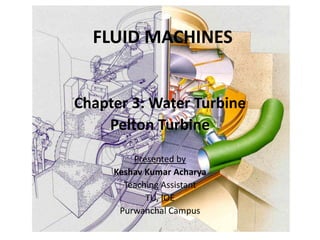
FLUID MACHINES
Chapter 3: Water Turbine
Pelton Turbine
Presented by
Keshav Kumar Acharya
Teaching Assistant
TU, IOE
Purwanchal Campus
Pelton Turbine
• Mostly used impulse turbine. Also called free jet turbine
• Operates under a high head of water and thus requires a
comparatively less quantity of water
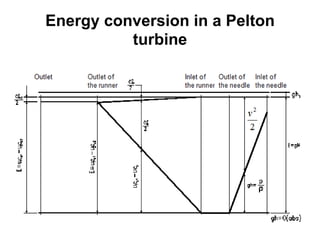
• All the pressure energy of water is converted into
velocity head with the help of nozzle and the so obtained
water with high velocity impinges the buckets fixed
around the wheel
• The water jet after impinging on the buckets is deflected
through an angle of about 165 degree instead of 180 to
prevent retardation of wheel
Pelton Turbine
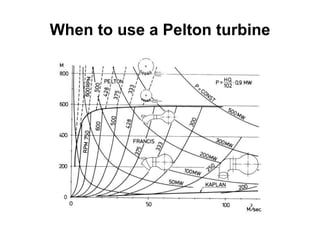
Pelton Turbine is not suitable/efficient for low head
• For a given power, if the head is reduced, the rate of flow
has to be increased
• Increased flow requires bigger jet diameter,
consequently the runner diameter will also increase
• Jet velocity and consequently the peripheral velocity of
runner will reduce
• These two factors make the turbine bulky and slow
running in low heads
Main Components and their Functions
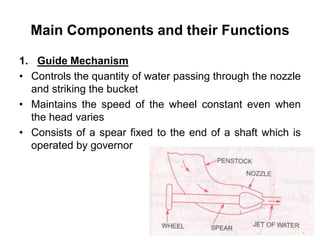
1. Guide Mechanism
• Controls the quantity of water passing through the nozzle
and striking the bucket
• Maintains the speed of the wheel constant even when
the head varies
• Consists of a spear fixed to the end of a shaft which is
operated by governor
Main Components and their Functions
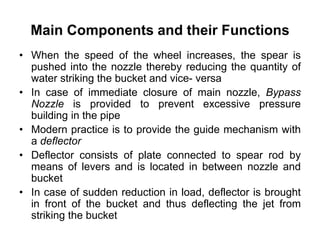
• When the speed of the wheel increases, the spear is
pushed into the nozzle thereby reducing the quantity of
water striking the bucket and vice- versa
• In case of immediate closure of main nozzle, Bypass
Nozzle is provided to prevent excessive pressure
building in the pipe
• Modern practice is to provide the guide mechanism with
a deflector
• Deflector consists of plate connected to spear rod by
means of levers and is located in between nozzle and
bucket
• In case of sudden reduction in load, deflector is brought
in front of the bucket and thus deflecting the jet from
striking the bucket
Main Components and their Functions
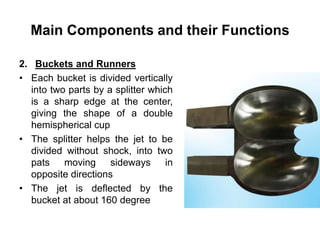
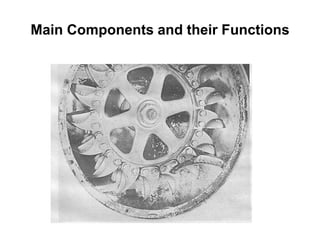
2. Buckets and Runners
• Each bucket is divided vertically
into two parts by a splitter which
is a sharp edge at the center,
giving the shape of a double
hemispherical cup
• The splitter helps the jet to be
divided without shock, into two
pats moving sideways in
opposite directions
• The jet is deflected by the
bucket at about 160 degree
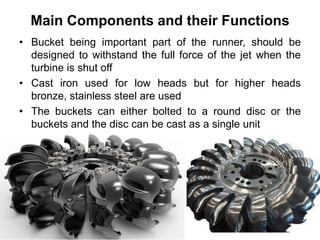
Main Components and their Functions
• Bucket being important part of the runner, should be
designed to withstand the full force of the jet when the
turbine is shut off
• Cast iron used for low heads but for higher heads
bronze, stainless steel are used
• The buckets can either bolted to a round disc or the
buckets and the disc can be cast as a single unit
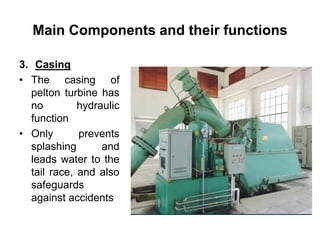
Main Components and their functions
3. Casing
• The casing of
pelton turbine has
no hydraulic
function
• Only prevents
splashing and
leads water to the
tail race, and also
safeguards
against accidents
Main Components and their Functions
4. Hydraulic Brake
• Even after shutting down the inlet valve, large capacity
turbine keeps on revolving for a considerable period of
time due to its inertia
• In order to bring the turbine to standstill in shortest
period of time, brake is required
• It consists of a small nozzle fitted in such a way that on
being opened, it directs a jet on the back of the buckets
to bring the revolving runner quickly to test
• The least diameter of brake jet has been found to be
equal to 0.6 times the least diameter of the main jet
Different Layouts of Pelton Turbine
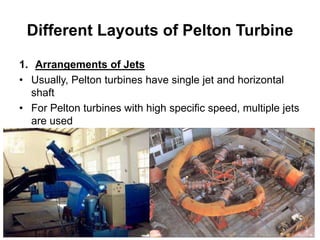
1. Arrangements of Jets
• Usually, Pelton turbines have single jet and horizontal
shaft
• For Pelton turbines with high specific speed, multiple jets
are used
Different Layouts of Pelton Turbine
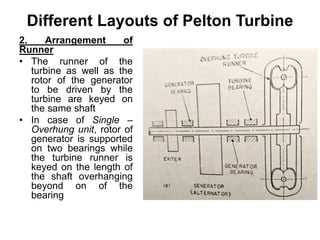
2. Arrangement of
Runner
• The runner of the
turbine as well as the
rotor of the generator
to be driven by the
turbine are keyed on
the same shaft
• In case of Single –
Overhung unit, rotor of
generator is supported
on two bearings while
the turbine runner is
keyed on the length of
the shaft overhanging
beyond on of the
bearing
Different Layouts of Pelton Turbine
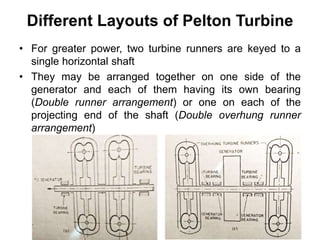
• For greater power, two turbine runners are keyed to a
single horizontal shaft
• They may be arranged together on one side of the
generator and each of them having its own bearing
(Double runner arrangement) or one on each of the
projecting end of the shaft (Double overhung runner
arrangement)
Different Layouts of Pelton Turbine
3. Arrangement of Turbine Shaft
• Pelton turbines are usually installed with horizontal shaft
and equipped with only one nozzle
• Horizontal shaft arrangement is employed if the number
of nozzles is two and for greater number of jets, vertical
arrangement is used
When to use a Pelton turbine
Energy conversion in a Pelton
turbine
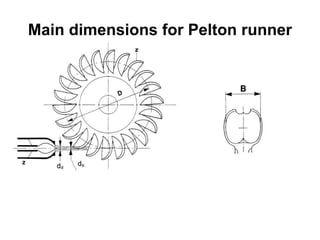
Main dimensions for Pelton runner
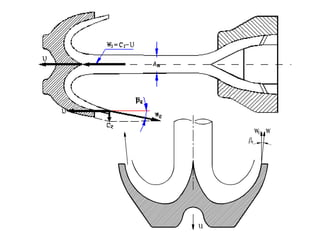
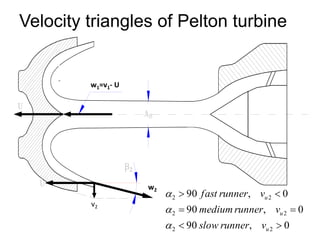
w1=v1- U
w2
v2
Velocity triangles of Pelton turbine
0,90
0,90
0,90
22
22
22



u
u
u
vrunnerslow
vrunnermedium
vrunnerfast



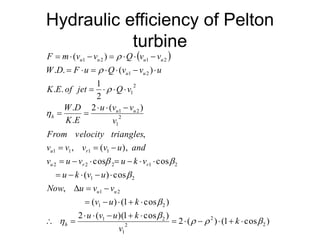
Hydraulic efficiency of Pelton
turbine
 
)cos1()(2
)cos1)((2
)cos1()(
,
cos)(
coscos
),(,
,
)(2
.
.
2
1
..
)(..
)(
2
2
2
1
21
21
21
21
21222
1111
2
1
21
2
1
21
2121























k
v
kuvu
kuv
vvuNow
uvku
vkuvuv
anduvvvv
trianglesvelocityFrom
v
vvu
EK
DW
vQjetofEK
uvvQuFDW
vvQvvmF
h
uu
rru
ru
uu
h
uu
uuuu
Hydraulic efficiency of Pelton
turbine Contd..
• The power output becomes zero
when u = 0 and when u = v1
• First case the wheel is at rest and
second case the wheel runs at the
highest speed called runaway speed
• For maximum efficiency,
)cos1(
2
1
,
2
cos1
2
1
0)21(
0)cos1(2sin
0)cos1()21(2
0)]cos1()(2[
2
2
max
2
max
1
2
2
2
2















kklossesnozzleif
v
u
or
kce
kor
k
d
d
v
Practically, blade angle =
10-15 degree
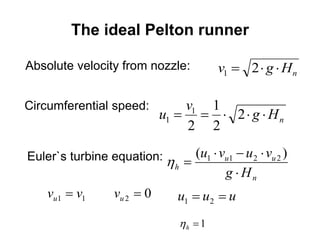
The ideal Pelton runner
Absolute velocity from nozzle: nHgv  21
Circumferential speed:
nHg
v
u  2
2
1
2
1
1
Euler`s turbine equation:
n
uu
h
Hg
vuvu



)( 2211

11 vvu  02 uv uuu  21
1h
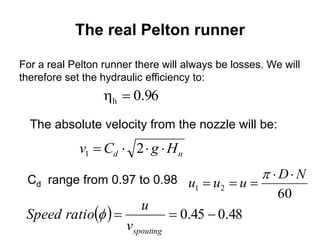
The real Pelton runner
For a real Pelton runner there will always be losses. We will
therefore set the hydraulic efficiency to:
96.0h 
The absolute velocity from the nozzle will be:
nd HgCv  21
Cd range from 0.97 to 0.98
60
21
ND
uuu



  48.045.0 
spoutingv
u
ratioSpeed 
Pelton runner contd..
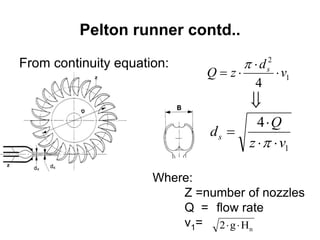
From continuity equation:
1
2
4
v
d
zQ s





1
4
vz
Q
ds




Where:
Z =number of nozzles
Q = flow rate
v1= nHg2 
Pelton runner contd..
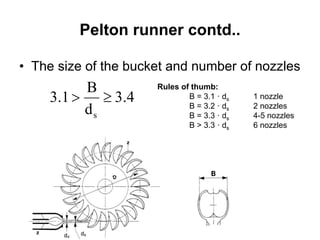
• The size of the bucket and number of nozzles
4.3
d
B
1.3
s

Rules of thumb:
B = 3.1 · ds 1 nozzle
B = 3.2 · ds 2 nozzles
B = 3.3 · ds 4-5 nozzles
B > 3.3 · ds 6 nozzles
Pelton runner contd..
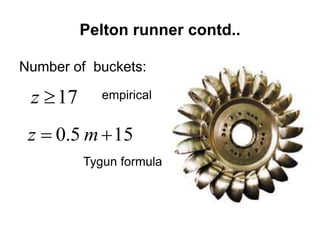
Number of buckets:
17z empirical
155.0  mz
Tygun formula
Pelton runner contd..
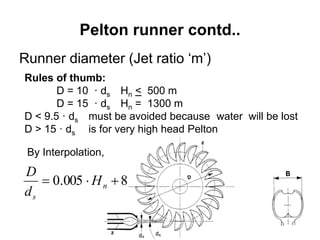
Runner diameter (Jet ratio ‘m’)
Rules of thumb:
D = 10 · ds Hn < 500 m
D = 15 · ds Hn = 1300 m
D < 9.5 · ds must be avoided because water will be lost
D > 15 · ds is for very high head Pelton
8005.0  n
s
H
d
D
By Interpolation,
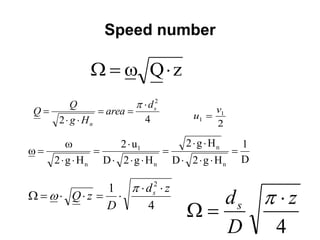
Speed number
zQ
42
2
s
n
d
area
Hg
Q
Q





2
1
1
v
u 
D
1
Hg2D
Hg2
Hg2D
u2
Hg2 n
n
n
1
n










4
1 2
zd
D
zQ s 



4
z
D
ds 


Pelton runner contd..
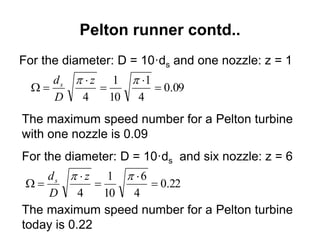
For the diameter: D = 10·ds and one nozzle: z = 1
09.0
4
1
10
1
4





 z
D
ds
The maximum speed number for a Pelton turbine
with one nozzle is 0.09
For the diameter: D = 10·ds and six nozzle: z = 6
22.0
4
6
10
1
4





 z
D
ds
The maximum speed number for a Pelton turbine
today is 0.22
Selection of Speed:
For a given conditions, Pelton turbines have a wide range of speed. If
the speed of the turbine made higher, then,
a) Specific speed will increases
Advantages:
– The size of the turbine will become smaller and hence it will less costly
– The jet diameter will decrease. Reduction in jet diameter will raise the
jet ratio and enhance the runner efficiency
Disadvantages:
– Need multi-jets with which the governing becomes complicated and
more expensive
b) The speed of directly coupled generator will increase. This means
that smaller number of pair of poles are required and hence the
generator will also be less costly
c) Material employed for high speed machines (turbine and generator)
will be costly, as high speed causes great stresses in revolving
parts
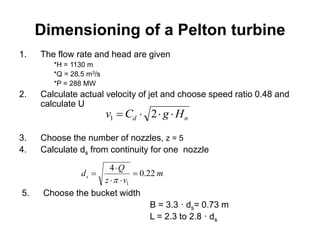
Dimensioning of a Pelton turbine
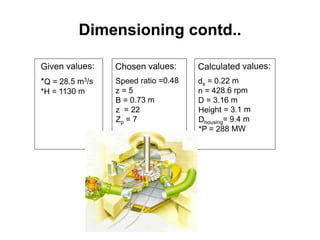
1. The flow rate and head are given
*H = 1130 m
*Q = 28.5 m3/s
*P = 288 MW
2. Calculate actual velocity of jet and choose speed ratio 0.48 and
calculate U
3. Choose the number of nozzles, z = 5
4. Calculate ds from continuity for one nozzle
nd HgCv  21
m
vz
Q
ds 22.0
4
1





5. Choose the bucket width
B = 3.3 · ds= 0.73 m
L = 2.3 to 2.8 · ds
Dimensioning contd..
6. Find the diameter by interpolation
mdD
H
d
D
s
n
s
0.365.13
65.138005.0



D/ds
Hn [m]
10
15
400 1400
Dimensioning contd..
7. Calculate the speed:
8. Choose the number of poles on the generator:
The speed of the runner is given by the generator and the net frequency:
where Zp= pair of poles on the generator
The pair of poles will be:
rpm
D
u
n
DND
u
452
60
260
2
2
1
1











][
3000
rpm
Z
N
p

764.6
3000

N
Zp
Dimensioning contd..
9. Recalculate the speed:
10. Recalculate the diameter:
11. Choose the number of buckets
z = 22
][6.428
3000
rpm
Z
N
p

m
N
u
D
DND
u 16.3
60
260
2
2
1
1 








Dimensioning contd..
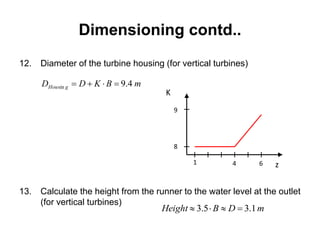
12. Diameter of the turbine housing (for vertical turbines)
13. Calculate the height from the runner to the water level at the outlet
(for vertical turbines)
mBKDD gHou 4.9sin 
K
z
8
9
1 64
mDBHeight 1.35.3 
Dimensioning contd..

4. pelton turbine

  • 1.
    FLUID MACHINES Chapter 3:Water Turbine Pelton Turbine Presented by Keshav Kumar Acharya Teaching Assistant TU, IOE Purwanchal Campus
  • 2.
    Pelton Turbine • Mostlyused impulse turbine. Also called free jet turbine • Operates under a high head of water and thus requires a comparatively less quantity of water • All the pressure energy of water is converted into velocity head with the help of nozzle and the so obtained water with high velocity impinges the buckets fixed around the wheel • The water jet after impinging on the buckets is deflected through an angle of about 165 degree instead of 180 to prevent retardation of wheel
  • 3.
    Pelton Turbine Pelton Turbineis not suitable/efficient for low head • For a given power, if the head is reduced, the rate of flow has to be increased • Increased flow requires bigger jet diameter, consequently the runner diameter will also increase • Jet velocity and consequently the peripheral velocity of runner will reduce • These two factors make the turbine bulky and slow running in low heads
  • 4.
    Main Components andtheir Functions 1. Guide Mechanism • Controls the quantity of water passing through the nozzle and striking the bucket • Maintains the speed of the wheel constant even when the head varies • Consists of a spear fixed to the end of a shaft which is operated by governor
  • 5.
    Main Components andtheir Functions • When the speed of the wheel increases, the spear is pushed into the nozzle thereby reducing the quantity of water striking the bucket and vice- versa • In case of immediate closure of main nozzle, Bypass Nozzle is provided to prevent excessive pressure building in the pipe • Modern practice is to provide the guide mechanism with a deflector • Deflector consists of plate connected to spear rod by means of levers and is located in between nozzle and bucket • In case of sudden reduction in load, deflector is brought in front of the bucket and thus deflecting the jet from striking the bucket
  • 6.
    Main Components andtheir Functions 2. Buckets and Runners • Each bucket is divided vertically into two parts by a splitter which is a sharp edge at the center, giving the shape of a double hemispherical cup • The splitter helps the jet to be divided without shock, into two pats moving sideways in opposite directions • The jet is deflected by the bucket at about 160 degree
  • 7.
    Main Components andtheir Functions
  • 8.
    Main Components andtheir Functions • Bucket being important part of the runner, should be designed to withstand the full force of the jet when the turbine is shut off • Cast iron used for low heads but for higher heads bronze, stainless steel are used • The buckets can either bolted to a round disc or the buckets and the disc can be cast as a single unit
  • 9.
    Main Components andtheir functions 3. Casing • The casing of pelton turbine has no hydraulic function • Only prevents splashing and leads water to the tail race, and also safeguards against accidents
  • 10.
    Main Components andtheir Functions 4. Hydraulic Brake • Even after shutting down the inlet valve, large capacity turbine keeps on revolving for a considerable period of time due to its inertia • In order to bring the turbine to standstill in shortest period of time, brake is required • It consists of a small nozzle fitted in such a way that on being opened, it directs a jet on the back of the buckets to bring the revolving runner quickly to test • The least diameter of brake jet has been found to be equal to 0.6 times the least diameter of the main jet
  • 11.
    Different Layouts ofPelton Turbine 1. Arrangements of Jets • Usually, Pelton turbines have single jet and horizontal shaft • For Pelton turbines with high specific speed, multiple jets are used
  • 12.
    Different Layouts ofPelton Turbine 2. Arrangement of Runner • The runner of the turbine as well as the rotor of the generator to be driven by the turbine are keyed on the same shaft • In case of Single – Overhung unit, rotor of generator is supported on two bearings while the turbine runner is keyed on the length of the shaft overhanging beyond on of the bearing
  • 13.
    Different Layouts ofPelton Turbine • For greater power, two turbine runners are keyed to a single horizontal shaft • They may be arranged together on one side of the generator and each of them having its own bearing (Double runner arrangement) or one on each of the projecting end of the shaft (Double overhung runner arrangement)
  • 14.
    Different Layouts ofPelton Turbine 3. Arrangement of Turbine Shaft • Pelton turbines are usually installed with horizontal shaft and equipped with only one nozzle • Horizontal shaft arrangement is employed if the number of nozzles is two and for greater number of jets, vertical arrangement is used
  • 15.
    When to usea Pelton turbine
  • 16.
    Energy conversion ina Pelton turbine
  • 17.
    Main dimensions forPelton runner
  • 19.
    w1=v1- U w2 v2 Velocity trianglesof Pelton turbine 0,90 0,90 0,90 22 22 22    u u u vrunnerslow vrunnermedium vrunnerfast   
  • 20.
    Hydraulic efficiency ofPelton turbine   )cos1()(2 )cos1)((2 )cos1()( , cos)( coscos ),(, , )(2 . . 2 1 .. )(.. )( 2 2 2 1 21 21 21 21 21222 1111 2 1 21 2 1 21 2121                        k v kuvu kuv vvuNow uvku vkuvuv anduvvvv trianglesvelocityFrom v vvu EK DW vQjetofEK uvvQuFDW vvQvvmF h uu rru ru uu h uu uuuu
  • 21.
    Hydraulic efficiency ofPelton turbine Contd.. • The power output becomes zero when u = 0 and when u = v1 • First case the wheel is at rest and second case the wheel runs at the highest speed called runaway speed • For maximum efficiency, )cos1( 2 1 , 2 cos1 2 1 0)21( 0)cos1(2sin 0)cos1()21(2 0)]cos1()(2[ 2 2 max 2 max 1 2 2 2 2                kklossesnozzleif v u or kce kor k d d v Practically, blade angle = 10-15 degree
  • 22.
    The ideal Peltonrunner Absolute velocity from nozzle: nHgv  21 Circumferential speed: nHg v u  2 2 1 2 1 1 Euler`s turbine equation: n uu h Hg vuvu    )( 2211  11 vvu  02 uv uuu  21 1h
  • 23.
    The real Peltonrunner For a real Pelton runner there will always be losses. We will therefore set the hydraulic efficiency to: 96.0h  The absolute velocity from the nozzle will be: nd HgCv  21 Cd range from 0.97 to 0.98 60 21 ND uuu      48.045.0  spoutingv u ratioSpeed 
  • 24.
    Pelton runner contd.. Fromcontinuity equation: 1 2 4 v d zQ s      1 4 vz Q ds     Where: Z =number of nozzles Q = flow rate v1= nHg2 
  • 25.
    Pelton runner contd.. •The size of the bucket and number of nozzles 4.3 d B 1.3 s  Rules of thumb: B = 3.1 · ds 1 nozzle B = 3.2 · ds 2 nozzles B = 3.3 · ds 4-5 nozzles B > 3.3 · ds 6 nozzles
  • 26.
    Pelton runner contd.. Numberof buckets: 17z empirical 155.0  mz Tygun formula
  • 27.
    Pelton runner contd.. Runnerdiameter (Jet ratio ‘m’) Rules of thumb: D = 10 · ds Hn < 500 m D = 15 · ds Hn = 1300 m D < 9.5 · ds must be avoided because water will be lost D > 15 · ds is for very high head Pelton 8005.0  n s H d D By Interpolation,
  • 28.
    Speed number zQ 42 2 s n d area Hg Q Q      2 1 1 v u  D 1 Hg2D Hg2 Hg2D u2 Hg2n n n 1 n           4 1 2 zd D zQ s     4 z D ds   
  • 29.
    Pelton runner contd.. Forthe diameter: D = 10·ds and one nozzle: z = 1 09.0 4 1 10 1 4       z D ds The maximum speed number for a Pelton turbine with one nozzle is 0.09 For the diameter: D = 10·ds and six nozzle: z = 6 22.0 4 6 10 1 4       z D ds The maximum speed number for a Pelton turbine today is 0.22
  • 30.
    Selection of Speed: Fora given conditions, Pelton turbines have a wide range of speed. If the speed of the turbine made higher, then, a) Specific speed will increases Advantages: – The size of the turbine will become smaller and hence it will less costly – The jet diameter will decrease. Reduction in jet diameter will raise the jet ratio and enhance the runner efficiency Disadvantages: – Need multi-jets with which the governing becomes complicated and more expensive b) The speed of directly coupled generator will increase. This means that smaller number of pair of poles are required and hence the generator will also be less costly c) Material employed for high speed machines (turbine and generator) will be costly, as high speed causes great stresses in revolving parts
  • 31.
    Dimensioning of aPelton turbine 1. The flow rate and head are given *H = 1130 m *Q = 28.5 m3/s *P = 288 MW 2. Calculate actual velocity of jet and choose speed ratio 0.48 and calculate U 3. Choose the number of nozzles, z = 5 4. Calculate ds from continuity for one nozzle nd HgCv  21 m vz Q ds 22.0 4 1      5. Choose the bucket width B = 3.3 · ds= 0.73 m L = 2.3 to 2.8 · ds
  • 32.
    Dimensioning contd.. 6. Findthe diameter by interpolation mdD H d D s n s 0.365.13 65.138005.0    D/ds Hn [m] 10 15 400 1400
  • 33.
    Dimensioning contd.. 7. Calculatethe speed: 8. Choose the number of poles on the generator: The speed of the runner is given by the generator and the net frequency: where Zp= pair of poles on the generator The pair of poles will be: rpm D u n DND u 452 60 260 2 2 1 1            ][ 3000 rpm Z N p  764.6 3000  N Zp
  • 34.
    Dimensioning contd.. 9. Recalculatethe speed: 10. Recalculate the diameter: 11. Choose the number of buckets z = 22 ][6.428 3000 rpm Z N p  m N u D DND u 16.3 60 260 2 2 1 1         
  • 35.
    Dimensioning contd.. 12. Diameterof the turbine housing (for vertical turbines) 13. Calculate the height from the runner to the water level at the outlet (for vertical turbines) mBKDD gHou 4.9sin  K z 8 9 1 64 mDBHeight 1.35.3 
  • 36.