Pelagic Ecology and Environments (3):
PELAGIC PREDATORS (cont.)

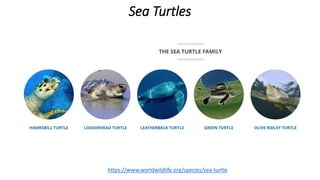
Sea Turtles
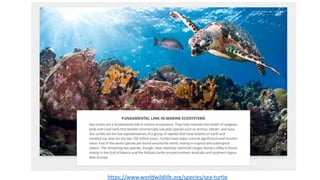
https://www.worldwildlife.org/species/sea-turtle
https://www.youtube.com/watch?v=5Rmv3nliwCs
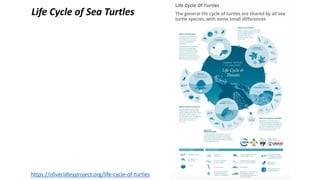
Life Cycle of Sea Turtles
https://oliveridleyproject.org/life-cycle-of-turtles
https://www.worldwildlife.org/species/sea-turtle
Green Turtles
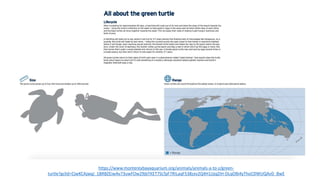
https://www.montereybayaquarium.org/animals/animals-a-to-z/green-
turtle?gclid=CjwKCAjwqJ_1BRBZEiwAv73uwFOw29jbTKET7SLTpF7RILaqF538zxv2Q4H1JJjqZIH-DLqOBi4yThoCDWUQAvD_BwE
https://www.youtube.com/watch?v=5SsPmHR3nJI
https://www
.fws.gov/ne
ws/blog/ind
ex.cfm/2015
/8/5/balloon
s-and-
wildlife-
please-dont-
release-your-
balloons
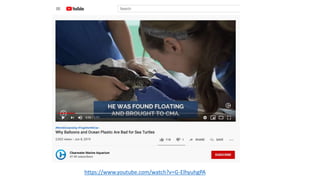
https://www.youtube.com/watch?v=G-ElhyuhgPA
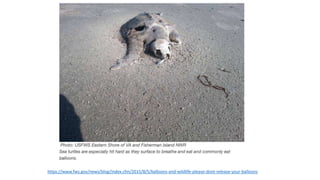
https://www.fws.gov/news/blog/index.cfm/2015/8/5/balloons-and-wildlife-please-dont-release-your-balloons
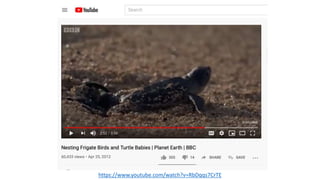
https://www.youtube.com/watch?v=RbDqqs7CrTE
https://www.fws.gov/news/blog/index.cfm/2015/8/5/balloons-and-wildlife-please-dont-release-your-balloons
Pelagic Sea Birds
https://www.usgs.gov/centers/asc/s
cience/seabirds-and-forage-fish-
ecology?qt-
science_center_objects=0#qt-
science_center_objects
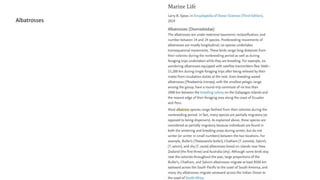
Albatrosses
Albatrosses (Diomedeidae)
“The albatrosses are under extensive taxonomic reclassification, and number between 14 and 24 species. Post-breeding movements of
albatrosses are mostly longitudinal; no species undertakes transequatorial movements. These birds range long distances from their colonies
during the nonbreeding period as well as during foraging trips undertaken while they are breeding. For example, six wandering albatrosses
equipped with satellite transmitters flew 3660–15,200 km during single foraging trips after being relieved by their mates from incubation
duties at the nest. Even breeding waved albatrosses (Phoebastria irrorata), with the smallest pelagic range among the group, have a round-
trip commute of no less than 2000 km between the breeding colony on the Galapagos Islands and the nearest edge of their foraging area
along the coast of Ecuador and Peru.
“Most albatross species range farthest from their colonies during the nonbreeding period. In fact, many species are partially migratory (as
opposed to being dispersers). As explained above, these species are considered as partially migratory because individuals are found in both
the wintering and breeding areas during winter, but do not winter (or winter in small numbers) between the two locations. For example,
Buller's (Thalassarche bulleri), Chatham (T. eremita), Salvin's (T. salvini), and shy (T. cauta) albatrosses breed on islands near New Zealand (the
first three) and Australia (shy). Although some birds stay near the colonies throughout the year, large proportions of the Buller’s, Chatham,
and Salvin's albatrosses migrate at least 8500 km eastward across the South Pacific to the coast of South America, and many shy albatrosses
migrate westward across the Indian Ocean to the coast of South Africa.
“Three other species, the wandering, black-browed (T. melanophris), and gray-headed (T. crysostoma) albatrosses, have breeding colonies
located circumpolarly across southern latitudes near 50°S. The South Georgia populations may be partially migratory, although the distinction
from dispersive is not clear. South Georgian wandering albatross fly north to waters off Argentina, and then eastward to important wintering
areas off South Africa. Some continue to Australian waters and may even circumnavigate the Southern Ocean. One of several of these birds
equipped with a satellite transmitter averaged 690 km/day. A large proportion (c. 85%) of South Georgian black-browed albatrosses also
winter off South Africa, and many South Georgian gray-headed albatrosses are thought to fly westward to waters off the Pacific coast of Chile,
and then to New Zealand.”
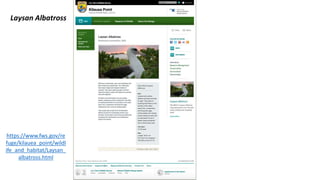
Laysan Albatross
https://www.fws.gov/re
fuge/kilauea_point/wildl
ife_and_habitat/Laysan_
albatross.html
https://www.smithsonianmag.com/science-nature/the-amazing-albatrosses-162515529/
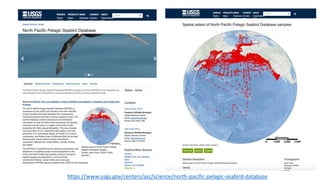
https://www.usgs.gov/centers/asc/science/north-pacific-pelagic-seabird-database
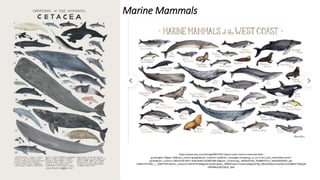
Marine Mammals
https://www.etsy.com/listing/698375917/west-coast-marine-mammals-field-
guide?gpla=1&gao=1&&utm_source=google&utm_medium=cpc&utm_campaign=shopping_us_ts1-b-art_and_collectibles-prints-
giclee&utm_custom1=d923cf30-0457-4438-8260-5c63607d8c7d&utm_content=go_1843970146_70388567515_346428263003_pla-
354814757658_c__698375917&utm_custom2=1843970146&gclid=CjwKCAjwqJ_1BRBZEiwAv73uwHuaWgGib2T8j_X8eOe5KduJsT3wCBa19z1D8kKIc7lDdjpW
hfRHBBoC0KcQAvD_BwE
https://www.noaa.gov/education/resource-
collections/marine-life/marine-mammals
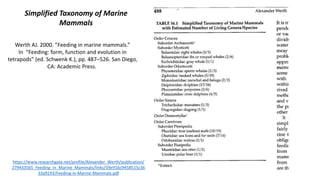
Werth AJ. 2000. ”Feeding in marine mammals.”
In “Feeding: form, function and evolution in
tetrapods” (ed. Schwenk K.), pp. 487–526. San Diego,
CA: Academic Press.
https://www.researchgate.net/profile/Alexander_Werth/publication/
279433565_Feeding_in_Marine_Mammals/links/59e916c9458515c36
33a9193/Feeding-in-Marine-Mammals.pdf
Simplified Taxonomy of Marine
Mammals
https://www.researchgate.net/profile/Alexander_Werth/publication/
279433565_Feeding_in_Marine_Mammals/links/59e916c9458515c36
33a9193/Feeding-in-Marine-Mammals.pdf
Werth AJ. 2000. ”Feeding in marine mammals.”
In “Feeding: form, function and evolution in
tetrapods” (ed. Schwenk K.), pp. 487–526. San Diego,
CA: Academic Press.
Evolution of Marine Mammals
“Abstract: The fossil record demonstrates that mammals re‐entered
the marine realm on at least seven separate occasions. Five of these
clades are still extant, whereas two are extinct. This review presents a
brief introduction to the phylogeny of each group of marine mammals,
based on the latest studies using both morphological and molecular
data. Evolutionary highlights are presented, focusing on changes
affecting the sensory systems, locomotion, breathing, feeding, and
reproduction in Cetacea, Sirenia, Desmostylia, and Pinnipedia.
Aquatic adaptations are specifically cited, supported by data from
morphological and geochemical studies. ”
-- M.D. Uhen “Evolution of marine mammals: Back to the sea after 300 million years,”
Anatomical Record
Volume 290, Issue 6, [Special Issue: Anatomical Adaptations of Aquatic Mammals]
June 2007 Pages 514-522
https://www.youtube.com/watch?v=bgiPTUy2RqI
https://www.slideshare.net/india
waterportal/an-introduction-to-
marine-mammals-temi
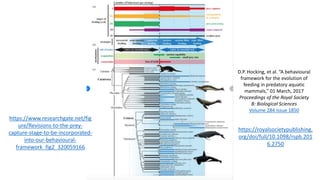
D.P. Hocking, et al. “A behavioural
framework for the evolution of
feeding in predatory aquatic
mammals,” 01 March, 2017
Proceedings of the Royal Society
B: Biological Sciences
Volume 284 Issue 1850
https://royalsocietypublishing.
org/doi/full/10.1098/rspb.201
6.2750
https://www.researchgate.net/fig
ure/Revisions-to-the-prey-
capture-stage-to-be-incorporated-
into-our-behavioural-
framework_fig2_320059166
https://www.researchgate.net/fig
ure/Revisions-to-the-prey-
capture-stage-to-be-incorporated-
into-our-behavioural-
framework_fig2_320059166
D.P. Hocking, et al. “A behavioural
framework for the evolution of
feeding in predatory aquatic
mammals,” 01 March, 2017
Proceedings of the Royal Society
B: Biological Sciences
Volume 284 Issue 1850
https://royalsocietypublishing.
org/doi/full/10.1098/rspb.201
6.2750
A behavioural framework for the evolution of feeding in predatory aquatic mammals, Volume: 284, Issue: 1850, DOI: (10.1098/rspb.2016.2750)
“Within our new framework, semi-aquatic feeding describes any feeding events where some
behaviours occur underwater (e.g. ram feeding or snapping during prey capture), while others
occur in air at the surface, either while floating or treading water, or while hauled out on land (e.g.
prey manipulation and processing). Both otters and pinnipeds use semi-aquatic feeding when
consuming large prey, which is typically captured underwater before being processed at the surface
[26,37]. Water ingested along with prey can generally be drained from the oral cavity while the
head is held clear of the water.
“In contrast to semi-aquatic feeding, aquatic raptorial feeding describes feeding events where all
components of the feeding cycle occur underwater. Here, snapping and ram feeding are typically
used for prey capture, although suction may facilitate the process by drawing prey within range of
the teeth prior to biting [17]. Following initial capture, intraoral suction is used to transport prey to
the back of the oral cavity, with any ingested water being expelled via simple sieving. Aquatic
raptorial feeding is common among pinnipeds and dolphins, both of which tend to capture and
swallow small fish whole. In some cases, however, larger prey is also targeted and may be partly
processed underwater by shaking or tearing [38].
“Suction feeding describes events where prey capture occurs mainly via suction. For this mode of
capture to be effective, targeted prey is typically small enough to be sucked entirely into the oral
cavity, with minimal or no prey processing [37]. Prey can be either immobile (e.g. benthic
invertebrates) or evasive (e.g. squid), with the latter sometimes requiring prolonged chases [48,49].
In cetaceans, specialization towards suction feeding tends to be accompanied by the loss of most or
all of the teeth (e.g. beaked whales) [14]. Following suction, simple sieving is used to retain
individual prey items inside the oral cavity while water is expelled.
“Suction filter feeding is effectively an extension of suction feeding, but, instead of simple sieving,
uses a specialized filter to separate prey from ingested water. This filter consists of either highly
elaborate teeth (in leopard and crabeater seals) [7,43] or baleen (in the grey whale) [34,47], and is
capable of retaining smaller prey than simple sieving, thus enabling suction filter feeders to gather
small prey in bulk. Finally, filtering and bulk feeding are also characteristic of ram filter feeding,
which is arguably the most highly specialized of all aquatic mammal strategies. Ram filter feeding is
only used by baleen-bearing mysticetes, and involves neither suction nor teeth to capture prey.
Instead, prey is ingested via continuous (skim feeding, as seen in right whales) or intermittent
(lunge feeding, as seen in rorquals) ram movements, and then retained in the oral cavity via a
specialized filter while excess water is expelled [5,50].”
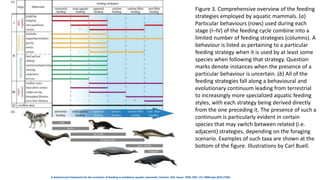
A behavioural framework for the evolution of feeding in predatory aquatic mammals, Volume: 284, Issue: 1850, DOI: (10.1098/rspb.2016.2750)
Figure 3. Comprehensive overview of the feeding
strategies employed by aquatic mammals. (a)
Particular behaviours (rows) used during each
stage (I–IV) of the feeding cycle combine into a
limited number of feeding strategies (columns). A
behaviour is listed as pertaining to a particular
feeding strategy when it is used by at least some
species when following that strategy. Question
marks denote instances when the presence of a
particular behaviour is uncertain. (b) All of the
feeding strategies fall along a behavioural and
evolutionary continuum leading from terrestrial
to increasingly more specialized aquatic feeding
styles, with each strategy being derived directly
from the one preceding it. The presence of such a
continuum is particularly evident in certain
species that may switch between related (i.e.
adjacent) strategies, depending on the foraging
scenario. Examples of such taxa are shown at the
bottom of the figure. Illustrations by Carl Buell.
Elephant Seals
https://video.nationalgeographic.com/video/short-film-showcase/00000149-
bf44-dbb2-abcf-bf5e865b0000
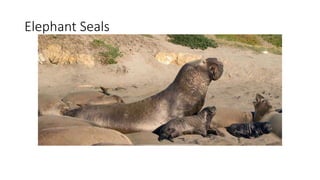
Elephant Seals
“Description: Elephant seals are well named because adult males have large noses that
resemble an elephant's trunk. Males begin developing this enlarged nose, or proboscis,
at sexual maturity (about three to five years), and it is fully developed by seven to nine
years. Adult males may grow to over 13 feet (4 m) in length and weigh up to 4,500
pounds (2,000 kg). The females are much smaller at 10 feet (3 m) in length and 1,500
pounds (600 kg). The northern elephant seal is the second largest seal in the world, after
the southern elephant seal. The elephant seal is in the phocid, or true seal, family. It
lacks external ear flaps and moves on land by flopping on its belly. The elephant seal has
a broad, round face with very large eyes. Pups are born with a black coat which is
molted, or shed, at about the time of weaning (28 days), revealing a sleek, silver-gray
coat. Within a year, the coat will turn silvery brown.
“ Range/Habitat” Northern elephant seals are found in the North Pacific, from Baja
California, Mexico to the Gulf of Alaska and Aleutian Islands. During the breeding season,
they live on beaches on offshore islands and a few remote spots on the mainland. The
rest of the year, except for molting periods, elephant seals live well off shore (up to 5,000
miles, or 8,000 km), commonly descending to over 5,000 feet (1,524 m) below the
ocean's surface.”
http://www.marinemammalcenter.org/education/marine-mammal-
information/pinnipeds/northern-elephant-seal/
Elephant Seals
“While sailing along the Pacific coast in the 1800s, a whale and seal hunter
named Charles Scammon reported seeing northern elephant seals from
Baja California in Mexico to Point Reyes in California. Sharing the fate of
many of the oceans' great whales, the elephant seals were hunted to the
brink of extinction for their oil-rich blubber. One bull elephant seal would
yield nearly 25 gallons of oil. Though we don't know exactly how many
northern elephant seals were alive before the 20th Century, it has been
estimated that fewer than 1,000 northern elephant seals existed by 1910.
In 1922, the Mexican government banned hunting, followed shortly
thereafter by the United States government. Since then, the population of
northern elephant seals has recovered at an average rate of six percent per
year. Today, thanks to government protection and the seals' distant lives at
sea, the worldwide population has grown to an estimated 150,000 seals.”
http://www.nps.gov/pore/naturescience/elephant_seals.htm
Elephant Seals
“Hundreds of thousands of northern elephant seals once inhabited the Pacific Ocean. They
were slaughtered wholesale in the 1800s for the oil that could be rendered from their
blubber. By 1892, only 50 to 100 individuals were left. The only remaining colony was on
the Guadalupe Island off the coast of Baja California. In 1922, the Mexican government
gave protected status to elephant seals, and the U. S. government followed suit a few
years later when the seals began to appear in Southern California waters. Since that
time, elephant seals have continued to multiply exponentially, and they have extended
their breeding range as far north as Point Reyes. Today, there are approximately 160,000
northern elephant seals.
“The first elephant seals on Año Nuevo Island were sighted in 1955, and the first pup was
born there in 1961. In 1978, 872 were born there. Males began to haul out on the
mainland in 1965. A pup born in January 1975 was the first known mainland birth of a
northern elephant seal at Año Nuevo; 86 pups were born there in 1978. By 1988/1989,
about 2,000 elephant seals came ashore at Año Nuevo, and the number of seals
breeding and giving birth on the mainland is still increasing. During the 1994-95 breeding
season, approximately 2,000 pups were born on the mainland.”
http://www.parks.ca.gov/?page_id=1115
Walrus (Odobenus rosmarus)
Mammal
Diet:
Carnivore
Average life span in the
wild:
Up to 40 years
Size:
7.25 to 11.5 ft (2.2 to 3.5
m)
Weight:
Up to 1.5 tons (1.4 metric
tons)
Group name:
Herd
Protection status:
Endangered
The walrus' scientific name,
Odobenus rosmarus, is
Latin for "tooth-walking
sea-horse."
IUCN STATUS (2010) - DATA DEFICIENT
“Distribution and Numbers
Easily recognised by its long tusks, the walrus is the only living member of the Odobenidae family of pinnipeds and has two
generally recognised subspecies. The Atlantic walrus (O.r. rosmarus) is found from the east Canadian Arctic eastwards to the Kara
Sea. The Pacific walrus (O.r. divergens) is found in the north Pacific Ocean and in Arctic waters from the East Siberian Sea to the
western Beaufort Sea, as well as in the Laptev Sea. It has been proposed by some scientists that the Laptev Sea population be
given subspecific status as the Laptev walrus (O.r. laptevi) but this is not widely accepted. Accurate data on walrus abundance is
not available but the most recent rough population estimates have been 22,500 Atlantic walruses (6,000 in Norway and Russia,
12,000 in Canada and 4,500 in Greenland), and a minimum of 200,000 Pacific walruses in eastern Russia and the United States.
“Status
Walruses are long-lived and have a relatively low reproductive rate, so their numbers are easily influenced by hunting and other
mortality. Both subspecies of walrus have been subjected to intensive commercial hunting in the past for their blubber oil, tusk
ivory and skins, leading to the extermination of local populations in some areas and severe depletion of others. Although
commercial hunting has now ceased, other forms of hunting currently have the most direct and quantifiable impact on walrus
populations. Native subsistence hunting of the walrus for its meat, skin, ivory, oil and other products has taken place for thousands
of years and continues today. Lack of accurate information on walrus population numbers means that hunting quota levels may be
having a detrimental effect on the species, particularly for the Atlantic walrus. Certainly the problem of walruses being "struck and
lost" results in kill statistics that are very probably underestimated, figures of 30-42% having been quoted for the percentage of
walruses killed in this way.”
Walrus (Odobenus rosmarus)
http://www.pinnipeds.org/seal-information/species-information-pages/walrus
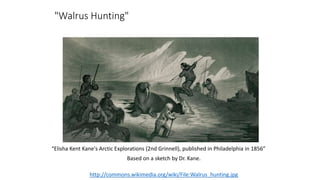
"Walrus Hunting"
“Elisha Kent Kane's Arctic Explorations (2nd Grinnell), published in Philadelphia in 1856”
Based on a sketch by Dr. Kane.
http://commons.wikimedia.org/wiki/File:Walrus_hunting.jpg
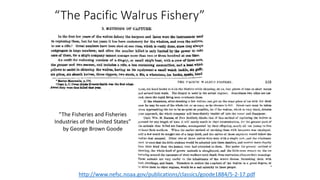
“The Pacific Walrus Fishery”
http://www.nefsc.noaa.gov/publications/classics/goode1884/5-2-17.pdf
“The Fisheries and Fisheries
Industries of the United States”
by George Brown Goode
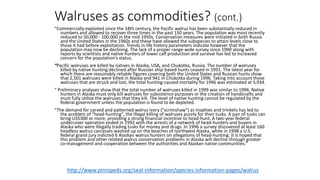
Walruses as commodities? (cont.)
“Commercially exploited since the 18th century, the Pacific walrus has been substantially reduced in
numbers and allowed to recover three times in the past 150 years. The population was most recently
reduced to 50,000 - 100,000 in the mid-1950s. Conservation measures were initiated in both Russia
and the United States in the 1960s and these have allowed the subspecies to attain levels close to
those it had before exploitation. Trends in life history parameters indicate however that the
population may now be declining. The lack of a proper range-wide survey since 1990 along with
reports by scientists and native hunters of lower calf production and survival has led to increased
concern for the population's status.
“Pacific walruses are killed by natives in Alaska, USA, and Chukotka, Russia. The number of walruses
killed by native hunting declined after Russian ship-based hunts ceased in 1991. The latest year for
which there are reasonably reliable figures covering both the United States and Russian hunts show
that 2,501 walruses were killed in Alaska and 941 in Chukotka during 1996. Taking into account those
walruses that are struck and lost, the total hunting-caused mortality for 1996 was estimated at 5,934.
“ Preliminary analyses show that the total number of walruses killed in 1999 was similar to 1996. Native
hunters in Alaska must only kill walruses for subsistence purposes or the creation of handicrafts and
must fully utilise the walruses that they kill. The level of native hunting cannot be regulated by the
federal government unless the population is found to be depleted.
“The demand for carved and patterned walrus ivory ("scrimshaw") as trophies and trinkets has led to
the problem of "head-hunting", the illegal killing of walruses purely for their tusks. A pair of tusks can
bring US$300 or more, providing a strong financial incentive to head-hunt. A two-year federal
undercover operation ended in 1992 with the arrests of a network of head-hunters and buyers in
Alaska who were illegally trading tusks for money and drugs. In 1996 a survey discovered at least 160
headless walrus carcasses washed up on the beaches of northwest Alaska, while in 1998 a U.S.
federal grand jury indicted 6 Alaskan walrus hunters on allegations of head-hunting. It is hoped that
this problem and other related walrus conservation problems in Alaska will decline through greater
co-management and cooperation between the authorities and Alaskan native communities.”
http://www.pinnipeds.org/seal-information/species-information-pages/walrus
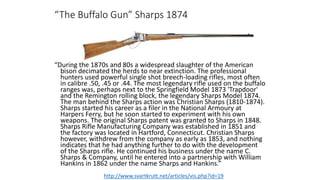
“The Buffalo Gun” Sharps 1874
“During the 1870s and 80s a widespread slaughter of the American
bison decimated the herds to near extinction. The professional
hunters used powerful single shot breech-loading rifles, most often
in calibre .50, .45 or .44. The most legendary rifle used on the buffalo
ranges was, perhaps next to the Springfield Model 1873 'Trapdoor'
and the Remington rolling block, the legendary Sharps Model 1874.
The man behind the Sharps action was Christian Sharps (1810-1874).
Sharps started his career as a filer in the National Armoury at
Harpers Ferry, but he soon started to experiment with his own
weapons. The original Sharps patent was granted to Sharps in 1848.
Sharps Rifle Manufacturing Company was established in 1851 and
the factory was located in Hartford, Connecticut. Christian Sharps
however, withdrew from the company as early as 1853, and nothing
indicates that he had anything further to do with the development
of the Sharps rifle. He continued his business under the name C.
Sharps & Company, until he entered into a partnership with William
Hankins in 1862 under the name Sharps and Hankins.”
http://www.svartkrutt.net/articles/vis.php?id=19
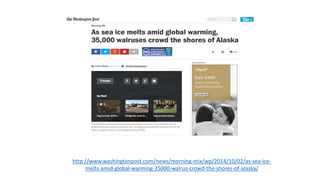
http://www.washingtonpost.com/news/morning-mix/wp/2014/10/02/as-sea-ice-
melts-amid-global-warming-35000-walrus-crowd-the-shores-of-alaska/
Environmental Impacts
“A survey of hunters and elders from Nunavut in the Canadian Arctic,
released in September 2000, revealed that hunters had observed walruses
and other wildlife with a large number of deformities, including swollen
internal organs and missing patches of skin. A strange occurrence of "round
wounds" was observed in the skin of some walruses, and the analysis of a
similar abnormality found in a walrus in March 2000 had pinpointed a
strain of bacteria as the cause. Hunters also reported finding walruses with
fluid or pus between their meat and fat or with unusual stomach contents,
and even one walrus which had its gall bladder reversed and draining into
its stomach. Changes in the colour of walrus meat and fat were also
reported. The survey report recommended a specific system of monitoring
for such abnormalities in the future, as well as further studies on affected
animals. One possible reason suggested for these abnormalities is the high
level of persistent organic pollutants (POPs) in the Canadian Arctic.”
http://www.pinnipeds.org/seal-information/species-information-pages/walrus
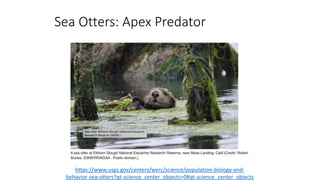
https://www.usgs.gov/centers/werc/science/population-biology-and-
behavior-sea-otters?qt-science_center_objects=0#qt-science_center_objects
Sea Otters: Apex Predator
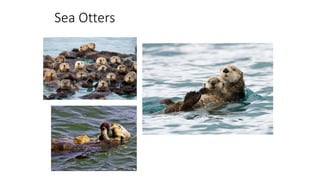
Sea Otters
Sea Otters
https://www.youtube.com/watch?v=N-UZc3Ur6k0
Sea Otters
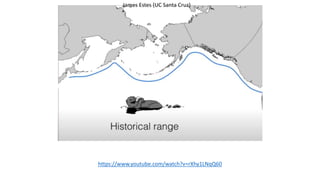
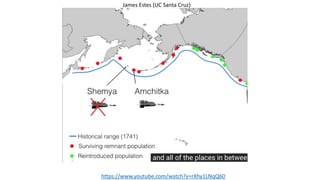
“Sea otters have inhabited the northern coasts of the Pacific Ocean since the Pleistocene, about 1
to 3 million years ago. The historical range of the sea otter extended from central Baja California
northward along the coast of North America to Alaska, westward through the Aleutian, Pribilof,
and Commander islands to the coast of Kamchatka, Russia, and south through the Kuril Islands to
southern Sakhalin Island, Russia, and northern Japan. In the mid-1700s, between 100,000 and
300,000 sea otters lived along the North Pacific coast
“In 1741, Vitus Bering and his expedition sailed from Russia to explore and map the coastlines of the
North Pacific. Also on board the ship was the naturalist Georg Steller, who studied and
documented the flora and fauna, including the sea otter, which was encountered in the Aleutian
and Commander islands. The first scientific description of the sea otter was later published in
1751 in Steller’s book De Bestiis Marinis (The Beasts of the Sea).
“Intensive commercial exploitation of sea otters began with their discovery by Bering’s expedition
and continued through the early 1900s. Historically, Native Americans along the Pacific coast
hunted sea otters, but the abundant numbers encountered by the early Russian hunters indicate
that sea otters were not widely overhunted before contact with Europeans.”
http://www.fws.gov/alaska/fisheries/mmm/seaotters/history.htm
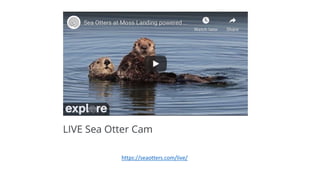
https://seaotters.com/live/
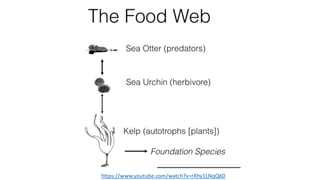
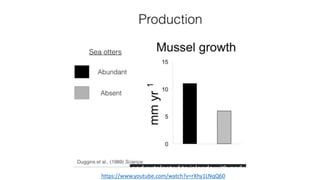
https://www.youtube.com/watch?v=rXhy1LNqQ60
James Estes (UC Santa Cruz)
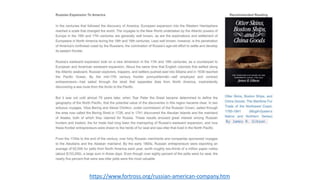
https://www.fortross.org/russian-american-company.htm
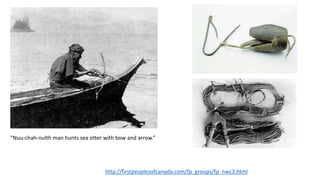
“Nuu-chah-nulth man hunts sea otter with bow and arrow.”
http://firstpeoplesofcanada.com/fp_groups/fp_nwc3.html
https://www.youtube.com/watch?v=rXhy1LNqQ60
James Estes (UC Santa Cruz)
https://www.youtube.com/watch?v=rXhy1LNqQ60
James Estes (UC Santa Cruz)
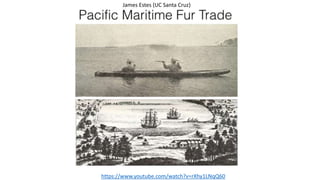
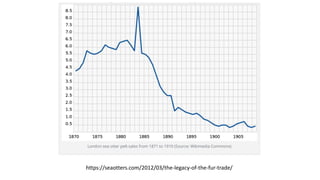
“Just a few hundred years ago, thousands of sea otters peppered the coast of California, dwarfing
the current population of less than 3000 animals. A host of human impacts are to blame for
keeping otters near the edge of extinction today—loss of habitat, competition for food, diseases
carried by our pets and oils spills, to name just a few. But only the fur trade could whittle the
otter population down to the few dozen that were left in the early 1900s.
“When Russian explorer Vitus Bering stumbled upon a group of otters living on the Commander
Islands in 1741, he probably didn’t anticipate that these animals would play a role in changing
boundary lines on the world map and unhinging the fragile coastal ecosystem of North America.
What was clear was the value of their pelts. With up to a million hairs per square inch, otter fur
was prized for its softness and warmth—the warmest in the animal kingdom. For comparison, we
only have about 100,000 hairs on our heads.
“Until the late 19th century, Russian fur traders hop scotched through Alaska’s Aleutian Islands,
killing most of the curious, slow-moving otters in their path and then shipping the furs off to
profitable markets in back home in Russia and in China, Japan, and Europe. In the process, the
hunters decimated a relative of the manatee called the Stellar’s sea cow (Hydrodamalis gigas).
These slow-swimming kelp-eaters provided the on-the-go meals the hunters needed. But unlike
sea otters, the sea cows didn’t survive the onslaught. The otter fur trade wiped them from
existence.”
Fur Trade (Commodities vs. Sustainable Use
Sea Otter Hunters
https://seaotters.com/2012/03/the-legacy-of-the-fur-trade/
https://www.youtube.com/watch?v=rXhy1LNqQ60
Sea Otters
“Between 1741 and 1900, Russian and American fur traders harvested the sea otter almost
to extinction in order to profit from its luxurious fur. Sea otter fur is extraordinarily
dense, providing excellent insulation to sea otters in cold ocean waters and to humans in
their fine fur coats. Sea otter fur has up to 1 million hairs per square inch, more than any
other mammal, and is considered some of the finest fur in the world.
“By the early 1900s commercial harvest had essentially ceased, for the simple reason that
it was difficult to locate a sea otter. Their numbers had been reduced to 13 tiny remnant
colonies, scattered across their former range and totaling no more than a few hundred
sea otters each. In 1911, the International Fur Seal Treaty was signed by the U.S., Russia,
Great Britain, and Japan, halting commercial hunting of sea otters. Once commercial
harvest ceased, sea otter numbers rebounded and they re-colonized much of their
former range between Prince William Sound, Alaska, and west to the Kuril Islands,
Russia. However, by the 1950s they had disappeared from the Pacific coast from Prince
William Sound south to Baja California, with the exception of one remnant population in
California.
http://www.fws.gov/alaska/fisheries/mmm/seaotters/history.htm
Sea Otters
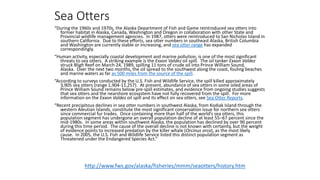
“During the 1960s and 1970s, the Alaska Department of Fish and Game reintroduced sea otters into
former habitat in Alaska, Canada, Washington and Oregon in collaboration with other State and
Provincial wildlife management agencies. In 1987, otters were reintroduced to San Nicholas Island in
southern California. Due to these efforts, sea otter numbers in southeast Alaska, British Columbia
and Washington are currently stable or increasing, and sea otter range has expanded
correspondingly.
“Human activity, especially coastal development and marine pollution, is one of the most significant
threats to sea otters. A striking example is the Exxon Valdez oil spill. The oil tanker Exxon Valdez
struck Bligh Reef on March 24, 1989, spilling 11 tons of crude oil into Prince William Sound,
Alaska. Over the next two months, the oil spread to the southwest along the coast, fouling beaches
and marine waters as far as 500 miles from the source of the spill.
“According to surveys conducted by the U.S. Fish and Wildlife Service, the spill killed approximately
3,905 sea otters (range 1,904-11,257). At present, abundance of sea otters in some oiled areas of
Prince William Sound remains below pre-spill estimates, and evidence from ongoing studies suggests
that sea otters and the nearshore ecosystem have not fully recovered from the spill. For more
information on the Exxon Valdez oil spill and its effect on sea otters, see Sea Otter Reports.
“Recent precipitous declines in sea otter numbers in southwest Alaska, from Kodiak Island through the
western Aleutian Islands, constitute the most significant conservation issue for northern sea otters
since commercial fur trades. Once containing more than half of the world’s sea otters, this
population segment has undergone an overall population decline of at least 55–67 percent since the
mid-1980s. In some areas within southwest Alaska, the population has declined by over 90 percent
during this time period. The cause of the overall decline is not known with certainty, but the weight
of evidence points to increased predation by the killer whale (Orcinus orca), as the most likely
cause. In 2005, the U.S. Fish and Wildlife Service listed this distinct population segment as
Threatened under the Endangered Species Act.”
http://www.fws.gov/alaska/fisheries/mmm/seaotters/history.htm
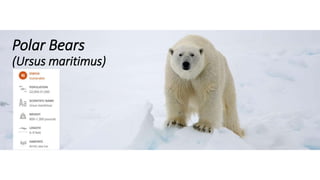
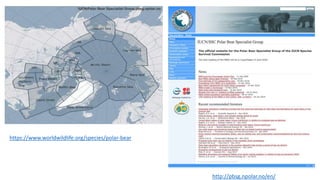
Polar Bears
(Ursus maritimus)
https://eol.org/pages/46559143
https://www.youtube.com/watch?v=Bv51d-VDU_I
https://www.worldwildlife.org/species/polar-bear
http://pbsg.npolar.no/en/
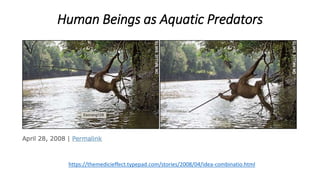
https://themedicieffect.typepad.com/stories/2008/04/idea-combinatio.html
Human Beings as Aquatic Predators
https://video.nationalgeographic.com/video/worlds-deadliest/00000144-0a2b-d3cb-a96c-7b2f210d0000
Atlantic Salmon Life
Cycle
https://www.youtube.com/watch?v=aPf4qtCDRtE&list=PLY-ldlffgCRqTv1nerFcJ4bjRYO5v59JJ&index=9&t=0s
http://firstpeoplesofcanada.com/fp_groups/fp_nwc3.html
https://www.harvardartmuseums.org/art/204094
http://firstpeoplesofcanada.com/fp_groups/fp_nwc3.html
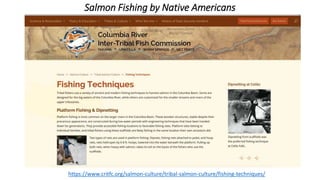
Salmon Fishing by Native Americans
https://www.critfc.org/salmon-culture/tribal-salmon-culture/fishing-techniques/
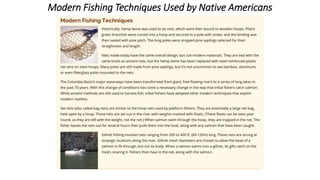
Modern Fishing Techniques Used by Native Americans
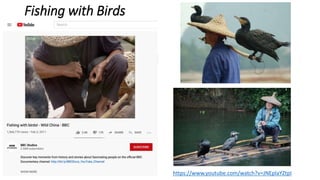
Fishing with Birds
https://www.youtube.com/watch?v=JNEplaYZtpI
Natural cormorant predation…
“Based on estimated ratios of non- breeders to breeding pairs, the NBE [Narragansett Bay Estuary]population
of the Double-crested Cormorant in the late 1990s was about 11,000 birds, a level where it appears to remain
at present. Estimates of numbers of the Great Cormorant (Phalacrocorax carbo) in the NBE are not available,
but since they primarily migrate through the area in spring and fall and do not breed in NBE, their fish
consumption would be much lower than for the Double-crested Cormorant population.
“About 85% of the Double-crested Cormorants nest in the Sakonnet River, with 34% of the total population
nesting at Little Gould Island in the upper part of the Sakonnet River and 51% nesting around Sakon- net Point
(Figure 2). The majority of the remainder, 13% of the population, nest at Hope Island in the West Passage of
Narragansett Bay. Cormorants fly up to 8–16 km to feed in waters shallower than 8 m. The relatively large
population associated with the Sakonnet River nesting colonies most likely feeds in Mount Hope Bay and the
Sakonnet River, where shallow-water foraging areas are much more extensive than in nearby waters of the
lower East Pas- sage of Narragansett Bay. Thus, predation pressure on fish is likely higher in Mount Hope Bay
and the Sakonnet River than in the East and West Pas- sages of Narragansett Bay.
“Fish consumption rates per day were estimated for adults and their chicks based on bioenergetic modeling,
i.e., by estimating their calorific requirements for metabolism, daily activities, and growth. The amount of fish
consumed annually per cormorant in the population (on average) was estimated accounting for breeding rates,
chicks hatched per nest, chick growth rate and food needs, survival to fledging, and survival from fledging to
fall migration. A full-grown bird consumes about 510 g of fish per day, or 93 kg in the 6 months it resides in
the NBE (April to October). An additional 57 kg per breeding adult is consumed by their young before fall
migration. The total consumption of fish by the Double-crested Cormorant population in the NBE during
April–October was estimated at about 1.2 million kg (2.7 million lb) annually from 1993 to 1997. “
"Estimating Fish Predation by Cormorants in the Narragansett Bay Estuary,"
Deborah P. French, McCay Rowe and Jill J. Rowe.
Rhode Island Naturalist V. 11:2, November 2004.
https://rinhs.org/wp-content/uploads/2014/02/ri_naturalist_fall04.pdf
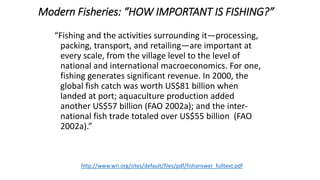
Modern Fisheries: “HOW IMPORTANT IS FISHING?”
“Fishing and the activities surrounding it—processing,
packing, transport, and retailing—are important at
every scale, from the village level to the level of
national and international macroeconomics. For one,
fishing generates significant revenue. In 2000, the
global fish catch was worth US$81 billion when
landed at port; aquaculture production added
another US$57 billion (FAO 2002a); and the inter-
national fish trade totaled over US$55 billion (FAO
2002a).”
http://www.wri.org/sites/default/files/pdf/fishanswer_fulltext.pdf
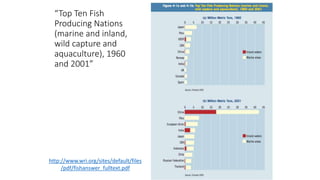
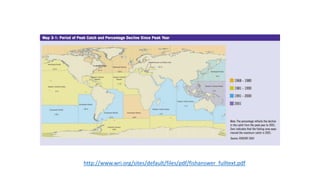
“Top Ten Fish
Producing Nations
(marine and inland,
wild capture and
aquaculture), 1960
and 2001”
http://www.wri.org/sites/default/files
/pdf/fishanswer_fulltext.pdf
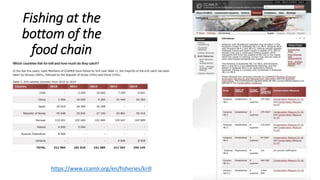
Fishing at the
bottom of the
food chain
https://www.ccamlr.org/en/fisheries/krill
https://marinesanctuary.org/blog/krill-behavior-diet-
lifecycle/?gclid=CjwKCAjwh472BRAGEiwAvHVfGqA8gLxgWZ8k9DUSSH0ToxbwsDxNaKn_XvHdIWMVQ0gszerMiPfy4hoCT88QAvD_BwE
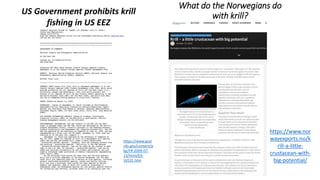
What do the Norwegians do
with krill?
https://www.nor
wayexports.no/k
rill-a-little-
crustacean-with-
big-potential/
US Government prohibits krill
fishing in US EEZ
https://www.govi
nfo.gov/content/p
kg/FR-2009-07-
13/html/E9-
16531.htm
https://www.ccamlr.org/en/compliance/iuu
“Factory Ships”
http://www.marineinsight.com/marine/types-of-ships-marine/what-is-a-factory-ship/
http://www.wri.org/sites/default/files/pdf/fishanswer_fulltext.pdf
“International Trade Increasingly
Influences Fishing”
“Trade has become a driving force in the global fishing enterprise, influencing the species
of fish targeted and farmed, the intensity of fishing pressure, and, in many cases, the
incentives for fishing either sustainably or destructively. Whether trade encourages
overfishing or is part of its solution can’t be answered with certainty. However,
it is likely that trade simply magnifies the environmental effects of existing fishing
practices. Where those practices are harmful, the effects of trade will be
compounded by for example, expanding the market for fish caught in this way, or by
providing easier market access to illegally harvested products.
Part of the problem is that the World Trade Organization (WTO) trade rules are often in
conflict with trade restrictions that aim to promote sustainable fishing practices. Some
steps to reconcile environment and trade rules would require granting observer status
at the WTO to the UN Environment Programme and to the secretariats of international
environmental treaties, incorporating the precautionary approach into WTO and other
trade rules, and reducing environmentally harmful fisheries Subsidies through
negotiations within the WTO and other trade bodies…”
http://www.wri.org/sites/default/files/pdf/fishanswer_fulltext.pdf
FAO: “Ghost Fishing”
http://www.fao.org/fishery/topic/14798/en
Ghost Fishing
http://oceanservice.noaa.gov/facts/ghostfishing.html
https://www.forbes.com/sites/priyashukla/2019/10/31/ghost-fishing-nets-and-traps-haunt-seafloors-and-coastlines/#bda8e9553cd7
http://texts.cdlib.org/view?docId=kt8d5nb34r&brand=calisphere&doc.view=entire_text
“…the oceans of the world continue to suffer from the survival of the
philosophy of the commons. Maritime nations still respond
automatically to the shibboleth of the ‘freedom of the seas.’
Professing to believe in the ‘inexhaustible resources of the oceans,’
they bring species after species of fish and whales closer to
extinction.”
-- Garrett Hardin “The Tragedy of the Commons”
“The Tragedy of the Commons”
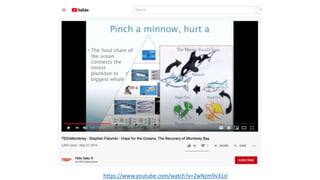
https://www.youtube.com/watch?v=2wNzm9v31sI
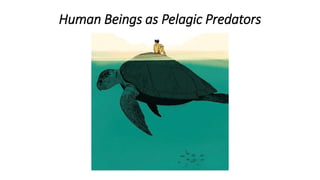
Human Beings as Pelagic Predators

Pelagic Environments and Ecology (3) copy

  • 1.
    Pelagic Ecology andEnvironments (3): PELAGIC PREDATORS (cont.)
  • 2.
  • 3.
  • 4.
    Life Cycle ofSea Turtles https://oliveridleyproject.org/life-cycle-of-turtles
  • 5.
  • 6.
  • 7.
  • 8.
  • 9.
  • 10.
  • 11.
  • 12.
  • 13.
  • 14.
  • 15.
  • 16.
    Albatrosses (Diomedeidae) “The albatrossesare under extensive taxonomic reclassification, and number between 14 and 24 species. Post-breeding movements of albatrosses are mostly longitudinal; no species undertakes transequatorial movements. These birds range long distances from their colonies during the nonbreeding period as well as during foraging trips undertaken while they are breeding. For example, six wandering albatrosses equipped with satellite transmitters flew 3660–15,200 km during single foraging trips after being relieved by their mates from incubation duties at the nest. Even breeding waved albatrosses (Phoebastria irrorata), with the smallest pelagic range among the group, have a round- trip commute of no less than 2000 km between the breeding colony on the Galapagos Islands and the nearest edge of their foraging area along the coast of Ecuador and Peru. “Most albatross species range farthest from their colonies during the nonbreeding period. In fact, many species are partially migratory (as opposed to being dispersers). As explained above, these species are considered as partially migratory because individuals are found in both the wintering and breeding areas during winter, but do not winter (or winter in small numbers) between the two locations. For example, Buller's (Thalassarche bulleri), Chatham (T. eremita), Salvin's (T. salvini), and shy (T. cauta) albatrosses breed on islands near New Zealand (the first three) and Australia (shy). Although some birds stay near the colonies throughout the year, large proportions of the Buller’s, Chatham, and Salvin's albatrosses migrate at least 8500 km eastward across the South Pacific to the coast of South America, and many shy albatrosses migrate westward across the Indian Ocean to the coast of South Africa. “Three other species, the wandering, black-browed (T. melanophris), and gray-headed (T. crysostoma) albatrosses, have breeding colonies located circumpolarly across southern latitudes near 50°S. The South Georgia populations may be partially migratory, although the distinction from dispersive is not clear. South Georgian wandering albatross fly north to waters off Argentina, and then eastward to important wintering areas off South Africa. Some continue to Australian waters and may even circumnavigate the Southern Ocean. One of several of these birds equipped with a satellite transmitter averaged 690 km/day. A large proportion (c. 85%) of South Georgian black-browed albatrosses also winter off South Africa, and many South Georgian gray-headed albatrosses are thought to fly westward to waters off the Pacific coast of Chile, and then to New Zealand.”
  • 17.
  • 18.
  • 19.
  • 20.
  • 21.
  • 22.
    Werth AJ. 2000.”Feeding in marine mammals.” In “Feeding: form, function and evolution in tetrapods” (ed. Schwenk K.), pp. 487–526. San Diego, CA: Academic Press. https://www.researchgate.net/profile/Alexander_Werth/publication/ 279433565_Feeding_in_Marine_Mammals/links/59e916c9458515c36 33a9193/Feeding-in-Marine-Mammals.pdf
  • 23.
    Simplified Taxonomy ofMarine Mammals https://www.researchgate.net/profile/Alexander_Werth/publication/ 279433565_Feeding_in_Marine_Mammals/links/59e916c9458515c36 33a9193/Feeding-in-Marine-Mammals.pdf Werth AJ. 2000. ”Feeding in marine mammals.” In “Feeding: form, function and evolution in tetrapods” (ed. Schwenk K.), pp. 487–526. San Diego, CA: Academic Press.
  • 24.
    Evolution of MarineMammals “Abstract: The fossil record demonstrates that mammals re‐entered the marine realm on at least seven separate occasions. Five of these clades are still extant, whereas two are extinct. This review presents a brief introduction to the phylogeny of each group of marine mammals, based on the latest studies using both morphological and molecular data. Evolutionary highlights are presented, focusing on changes affecting the sensory systems, locomotion, breathing, feeding, and reproduction in Cetacea, Sirenia, Desmostylia, and Pinnipedia. Aquatic adaptations are specifically cited, supported by data from morphological and geochemical studies. ” -- M.D. Uhen “Evolution of marine mammals: Back to the sea after 300 million years,” Anatomical Record Volume 290, Issue 6, [Special Issue: Anatomical Adaptations of Aquatic Mammals] June 2007 Pages 514-522
  • 25.
  • 26.
  • 27.
    D.P. Hocking, etal. “A behavioural framework for the evolution of feeding in predatory aquatic mammals,” 01 March, 2017 Proceedings of the Royal Society B: Biological Sciences Volume 284 Issue 1850 https://royalsocietypublishing. org/doi/full/10.1098/rspb.201 6.2750 https://www.researchgate.net/fig ure/Revisions-to-the-prey- capture-stage-to-be-incorporated- into-our-behavioural- framework_fig2_320059166
  • 28.
    https://www.researchgate.net/fig ure/Revisions-to-the-prey- capture-stage-to-be-incorporated- into-our-behavioural- framework_fig2_320059166 D.P. Hocking, etal. “A behavioural framework for the evolution of feeding in predatory aquatic mammals,” 01 March, 2017 Proceedings of the Royal Society B: Biological Sciences Volume 284 Issue 1850 https://royalsocietypublishing. org/doi/full/10.1098/rspb.201 6.2750
  • 29.
    A behavioural frameworkfor the evolution of feeding in predatory aquatic mammals, Volume: 284, Issue: 1850, DOI: (10.1098/rspb.2016.2750) “Within our new framework, semi-aquatic feeding describes any feeding events where some behaviours occur underwater (e.g. ram feeding or snapping during prey capture), while others occur in air at the surface, either while floating or treading water, or while hauled out on land (e.g. prey manipulation and processing). Both otters and pinnipeds use semi-aquatic feeding when consuming large prey, which is typically captured underwater before being processed at the surface [26,37]. Water ingested along with prey can generally be drained from the oral cavity while the head is held clear of the water. “In contrast to semi-aquatic feeding, aquatic raptorial feeding describes feeding events where all components of the feeding cycle occur underwater. Here, snapping and ram feeding are typically used for prey capture, although suction may facilitate the process by drawing prey within range of the teeth prior to biting [17]. Following initial capture, intraoral suction is used to transport prey to the back of the oral cavity, with any ingested water being expelled via simple sieving. Aquatic raptorial feeding is common among pinnipeds and dolphins, both of which tend to capture and swallow small fish whole. In some cases, however, larger prey is also targeted and may be partly processed underwater by shaking or tearing [38]. “Suction feeding describes events where prey capture occurs mainly via suction. For this mode of capture to be effective, targeted prey is typically small enough to be sucked entirely into the oral cavity, with minimal or no prey processing [37]. Prey can be either immobile (e.g. benthic invertebrates) or evasive (e.g. squid), with the latter sometimes requiring prolonged chases [48,49]. In cetaceans, specialization towards suction feeding tends to be accompanied by the loss of most or all of the teeth (e.g. beaked whales) [14]. Following suction, simple sieving is used to retain individual prey items inside the oral cavity while water is expelled. “Suction filter feeding is effectively an extension of suction feeding, but, instead of simple sieving, uses a specialized filter to separate prey from ingested water. This filter consists of either highly elaborate teeth (in leopard and crabeater seals) [7,43] or baleen (in the grey whale) [34,47], and is capable of retaining smaller prey than simple sieving, thus enabling suction filter feeders to gather small prey in bulk. Finally, filtering and bulk feeding are also characteristic of ram filter feeding, which is arguably the most highly specialized of all aquatic mammal strategies. Ram filter feeding is only used by baleen-bearing mysticetes, and involves neither suction nor teeth to capture prey. Instead, prey is ingested via continuous (skim feeding, as seen in right whales) or intermittent (lunge feeding, as seen in rorquals) ram movements, and then retained in the oral cavity via a specialized filter while excess water is expelled [5,50].”
  • 30.
    A behavioural frameworkfor the evolution of feeding in predatory aquatic mammals, Volume: 284, Issue: 1850, DOI: (10.1098/rspb.2016.2750) Figure 3. Comprehensive overview of the feeding strategies employed by aquatic mammals. (a) Particular behaviours (rows) used during each stage (I–IV) of the feeding cycle combine into a limited number of feeding strategies (columns). A behaviour is listed as pertaining to a particular feeding strategy when it is used by at least some species when following that strategy. Question marks denote instances when the presence of a particular behaviour is uncertain. (b) All of the feeding strategies fall along a behavioural and evolutionary continuum leading from terrestrial to increasingly more specialized aquatic feeding styles, with each strategy being derived directly from the one preceding it. The presence of such a continuum is particularly evident in certain species that may switch between related (i.e. adjacent) strategies, depending on the foraging scenario. Examples of such taxa are shown at the bottom of the figure. Illustrations by Carl Buell.
  • 33.
  • 34.
  • 35.
    Elephant Seals “Description: Elephantseals are well named because adult males have large noses that resemble an elephant's trunk. Males begin developing this enlarged nose, or proboscis, at sexual maturity (about three to five years), and it is fully developed by seven to nine years. Adult males may grow to over 13 feet (4 m) in length and weigh up to 4,500 pounds (2,000 kg). The females are much smaller at 10 feet (3 m) in length and 1,500 pounds (600 kg). The northern elephant seal is the second largest seal in the world, after the southern elephant seal. The elephant seal is in the phocid, or true seal, family. It lacks external ear flaps and moves on land by flopping on its belly. The elephant seal has a broad, round face with very large eyes. Pups are born with a black coat which is molted, or shed, at about the time of weaning (28 days), revealing a sleek, silver-gray coat. Within a year, the coat will turn silvery brown. “ Range/Habitat” Northern elephant seals are found in the North Pacific, from Baja California, Mexico to the Gulf of Alaska and Aleutian Islands. During the breeding season, they live on beaches on offshore islands and a few remote spots on the mainland. The rest of the year, except for molting periods, elephant seals live well off shore (up to 5,000 miles, or 8,000 km), commonly descending to over 5,000 feet (1,524 m) below the ocean's surface.” http://www.marinemammalcenter.org/education/marine-mammal- information/pinnipeds/northern-elephant-seal/
  • 36.
    Elephant Seals “While sailingalong the Pacific coast in the 1800s, a whale and seal hunter named Charles Scammon reported seeing northern elephant seals from Baja California in Mexico to Point Reyes in California. Sharing the fate of many of the oceans' great whales, the elephant seals were hunted to the brink of extinction for their oil-rich blubber. One bull elephant seal would yield nearly 25 gallons of oil. Though we don't know exactly how many northern elephant seals were alive before the 20th Century, it has been estimated that fewer than 1,000 northern elephant seals existed by 1910. In 1922, the Mexican government banned hunting, followed shortly thereafter by the United States government. Since then, the population of northern elephant seals has recovered at an average rate of six percent per year. Today, thanks to government protection and the seals' distant lives at sea, the worldwide population has grown to an estimated 150,000 seals.” http://www.nps.gov/pore/naturescience/elephant_seals.htm
  • 37.
    Elephant Seals “Hundreds ofthousands of northern elephant seals once inhabited the Pacific Ocean. They were slaughtered wholesale in the 1800s for the oil that could be rendered from their blubber. By 1892, only 50 to 100 individuals were left. The only remaining colony was on the Guadalupe Island off the coast of Baja California. In 1922, the Mexican government gave protected status to elephant seals, and the U. S. government followed suit a few years later when the seals began to appear in Southern California waters. Since that time, elephant seals have continued to multiply exponentially, and they have extended their breeding range as far north as Point Reyes. Today, there are approximately 160,000 northern elephant seals. “The first elephant seals on Año Nuevo Island were sighted in 1955, and the first pup was born there in 1961. In 1978, 872 were born there. Males began to haul out on the mainland in 1965. A pup born in January 1975 was the first known mainland birth of a northern elephant seal at Año Nuevo; 86 pups were born there in 1978. By 1988/1989, about 2,000 elephant seals came ashore at Año Nuevo, and the number of seals breeding and giving birth on the mainland is still increasing. During the 1994-95 breeding season, approximately 2,000 pups were born on the mainland.” http://www.parks.ca.gov/?page_id=1115
  • 38.
    Walrus (Odobenus rosmarus) Mammal Diet: Carnivore Averagelife span in the wild: Up to 40 years Size: 7.25 to 11.5 ft (2.2 to 3.5 m) Weight: Up to 1.5 tons (1.4 metric tons) Group name: Herd Protection status: Endangered The walrus' scientific name, Odobenus rosmarus, is Latin for "tooth-walking sea-horse."
  • 39.
    IUCN STATUS (2010)- DATA DEFICIENT “Distribution and Numbers Easily recognised by its long tusks, the walrus is the only living member of the Odobenidae family of pinnipeds and has two generally recognised subspecies. The Atlantic walrus (O.r. rosmarus) is found from the east Canadian Arctic eastwards to the Kara Sea. The Pacific walrus (O.r. divergens) is found in the north Pacific Ocean and in Arctic waters from the East Siberian Sea to the western Beaufort Sea, as well as in the Laptev Sea. It has been proposed by some scientists that the Laptev Sea population be given subspecific status as the Laptev walrus (O.r. laptevi) but this is not widely accepted. Accurate data on walrus abundance is not available but the most recent rough population estimates have been 22,500 Atlantic walruses (6,000 in Norway and Russia, 12,000 in Canada and 4,500 in Greenland), and a minimum of 200,000 Pacific walruses in eastern Russia and the United States. “Status Walruses are long-lived and have a relatively low reproductive rate, so their numbers are easily influenced by hunting and other mortality. Both subspecies of walrus have been subjected to intensive commercial hunting in the past for their blubber oil, tusk ivory and skins, leading to the extermination of local populations in some areas and severe depletion of others. Although commercial hunting has now ceased, other forms of hunting currently have the most direct and quantifiable impact on walrus populations. Native subsistence hunting of the walrus for its meat, skin, ivory, oil and other products has taken place for thousands of years and continues today. Lack of accurate information on walrus population numbers means that hunting quota levels may be having a detrimental effect on the species, particularly for the Atlantic walrus. Certainly the problem of walruses being "struck and lost" results in kill statistics that are very probably underestimated, figures of 30-42% having been quoted for the percentage of walruses killed in this way.” Walrus (Odobenus rosmarus) http://www.pinnipeds.org/seal-information/species-information-pages/walrus
  • 40.
    "Walrus Hunting" “Elisha KentKane's Arctic Explorations (2nd Grinnell), published in Philadelphia in 1856” Based on a sketch by Dr. Kane. http://commons.wikimedia.org/wiki/File:Walrus_hunting.jpg
  • 41.
    “The Pacific WalrusFishery” http://www.nefsc.noaa.gov/publications/classics/goode1884/5-2-17.pdf “The Fisheries and Fisheries Industries of the United States” by George Brown Goode
  • 42.
    Walruses as commodities?(cont.) “Commercially exploited since the 18th century, the Pacific walrus has been substantially reduced in numbers and allowed to recover three times in the past 150 years. The population was most recently reduced to 50,000 - 100,000 in the mid-1950s. Conservation measures were initiated in both Russia and the United States in the 1960s and these have allowed the subspecies to attain levels close to those it had before exploitation. Trends in life history parameters indicate however that the population may now be declining. The lack of a proper range-wide survey since 1990 along with reports by scientists and native hunters of lower calf production and survival has led to increased concern for the population's status. “Pacific walruses are killed by natives in Alaska, USA, and Chukotka, Russia. The number of walruses killed by native hunting declined after Russian ship-based hunts ceased in 1991. The latest year for which there are reasonably reliable figures covering both the United States and Russian hunts show that 2,501 walruses were killed in Alaska and 941 in Chukotka during 1996. Taking into account those walruses that are struck and lost, the total hunting-caused mortality for 1996 was estimated at 5,934. “ Preliminary analyses show that the total number of walruses killed in 1999 was similar to 1996. Native hunters in Alaska must only kill walruses for subsistence purposes or the creation of handicrafts and must fully utilise the walruses that they kill. The level of native hunting cannot be regulated by the federal government unless the population is found to be depleted. “The demand for carved and patterned walrus ivory ("scrimshaw") as trophies and trinkets has led to the problem of "head-hunting", the illegal killing of walruses purely for their tusks. A pair of tusks can bring US$300 or more, providing a strong financial incentive to head-hunt. A two-year federal undercover operation ended in 1992 with the arrests of a network of head-hunters and buyers in Alaska who were illegally trading tusks for money and drugs. In 1996 a survey discovered at least 160 headless walrus carcasses washed up on the beaches of northwest Alaska, while in 1998 a U.S. federal grand jury indicted 6 Alaskan walrus hunters on allegations of head-hunting. It is hoped that this problem and other related walrus conservation problems in Alaska will decline through greater co-management and cooperation between the authorities and Alaskan native communities.” http://www.pinnipeds.org/seal-information/species-information-pages/walrus
  • 43.
    “The Buffalo Gun”Sharps 1874 “During the 1870s and 80s a widespread slaughter of the American bison decimated the herds to near extinction. The professional hunters used powerful single shot breech-loading rifles, most often in calibre .50, .45 or .44. The most legendary rifle used on the buffalo ranges was, perhaps next to the Springfield Model 1873 'Trapdoor' and the Remington rolling block, the legendary Sharps Model 1874. The man behind the Sharps action was Christian Sharps (1810-1874). Sharps started his career as a filer in the National Armoury at Harpers Ferry, but he soon started to experiment with his own weapons. The original Sharps patent was granted to Sharps in 1848. Sharps Rifle Manufacturing Company was established in 1851 and the factory was located in Hartford, Connecticut. Christian Sharps however, withdrew from the company as early as 1853, and nothing indicates that he had anything further to do with the development of the Sharps rifle. He continued his business under the name C. Sharps & Company, until he entered into a partnership with William Hankins in 1862 under the name Sharps and Hankins.” http://www.svartkrutt.net/articles/vis.php?id=19
  • 44.
  • 45.
    Environmental Impacts “A surveyof hunters and elders from Nunavut in the Canadian Arctic, released in September 2000, revealed that hunters had observed walruses and other wildlife with a large number of deformities, including swollen internal organs and missing patches of skin. A strange occurrence of "round wounds" was observed in the skin of some walruses, and the analysis of a similar abnormality found in a walrus in March 2000 had pinpointed a strain of bacteria as the cause. Hunters also reported finding walruses with fluid or pus between their meat and fat or with unusual stomach contents, and even one walrus which had its gall bladder reversed and draining into its stomach. Changes in the colour of walrus meat and fat were also reported. The survey report recommended a specific system of monitoring for such abnormalities in the future, as well as further studies on affected animals. One possible reason suggested for these abnormalities is the high level of persistent organic pollutants (POPs) in the Canadian Arctic.” http://www.pinnipeds.org/seal-information/species-information-pages/walrus
  • 46.
  • 47.
  • 48.
  • 49.
    Sea Otters “Sea ottershave inhabited the northern coasts of the Pacific Ocean since the Pleistocene, about 1 to 3 million years ago. The historical range of the sea otter extended from central Baja California northward along the coast of North America to Alaska, westward through the Aleutian, Pribilof, and Commander islands to the coast of Kamchatka, Russia, and south through the Kuril Islands to southern Sakhalin Island, Russia, and northern Japan. In the mid-1700s, between 100,000 and 300,000 sea otters lived along the North Pacific coast “In 1741, Vitus Bering and his expedition sailed from Russia to explore and map the coastlines of the North Pacific. Also on board the ship was the naturalist Georg Steller, who studied and documented the flora and fauna, including the sea otter, which was encountered in the Aleutian and Commander islands. The first scientific description of the sea otter was later published in 1751 in Steller’s book De Bestiis Marinis (The Beasts of the Sea). “Intensive commercial exploitation of sea otters began with their discovery by Bering’s expedition and continued through the early 1900s. Historically, Native Americans along the Pacific coast hunted sea otters, but the abundant numbers encountered by the early Russian hunters indicate that sea otters were not widely overhunted before contact with Europeans.” http://www.fws.gov/alaska/fisheries/mmm/seaotters/history.htm
  • 50.
  • 51.
  • 52.
  • 53.
  • 54.
    “Nuu-chah-nulth man huntssea otter with bow and arrow.” http://firstpeoplesofcanada.com/fp_groups/fp_nwc3.html
  • 55.
  • 56.
  • 57.
    “Just a fewhundred years ago, thousands of sea otters peppered the coast of California, dwarfing the current population of less than 3000 animals. A host of human impacts are to blame for keeping otters near the edge of extinction today—loss of habitat, competition for food, diseases carried by our pets and oils spills, to name just a few. But only the fur trade could whittle the otter population down to the few dozen that were left in the early 1900s. “When Russian explorer Vitus Bering stumbled upon a group of otters living on the Commander Islands in 1741, he probably didn’t anticipate that these animals would play a role in changing boundary lines on the world map and unhinging the fragile coastal ecosystem of North America. What was clear was the value of their pelts. With up to a million hairs per square inch, otter fur was prized for its softness and warmth—the warmest in the animal kingdom. For comparison, we only have about 100,000 hairs on our heads. “Until the late 19th century, Russian fur traders hop scotched through Alaska’s Aleutian Islands, killing most of the curious, slow-moving otters in their path and then shipping the furs off to profitable markets in back home in Russia and in China, Japan, and Europe. In the process, the hunters decimated a relative of the manatee called the Stellar’s sea cow (Hydrodamalis gigas). These slow-swimming kelp-eaters provided the on-the-go meals the hunters needed. But unlike sea otters, the sea cows didn’t survive the onslaught. The otter fur trade wiped them from existence.” Fur Trade (Commodities vs. Sustainable Use
  • 58.
  • 59.
  • 60.
  • 61.
    Sea Otters “Between 1741and 1900, Russian and American fur traders harvested the sea otter almost to extinction in order to profit from its luxurious fur. Sea otter fur is extraordinarily dense, providing excellent insulation to sea otters in cold ocean waters and to humans in their fine fur coats. Sea otter fur has up to 1 million hairs per square inch, more than any other mammal, and is considered some of the finest fur in the world. “By the early 1900s commercial harvest had essentially ceased, for the simple reason that it was difficult to locate a sea otter. Their numbers had been reduced to 13 tiny remnant colonies, scattered across their former range and totaling no more than a few hundred sea otters each. In 1911, the International Fur Seal Treaty was signed by the U.S., Russia, Great Britain, and Japan, halting commercial hunting of sea otters. Once commercial harvest ceased, sea otter numbers rebounded and they re-colonized much of their former range between Prince William Sound, Alaska, and west to the Kuril Islands, Russia. However, by the 1950s they had disappeared from the Pacific coast from Prince William Sound south to Baja California, with the exception of one remnant population in California. http://www.fws.gov/alaska/fisheries/mmm/seaotters/history.htm
  • 62.
    Sea Otters “During the1960s and 1970s, the Alaska Department of Fish and Game reintroduced sea otters into former habitat in Alaska, Canada, Washington and Oregon in collaboration with other State and Provincial wildlife management agencies. In 1987, otters were reintroduced to San Nicholas Island in southern California. Due to these efforts, sea otter numbers in southeast Alaska, British Columbia and Washington are currently stable or increasing, and sea otter range has expanded correspondingly. “Human activity, especially coastal development and marine pollution, is one of the most significant threats to sea otters. A striking example is the Exxon Valdez oil spill. The oil tanker Exxon Valdez struck Bligh Reef on March 24, 1989, spilling 11 tons of crude oil into Prince William Sound, Alaska. Over the next two months, the oil spread to the southwest along the coast, fouling beaches and marine waters as far as 500 miles from the source of the spill. “According to surveys conducted by the U.S. Fish and Wildlife Service, the spill killed approximately 3,905 sea otters (range 1,904-11,257). At present, abundance of sea otters in some oiled areas of Prince William Sound remains below pre-spill estimates, and evidence from ongoing studies suggests that sea otters and the nearshore ecosystem have not fully recovered from the spill. For more information on the Exxon Valdez oil spill and its effect on sea otters, see Sea Otter Reports. “Recent precipitous declines in sea otter numbers in southwest Alaska, from Kodiak Island through the western Aleutian Islands, constitute the most significant conservation issue for northern sea otters since commercial fur trades. Once containing more than half of the world’s sea otters, this population segment has undergone an overall population decline of at least 55–67 percent since the mid-1980s. In some areas within southwest Alaska, the population has declined by over 90 percent during this time period. The cause of the overall decline is not known with certainty, but the weight of evidence points to increased predation by the killer whale (Orcinus orca), as the most likely cause. In 2005, the U.S. Fish and Wildlife Service listed this distinct population segment as Threatened under the Endangered Species Act.” http://www.fws.gov/alaska/fisheries/mmm/seaotters/history.htm
  • 63.
  • 64.
  • 65.
  • 66.
  • 67.
  • 68.
  • 69.
  • 70.
  • 71.
  • 72.
    Salmon Fishing byNative Americans https://www.critfc.org/salmon-culture/tribal-salmon-culture/fishing-techniques/
  • 73.
    Modern Fishing TechniquesUsed by Native Americans
  • 74.
  • 75.
    Natural cormorant predation… “Basedon estimated ratios of non- breeders to breeding pairs, the NBE [Narragansett Bay Estuary]population of the Double-crested Cormorant in the late 1990s was about 11,000 birds, a level where it appears to remain at present. Estimates of numbers of the Great Cormorant (Phalacrocorax carbo) in the NBE are not available, but since they primarily migrate through the area in spring and fall and do not breed in NBE, their fish consumption would be much lower than for the Double-crested Cormorant population. “About 85% of the Double-crested Cormorants nest in the Sakonnet River, with 34% of the total population nesting at Little Gould Island in the upper part of the Sakonnet River and 51% nesting around Sakon- net Point (Figure 2). The majority of the remainder, 13% of the population, nest at Hope Island in the West Passage of Narragansett Bay. Cormorants fly up to 8–16 km to feed in waters shallower than 8 m. The relatively large population associated with the Sakonnet River nesting colonies most likely feeds in Mount Hope Bay and the Sakonnet River, where shallow-water foraging areas are much more extensive than in nearby waters of the lower East Pas- sage of Narragansett Bay. Thus, predation pressure on fish is likely higher in Mount Hope Bay and the Sakonnet River than in the East and West Pas- sages of Narragansett Bay. “Fish consumption rates per day were estimated for adults and their chicks based on bioenergetic modeling, i.e., by estimating their calorific requirements for metabolism, daily activities, and growth. The amount of fish consumed annually per cormorant in the population (on average) was estimated accounting for breeding rates, chicks hatched per nest, chick growth rate and food needs, survival to fledging, and survival from fledging to fall migration. A full-grown bird consumes about 510 g of fish per day, or 93 kg in the 6 months it resides in the NBE (April to October). An additional 57 kg per breeding adult is consumed by their young before fall migration. The total consumption of fish by the Double-crested Cormorant population in the NBE during April–October was estimated at about 1.2 million kg (2.7 million lb) annually from 1993 to 1997. “ "Estimating Fish Predation by Cormorants in the Narragansett Bay Estuary," Deborah P. French, McCay Rowe and Jill J. Rowe. Rhode Island Naturalist V. 11:2, November 2004. https://rinhs.org/wp-content/uploads/2014/02/ri_naturalist_fall04.pdf
  • 76.
    Modern Fisheries: “HOWIMPORTANT IS FISHING?” “Fishing and the activities surrounding it—processing, packing, transport, and retailing—are important at every scale, from the village level to the level of national and international macroeconomics. For one, fishing generates significant revenue. In 2000, the global fish catch was worth US$81 billion when landed at port; aquaculture production added another US$57 billion (FAO 2002a); and the inter- national fish trade totaled over US$55 billion (FAO 2002a).” http://www.wri.org/sites/default/files/pdf/fishanswer_fulltext.pdf
  • 77.
    “Top Ten Fish ProducingNations (marine and inland, wild capture and aquaculture), 1960 and 2001” http://www.wri.org/sites/default/files /pdf/fishanswer_fulltext.pdf
  • 78.
    Fishing at the bottomof the food chain https://www.ccamlr.org/en/fisheries/krill
  • 79.
  • 80.
    What do theNorwegians do with krill? https://www.nor wayexports.no/k rill-a-little- crustacean-with- big-potential/ US Government prohibits krill fishing in US EEZ https://www.govi nfo.gov/content/p kg/FR-2009-07- 13/html/E9- 16531.htm
  • 81.
  • 82.
  • 83.
  • 84.
    “International Trade Increasingly InfluencesFishing” “Trade has become a driving force in the global fishing enterprise, influencing the species of fish targeted and farmed, the intensity of fishing pressure, and, in many cases, the incentives for fishing either sustainably or destructively. Whether trade encourages overfishing or is part of its solution can’t be answered with certainty. However, it is likely that trade simply magnifies the environmental effects of existing fishing practices. Where those practices are harmful, the effects of trade will be compounded by for example, expanding the market for fish caught in this way, or by providing easier market access to illegally harvested products. Part of the problem is that the World Trade Organization (WTO) trade rules are often in conflict with trade restrictions that aim to promote sustainable fishing practices. Some steps to reconcile environment and trade rules would require granting observer status at the WTO to the UN Environment Programme and to the secretariats of international environmental treaties, incorporating the precautionary approach into WTO and other trade rules, and reducing environmentally harmful fisheries Subsidies through negotiations within the WTO and other trade bodies…” http://www.wri.org/sites/default/files/pdf/fishanswer_fulltext.pdf
  • 85.
  • 86.
  • 87.
  • 88.
  • 89.
    “…the oceans ofthe world continue to suffer from the survival of the philosophy of the commons. Maritime nations still respond automatically to the shibboleth of the ‘freedom of the seas.’ Professing to believe in the ‘inexhaustible resources of the oceans,’ they bring species after species of fish and whales closer to extinction.” -- Garrett Hardin “The Tragedy of the Commons” “The Tragedy of the Commons”
  • 90.
  • 91.
    Human Beings asPelagic Predators