• Marine air-breathing reptiles
• Can be found in tropical and subtropical waters
throughout the world.
• Seven species worldwide
• Five found off the coast of Florida
• Three species nest on our beaches
• All are endangered or threatened species and
are protected by Federal, State, County, and
Municipal laws.
INTRODUCTION TO SEA TURTLES
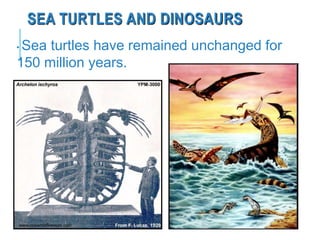
SEA TURTLES AND DINOSAURS
• Sea turtles have remained unchanged for
150 million years.
www.oceansofkansas.com
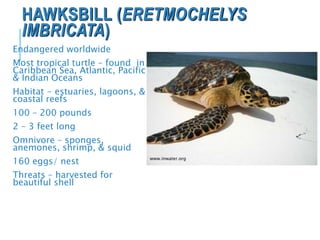
HAWKSBILL (ERETMOCHELYS
IMBRICATA)
Endangered worldwide
Most tropical turtle – found in
Caribbean Sea, Atlantic, Pacific
& Indian Oceans
Habitat - estuaries, lagoons, &
coastal reefs
100 – 200 pounds
2 – 3 feet long
Omnivore – sponges,
anemones, shrimp, & squid
160 eggs/ nest
Threats – harvested for
beautiful shell
www.inwater.org
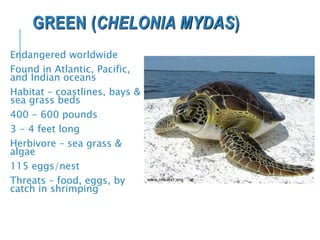
GREEN (CHELONIA MYDAS)
Endangered worldwide
Found in Atlantic, Pacific,
and Indian oceans
Habitat – coastlines, bays &
sea grass beds
400 - 600 pounds
3 - 4 feet long
Herbivore – sea grass &
algae
115 eggs/nest
Threats – food, eggs, by
catch in shrimping
www.inwater.org
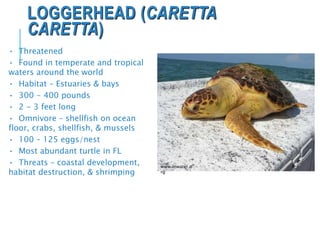
LOGGERHEAD (CARETTA
CARETTA)
• Threatened
• Found in temperate and tropical
waters around the world
• Habitat – Estuaries & bays
• 300 - 400 pounds
• 2 - 3 feet long
• Omnivore – shellfish on ocean
floor, crabs, shellfish, & mussels
• 100 – 125 eggs/nest
• Most abundant turtle in FL
• Threats – coastal development,
habitat destruction, & shrimping
www.inwater.o
rg
LEATHERBACK (DERMOCHELYS
CORIACEA)
Endangered worldwide.
Most widely distributed turtle
around the world. From Alaska
to Southern tip of Africa.
Habitat – pelagic open ocean,
migrating thousands of miles.
700 – 2000 pounds.
5 - 9 feet long.
Shell is made of tiny bone plates
covered by skin.
Eat jellyfish.
80 eggs/nest
Threats – long-line fishery,
pollution, and poaching eggs.
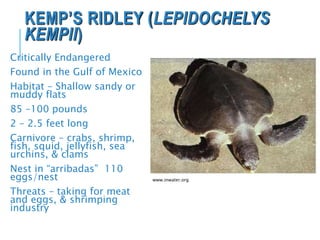
KEMP’S RIDLEY (LEPIDOCHELYS
KEMPII)
Critically Endangered
Found in the Gulf of Mexico
Habitat – Shallow sandy or
muddy flats
85 –100 pounds
2 – 2.5 feet long
Carnivore – crabs, shrimp,
fish, squid, jellyfish, sea
urchins, & clams
Nest in “arribadas” 110
eggs/nest
Threats – taking for meat
and eggs, & shrimping
industry
www.inwater.org
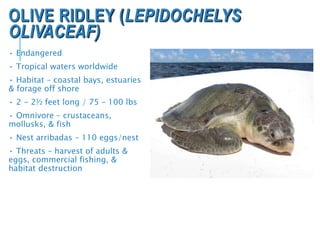
• Endangered
• Tropical waters worldwide
• Habitat – coastal bays, estuaries
& forage off shore
• 2 - 2½ feet long / 75 – 100 lbs
• Omnivore – crustaceans,
mollusks, & fish
• Nest arribadas – 110 eggs/nest
• Threats – harvest of adults &
eggs, commercial fishing, &
habitat destruction
OLIVE RIDLEY (LEPIDOCHELYS
OLIVACEAF)
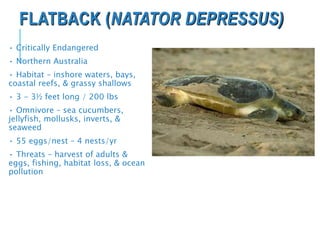
FLATBACK (NATATOR DEPRESSUS)
• Critically Endangered
• Northern Australia
• Habitat – inshore waters, bays,
coastal reefs, & grassy shallows
• 3 - 3½ feet long / 200 lbs
• Omnivore – sea cucumbers,
jellyfish, mollusks, inverts, &
seaweed
• 55 eggs/nest – 4 nests/yr
• Threats – harvest of adults &
eggs, fishing, habitat loss, & ocean
pollution
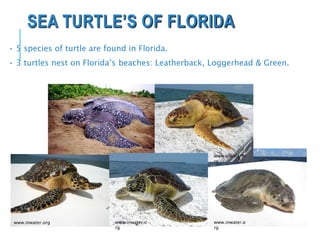
SEA TURTLE’S OF FLORIDA
• 5 species of turtle are found in Florida.
• 3 turtles nest on Florida’s beaches: Leatherback, Loggerhead & Green.
www.inwater.org www.inwater.o
rg
www.inwater.o
rg
www.inwater.o
rg
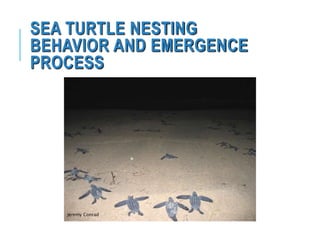
SEA TURTLE NESTING
BEHAVIOR AND EMERGENCE
PROCESS
Jeremy Conrad
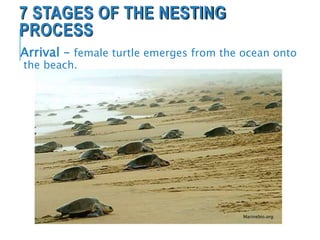
7 STAGES OF THE NESTING
PROCESS
Arrival – female turtle emerges from the ocean onto
the beach.
Marinebio.org
NEST CONSTRUCTION
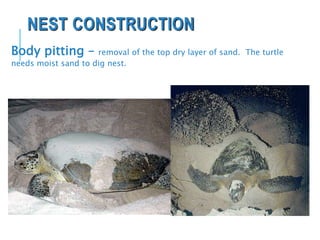
Body pitting – removal of the top dry layer of sand. The turtle
needs moist sand to dig nest.
NEST CONSTRUCTION
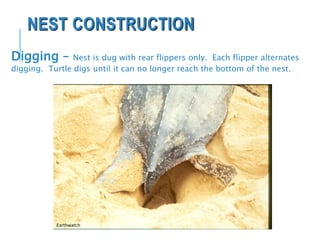
Digging – Nest is dug with rear flippers only. Each flipper alternates
digging. Turtle digs until it can no longer reach the bottom of the nest.
Earthwatch
EGG DEPOSITION (LAYING)
www.marinecreatures.com
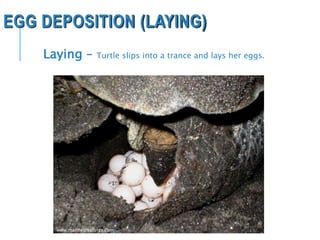
Laying – Turtle slips into a trance and lays her eggs.
TAMPING & CAMOUFLAGING
www.kevinschafer.com
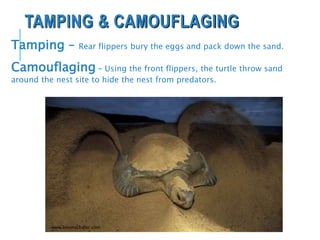
Tamping – Rear flippers bury the eggs and pack down the sand.
Camouflaging – Using the front flippers, the turtle throw sand
around the nest site to hide the nest from predators.
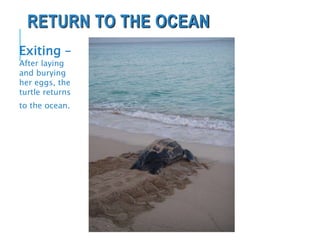
RETURN TO THE OCEAN
Exiting –
After laying
and burying
her eggs, the
turtle returns
to the ocean.
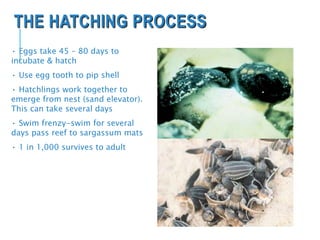
THE HATCHING PROCESS
• Eggs take 45 – 80 days to
incubate & hatch
• Use egg tooth to pip shell
• Hatchlings work together to
emerge from nest (sand elevator).
This can take several days
• Swim frenzy-swim for several
days pass reef to sargassum mats
• 1 in 1,000 survives to adult
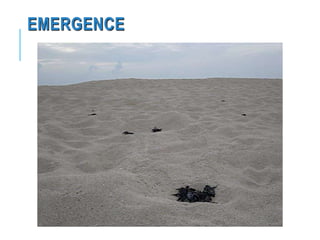
EMERGENCE
WHAT DOES ENDANGERED
MEAN?
Endangered Species Act of 1973 – protects
plants or animals that are listed by the federal
government as endangered or threatened.
• Provides a means to conserve the ecosystem
upon which endangered and threatened
species depend, thus preventing extinction
• Can not harm, kill, or harass any sea turtle,
nests, eggs, or hatchlings.
WHAT DOES ENDANGERED MEAN?
CITES (Convention on International Trade in
Endangered Species of Wild Fauna & Flora) –
Regulates and prohibits international trade of
plant & animal species that are threatened or
endangered.
• Can not transport, sell, or trade any
endangered species product. (ex: turtle
shells, meat, or eggs)
WHAT DOES ENDANGERED MEAN?
• Critically endangered – Facing an
extremely high risk of extinction from the wild
in the immediate future.
• Endangered species – An animal or plant
species in danger of extinction throughout all
or a significant portion of its range.
• Threatened species – An animal or plant
species likely to become endangered with in
the foreseeable future throughout all or a
significant portion of its range.
WHAT IS EXTINCTION & WHY IS IT
BAD?
Extinction – the last individual of a species dies and there are no
more of that species on earth.
• Each species of animal has its place and a specific role in the
ecosystem.
• Extinction of a species results in an imbalance in the ecosystem.
• Scientific evidence reveals that we are in the midst of and largely
responsible for the 6th and largest mass extinction in the earth’s
history.
SEA TURTLES & THE
ENVIRONMENT
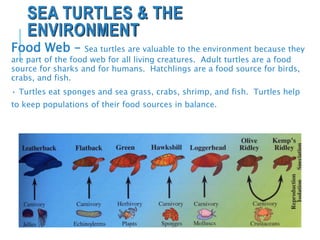
Food Web – Sea turtles are valuable to the environment because they
are part of the food web for all living creatures. Adult turtles are a food
source for sharks and for humans. Hatchlings are a food source for birds,
crabs, and fish.
• Turtles eat sponges and sea grass, crabs, shrimp, and fish. Turtles help
to keep populations of their food sources in balance.
SEA TURTLES AND THE
ENVIRONMENT
• Sea turtles are a primary transporter of
marine nutrients to terrestrial habitats.
• Sea turtle nests are full of nutrients and
energy for the terrestrial ecosystem.
• Unhatched eggs, dead hatchlings, and
decaying material provide nutrition and
energy for: plants and dune vegetation,
bacteria, insects, fungi, invertebrates, birds,
crabs, and fish.
THREATS TO SEA TURTLES
Natural Threats – Predation of adults and
hatchlings, weather (hurricanes & erosion), and
climate change.
Predation of adults include: Killer Whales,
Sharks, Jaguars, Feral Dogs and Humans
Predation of hatchlings include: Raccoons,
Mongoose, Rats, Birds, Ants, Wild Boars, Feral
Cats & Dogs, Crabs, Fish, Plants, and Humans
THREATS TO SEA TURTLES
Anthropogenic threats – Threats to sea turtles as a
result of human actions.
Human threats include:
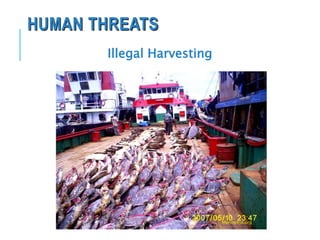
• Harvesting & poaching of eggs and adults
• International trade and commerce of turtle products
• Commercial fishing & shrimping
• Urbanization, development, coastal armoring & habitat destruction
• Artificial lighting
• Pollution & debris.
NATURAL THREATS
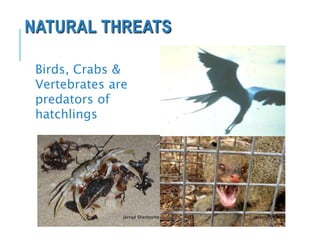
Jarrad Sherborne Jeremy Conrad
Birds, Crabs &
Vertebrates are
predators of
hatchlings
NATURAL THREATS
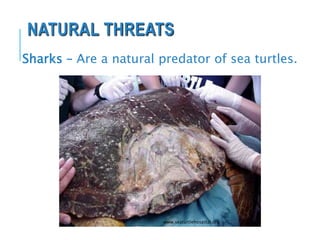
Sharks – Are a natural predator of sea turtles.
www.seaturtlehospital.org
NATURAL THREATS
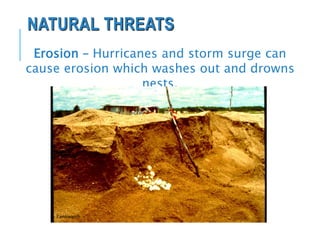
Erosion – Hurricanes and storm surge can
cause erosion which washes out and drowns
nests.
Earthwatch
HUMAN THREATS
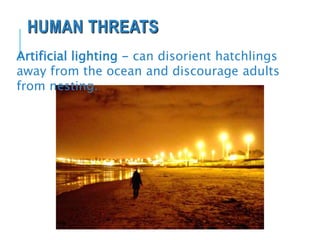
Artificial lighting - can disorient hatchlings
away from the ocean and discourage adults
from nesting.
HUMAN THREATS
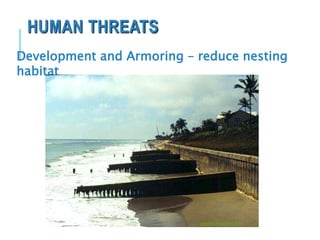
Development and Armoring – reduce nesting
habitat
research.myfwc.com
HUMAN THREATS
Illegal Harvesting
Marinebio.org
HUMAN THREATS
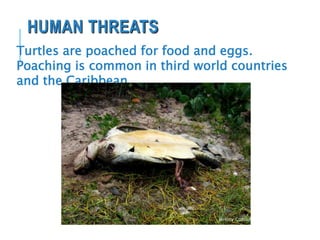
Turtles are poached for food and eggs.
Poaching is common in third world countries
and the Caribbean.
Jeremy Conrad
FISHING GEAR
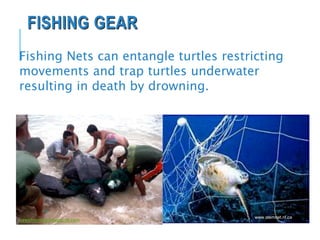
Fishing Nets can entangle turtles restricting
movements and trap turtles underwater
resulting in death by drowning.
newsfromkkp.blogspirit.com
www.stemnet.nf.ca
FISHING GEAR
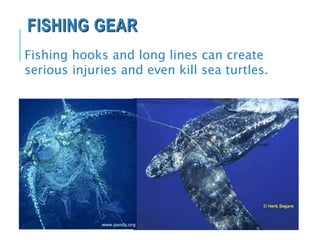
Fishing hooks and long lines can create
serious injuries and even kill sea turtles.
www.panda.org
FISHING GEAR
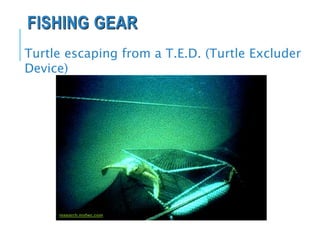
Turtle escaping from a T.E.D. (Turtle Excluder
Device)
research.myfwc.com
CONSERVATION GOALS
• Enforce laws against illegal poaching of sea
turtles and their eggs
• Protect nesting beaches from armoring,
artificial lighting, and development through
establishment of parks and refuges
• Eliminate illegal international trade of sea
turtles and their products
• Reduce turtle deaths from commercial fishing
and shrimping
CONSERVATION GOALS
• Enforce local, national, and international
laws to reduce dumping of pollution, solid
waste and toxins into the ocean and
sensitive sea turtle habitats
• Increase education and public awareness
about sea turtle conservation efforts and
how the community can get involved.
• Continued and increased research of sea
turtle populations, their habitats (nesting
beach and in water migrations) and their
behavior.
WAYS YOU CAN HELP SEA TURTLES .
. .
• Pick up trash at the beach and place
in garbage can
• Volunteer for beach cleanups
• Buy turtle safe shrimp
• Hold onto your balloons
• Don’t feed the raccoons and foxes
• Build sand castles near the water as
they may obstruct nesting attempts or
disorient hatchlings emerging from
the nest.
WHAT TO DO IF YOU SEE A TURTLE
NESTING
• Stay clear of and out of the sight of the
turtle. Your movement could disturb
the turtle and scare it back into the sea.
• Do not shine your light at the turtle.
• Do not take pictures with flashes as
this will disorient the turtle and cause it
to abort the nest.
WHAT TO DO IF YOU SEE A TURTLE
NESTING
• Do not approach, touch, or ride the
turtle. This is for your safety as well as
the turtle’s.
• Do not touch, take or handle turtle
eggs.
• Do not destroy the tracks left by the
turtle as they are important for
researchers to help locate and protect
the nest.
QUESTIONS?

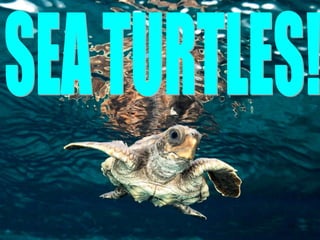
sea turtles

  • 2.
    • Marine air-breathingreptiles • Can be found in tropical and subtropical waters throughout the world. • Seven species worldwide • Five found off the coast of Florida • Three species nest on our beaches • All are endangered or threatened species and are protected by Federal, State, County, and Municipal laws. INTRODUCTION TO SEA TURTLES
  • 3.
    SEA TURTLES ANDDINOSAURS • Sea turtles have remained unchanged for 150 million years. www.oceansofkansas.com
  • 4.
    HAWKSBILL (ERETMOCHELYS IMBRICATA) Endangered worldwide Mosttropical turtle – found in Caribbean Sea, Atlantic, Pacific & Indian Oceans Habitat - estuaries, lagoons, & coastal reefs 100 – 200 pounds 2 – 3 feet long Omnivore – sponges, anemones, shrimp, & squid 160 eggs/ nest Threats – harvested for beautiful shell www.inwater.org
  • 5.
    GREEN (CHELONIA MYDAS) Endangeredworldwide Found in Atlantic, Pacific, and Indian oceans Habitat – coastlines, bays & sea grass beds 400 - 600 pounds 3 - 4 feet long Herbivore – sea grass & algae 115 eggs/nest Threats – food, eggs, by catch in shrimping www.inwater.org
  • 6.
    LOGGERHEAD (CARETTA CARETTA) • Threatened •Found in temperate and tropical waters around the world • Habitat – Estuaries & bays • 300 - 400 pounds • 2 - 3 feet long • Omnivore – shellfish on ocean floor, crabs, shellfish, & mussels • 100 – 125 eggs/nest • Most abundant turtle in FL • Threats – coastal development, habitat destruction, & shrimping www.inwater.o rg
  • 7.
    LEATHERBACK (DERMOCHELYS CORIACEA) Endangered worldwide. Mostwidely distributed turtle around the world. From Alaska to Southern tip of Africa. Habitat – pelagic open ocean, migrating thousands of miles. 700 – 2000 pounds. 5 - 9 feet long. Shell is made of tiny bone plates covered by skin. Eat jellyfish. 80 eggs/nest Threats – long-line fishery, pollution, and poaching eggs.
  • 8.
    KEMP’S RIDLEY (LEPIDOCHELYS KEMPII) CriticallyEndangered Found in the Gulf of Mexico Habitat – Shallow sandy or muddy flats 85 –100 pounds 2 – 2.5 feet long Carnivore – crabs, shrimp, fish, squid, jellyfish, sea urchins, & clams Nest in “arribadas” 110 eggs/nest Threats – taking for meat and eggs, & shrimping industry www.inwater.org
  • 9.
    • Endangered • Tropicalwaters worldwide • Habitat – coastal bays, estuaries & forage off shore • 2 - 2½ feet long / 75 – 100 lbs • Omnivore – crustaceans, mollusks, & fish • Nest arribadas – 110 eggs/nest • Threats – harvest of adults & eggs, commercial fishing, & habitat destruction OLIVE RIDLEY (LEPIDOCHELYS OLIVACEAF)
  • 10.
    FLATBACK (NATATOR DEPRESSUS) •Critically Endangered • Northern Australia • Habitat – inshore waters, bays, coastal reefs, & grassy shallows • 3 - 3½ feet long / 200 lbs • Omnivore – sea cucumbers, jellyfish, mollusks, inverts, & seaweed • 55 eggs/nest – 4 nests/yr • Threats – harvest of adults & eggs, fishing, habitat loss, & ocean pollution
  • 11.
    SEA TURTLE’S OFFLORIDA • 5 species of turtle are found in Florida. • 3 turtles nest on Florida’s beaches: Leatherback, Loggerhead & Green. www.inwater.org www.inwater.o rg www.inwater.o rg www.inwater.o rg
  • 12.
    SEA TURTLE NESTING BEHAVIORAND EMERGENCE PROCESS Jeremy Conrad
  • 13.
    7 STAGES OFTHE NESTING PROCESS Arrival – female turtle emerges from the ocean onto the beach. Marinebio.org
  • 14.
    NEST CONSTRUCTION Body pitting– removal of the top dry layer of sand. The turtle needs moist sand to dig nest.
  • 15.
    NEST CONSTRUCTION Digging –Nest is dug with rear flippers only. Each flipper alternates digging. Turtle digs until it can no longer reach the bottom of the nest. Earthwatch
  • 16.
    EGG DEPOSITION (LAYING) www.marinecreatures.com Laying– Turtle slips into a trance and lays her eggs.
  • 17.
    TAMPING & CAMOUFLAGING www.kevinschafer.com Tamping– Rear flippers bury the eggs and pack down the sand. Camouflaging – Using the front flippers, the turtle throw sand around the nest site to hide the nest from predators.
  • 18.
    RETURN TO THEOCEAN Exiting – After laying and burying her eggs, the turtle returns to the ocean.
  • 19.
    THE HATCHING PROCESS •Eggs take 45 – 80 days to incubate & hatch • Use egg tooth to pip shell • Hatchlings work together to emerge from nest (sand elevator). This can take several days • Swim frenzy-swim for several days pass reef to sargassum mats • 1 in 1,000 survives to adult
  • 20.
  • 21.
    WHAT DOES ENDANGERED MEAN? EndangeredSpecies Act of 1973 – protects plants or animals that are listed by the federal government as endangered or threatened. • Provides a means to conserve the ecosystem upon which endangered and threatened species depend, thus preventing extinction • Can not harm, kill, or harass any sea turtle, nests, eggs, or hatchlings.
  • 22.
    WHAT DOES ENDANGEREDMEAN? CITES (Convention on International Trade in Endangered Species of Wild Fauna & Flora) – Regulates and prohibits international trade of plant & animal species that are threatened or endangered. • Can not transport, sell, or trade any endangered species product. (ex: turtle shells, meat, or eggs)
  • 23.
    WHAT DOES ENDANGEREDMEAN? • Critically endangered – Facing an extremely high risk of extinction from the wild in the immediate future. • Endangered species – An animal or plant species in danger of extinction throughout all or a significant portion of its range. • Threatened species – An animal or plant species likely to become endangered with in the foreseeable future throughout all or a significant portion of its range.
  • 24.
    WHAT IS EXTINCTION& WHY IS IT BAD? Extinction – the last individual of a species dies and there are no more of that species on earth. • Each species of animal has its place and a specific role in the ecosystem. • Extinction of a species results in an imbalance in the ecosystem. • Scientific evidence reveals that we are in the midst of and largely responsible for the 6th and largest mass extinction in the earth’s history.
  • 25.
    SEA TURTLES &THE ENVIRONMENT Food Web – Sea turtles are valuable to the environment because they are part of the food web for all living creatures. Adult turtles are a food source for sharks and for humans. Hatchlings are a food source for birds, crabs, and fish. • Turtles eat sponges and sea grass, crabs, shrimp, and fish. Turtles help to keep populations of their food sources in balance.
  • 26.
    SEA TURTLES ANDTHE ENVIRONMENT • Sea turtles are a primary transporter of marine nutrients to terrestrial habitats. • Sea turtle nests are full of nutrients and energy for the terrestrial ecosystem. • Unhatched eggs, dead hatchlings, and decaying material provide nutrition and energy for: plants and dune vegetation, bacteria, insects, fungi, invertebrates, birds, crabs, and fish.
  • 27.
    THREATS TO SEATURTLES Natural Threats – Predation of adults and hatchlings, weather (hurricanes & erosion), and climate change. Predation of adults include: Killer Whales, Sharks, Jaguars, Feral Dogs and Humans Predation of hatchlings include: Raccoons, Mongoose, Rats, Birds, Ants, Wild Boars, Feral Cats & Dogs, Crabs, Fish, Plants, and Humans
  • 28.
    THREATS TO SEATURTLES Anthropogenic threats – Threats to sea turtles as a result of human actions. Human threats include: • Harvesting & poaching of eggs and adults • International trade and commerce of turtle products • Commercial fishing & shrimping • Urbanization, development, coastal armoring & habitat destruction • Artificial lighting • Pollution & debris.
  • 29.
    NATURAL THREATS Jarrad SherborneJeremy Conrad Birds, Crabs & Vertebrates are predators of hatchlings
  • 30.
    NATURAL THREATS Sharks –Are a natural predator of sea turtles. www.seaturtlehospital.org
  • 31.
    NATURAL THREATS Erosion –Hurricanes and storm surge can cause erosion which washes out and drowns nests. Earthwatch
  • 32.
    HUMAN THREATS Artificial lighting- can disorient hatchlings away from the ocean and discourage adults from nesting.
  • 33.
    HUMAN THREATS Development andArmoring – reduce nesting habitat research.myfwc.com
  • 34.
  • 35.
    HUMAN THREATS Turtles arepoached for food and eggs. Poaching is common in third world countries and the Caribbean. Jeremy Conrad
  • 36.
    FISHING GEAR Fishing Netscan entangle turtles restricting movements and trap turtles underwater resulting in death by drowning. newsfromkkp.blogspirit.com www.stemnet.nf.ca
  • 37.
    FISHING GEAR Fishing hooksand long lines can create serious injuries and even kill sea turtles. www.panda.org
  • 38.
    FISHING GEAR Turtle escapingfrom a T.E.D. (Turtle Excluder Device) research.myfwc.com
  • 39.
    CONSERVATION GOALS • Enforcelaws against illegal poaching of sea turtles and their eggs • Protect nesting beaches from armoring, artificial lighting, and development through establishment of parks and refuges • Eliminate illegal international trade of sea turtles and their products • Reduce turtle deaths from commercial fishing and shrimping
  • 40.
    CONSERVATION GOALS • Enforcelocal, national, and international laws to reduce dumping of pollution, solid waste and toxins into the ocean and sensitive sea turtle habitats • Increase education and public awareness about sea turtle conservation efforts and how the community can get involved. • Continued and increased research of sea turtle populations, their habitats (nesting beach and in water migrations) and their behavior.
  • 41.
    WAYS YOU CANHELP SEA TURTLES . . . • Pick up trash at the beach and place in garbage can • Volunteer for beach cleanups • Buy turtle safe shrimp • Hold onto your balloons • Don’t feed the raccoons and foxes • Build sand castles near the water as they may obstruct nesting attempts or disorient hatchlings emerging from the nest.
  • 42.
    WHAT TO DOIF YOU SEE A TURTLE NESTING • Stay clear of and out of the sight of the turtle. Your movement could disturb the turtle and scare it back into the sea. • Do not shine your light at the turtle. • Do not take pictures with flashes as this will disorient the turtle and cause it to abort the nest.
  • 43.
    WHAT TO DOIF YOU SEE A TURTLE NESTING • Do not approach, touch, or ride the turtle. This is for your safety as well as the turtle’s. • Do not touch, take or handle turtle eggs. • Do not destroy the tracks left by the turtle as they are important for researchers to help locate and protect the nest.
  • 44.