Peer Pressure
Concept of Peer Pressure
In everyone’s social life, there are social groups or primary groups of
people with similar interests, background, age, and even social class. In
context to the aforementioned, people feel pressured by their peers
they become so influenced by them that they feel compelled to the
behaviours, beliefs, and attitudes of others in the group. For those who
are the followers, this can either affect negatively or positively, or
sometimes even both. Research about the effect of peer pressure on
children and adolescents has revealed that it occurs mostly in pre-teens
and teenagers. However, this concept has expanded in today’s age due
to digitalization and the invasion of social media in our lives. It has
become one of the main causes of stress in children, adolescents, and
even adults.
Peer Pressure in Children
Imitation has a very large role to play in the lives of youngsters due to
their desire of picking up techniques and skills which may be useful for
them in future. And so, children are always in search of personality
traits of others which they can co-opt. Young adults get influenced
quite easily by friends and family besides celebrities. The awareness
within children about their position in society and which leads to them
deferring the judgements of adults around them. Studies conducted on
many children across schools have revealed that the behavioural
patterns and viewpoints are often impacted negatively by their peer
group. According to another group of researchers, even very small
children are susceptible to pressure from their peers, and which may
have positive effects on them, academically and socially.
Peer Pressure in Adolescents
Adolescents are most likely to get influenced by their peers due to
them giving more social priority to their friends in their lives. In this
period of life, the awareness about all those who are involved in their
lives, be it family, friends, or even distant acquaintances, begins to
dawn upon them. And so, they begin to realize the importance of
perception in their interactions with other people. Even though
teenagers who are socially accepted have many opportunities besides
positive experiences, they could even engage in behaviour which is
risky, that is, involvement in drugs and delinquency. Substance abuse
can be linked to peer pressure to a very large extent. Peer pressure has
also been associated with risk-taking in many other spheres too and
which is caused by social; gatherings without any adult monitoring.
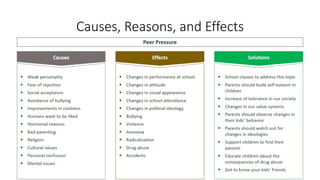
Causes, Reasons, and Effects
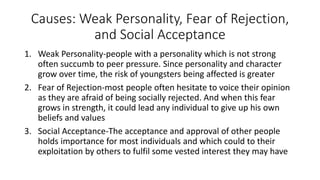
Causes: Weak Personality, Fear of Rejection,
and Social Acceptance
1. Weak Personality-people with a personality which is not strong
often succumb to peer pressure. Since personality and character
grow over time, the risk of youngsters being affected is greater
2. Fear of Rejection-most people often hesitate to voice their opinion
as they are afraid of being socially rejected. And when this fear
grows in strength, it could lead any individual to give up his own
beliefs and values
3. Social Acceptance-The acceptance and approval of other people
holds importance for most individuals and which could to their
exploitation by others to fulfil some vested interest they may have
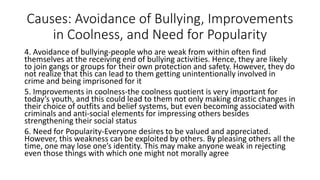
Causes: Avoidance of Bullying, Improvements
in Coolness, and Need for Popularity
4. Avoidance of bullying-people who are weak from within often find
themselves at the receiving end of bullying activities. Hence, they are likely
to join gangs or groups for their own protection and safety. However, they do
not realize that this can lead to them getting unintentionally involved in
crime and being imprisoned for it
5. Improvements in coolness-the coolness quotient is very important for
today’s youth, and this could lead to them not only making drastic changes in
their choice of outfits and belief systems, but even becoming associated with
criminals and anti-social elements for impressing others besides
strengthening their social status
6. Need for Popularity-Everyone desires to be valued and appreciated.
However, this weakness can be exploited by others. By pleasing others all the
time, one may lose one’s identity. This may make anyone weak in rejecting
even those things with which one might not morally agree
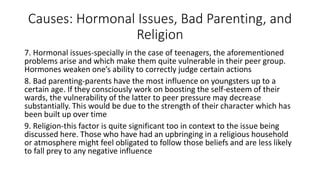
Causes: Hormonal Issues, Bad Parenting, and
Religion
7. Hormonal issues-specially in the case of teenagers, the aforementioned
problems arise and which make them quite vulnerable in their peer group.
Hormones weaken one’s ability to correctly judge certain actions
8. Bad parenting-parents have the most influence on youngsters up to a
certain age. If they consciously work on boosting the self-esteem of their
wards, the vulnerability of the latter to peer pressure may decrease
substantially. This would be due to the strength of their character which has
been built up over time
9. Religion-this factor is quite significant too in context to the issue being
discussed here. Those who have had an upbringing in a religious household
or atmosphere might feel obligated to follow those beliefs and are less likely
to fall prey to any negative influence
Causes: Cultural Values, Personal Confusion,
Mental Issues
10. Cultural values-these values too, like religious ones, are vital in the
development of peer pressure. Those who come from conservative
backgrounds having strict cultural rules might feel obliged to follow the
same, and this may guard them against being unconsciously manipulated
into acting immorally
11. Personal confusion-some youngsters might have confusion or feel lost.
This is likely to increase their vulnerability and which in turn might increase
their desperation for external support. Thus, they may end up joining anti-
social groups
12. Mental issues-mental health problems are another cause for anyone
becoming vulnerable to peer pressure. People who may be dealing with
them are likely to have little or no understanding of morals
Effects: Change in Academic Performance,
Changes in Attitude, Changes in Visual Appearance
1. Change in academic performance-youngsters may not be able to
maintain their track record at school if they are surrounded by
those who are wayward and have no value for education
2. Changes in attitude-serious changes in one’s worldview may take
place since teenagers have impressionable minds which can get
influenced quite easily
3. Changes in visual appearance-one’s preferences in dressing up may
undergo drastic changes. For instance, tattoos or piercings may be
done besides colouring of hair
Effects: Changes in School Attendance,
Changes in Political Ideology, Bullying
4. Changes in school attendance-the company of people who are not
worried about missing out on school at all besides their future and
have no respect for their teachers whatsoever may lessen the
importance one gives to school attendance
5. Changes in political ideology-the political viewpoint of youngsters
may not be the same as before. Those who were tolerant towards
minorities may become extremists
6. Bullying-students belonging to minority communities may face the
aforementioned issue. And in many cases, those who do not want to be
victims themselves may become troublemakers for others
Effects: Violence or Radical Activities and
Anorexia
7. Violence or Radical Activities-people may decide to radicalize
themselves. For example, mingling with political extremists, those who
are either on the far right or the far left of the political spectrum, can
take anyone into a radical direction. The same is true when it comes to
religious radicalization. In worst cases concerning the latter, crimes may
be committed motivated by politics or religion.
8. Anorexia-this is an eating disorder with symptoms such as food
restriction, loss of weight, and a strong desire to become thin. This is
more common in girls, who become obsessed with their physical
image. Due to them constantly being on diets, their chances of them
developing eating disorders increase substantially and which could lead
to serious health issues-physical as well as mental.
Effects: Drug Abuse and Accidents
9. Drug abuse-the rampancy of this problem is alarming within today’s
youth. Psychotropic substances are addictive. And so, their users and
peddlers will try their level best to drag more people into this dark
underbelly. But children and adolescents must have a lot of moral
strength within them so as not to become a pawn in this racket.
10. Accidents-peer pressure can cause any kind of accidents. For
example, there are a lot of people who do crazy things like climbing on
buildings and trains. Their main intention behind doing so remains to
attract the attention of other people or even to make an impression
amongst their friends. But they do not realize that in doing so, they are
putting their own life at risk and sometimes even endangering that of
other people.
Solutions: Inclusion in School Classes, Self-Esteem
Building by Parents, and Increase in Social
Tolerance
11. Inclusion in school classes-academic education should never be limited to
rote learning. Teachers can impart knowledge about many other aspects of
life too. The impact of peer pressure on one’s present and even future life
can be one of them. This may increase the level of their preparedness
towards refraining from acting on peer pressure and follow their value
systems or act according to what their moral conscience dictates them.
12. Self-esteem building by parents-the elders of the family can play a vital
role in building the self-worth and moral character of their wards. If the
foundation of the latter is unshakeable, no external influence would succeed
in swaying them into immoral pastures.
13. Increase in social tolerance-our society must become more empathic
towards youth. This may result in lower levels of crimes committed due to
intolerance.
Solutions: Changes in Value Systems and
Behavioural Observance by Parents
14. Changes in value systems-moral principles need to be changed
drastically in domains where religion and ideologies have no reach. This
need not involve making changes in our belief systems. One should
only increase the level of intolerance towards the fearless and open
display of extremism.
15. Behavioural observance by parents-parents should be able to
notice even minor changes in the pattern of their children’s behaviour.
These changes may indicate the presence of any mental or
psychological disturbance in the lives of their children, and in which
case remedial measures could be taken before the situation gets too
out of control.
Solutions: Tracking Ideological Changes and
Supporting in Finding Passion
16. Tracking ideological changes-parents must maintain a level of
awareness about any drastic changes in their children’s ideologies. This
may be achieved through regular conversations with children about the
flawed arguments on which radical ideologies are based and which may
encourage children to break away from radical groups.
17. Supporting in Finding passion-another powerful methodology for
protecting children from any negative social elements in their lives is to
support them in finding out their true passions and helping them in
pursuing them. This may distract them from all those people who are
influencing them negatively.
Solutions: Educating Youngsters about Alcoholism,
and Keeping Knowledge about Social Group
18. Educating youngsters about alcoholism-alcohol, like drugs is another
addictive substance which becomes an addiction over a very short period of
time. It not only causes damage to one’s internal organs, specially liver, but
even overpowers and gradually destroys one’s mental faculties. And so, one
must ensure that children and teenagers are made aware of the
aforementioned facts.
19. Keeping knowledge about social group-parents must ensure that children
keep them in the loop about who they are hanging out with. Quite often, the
intent and attitude of people can be determined by having just a short
conversation with them. This is another method which can help in the
identification of people who are bad influences on their children following
which, the latter may break away from their company.
Conclusion: Peer pressure is has become very deep rooted in our society.
Teenagers and young adults may face significant dangers and which may in turn lead to
adverse consequences. Therefore parents must be aware of the negative behavioral
effects of peer pressure and take suitable remedial measures in time.
References:
https://en.wikipedia.org/wiki/Peer_pressure#Children
https://environmental-conscience.com/peer-pressure-causes-effects-solutions/
For research-based Powerpoint or Word
presentations on any topic, please
call/SMS/whatsapp on 9653254172 or email at
saifalisanjli@gmail.com
Saif Ali Sajid Amir

Peer pressure

  • 1.
  • 2.
    Concept of PeerPressure In everyone’s social life, there are social groups or primary groups of people with similar interests, background, age, and even social class. In context to the aforementioned, people feel pressured by their peers they become so influenced by them that they feel compelled to the behaviours, beliefs, and attitudes of others in the group. For those who are the followers, this can either affect negatively or positively, or sometimes even both. Research about the effect of peer pressure on children and adolescents has revealed that it occurs mostly in pre-teens and teenagers. However, this concept has expanded in today’s age due to digitalization and the invasion of social media in our lives. It has become one of the main causes of stress in children, adolescents, and even adults.
  • 3.
    Peer Pressure inChildren Imitation has a very large role to play in the lives of youngsters due to their desire of picking up techniques and skills which may be useful for them in future. And so, children are always in search of personality traits of others which they can co-opt. Young adults get influenced quite easily by friends and family besides celebrities. The awareness within children about their position in society and which leads to them deferring the judgements of adults around them. Studies conducted on many children across schools have revealed that the behavioural patterns and viewpoints are often impacted negatively by their peer group. According to another group of researchers, even very small children are susceptible to pressure from their peers, and which may have positive effects on them, academically and socially.
  • 4.
    Peer Pressure inAdolescents Adolescents are most likely to get influenced by their peers due to them giving more social priority to their friends in their lives. In this period of life, the awareness about all those who are involved in their lives, be it family, friends, or even distant acquaintances, begins to dawn upon them. And so, they begin to realize the importance of perception in their interactions with other people. Even though teenagers who are socially accepted have many opportunities besides positive experiences, they could even engage in behaviour which is risky, that is, involvement in drugs and delinquency. Substance abuse can be linked to peer pressure to a very large extent. Peer pressure has also been associated with risk-taking in many other spheres too and which is caused by social; gatherings without any adult monitoring.
  • 5.
  • 6.
    Causes: Weak Personality,Fear of Rejection, and Social Acceptance 1. Weak Personality-people with a personality which is not strong often succumb to peer pressure. Since personality and character grow over time, the risk of youngsters being affected is greater 2. Fear of Rejection-most people often hesitate to voice their opinion as they are afraid of being socially rejected. And when this fear grows in strength, it could lead any individual to give up his own beliefs and values 3. Social Acceptance-The acceptance and approval of other people holds importance for most individuals and which could to their exploitation by others to fulfil some vested interest they may have
  • 7.
    Causes: Avoidance ofBullying, Improvements in Coolness, and Need for Popularity 4. Avoidance of bullying-people who are weak from within often find themselves at the receiving end of bullying activities. Hence, they are likely to join gangs or groups for their own protection and safety. However, they do not realize that this can lead to them getting unintentionally involved in crime and being imprisoned for it 5. Improvements in coolness-the coolness quotient is very important for today’s youth, and this could lead to them not only making drastic changes in their choice of outfits and belief systems, but even becoming associated with criminals and anti-social elements for impressing others besides strengthening their social status 6. Need for Popularity-Everyone desires to be valued and appreciated. However, this weakness can be exploited by others. By pleasing others all the time, one may lose one’s identity. This may make anyone weak in rejecting even those things with which one might not morally agree
  • 8.
    Causes: Hormonal Issues,Bad Parenting, and Religion 7. Hormonal issues-specially in the case of teenagers, the aforementioned problems arise and which make them quite vulnerable in their peer group. Hormones weaken one’s ability to correctly judge certain actions 8. Bad parenting-parents have the most influence on youngsters up to a certain age. If they consciously work on boosting the self-esteem of their wards, the vulnerability of the latter to peer pressure may decrease substantially. This would be due to the strength of their character which has been built up over time 9. Religion-this factor is quite significant too in context to the issue being discussed here. Those who have had an upbringing in a religious household or atmosphere might feel obligated to follow those beliefs and are less likely to fall prey to any negative influence
  • 9.
    Causes: Cultural Values,Personal Confusion, Mental Issues 10. Cultural values-these values too, like religious ones, are vital in the development of peer pressure. Those who come from conservative backgrounds having strict cultural rules might feel obliged to follow the same, and this may guard them against being unconsciously manipulated into acting immorally 11. Personal confusion-some youngsters might have confusion or feel lost. This is likely to increase their vulnerability and which in turn might increase their desperation for external support. Thus, they may end up joining anti- social groups 12. Mental issues-mental health problems are another cause for anyone becoming vulnerable to peer pressure. People who may be dealing with them are likely to have little or no understanding of morals
  • 10.
    Effects: Change inAcademic Performance, Changes in Attitude, Changes in Visual Appearance 1. Change in academic performance-youngsters may not be able to maintain their track record at school if they are surrounded by those who are wayward and have no value for education 2. Changes in attitude-serious changes in one’s worldview may take place since teenagers have impressionable minds which can get influenced quite easily 3. Changes in visual appearance-one’s preferences in dressing up may undergo drastic changes. For instance, tattoos or piercings may be done besides colouring of hair
  • 11.
    Effects: Changes inSchool Attendance, Changes in Political Ideology, Bullying 4. Changes in school attendance-the company of people who are not worried about missing out on school at all besides their future and have no respect for their teachers whatsoever may lessen the importance one gives to school attendance 5. Changes in political ideology-the political viewpoint of youngsters may not be the same as before. Those who were tolerant towards minorities may become extremists 6. Bullying-students belonging to minority communities may face the aforementioned issue. And in many cases, those who do not want to be victims themselves may become troublemakers for others
  • 12.
    Effects: Violence orRadical Activities and Anorexia 7. Violence or Radical Activities-people may decide to radicalize themselves. For example, mingling with political extremists, those who are either on the far right or the far left of the political spectrum, can take anyone into a radical direction. The same is true when it comes to religious radicalization. In worst cases concerning the latter, crimes may be committed motivated by politics or religion. 8. Anorexia-this is an eating disorder with symptoms such as food restriction, loss of weight, and a strong desire to become thin. This is more common in girls, who become obsessed with their physical image. Due to them constantly being on diets, their chances of them developing eating disorders increase substantially and which could lead to serious health issues-physical as well as mental.
  • 13.
    Effects: Drug Abuseand Accidents 9. Drug abuse-the rampancy of this problem is alarming within today’s youth. Psychotropic substances are addictive. And so, their users and peddlers will try their level best to drag more people into this dark underbelly. But children and adolescents must have a lot of moral strength within them so as not to become a pawn in this racket. 10. Accidents-peer pressure can cause any kind of accidents. For example, there are a lot of people who do crazy things like climbing on buildings and trains. Their main intention behind doing so remains to attract the attention of other people or even to make an impression amongst their friends. But they do not realize that in doing so, they are putting their own life at risk and sometimes even endangering that of other people.
  • 14.
    Solutions: Inclusion inSchool Classes, Self-Esteem Building by Parents, and Increase in Social Tolerance 11. Inclusion in school classes-academic education should never be limited to rote learning. Teachers can impart knowledge about many other aspects of life too. The impact of peer pressure on one’s present and even future life can be one of them. This may increase the level of their preparedness towards refraining from acting on peer pressure and follow their value systems or act according to what their moral conscience dictates them. 12. Self-esteem building by parents-the elders of the family can play a vital role in building the self-worth and moral character of their wards. If the foundation of the latter is unshakeable, no external influence would succeed in swaying them into immoral pastures. 13. Increase in social tolerance-our society must become more empathic towards youth. This may result in lower levels of crimes committed due to intolerance.
  • 15.
    Solutions: Changes inValue Systems and Behavioural Observance by Parents 14. Changes in value systems-moral principles need to be changed drastically in domains where religion and ideologies have no reach. This need not involve making changes in our belief systems. One should only increase the level of intolerance towards the fearless and open display of extremism. 15. Behavioural observance by parents-parents should be able to notice even minor changes in the pattern of their children’s behaviour. These changes may indicate the presence of any mental or psychological disturbance in the lives of their children, and in which case remedial measures could be taken before the situation gets too out of control.
  • 16.
    Solutions: Tracking IdeologicalChanges and Supporting in Finding Passion 16. Tracking ideological changes-parents must maintain a level of awareness about any drastic changes in their children’s ideologies. This may be achieved through regular conversations with children about the flawed arguments on which radical ideologies are based and which may encourage children to break away from radical groups. 17. Supporting in Finding passion-another powerful methodology for protecting children from any negative social elements in their lives is to support them in finding out their true passions and helping them in pursuing them. This may distract them from all those people who are influencing them negatively.
  • 17.
    Solutions: Educating Youngstersabout Alcoholism, and Keeping Knowledge about Social Group 18. Educating youngsters about alcoholism-alcohol, like drugs is another addictive substance which becomes an addiction over a very short period of time. It not only causes damage to one’s internal organs, specially liver, but even overpowers and gradually destroys one’s mental faculties. And so, one must ensure that children and teenagers are made aware of the aforementioned facts. 19. Keeping knowledge about social group-parents must ensure that children keep them in the loop about who they are hanging out with. Quite often, the intent and attitude of people can be determined by having just a short conversation with them. This is another method which can help in the identification of people who are bad influences on their children following which, the latter may break away from their company.
  • 18.
    Conclusion: Peer pressureis has become very deep rooted in our society. Teenagers and young adults may face significant dangers and which may in turn lead to adverse consequences. Therefore parents must be aware of the negative behavioral effects of peer pressure and take suitable remedial measures in time. References: https://en.wikipedia.org/wiki/Peer_pressure#Children https://environmental-conscience.com/peer-pressure-causes-effects-solutions/
  • 19.
    For research-based Powerpointor Word presentations on any topic, please call/SMS/whatsapp on 9653254172 or email at saifalisanjli@gmail.com Saif Ali Sajid Amir