Building Resilience and
Social Emotional
Intelligence
Social emotional learning is a specific subject in the
field of child development. This process, which is
integrative besides being a gradual one, is aimed at
making children acquire the capacity of
understanding, experiencing, expressing, and
managing their emotions. The aforementioned also
supports the development of meaningful
relationships with other people. The range of
constructs and skills involved here is very large and
which involves play, theory of mind, joint attention,
and self-awareness besides many other ones. This
may be the foundation for youngsters to engage
themselves in other developmental procedures.
Many disorders concerning mental health, such as
eating disorders, borderline personality disorders,
anxiety disorders, and major depressive disorders
can be perceived from the point of view of social
emotional development, and most importantly,
emotional regulation.
How Children Learn to Share and Care
Social-Emotional Experiences in Early Childhood
According to research, the maximum amount of social-emotional development takes place in one’s
Formative years. Their experiences with their own mood swings and temper tantrums besides the social
expansion in their lives increases their level of awareness not only of their own emotions but even all those
other people surrounding them and who meaningfully impact their lives in one way or the other.
IMPORTANT: Social skills and emotional development hold important for helping children prepare
themselves for their schooling years. Some broad examples of the aforementioned
would be inclusive of corporation with their peers, transitioning amongst different activities,
and not only paying attention to what the attention have to tell them but also obeying them
and accepting their suggestions or advice.
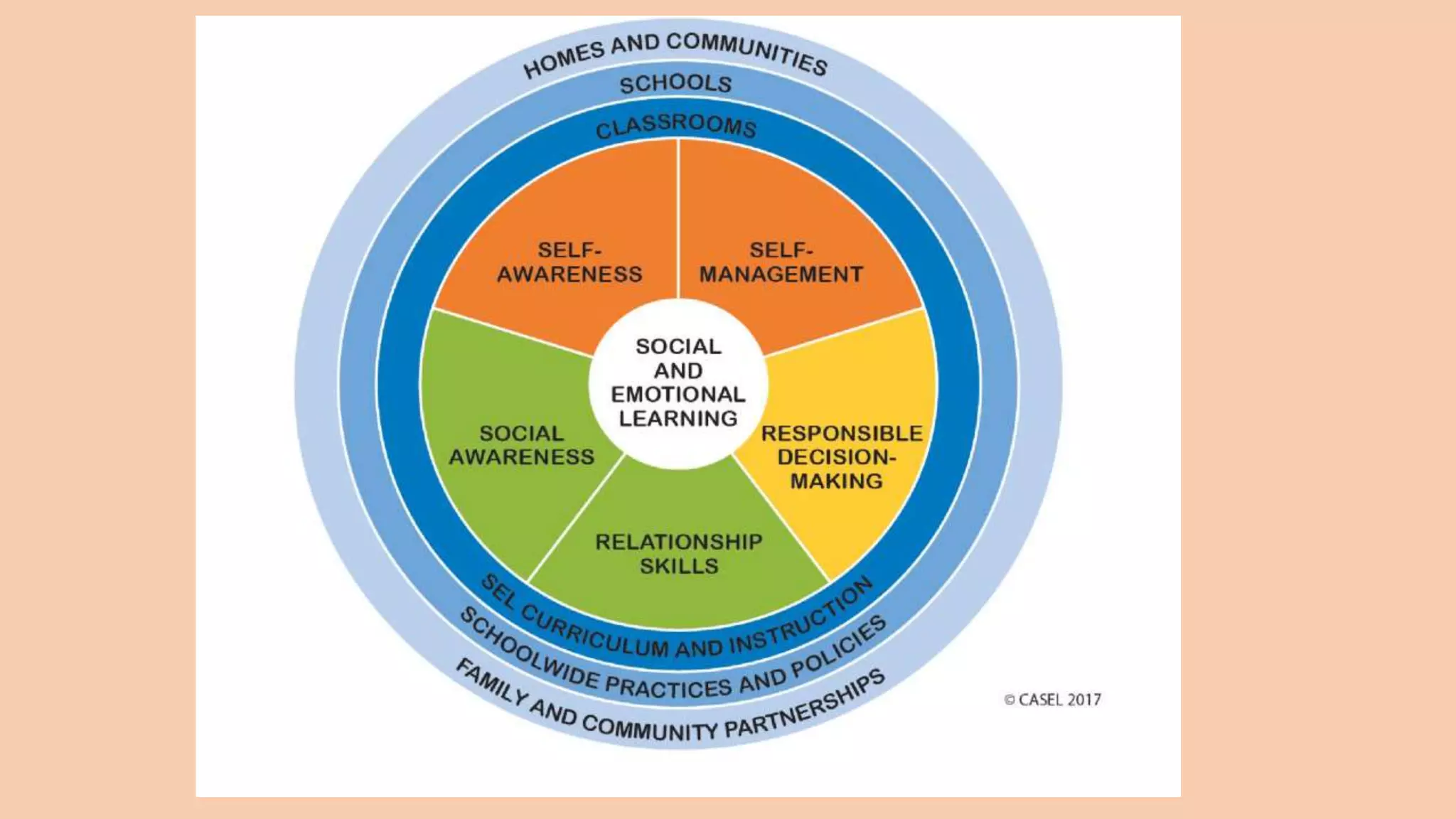
SEL CURRICULUM AND INSTRUCTION IN
SCHOOLS AND CLASSROOMS
Mindfulness is paying attention in a particular way,
and on purpose, to the present moment.
All our feelings are the result of our own thoughts
and beliefs
Determination and persistence are vital for the
accomplishment of any goal
Listening with empathy often strengthens relationships
The expression and even the feeling of gratitude brings
positivity in one’s life
Policies and Practices for
Emotional Development in
Schools
Many disciplinary approaches have their focus on the establishment of order and
control for correcting or preventing behavioral problems. These may include many
processes which may lead to the strengthening of their emotional and social
competencies besides maintaining their sense of belonging and purpose by using
encouragement and respect while interacting with youngsters. Policy-makers and even
those who put them into practice should take into consideration what the students are
learning, thinking, feeling, and deciding about themselves. The root cause of the
problem needs to be understood in order to provide additional services to students
when required. The constructive use of autonomy and personal agency must be
encouraged. While working with students, those impacted and those who are
responsible for the wrongdoing must repair harm besides restoring relationships and
rebuilding communities. The use of fair processes must be done and in which students
may have their own voices in decisions affecting them besides understanding the
reasons behind them, and must have clarity about the expectations from them in the
near future.
Family and Community
Practices for SEL
Social emotional learning cannot take place only in classrooms. The
extension of such learning into one’s home increases the scope for
students to gain real-world experiences. The engagement of families as
partners in this process adds much more relevance and meaning to the
lessons being learned in schools. It involves the use of those moments
by families which take place organically. These may include trips to
grocery stores and supermarkets besides playing board games,
responding to any kind of experience the family may have had in the
past besides those which may be happening in the present on a day-to-
day basis.
Families can enhance children’s social-
emotional needs through:
 Creating new avenues for learning and which can include recreational trips
and books
 Anticipating and previewing particular experiences to help them recognize
their feelings besides preparing them for any situation
 Listening to them while they vent out their feelings
 Engaging them in reflective conversations
 Encouraging self-talk as a method to vent out frustration
 Including the experiences and background of one’s family so that
conversations seem personalized
 Teaching them to manage their own feelings through the application of
their own understanding and skills
 Connecting with other people and making the use of parenting toolkits
Development of Self-Awareness
The importance of self-awareness in children stems from the fact that it
is a pathway for success. The more they understand their own actions,
emotions, and abilities, the higher the chances of them making
appropriate choices in life.
The learning and practicing of self-awareness skills can take place on a
regular or even daily basis. It is important to remember that self-
awareness skills develop over time.
Many Self-Awareness Units have been developed and which are even
available for use on the internet.
Useful Strategies for Self-Awareness Building
• Teaching them to use any one field of their own strong point and interest as a strength which would develop eventually
• Allowing them to take risks so that their level of confidence grows
• Making children prepare a list of compliments for their own selves
• Keeping a weekly show in which children may display their talent in something in which they possess above average skills
or are most passionate about
• Exploring varied genres of books and music with them
• Teaching them about emotional concepts which are in-depth
• Fix up daily timings when children may evaluate their own feelings
• Embracing the concept that hard work and positivity can and will eventually lead to success
• Discussing and eventually discovering their dreams and aspirations periodically
• Doing research on whichever career option they wish to choose in future
• Helping them to develop goals for themselves besides monitoring their progress on a regular basis
• Scheduling student conferences wherein teachers facilitate their discussion about the level of progress which they have
made towards achieving their goals
Importance of Developing Self-Management
Abilities
Self-management has been recognized as a vital component in the process of
education. It helps them on following through on their plans for completing
assignments and preparing for tests besides maintaining focus in classes. It is
vital for the achievement of one’s goal whether it concerns academics or any
other sphere of life. According to a study, the association between social
emotional learning skills in pre-primary and the outcomes of significance in
the later years of young adults concerning their education, employment, and
criminal activities besides mental health and substance use is quite strong.
The aforementioned even highlighted the correlation between the
development of prosocial skills in one’s early years and not only decreased
the likelihood of having run-ins with the law but also improved the quality of
life in terms of public housing besides receiving the government’s welfare
assistance.
Methods for Developing Self-
Management Skills
In context to the type skills being discussed here, it is important to note that they can be divided into six
broad categories and which include:
1. Stress Management-This involves and is helpful in keeping negativity out of one’s life
2. Time Management-Life is short, and so, using one’s waking hours most productively
is a self-disciplinary method for utilizing one’s day to the fullest
3. Organizing Skills: This is about bringing an order in life and being methodical about
everything in the working and living space
4. Decision-Making Skills: Taking your own decisions and being responsible for them can give
youngsters immense confidence in life
5. Problem-Solving Skills: Though life is full of complexities, sorting them out most appropriately
is what a successful life is all about
6. Health Management Skills: Health is wealth-and the secret to a healthy body lies in
having a balanced diet and moderate exercises but above all being
calm and happy from within
Social Awareness Development
Since all human and other living beings co-exist in this one world which
we also define as a society, social consciousness can be defined as
being aware about being a part of a group of people or community
which is interrelated. Karl Marx, a German philosopher, has stated that
social consciousness may be formed when people enter certain
economic or productive relations. According to him, people’s social
productivity is dependent upon the meaningful relationships people
enter into and which are indispensable besides being independent of
their own free will. He further goes on to say that the social identity of
humans is what determines their consciousness.
Strategies for Building Social Awareness
• Challenging the way in which youngsters may be mentally or emotionally
affected by situations in life besides the manner in which they may handle
them helps them in forming friendships besides any social interaction in
general
• Group physical activities, like yoga classes, not only boosts energy levels
and coordination but even teaches their participants to accept their own
selves besides developing compassion towards those who surround them
• Caregivers who display compassion and empathy often become role
models for children. The mistakes made by adults around them helps them
to understand that even they are not perfect, making children give them
back the same emotions
Significance of Relationship-Building Skills
All of us are constantly surrounded by people. We come across many of
them who seem more popular than many other ones. They may be
defined as extroverts. Both children and teenagers need the love and
support of family and friends. Responsive, loving, and stable
relationships are vital in the overall development of children and
teenagers. It helps them to enhance their thinking, understanding,
communicating, behavioral, expressive, and social skills. Receiving love
and affection from other people facilitates the development of their
relationship-building abilities. It is a proven fact that teenagers who are
surrounded by their family members have much less personality
problems.
Methods of Developing Healthy
Relationships:
1. Mealtimes: Have at least one meal a day as a family. The exchange of experiences and ideas
amongst family members makes the consumption of food much more pleasurable
2. Family Outings: Relaxing holidays and weekend getaways builds togetherness
3. One-on-one Time: Enjoying one another’s company on a one-to-one basis provides an
opportunity for the exchange of ideas and thoughts
4. Success and Failures: Display feelings of joy on accomplishments express empathy on when the
goals are not achieved
5. Family Traditions: Rituals and routines within families like movie nights and cooking sessions
makes both adults and children set aside dates and make time for them on a regular basis
6. Assignment of Household Duties: Delegating them responsibilities of the house such as grocery
shopping and cleaning gives them a sense of being important contributors within the family
7. Consequences and Limits: To give them a sense of predictability, structure, and security, make
them aware of their boundaries and the repercussions if they ever cross them
8. Family Meetings: Conferences within families gives all the members a platform to raise their
opinions on matters of importance.
Responsible Decision-Making for Children and
Adolescents
Learning to take decisions for one’s own self and being responsible for
their consequences is something which should be learnt from an early
age. Choosing between two or more alternatives is a skill which
everyone should achieve mastery in since it is useful in every sphere of
life. Decisions can be made once all the available information is
processed and the concerned people are consulted. Identifying the
processes which are useful in making the appropriate choices holds
importance besides making concerted efforts of uncovering any kind of
biases which will affect or alter its end result. The skills involved here
include problem-solving, leadership, reasoning, intuition, teamwork,
emotional intelligence, creativity, time management, and organization
Decision-Making Process
This four-step guide may be quite useful in making choices or coming to
a decision about any problem. It includes:
1. Identifying the issue or the root cause of the issue and even its
magnitude
2. Listing down all the possible options which can solve it
3. Noting down the advantages and the disadvantages of each one of
them
4. Zeroing down on any one option after analyzing its short-term and
long-term impact
References:
• https://en.wikipedia.org/wiki/Social_emotional_development
• https://casel.org/sel-framework/
• https://casel.org/wp-content/uploads/2020/12/CASEL-SEL-Framework-11.2020.pdf
• https://casel.org/what-is-sel-4/
• https://gtlcenter.org/sel-school
• https://gtlcenter.org/sites/default/files/TeachingtheWholeChild.pdf
• https://casel.org/wp-content/uploads/2017/04/When-Districts-Support-SEL-Brief.pdf
• https://www.verywellmind.com/social-and-emotional-development-in-early-childhood-2795106
• https://www.thepathway2success.com/25-ways-to-integrate-social-emotional-learning/
• https://www.teachthought.com/pedagogy/5-strategies-for-incorporating-social-emotional-learning-into-your-classroom/
• https://schoolguide.casel.org/focus-area-3/school/establish-discipline-policies-that-promote-sel/
• https://www.gettingsmart.com/2018/10/social-emotional-learning-in-the-home/
• https://www.thepathway2success.com/teaching-kids-to-be-self-aware-2/
• https://achieve.lausd.net/cms/lib/CA01000043/Centricity/domain/625/pdfs/self-management/educators/Why%20V2%20is%20learning%20about%20Self-Management%20important.pdf
• https://www.risepreneur.com/ways-to-develop-self-management-skills-in-
teens/#:~:text=Self%2Dmanagement%20skills%20will%20help%20you%20learn%20how%20to%20avoid,wants%20to%20become%20an%20entrepreneur.&text=Kid%20with%20stress%20management%20skills,he%20feels%20because%20of%2
0others
• https://en.wikipedia.org/wiki/Social_consciousness
• https://www.lifeskillsgroup.com.au/blog/3-strategies-to-improve-social-awareness-in-children
• https://www.healthyfamiliesbc.ca/home/articles/teens-and-family-relationships#:~:text=Supportive%20and%20close%20family%20relationships,desire%20to%20do%20well%20academically.
• https://www.indeed.com/career-advice/career-development/relationship-building-skills
• https://raisingchildren.net.au/newborns/development/understanding-development/relationships-development#:~:text=Loving%2C%20stable%20and%20responsive%20relationships,emotions%20and%20develop%20social%20skills
• https://www.indeed.com/career-advice/career-development/decision-making-skills
Resilience-Building and Emotional Learning
Activities and Games:
https://www.tomsofmaine.com/good-matters/healthy-feeling/building-resilience-
in-children-using-fun-games
https://www.sdera.wa.edu.au/resilience-games-and-activities-for-parents-and-
children/
https://resources.beyondblue.org.au/prism/file?token=BL/1810_A
https://positivepsychology.com/resilience-activities-worksheets/
file:///C:/Users/Lenovo/Downloads/Promoting_Social_and_Emotional_Learning_
With_Games.pdf
https://healthiersfexcel.org/wp-content/uploads/2018/07/101-Ways-to-Teach-
Children-Social-Skills.pdf
https://www.freespirit.com/files/original/Boost-Emotional-Intelligence-in-
Students-preview-1.pdf
• =
For research-based Powerpoint or Word
presentations on any topic, please
call/SMS/whatsapp on 9653254172 or email at
saifalisanjli@gmail.com
Saif Ali Sajid Amir

Building resilience and social emotional intelligence

  • 1.
    Building Resilience and SocialEmotional Intelligence
  • 2.
    Social emotional learningis a specific subject in the field of child development. This process, which is integrative besides being a gradual one, is aimed at making children acquire the capacity of understanding, experiencing, expressing, and managing their emotions. The aforementioned also supports the development of meaningful relationships with other people. The range of constructs and skills involved here is very large and which involves play, theory of mind, joint attention, and self-awareness besides many other ones. This may be the foundation for youngsters to engage themselves in other developmental procedures. Many disorders concerning mental health, such as eating disorders, borderline personality disorders, anxiety disorders, and major depressive disorders can be perceived from the point of view of social emotional development, and most importantly, emotional regulation.
  • 3.
    How Children Learnto Share and Care Social-Emotional Experiences in Early Childhood According to research, the maximum amount of social-emotional development takes place in one’s Formative years. Their experiences with their own mood swings and temper tantrums besides the social expansion in their lives increases their level of awareness not only of their own emotions but even all those other people surrounding them and who meaningfully impact their lives in one way or the other. IMPORTANT: Social skills and emotional development hold important for helping children prepare themselves for their schooling years. Some broad examples of the aforementioned would be inclusive of corporation with their peers, transitioning amongst different activities, and not only paying attention to what the attention have to tell them but also obeying them and accepting their suggestions or advice.
  • 5.
    SEL CURRICULUM ANDINSTRUCTION IN SCHOOLS AND CLASSROOMS
  • 6.
    Mindfulness is payingattention in a particular way, and on purpose, to the present moment. All our feelings are the result of our own thoughts and beliefs Determination and persistence are vital for the accomplishment of any goal Listening with empathy often strengthens relationships The expression and even the feeling of gratitude brings positivity in one’s life
  • 7.
    Policies and Practicesfor Emotional Development in Schools Many disciplinary approaches have their focus on the establishment of order and control for correcting or preventing behavioral problems. These may include many processes which may lead to the strengthening of their emotional and social competencies besides maintaining their sense of belonging and purpose by using encouragement and respect while interacting with youngsters. Policy-makers and even those who put them into practice should take into consideration what the students are learning, thinking, feeling, and deciding about themselves. The root cause of the problem needs to be understood in order to provide additional services to students when required. The constructive use of autonomy and personal agency must be encouraged. While working with students, those impacted and those who are responsible for the wrongdoing must repair harm besides restoring relationships and rebuilding communities. The use of fair processes must be done and in which students may have their own voices in decisions affecting them besides understanding the reasons behind them, and must have clarity about the expectations from them in the near future.
  • 9.
    Family and Community Practicesfor SEL Social emotional learning cannot take place only in classrooms. The extension of such learning into one’s home increases the scope for students to gain real-world experiences. The engagement of families as partners in this process adds much more relevance and meaning to the lessons being learned in schools. It involves the use of those moments by families which take place organically. These may include trips to grocery stores and supermarkets besides playing board games, responding to any kind of experience the family may have had in the past besides those which may be happening in the present on a day-to- day basis.
  • 10.
    Families can enhancechildren’s social- emotional needs through:  Creating new avenues for learning and which can include recreational trips and books  Anticipating and previewing particular experiences to help them recognize their feelings besides preparing them for any situation  Listening to them while they vent out their feelings  Engaging them in reflective conversations  Encouraging self-talk as a method to vent out frustration  Including the experiences and background of one’s family so that conversations seem personalized  Teaching them to manage their own feelings through the application of their own understanding and skills  Connecting with other people and making the use of parenting toolkits
  • 11.
    Development of Self-Awareness Theimportance of self-awareness in children stems from the fact that it is a pathway for success. The more they understand their own actions, emotions, and abilities, the higher the chances of them making appropriate choices in life. The learning and practicing of self-awareness skills can take place on a regular or even daily basis. It is important to remember that self- awareness skills develop over time. Many Self-Awareness Units have been developed and which are even available for use on the internet.
  • 12.
    Useful Strategies forSelf-Awareness Building • Teaching them to use any one field of their own strong point and interest as a strength which would develop eventually • Allowing them to take risks so that their level of confidence grows • Making children prepare a list of compliments for their own selves • Keeping a weekly show in which children may display their talent in something in which they possess above average skills or are most passionate about • Exploring varied genres of books and music with them • Teaching them about emotional concepts which are in-depth • Fix up daily timings when children may evaluate their own feelings • Embracing the concept that hard work and positivity can and will eventually lead to success • Discussing and eventually discovering their dreams and aspirations periodically • Doing research on whichever career option they wish to choose in future • Helping them to develop goals for themselves besides monitoring their progress on a regular basis • Scheduling student conferences wherein teachers facilitate their discussion about the level of progress which they have made towards achieving their goals
  • 13.
    Importance of DevelopingSelf-Management Abilities Self-management has been recognized as a vital component in the process of education. It helps them on following through on their plans for completing assignments and preparing for tests besides maintaining focus in classes. It is vital for the achievement of one’s goal whether it concerns academics or any other sphere of life. According to a study, the association between social emotional learning skills in pre-primary and the outcomes of significance in the later years of young adults concerning their education, employment, and criminal activities besides mental health and substance use is quite strong. The aforementioned even highlighted the correlation between the development of prosocial skills in one’s early years and not only decreased the likelihood of having run-ins with the law but also improved the quality of life in terms of public housing besides receiving the government’s welfare assistance.
  • 14.
    Methods for DevelopingSelf- Management Skills In context to the type skills being discussed here, it is important to note that they can be divided into six broad categories and which include: 1. Stress Management-This involves and is helpful in keeping negativity out of one’s life 2. Time Management-Life is short, and so, using one’s waking hours most productively is a self-disciplinary method for utilizing one’s day to the fullest 3. Organizing Skills: This is about bringing an order in life and being methodical about everything in the working and living space 4. Decision-Making Skills: Taking your own decisions and being responsible for them can give youngsters immense confidence in life 5. Problem-Solving Skills: Though life is full of complexities, sorting them out most appropriately is what a successful life is all about 6. Health Management Skills: Health is wealth-and the secret to a healthy body lies in having a balanced diet and moderate exercises but above all being calm and happy from within
  • 15.
    Social Awareness Development Sinceall human and other living beings co-exist in this one world which we also define as a society, social consciousness can be defined as being aware about being a part of a group of people or community which is interrelated. Karl Marx, a German philosopher, has stated that social consciousness may be formed when people enter certain economic or productive relations. According to him, people’s social productivity is dependent upon the meaningful relationships people enter into and which are indispensable besides being independent of their own free will. He further goes on to say that the social identity of humans is what determines their consciousness.
  • 16.
    Strategies for BuildingSocial Awareness • Challenging the way in which youngsters may be mentally or emotionally affected by situations in life besides the manner in which they may handle them helps them in forming friendships besides any social interaction in general • Group physical activities, like yoga classes, not only boosts energy levels and coordination but even teaches their participants to accept their own selves besides developing compassion towards those who surround them • Caregivers who display compassion and empathy often become role models for children. The mistakes made by adults around them helps them to understand that even they are not perfect, making children give them back the same emotions
  • 17.
    Significance of Relationship-BuildingSkills All of us are constantly surrounded by people. We come across many of them who seem more popular than many other ones. They may be defined as extroverts. Both children and teenagers need the love and support of family and friends. Responsive, loving, and stable relationships are vital in the overall development of children and teenagers. It helps them to enhance their thinking, understanding, communicating, behavioral, expressive, and social skills. Receiving love and affection from other people facilitates the development of their relationship-building abilities. It is a proven fact that teenagers who are surrounded by their family members have much less personality problems.
  • 18.
    Methods of DevelopingHealthy Relationships: 1. Mealtimes: Have at least one meal a day as a family. The exchange of experiences and ideas amongst family members makes the consumption of food much more pleasurable 2. Family Outings: Relaxing holidays and weekend getaways builds togetherness 3. One-on-one Time: Enjoying one another’s company on a one-to-one basis provides an opportunity for the exchange of ideas and thoughts 4. Success and Failures: Display feelings of joy on accomplishments express empathy on when the goals are not achieved 5. Family Traditions: Rituals and routines within families like movie nights and cooking sessions makes both adults and children set aside dates and make time for them on a regular basis 6. Assignment of Household Duties: Delegating them responsibilities of the house such as grocery shopping and cleaning gives them a sense of being important contributors within the family 7. Consequences and Limits: To give them a sense of predictability, structure, and security, make them aware of their boundaries and the repercussions if they ever cross them 8. Family Meetings: Conferences within families gives all the members a platform to raise their opinions on matters of importance.
  • 19.
    Responsible Decision-Making forChildren and Adolescents Learning to take decisions for one’s own self and being responsible for their consequences is something which should be learnt from an early age. Choosing between two or more alternatives is a skill which everyone should achieve mastery in since it is useful in every sphere of life. Decisions can be made once all the available information is processed and the concerned people are consulted. Identifying the processes which are useful in making the appropriate choices holds importance besides making concerted efforts of uncovering any kind of biases which will affect or alter its end result. The skills involved here include problem-solving, leadership, reasoning, intuition, teamwork, emotional intelligence, creativity, time management, and organization
  • 20.
    Decision-Making Process This four-stepguide may be quite useful in making choices or coming to a decision about any problem. It includes: 1. Identifying the issue or the root cause of the issue and even its magnitude 2. Listing down all the possible options which can solve it 3. Noting down the advantages and the disadvantages of each one of them 4. Zeroing down on any one option after analyzing its short-term and long-term impact
  • 21.
    References: • https://en.wikipedia.org/wiki/Social_emotional_development • https://casel.org/sel-framework/ •https://casel.org/wp-content/uploads/2020/12/CASEL-SEL-Framework-11.2020.pdf • https://casel.org/what-is-sel-4/ • https://gtlcenter.org/sel-school • https://gtlcenter.org/sites/default/files/TeachingtheWholeChild.pdf • https://casel.org/wp-content/uploads/2017/04/When-Districts-Support-SEL-Brief.pdf • https://www.verywellmind.com/social-and-emotional-development-in-early-childhood-2795106 • https://www.thepathway2success.com/25-ways-to-integrate-social-emotional-learning/ • https://www.teachthought.com/pedagogy/5-strategies-for-incorporating-social-emotional-learning-into-your-classroom/ • https://schoolguide.casel.org/focus-area-3/school/establish-discipline-policies-that-promote-sel/ • https://www.gettingsmart.com/2018/10/social-emotional-learning-in-the-home/ • https://www.thepathway2success.com/teaching-kids-to-be-self-aware-2/ • https://achieve.lausd.net/cms/lib/CA01000043/Centricity/domain/625/pdfs/self-management/educators/Why%20V2%20is%20learning%20about%20Self-Management%20important.pdf • https://www.risepreneur.com/ways-to-develop-self-management-skills-in- teens/#:~:text=Self%2Dmanagement%20skills%20will%20help%20you%20learn%20how%20to%20avoid,wants%20to%20become%20an%20entrepreneur.&text=Kid%20with%20stress%20management%20skills,he%20feels%20because%20of%2 0others • https://en.wikipedia.org/wiki/Social_consciousness • https://www.lifeskillsgroup.com.au/blog/3-strategies-to-improve-social-awareness-in-children • https://www.healthyfamiliesbc.ca/home/articles/teens-and-family-relationships#:~:text=Supportive%20and%20close%20family%20relationships,desire%20to%20do%20well%20academically. • https://www.indeed.com/career-advice/career-development/relationship-building-skills • https://raisingchildren.net.au/newborns/development/understanding-development/relationships-development#:~:text=Loving%2C%20stable%20and%20responsive%20relationships,emotions%20and%20develop%20social%20skills • https://www.indeed.com/career-advice/career-development/decision-making-skills
  • 22.
    Resilience-Building and EmotionalLearning Activities and Games: https://www.tomsofmaine.com/good-matters/healthy-feeling/building-resilience- in-children-using-fun-games https://www.sdera.wa.edu.au/resilience-games-and-activities-for-parents-and- children/ https://resources.beyondblue.org.au/prism/file?token=BL/1810_A https://positivepsychology.com/resilience-activities-worksheets/ file:///C:/Users/Lenovo/Downloads/Promoting_Social_and_Emotional_Learning_ With_Games.pdf https://healthiersfexcel.org/wp-content/uploads/2018/07/101-Ways-to-Teach- Children-Social-Skills.pdf https://www.freespirit.com/files/original/Boost-Emotional-Intelligence-in- Students-preview-1.pdf
  • 23.
    • = For research-basedPowerpoint or Word presentations on any topic, please call/SMS/whatsapp on 9653254172 or email at saifalisanjli@gmail.com Saif Ali Sajid Amir